“Know your enemy”
                                        Sun Tzu's The Art of War


    The #1 Issue on VoIP, Fraud!


How to identify, prevent and reduce damages caused by fraud
                      Flavio E. Goncalves
About me
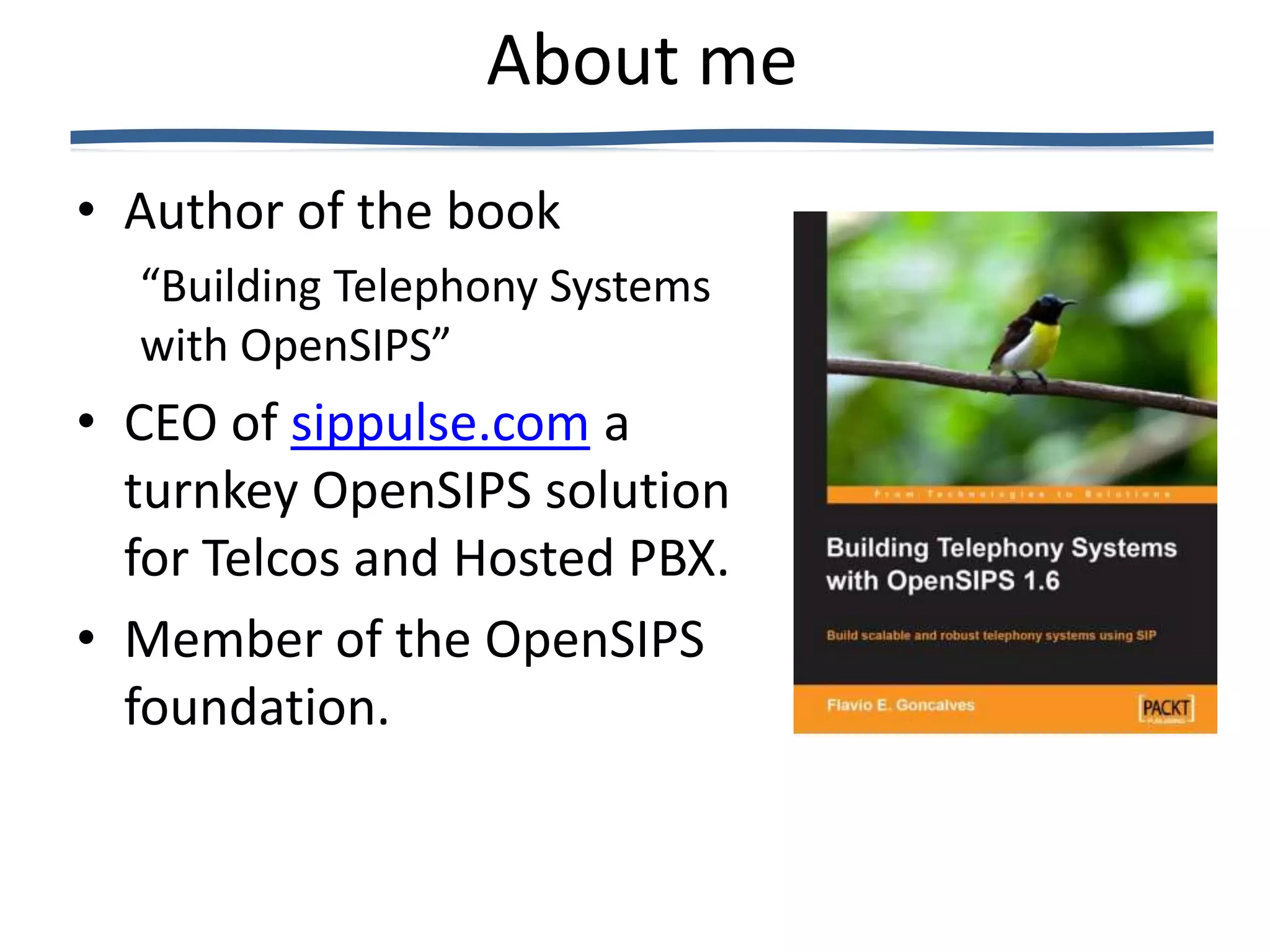
• Author of the book
  “Building Telephony Systems
  with OpenSIPS”
• CEO of sippulse.com a
  turnkey OpenSIPS solution
  for Telcos and Hosted PBX.
• Member of the OpenSIPS
  foundation.
Agenda

1.   How big is the problem?
2.   Anatomy of an attack.
3.   Types of attacks
4.   Mitigation techniques
5.   How to reduce damage if all previous measures
     failed


Warning:      This presentation is about VoIP fraud, there are many
security issues, such as DOS and Eavesdropping not covered here !
How big is the problem?

• June, 2009 – announced it had broken up a
  $55 million toll fraud ring that was operating
  internationally and targeting enterprise PBXs
                                     Source: Network World


• December, 2010 – 11 million Euros on VoIP
  Fraud, calling to premium numbers in Somalia,
  Sierra Leone….                Source: SipVicious Blog
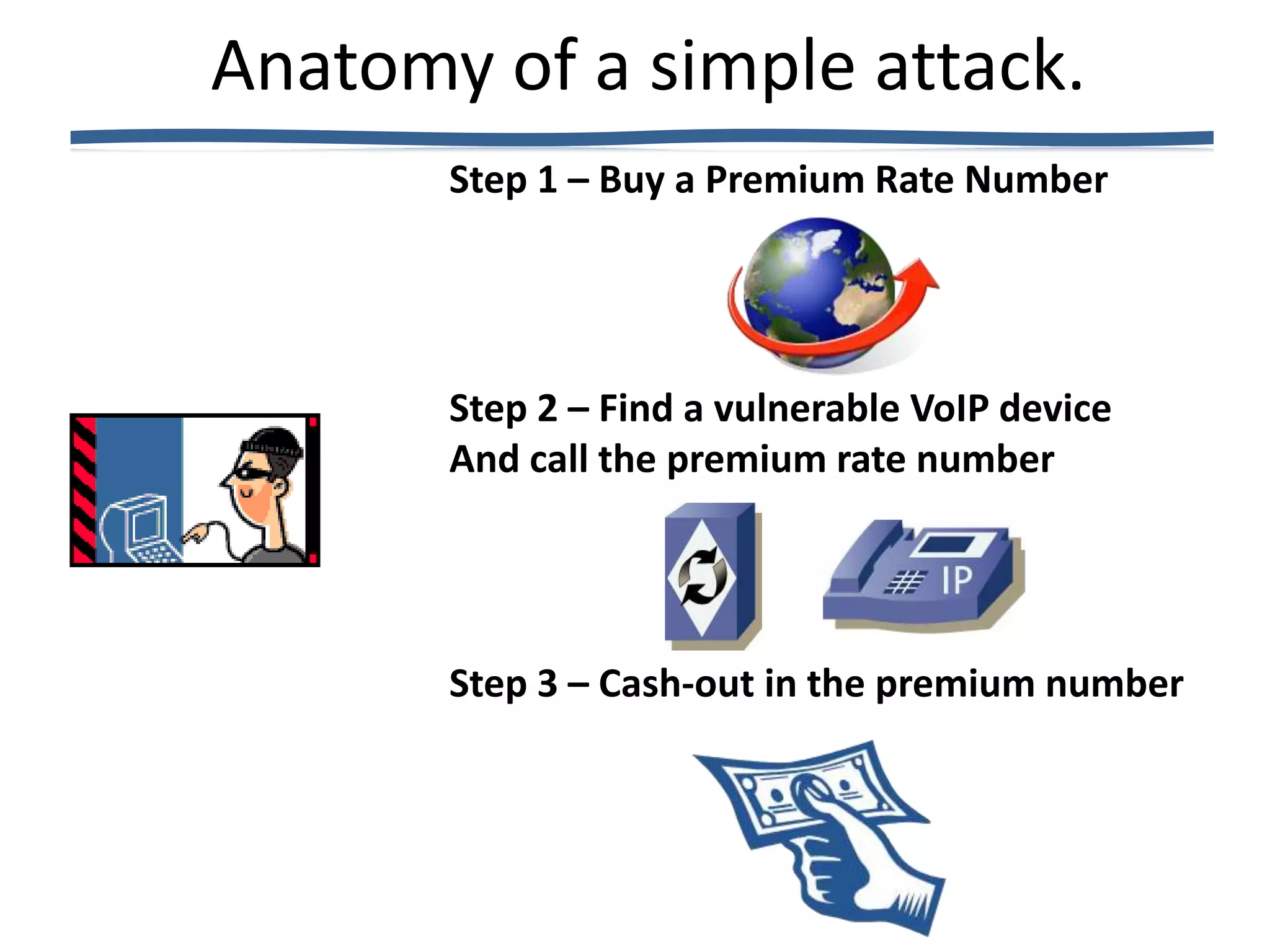
Anatomy of a simple attack.
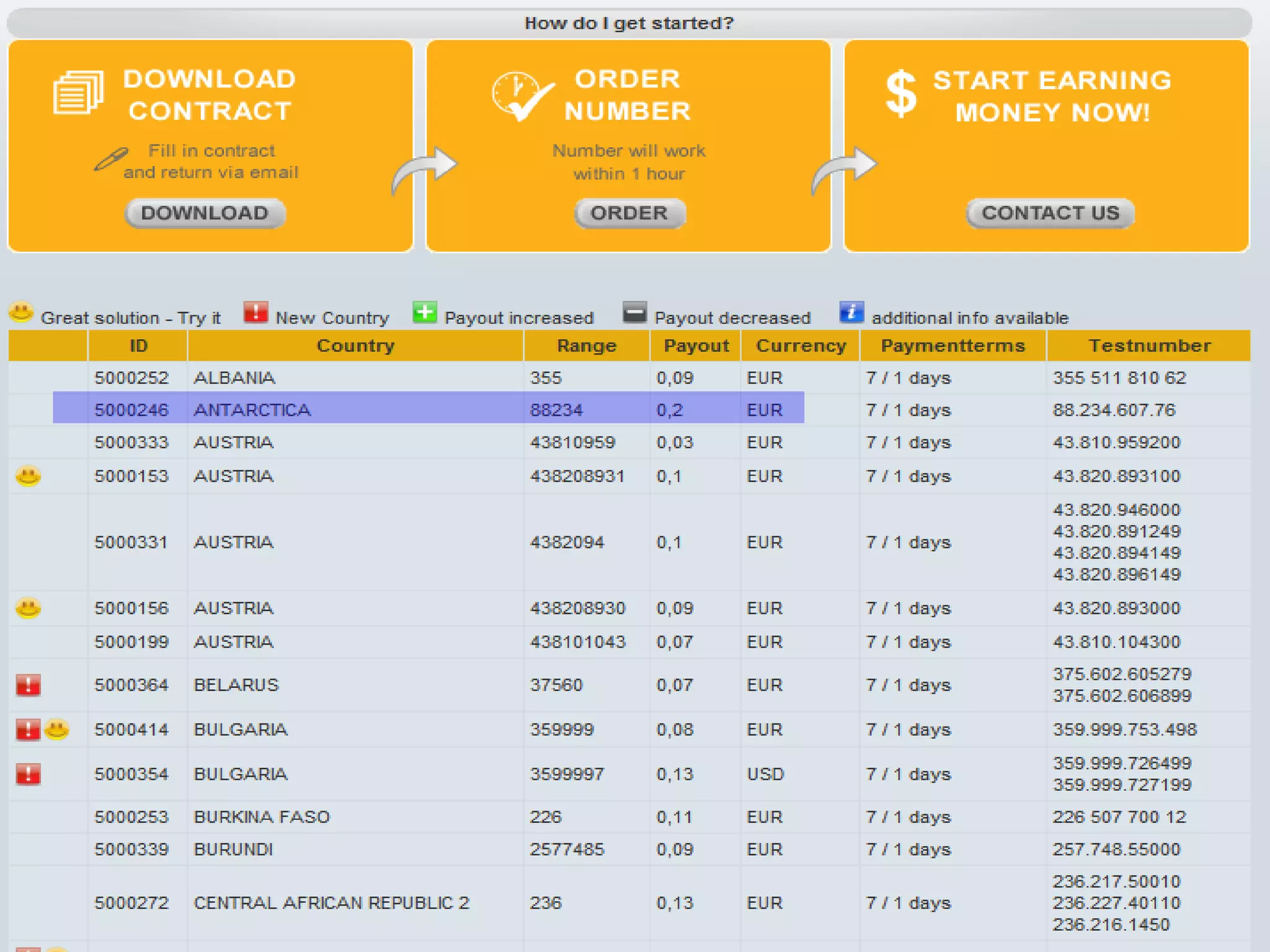
       Step 1 – Buy a Premium Rate Number


       Step 2 – Find a vulnerable VoIP device
       And call the premium rate number


       Step 3 – Cash-out in the premium number
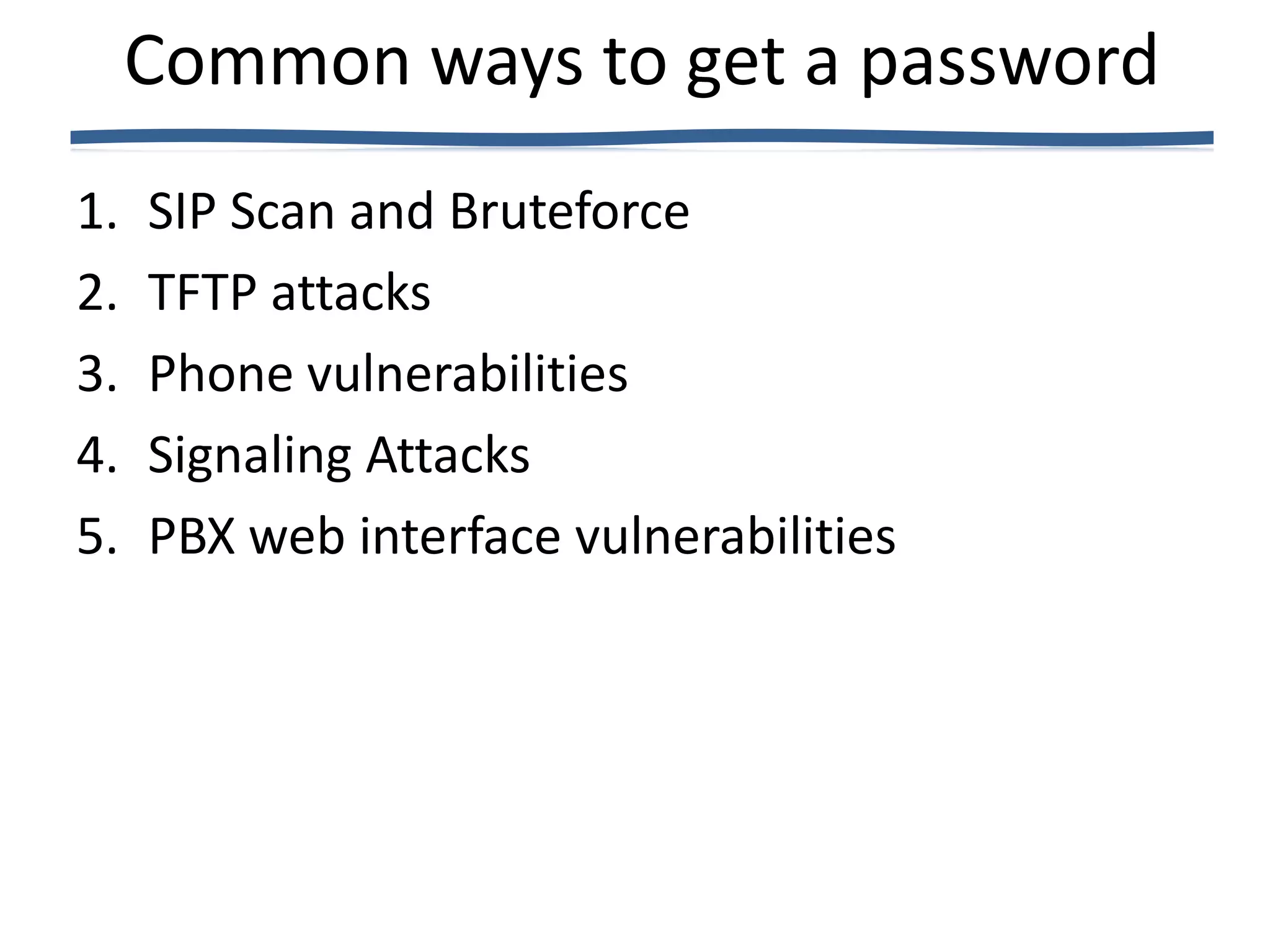
Common ways to get a password
1.   SIP Scan and Bruteforce
2.   TFTP attacks
3.   Phone vulnerabilities
4.   Signaling Attacks
5.   PBX web interface vulnerabilities
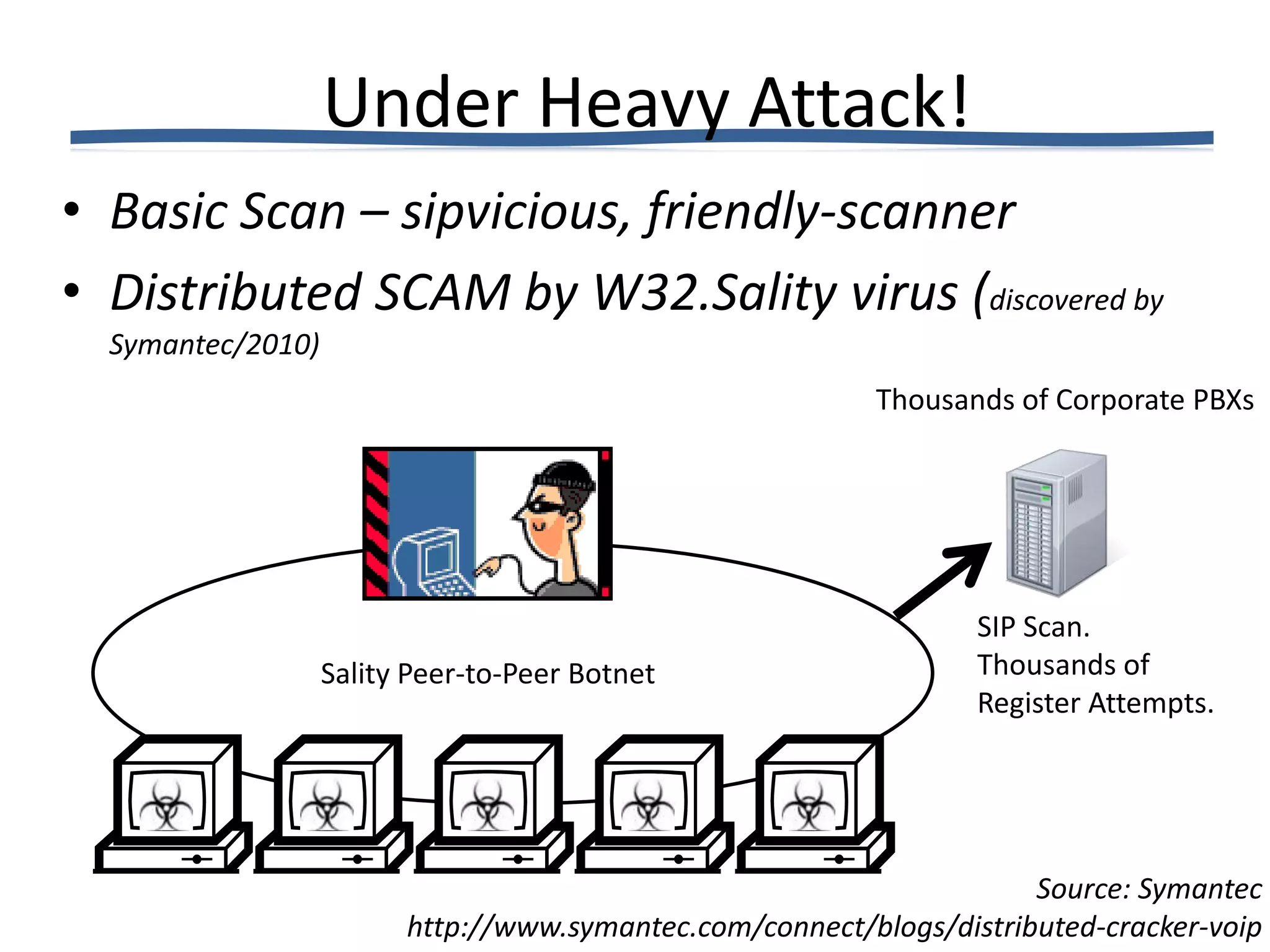
Under Heavy Attack!
• Basic Scan – sipvicious, friendly-scanner
• Distributed SCAM by W32.Sality virus (discovered by
  Symantec/2010)
                                                          Thousands of Corporate PBXs


                                                                  SIP Scan.
                   Sality Peer-to-Peer Botnet                     Thousands of
                                                                  Register Attempts.


                                                                      Source: Symantec
                         http://www.symantec.com/connect/blogs/distributed-cracker-voip
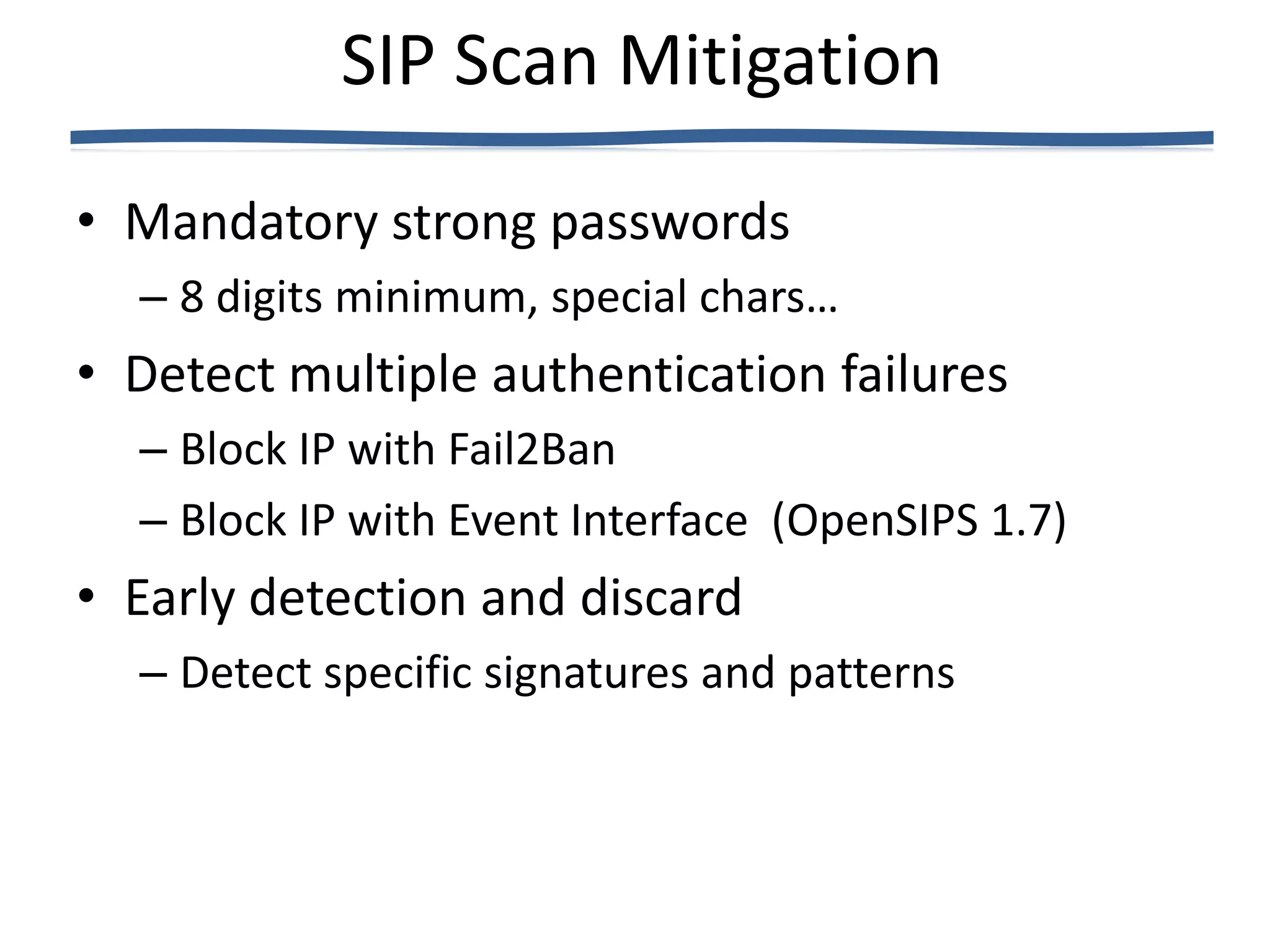
SIP Scan Mitigation
• Mandatory strong passwords
  – 8 digits minimum, special chars…
• Detect multiple authentication failures
  – Block IP with Fail2Ban
  – Block IP with Event Interface (OpenSIPS 1.7)
• Early detection and discard
  – Detect specific signatures and patterns
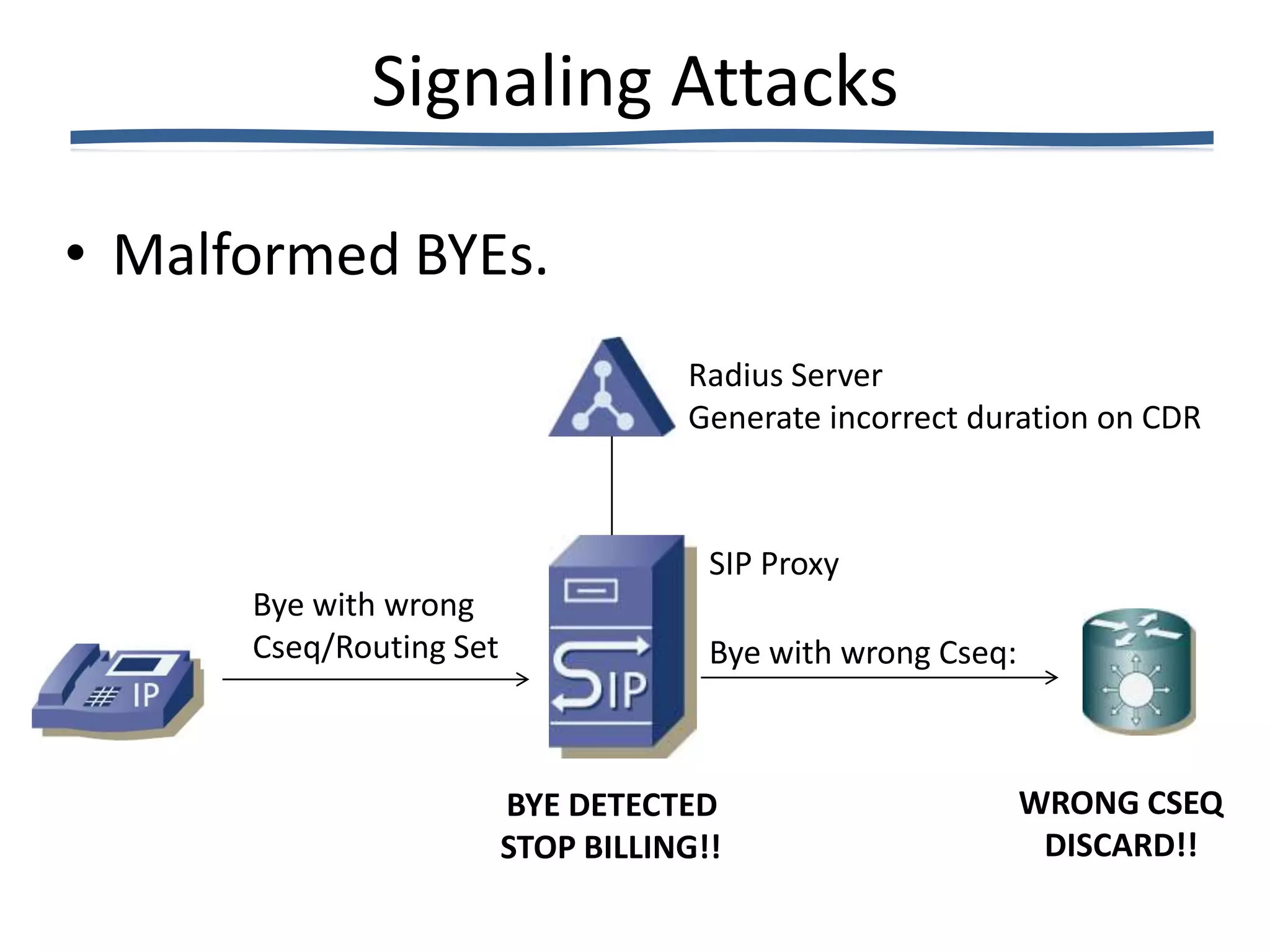
Signaling Attacks

• Malformed BYEs.
                                    Radius Server
                                    Generate incorrect duration on CDR


                                      SIP Proxy
      Bye with wrong
      Cseq/Routing Set                Bye with wrong Cseq:


                         BYE DETECTED                        WRONG CSEQ
                         STOP BILLING!!                       DISCARD!!
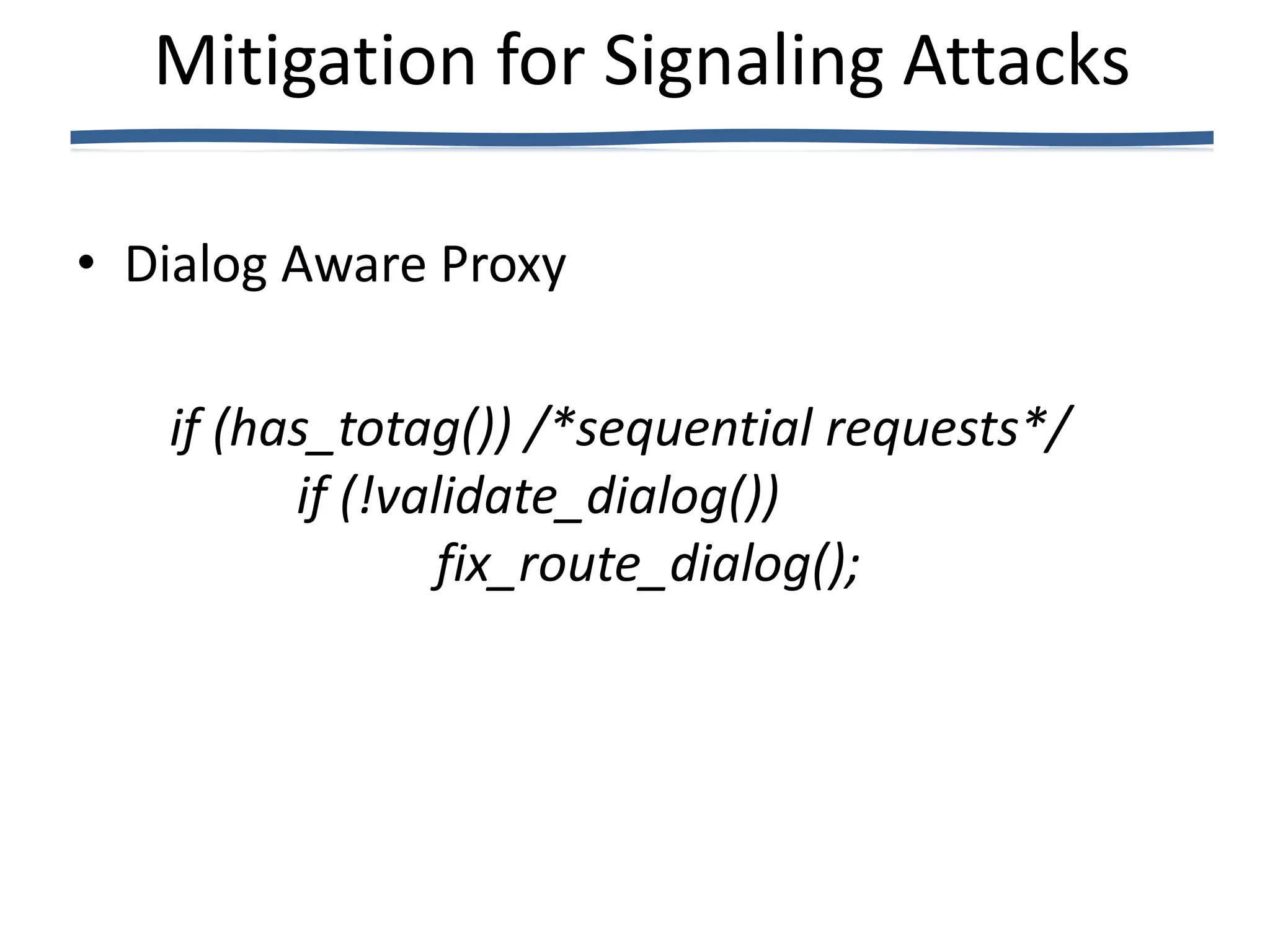
Mitigation for Signaling Attacks

• Dialog Aware Proxy

   if (has_totag()) /*sequential requests*/
         if (!validate_dialog())
                 fix_route_dialog();
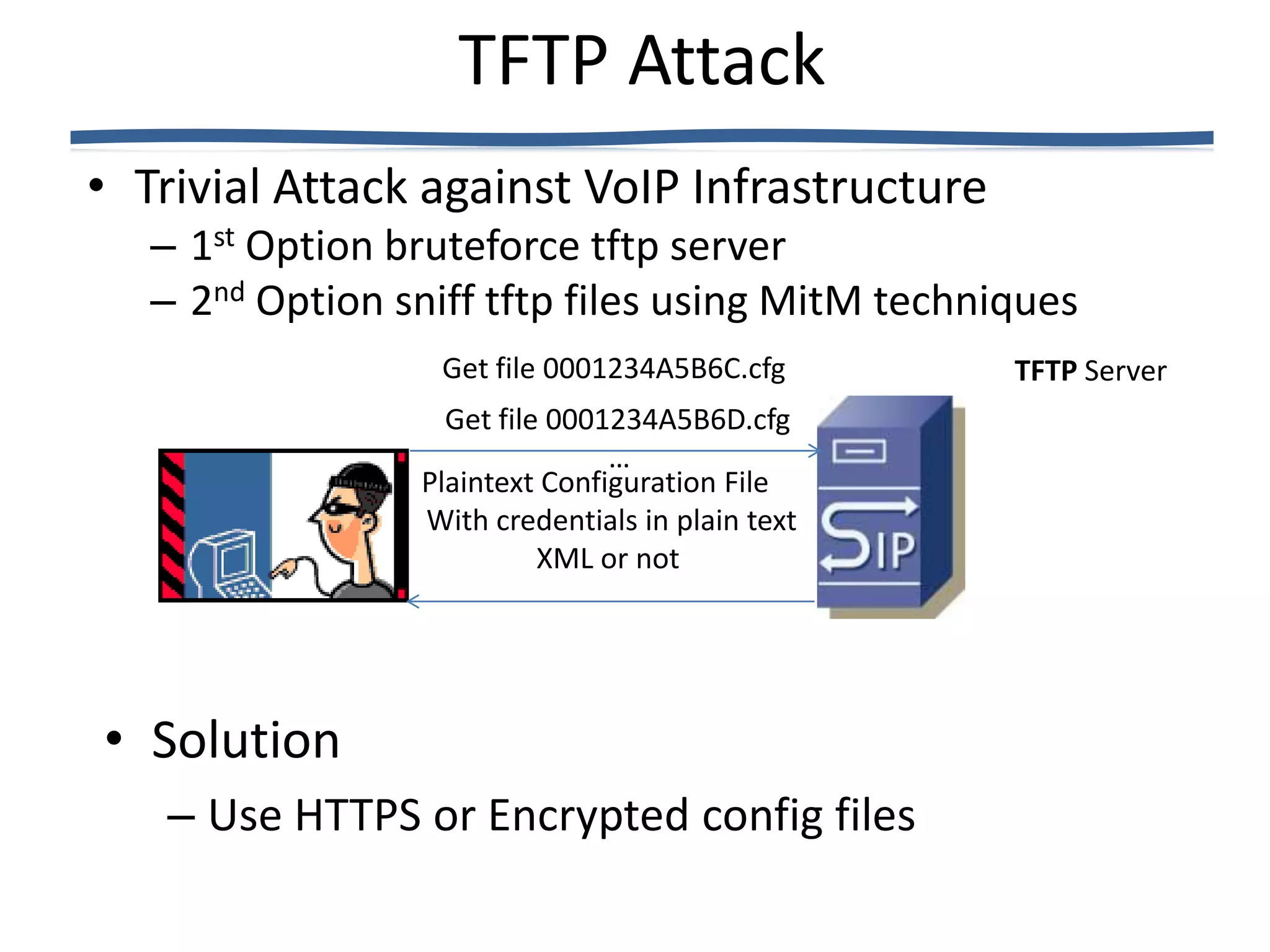
TFTP Attack
• Trivial Attack against VoIP Infrastructure
   – 1st Option bruteforce tftp server
   – 2nd Option sniff tftp files using MitM techniques
                   Get file 0001234A5B6C.cfg      TFTP Server
                   Get file 0001234A5B6D.cfg
                                …
                 Plaintext Configuration File
                 With credentials in plain text
                           XML or not


• Solution
   – Use HTTPS or Encrypted config files
Attacks on SIP Phones

• How many of you change the default
  password for IP phones?
• How many of you update the IP Phone’s
  firmware regularly?


       Video #2             Video #1
More sophisticated attacks

     • SIP Digest Leak
                                    (1) INVITE in Mute
                                  (2) 200OK, User Answered

                                      (3) BYE, No Audio?

                                 (4) 401, WWW-Authenticate?

                               (5) BYE, With Phone Credentials

        Current estimated time needed to break all 8 chars length passwords
        [a-zA-Z0-9]{1,8} ... 497 days
        [a-z0-9]{1,8} ...... 6 days


Credits to Sandro Gaudio: blog.sipvicious.org
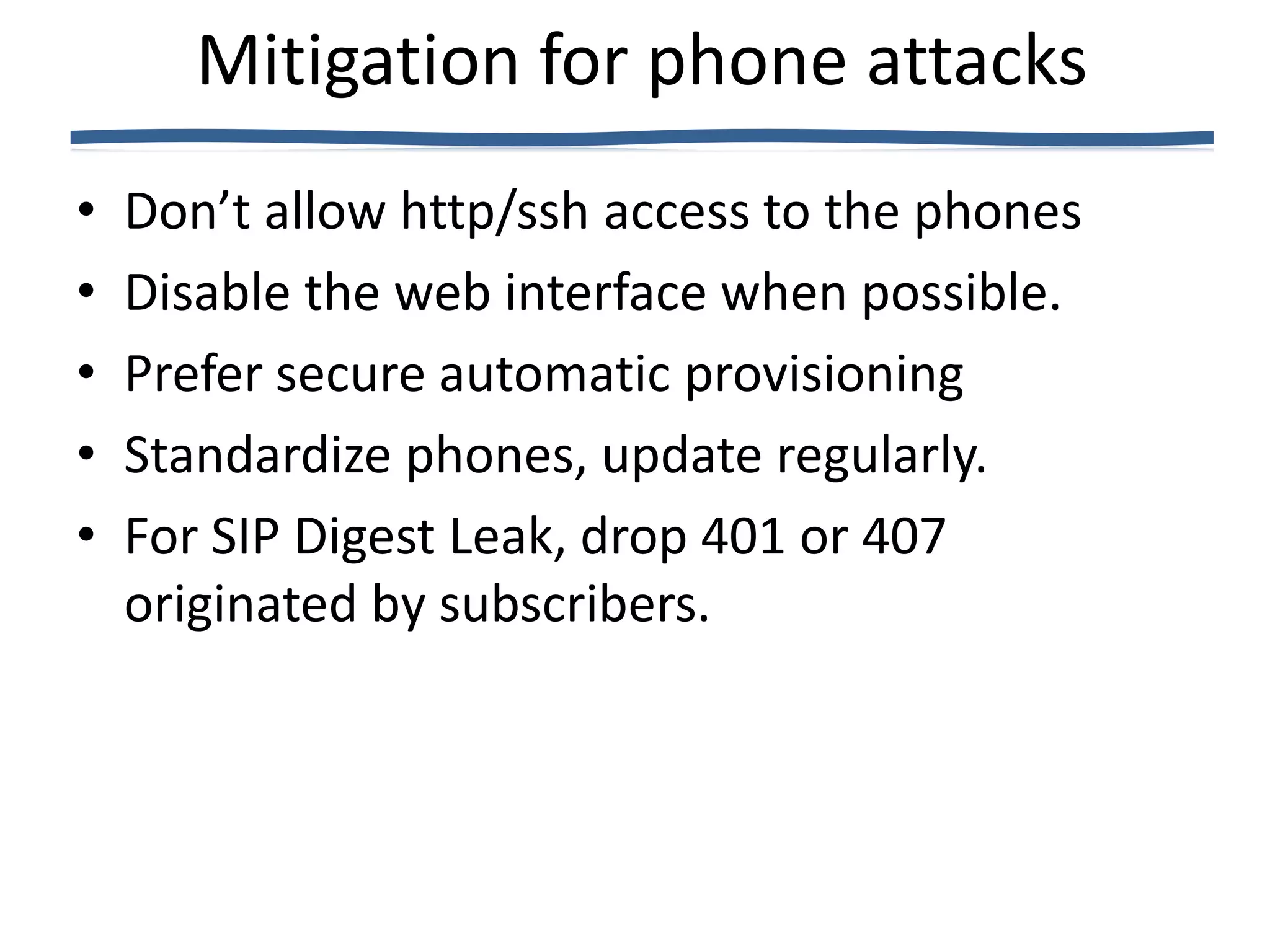
Mitigation for phone attacks
•   Don’t allow http/ssh access to the phones
•   Disable the web interface when possible.
•   Prefer secure automatic provisioning
•   Standardize phones, update regularly.
•   For SIP Digest Leak, drop 401 or 407
    originated by subscribers.
Malformed Packets
• Attack
   – Malformed packets can be used to exploit buffer
     overflows on phones.
      • Tools: Protos TEST suite
• Mitigation
   – Detect malformed packets using OpenSIPS
      • Use Error_route to generate alerts
      • Handle exceptions
   – Use the event interface or fail2ban to ban the
     ofenders
failregex=   Auth Error for .* from <HOST> cause -[0-9]
             Malformed SIP request from user .* from <HOST>
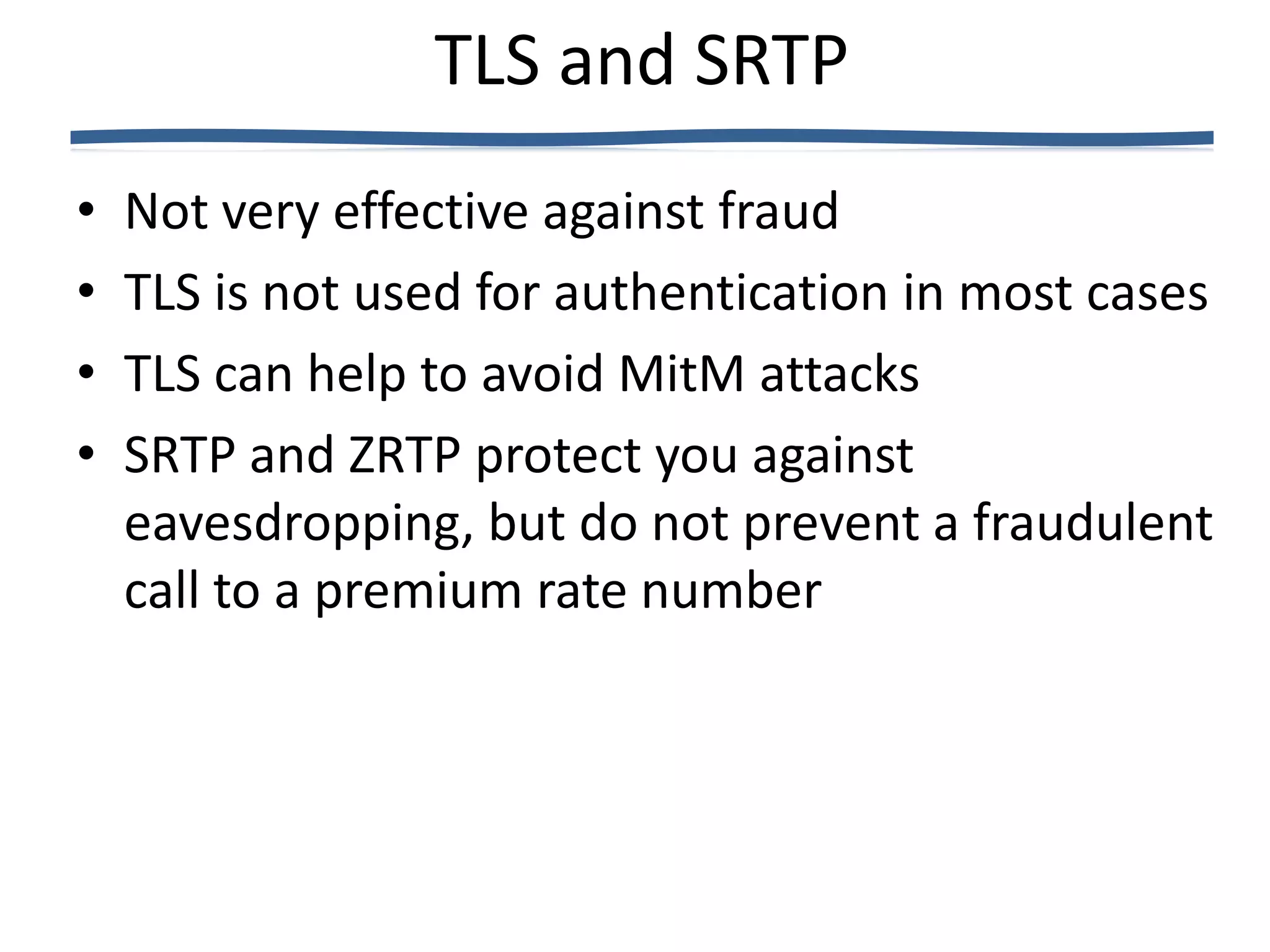
TLS and SRTP
•   Not very effective against fraud
•   TLS is not used for authentication in most cases
•   TLS can help to avoid MitM attacks
•   SRTP and ZRTP protect you against
    eavesdropping, but do not prevent a fraudulent
    call to a premium rate number
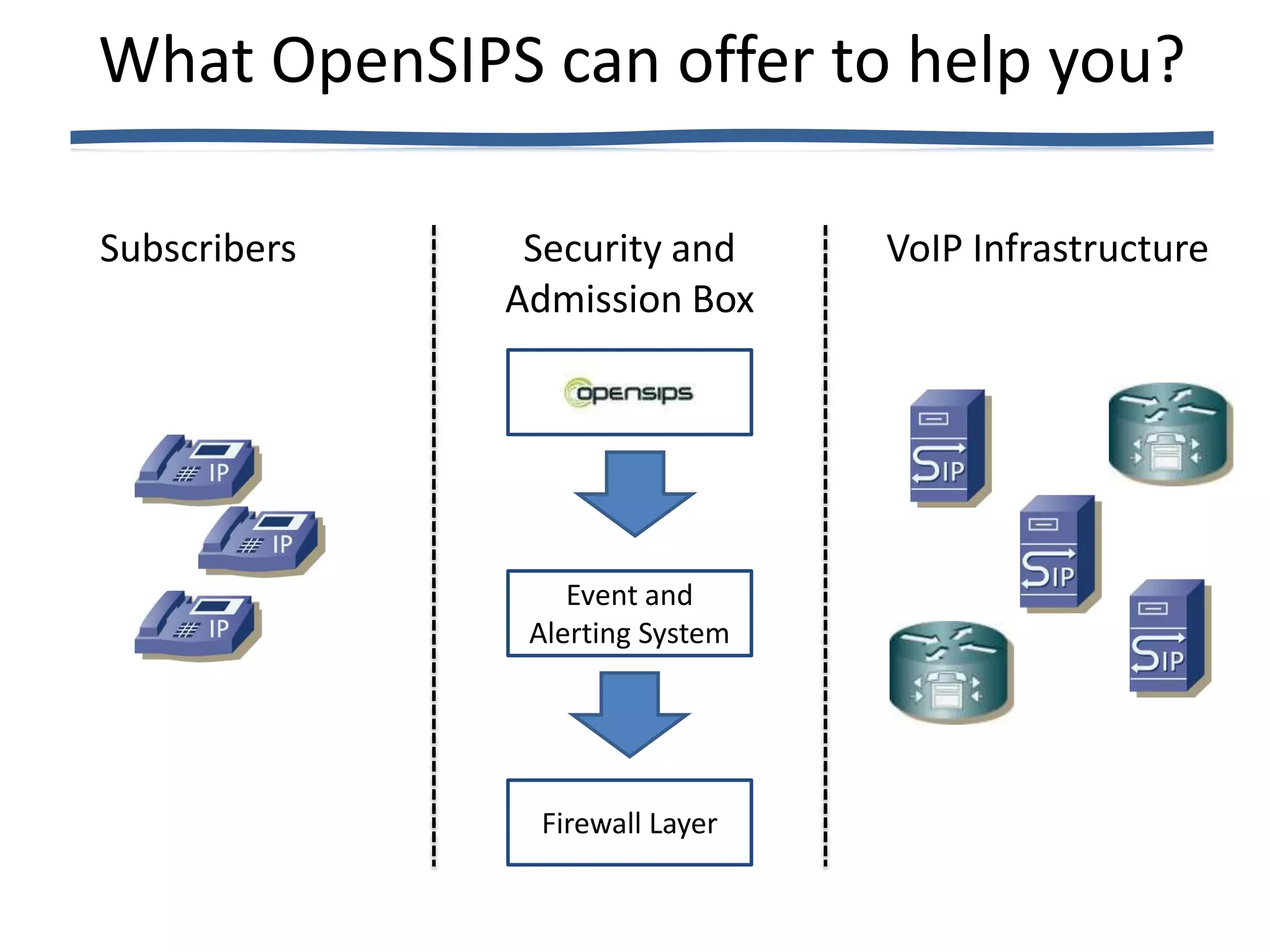
What OpenSIPS can offer to help you?

Subscribers    Security and      VoIP Infrastructure
              Admission Box


                  Event and
               Alerting System


               Firewall Layer
What OpenSIPS can offer?
•   TLS and protocol translation
•   Nonce re-usage prevention
•   PIKE to detect spikes in req/s
•   Rate-Limit to throttle SIP traffic
•   Access any SIP header for sanity checks
    – Signature detection
• Use the new event interface
    – Predefined events E_PIKE_BLOCKED
    – raise_event(event_name[, attrs] [, vals])
• Connect the event interface to a firewall and/or
  alerting system
• Global Blacklists for premium rate numbers
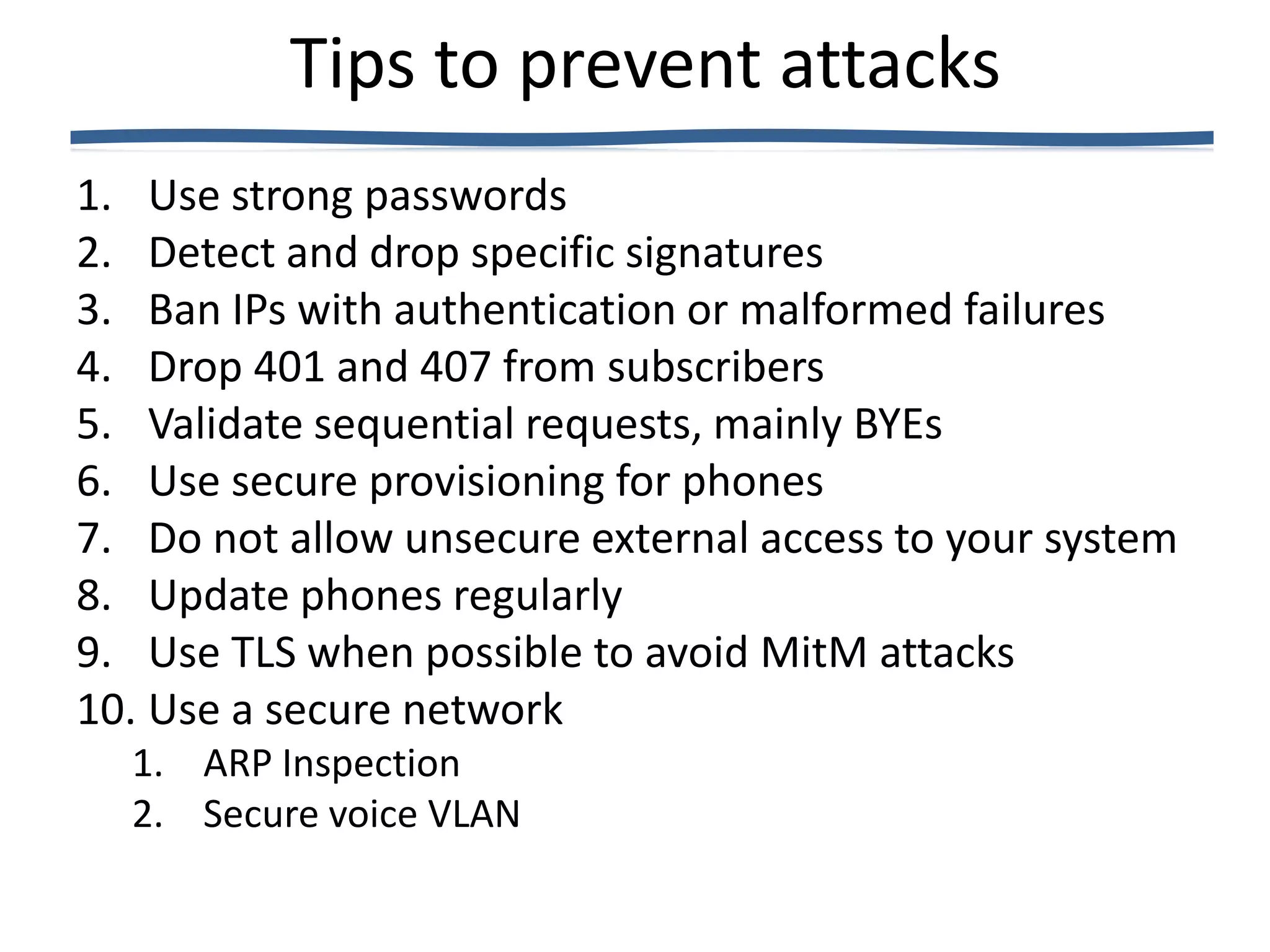
Tips to prevent attacks
1. Use strong passwords
2. Detect and drop specific signatures
3. Ban IPs with authentication or malformed failures
4. Drop 401 and 407 from subscribers
5. Validate sequential requests, mainly BYEs
6. Use secure provisioning for phones
7. Do not allow unsecure external access to your system
8. Update phones regularly
9. Use TLS when possible to avoid MitM attacks
10. Use a secure network
  1. ARP Inspection
  2. Secure voice VLAN
Damage Control
• Face a simple fact, sooner or later, a system
  open to the Internet will be compromised.
• The hacker’s advantage
  – Administrators have to defend against all attacks,
    while one vulnerability is enough for the attacker!
  – The administrator is one, attackers are many!
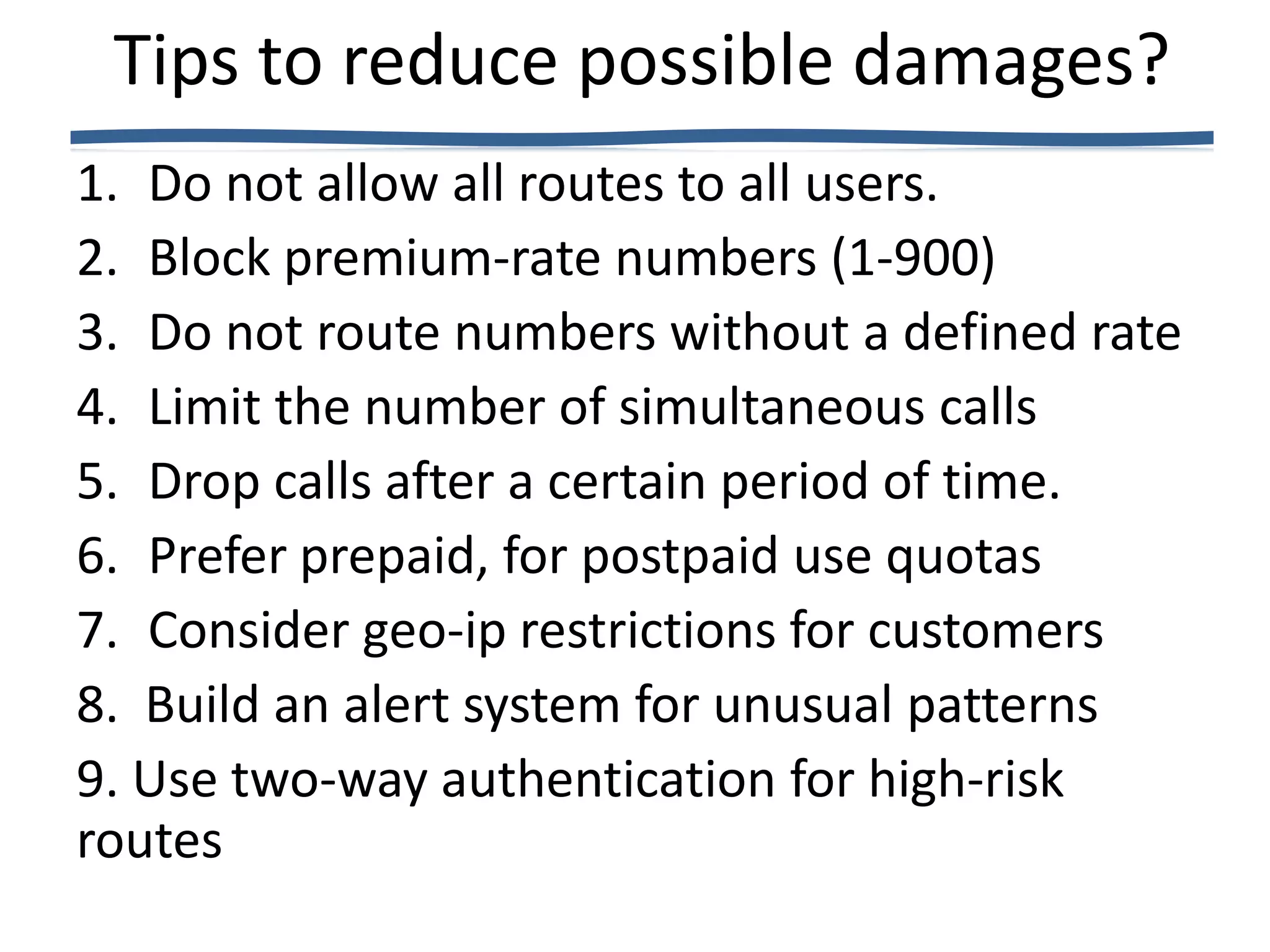
Tips to reduce possible damages?
1. Do not allow all routes to all users.
2. Block premium-rate numbers (1-900)
3. Do not route numbers without a defined rate
4. Limit the number of simultaneous calls
5. Drop calls after a certain period of time.
6. Prefer prepaid, for postpaid use quotas
7. Consider geo-ip restrictions for customers
8. Build an alert system for unusual patterns
9. Use two-way authentication for high-risk
routes
Thank You!


 Next OpenSIPS eBootcamp September 19th
             Learn OpenSIPS!


Visit www.sippulse.com, a turnkey solution based
                  on OpenSIPS

  Questions and contact, please send an email to
  flavio@sippulse.com or flavio@opensips.org

Number one-issue-voip-today-fraud

  • 1.
    “Know your enemy” Sun Tzu's The Art of War The #1 Issue on VoIP, Fraud! How to identify, prevent and reduce damages caused by fraud Flavio E. Goncalves
  • 2.
    About me • Authorof the book “Building Telephony Systems with OpenSIPS” • CEO of sippulse.com a turnkey OpenSIPS solution for Telcos and Hosted PBX. • Member of the OpenSIPS foundation.
  • 3.
    Agenda 1. How big is the problem? 2. Anatomy of an attack. 3. Types of attacks 4. Mitigation techniques 5. How to reduce damage if all previous measures failed Warning: This presentation is about VoIP fraud, there are many security issues, such as DOS and Eavesdropping not covered here !
  • 4.
    How big isthe problem? • June, 2009 – announced it had broken up a $55 million toll fraud ring that was operating internationally and targeting enterprise PBXs Source: Network World • December, 2010 – 11 million Euros on VoIP Fraud, calling to premium numbers in Somalia, Sierra Leone…. Source: SipVicious Blog
  • 5.
    Anatomy of asimple attack. Step 1 – Buy a Premium Rate Number Step 2 – Find a vulnerable VoIP device And call the premium rate number Step 3 – Cash-out in the premium number
  • 7.
    Common ways toget a password 1. SIP Scan and Bruteforce 2. TFTP attacks 3. Phone vulnerabilities 4. Signaling Attacks 5. PBX web interface vulnerabilities
  • 8.
    Under Heavy Attack! •Basic Scan – sipvicious, friendly-scanner • Distributed SCAM by W32.Sality virus (discovered by Symantec/2010) Thousands of Corporate PBXs SIP Scan. Sality Peer-to-Peer Botnet Thousands of Register Attempts. Source: Symantec http://www.symantec.com/connect/blogs/distributed-cracker-voip
  • 9.
    SIP Scan Mitigation •Mandatory strong passwords – 8 digits minimum, special chars… • Detect multiple authentication failures – Block IP with Fail2Ban – Block IP with Event Interface (OpenSIPS 1.7) • Early detection and discard – Detect specific signatures and patterns
  • 10.
    Signaling Attacks • MalformedBYEs. Radius Server Generate incorrect duration on CDR SIP Proxy Bye with wrong Cseq/Routing Set Bye with wrong Cseq: BYE DETECTED WRONG CSEQ STOP BILLING!! DISCARD!!
  • 11.
    Mitigation for SignalingAttacks • Dialog Aware Proxy if (has_totag()) /*sequential requests*/ if (!validate_dialog()) fix_route_dialog();
  • 12.
    TFTP Attack • TrivialAttack against VoIP Infrastructure – 1st Option bruteforce tftp server – 2nd Option sniff tftp files using MitM techniques Get file 0001234A5B6C.cfg TFTP Server Get file 0001234A5B6D.cfg … Plaintext Configuration File With credentials in plain text XML or not • Solution – Use HTTPS or Encrypted config files
  • 13.
    Attacks on SIPPhones • How many of you change the default password for IP phones? • How many of you update the IP Phone’s firmware regularly? Video #2 Video #1
  • 14.
    More sophisticated attacks • SIP Digest Leak (1) INVITE in Mute (2) 200OK, User Answered (3) BYE, No Audio? (4) 401, WWW-Authenticate? (5) BYE, With Phone Credentials Current estimated time needed to break all 8 chars length passwords [a-zA-Z0-9]{1,8} ... 497 days [a-z0-9]{1,8} ...... 6 days Credits to Sandro Gaudio: blog.sipvicious.org
  • 15.
    Mitigation for phoneattacks • Don’t allow http/ssh access to the phones • Disable the web interface when possible. • Prefer secure automatic provisioning • Standardize phones, update regularly. • For SIP Digest Leak, drop 401 or 407 originated by subscribers.
  • 16.
    Malformed Packets • Attack – Malformed packets can be used to exploit buffer overflows on phones. • Tools: Protos TEST suite • Mitigation – Detect malformed packets using OpenSIPS • Use Error_route to generate alerts • Handle exceptions – Use the event interface or fail2ban to ban the ofenders failregex= Auth Error for .* from <HOST> cause -[0-9] Malformed SIP request from user .* from <HOST>
  • 17.
    TLS and SRTP • Not very effective against fraud • TLS is not used for authentication in most cases • TLS can help to avoid MitM attacks • SRTP and ZRTP protect you against eavesdropping, but do not prevent a fraudulent call to a premium rate number
  • 18.
    What OpenSIPS canoffer to help you? Subscribers Security and VoIP Infrastructure Admission Box Event and Alerting System Firewall Layer
  • 19.
    What OpenSIPS canoffer? • TLS and protocol translation • Nonce re-usage prevention • PIKE to detect spikes in req/s • Rate-Limit to throttle SIP traffic • Access any SIP header for sanity checks – Signature detection • Use the new event interface – Predefined events E_PIKE_BLOCKED – raise_event(event_name[, attrs] [, vals]) • Connect the event interface to a firewall and/or alerting system • Global Blacklists for premium rate numbers
  • 20.
    Tips to preventattacks 1. Use strong passwords 2. Detect and drop specific signatures 3. Ban IPs with authentication or malformed failures 4. Drop 401 and 407 from subscribers 5. Validate sequential requests, mainly BYEs 6. Use secure provisioning for phones 7. Do not allow unsecure external access to your system 8. Update phones regularly 9. Use TLS when possible to avoid MitM attacks 10. Use a secure network 1. ARP Inspection 2. Secure voice VLAN
  • 21.
    Damage Control • Facea simple fact, sooner or later, a system open to the Internet will be compromised. • The hacker’s advantage – Administrators have to defend against all attacks, while one vulnerability is enough for the attacker! – The administrator is one, attackers are many!
  • 22.
    Tips to reducepossible damages? 1. Do not allow all routes to all users. 2. Block premium-rate numbers (1-900) 3. Do not route numbers without a defined rate 4. Limit the number of simultaneous calls 5. Drop calls after a certain period of time. 6. Prefer prepaid, for postpaid use quotas 7. Consider geo-ip restrictions for customers 8. Build an alert system for unusual patterns 9. Use two-way authentication for high-risk routes
  • 23.
    Thank You! NextOpenSIPS eBootcamp September 19th Learn OpenSIPS! Visit www.sippulse.com, a turnkey solution based on OpenSIPS Questions and contact, please send an email to flavio@sippulse.com or flavio@opensips.org