Fortinet ConfidentialFortinet Confidential
November 3, 2010
Fortinet Overview
Fortinet VoIP Security
Rainer Baeder
08-10-2010
Fortinet ConfidentialFortinet Confidential
Fortinet Overview
Market-Leading Provider of End-to-End IT Security Solutions
Company Stats
• Founded in 2000
• Silicon Valley-based, strong
global presence with
32+ offices worldwide
• $212M+ in revenues (2008)
• Seasoned and proven
executive management team
• 1,250+ employees /
750+ engineers
• 550,000+ FortiGate devices
shipped worldwide
Innovative,
Best-in-Class
Technologies and
Products
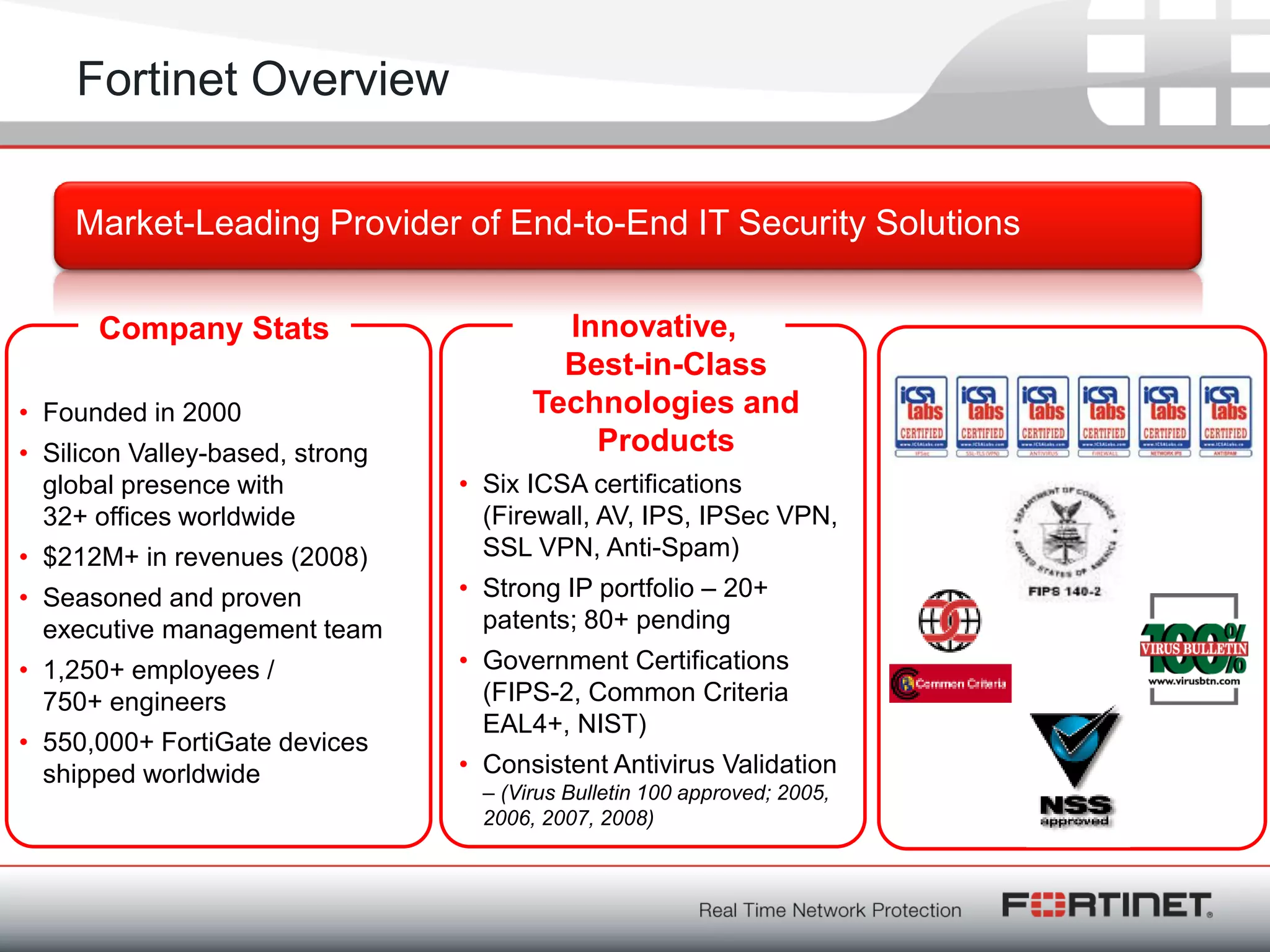
• Six ICSA certifications
(Firewall, AV, IPS, IPSec VPN,
SSL VPN, Anti-Spam)
• Strong IP portfolio – 20+
patents; 80+ pending
• Government Certifications
(FIPS-2, Common Criteria
EAL4+, NIST)
• Consistent Antivirus Validation
– (Virus Bulletin 100 approved; 2005,
2006, 2007, 2008)
Fortinet ConfidentialFortinet Confidential
Still not relevant to you ??
Cyberwarfare: VoIP and Convergence
Increase Vulnerability
David L. Fraley
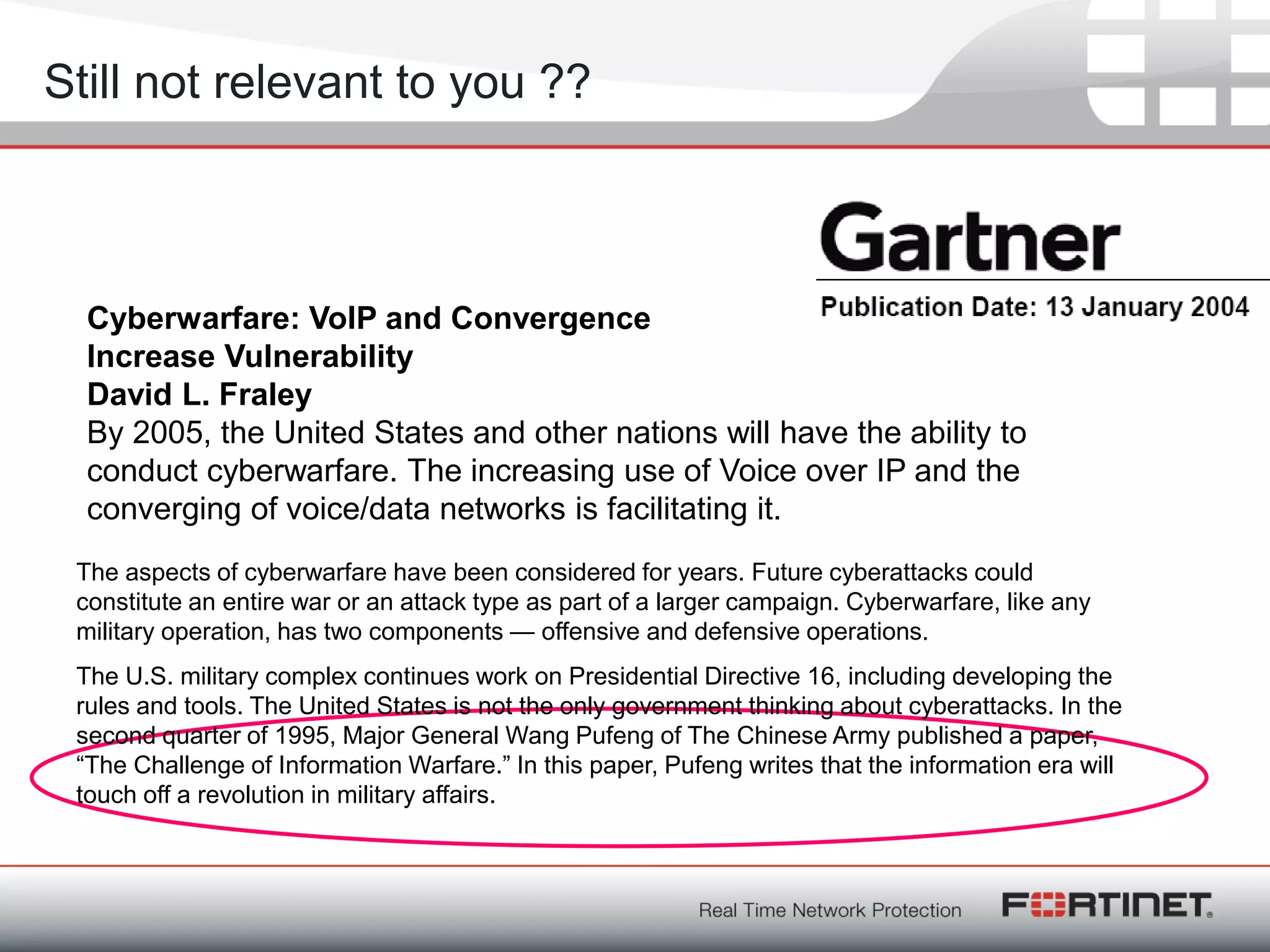
By 2005, the United States and other nations will have the ability to
conduct cyberwarfare. The increasing use of Voice over IP and the
converging of voice/data networks is facilitating it.
The U.S. military complex continues work on Presidential Directive 16, including developing the
rules and tools. The United States is not the only government thinking about cyberattacks. In the
second quarter of 1995, Major General Wang Pufeng of The Chinese Army published a paper,
―The Challenge of Information Warfare.‖ In this paper, Pufeng writes that the information era will
touch off a revolution in military affairs.
The aspects of cyberwarfare have been considered for years. Future cyberattacks could
constitute an entire war or an attack type as part of a larger campaign. Cyberwarfare, like any
military operation, has two components — offensive and defensive operations.
Fortinet ConfidentialFortinet Confidential
Phony Phone Calls Distract Consumers from Genuine Theft
TDoS - FBI and Partners Warn Public
• NEWARK, NJ—Have you recently received a large number of
strange and unexplained calls on your mobile or landline
telephones? The FBI is warning consumers about a new scheme
that uses telecommunications denial-of-service attacks as a
diversion to what is really happening: the looting of bank and
online trading accounts.
• The Scheme
– The scheme is known as telephony denial-of–service (TDOS) and
according to several telecommunications companies working with the
FBI, there has been a recent surge of these attacks in the past few
weeks. The perpetrators are suspected of using automated dialing
programs and multiple accounts to overwhelm the land and cell
phone lines of their victims with thousands of calls. When the
calls are answered, the victim may hear anything from dead air
(nothing on the other end), an innocuous recorded message, an
advertisement, or even a telephone sex menu. The calls are
typically short in duration but so numerous that victims have had to
have their numbers changed to make the calls stop…….
http://newark.fbi.gov/pressrel/pressrel10/nk051110.htm
Fortinet ConfidentialFortinet Confidential
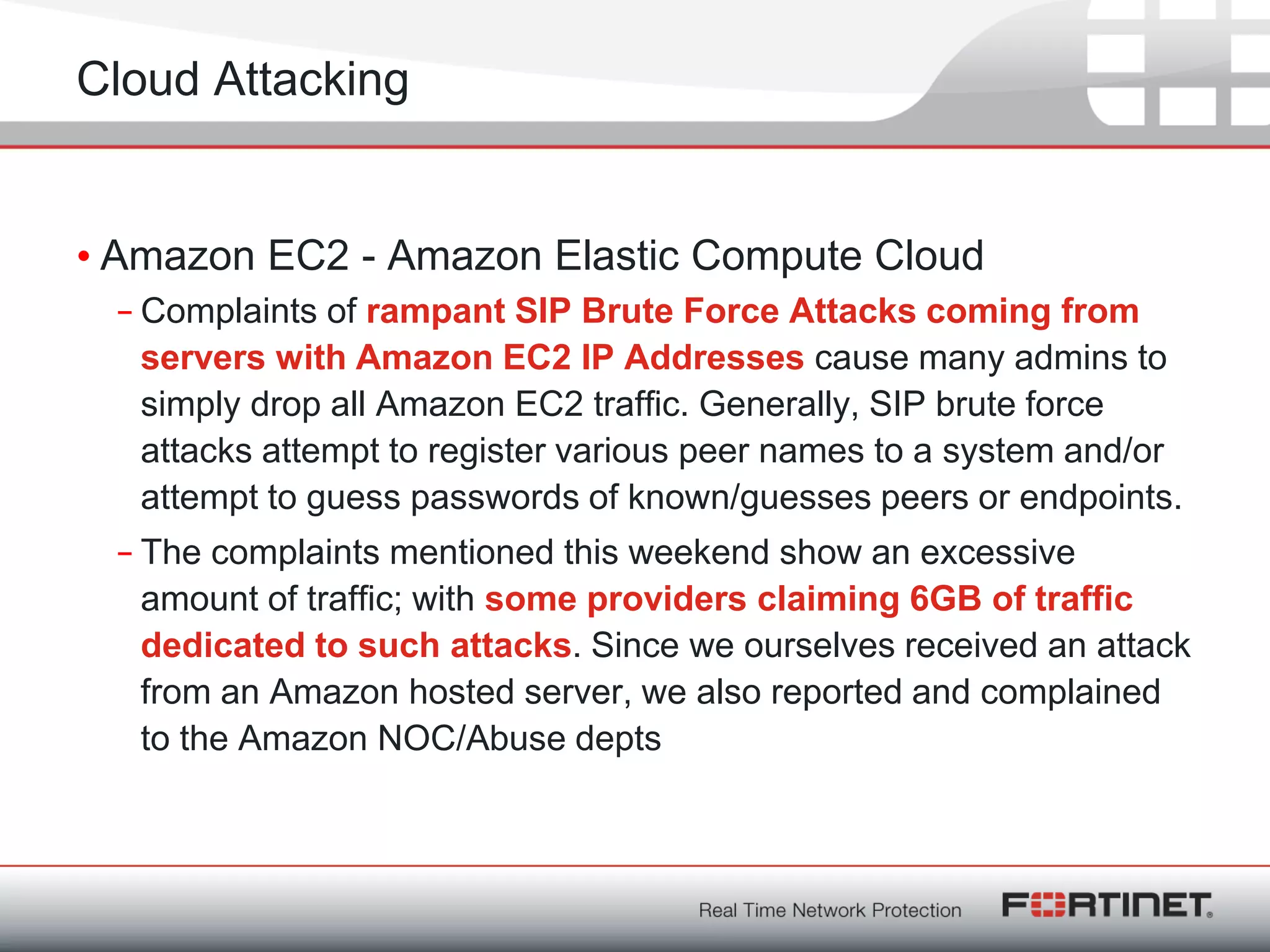
Cloud Attacking
• Amazon EC2 - Amazon Elastic Compute Cloud
– Complaints of rampant SIP Brute Force Attacks coming from
servers with Amazon EC2 IP Addresses cause many admins to
simply drop all Amazon EC2 traffic. Generally, SIP brute force
attacks attempt to register various peer names to a system and/or
attempt to guess passwords of known/guesses peers or endpoints.
– The complaints mentioned this weekend show an excessive
amount of traffic; with some providers claiming 6GB of traffic
dedicated to such attacks. Since we ourselves received an attack
from an Amazon hosted server, we also reported and complained
to the Amazon NOC/Abuse depts
Fortinet ConfidentialFortinet Confidential
The SIP messages
REGISTER sip:[...] SIP/2.0
Via: SIP/2.0/UDP 10.242.91.15:5182; branch=z9hG4bK-2528031440;rport
Content-Length: 0
From: "2011" <sip:2011@[...]>
Accept: application/sdp
User-Agent: friendly-scanner
To: "2011" <sip:2011@[...]>
Contact: sip:123@1.1.1.1
CSeq: 1 REGISTER
Call-ID: 3361196543
Max-Forwards: 70
["AF_INET", 5182, "ec2-174-129-137-135.compute-1.amazonaws.com", "174.129.137.135"]
REGISTER sip:[...] SIP/2.0
Via: SIP/2.0/UDP 10.242.91.15:5209;branch=z9hG4bK-1678605574;rport
Content-Length: 0
From: "2011" <sip:2011@[...]>
Accept: application/sdp
User-Agent: friendly-scanner
To: "2011" <sip:2011@[...]>
Contact: sip:123@1.1.1.1
CSeq: 1 REGISTER
Call-ID: 1992838843
Max-Forwards: 70
["AF_INET", 5209, "ec2-174-129-137-135.compute-1.amazonaws.com", "174.129.137.135"]
constant = signature !!!
Fortinet ConfidentialFortinet Confidential
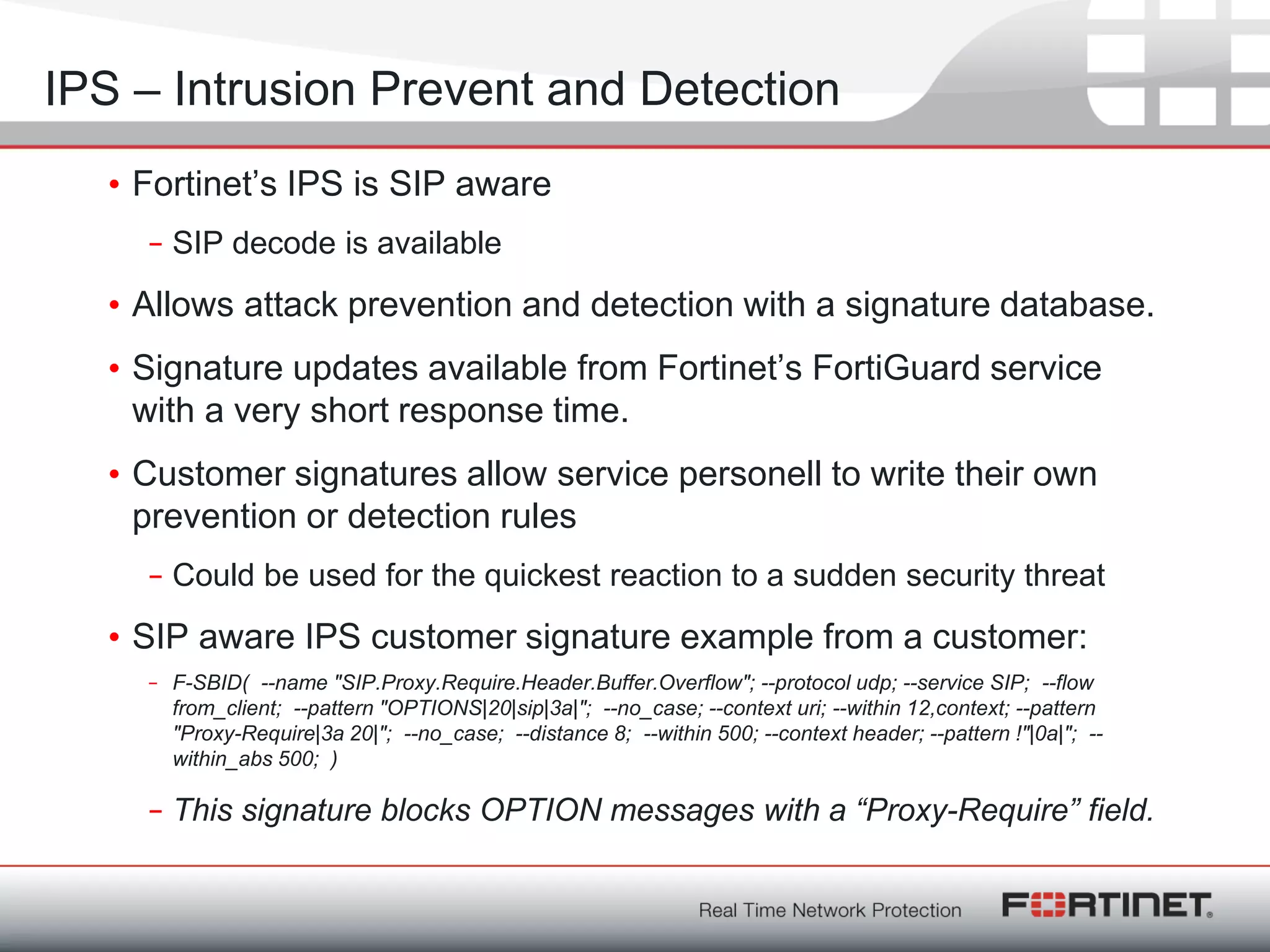
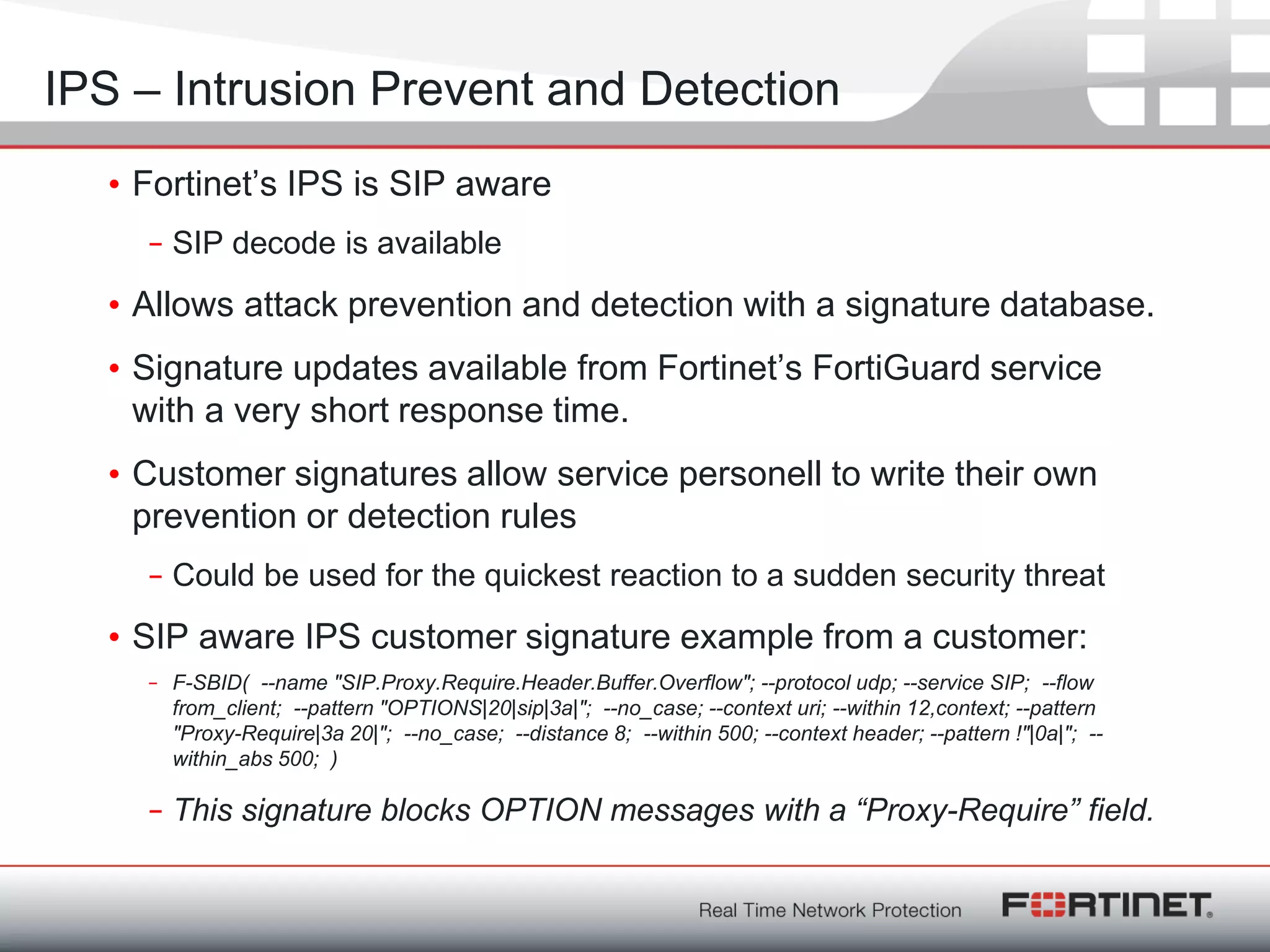
• Fortinet‘s IPS is SIP aware
– SIP decode is available
• Allows attack prevention and detection with a signature database.
• Signature updates available from Fortinet‘s FortiGuard service
with a very short response time.
• Customer signatures allow service personell to write their own
prevention or detection rules
– Could be used for the quickest reaction to a sudden security threat
• SIP aware IPS customer signature example from a customer:
– F-SBID( --name "SIP.Proxy.Require.Header.Buffer.Overflow"; --protocol udp; --service SIP; --flow
from_client; --pattern "OPTIONS|20|sip|3a|"; --no_case; --context uri; --within 12,context; --pattern
"Proxy-Require|3a 20|"; --no_case; --distance 8; --within 500; --context header; --pattern !"|0a|"; --
within_abs 500; )
– This signature blocks OPTION messages with a “Proxy-Require” field.
IPS – Intrusion Prevent and Detection
Fortinet ConfidentialFortinet Confidential
VoIP Blacklist Project
• 2010-09-20 10:08:06 NOTICE[14155] chan_sip.c: Registration from
'"3147172873"<sip:3147172873@208.51.xxx.xxx>' failed for
'206.71.179.32' - Username/auth name mismatch
• 2010-09-20 10:08:06 NOTICE[14155] chan_sip.c: Registration from
'"thomas"<sip:thomas@208.51.xxx.xxx>' failed for '206.71.179.32' -
Username/auth name mismatch
• 2010-09-20 10:08:06 NOTICE[14155] chan_sip.c: Registration from
'"arsenal"<sip:arsenal@208.51.xxx.xxx>' failed for '206.71.179.32'
- Username/auth name mismatch
• 2010-09-20 10:08:06 NOTICE[14155] chan_sip.c: Registration from
'"monkey"<sip:monkey@208.51.xxx.xxx>' failed for '206.71.179.32' -
Username/auth name mismatch
• 2010-09-20 10:08:06 NOTICE[14155] chan_sip.c: Registration from
'"charlie"<sip:charlie@208.51.xxx.xxx>' failed for '206.71.179.32'
- Username/auth name mismatch
• .......
• and a couple 100 thousand more like this
http://www.infiltrated.net/voipabuse/logs/americanis.txt.gz
Fortinet ConfidentialFortinet Confidential
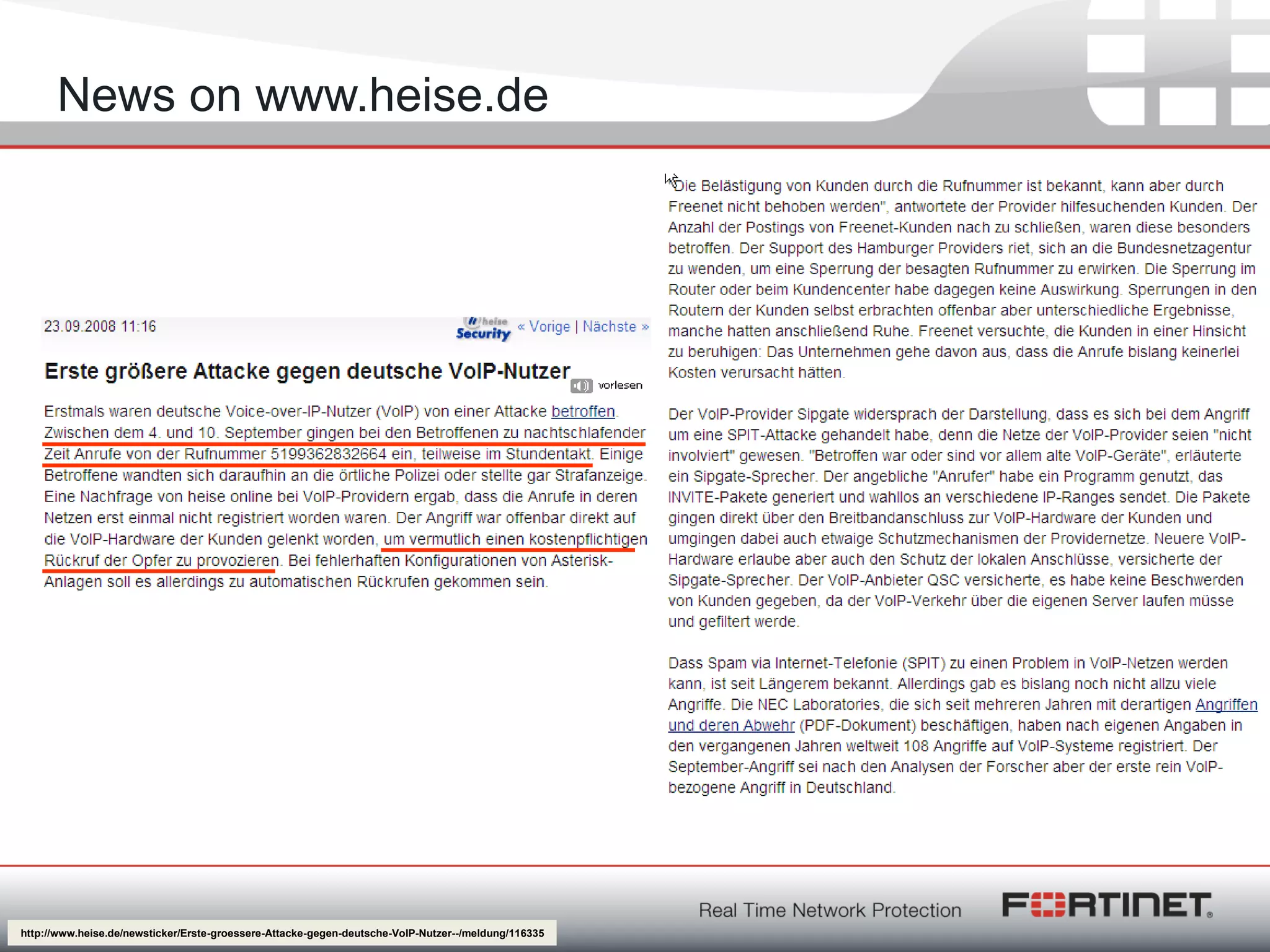
http://www.heise.de/newsticker/Erste-groessere-Attacke-gegen-deutsche-VoIP-Nutzer--/meldung/116335
News on www.heise.de
Fortinet ConfidentialFortinet Confidential
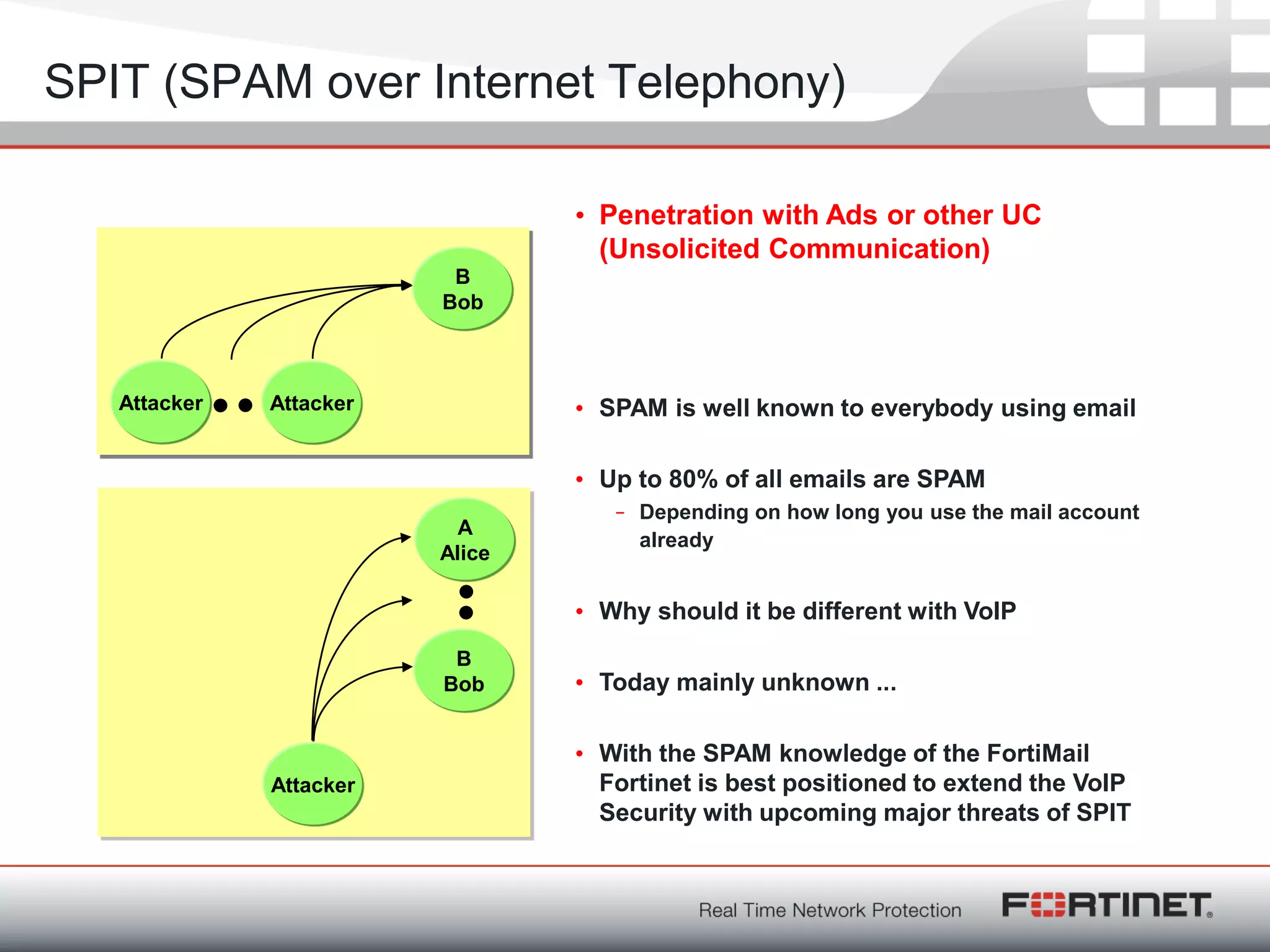
SPIT (SPAM over Internet Telephony)
B
Bob
Attacker
• Penetration with Ads or other UC
(Unsolicited Communication)
• SPAM is well known to everybody using email
• Up to 80% of all emails are SPAM
– Depending on how long you use the mail account
already
• Why should it be different with VoIP
• Today mainly unknown ...
• With the SPAM knowledge of the FortiMail
Fortinet is best positioned to extend the VoIP
Security with upcoming major threats of SPIT
Attacker
B
Bob
Attacker
A
Alice
Fortinet ConfidentialFortinet Confidential
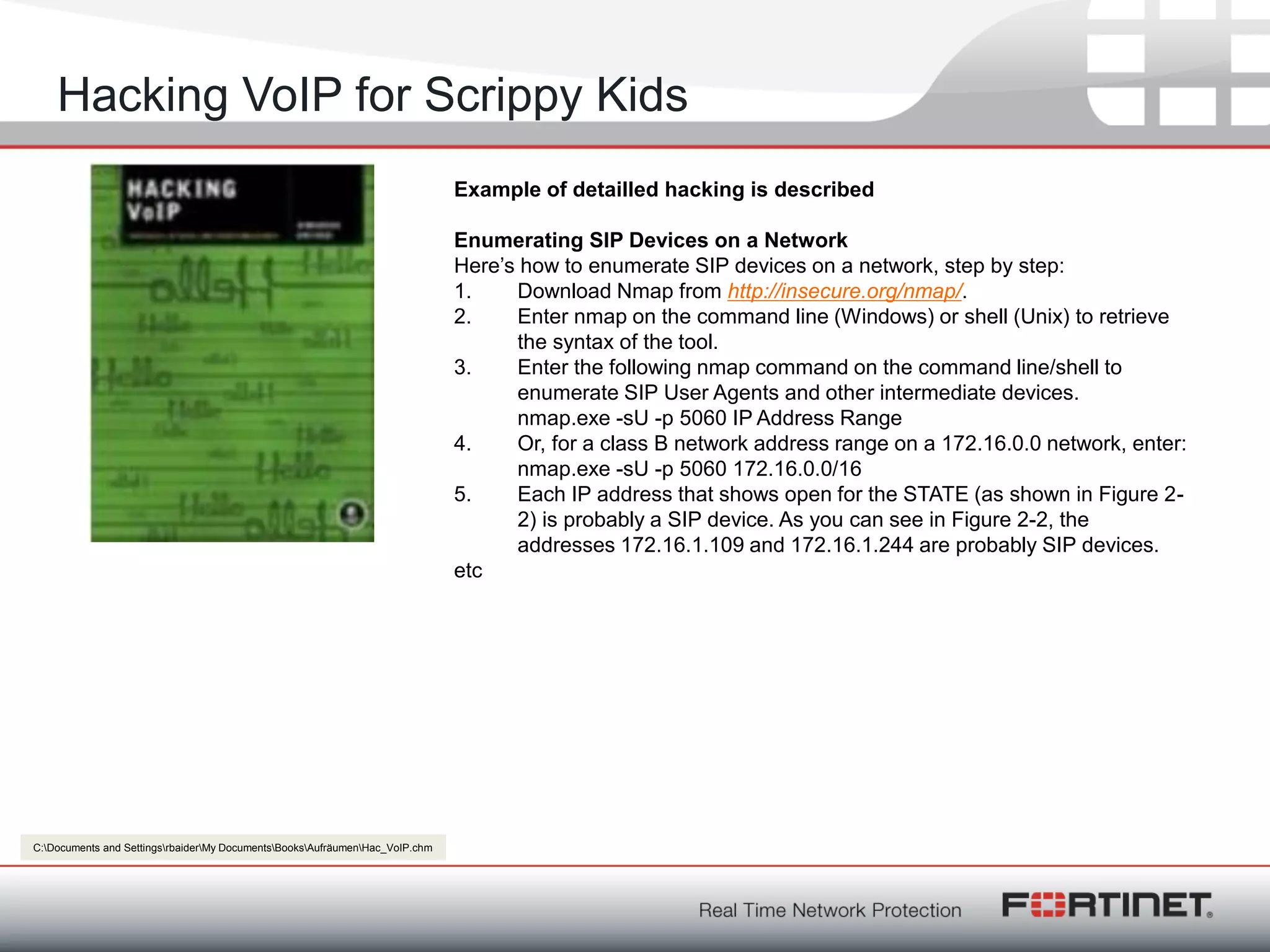
Hacking VoIP for Scrippy Kids
Example of detailled hacking is described
Enumerating SIP Devices on a Network
Here‘s how to enumerate SIP devices on a network, step by step:
1. Download Nmap from http://insecure.org/nmap/.
2. Enter nmap on the command line (Windows) or shell (Unix) to retrieve
the syntax of the tool.
3. Enter the following nmap command on the command line/shell to
enumerate SIP User Agents and other intermediate devices.
nmap.exe -sU -p 5060 IP Address Range
4. Or, for a class B network address range on a 172.16.0.0 network, enter:
nmap.exe -sU -p 5060 172.16.0.0/16
5. Each IP address that shows open for the STATE (as shown in Figure 2-
2) is probably a SIP device. As you can see in Figure 2-2, the
addresses 172.16.1.109 and 172.16.1.244 are probably SIP devices.
etc
C:Documents and SettingsrbaiderMy DocumentsBooksAufräumenHac_VoIP.chm
Fortinet ConfidentialFortinet Confidential
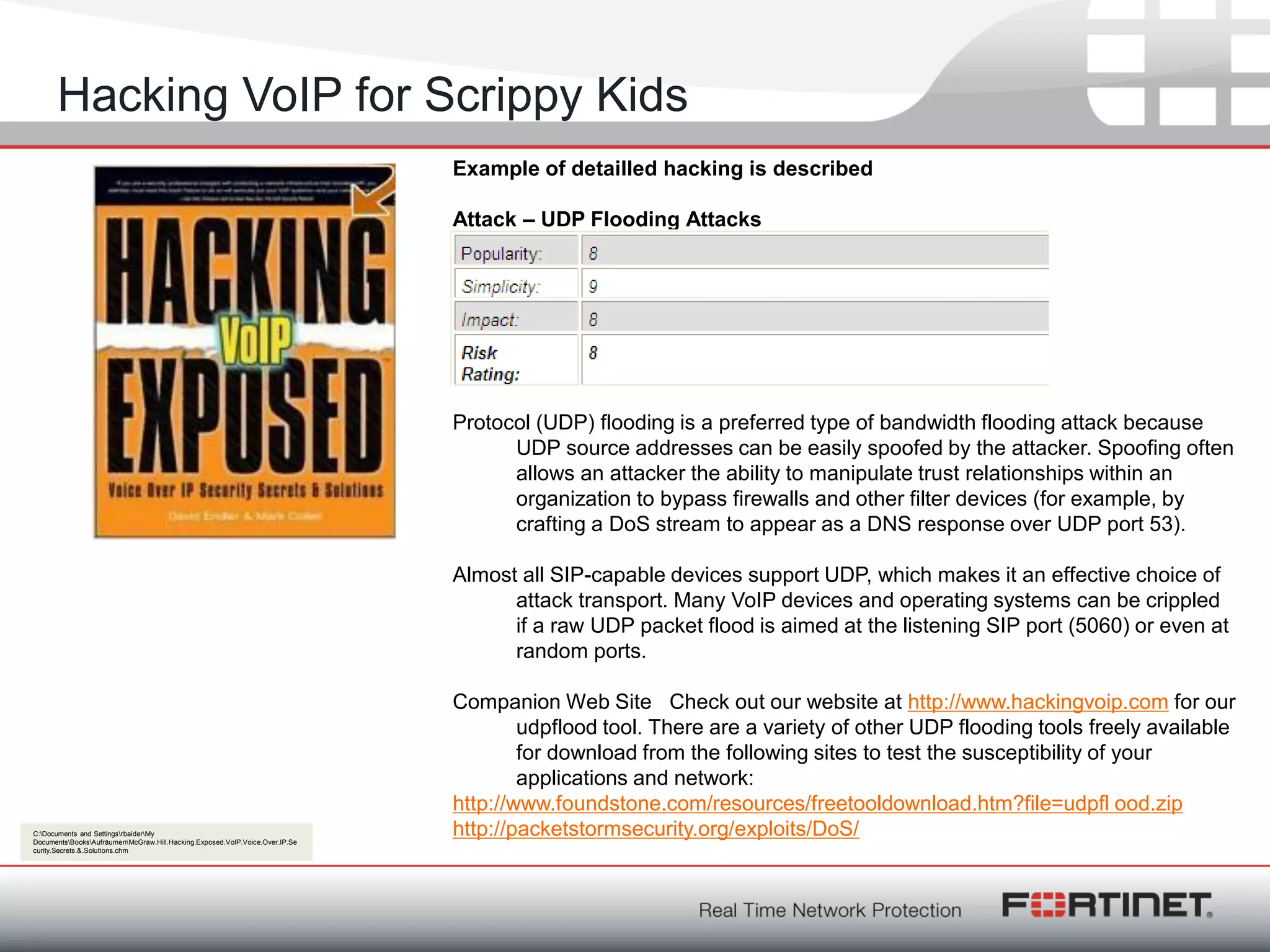
Hacking VoIP for Scrippy Kids
Example of detailled hacking is described
Attack – UDP Flooding Attacks
Protocol (UDP) flooding is a preferred type of bandwidth flooding attack because
UDP source addresses can be easily spoofed by the attacker. Spoofing often
allows an attacker the ability to manipulate trust relationships within an
organization to bypass firewalls and other filter devices (for example, by
crafting a DoS stream to appear as a DNS response over UDP port 53).
Almost all SIP-capable devices support UDP, which makes it an effective choice of
attack transport. Many VoIP devices and operating systems can be crippled
if a raw UDP packet flood is aimed at the listening SIP port (5060) or even at
random ports.
Companion Web Site Check out our website at http://www.hackingvoip.com for our
udpflood tool. There are a variety of other UDP flooding tools freely available
for download from the following sites to test the susceptibility of your
applications and network:
http://www.foundstone.com/resources/freetooldownload.htm?file=udpfl ood.zip
http://packetstormsecurity.org/exploits/DoS/C:Documents and SettingsrbaiderMy
DocumentsBooksAufräumenMcGraw.Hill.Hacking.Exposed.VoIP.Voice.Over.IP.Se
curity.Secrets.&.Solutions.chm
Fortinet ConfidentialFortinet Confidential
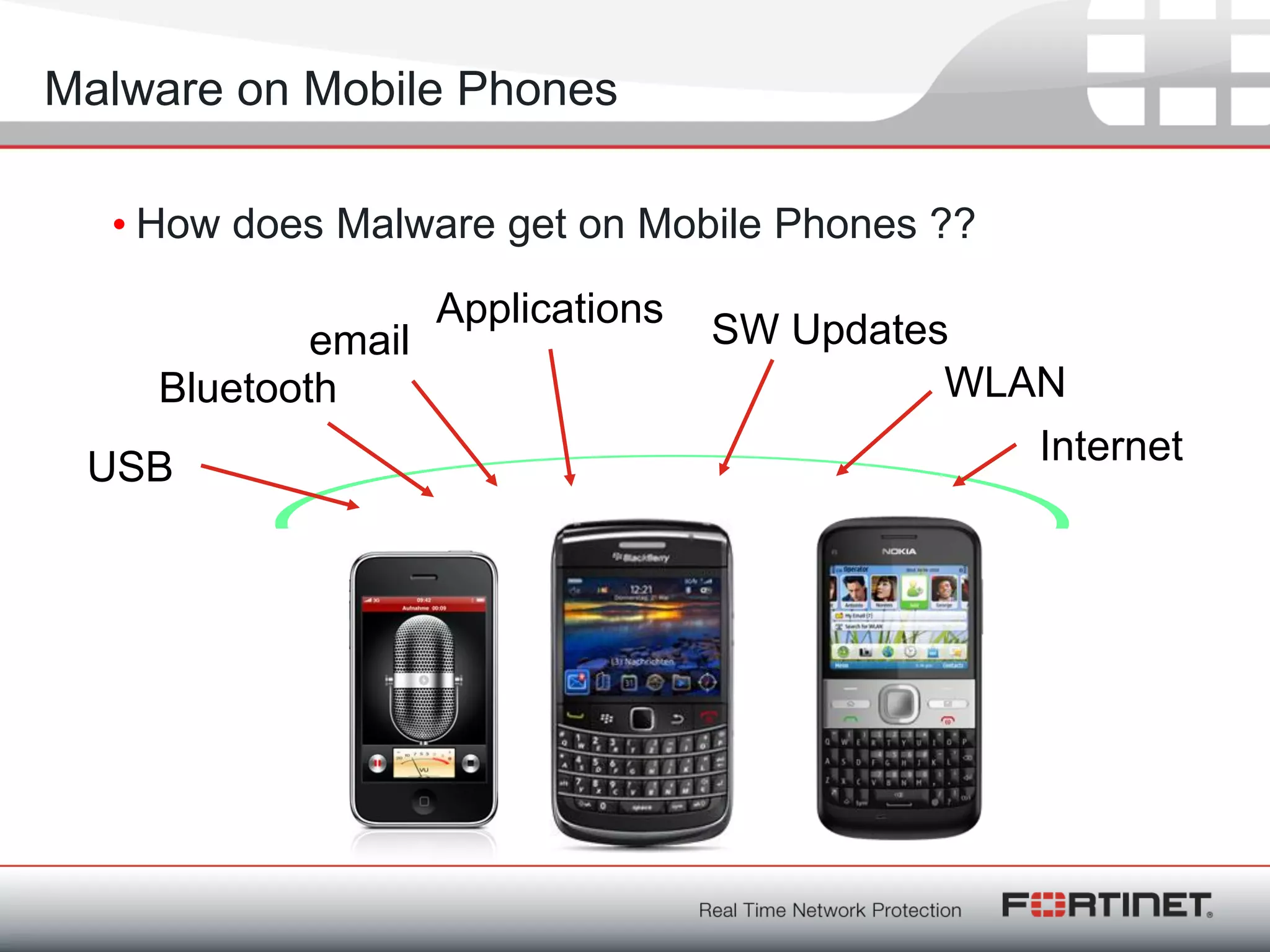
Malware on Mobile Phones
• How does Malware get on Mobile Phones ??
Bluetooth
Applications
USB
SW Updates
WLAN
email
Internet
Fortinet ConfidentialFortinet Confidential
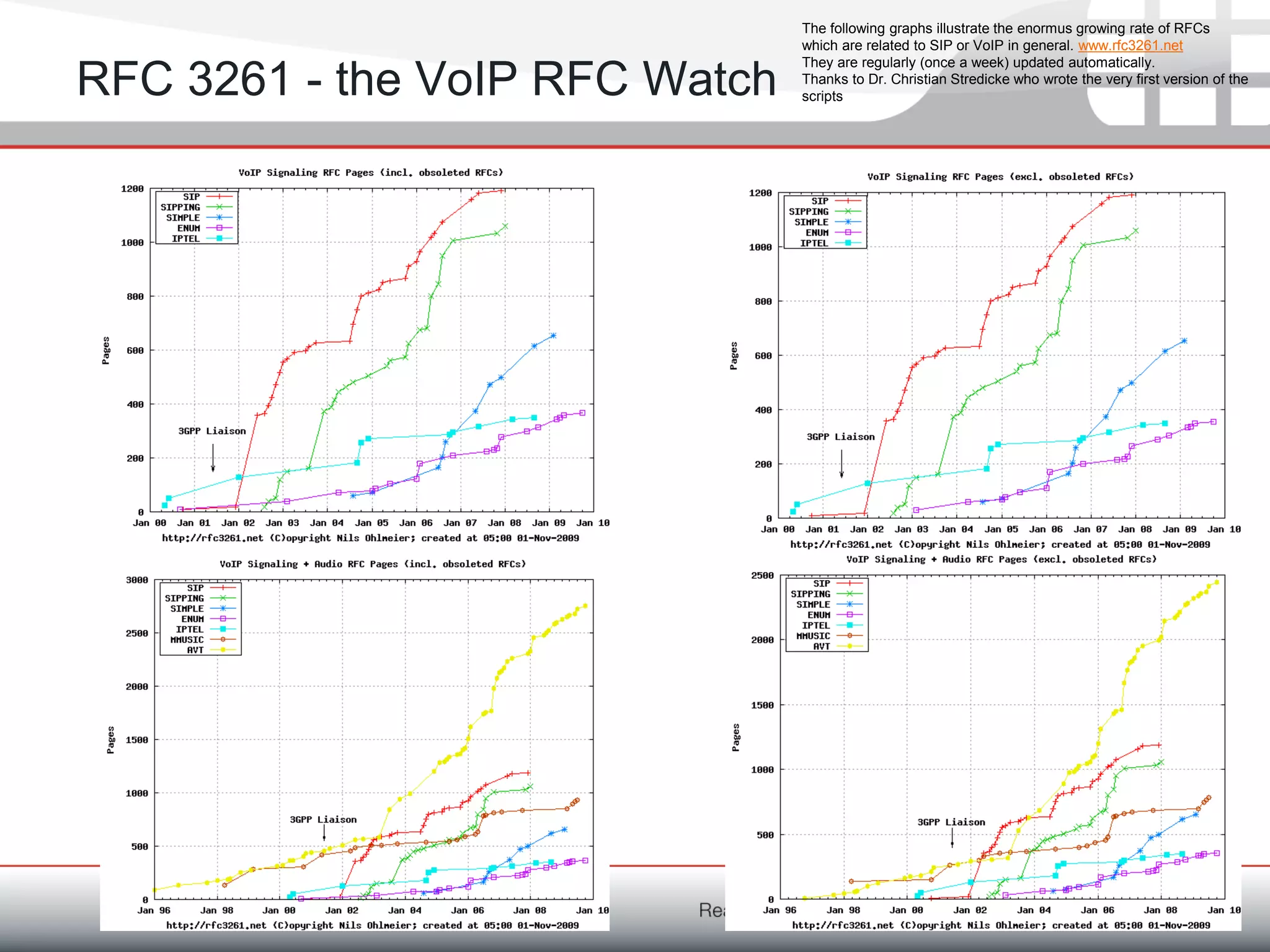
RFC 3261 - the VoIP RFC Watch
The following graphs illustrate the enormus growing rate of RFCs
which are related to SIP or VoIP in general. www.rfc3261.net
They are regularly (once a week) updated automatically.
Thanks to Dr. Christian Stredicke who wrote the very first version of the
scripts
Fortinet ConfidentialFortinet Confidential
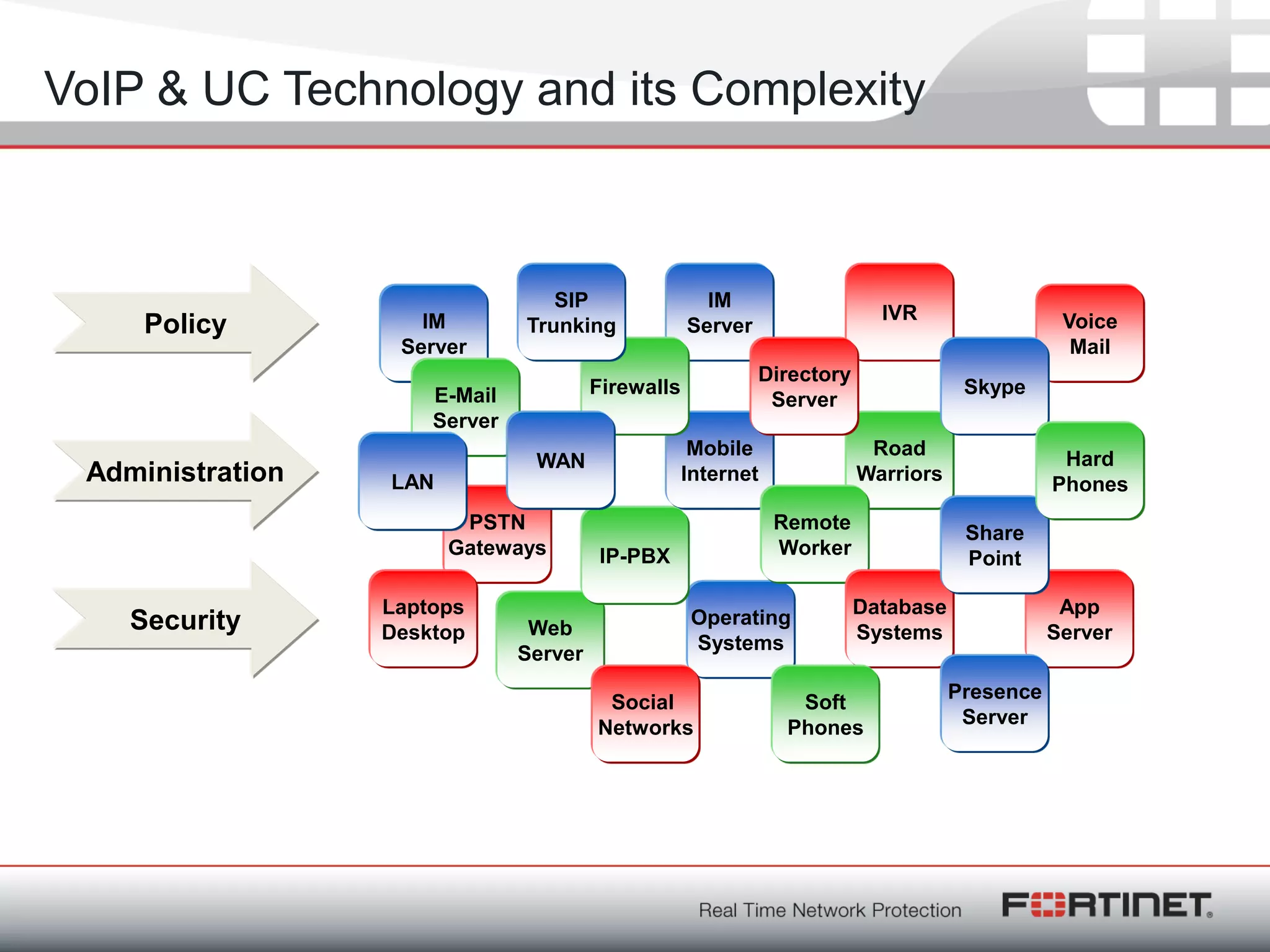
VoIP & UC Technology and its Complexity
IM
Server
Operating
Systems
Mobile
Internet
IM
Server
IVR Voice
Mail
PSTN
Gateways
App
ServerWeb
Server
FirewallsE-Mail
Server
IP-PBX
LAN
WAN
Road
Warriors
Remote
Worker
Laptops
Desktop
Directory
Server
Social
Networks
Database
Systems
Skype
Share
Point
SIP
Trunking
Presence
Server
Soft
Phones
Hard
Phones
Policy
Administration
Security
Fortinet ConfidentialFortinet Confidential
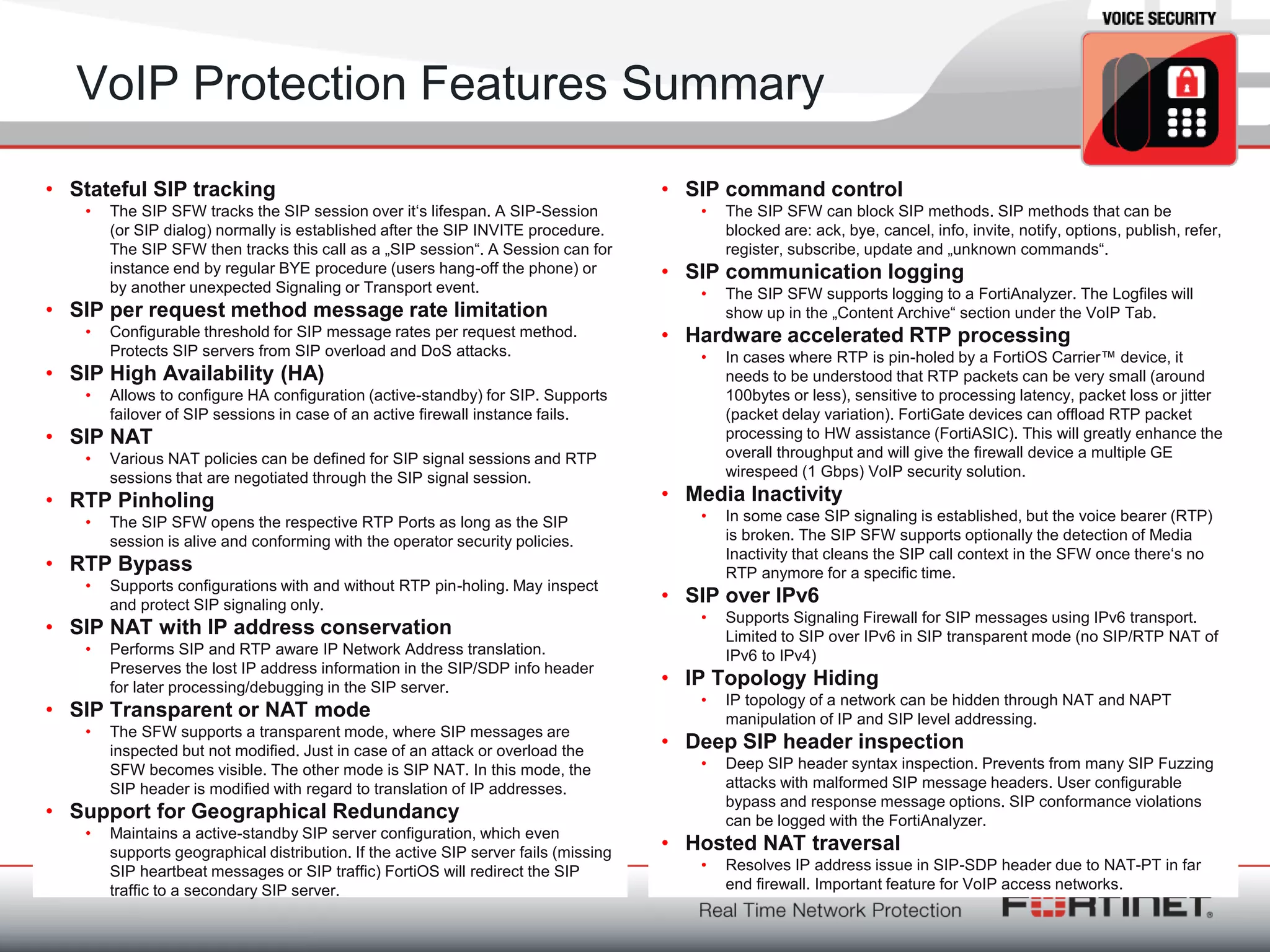
VoIP Protection Features Summary
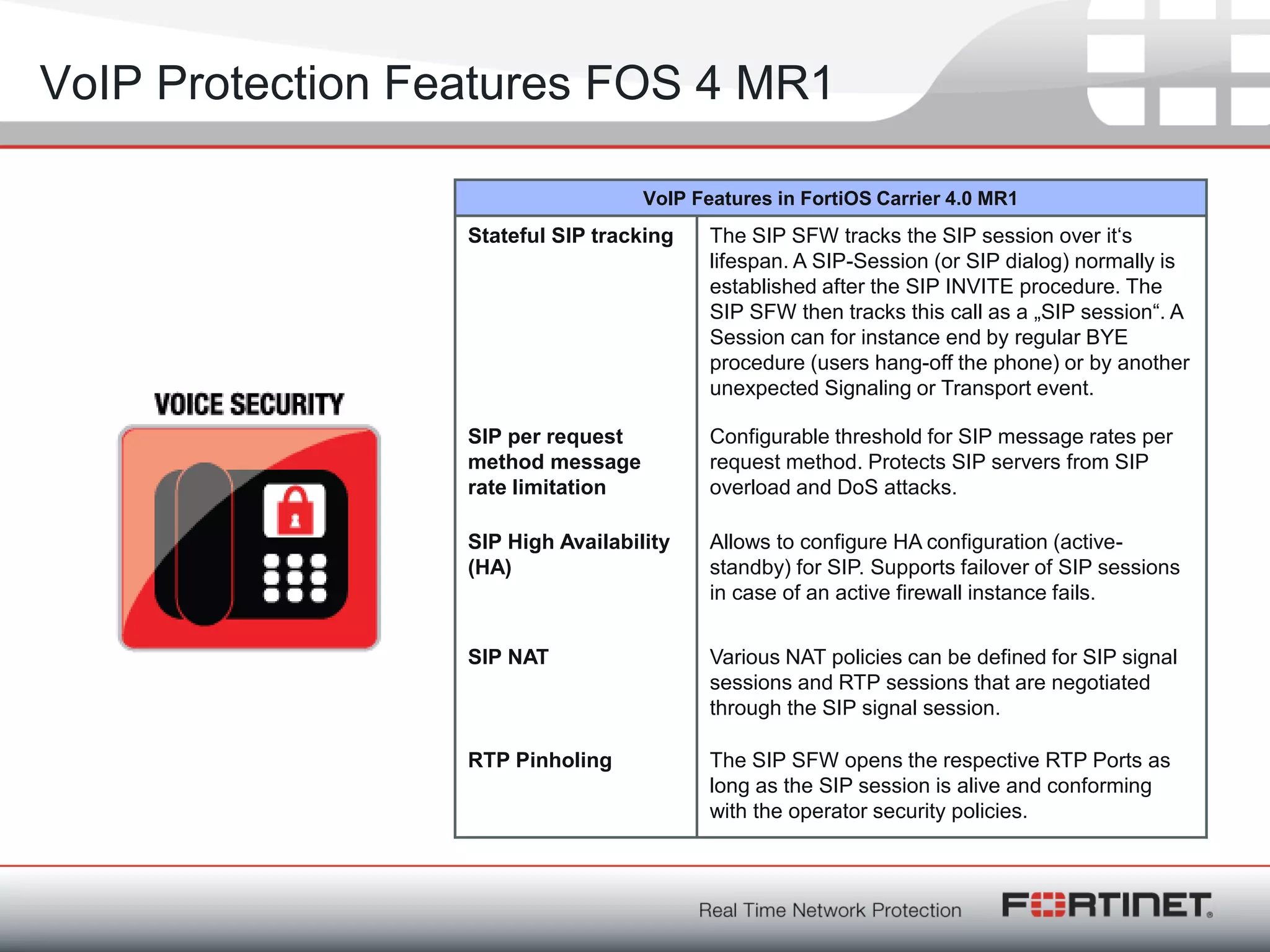
• Stateful SIP tracking
• The SIP SFW tracks the SIP session over it‗s lifespan. A SIP-Session
(or SIP dialog) normally is established after the SIP INVITE procedure.
The SIP SFW then tracks this call as a „SIP session―. A Session can for
instance end by regular BYE procedure (users hang-off the phone) or
by another unexpected Signaling or Transport event.
• SIP per request method message rate limitation
• Configurable threshold for SIP message rates per request method.
Protects SIP servers from SIP overload and DoS attacks.
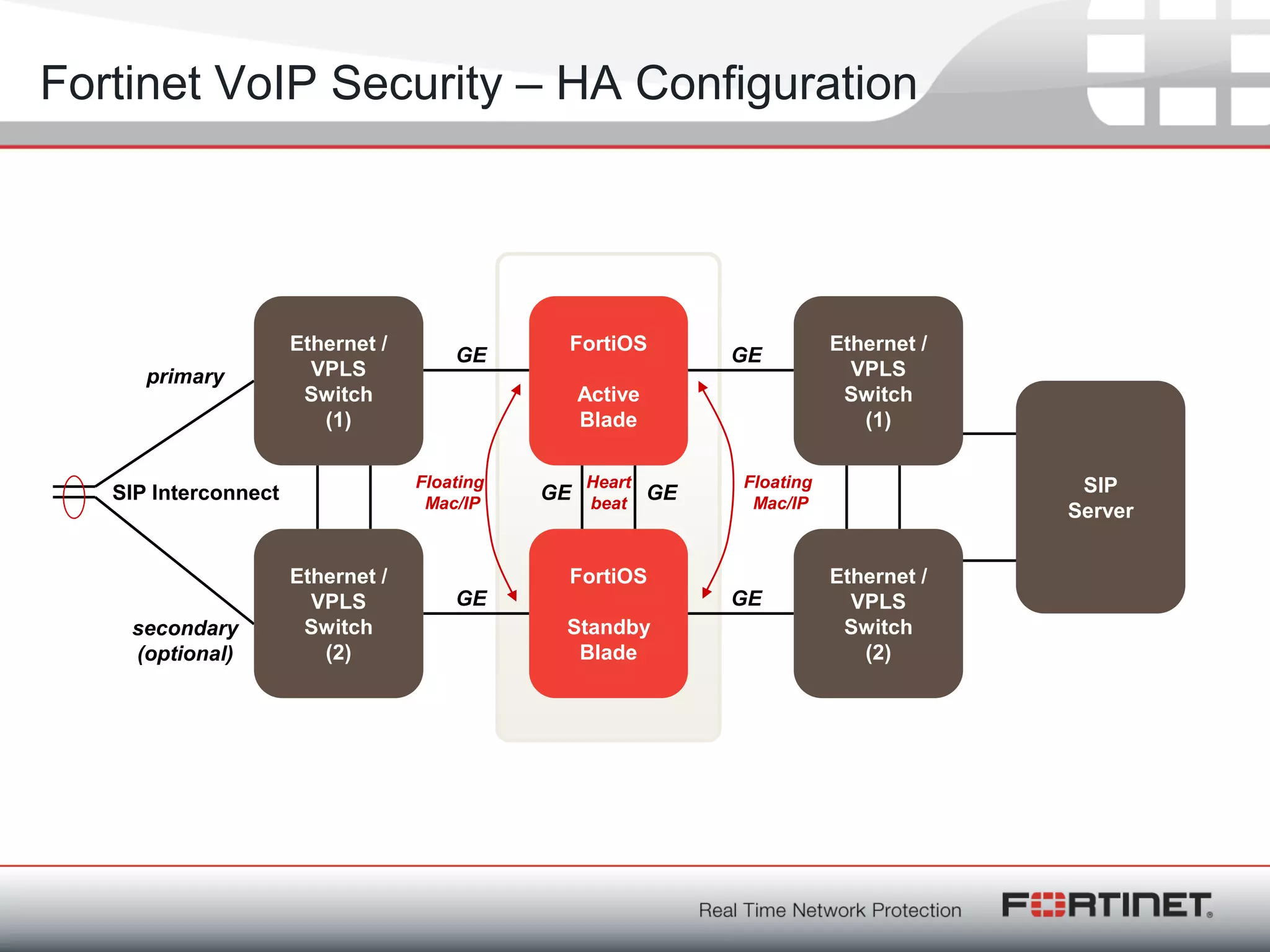
• SIP High Availability (HA)
• Allows to configure HA configuration (active-standby) for SIP. Supports
failover of SIP sessions in case of an active firewall instance fails.
• SIP NAT
• Various NAT policies can be defined for SIP signal sessions and RTP
sessions that are negotiated through the SIP signal session.
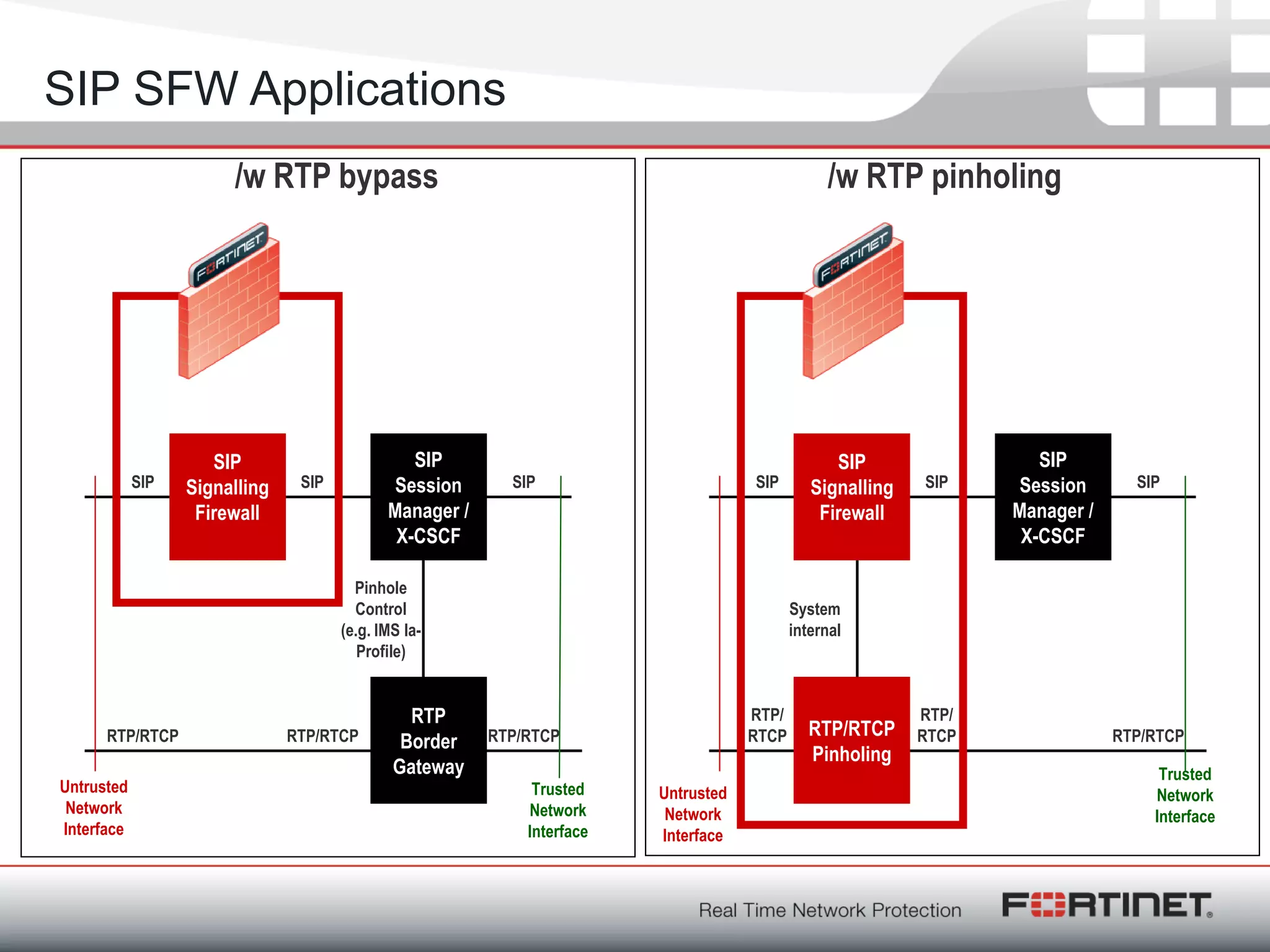
• RTP Pinholing
• The SIP SFW opens the respective RTP Ports as long as the SIP
session is alive and conforming with the operator security policies.
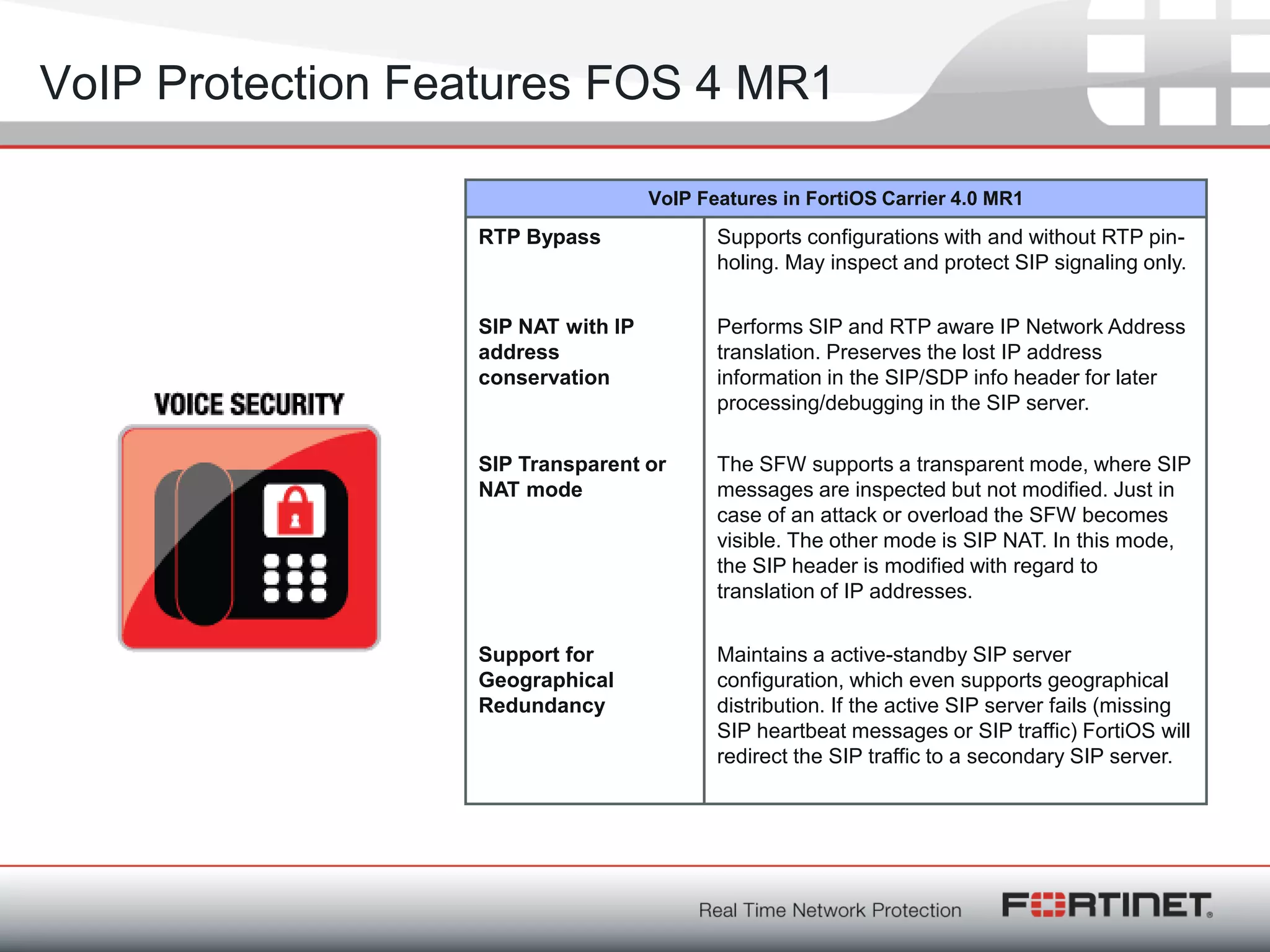
• RTP Bypass
• Supports configurations with and without RTP pin-holing. May inspect
and protect SIP signaling only.
• SIP NAT with IP address conservation
• Performs SIP and RTP aware IP Network Address translation.
Preserves the lost IP address information in the SIP/SDP info header
for later processing/debugging in the SIP server.
• SIP Transparent or NAT mode
• The SFW supports a transparent mode, where SIP messages are
inspected but not modified. Just in case of an attack or overload the
SFW becomes visible. The other mode is SIP NAT. In this mode, the
SIP header is modified with regard to translation of IP addresses.
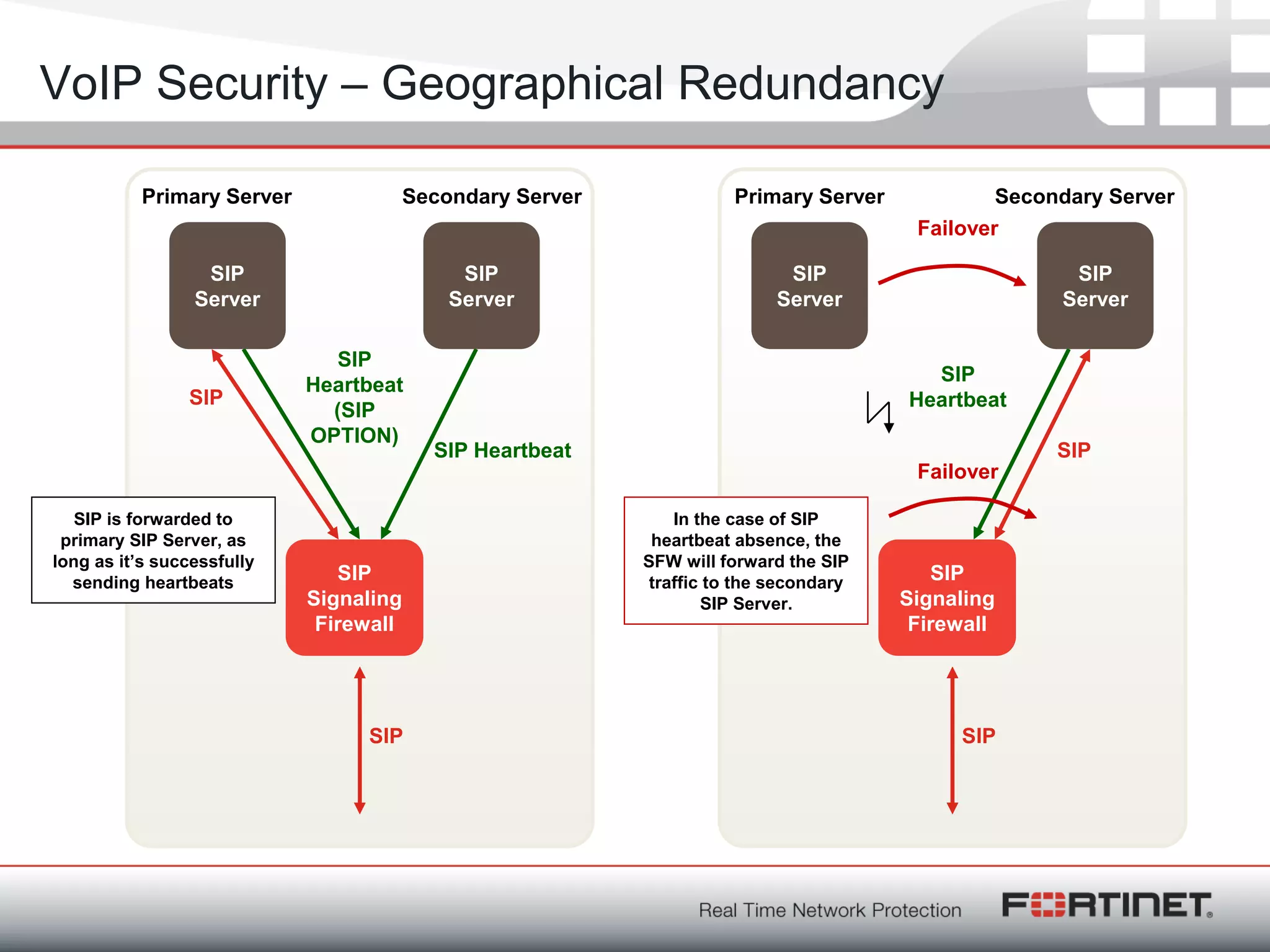
• Support for Geographical Redundancy
• Maintains a active-standby SIP server configuration, which even
supports geographical distribution. If the active SIP server fails (missing
SIP heartbeat messages or SIP traffic) FortiOS will redirect the SIP
traffic to a secondary SIP server.
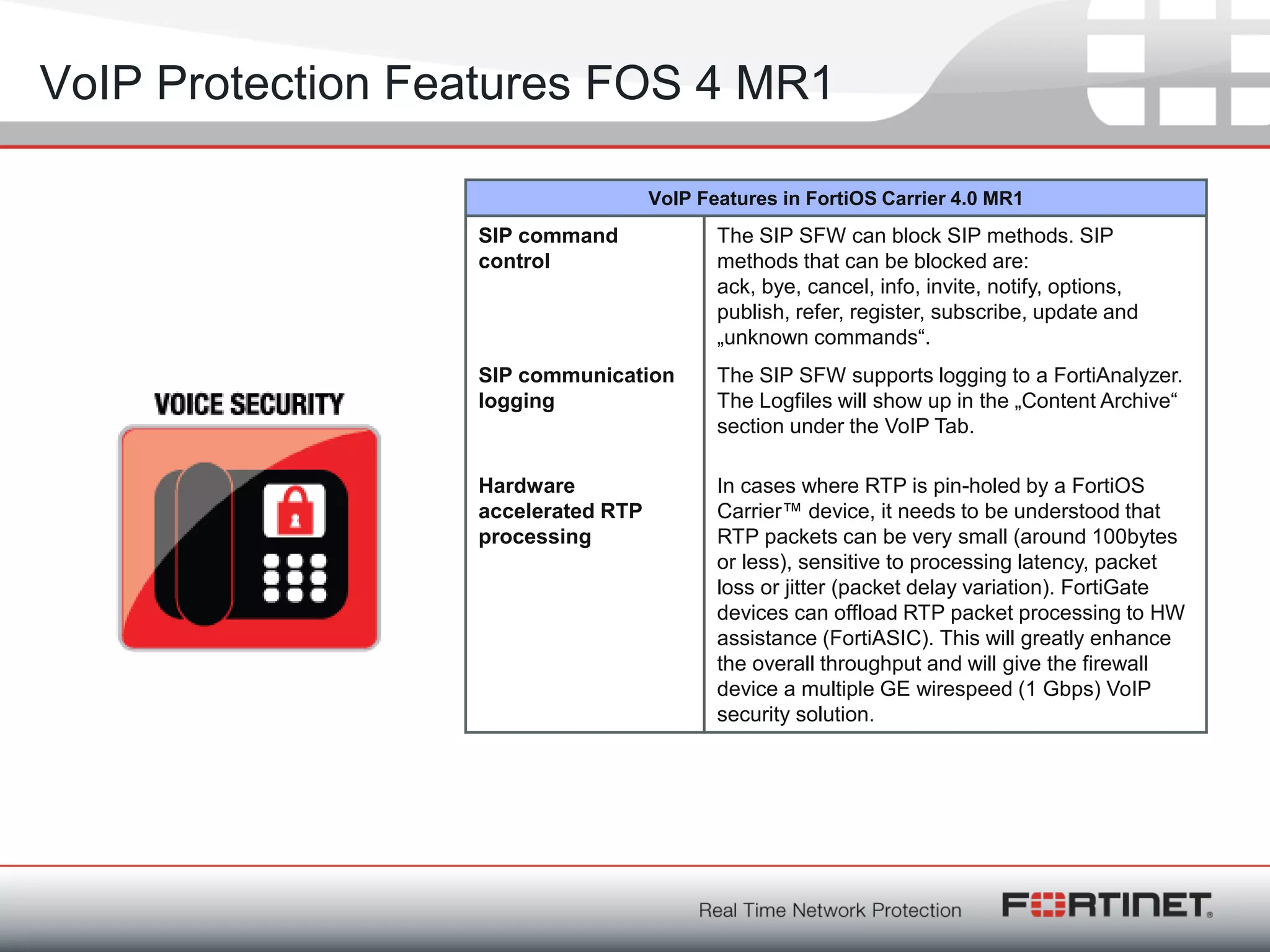
• SIP command control
• The SIP SFW can block SIP methods. SIP methods that can be
blocked are: ack, bye, cancel, info, invite, notify, options, publish, refer,
register, subscribe, update and „unknown commands―.
• SIP communication logging
• The SIP SFW supports logging to a FortiAnalyzer. The Logfiles will
show up in the „Content Archive― section under the VoIP Tab.
• Hardware accelerated RTP processing
• In cases where RTP is pin-holed by a FortiOS Carrier™ device, it
needs to be understood that RTP packets can be very small (around
100bytes or less), sensitive to processing latency, packet loss or jitter
(packet delay variation). FortiGate devices can offload RTP packet
processing to HW assistance (FortiASIC). This will greatly enhance the
overall throughput and will give the firewall device a multiple GE
wirespeed (1 Gbps) VoIP security solution.
• Media Inactivity
• In some case SIP signaling is established, but the voice bearer (RTP)
is broken. The SIP SFW supports optionally the detection of Media
Inactivity that cleans the SIP call context in the SFW once there‗s no
RTP anymore for a specific time.
• SIP over IPv6
• Supports Signaling Firewall for SIP messages using IPv6 transport.
Limited to SIP over IPv6 in SIP transparent mode (no SIP/RTP NAT of
IPv6 to IPv4)
• IP Topology Hiding
• IP topology of a network can be hidden through NAT and NAPT
manipulation of IP and SIP level addressing.
• Deep SIP header inspection
• Deep SIP header syntax inspection. Prevents from many SIP Fuzzing
attacks with malformed SIP message headers. User configurable
bypass and response message options. SIP conformance violations
can be logged with the FortiAnalyzer.
• Hosted NAT traversal
• Resolves IP address issue in SIP-SDP header due to NAT-PT in far
end firewall. Important feature for VoIP access networks.
Fortinet ConfidentialFortinet Confidential
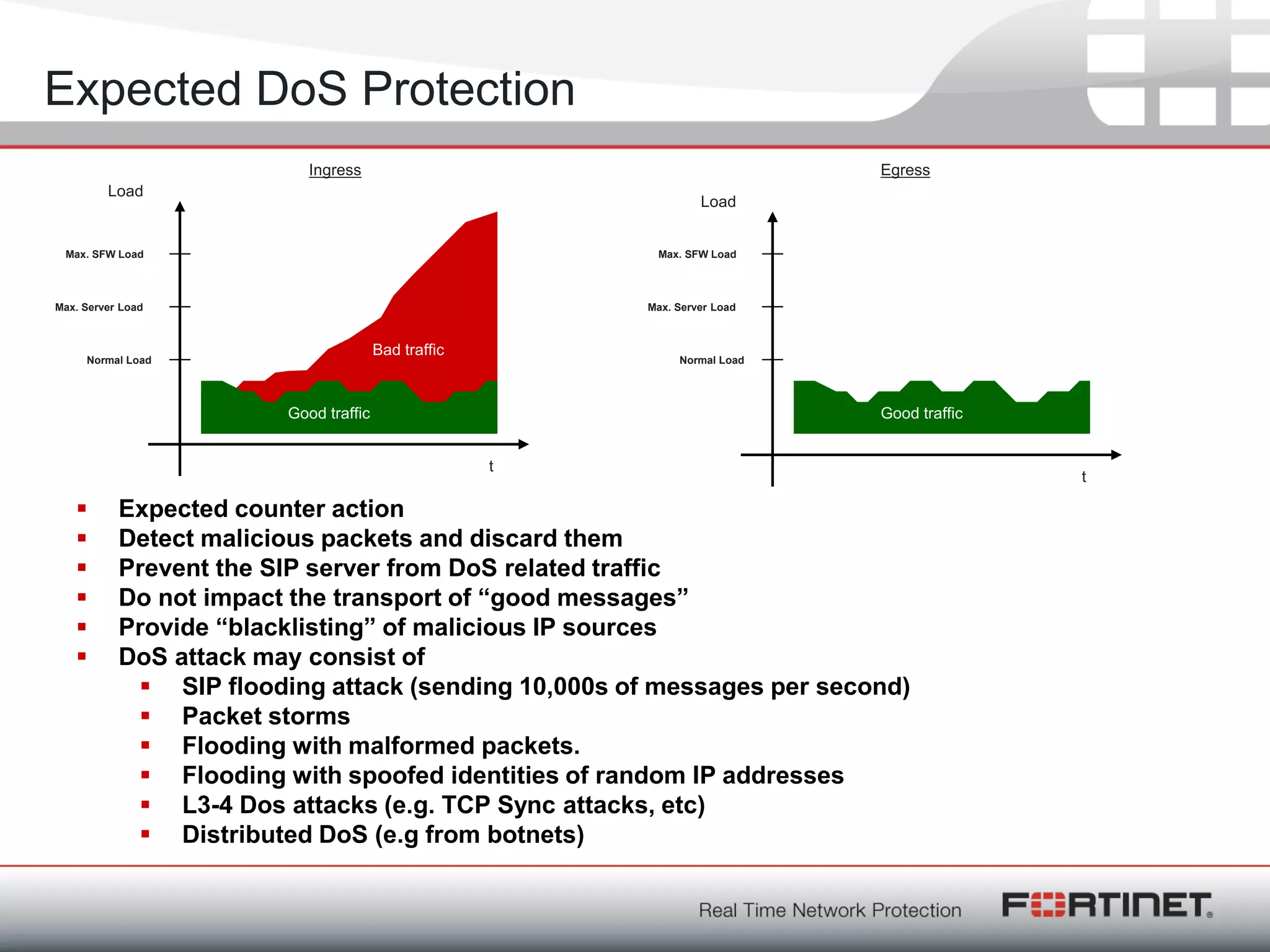
Load
t
Load
t
Bad traffic
Good traffic
Ingress Egress
Normal Load
Max. Server Load
Max. SFW Load
Normal Load
Max. Server Load
Max. SFW Load
 Expected counter action
 Detect malicious packets and discard them
 Prevent the SIP server from DoS related traffic
 Do not impact the transport of “good messages”
 Provide “blacklisting” of malicious IP sources
 DoS attack may consist of
 SIP flooding attack (sending 10,000s of messages per second)
 Packet storms
 Flooding with malformed packets.
 Flooding with spoofed identities of random IP addresses
 L3-4 Dos attacks (e.g. TCP Sync attacks, etc)
 Distributed DoS (e.g from botnets)
Good traffic
Expected DoS Protection
Fortinet ConfidentialFortinet Confidential
Load
t
Good traffic
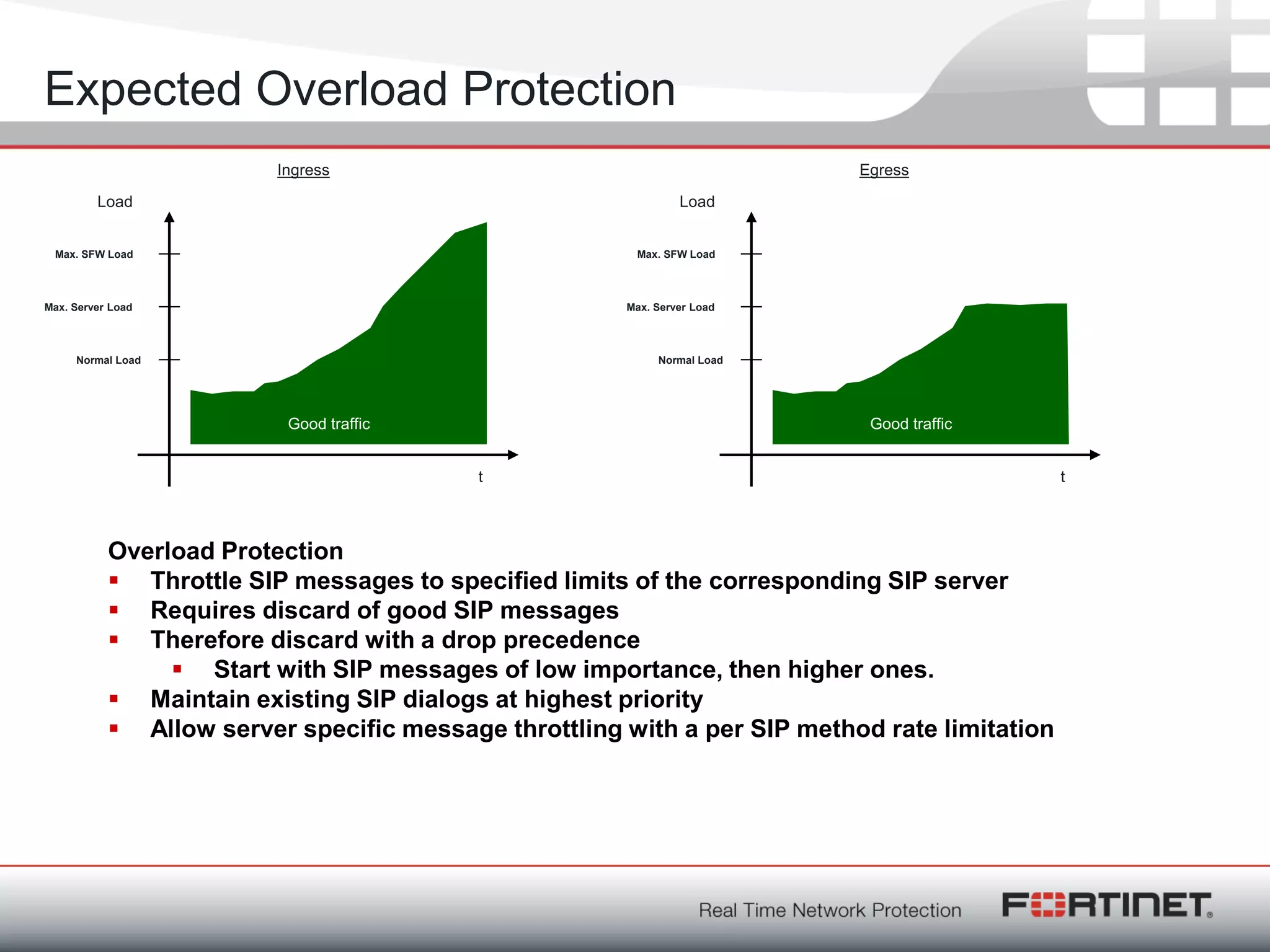
Overload Protection
 Throttle SIP messages to specified limits of the corresponding SIP server
 Requires discard of good SIP messages
 Therefore discard with a drop precedence
 Start with SIP messages of low importance, then higher ones.
 Maintain existing SIP dialogs at highest priority
 Allow server specific message throttling with a per SIP method rate limitation
Ingress
Normal Load
Max. Server Load
Max. SFW Load
Load
t
Good traffic
Egress
Normal Load
Max. Server Load
Max. SFW Load
Expected Overload Protection
Fortinet ConfidentialFortinet Confidential
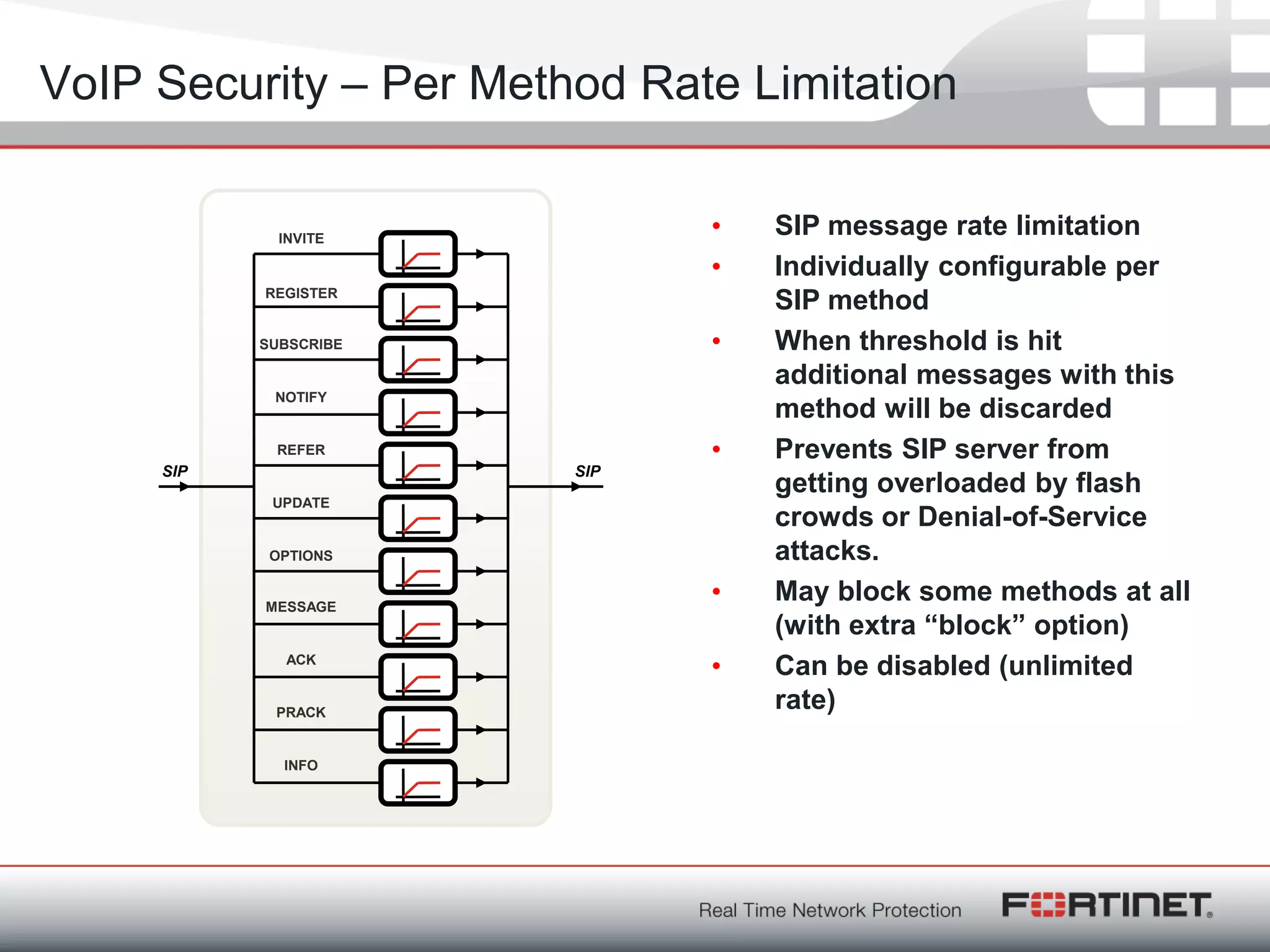
VoIP Security – Per Method Rate Limitation
• SIP message rate limitation
• Individually configurable per
SIP method
• When threshold is hit
additional messages with this
method will be discarded
• Prevents SIP server from
getting overloaded by flash
crowds or Denial-of-Service
attacks.
• May block some methods at all
(with extra “block” option)
• Can be disabled (unlimited
rate)
SIP
INVITE
REGISTER
SUBSCRIBE
NOTIFY
REFER
UPDATE
OPTIONS
MESSAGE
ACK
PRACK
INFO
SIP
Fortinet ConfidentialFortinet Confidential
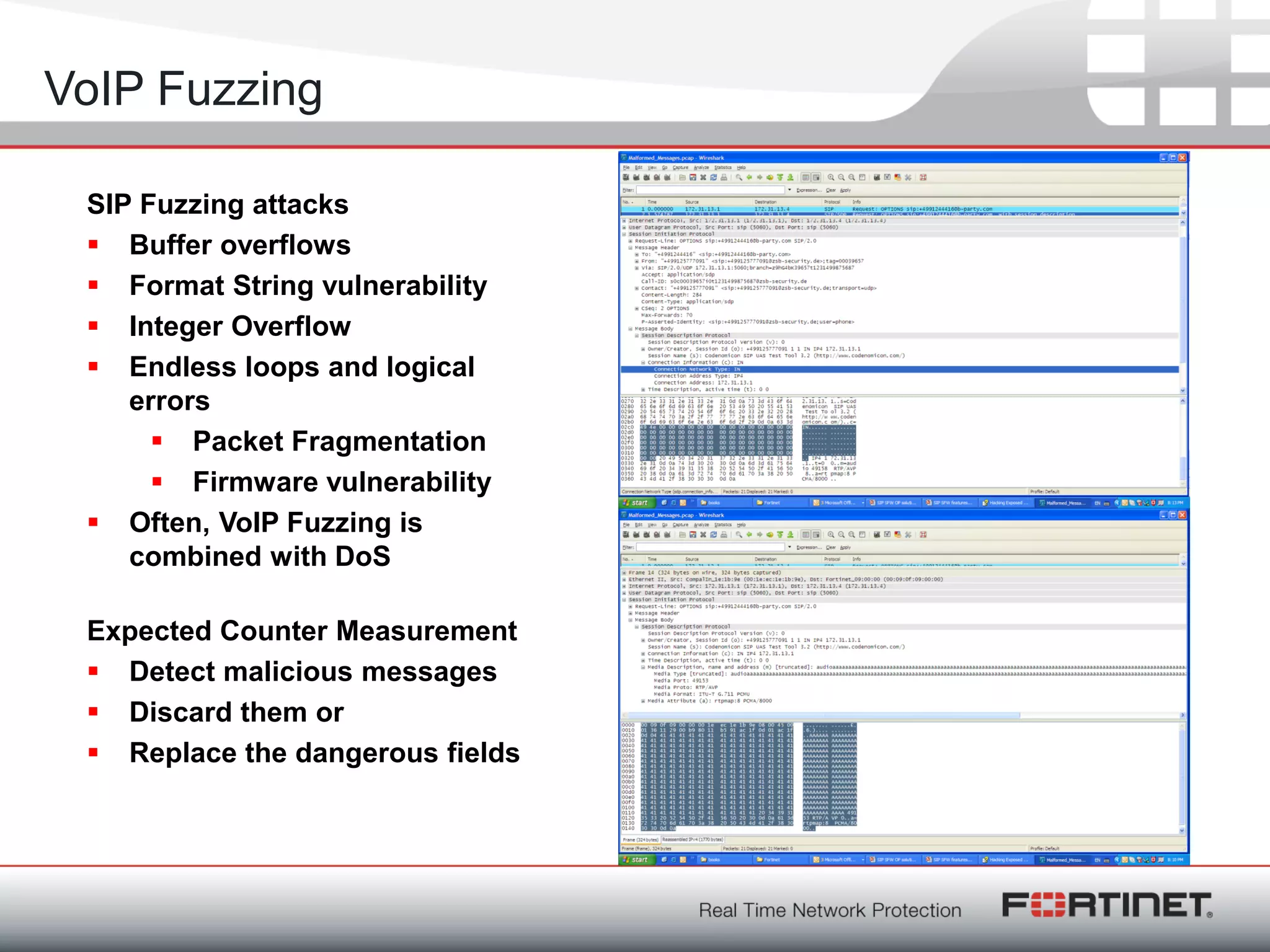
SIP Fuzzing attacks
 Buffer overflows
 Format String vulnerability
 Integer Overflow
 Endless loops and logical
errors
 Packet Fragmentation
 Firmware vulnerability
 Often, VoIP Fuzzing is
combined with DoS
Expected Counter Measurement
 Detect malicious messages
 Discard them or
 Replace the dangerous fields
VoIP Fuzzing
Fortinet ConfidentialFortinet Confidential
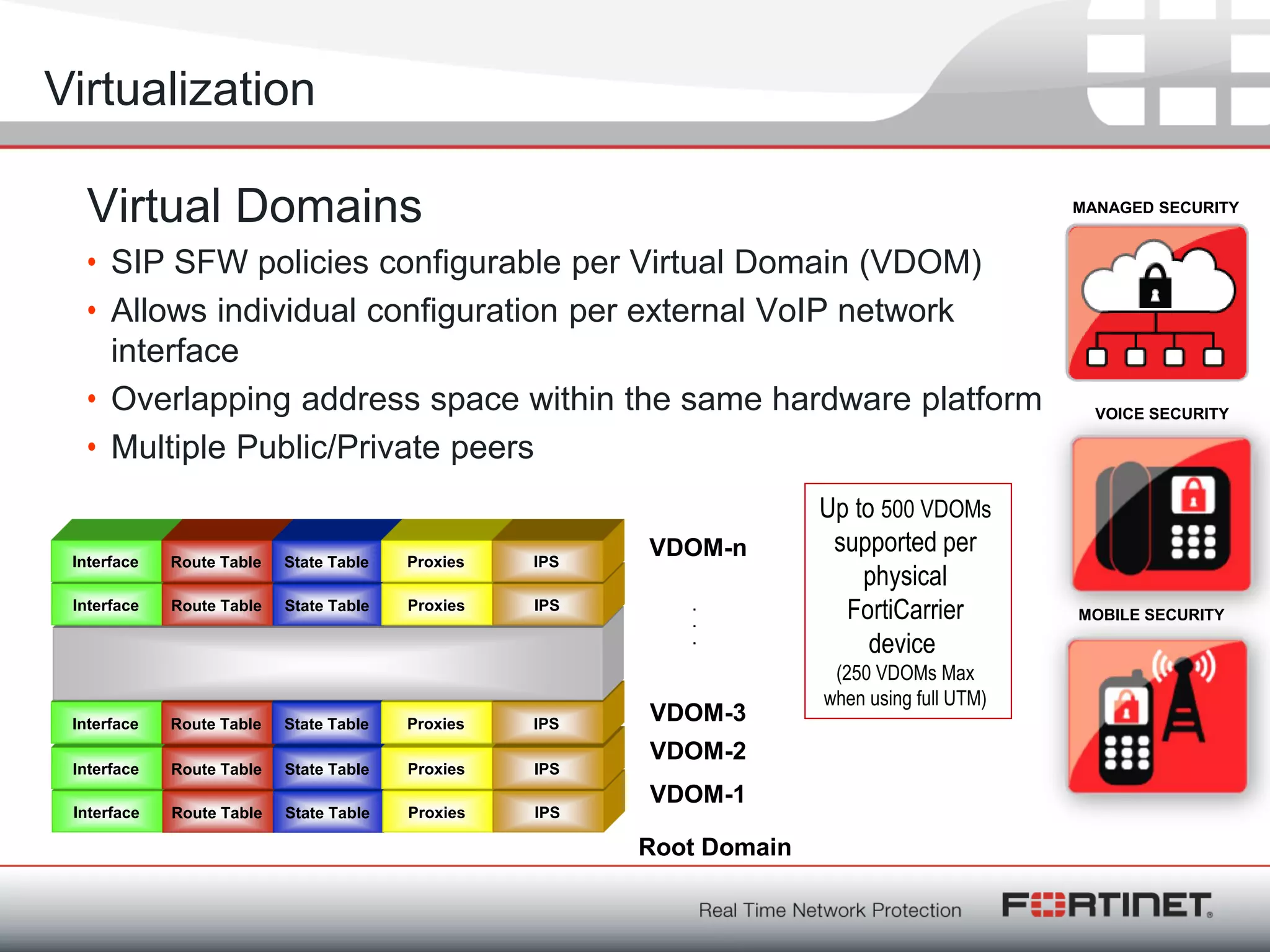
Virtual Domains
• SIP SFW policies configurable per Virtual Domain (VDOM)
• Allows individual configuration per external VoIP network
interface
• Overlapping address space within the same hardware platform
• Multiple Public/Private peers
Virtualization
Interface Route Table State Table Proxies IPS
Root Domain
VDOM-1
VDOM-2
VDOM-3
VDOM-n
.
.
.
Up to 500 VDOMs
supported per
physical
FortiCarrier
device
(250 VDOMs Max
when using full UTM)
MOBILE SECURITY
MANAGED SECURITY
VOICE SECURITY
Fortinet ConfidentialFortinet Confidential
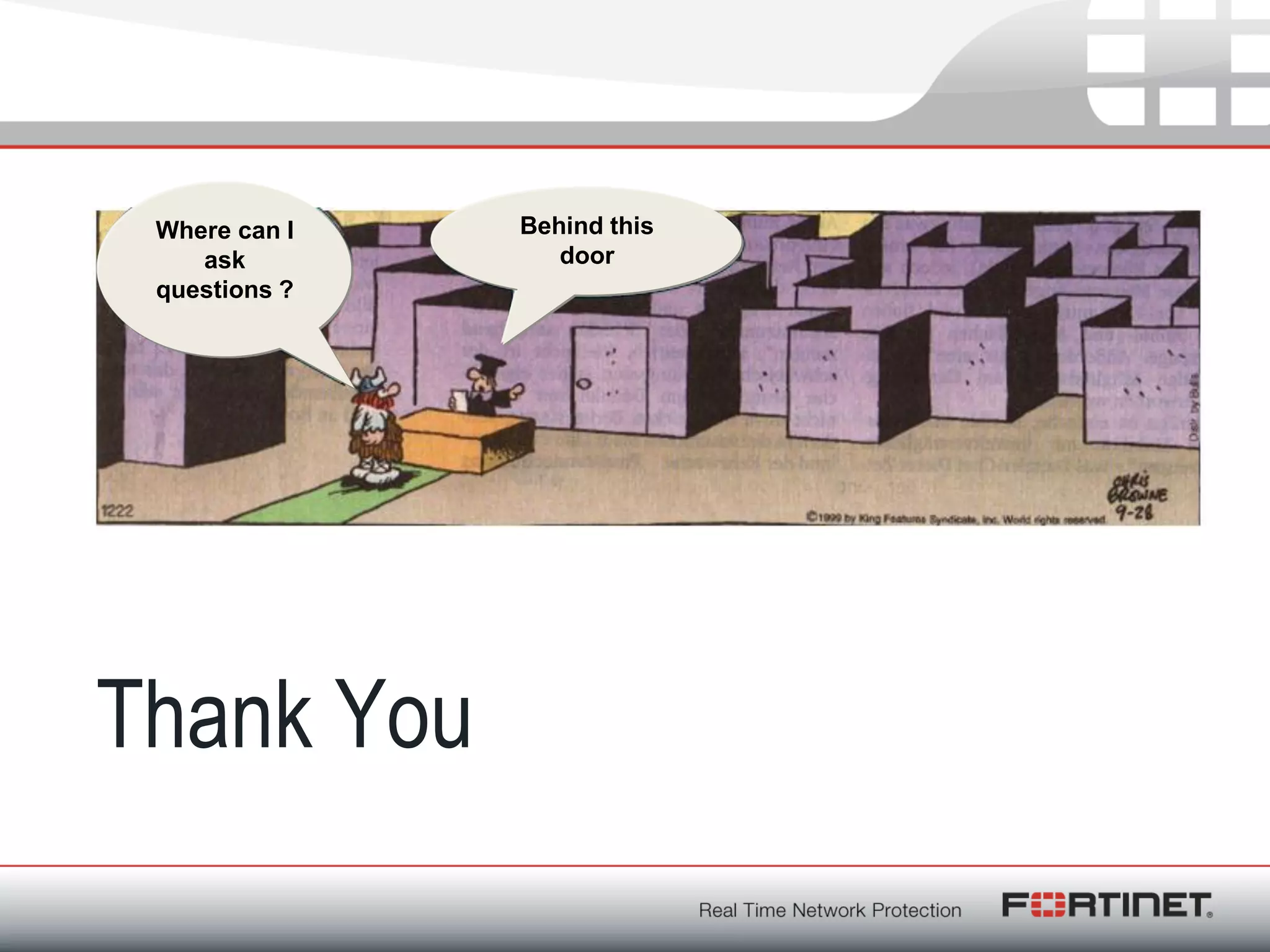
Thank You
Where can I
ask
questions ?
Behind this
door
Fortinet ConfidentialFortinet Confidential
Backup
Fortinet ConfidentialFortinet Confidential
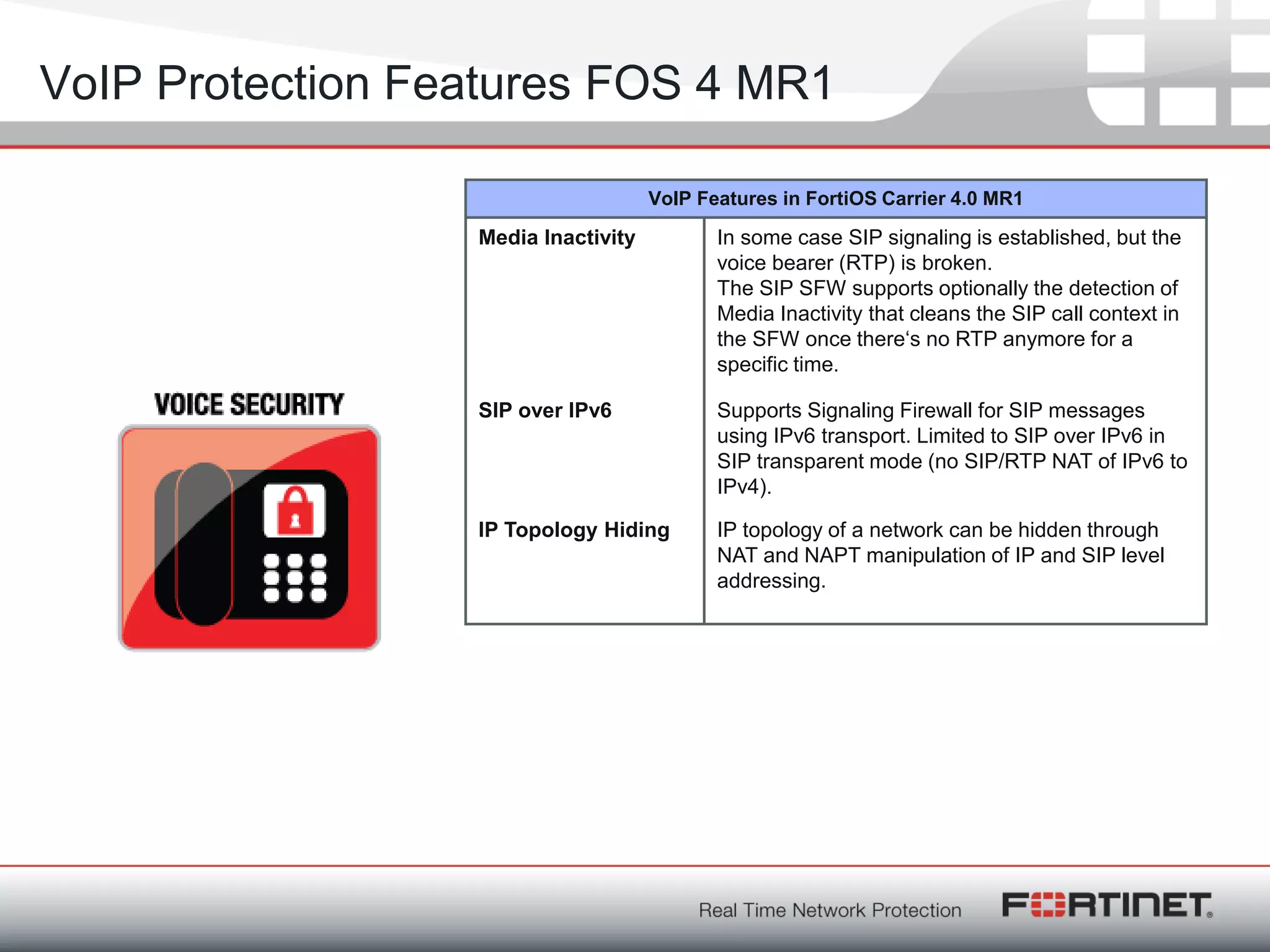
VoIP Protection Features FOS 4 MR1
VoIP Features in FortiOS Carrier 4.0 MR1
Stateful SIP tracking The SIP SFW tracks the SIP session over it‗s
lifespan. A SIP-Session (or SIP dialog) normally is
established after the SIP INVITE procedure. The
SIP SFW then tracks this call as a „SIP session―. A
Session can for instance end by regular BYE
procedure (users hang-off the phone) or by another
unexpected Signaling or Transport event.
SIP per request
method message
rate limitation
Configurable threshold for SIP message rates per
request method. Protects SIP servers from SIP
overload and DoS attacks.
SIP High Availability
(HA)
Allows to configure HA configuration (active-
standby) for SIP. Supports failover of SIP sessions
in case of an active firewall instance fails.
SIP NAT Various NAT policies can be defined for SIP signal
sessions and RTP sessions that are negotiated
through the SIP signal session.
RTP Pinholing The SIP SFW opens the respective RTP Ports as
long as the SIP session is alive and conforming
with the operator security policies.
Fortinet ConfidentialFortinet Confidential
VoIP Protection Features FOS 4 MR1
VoIP Features in FortiOS Carrier 4.0 MR1
RTP Bypass Supports configurations with and without RTP pin-
holing. May inspect and protect SIP signaling only.
SIP NAT with IP
address
conservation
Performs SIP and RTP aware IP Network Address
translation. Preserves the lost IP address
information in the SIP/SDP info header for later
processing/debugging in the SIP server.
SIP Transparent or
NAT mode
The SFW supports a transparent mode, where SIP
messages are inspected but not modified. Just in
case of an attack or overload the SFW becomes
visible. The other mode is SIP NAT. In this mode,
the SIP header is modified with regard to
translation of IP addresses.
Support for
Geographical
Redundancy
Maintains a active-standby SIP server
configuration, which even supports geographical
distribution. If the active SIP server fails (missing
SIP heartbeat messages or SIP traffic) FortiOS will
redirect the SIP traffic to a secondary SIP server.
Fortinet ConfidentialFortinet Confidential
VoIP Protection Features FOS 4 MR1
VoIP Features in FortiOS Carrier 4.0 MR1
SIP command
control
The SIP SFW can block SIP methods. SIP
methods that can be blocked are:
ack, bye, cancel, info, invite, notify, options,
publish, refer, register, subscribe, update and
„unknown commands―.
SIP communication
logging
The SIP SFW supports logging to a FortiAnalyzer.
The Logfiles will show up in the „Content Archive―
section under the VoIP Tab.
Hardware
accelerated RTP
processing
In cases where RTP is pin-holed by a FortiOS
Carrier™ device, it needs to be understood that
RTP packets can be very small (around 100bytes
or less), sensitive to processing latency, packet
loss or jitter (packet delay variation). FortiGate
devices can offload RTP packet processing to HW
assistance (FortiASIC). This will greatly enhance
the overall throughput and will give the firewall
device a multiple GE wirespeed (1 Gbps) VoIP
security solution.
Fortinet ConfidentialFortinet Confidential
VoIP Protection Features FOS 4 MR1
VoIP Features in FortiOS Carrier 4.0 MR1
Media Inactivity In some case SIP signaling is established, but the
voice bearer (RTP) is broken.
The SIP SFW supports optionally the detection of
Media Inactivity that cleans the SIP call context in
the SFW once there‗s no RTP anymore for a
specific time.
SIP over IPv6 Supports Signaling Firewall for SIP messages
using IPv6 transport. Limited to SIP over IPv6 in
SIP transparent mode (no SIP/RTP NAT of IPv6 to
IPv4).
IP Topology Hiding IP topology of a network can be hidden through
NAT and NAPT manipulation of IP and SIP level
addressing.
Fortinet ConfidentialFortinet Confidential
• Fortinet‘s IPS is SIP aware
– SIP decode is available
• Allows attack prevention and detection with a signature database.
• Signature updates available from Fortinet‘s FortiGuard service
with a very short response time.
• Customer signatures allow service personell to write their own
prevention or detection rules
– Could be used for the quickest reaction to a sudden security threat
• SIP aware IPS customer signature example from a customer:
– F-SBID( --name "SIP.Proxy.Require.Header.Buffer.Overflow"; --protocol udp; --service SIP; --flow
from_client; --pattern "OPTIONS|20|sip|3a|"; --no_case; --context uri; --within 12,context; --pattern
"Proxy-Require|3a 20|"; --no_case; --distance 8; --within 500; --context header; --pattern !"|0a|"; --
within_abs 500; )
– This signature blocks OPTION messages with a “Proxy-Require” field.
IPS – Intrusion Prevent and Detection
Fortinet ConfidentialFortinet Confidential
Fortinet VoIP Security – HA Configuration
SIP
Server
ENET/VPL
S
Switch
(1)
ENET/VP
LS
Switch
(2)
ENET/VP
LS
Switch
(1)
ENET/VPL
S
Switch
(2)
FortiCarri
er
Active
Blade
FortiCarri
er
Standby
Blade
SIP Interconnect
primary
secondary
(optional)
GE
GE GE
GE
GEGE
Heart
beat
Floating
Mac/IP
Floating
Mac/IP
Ethernet /
VPLS
Switch
(1)
Ethernet /
VPLS
Switch
(2)
Ethernet /
VPLS
Switch
(1)
Ethernet /
VPLS
Switch
(2)
SIP
Server
FortiOS
Active
Blade
FortiOS
Standby
Blade
Fortinet ConfidentialFortinet Confidential
VoIP Security – Geographical Redundancy
SIP
Server
SIP
Server
Primary Server Secondary Server
SIP Heartbeat
SIP
Heartbeat
(SIP
OPTION)
SIP
SIP
SIP is forwarded to
primary SIP Server, as
long as it’s successfully
sending heartbeats
SIP
Server
SIP
Server
Primary Server Secondary Server
SIP
Heartbeat
SIP
SIP
In the case of SIP
heartbeat absence, the
SFW will forward the SIP
traffic to the secondary
SIP Server.
Failover
Failover
SIP
Signaling
Firewall
SIP
Signaling
Firewall
SIP
Server
SIP
Server
SIP
Server
SIP
Server
Fortinet ConfidentialFortinet Confidential
VoIP Protection Features FOS 4 MR2
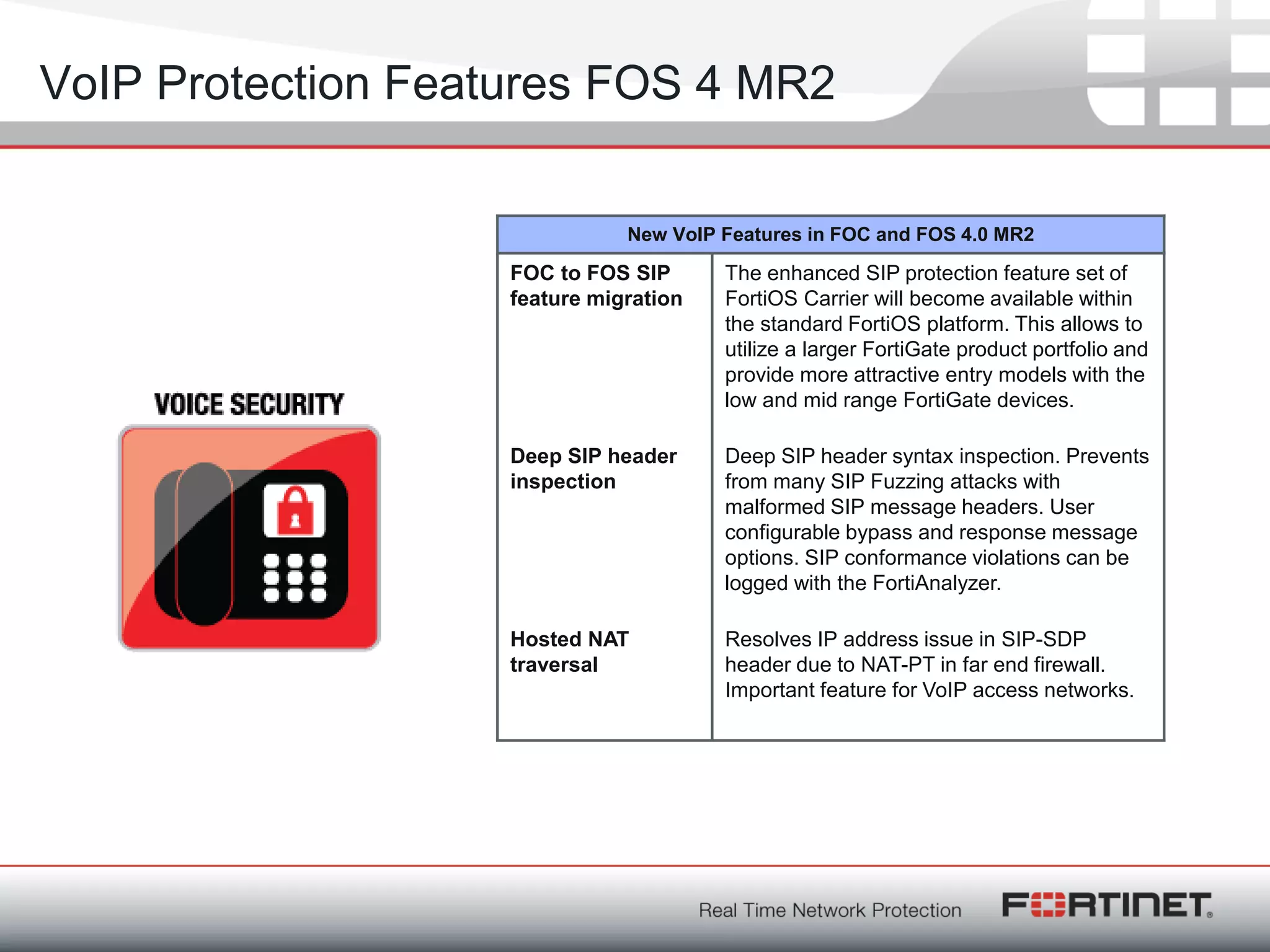
New VoIP Features in FOC and FOS 4.0 MR2
FOC to FOS SIP
feature migration
The enhanced SIP protection feature set of
FortiOS Carrier will become available within
the standard FortiOS platform. This allows to
utilize a larger FortiGate product portfolio and
provide more attractive entry models with the
low and mid range FortiGate devices.
Deep SIP header
inspection
Deep SIP header syntax inspection. Prevents
from many SIP Fuzzing attacks with
malformed SIP message headers. User
configurable bypass and response message
options. SIP conformance violations can be
logged with the FortiAnalyzer.
Hosted NAT
traversal
Resolves IP address issue in SIP-SDP
header due to NAT-PT in far end firewall.
Important feature for VoIP access networks.
Fortinet ConfidentialFortinet Confidential
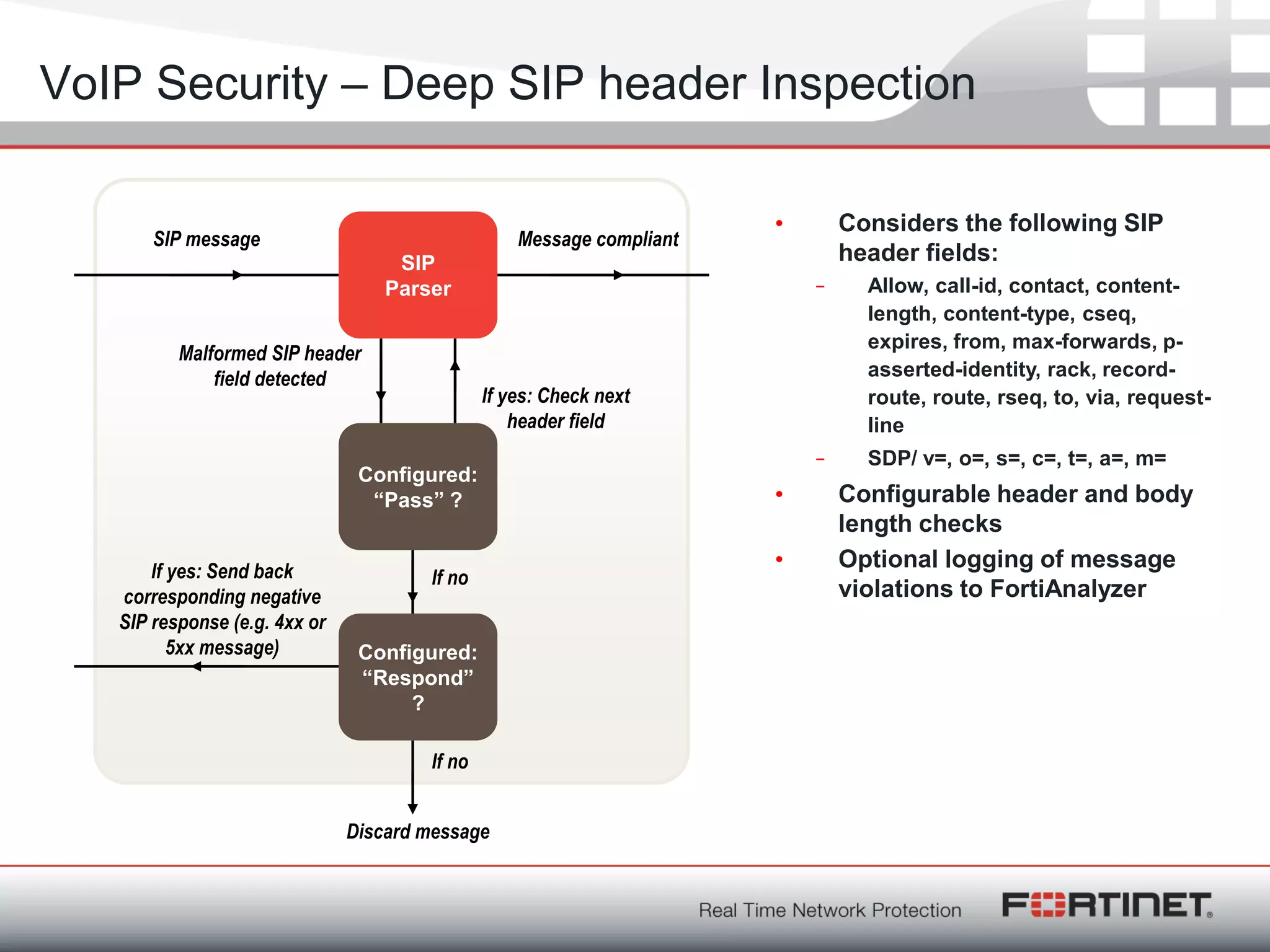
VoIP Security – Deep SIP header Inspection
FortiCarrier
Active
Blade
SIP message
Malformed SIP header
field detected
If yes: Check next
header field
If yes: Send back
corresponding negative
SIP response (e.g. 4xx or
5xx message)
If no
Discard message
Message compliant
• Considers the following SIP
header fields:
– Allow, call-id, contact, content-
length, content-type, cseq,
expires, from, max-forwards, p-
asserted-identity, rack, record-
route, route, rseq, to, via, request-
line
– SDP/ v=, o=, s=, c=, t=, a=, m=
• Configurable header and body
length checks
• Optional logging of message
violations to FortiAnalyzer
SIP
Parser
Configured:
“Pass” ?
Configured:
“Respond”
?
If no
Fortinet ConfidentialFortinet Confidential
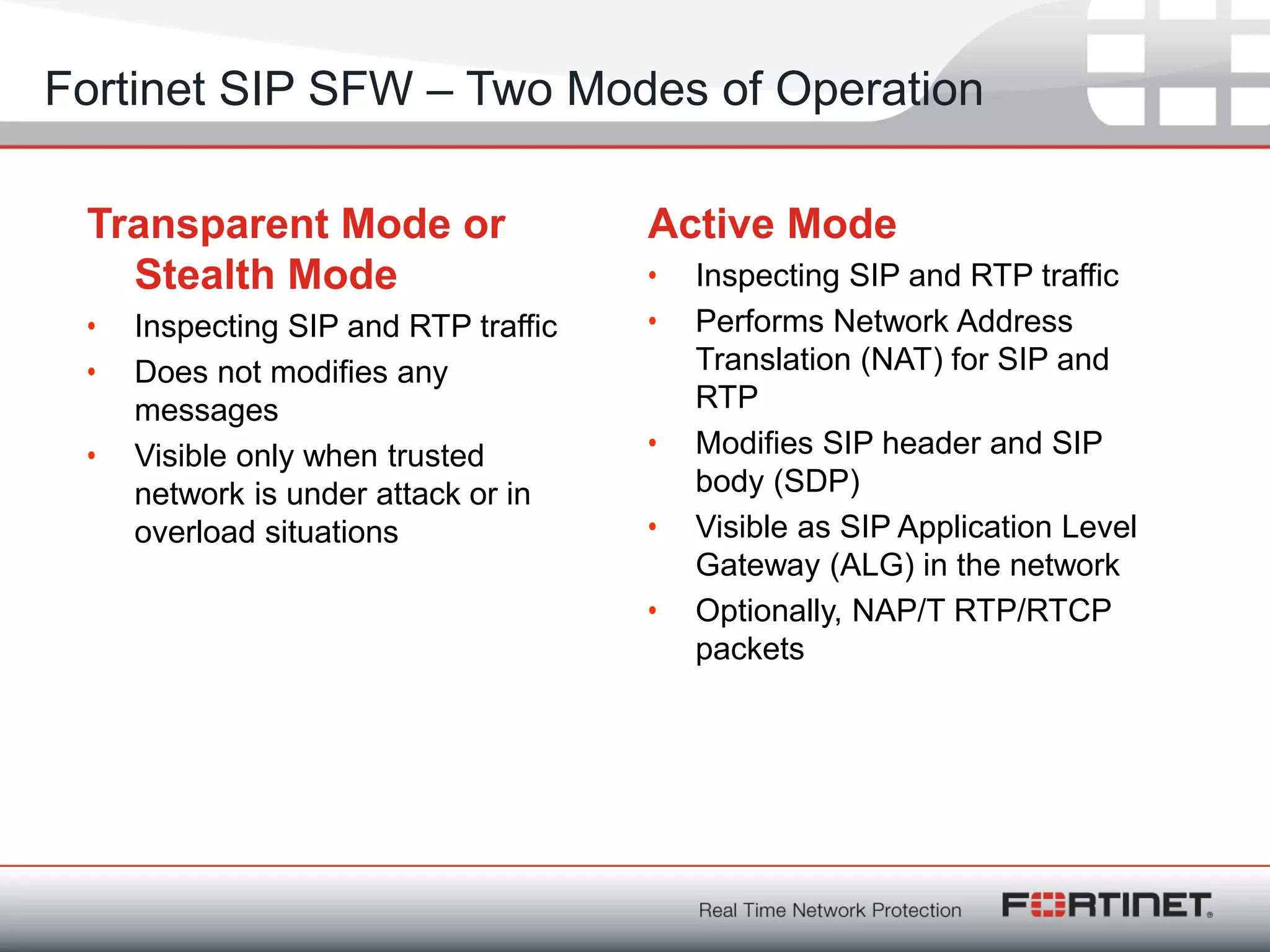
Transparent Mode or
Stealth Mode
• Inspecting SIP and RTP traffic
• Does not modifies any
messages
• Visible only when trusted
network is under attack or in
overload situations
Active Mode
• Inspecting SIP and RTP traffic
• Performs Network Address
Translation (NAT) for SIP and
RTP
• Modifies SIP header and SIP
body (SDP)
• Visible as SIP Application Level
Gateway (ALG) in the network
• Optionally, NAP/T RTP/RTCP
packets
Fortinet SIP SFW – Two Modes of Operation
Fortinet ConfidentialFortinet Confidential
IP network address translation
• SIP NAT
• IP network topology hiding
• Mapping external IP addresses
with internal IP address ranges
• Resolves overlapping IP
address between external
and internal networks
Media Handling
• Pin-holing of RTP/RTCP
• (Police RTP/RTCP traffic)
• Open and close pin-holes
from SIP context
• Hardware acceleration
• Line rate performance
• 5 micro seconds latency
Fortinet SIP SFW – Signaling and Media
Fortinet ConfidentialFortinet Confidential
SIP
Signalling
Firewall
SIP
Session
Manager /
X-CSCF
RTP
Border
Gateway
SIP SIP
Pinhole
Control
(e.g. IMS Ia-
Profile)
RTP/RTCP RTP/RTCP
SIP
RTP/RTCP
Untrusted
Network
Interface
Trusted
Network
Interface
SIP
Signalling
Firewall
SIP
Session
Manager /
X-CSCF
RTP
Border
Gateway
SIP SIP
RTP/RTCP
SIP
RTP/
RTCP
Untrusted
Network
Interface
Trusted
Network
Interface
RTP/RTCP
Pinholing
System
internal
/w RTP bypass /w RTP pinholing
RTP/
RTCP
SIP SFW Applications
Fortinet ConfidentialFortinet Confidential
Thank You

PLNOG 5: Rainer Baeder - Fortinet Overview, Fortinet VoIP Security

  • 1.
    Fortinet ConfidentialFortinet Confidential November3, 2010 Fortinet Overview Fortinet VoIP Security Rainer Baeder 08-10-2010
  • 2.
    Fortinet ConfidentialFortinet Confidential FortinetOverview Market-Leading Provider of End-to-End IT Security Solutions Company Stats • Founded in 2000 • Silicon Valley-based, strong global presence with 32+ offices worldwide • $212M+ in revenues (2008) • Seasoned and proven executive management team • 1,250+ employees / 750+ engineers • 550,000+ FortiGate devices shipped worldwide Innovative, Best-in-Class Technologies and Products • Six ICSA certifications (Firewall, AV, IPS, IPSec VPN, SSL VPN, Anti-Spam) • Strong IP portfolio – 20+ patents; 80+ pending • Government Certifications (FIPS-2, Common Criteria EAL4+, NIST) • Consistent Antivirus Validation – (Virus Bulletin 100 approved; 2005, 2006, 2007, 2008)
  • 3.
    Fortinet ConfidentialFortinet Confidential Stillnot relevant to you ?? Cyberwarfare: VoIP and Convergence Increase Vulnerability David L. Fraley By 2005, the United States and other nations will have the ability to conduct cyberwarfare. The increasing use of Voice over IP and the converging of voice/data networks is facilitating it. The U.S. military complex continues work on Presidential Directive 16, including developing the rules and tools. The United States is not the only government thinking about cyberattacks. In the second quarter of 1995, Major General Wang Pufeng of The Chinese Army published a paper, ―The Challenge of Information Warfare.‖ In this paper, Pufeng writes that the information era will touch off a revolution in military affairs. The aspects of cyberwarfare have been considered for years. Future cyberattacks could constitute an entire war or an attack type as part of a larger campaign. Cyberwarfare, like any military operation, has two components — offensive and defensive operations.
  • 4.
    Fortinet ConfidentialFortinet Confidential PhonyPhone Calls Distract Consumers from Genuine Theft TDoS - FBI and Partners Warn Public • NEWARK, NJ—Have you recently received a large number of strange and unexplained calls on your mobile or landline telephones? The FBI is warning consumers about a new scheme that uses telecommunications denial-of-service attacks as a diversion to what is really happening: the looting of bank and online trading accounts. • The Scheme – The scheme is known as telephony denial-of–service (TDOS) and according to several telecommunications companies working with the FBI, there has been a recent surge of these attacks in the past few weeks. The perpetrators are suspected of using automated dialing programs and multiple accounts to overwhelm the land and cell phone lines of their victims with thousands of calls. When the calls are answered, the victim may hear anything from dead air (nothing on the other end), an innocuous recorded message, an advertisement, or even a telephone sex menu. The calls are typically short in duration but so numerous that victims have had to have their numbers changed to make the calls stop……. http://newark.fbi.gov/pressrel/pressrel10/nk051110.htm
  • 5.
    Fortinet ConfidentialFortinet Confidential CloudAttacking • Amazon EC2 - Amazon Elastic Compute Cloud – Complaints of rampant SIP Brute Force Attacks coming from servers with Amazon EC2 IP Addresses cause many admins to simply drop all Amazon EC2 traffic. Generally, SIP brute force attacks attempt to register various peer names to a system and/or attempt to guess passwords of known/guesses peers or endpoints. – The complaints mentioned this weekend show an excessive amount of traffic; with some providers claiming 6GB of traffic dedicated to such attacks. Since we ourselves received an attack from an Amazon hosted server, we also reported and complained to the Amazon NOC/Abuse depts
  • 6.
    Fortinet ConfidentialFortinet Confidential TheSIP messages REGISTER sip:[...] SIP/2.0 Via: SIP/2.0/UDP 10.242.91.15:5182; branch=z9hG4bK-2528031440;rport Content-Length: 0 From: "2011" <sip:2011@[...]> Accept: application/sdp User-Agent: friendly-scanner To: "2011" <sip:2011@[...]> Contact: sip:123@1.1.1.1 CSeq: 1 REGISTER Call-ID: 3361196543 Max-Forwards: 70 ["AF_INET", 5182, "ec2-174-129-137-135.compute-1.amazonaws.com", "174.129.137.135"] REGISTER sip:[...] SIP/2.0 Via: SIP/2.0/UDP 10.242.91.15:5209;branch=z9hG4bK-1678605574;rport Content-Length: 0 From: "2011" <sip:2011@[...]> Accept: application/sdp User-Agent: friendly-scanner To: "2011" <sip:2011@[...]> Contact: sip:123@1.1.1.1 CSeq: 1 REGISTER Call-ID: 1992838843 Max-Forwards: 70 ["AF_INET", 5209, "ec2-174-129-137-135.compute-1.amazonaws.com", "174.129.137.135"] constant = signature !!!
  • 7.
    Fortinet ConfidentialFortinet Confidential •Fortinet‘s IPS is SIP aware – SIP decode is available • Allows attack prevention and detection with a signature database. • Signature updates available from Fortinet‘s FortiGuard service with a very short response time. • Customer signatures allow service personell to write their own prevention or detection rules – Could be used for the quickest reaction to a sudden security threat • SIP aware IPS customer signature example from a customer: – F-SBID( --name "SIP.Proxy.Require.Header.Buffer.Overflow"; --protocol udp; --service SIP; --flow from_client; --pattern "OPTIONS|20|sip|3a|"; --no_case; --context uri; --within 12,context; --pattern "Proxy-Require|3a 20|"; --no_case; --distance 8; --within 500; --context header; --pattern !"|0a|"; -- within_abs 500; ) – This signature blocks OPTION messages with a “Proxy-Require” field. IPS – Intrusion Prevent and Detection
  • 8.
    Fortinet ConfidentialFortinet Confidential VoIPBlacklist Project • 2010-09-20 10:08:06 NOTICE[14155] chan_sip.c: Registration from '"3147172873"<sip:3147172873@208.51.xxx.xxx>' failed for '206.71.179.32' - Username/auth name mismatch • 2010-09-20 10:08:06 NOTICE[14155] chan_sip.c: Registration from '"thomas"<sip:thomas@208.51.xxx.xxx>' failed for '206.71.179.32' - Username/auth name mismatch • 2010-09-20 10:08:06 NOTICE[14155] chan_sip.c: Registration from '"arsenal"<sip:arsenal@208.51.xxx.xxx>' failed for '206.71.179.32' - Username/auth name mismatch • 2010-09-20 10:08:06 NOTICE[14155] chan_sip.c: Registration from '"monkey"<sip:monkey@208.51.xxx.xxx>' failed for '206.71.179.32' - Username/auth name mismatch • 2010-09-20 10:08:06 NOTICE[14155] chan_sip.c: Registration from '"charlie"<sip:charlie@208.51.xxx.xxx>' failed for '206.71.179.32' - Username/auth name mismatch • ....... • and a couple 100 thousand more like this http://www.infiltrated.net/voipabuse/logs/americanis.txt.gz
  • 9.
  • 10.
    Fortinet ConfidentialFortinet Confidential SPIT(SPAM over Internet Telephony) B Bob Attacker • Penetration with Ads or other UC (Unsolicited Communication) • SPAM is well known to everybody using email • Up to 80% of all emails are SPAM – Depending on how long you use the mail account already • Why should it be different with VoIP • Today mainly unknown ... • With the SPAM knowledge of the FortiMail Fortinet is best positioned to extend the VoIP Security with upcoming major threats of SPIT Attacker B Bob Attacker A Alice
  • 11.
    Fortinet ConfidentialFortinet Confidential HackingVoIP for Scrippy Kids Example of detailled hacking is described Enumerating SIP Devices on a Network Here‘s how to enumerate SIP devices on a network, step by step: 1. Download Nmap from http://insecure.org/nmap/. 2. Enter nmap on the command line (Windows) or shell (Unix) to retrieve the syntax of the tool. 3. Enter the following nmap command on the command line/shell to enumerate SIP User Agents and other intermediate devices. nmap.exe -sU -p 5060 IP Address Range 4. Or, for a class B network address range on a 172.16.0.0 network, enter: nmap.exe -sU -p 5060 172.16.0.0/16 5. Each IP address that shows open for the STATE (as shown in Figure 2- 2) is probably a SIP device. As you can see in Figure 2-2, the addresses 172.16.1.109 and 172.16.1.244 are probably SIP devices. etc C:Documents and SettingsrbaiderMy DocumentsBooksAufräumenHac_VoIP.chm
  • 12.
    Fortinet ConfidentialFortinet Confidential HackingVoIP for Scrippy Kids Example of detailled hacking is described Attack – UDP Flooding Attacks Protocol (UDP) flooding is a preferred type of bandwidth flooding attack because UDP source addresses can be easily spoofed by the attacker. Spoofing often allows an attacker the ability to manipulate trust relationships within an organization to bypass firewalls and other filter devices (for example, by crafting a DoS stream to appear as a DNS response over UDP port 53). Almost all SIP-capable devices support UDP, which makes it an effective choice of attack transport. Many VoIP devices and operating systems can be crippled if a raw UDP packet flood is aimed at the listening SIP port (5060) or even at random ports. Companion Web Site Check out our website at http://www.hackingvoip.com for our udpflood tool. There are a variety of other UDP flooding tools freely available for download from the following sites to test the susceptibility of your applications and network: http://www.foundstone.com/resources/freetooldownload.htm?file=udpfl ood.zip http://packetstormsecurity.org/exploits/DoS/C:Documents and SettingsrbaiderMy DocumentsBooksAufräumenMcGraw.Hill.Hacking.Exposed.VoIP.Voice.Over.IP.Se curity.Secrets.&.Solutions.chm
  • 13.
    Fortinet ConfidentialFortinet Confidential Malwareon Mobile Phones • How does Malware get on Mobile Phones ?? Bluetooth Applications USB SW Updates WLAN email Internet
  • 14.
    Fortinet ConfidentialFortinet Confidential RFC3261 - the VoIP RFC Watch The following graphs illustrate the enormus growing rate of RFCs which are related to SIP or VoIP in general. www.rfc3261.net They are regularly (once a week) updated automatically. Thanks to Dr. Christian Stredicke who wrote the very first version of the scripts
  • 15.
    Fortinet ConfidentialFortinet Confidential VoIP& UC Technology and its Complexity IM Server Operating Systems Mobile Internet IM Server IVR Voice Mail PSTN Gateways App ServerWeb Server FirewallsE-Mail Server IP-PBX LAN WAN Road Warriors Remote Worker Laptops Desktop Directory Server Social Networks Database Systems Skype Share Point SIP Trunking Presence Server Soft Phones Hard Phones Policy Administration Security
  • 16.
    Fortinet ConfidentialFortinet Confidential VoIPProtection Features Summary • Stateful SIP tracking • The SIP SFW tracks the SIP session over it‗s lifespan. A SIP-Session (or SIP dialog) normally is established after the SIP INVITE procedure. The SIP SFW then tracks this call as a „SIP session―. A Session can for instance end by regular BYE procedure (users hang-off the phone) or by another unexpected Signaling or Transport event. • SIP per request method message rate limitation • Configurable threshold for SIP message rates per request method. Protects SIP servers from SIP overload and DoS attacks. • SIP High Availability (HA) • Allows to configure HA configuration (active-standby) for SIP. Supports failover of SIP sessions in case of an active firewall instance fails. • SIP NAT • Various NAT policies can be defined for SIP signal sessions and RTP sessions that are negotiated through the SIP signal session. • RTP Pinholing • The SIP SFW opens the respective RTP Ports as long as the SIP session is alive and conforming with the operator security policies. • RTP Bypass • Supports configurations with and without RTP pin-holing. May inspect and protect SIP signaling only. • SIP NAT with IP address conservation • Performs SIP and RTP aware IP Network Address translation. Preserves the lost IP address information in the SIP/SDP info header for later processing/debugging in the SIP server. • SIP Transparent or NAT mode • The SFW supports a transparent mode, where SIP messages are inspected but not modified. Just in case of an attack or overload the SFW becomes visible. The other mode is SIP NAT. In this mode, the SIP header is modified with regard to translation of IP addresses. • Support for Geographical Redundancy • Maintains a active-standby SIP server configuration, which even supports geographical distribution. If the active SIP server fails (missing SIP heartbeat messages or SIP traffic) FortiOS will redirect the SIP traffic to a secondary SIP server. • SIP command control • The SIP SFW can block SIP methods. SIP methods that can be blocked are: ack, bye, cancel, info, invite, notify, options, publish, refer, register, subscribe, update and „unknown commands―. • SIP communication logging • The SIP SFW supports logging to a FortiAnalyzer. The Logfiles will show up in the „Content Archive― section under the VoIP Tab. • Hardware accelerated RTP processing • In cases where RTP is pin-holed by a FortiOS Carrier™ device, it needs to be understood that RTP packets can be very small (around 100bytes or less), sensitive to processing latency, packet loss or jitter (packet delay variation). FortiGate devices can offload RTP packet processing to HW assistance (FortiASIC). This will greatly enhance the overall throughput and will give the firewall device a multiple GE wirespeed (1 Gbps) VoIP security solution. • Media Inactivity • In some case SIP signaling is established, but the voice bearer (RTP) is broken. The SIP SFW supports optionally the detection of Media Inactivity that cleans the SIP call context in the SFW once there‗s no RTP anymore for a specific time. • SIP over IPv6 • Supports Signaling Firewall for SIP messages using IPv6 transport. Limited to SIP over IPv6 in SIP transparent mode (no SIP/RTP NAT of IPv6 to IPv4) • IP Topology Hiding • IP topology of a network can be hidden through NAT and NAPT manipulation of IP and SIP level addressing. • Deep SIP header inspection • Deep SIP header syntax inspection. Prevents from many SIP Fuzzing attacks with malformed SIP message headers. User configurable bypass and response message options. SIP conformance violations can be logged with the FortiAnalyzer. • Hosted NAT traversal • Resolves IP address issue in SIP-SDP header due to NAT-PT in far end firewall. Important feature for VoIP access networks.
  • 17.
    Fortinet ConfidentialFortinet Confidential Load t Load t Badtraffic Good traffic Ingress Egress Normal Load Max. Server Load Max. SFW Load Normal Load Max. Server Load Max. SFW Load  Expected counter action  Detect malicious packets and discard them  Prevent the SIP server from DoS related traffic  Do not impact the transport of “good messages”  Provide “blacklisting” of malicious IP sources  DoS attack may consist of  SIP flooding attack (sending 10,000s of messages per second)  Packet storms  Flooding with malformed packets.  Flooding with spoofed identities of random IP addresses  L3-4 Dos attacks (e.g. TCP Sync attacks, etc)  Distributed DoS (e.g from botnets) Good traffic Expected DoS Protection
  • 18.
    Fortinet ConfidentialFortinet Confidential Load t Goodtraffic Overload Protection  Throttle SIP messages to specified limits of the corresponding SIP server  Requires discard of good SIP messages  Therefore discard with a drop precedence  Start with SIP messages of low importance, then higher ones.  Maintain existing SIP dialogs at highest priority  Allow server specific message throttling with a per SIP method rate limitation Ingress Normal Load Max. Server Load Max. SFW Load Load t Good traffic Egress Normal Load Max. Server Load Max. SFW Load Expected Overload Protection
  • 19.
    Fortinet ConfidentialFortinet Confidential VoIPSecurity – Per Method Rate Limitation • SIP message rate limitation • Individually configurable per SIP method • When threshold is hit additional messages with this method will be discarded • Prevents SIP server from getting overloaded by flash crowds or Denial-of-Service attacks. • May block some methods at all (with extra “block” option) • Can be disabled (unlimited rate) SIP INVITE REGISTER SUBSCRIBE NOTIFY REFER UPDATE OPTIONS MESSAGE ACK PRACK INFO SIP
  • 20.
    Fortinet ConfidentialFortinet Confidential SIPFuzzing attacks  Buffer overflows  Format String vulnerability  Integer Overflow  Endless loops and logical errors  Packet Fragmentation  Firmware vulnerability  Often, VoIP Fuzzing is combined with DoS Expected Counter Measurement  Detect malicious messages  Discard them or  Replace the dangerous fields VoIP Fuzzing
  • 21.
    Fortinet ConfidentialFortinet Confidential VirtualDomains • SIP SFW policies configurable per Virtual Domain (VDOM) • Allows individual configuration per external VoIP network interface • Overlapping address space within the same hardware platform • Multiple Public/Private peers Virtualization Interface Route Table State Table Proxies IPS Interface Route Table State Table Proxies IPS Interface Route Table State Table Proxies IPS Interface Route Table State Table Proxies IPS Interface Route Table State Table Proxies IPS Root Domain VDOM-1 VDOM-2 VDOM-3 VDOM-n . . . Up to 500 VDOMs supported per physical FortiCarrier device (250 VDOMs Max when using full UTM) MOBILE SECURITY MANAGED SECURITY VOICE SECURITY
  • 22.
    Fortinet ConfidentialFortinet Confidential ThankYou Where can I ask questions ? Behind this door
  • 23.
  • 24.
    Fortinet ConfidentialFortinet Confidential VoIPProtection Features FOS 4 MR1 VoIP Features in FortiOS Carrier 4.0 MR1 Stateful SIP tracking The SIP SFW tracks the SIP session over it‗s lifespan. A SIP-Session (or SIP dialog) normally is established after the SIP INVITE procedure. The SIP SFW then tracks this call as a „SIP session―. A Session can for instance end by regular BYE procedure (users hang-off the phone) or by another unexpected Signaling or Transport event. SIP per request method message rate limitation Configurable threshold for SIP message rates per request method. Protects SIP servers from SIP overload and DoS attacks. SIP High Availability (HA) Allows to configure HA configuration (active- standby) for SIP. Supports failover of SIP sessions in case of an active firewall instance fails. SIP NAT Various NAT policies can be defined for SIP signal sessions and RTP sessions that are negotiated through the SIP signal session. RTP Pinholing The SIP SFW opens the respective RTP Ports as long as the SIP session is alive and conforming with the operator security policies.
  • 25.
    Fortinet ConfidentialFortinet Confidential VoIPProtection Features FOS 4 MR1 VoIP Features in FortiOS Carrier 4.0 MR1 RTP Bypass Supports configurations with and without RTP pin- holing. May inspect and protect SIP signaling only. SIP NAT with IP address conservation Performs SIP and RTP aware IP Network Address translation. Preserves the lost IP address information in the SIP/SDP info header for later processing/debugging in the SIP server. SIP Transparent or NAT mode The SFW supports a transparent mode, where SIP messages are inspected but not modified. Just in case of an attack or overload the SFW becomes visible. The other mode is SIP NAT. In this mode, the SIP header is modified with regard to translation of IP addresses. Support for Geographical Redundancy Maintains a active-standby SIP server configuration, which even supports geographical distribution. If the active SIP server fails (missing SIP heartbeat messages or SIP traffic) FortiOS will redirect the SIP traffic to a secondary SIP server.
  • 26.
    Fortinet ConfidentialFortinet Confidential VoIPProtection Features FOS 4 MR1 VoIP Features in FortiOS Carrier 4.0 MR1 SIP command control The SIP SFW can block SIP methods. SIP methods that can be blocked are: ack, bye, cancel, info, invite, notify, options, publish, refer, register, subscribe, update and „unknown commands―. SIP communication logging The SIP SFW supports logging to a FortiAnalyzer. The Logfiles will show up in the „Content Archive― section under the VoIP Tab. Hardware accelerated RTP processing In cases where RTP is pin-holed by a FortiOS Carrier™ device, it needs to be understood that RTP packets can be very small (around 100bytes or less), sensitive to processing latency, packet loss or jitter (packet delay variation). FortiGate devices can offload RTP packet processing to HW assistance (FortiASIC). This will greatly enhance the overall throughput and will give the firewall device a multiple GE wirespeed (1 Gbps) VoIP security solution.
  • 27.
    Fortinet ConfidentialFortinet Confidential VoIPProtection Features FOS 4 MR1 VoIP Features in FortiOS Carrier 4.0 MR1 Media Inactivity In some case SIP signaling is established, but the voice bearer (RTP) is broken. The SIP SFW supports optionally the detection of Media Inactivity that cleans the SIP call context in the SFW once there‗s no RTP anymore for a specific time. SIP over IPv6 Supports Signaling Firewall for SIP messages using IPv6 transport. Limited to SIP over IPv6 in SIP transparent mode (no SIP/RTP NAT of IPv6 to IPv4). IP Topology Hiding IP topology of a network can be hidden through NAT and NAPT manipulation of IP and SIP level addressing.
  • 28.
    Fortinet ConfidentialFortinet Confidential •Fortinet‘s IPS is SIP aware – SIP decode is available • Allows attack prevention and detection with a signature database. • Signature updates available from Fortinet‘s FortiGuard service with a very short response time. • Customer signatures allow service personell to write their own prevention or detection rules – Could be used for the quickest reaction to a sudden security threat • SIP aware IPS customer signature example from a customer: – F-SBID( --name "SIP.Proxy.Require.Header.Buffer.Overflow"; --protocol udp; --service SIP; --flow from_client; --pattern "OPTIONS|20|sip|3a|"; --no_case; --context uri; --within 12,context; --pattern "Proxy-Require|3a 20|"; --no_case; --distance 8; --within 500; --context header; --pattern !"|0a|"; -- within_abs 500; ) – This signature blocks OPTION messages with a “Proxy-Require” field. IPS – Intrusion Prevent and Detection
  • 29.
    Fortinet ConfidentialFortinet Confidential FortinetVoIP Security – HA Configuration SIP Server ENET/VPL S Switch (1) ENET/VP LS Switch (2) ENET/VP LS Switch (1) ENET/VPL S Switch (2) FortiCarri er Active Blade FortiCarri er Standby Blade SIP Interconnect primary secondary (optional) GE GE GE GE GEGE Heart beat Floating Mac/IP Floating Mac/IP Ethernet / VPLS Switch (1) Ethernet / VPLS Switch (2) Ethernet / VPLS Switch (1) Ethernet / VPLS Switch (2) SIP Server FortiOS Active Blade FortiOS Standby Blade
  • 30.
    Fortinet ConfidentialFortinet Confidential VoIPSecurity – Geographical Redundancy SIP Server SIP Server Primary Server Secondary Server SIP Heartbeat SIP Heartbeat (SIP OPTION) SIP SIP SIP is forwarded to primary SIP Server, as long as it’s successfully sending heartbeats SIP Server SIP Server Primary Server Secondary Server SIP Heartbeat SIP SIP In the case of SIP heartbeat absence, the SFW will forward the SIP traffic to the secondary SIP Server. Failover Failover SIP Signaling Firewall SIP Signaling Firewall SIP Server SIP Server SIP Server SIP Server
  • 31.
    Fortinet ConfidentialFortinet Confidential VoIPProtection Features FOS 4 MR2 New VoIP Features in FOC and FOS 4.0 MR2 FOC to FOS SIP feature migration The enhanced SIP protection feature set of FortiOS Carrier will become available within the standard FortiOS platform. This allows to utilize a larger FortiGate product portfolio and provide more attractive entry models with the low and mid range FortiGate devices. Deep SIP header inspection Deep SIP header syntax inspection. Prevents from many SIP Fuzzing attacks with malformed SIP message headers. User configurable bypass and response message options. SIP conformance violations can be logged with the FortiAnalyzer. Hosted NAT traversal Resolves IP address issue in SIP-SDP header due to NAT-PT in far end firewall. Important feature for VoIP access networks.
  • 32.
    Fortinet ConfidentialFortinet Confidential VoIPSecurity – Deep SIP header Inspection FortiCarrier Active Blade SIP message Malformed SIP header field detected If yes: Check next header field If yes: Send back corresponding negative SIP response (e.g. 4xx or 5xx message) If no Discard message Message compliant • Considers the following SIP header fields: – Allow, call-id, contact, content- length, content-type, cseq, expires, from, max-forwards, p- asserted-identity, rack, record- route, route, rseq, to, via, request- line – SDP/ v=, o=, s=, c=, t=, a=, m= • Configurable header and body length checks • Optional logging of message violations to FortiAnalyzer SIP Parser Configured: “Pass” ? Configured: “Respond” ? If no
  • 33.
    Fortinet ConfidentialFortinet Confidential TransparentMode or Stealth Mode • Inspecting SIP and RTP traffic • Does not modifies any messages • Visible only when trusted network is under attack or in overload situations Active Mode • Inspecting SIP and RTP traffic • Performs Network Address Translation (NAT) for SIP and RTP • Modifies SIP header and SIP body (SDP) • Visible as SIP Application Level Gateway (ALG) in the network • Optionally, NAP/T RTP/RTCP packets Fortinet SIP SFW – Two Modes of Operation
  • 34.
    Fortinet ConfidentialFortinet Confidential IPnetwork address translation • SIP NAT • IP network topology hiding • Mapping external IP addresses with internal IP address ranges • Resolves overlapping IP address between external and internal networks Media Handling • Pin-holing of RTP/RTCP • (Police RTP/RTCP traffic) • Open and close pin-holes from SIP context • Hardware acceleration • Line rate performance • 5 micro seconds latency Fortinet SIP SFW – Signaling and Media
  • 35.
    Fortinet ConfidentialFortinet Confidential SIP Signalling Firewall SIP Session Manager/ X-CSCF RTP Border Gateway SIP SIP Pinhole Control (e.g. IMS Ia- Profile) RTP/RTCP RTP/RTCP SIP RTP/RTCP Untrusted Network Interface Trusted Network Interface SIP Signalling Firewall SIP Session Manager / X-CSCF RTP Border Gateway SIP SIP RTP/RTCP SIP RTP/ RTCP Untrusted Network Interface Trusted Network Interface RTP/RTCP Pinholing System internal /w RTP bypass /w RTP pinholing RTP/ RTCP SIP SFW Applications
  • 36.