
Making time for learning:
managing student workload.
Liz Norman
Director of Teaching & Learning, College of Sciences
NCTL Friday Sessions, Massey University, 9 November, 2018
How does your
course look to
students?
overflowing by zoetnet, Attribution License
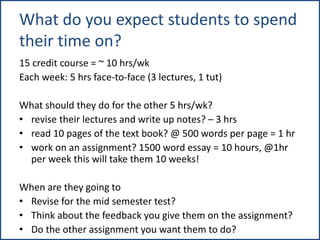
What do you expect students to spend
their time on?
15 credit course = ~ 10 hrs/wk
Each week: 5 hrs face-to-face (3 lectures, 1 tut)
What should they do for the other 5 hrs/wk?
• revise their lectures and write up notes? – 3 hrs
• read 10 pages of the text book? @ 500 words per page = 1 hr
• work on an assignment? 1500 word essay = 10 hours, @1hr
per week this will take them 10 weeks!
When are they going to
• Revise for the mid semester test?
• Think about the feedback you give them on the assignment?
• Do the other assignment you want them to do?
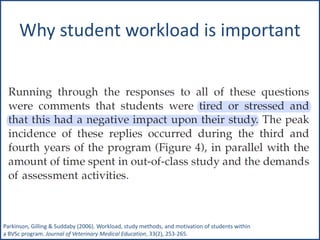
Parkinson, Gilling & Suddaby (2006). Workload, study methods, and motivation of students within
a BVSc program. Journal of Veterinary Medical Education, 33(2), 253-265.
Why student workload is important
Why student
workload is
important
excess
material
superficial
approach
lack of
connections
inability to
be selective
perception
of overload
superficial
approach
Excess material leads to
rote learning strategies
Entwistle & Ramsden (1982) Understanding student learning. Kent, UK.
Kember & Leung (1998) Influences upon students’ perceptions of workload. Educational Psychology, 18(3), 293-307
Kember & Leung (2006) Characterising a teaching and learning environment conducive to making demands on students
while not making their workload excessive. Studies in Higher Education, 31(2), 185-198
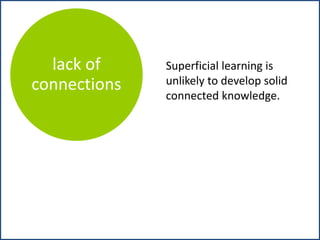
lack of
connections
Superficial learning is
unlikely to develop solid
connected knowledge.
lack of
connections
Superficial learning is
unlikely to develop solid
connected knowledge.
insufficient disconnected
disordered
connected
ordered
Biggs & Collis (1982) Evaluating the quality of learning: The SOLO taxonomy (structure of the observed learning outcome).
New York: Academic Press
inability
to be
selective
Lack of connected
knowledge leads to
difficulty identifying
relevant and irrelevant
material.
perception
of
overload
Teachers and students
may have very different
perceptions of the course
workload
perception
of
overload
Filename: Save date: 4/11/2014
excess
material
superficial
approach
lack of
connections
inability to
be selective
perception
of overload
But what about…
Studies of award
winning teachers show
that they place high
demands on students
sheep with blue ribbon
by K-State Research and Extension, Attribution Licence.
Kember & McNaught (2006) Excellent university teaching:
The Chinese University Press.
‘Good’ vs ‘bad’ workload
• Differential effect of ‘bad’ and ‘good’
workload on evaluations of teaching:
• an increase in work the student considers
valuable for learning is associated with
increased course satisfaction. (up to a point)
• an increase in work not considered valuable is
negatively related.
Marsh (2001) Distinguishing between good (useful) and bad workloads on students’ evaluations of teaching.
American Educational Research Journal, 38(1), 183-212.
‘Perceived’ vs ‘actual’ workload
Differential effect of
‘perceived’ and ‘actual’
workload
• actual workload is only a
minor contributor to
variances in perceived
workload
• we can lower the perceived
workload without reducing
the amount of work
Kember & Leung (1998) Influences upon students’ perceptions of
workload. Educational Psychology, 18(3), 293-307
Kyndt, Berghmans, Dochy & Bulckens (2013) ‘Time is not enough.’
workload in higher education: A student perspective. Higher Education
Research & Development, 33(4), 684-698.
Perception:IsitaSnakeorstick?Rosiechewing,lawn,tree,Broadview,
Seattle,Washington,USAbyWonderlane,AttributionLicense
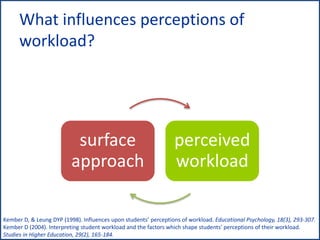
What influences perceptions of
workload?
surface
approach
perceived
workload
Kember D, & Leung DYP (1998). Influences upon students’ perceptions of workload. Educational Psychology, 18(3), 293-307.
Kember D (2004). Interpreting student workload and the factors which shape students' perceptions of their workload.
Studies in Higher Education, 29(2), 165-184.
surface
approach
perceived
workload
Biggs & Collis (1982) Evaluating the quality of learning : The SOLO taxonomy (structure of the observed learning outcome).
New York: Academic Press.
assessment
Parkinson, Gilling & Suddaby (2006). Workload, study methods, and motivation of students within a BVSc program.
Journal of Veterinary Medical Education, 33(2), 253-265.
What influences perceptions of
workload?
Complex interplay of factors including:
• Surface vs deep learning approaches by the student
• Assessment
• Motivation and interest of the student
• Time savers: clear structure, asking Qs
• Contact hours (but not independent study time)
• Projects – ‘active’ learning activities
• Student-student relationships
• Difficulty of the subject
• Concentrated deadlines
• Other stressors going on in the student’s life
• English ability
So what can we do?
1. Reduce ‘bad’ workload
2. Reduce perceptions of excessive workload
3. Reduce actual workload (and keep it evenly
spread)
Reduce ‘bad’ workload
Remove all work that is not related to learning
outcomes
– reduce ‘admin’ activities
– think of how you can make it easier for students
to find what they need
– direct them to what is important
– do the “little things” for them eg: point them to
the page in the textbook
Reduce perceived workload
1. Trim the actual workload
2. Make the work as interesting as possible – be
enthusiastic!
3. Align assessment activity with learning outcomes
4. Reduce “bad” workload
5. Provide opportunities for questions and the climate
that encourages students to ask them
6. Increase interaction
7. Use project-based work and group work (but ensure
there is enough time for it)
8. Support good peer-peer relationships
9. Space out deadlines (in relation to other courses)
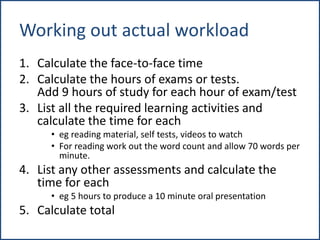
Working out actual workload
1. Calculate the face-to-face time
2. Calculate the hours of exams or tests.
Add 9 hours of study for each hour of exam/test
3. List all the required learning activities and
calculate the time for each
• eg reading material, self tests, videos to watch
• For reading work out the word count and allow 70 words per
minute.
4. List any other assessments and calculate the
time for each
• eg 5 hours to produce a 10 minute oral presentation
5. Calculate total
Some helpful metrics
Student task Time to allow
Reading time 70 words per min
Examination/Test
preparation time
9 hours per hr
of exam/test
Prep time for a 10 min
oral presentation
5 hours
Poster preparation 10 hours
1500 word assignment 10 hours
5000 word assignment 50 hours
Reduce actual workload
1. Trim content
– If we try to teach too much they won’t retain everything –
you are better at deciding what to leave out than they are.
– Think in terms of teaching skills (what students need to be
able to do) rather than content
– Think in terms of the expected knowledge and skills for the
level of that course (eg first year, second year). Remember
they will gain more knowledge, skills, and experience later
2. Reduce summative assessment
– keep it to 3 or fewer occasions per 15 credit course.
– 3 per 15 credit course = 12 per semester, 8 of which occur
during the 12 weeks of semester, most during the last 6
weeks.
Reduce actual workload
3. Align learning activities with assessment
activities
– Ensure that what you have them do to learn, is
also preparing them for what you need them to
do to be assessed.
– This does not necessarily mean that learning
activities are also used for assessment but could
do).
– Show them how these learning activities link to
assessment activities
Reduce actual workload
4. Provide clear direction about what we want
students to spend time on and how much
time we want them to spend and how it will
help them do the assessments
– Clear instructions, organised materials, lecture
slides, Stream sites
– Remove optional materials – don’t fall into the
learning styles trap (the false belief that students
need to learn according to their own learning
style)
– Provide exemplars for the work you expect
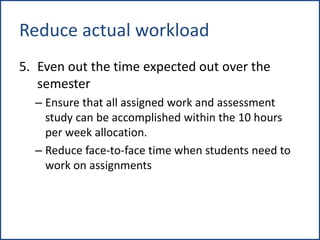
Reduce actual workload
5. Even out the time expected out over the
semester
– Ensure that all assigned work and assessment
study can be accomplished within the 10 hours
per week allocation.
– Reduce face-to-face time when students need to
work on assignments
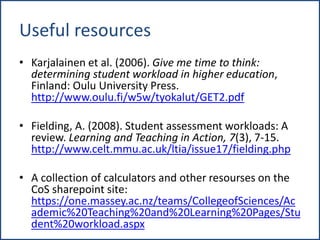
Useful resources
• Karjalainen et al. (2006). Give me time to think:
determining student workload in higher education,
Finland: Oulu University Press.
http://www.oulu.fi/w5w/tyokalut/GET2.pdf
• Fielding, A. (2008). Student assessment workloads: A
review. Learning and Teaching in Action, 7(3), 7-15.
http://www.celt.mmu.ac.uk/ltia/issue17/fielding.php
• A collection of calculators and other resourses on the
CoS sharepoint site:
https://one.massey.ac.nz/teams/CollegeofSciences/Ac
ademic%20Teaching%20and%20Learning%20Pages/Stu
dent%20workload.aspx
Liz’s presentations
http://www.slideshare.net/liznorman

Making time for learning: managing student workload

  • 1.
    Making time forlearning: managing student workload. Liz Norman Director of Teaching & Learning, College of Sciences NCTL Friday Sessions, Massey University, 9 November, 2018
  • 2.
    How does your courselook to students? overflowing by zoetnet, Attribution License
  • 3.
    What do youexpect students to spend their time on? 15 credit course = ~ 10 hrs/wk Each week: 5 hrs face-to-face (3 lectures, 1 tut) What should they do for the other 5 hrs/wk? • revise their lectures and write up notes? – 3 hrs • read 10 pages of the text book? @ 500 words per page = 1 hr • work on an assignment? 1500 word essay = 10 hours, @1hr per week this will take them 10 weeks! When are they going to • Revise for the mid semester test? • Think about the feedback you give them on the assignment? • Do the other assignment you want them to do?
  • 4.
    Parkinson, Gilling &Suddaby (2006). Workload, study methods, and motivation of students within a BVSc program. Journal of Veterinary Medical Education, 33(2), 253-265. Why student workload is important
  • 5.
    Why student workload is important excess material superficial approach lackof connections inability to be selective perception of overload
  • 6.
    superficial approach Excess material leadsto rote learning strategies Entwistle & Ramsden (1982) Understanding student learning. Kent, UK. Kember & Leung (1998) Influences upon students’ perceptions of workload. Educational Psychology, 18(3), 293-307 Kember & Leung (2006) Characterising a teaching and learning environment conducive to making demands on students while not making their workload excessive. Studies in Higher Education, 31(2), 185-198
  • 7.
    lack of connections Superficial learningis unlikely to develop solid connected knowledge.
  • 8.
    lack of connections Superficial learningis unlikely to develop solid connected knowledge. insufficient disconnected disordered connected ordered Biggs & Collis (1982) Evaluating the quality of learning: The SOLO taxonomy (structure of the observed learning outcome). New York: Academic Press
  • 9.
    inability to be selective Lack ofconnected knowledge leads to difficulty identifying relevant and irrelevant material.
  • 10.
    perception of overload Teachers and students mayhave very different perceptions of the course workload
  • 11.
    perception of overload Filename: Save date:4/11/2014 excess material superficial approach lack of connections inability to be selective perception of overload
  • 12.
    But what about… Studiesof award winning teachers show that they place high demands on students sheep with blue ribbon by K-State Research and Extension, Attribution Licence. Kember & McNaught (2006) Excellent university teaching: The Chinese University Press.
  • 13.
    ‘Good’ vs ‘bad’workload • Differential effect of ‘bad’ and ‘good’ workload on evaluations of teaching: • an increase in work the student considers valuable for learning is associated with increased course satisfaction. (up to a point) • an increase in work not considered valuable is negatively related. Marsh (2001) Distinguishing between good (useful) and bad workloads on students’ evaluations of teaching. American Educational Research Journal, 38(1), 183-212.
  • 14.
    ‘Perceived’ vs ‘actual’workload Differential effect of ‘perceived’ and ‘actual’ workload • actual workload is only a minor contributor to variances in perceived workload • we can lower the perceived workload without reducing the amount of work Kember & Leung (1998) Influences upon students’ perceptions of workload. Educational Psychology, 18(3), 293-307 Kyndt, Berghmans, Dochy & Bulckens (2013) ‘Time is not enough.’ workload in higher education: A student perspective. Higher Education Research & Development, 33(4), 684-698. Perception:IsitaSnakeorstick?Rosiechewing,lawn,tree,Broadview, Seattle,Washington,USAbyWonderlane,AttributionLicense
  • 15.
    What influences perceptionsof workload? surface approach perceived workload Kember D, & Leung DYP (1998). Influences upon students’ perceptions of workload. Educational Psychology, 18(3), 293-307. Kember D (2004). Interpreting student workload and the factors which shape students' perceptions of their workload. Studies in Higher Education, 29(2), 165-184.
  • 16.
    surface approach perceived workload Biggs & Collis(1982) Evaluating the quality of learning : The SOLO taxonomy (structure of the observed learning outcome). New York: Academic Press. assessment
  • 17.
    Parkinson, Gilling &Suddaby (2006). Workload, study methods, and motivation of students within a BVSc program. Journal of Veterinary Medical Education, 33(2), 253-265.
  • 18.
    What influences perceptionsof workload? Complex interplay of factors including: • Surface vs deep learning approaches by the student • Assessment • Motivation and interest of the student • Time savers: clear structure, asking Qs • Contact hours (but not independent study time) • Projects – ‘active’ learning activities • Student-student relationships • Difficulty of the subject • Concentrated deadlines • Other stressors going on in the student’s life • English ability
  • 19.
    So what canwe do? 1. Reduce ‘bad’ workload 2. Reduce perceptions of excessive workload 3. Reduce actual workload (and keep it evenly spread)
  • 20.
    Reduce ‘bad’ workload Removeall work that is not related to learning outcomes – reduce ‘admin’ activities – think of how you can make it easier for students to find what they need – direct them to what is important – do the “little things” for them eg: point them to the page in the textbook
  • 21.
    Reduce perceived workload 1.Trim the actual workload 2. Make the work as interesting as possible – be enthusiastic! 3. Align assessment activity with learning outcomes 4. Reduce “bad” workload 5. Provide opportunities for questions and the climate that encourages students to ask them 6. Increase interaction 7. Use project-based work and group work (but ensure there is enough time for it) 8. Support good peer-peer relationships 9. Space out deadlines (in relation to other courses)
  • 22.
    Working out actualworkload 1. Calculate the face-to-face time 2. Calculate the hours of exams or tests. Add 9 hours of study for each hour of exam/test 3. List all the required learning activities and calculate the time for each • eg reading material, self tests, videos to watch • For reading work out the word count and allow 70 words per minute. 4. List any other assessments and calculate the time for each • eg 5 hours to produce a 10 minute oral presentation 5. Calculate total
  • 23.
    Some helpful metrics Studenttask Time to allow Reading time 70 words per min Examination/Test preparation time 9 hours per hr of exam/test Prep time for a 10 min oral presentation 5 hours Poster preparation 10 hours 1500 word assignment 10 hours 5000 word assignment 50 hours
  • 24.
    Reduce actual workload 1.Trim content – If we try to teach too much they won’t retain everything – you are better at deciding what to leave out than they are. – Think in terms of teaching skills (what students need to be able to do) rather than content – Think in terms of the expected knowledge and skills for the level of that course (eg first year, second year). Remember they will gain more knowledge, skills, and experience later 2. Reduce summative assessment – keep it to 3 or fewer occasions per 15 credit course. – 3 per 15 credit course = 12 per semester, 8 of which occur during the 12 weeks of semester, most during the last 6 weeks.
  • 25.
    Reduce actual workload 3.Align learning activities with assessment activities – Ensure that what you have them do to learn, is also preparing them for what you need them to do to be assessed. – This does not necessarily mean that learning activities are also used for assessment but could do). – Show them how these learning activities link to assessment activities
  • 26.
    Reduce actual workload 4.Provide clear direction about what we want students to spend time on and how much time we want them to spend and how it will help them do the assessments – Clear instructions, organised materials, lecture slides, Stream sites – Remove optional materials – don’t fall into the learning styles trap (the false belief that students need to learn according to their own learning style) – Provide exemplars for the work you expect
  • 27.
    Reduce actual workload 5.Even out the time expected out over the semester – Ensure that all assigned work and assessment study can be accomplished within the 10 hours per week allocation. – Reduce face-to-face time when students need to work on assignments
  • 28.
    Useful resources • Karjalainenet al. (2006). Give me time to think: determining student workload in higher education, Finland: Oulu University Press. http://www.oulu.fi/w5w/tyokalut/GET2.pdf • Fielding, A. (2008). Student assessment workloads: A review. Learning and Teaching in Action, 7(3), 7-15. http://www.celt.mmu.ac.uk/ltia/issue17/fielding.php • A collection of calculators and other resourses on the CoS sharepoint site: https://one.massey.ac.nz/teams/CollegeofSciences/Ac ademic%20Teaching%20and%20Learning%20Pages/Stu dent%20workload.aspx
  • 29.