Under s tanding Quer ies through Ent i t ies 
P e t e r M i k a , S r . R e s e a r c h S c i e n t i s t , Y a h o o L a b s ⎪ N o v e m b e r 7 , 2 0 1 4
Why Semantic Search? 
 Improvements in IR are harder and harder to come by 
› Basic relevance models are well established 
› Machine learning using hundreds of features 
› Heavy investment in computational power, e.g. real-time indexing and instant search 
 Remaining challenges are not computational, but in modeling user 
cognition 
› Need a deeper understanding of the query, the content and the relationship of the two
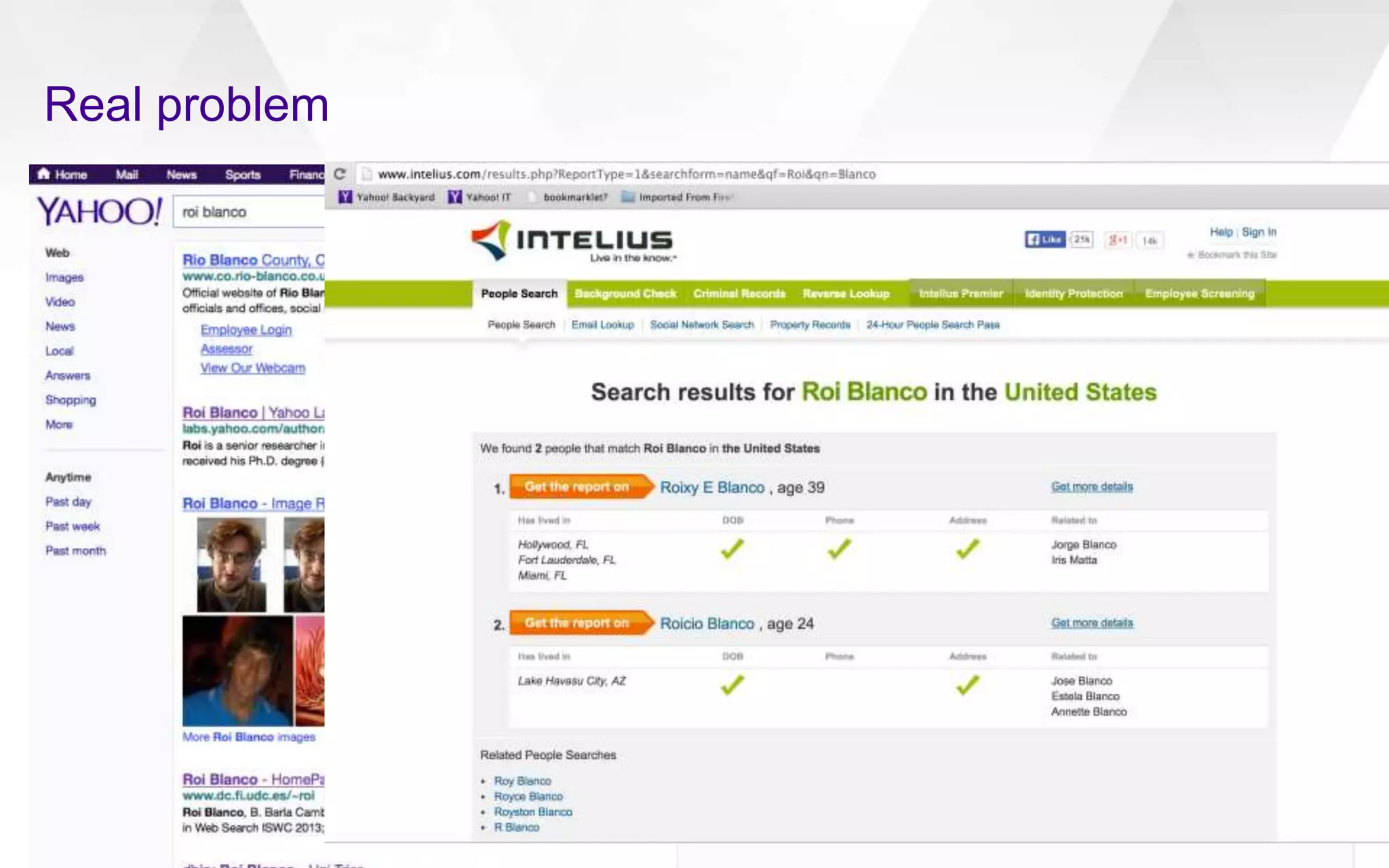
Real problem 
We found (some) Roi Blanco (maybe) 
Diversification
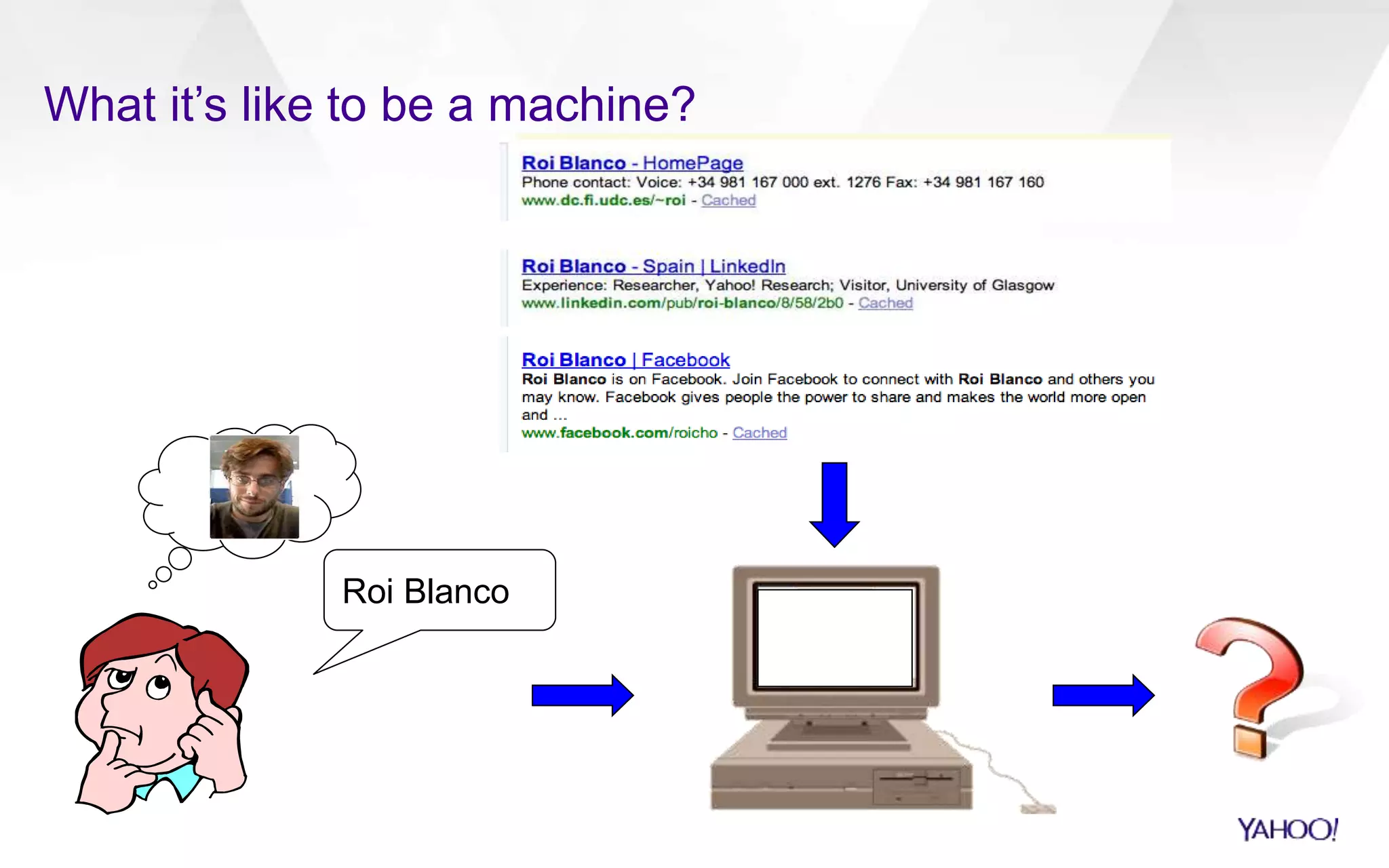
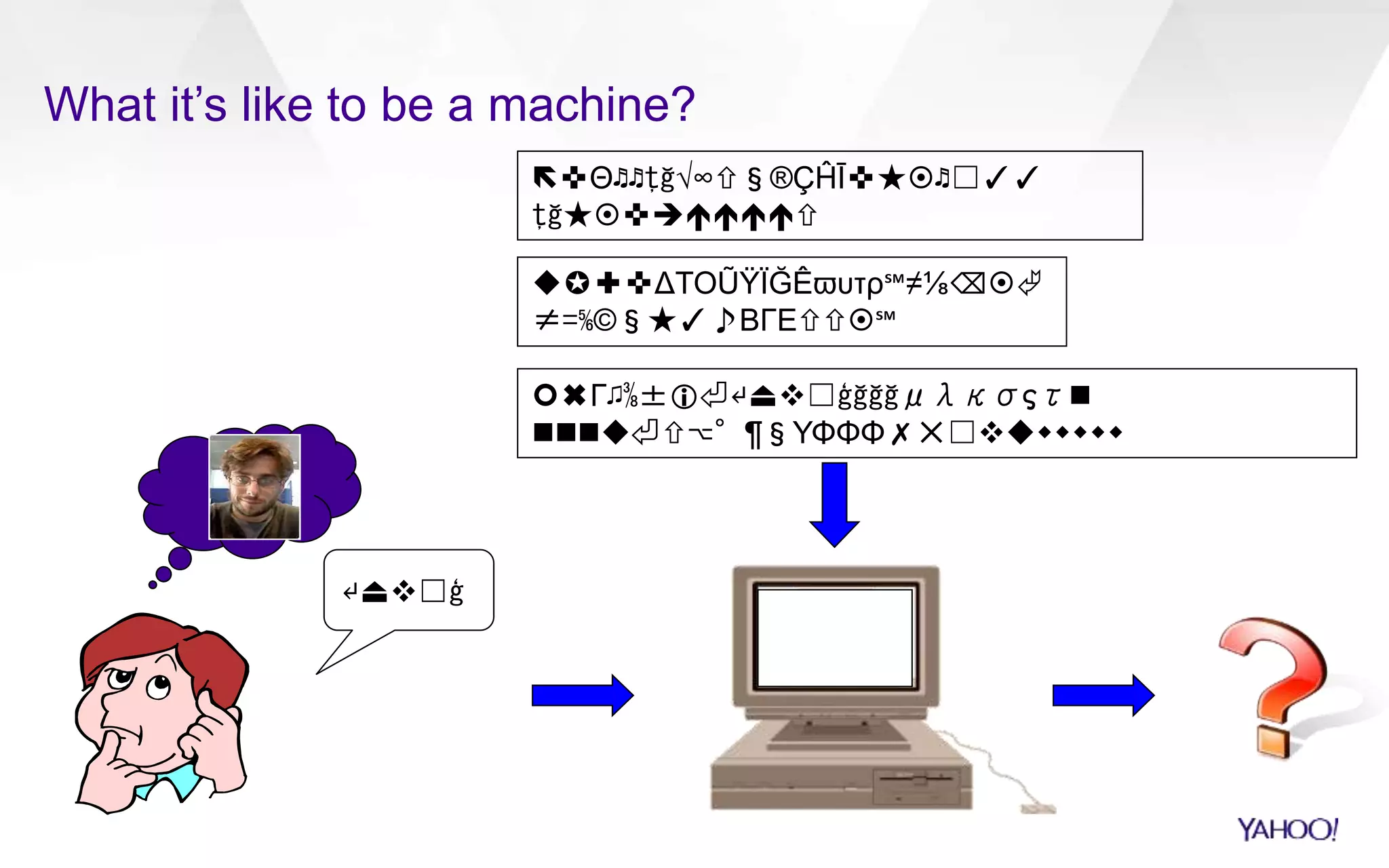
What it’s like to be a machine? 
Roi Blanco
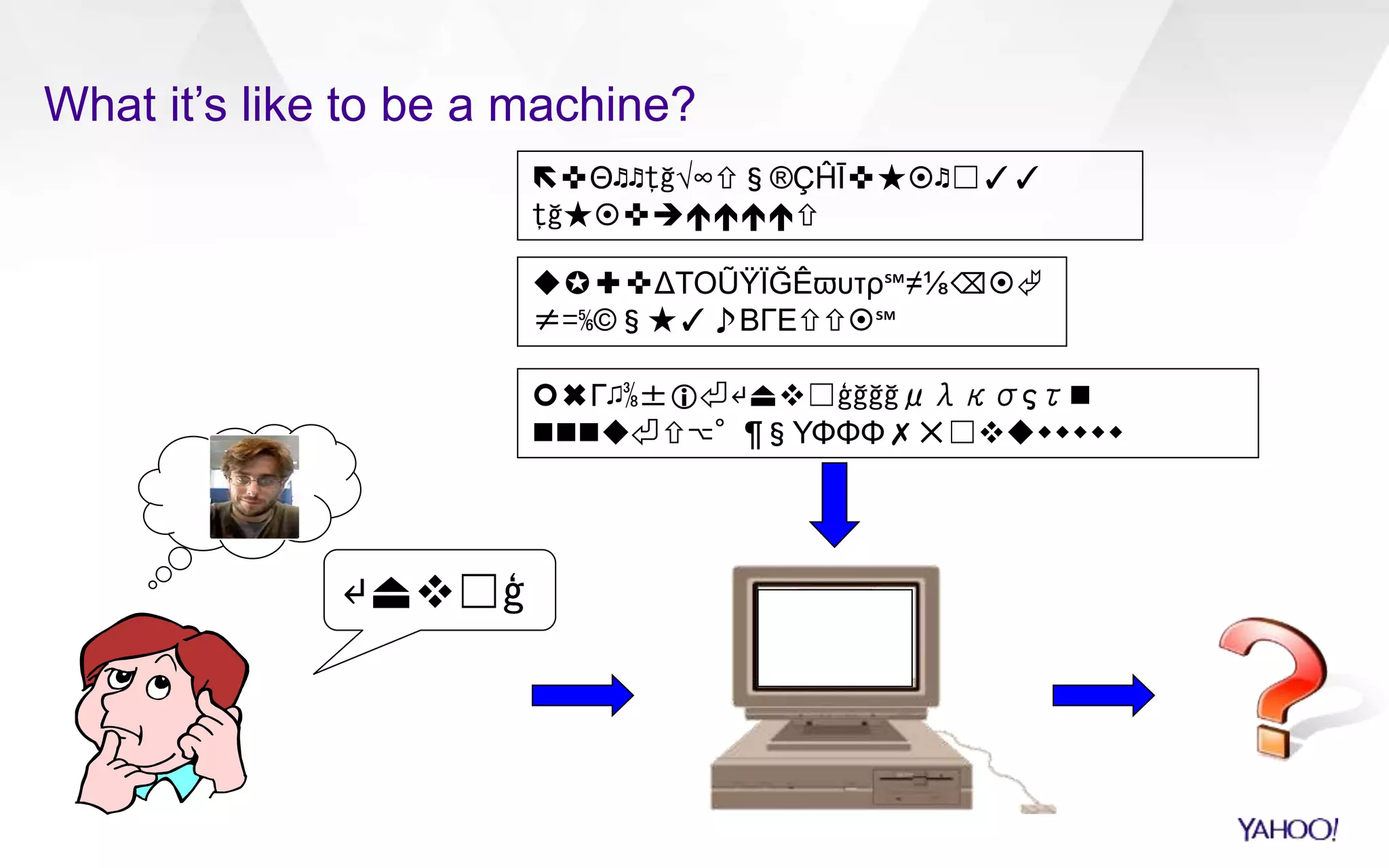
What it’s like to be a machine? 
↵⏏☐ģ 
✜Θ♬♬ţğ√∞§®ÇĤĪ✜★♬☐✓✓ 
ţğ★✜ 
✪✚✜ΔΤΟŨŸÏĞÊϖυτρ℠≠⅛⌫ 
≠=⅚©§★✓♪ΒΓΕ℠ 
✖Γ♫⅜±⏎↵⏏☐ģğğğμλκσςτ 
⏎⌥°¶§ΥΦΦΦ✗✕☐
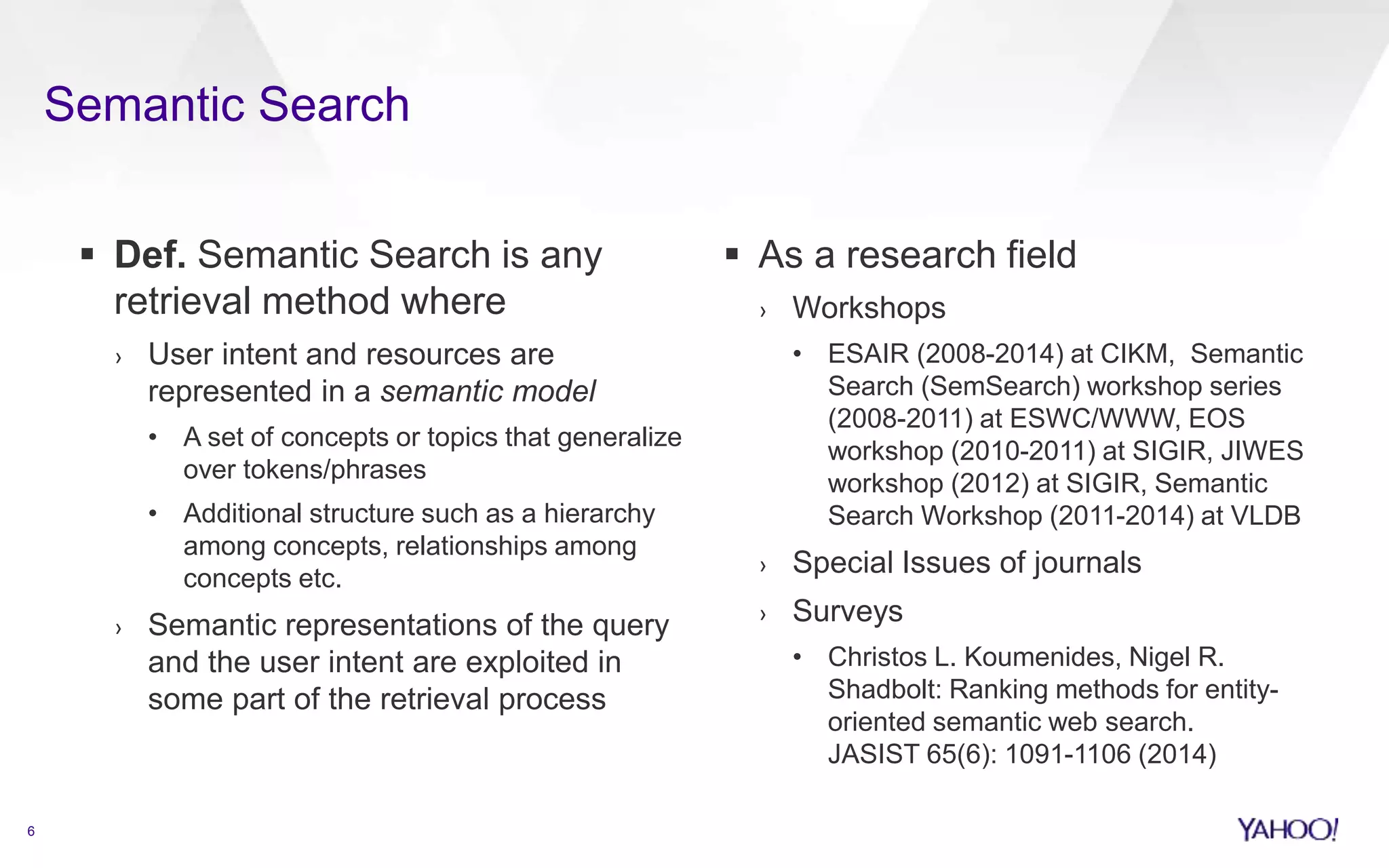
 Def. Semantic Search is any 
retrieval method where 
› User intent and resources are 
represented in a semantic model 
• A set of concepts or topics that generalize 
over tokens/phrases 
• Additional structure such as a hierarchy 
among concepts, relationships among 
concepts etc. 
› Semantic representations of the query 
and the user intent are exploited in 
some part of the retrieval process 
 As a research field 
› Workshops 
• ESAIR (2008-2014) at CIKM, Semantic 
Search (SemSearch) workshop series 
(2008-2011) at ESWC/WWW, EOS 
workshop (2010-2011) at SIGIR, JIWES 
workshop (2012) at SIGIR, Semantic 
Search Workshop (2011-2014) at VLDB 
› Special Issues of journals 
› Surveys 
• Christos L. Koumenides, Nigel R. 
Shadbolt: Ranking methods for entity-oriented 
semantic web search. 
JASIST 65(6): 1091-1106 (2014) 
6 
Semantic Search
Semantic search: implicit vs. explicit semantics 
7 
 Implicit/internal semantics 
› Models of text extracted from a corpus of queries, documents or interaction logs 
• Query reformulation, term dependency models, translation models, topic models, latent space 
models, learning to match (PLS), word embeddings 
› See 
• Hang Li and Jun Xu: Semantic Matching in Search. Foundations and Trends in Information 
Retrieval Vol 7 Issue 5, 2013, pp 343-469 
 Explicit/external semantics 
› Explicit linguistic or ontological structures extracted from text and linked to external 
knowledge 
› Obtained using IE techniques or acquired from Semantic Web markup
What it’s like to be a machine? 
↵⏏☐ģ 
✜Θ♬♬ţğ√∞§®ÇĤĪ✜★♬☐✓✓ 
ţğ★✜ 
✪✚✜ΔΤΟŨŸÏĞÊϖυτρ℠≠⅛⌫ 
≠=⅚©§★✓♪ΒΓΕ℠ 
✖Γ♫⅜±⏎↵⏏☐ģğğğμλκσςτ 
⏎⌥°¶§ΥΦΦΦ✗✕☐
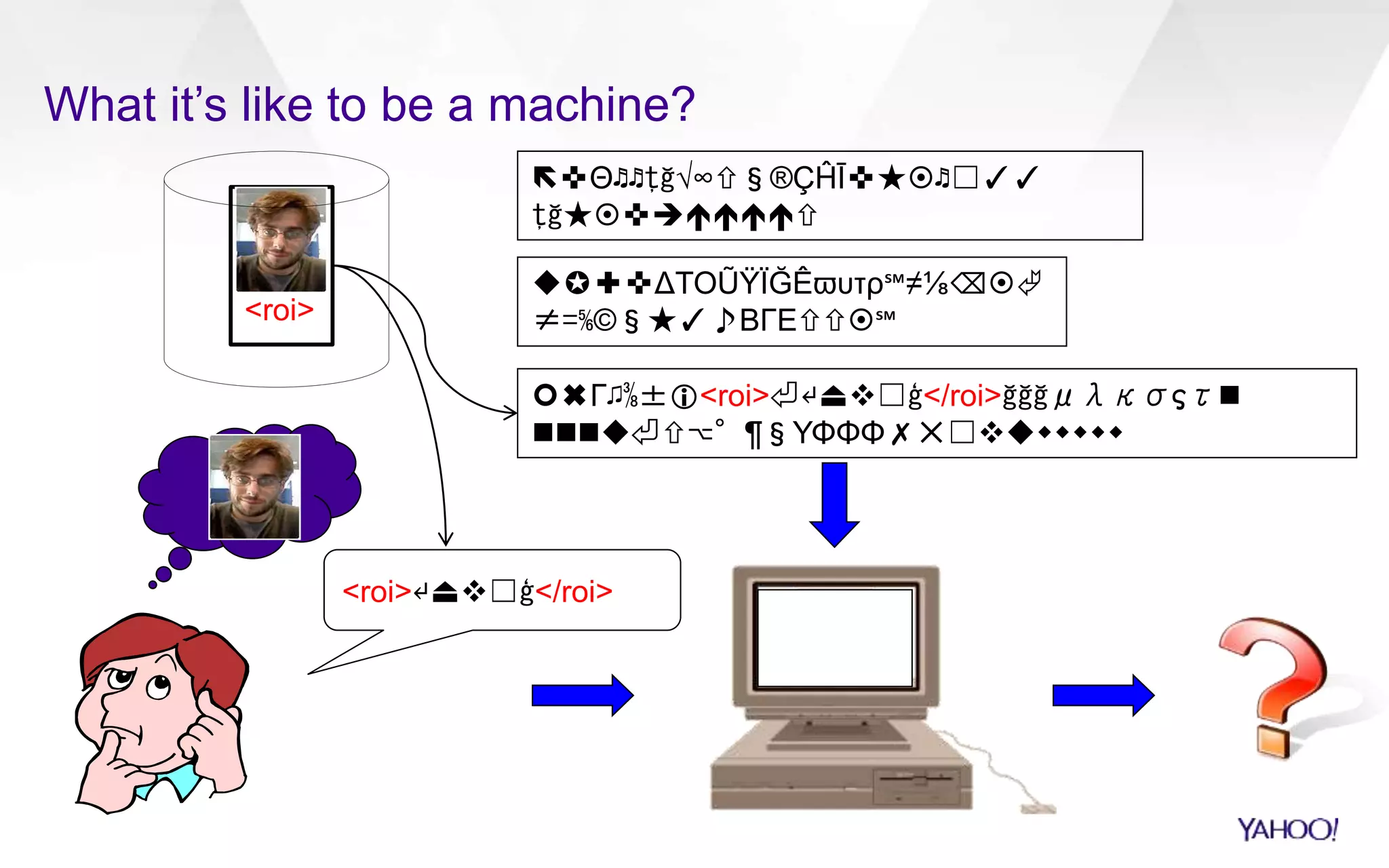
What it’s like to be a machine? 
✜Θ♬♬ţğ√∞§®ÇĤĪ✜★♬☐✓✓ 
ţğ★✜ 
✪✚✜ΔΤΟŨŸÏĞÊϖυτρ℠≠⅛⌫ 
≠=⅚©§★✓♪ΒΓΕ℠ 
✖Γ♫⅜±<roi>⏎↵⏏☐ģ</roi>ğğğμλκσςτ 
⏎⌥°¶§ΥΦΦΦ✗✕☐ 
<roi>↵⏏☐ģ</roi> 
<roi>
Semantic understanding 
10 
 Documents 
› Text in general 
• Exploiting natural language structure and semantic coherence 
› Specific to the Web 
• Exploiting structure of web pages, e.g. annotation of web tables 
 Queries 
› Short text and no structure… nothing to do?
Semantic understanding of queries 
11 
 Entities play an important role 
› [Pound et al, WWW 2010], [Lin et al WWW 2012] 
› ~70% of queries contain a named entity (entity mention queries) 
• brad pitt height 
› ~50% of queries have an entity focus (entity seeking queries) 
• brad pitt attacked by fans 
› ~10% of queries are looking for a class of entities 
• brad pitt movies 
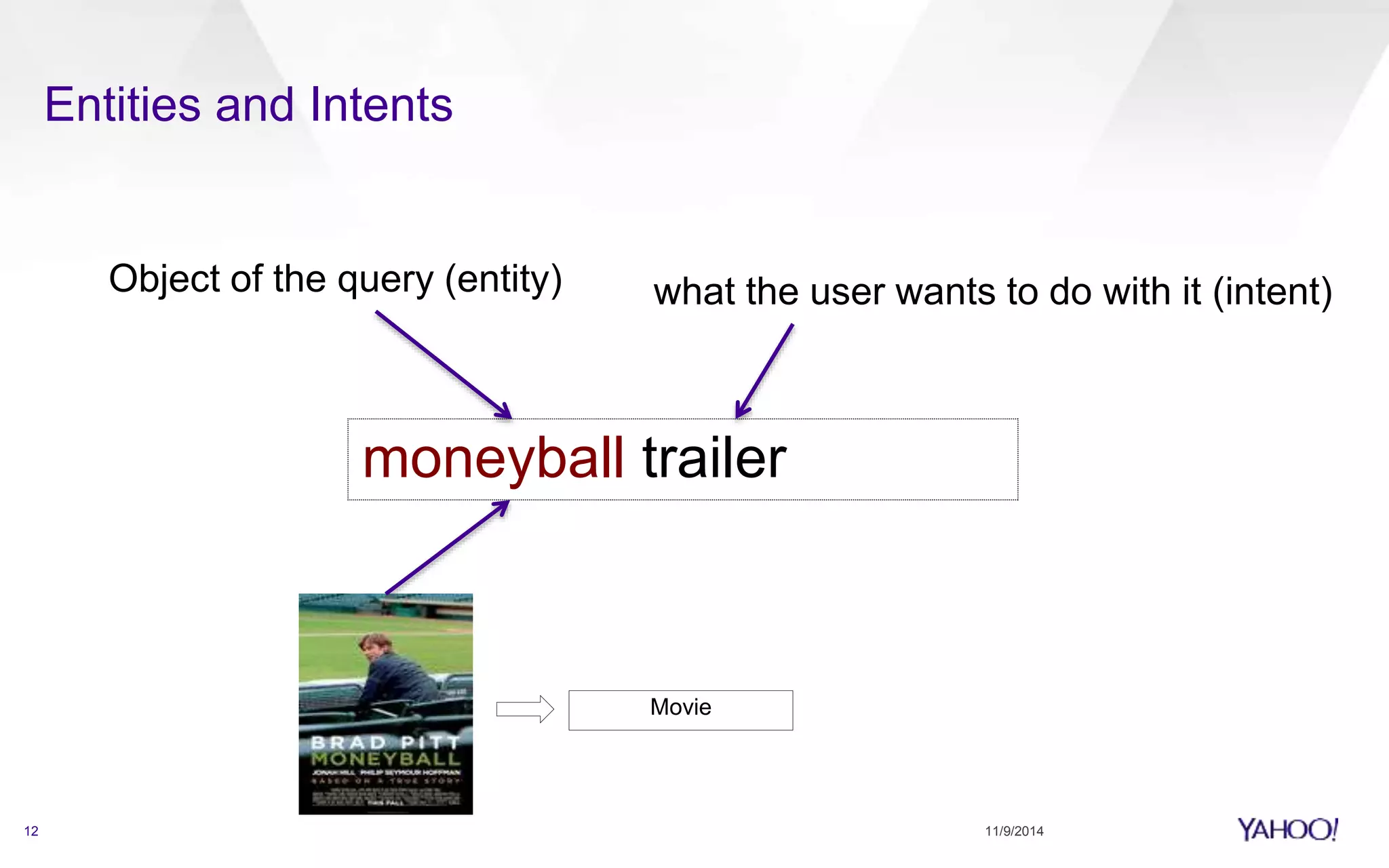
 Entity mention query = <entity> {+ <intent>} 
› Intent is typically an additional word or phrase to 
• Disambiguate, most often by type e.g. brad pitt actor 
• Specify action or aspect e.g. brad pitt net worth, toy story trailer
Entities and Intents 
what the user wants to do with it (intent) 
Object of the query (entity) 
moneyball trailer 
Movie 
12 11/9/2014
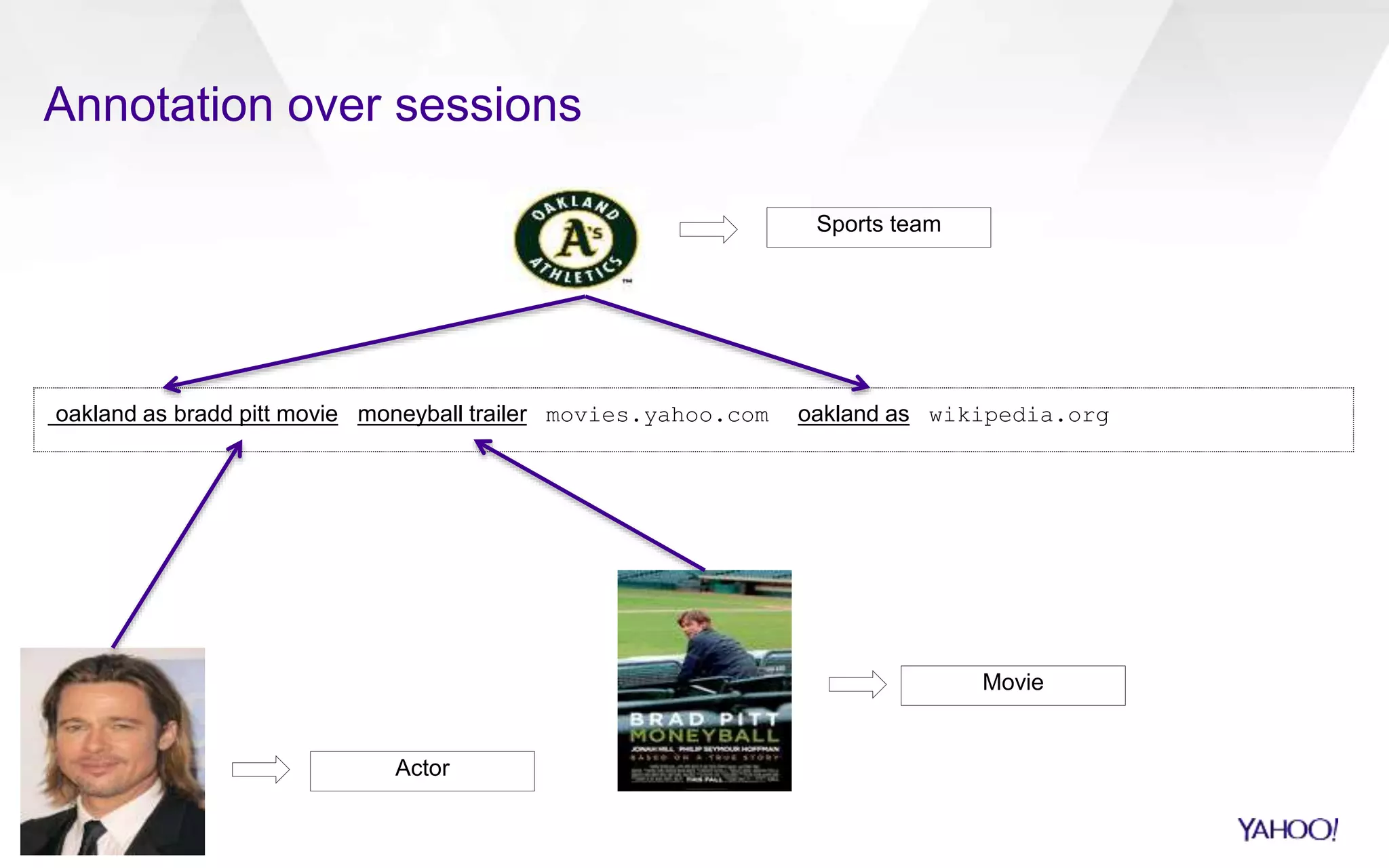
Annotation over sessions 
Sports team 
oakland as bradd pitt movie moneyball trailer movies.yahoo.com oakland as wikipedia.org 
Movie 
Actor
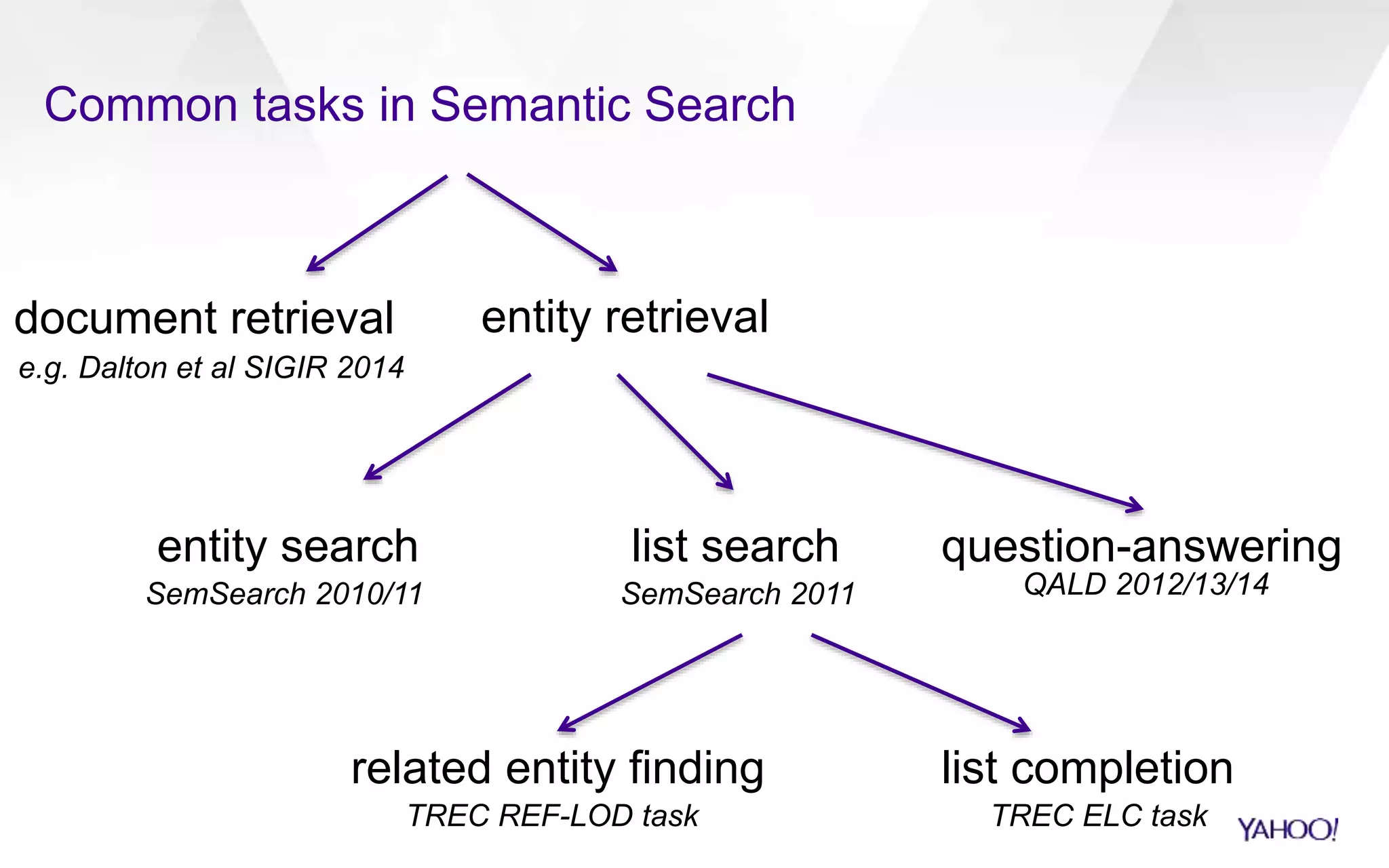
Common tasks in Semantic Search 
entity retrieval 
list search 
entity search 
SemSearch 2010/11 
related entity finding 
question-answering 
QALD 2012/13/14 
list completion 
SemSearch 2011 
TREC REF-LOD task TREC ELC task 
document retrieval 
e.g. Dalton et al SIGIR 2014
Query understanding 
15
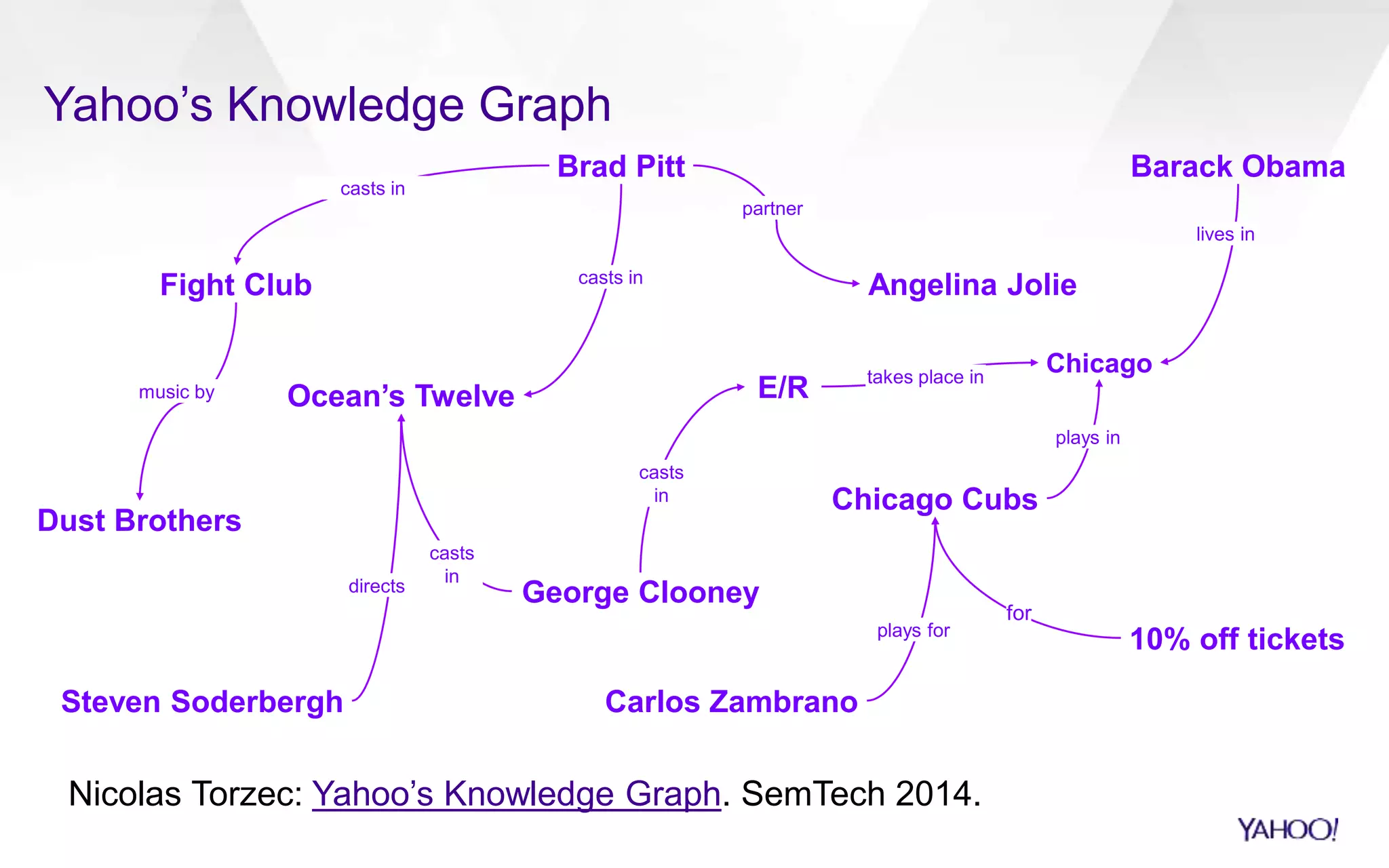
Yahoo’s Knowledge Graph 
Chicago Cubs 
Barack Obama 
Chicago 
Carlos Zambrano 
10% off tickets 
for 
plays for 
plays in 
lives in 
Brad Pitt 
Angelina Jolie 
Steven Soderbergh 
George Clooney 
Ocean’s Twelve 
partner 
directs 
casts in 
E/R 
casts 
in 
takes place in 
Fight Club 
casts in 
Dust Brothers 
casts 
in 
music by 
Nicolas Torzec: Yahoo’s Knowledge Graph. SemTech 2014.
17 
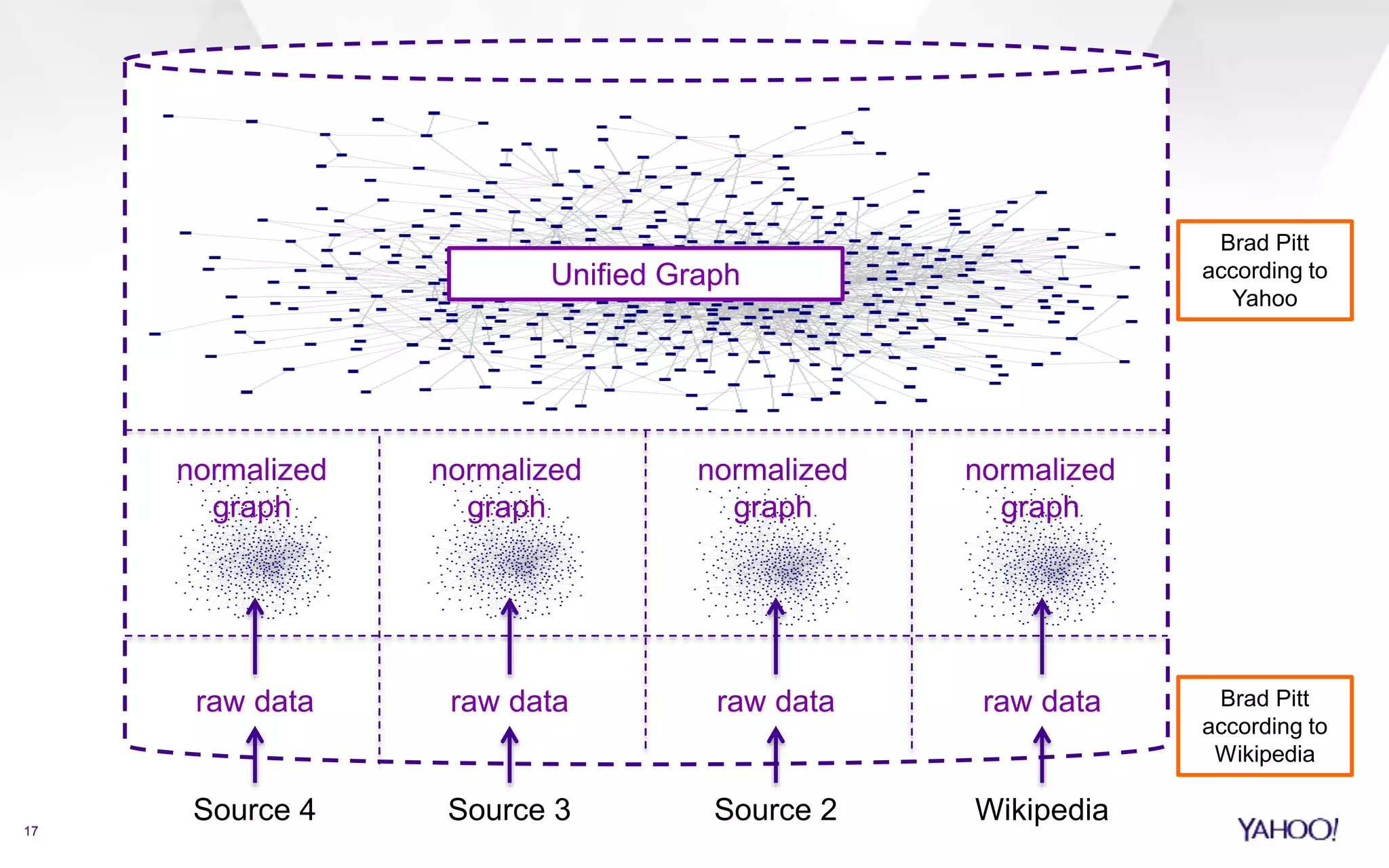
Brad Pitt 
according to 
Yahoo 
normalized 
graph 
normalized 
graph 
normalized 
graph 
raw data raw data Brad Pitt 
according to 
Wikipedia 
normalized 
graph 
Source 4 Source 3 
raw data 
Source 2 
raw data 
Wikipedia 
Unified Graph
Entity displays in Web search 
 Entity retrieval 
› Which entity does a keyword query 
refer to, if any? 
› This talk 
 Related entity recommendation 
› Which entity would the user visit next? 
› [Blanco et al. ISWC 2013]
 Match by keywords 
› Closer to text retrieval 
• Match individual keywords 
• Score and aggregate 
› e.g. [Blanco et al. ISWC 2013] 
• https://github.com/yahoo/Glimmer/ 
 Match by aliases 
› Closer to entity linking 
• Find potential mentions of entities (spots) 
in query 
• Score candidates for each spot 
› This talk 
Two matching approaches 
brad 
(actor) (boxer) (city) 
(actor) (boxer) (lake) 
pitt 
brad pitt 
(actor) (boxer)
Entity linking 
23 
 Large-scale entity-alias mining 
› From usage data, Wikipedia etc. 
 Novel method for linking (FEL) 
› Significantly improved relevance 
› Completely unsupervised 
› Efficient implementation 
 See next… more details in: 
› Roi Blanco, Giuseppe Ottaviano and Edgar Meij. 
Fast and space-efficient entity linking in queries. WSDM 2015 (to appear)
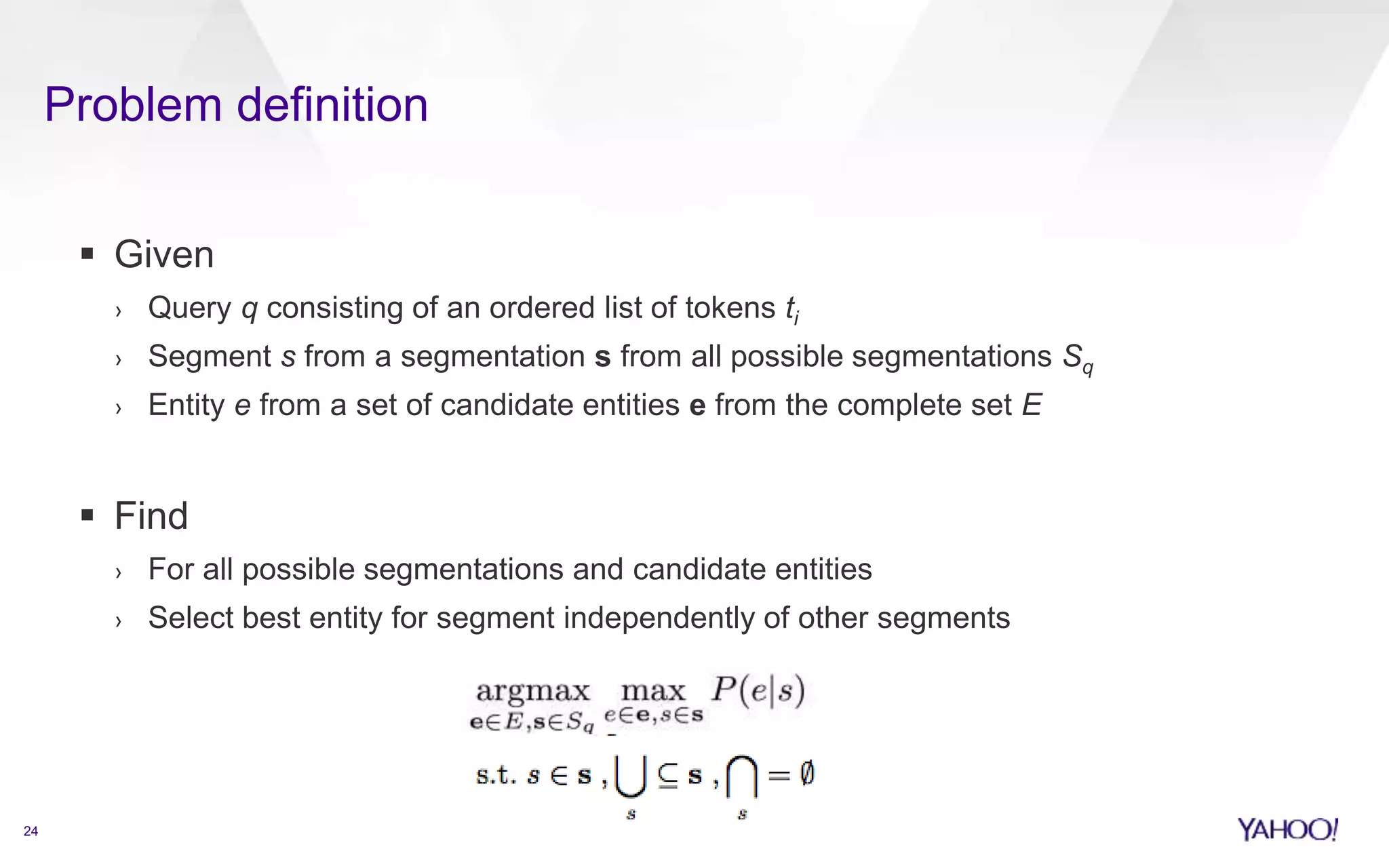
Problem definition 
24 
 Given 
› Query q consisting of an ordered list of tokens ti 
› Segment s from a segmentation s from all possible segmentations Sq 
› Entity e from a set of candidate entities e from the complete set E 
 Find 
› For all possible segmentations and candidate entities 
› Select best entity for segment independently of other segments
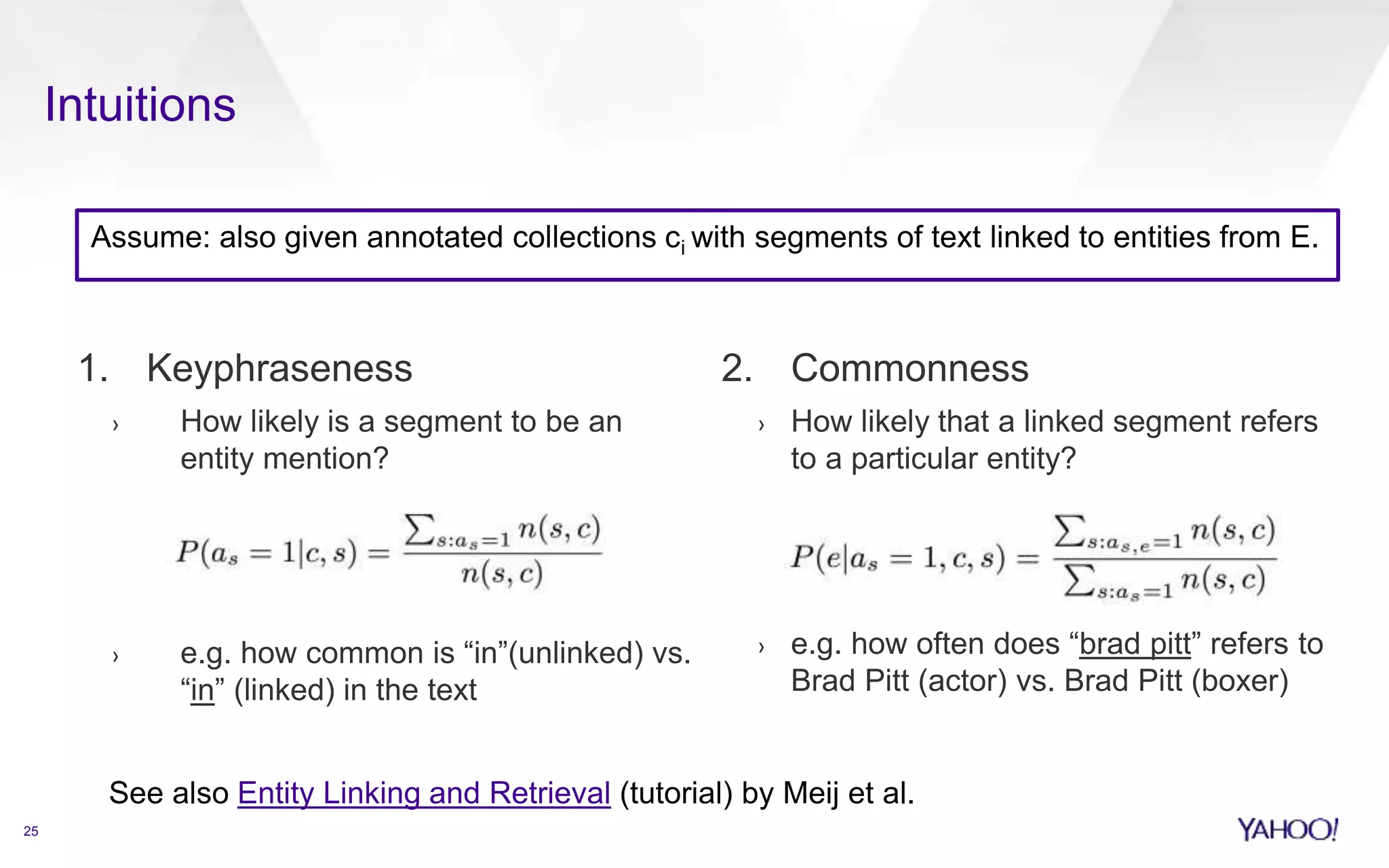
Assume: also given annotated collections ci with segments of text linked to entities from E. 
1. Keyphraseness 
› How likely is a segment to be an 
entity mention? 
› e.g. how common is “in”(unlinked) vs. 
“in” (linked) in the text 
2. Commonness 
› How likely that a linked segment refers 
to a particular entity? 
› e.g. how often does “brad pitt” refers to 
Brad Pitt (actor) vs. Brad Pitt (boxer) 
25 
Intuitions 
See also Entity Linking and Retrieval (tutorial) by Meij et al.
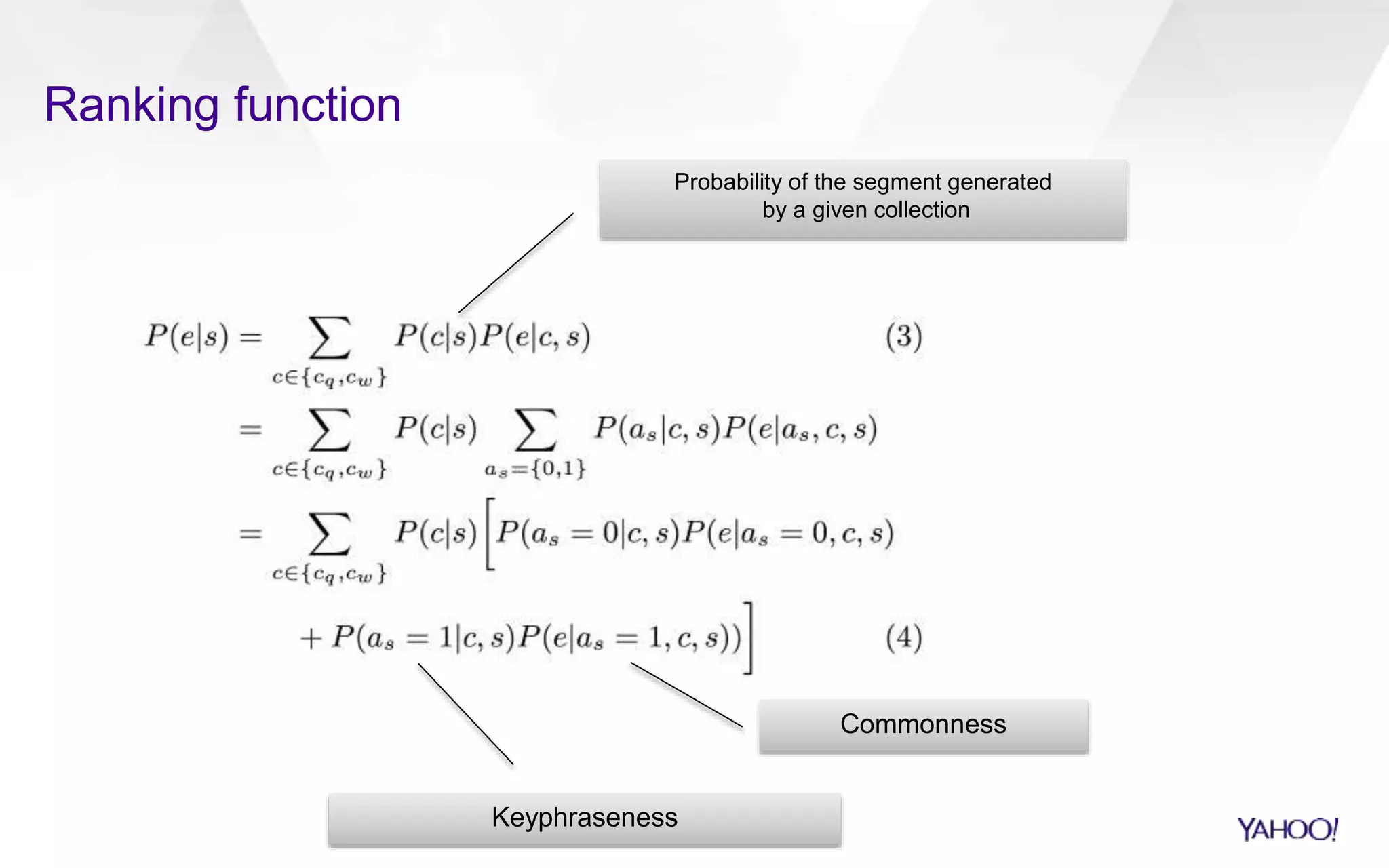
Ranking function 
Probability of the segment generated 
by a given collection 
Commonness 
Keyphraseness
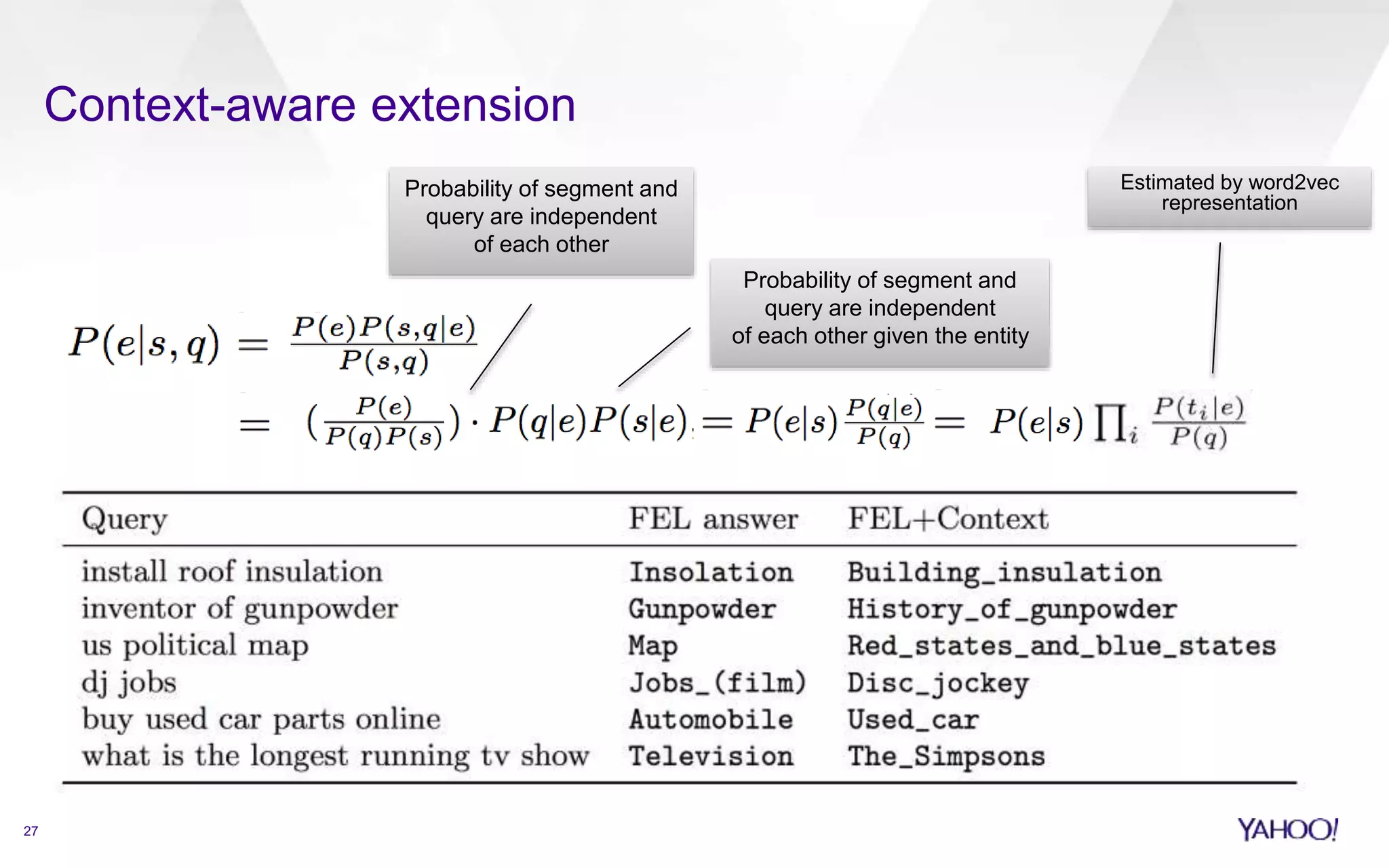
Context-aware extension 
27 
Estimated by word2vec 
representation 
Probability of segment and 
query are independent 
of each other given the entity 
Probability of segment and 
query are independent 
of each other
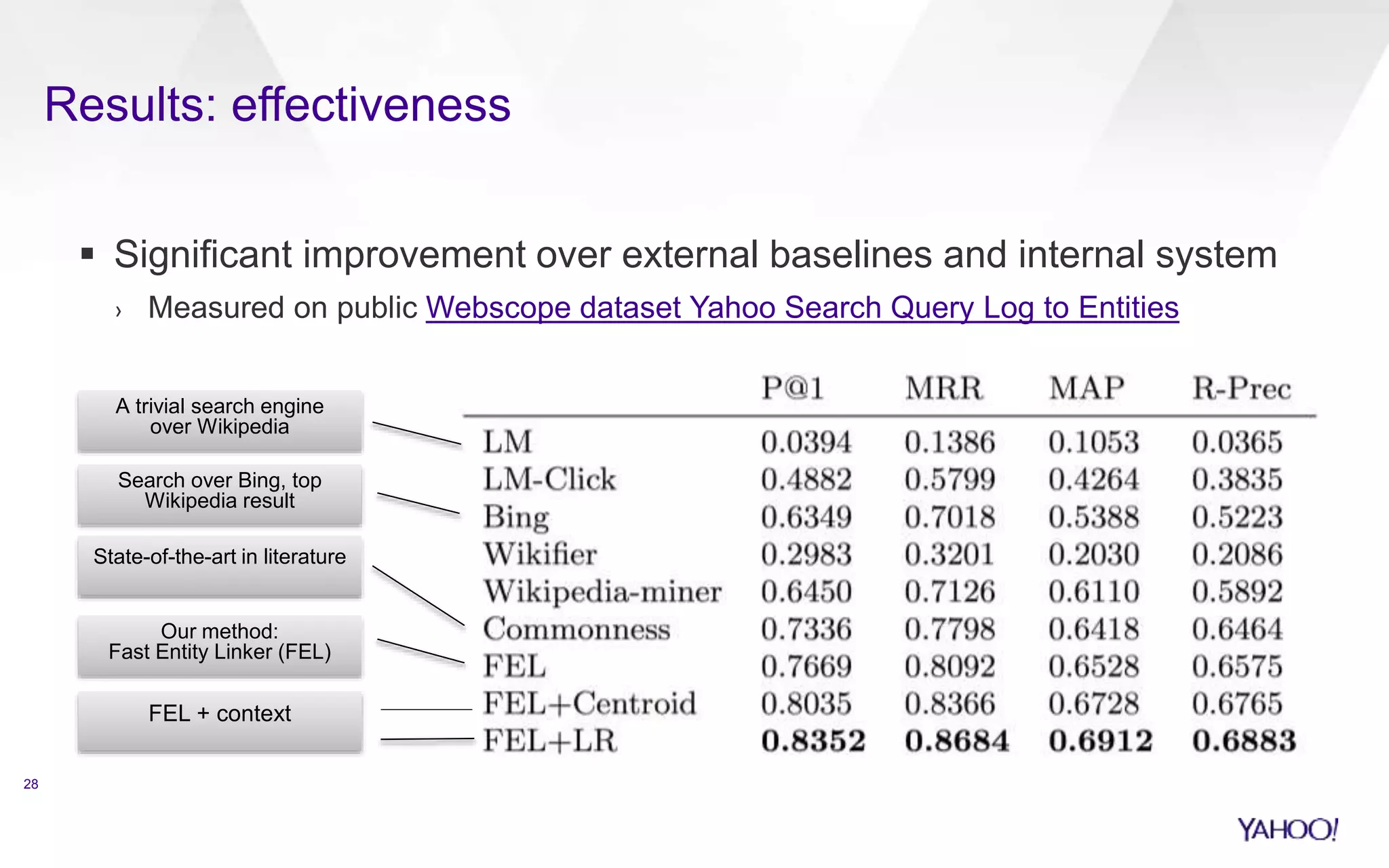
Results: effectiveness 
28 
 Significant improvement over external baselines and internal system 
› Measured on public Webscope dataset Yahoo Search Query Log to Entities 
A trivial search engine 
over Wikipedia 
Search over Bing, top 
Wikipedia result 
State-of-the-art in literature 
Our method: 
Fast Entity Linker (FEL) 
FEL + context
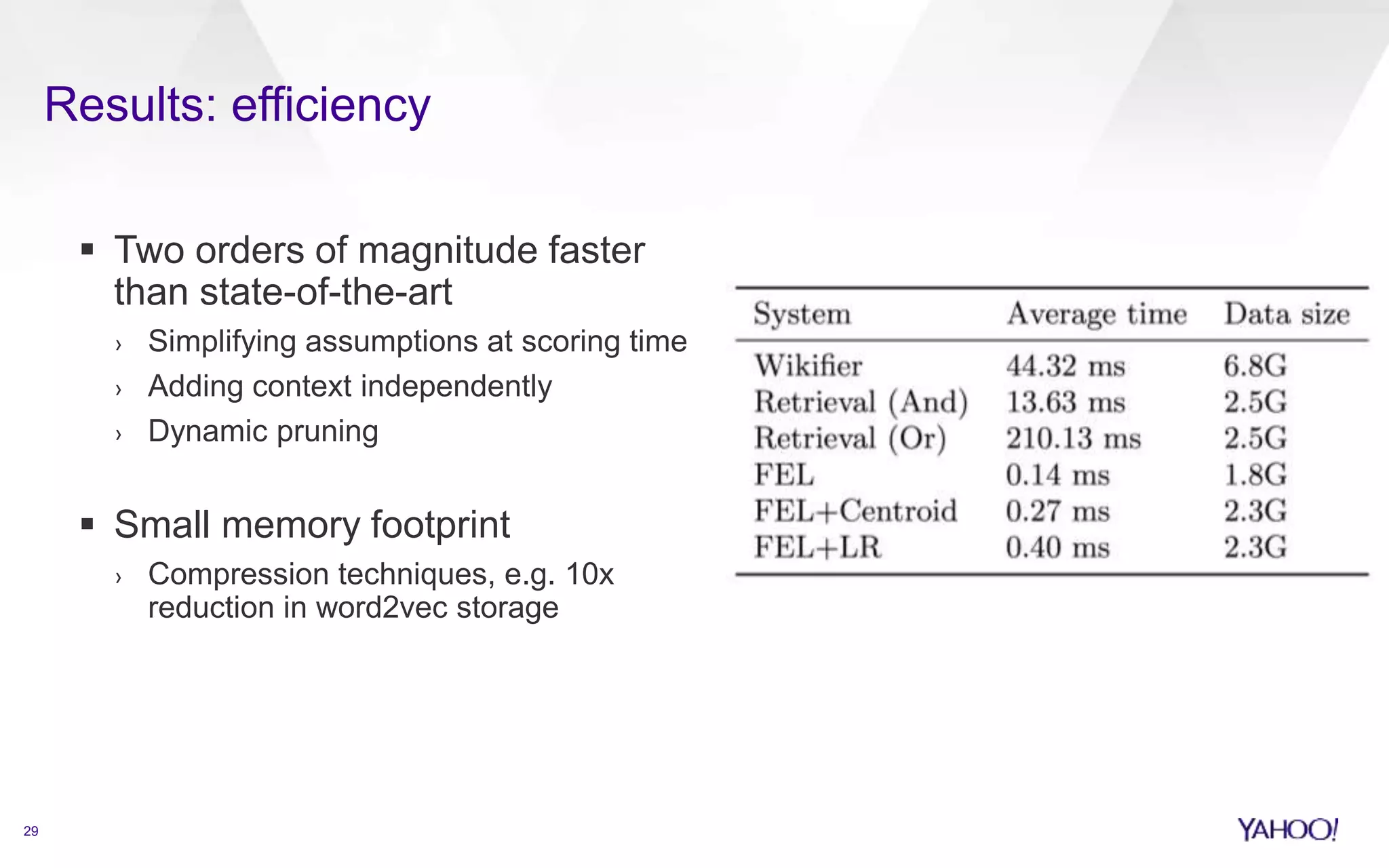
 Two orders of magnitude faster 
than state-of-the-art 
› Simplifying assumptions at scoring time 
› Adding context independently 
› Dynamic pruning 
 Small memory footprint 
› Compression techniques, e.g. 10x 
reduction in word2vec storage 
29 
Results: efficiency
Related and future work 
30 
 Session-level analysis 
› Online 
• Entity retrieval using queries in the same session or entire history 
› Offline 
• Dealing with sparseness, e.g. for usage mining 
– [Hollink et al. WWW 2013] 
 Intents/tasks/actions 
› Schema.org Actions as potential ontology of intents 
 Personalization? Temporal? 
› How often does the meaning of Brad Pitt change per user? 
› How often does the meaning of Brad Pitt change? 
 Interactive query construction
Q&A 
 Many thanks to members of the Semantic Search team 
at Yahoo Labs Barcelona and to Yahoos around the world 
 Contact 
› pmika@yahoo-inc.com 
› @pmika 
› http://www.slideshare.net/pmika/
Lef tover 
32
Entity Retrieval 
 Keyword search over entity graphs 
› see Pound et al. WWW08 for a definition 
› No common benchmark until 2010 
 SemSearch Challenge 2010/2011 
• 50 entity-mention queries Selected from the Search Query Tiny Sample v1.0 dataset (Yahoo! 
Webscope) 
• Billion Triples Challenge 2009 data set 
• Evaluation using Mechanical Turk 
› See report: 
• Roi Blanco, Harry Halpin, Daniel M. Herzig, Peter Mika, Jeffrey Pound, Henry S. Thompson, 
Thanh Tran: Repeatable and reliable semantic search evaluation. J. Web Sem. 21: 14-29 (2013)
Glimmer: open-source entity retrieval engine from Yahoo 
 Extension of MG4J from University of Milano 
 Indexing of RDF data 
› MapReduce-based 
› Horizontal indexing (subject/predicate/object fields) 
› Vertical indexing (one field per predicate) 
 Retrieval 
› BM25F with machine-learned weights for properties and domains 
› 52% improvement over the best system in SemSearch 2010 
 See 
› Roi Blanco, Peter Mika, Sebastiano Vigna: Effective and Efficient Entity Search in RDF Data. 
International Semantic Web Conference (1) 2011: 83-97 
› https://github.com/yahoo/Glimmer/
Other evaluations in Entity Retrieval 
 TREC Entity Track 
› 2009-2011 
› Data 
• ClueWeb 09 collection 
› Queries 
• Related Entity Finding 
– Entities related to a given entity through a 
particular relationship 
– (Homepages of) airlines that fly Boeing 747 
• Entity List Completion 
– Given some elements of a list of entities, 
complete the list 
 Professional sports teams in Philadelphia such 
as the Philadelphia Wings, … 
› Relevance assessments provided by 
TREC assessors 
 Question Answering over Linked Data 
› 2011-2014 
› Data 
• Dbpedia and MusicBrainz in RDF 
› Queries 
• Full natural language questions of different 
forms, written by the organizers 
• Multi-lingual 
• Give me all actors starring in Batman 
Begins 
› Results are defined by an equivalent 
SPARQL query 
• Systems are free to return list of results or 
a SPARQL query 
35

Understanding Queries through Entities

  • 1.
    Under s tandingQuer ies through Ent i t ies P e t e r M i k a , S r . R e s e a r c h S c i e n t i s t , Y a h o o L a b s ⎪ N o v e m b e r 7 , 2 0 1 4
  • 2.
    Why Semantic Search?  Improvements in IR are harder and harder to come by › Basic relevance models are well established › Machine learning using hundreds of features › Heavy investment in computational power, e.g. real-time indexing and instant search  Remaining challenges are not computational, but in modeling user cognition › Need a deeper understanding of the query, the content and the relationship of the two
  • 3.
    Real problem Wefound (some) Roi Blanco (maybe) Diversification
  • 4.
    What it’s liketo be a machine? Roi Blanco
  • 5.
    What it’s liketo be a machine? ↵⏏☐ģ ✜Θ♬♬ţğ√∞§®ÇĤĪ✜★♬☐✓✓ ţğ★✜ ✪✚✜ΔΤΟŨŸÏĞÊϖυτρ℠≠⅛⌫ ≠=⅚©§★✓♪ΒΓΕ℠ ✖Γ♫⅜±⏎↵⏏☐ģğğğμλκσςτ ⏎⌥°¶§ΥΦΦΦ✗✕☐
  • 6.
     Def. SemanticSearch is any retrieval method where › User intent and resources are represented in a semantic model • A set of concepts or topics that generalize over tokens/phrases • Additional structure such as a hierarchy among concepts, relationships among concepts etc. › Semantic representations of the query and the user intent are exploited in some part of the retrieval process  As a research field › Workshops • ESAIR (2008-2014) at CIKM, Semantic Search (SemSearch) workshop series (2008-2011) at ESWC/WWW, EOS workshop (2010-2011) at SIGIR, JIWES workshop (2012) at SIGIR, Semantic Search Workshop (2011-2014) at VLDB › Special Issues of journals › Surveys • Christos L. Koumenides, Nigel R. Shadbolt: Ranking methods for entity-oriented semantic web search. JASIST 65(6): 1091-1106 (2014) 6 Semantic Search
  • 7.
    Semantic search: implicitvs. explicit semantics 7  Implicit/internal semantics › Models of text extracted from a corpus of queries, documents or interaction logs • Query reformulation, term dependency models, translation models, topic models, latent space models, learning to match (PLS), word embeddings › See • Hang Li and Jun Xu: Semantic Matching in Search. Foundations and Trends in Information Retrieval Vol 7 Issue 5, 2013, pp 343-469  Explicit/external semantics › Explicit linguistic or ontological structures extracted from text and linked to external knowledge › Obtained using IE techniques or acquired from Semantic Web markup
  • 8.
    What it’s liketo be a machine? ↵⏏☐ģ ✜Θ♬♬ţğ√∞§®ÇĤĪ✜★♬☐✓✓ ţğ★✜ ✪✚✜ΔΤΟŨŸÏĞÊϖυτρ℠≠⅛⌫ ≠=⅚©§★✓♪ΒΓΕ℠ ✖Γ♫⅜±⏎↵⏏☐ģğğğμλκσςτ ⏎⌥°¶§ΥΦΦΦ✗✕☐
  • 9.
    What it’s liketo be a machine? ✜Θ♬♬ţğ√∞§®ÇĤĪ✜★♬☐✓✓ ţğ★✜ ✪✚✜ΔΤΟŨŸÏĞÊϖυτρ℠≠⅛⌫ ≠=⅚©§★✓♪ΒΓΕ℠ ✖Γ♫⅜±<roi>⏎↵⏏☐ģ</roi>ğğğμλκσςτ ⏎⌥°¶§ΥΦΦΦ✗✕☐ <roi>↵⏏☐ģ</roi> <roi>
  • 10.
    Semantic understanding 10  Documents › Text in general • Exploiting natural language structure and semantic coherence › Specific to the Web • Exploiting structure of web pages, e.g. annotation of web tables  Queries › Short text and no structure… nothing to do?
  • 11.
    Semantic understanding ofqueries 11  Entities play an important role › [Pound et al, WWW 2010], [Lin et al WWW 2012] › ~70% of queries contain a named entity (entity mention queries) • brad pitt height › ~50% of queries have an entity focus (entity seeking queries) • brad pitt attacked by fans › ~10% of queries are looking for a class of entities • brad pitt movies  Entity mention query = <entity> {+ <intent>} › Intent is typically an additional word or phrase to • Disambiguate, most often by type e.g. brad pitt actor • Specify action or aspect e.g. brad pitt net worth, toy story trailer
  • 12.
    Entities and Intents what the user wants to do with it (intent) Object of the query (entity) moneyball trailer Movie 12 11/9/2014
  • 13.
    Annotation over sessions Sports team oakland as bradd pitt movie moneyball trailer movies.yahoo.com oakland as wikipedia.org Movie Actor
  • 14.
    Common tasks inSemantic Search entity retrieval list search entity search SemSearch 2010/11 related entity finding question-answering QALD 2012/13/14 list completion SemSearch 2011 TREC REF-LOD task TREC ELC task document retrieval e.g. Dalton et al SIGIR 2014
  • 15.
  • 16.
    Yahoo’s Knowledge Graph Chicago Cubs Barack Obama Chicago Carlos Zambrano 10% off tickets for plays for plays in lives in Brad Pitt Angelina Jolie Steven Soderbergh George Clooney Ocean’s Twelve partner directs casts in E/R casts in takes place in Fight Club casts in Dust Brothers casts in music by Nicolas Torzec: Yahoo’s Knowledge Graph. SemTech 2014.
  • 17.
    17 Brad Pitt according to Yahoo normalized graph normalized graph normalized graph raw data raw data Brad Pitt according to Wikipedia normalized graph Source 4 Source 3 raw data Source 2 raw data Wikipedia Unified Graph
  • 21.
    Entity displays inWeb search  Entity retrieval › Which entity does a keyword query refer to, if any? › This talk  Related entity recommendation › Which entity would the user visit next? › [Blanco et al. ISWC 2013]
  • 22.
     Match bykeywords › Closer to text retrieval • Match individual keywords • Score and aggregate › e.g. [Blanco et al. ISWC 2013] • https://github.com/yahoo/Glimmer/  Match by aliases › Closer to entity linking • Find potential mentions of entities (spots) in query • Score candidates for each spot › This talk Two matching approaches brad (actor) (boxer) (city) (actor) (boxer) (lake) pitt brad pitt (actor) (boxer)
  • 23.
    Entity linking 23  Large-scale entity-alias mining › From usage data, Wikipedia etc.  Novel method for linking (FEL) › Significantly improved relevance › Completely unsupervised › Efficient implementation  See next… more details in: › Roi Blanco, Giuseppe Ottaviano and Edgar Meij. Fast and space-efficient entity linking in queries. WSDM 2015 (to appear)
  • 24.
    Problem definition 24  Given › Query q consisting of an ordered list of tokens ti › Segment s from a segmentation s from all possible segmentations Sq › Entity e from a set of candidate entities e from the complete set E  Find › For all possible segmentations and candidate entities › Select best entity for segment independently of other segments
  • 25.
    Assume: also givenannotated collections ci with segments of text linked to entities from E. 1. Keyphraseness › How likely is a segment to be an entity mention? › e.g. how common is “in”(unlinked) vs. “in” (linked) in the text 2. Commonness › How likely that a linked segment refers to a particular entity? › e.g. how often does “brad pitt” refers to Brad Pitt (actor) vs. Brad Pitt (boxer) 25 Intuitions See also Entity Linking and Retrieval (tutorial) by Meij et al.
  • 26.
    Ranking function Probabilityof the segment generated by a given collection Commonness Keyphraseness
  • 27.
    Context-aware extension 27 Estimated by word2vec representation Probability of segment and query are independent of each other given the entity Probability of segment and query are independent of each other
  • 28.
    Results: effectiveness 28  Significant improvement over external baselines and internal system › Measured on public Webscope dataset Yahoo Search Query Log to Entities A trivial search engine over Wikipedia Search over Bing, top Wikipedia result State-of-the-art in literature Our method: Fast Entity Linker (FEL) FEL + context
  • 29.
     Two ordersof magnitude faster than state-of-the-art › Simplifying assumptions at scoring time › Adding context independently › Dynamic pruning  Small memory footprint › Compression techniques, e.g. 10x reduction in word2vec storage 29 Results: efficiency
  • 30.
    Related and futurework 30  Session-level analysis › Online • Entity retrieval using queries in the same session or entire history › Offline • Dealing with sparseness, e.g. for usage mining – [Hollink et al. WWW 2013]  Intents/tasks/actions › Schema.org Actions as potential ontology of intents  Personalization? Temporal? › How often does the meaning of Brad Pitt change per user? › How often does the meaning of Brad Pitt change?  Interactive query construction
  • 31.
    Q&A  Manythanks to members of the Semantic Search team at Yahoo Labs Barcelona and to Yahoos around the world  Contact › pmika@yahoo-inc.com › @pmika › http://www.slideshare.net/pmika/
  • 32.
  • 33.
    Entity Retrieval Keyword search over entity graphs › see Pound et al. WWW08 for a definition › No common benchmark until 2010  SemSearch Challenge 2010/2011 • 50 entity-mention queries Selected from the Search Query Tiny Sample v1.0 dataset (Yahoo! Webscope) • Billion Triples Challenge 2009 data set • Evaluation using Mechanical Turk › See report: • Roi Blanco, Harry Halpin, Daniel M. Herzig, Peter Mika, Jeffrey Pound, Henry S. Thompson, Thanh Tran: Repeatable and reliable semantic search evaluation. J. Web Sem. 21: 14-29 (2013)
  • 34.
    Glimmer: open-source entityretrieval engine from Yahoo  Extension of MG4J from University of Milano  Indexing of RDF data › MapReduce-based › Horizontal indexing (subject/predicate/object fields) › Vertical indexing (one field per predicate)  Retrieval › BM25F with machine-learned weights for properties and domains › 52% improvement over the best system in SemSearch 2010  See › Roi Blanco, Peter Mika, Sebastiano Vigna: Effective and Efficient Entity Search in RDF Data. International Semantic Web Conference (1) 2011: 83-97 › https://github.com/yahoo/Glimmer/
  • 35.
    Other evaluations inEntity Retrieval  TREC Entity Track › 2009-2011 › Data • ClueWeb 09 collection › Queries • Related Entity Finding – Entities related to a given entity through a particular relationship – (Homepages of) airlines that fly Boeing 747 • Entity List Completion – Given some elements of a list of entities, complete the list  Professional sports teams in Philadelphia such as the Philadelphia Wings, … › Relevance assessments provided by TREC assessors  Question Answering over Linked Data › 2011-2014 › Data • Dbpedia and MusicBrainz in RDF › Queries • Full natural language questions of different forms, written by the organizers • Multi-lingual • Give me all actors starring in Batman Begins › Results are defined by an equivalent SPARQL query • Systems are free to return list of results or a SPARQL query 35