Copyright © 2016 Earley Information Science1
Intelligent Virtual Agents
– What’s Needed to
Make Them a Reality
Copyright © 2016 Earley Information Science
Seth Earley, EIS
Sue Feldman, Synthexis
Paul Wlodarczyk, EIS
Dino Eliopulos, EIS
Copyright © 2016 Earley Information Science2
Today’s Agenda
• Welcome & Housekeeping
• Dave Zwicker, CMO, Earley Information Science
• Session duration & questions
• Session recording & materials
• Take the polls & the survey!
• The Panelist Point of View
• Paul Wlodarczyk, VP, Client Services, Earley Information Science
(@twitcontentguy)
• Dino Eliopulos, Managing Director, Earley Information Science
(@deliopulos)
• Seth Earley, CEO, Earley Information Science (@sethearley)
• Sue Feldman, CEO, Synthexis (@susanfeldman)
• Expert Panel Discussion
• Questions & Answers
• Join the conversation: #earleyroundtable
Copyright © 2016 Earley Information Science3 Copyright © 2016 Earley Information Science
Intelligent Virtual Agents
What’s Needed to Make Them a Reality
Copyright © 2016 Earley Information Science4
Paul Wlodarczyk - Biography
• VP, Client Services & Industrial Practice Lead
• Joined Earley in 2008, with 30 years’ experience in unstructured content lifecycle
and related technologies (search, content management, classification, taxonomy,
localization)
• Currently working with enterprises leading digital transformation projects
• Deep product lifecycle experience for high-tech discrete products, software, and
batch process manufacturing, and industry experience in consumer products, life
sciences, energy & water infrastructure, finance, insurance, and aerospace.
• Former CEO of Jorsek Software, makers of the easyDITA XML Content Suite
• Established ECM practices at Xerox Global Services, Blast Radius, and
JustSystems
• Sought-after speaker and writer for such industry organizations as AIIM, B2B On-
line, CIDM, ebiz, Intelligent Content, Gartner, Gilbane, KM World, LavaCon,
Linked Data, LISA, MESA, STC, and TechLearn
• MBA, William E. Simon School of Business; BA, University of Rochester
(Psychology)
Paul Wlodarczyk
VP, Client Services
Earley Information Science
Copyright © 2016 Earley Information Science5
in·tel·li·gent /inˈteləjənt/ adjective
(of a device, machine, or building) able to vary its state or action in response to varying
situations, varying requirements, and past experience.
as·sis·tant /əˈsistənt/ noun
a person who helps in particular work
Intelligent Assistant – a device or application that helps in particular work
that is able to vary its state or action in response to varying situations, varying
requirements, and past experience.
What is an Intelligent Assistant?
Copyright © 2016 Earley Information Science6
Intelligent Assistant – a device or application that helps in particular work
that is able to vary its state or action in response to varying situations, varying
requirements, and past experience.
What is an Intelligent Assistant?
• Implication of “assistant” is anthropomorphic (Siri, Cortana, ABIe,
etc.)
• How do we make it intelligent – i.e. not static – to vary its state or
action?
• Continuously curated content & information architecture
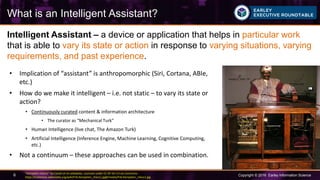
• The curator as “Mechanical Turk”
• Human Intelligence (live chat, The Amazon Turk)
• Artificial Intelligence (Inference Engine, Machine Learning, Cognitive Computing,
etc.)
• Not a continuum – these approaches can be used in combination.
"Kempelen chess1" by Carafe at en.wikipedia. Licensed under CC BY-SA 3.0 via Commons -
https://commons.wikimedia.org/wiki/File:Kempelen_chess1.jpg#/media/File:Kempelen_chess1.jpg
Copyright © 2016 Earley Information Science7
“A problem well-stated is a problem half-solved.” – Charles Kettering
Information architecture involves structuring the information-
seeking behavior of the knowledge worker and the content itself:
– Use cases
– Domain models
– Contextualization
– Content models / structured content
– Search curation (best bets, query suggestions, redirects)
– Taxonomy development & curation (synonyms, hierarchy)
Curation required to “feed the beast” – keep it intelligent.
Curated IA as Stepping Stone to Machine Solutions
Copyright © 2016 Earley Information Science8
“A problem well-stated is a problem half-solved.” – Charles Kettering
A curated knowledge-based solution lowers the risk of a machine-based
solution:
– Defines and highly strutures the problem
– Implements a more manageable, lower-cost, lower risk solution
– Makes crystal-clear the opportunities for machines to help
• E.g. – the long-tail inquiry
– Organizes the “training sets” for the machine
• Example: User “Chats” with ABIe
Curated IA as Stepping Stone to Machine Solutions
Copyright © 2016 Earley Information Science9
• Experienced leader and innovator in industry and high-end professional IT
consulting with deep specialization in user experience and highly complex
business applications.
• Has over 2 decades of experience in applying Machine Learning, Data
Mining and other AI techniques to deliver rich content-driven solutions for
Retail, CRM, hi-tech manufacturing, healthcare / insurance and financial
services.
• Has depth in many industries including Financial Services, Retail / CPG,
Telecommunications, Travel and Entertainment, Healthcare,
Pharmaceuticals, Hi-Tech Manufacturing and Energy.
• Expertise in all aspect of IT Professional Services including strategy,
planning, forecasting, budgeting, measurement, sales, talent acquisition /
management and retention, career stewardship, program management and
service delivery.
• Highly collaborative and results-oriented management style delivers
outstanding outcomes for his clients, his employers and his teams.
Dino Eliopulos - Biography
Dino Eliopulos
Managing Director
Earley Information
Science
Copyright © 2016 Earley Information Science10
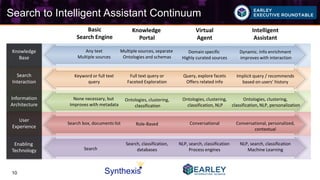
Search to Intelligent Assistant Continuum
Basic
Search Engine
Knowledge
Portal
Virtual
Agent
Intelligent
Assistant
Knowledge
Base
Search
Interaction
Information
Architecture
User
Experience
Enabling
Technology
Any text
Multiple sources
Keyword or full text
query
None necessary, but
Improves with metadata
Search box, documents list
Search
Multiple sources, separate
Ontologies and schemas
Full text query or
Faceted Exploration
Ontologies, clustering,
classification
Role-Based
Search, classification,
databases
Domain specific
Highly curated sources
Query, explore facets
Offers related info
Conversational
NLP, search, classification
Process engines
Dynamic. Info enrichment
improves with interaction
Implicit query / recommends
based on users’ history
Conversational, personalized,
contextual
NLP, search, classification
Machine Learning
Ontologies, clustering,
classification, NLP
Ontologies, clustering,
classification, NLP, personalization
Synthexis10
Copyright © 2016 Earley Information Science11
Synthexis11
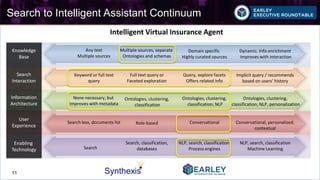
Search to Intelligent Assistant Continuum
Knowledge
Base
Search
Interaction
Information
Architecture
User
Experience
Enabling
Technology
Any text
Multiple sources
Keyword or full text
query
None necessary, but
Improves with metadata
Search box, documents list
Search
Multiple sources, separate
Ontologies and schemas
Full text query or
Faceted exploration
Ontologies, clustering,
classification
Role-based
Search, classification,
databases
Domain specific
Highly curated sources
Query, explore facets
Offers related info
Conversational
NLP, search, classification
Process engines
Dynamic. Info enrichment
Improves with interaction
Implicit query / recommends
based on users’ history
Conversational, personalized,
contextual
NLP, search, classification
Machine Learning
Ontologies, clustering,
classification, NLP
Ontologies, clustering,
classification, NLP, personalization
Intelligent Virtual Insurance Agent
Copyright © 2016 Earley Information Science12
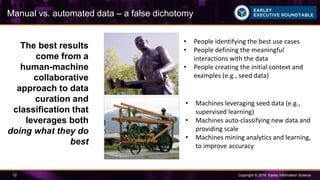
The best results
come from a
human-machine
collaborative
approach to data
curation and
classification that
leverages both
doing what they do
best
Manual vs. automated data – a false dichotomy
• Machines leveraging seed data (e.g.,
supervised learning)
• Machines auto-classifying new data and
providing scale
• Machines mining analytics and learning,
to improve accuracy
• People identifying the best use cases
• People defining the meaningful
interactions with the data
• People creating the initial context and
examples (e.g., seed data)
Copyright © 2016 Earley Information Science13
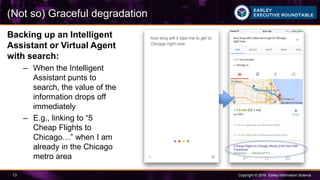
Backing up an Intelligent
Assistant or Virtual Agent
with search:
– When the Intelligent
Assistant punts to
search, the value of the
information drops off
immediately
– E.g., linking to “5
Cheap Flights to
Chicago…” when I am
already in the Chicago
metro area
(Not so) Graceful degradation
Copyright © 2016 Earley Information Science14 Copyright © 2016 Earley Information Science
Poll Question #1
How would you describe your company’s place on the Search to
IVA continuum?
Copyright © 2016 Earley Information Science15
Seth Earley - Biography
Seth Earley
CEO and Founder
Earley Information
Science
Over 20 years experience
Current work
Co-author
Editor
Member
Former Co-Chair
Founder
Former adjunct professor
Guest speaker
AIIM Master Trainer
Course Developer &
Master Instructor
Data science and technology, content and knowledge
management systems, background in sciences (chemistry)
Enterprise IA and Semantic Search
Information Organization and Access
US Strategic Command briefing on knowledge networks
Northeastern University
Boston Knowledge Management Forum
Long history of industry education and research in emerging fields
Academy of Motion Picture Arts and Sciences, Science
and Technology Council Metadata Project Committee
Editorial Journal of Applied Marketing Analytics
Data Analytics Department IEEE IT Professional Magazine
Practical Knowledge Management from IBM Press
Cognitive computing, knowledge and data
management systems, taxonomy, ontology and
metadata governance strategies
Copyright © 2016 Earley Information Science16
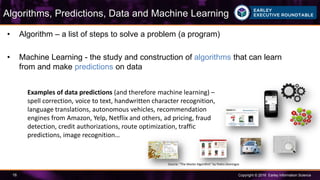
• Algorithm – a list of steps to solve a problem (a program)
• Machine Learning - the study and construction of algorithms that can learn
from and make predictions on data
Algorithms, Predictions, Data and Machine Learning
Source: “The Master Algorithm” by Pedro Domingos
Examples of data predictions (and therefore machine learning) –
spell correction, voice to text, handwritten character recognition,
language translations, autonomous vehicles, recommendation
engines from Amazon, Yelp, Netflix and others, ad pricing, fraud
detection, credit authorizations, route optimization, traffic
predictions, image recognition…
Copyright © 2016 Earley Information Science17
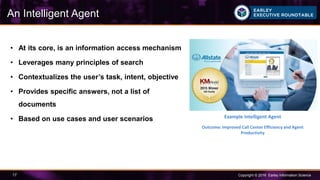
• At its core, is an information access mechanism
• Leverages many principles of search
• Contextualizes the user’s task, intent, objective
• Provides specific answers, not a list of
documents
• Based on use cases and user scenarios
An Intelligent Agent
Example Intelligent Agent
Outcome: Improved Call Center Efficiency and Agent
Productivity
Copyright © 2016 Earley Information Science18
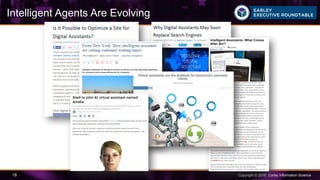
Intelligent Agents Are Evolving
Copyright © 2016 Earley Information Science19
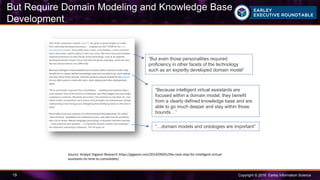
“But even those personalities required
proficiency in other facets of the technology
such as an expertly developed domain model”
“Because intelligent virtual assistants are
focused within a domain model, they benefit
from a clearly defined knowledge base and are
able to go much deeper and stay within those
bounds…”
Source: Analyst Gigaom Research https://gigaom.com/2014/09/01/the-next-step-for-intelligent-virtual-
assistants-its-time-to-consolidate/
“…domain models and ontologies are important”
But Require Domain Modeling and Knowledge Base
Development
Copyright © 2016 Earley Information Science20
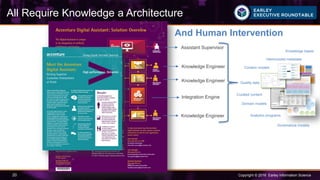
All Require Knowledge a Architecture
Knowledge Engineer
Knowledge Engineer
Knowledge Engineer
Assistant Supervisor
Integration Engine
Domain models
Knowledge bases
Harmonized metadata
Quality data
Curated content
Governance models
Analytics programs
Content models
And Human Intervention
Copyright © 2016 Earley Information Science21
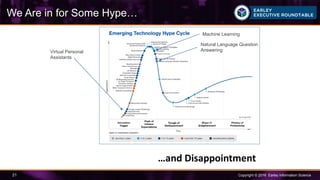
We Are in for Some Hype…
Virtual Personal
Assistants
Natural Language Question
Answering
Machine Learning
…and Disappointment
Copyright © 2016 Earley Information Science22
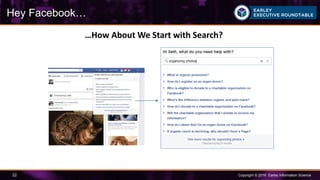
Hey Facebook…
…How About We Start with Search?
Copyright © 2016 Earley Information Science23
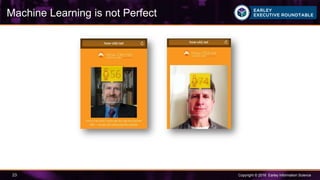
Machine Learning is not Perfect
Copyright © 2016 Earley Information Science24
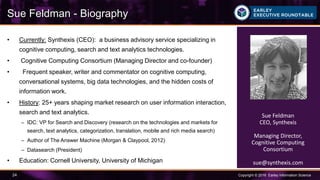
• Currently: Synthexis (CEO): a business advisory service specializing in
cognitive computing, search and text analytics technologies.
• Cognitive Computing Consortium (Managing Director and co-founder)
• Frequent speaker, writer and commentator on cognitive computing,
conversational systems, big data technologies, and the hidden costs of
information work.
• History: 25+ years shaping market research on user information interaction,
search and text analytics.
– IDC: VP for Search and Discovery (research on the technologies and markets for
search, text analytics, categorization, translation, mobile and rich media search)
– Author of The Answer Machine (Morgan & Claypool, 2012)
– Datasearch (President)
• Education: Cornell University, University of Michigan
Sue Feldman - Biography
Sue Feldman
CEO, Synthexis
Managing Director,
Cognitive Computing
Consortium
sue@synthexis.com
© 2015
Synthexis
Cognitive Computing…
…makes a new class of problem computable:
• Ambiguous, unpredictable
• Conflicting data
• Require exploration, not searching
• Need to uncover patterns and surprises
• Shifting situation, goals, information
• Best answers based on context
• Problem solving: beyond information gathering
© 2015
Synthexis
What Cognitive Systems Do
Act as an intelligent partner:
– Analyze BIG data
– Understand human language on multiple levels
– Analyze and merge all formats and sources of information
– Uncover relationships across sources
– Understand and filter by context
– Find patterns in the data that are both expected and unexpected
– Learn from new information, new interactions
© 2015
Synthexis
Cognitive Computing Systems
• Highly integrated: Search, BI, analytics, visualization, voting algorithms, categorization,
statistics, machine learning, NLP, inferencing, content management, voice recognition,
etc.
• Meaning-based
• Probabilistic
• Iterative and conversational
• Interactive
• Contextual
• Learn and adapt based on interactions, new information, users
• Big data knowledge base—multiple sources, formats
• Analytics: text, predictive, BI…
© 2015
Synthexis
When to Use Cognitive Technologies
• Diverse data sources, including unstructured (text, images)
• No clearly right answers:
– Data is complex and ambiguous
– Conflicting evidence
• Ranked (confidence scored) answers are acceptable
• Process intensive and difficult to automate because of unpredictability
• Time dependent: need up to the minute information (evidence) to support
decisions
• Big data
• Exploration is a priority
• Interaction on human terms
© 2015
Synthexis
And When NOT…
• When predictable, repeatable results are required (e.g. sales
reports)
• When all data is structured, numeric and predictable
– e.g. Internet of Things
• When shifting views and answers are not appropriate or are
indefensible due to industry regulations
• When interaction, especially in natural language, is not
necessary
• When a probabilistic approach is not desirable
© 2015
Synthexis
First: Frame the Project
• What is the goal of the project? What do you want to hand
to your users?
• Who are the users? Level of skill
• Speed
• Variety: Formats and sources
• Volume
• Velocity
© 2015
Synthexis
Trade-offs and Choices
What is good enough? It depends on the use:
• Serendipity vs. high confidence level
• Preprocessing and ingestion: depth vs. speed
• Speed of response: real time vs. a few seconds, days, or weeks
• Impact of outcome: life and death vs. trend detection in social media
• Thoroughness and type of data
• Thoroughness of analysis
• Type of use: question answering/monitoring/trend analysis/risk alerts/customer
interaction…
© 2015
Synthexis
The Future is Cognitive
• Improved, individualized healthcare
• A cognitive-assisted stockbroker
• Improved, individualized sales and customer support
• Computer-orchestrated political campaigns
• Executive Advisor: tells you the top 3 things to pay attention to
Interactive, Contextual, Personalized, Relevant
Copyright © 2016 Earley Information Science33 Copyright © 2016 Earley Information Science
Poll Question #2
What topic areas would be most helpful for your situation?
Copyright © 2016 Earley Information Science34 Copyright © 2016 Earley Information Science
Panel Discussion
Copyright © 2016 Earley Information Science35
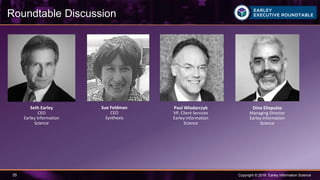
Roundtable Discussion
Paul Wlodarczyk
VP, Client Services
Earley Information
Science
Dino Eliopulos
Managing Director
Earley Information
Science
Seth Earley
CEO
Earley Information
Science
Sue Feldman
CEO
Synthexis
Copyright © 2016 Earley Information Science36
Suggested Resources
• Allstate’s ABIe project case study http://www.earley.com/knowledge/case-studies/allstate%E2%80%99s-intelligent-agent-reduces-call-
center-traffic-and-provides-help
• Sue Feldman’s website http://synthexis.com/
• Cognitive Systems Institute Group website http://cognitive-science.info/community/weekly-update/
• IBM Watson Outthink website www.ibm.com/outthink
• IBM Research on Cognitive Computing http://www.research.ibm.com/cognitive-computing/#fbid=WaBFwxRAB0M
• Inside IBM: The Inventors Who Are Creating the Era of Cognitive Computing http://www.ibm.com/blogs/think/2016/01/13/inside-ibm-the-
inventors-who-are-creating-the-era-of-cognitive-computing/
• The Answer Machine by Susan Feldman. Morgan & Claypool, 2012 http://www.amazon.com/Synthesis-Lectures-Information-Concepts-
Retrieval/dp/1608459349
• Online Searcher Magazine, Jan-Feb. 2016 issue (v.40 no. 1). P. 38. “If I only had a(other) brain.” By Sue Feldman
http://www.infotoday.com/OnlineSearcher/
• Cognitive Computing Consortium http://www.cognitivecomputingconsortium.com/
• Enterprise Search: 14 Industry Experts Predict the Future of Search http://www.docurated.com/enterprise-search/enterprise-search-14-
industry-experts-predict-future-search
Copyright © 2016 Earley Information Science37
• Intelligent Assistance Landscape http://1u88jj3r4db2x4txp44yqfj1.wpengine.netdna-cdn.com/wp-content/uploads/2015/10/Intelligence-
Assistant-Landscape-Final.jpg
• Intelligent Virtual Assistants. Virtual Agents. What’s the Difference? http://www.intelliresponse.com/blog/intelligent-virtual-assistant
• Artificial Intelligence is Resurrecting Enterprise Search http://www.cmswire.com/cms/information-management/artificial-intelligence-is-
resurrecting-enterprise-search-026427.php
• Evaluating Enterprise Virtual Assistants
http://info.intelliresponse.com/rs/intelliresponse/images/Opus_EvaluatingEnterpriseVirtualAssistants_Jan2014%20(2).pdf
• Intelligent Virtual Agent and Intelligent Personal Assistant News and Views http://virtualagentchat.com/
• Characteristics of Highly Effective Enterprise Virtual Assistants http://www.slideshare.net/intelligentfactors/characteristics-of-highly-
effective-enterprise-virtual-assistants
• Artificial Intelligence Is Almost Ready for Business https://hbr.org/2015/03/artificial-intelligence-is-almost-ready-for-business
• The Knowledge Graph and Its Importance for Intelligent Assistance http://opusresearch.net/wordpress/2016/01/12/the-knowledge-graph-
and-its-importance-for-intelligent-assistance/
Suggested Resources (continued)
Copyright © 2016 Earley Information Science38
Earley Information Science helps
organizations establish a strong
information architecture and content
management foundation
Realize your digital transformation
vision with EIS.
Earley Information Science (EIS)
Information Architects for the Digital Age
Founded – 1994
Headquarters – Boston, MA
www.earley.com
For more info contact:
info@earley.com
careers@earley.com

Making Intelligent Virtual Assistants a Reality

  • 1.
    Copyright © 2016Earley Information Science1 Intelligent Virtual Agents – What’s Needed to Make Them a Reality Copyright © 2016 Earley Information Science Seth Earley, EIS Sue Feldman, Synthexis Paul Wlodarczyk, EIS Dino Eliopulos, EIS
  • 2.
    Copyright © 2016Earley Information Science2 Today’s Agenda • Welcome & Housekeeping • Dave Zwicker, CMO, Earley Information Science • Session duration & questions • Session recording & materials • Take the polls & the survey! • The Panelist Point of View • Paul Wlodarczyk, VP, Client Services, Earley Information Science (@twitcontentguy) • Dino Eliopulos, Managing Director, Earley Information Science (@deliopulos) • Seth Earley, CEO, Earley Information Science (@sethearley) • Sue Feldman, CEO, Synthexis (@susanfeldman) • Expert Panel Discussion • Questions & Answers • Join the conversation: #earleyroundtable
  • 3.
    Copyright © 2016Earley Information Science3 Copyright © 2016 Earley Information Science Intelligent Virtual Agents What’s Needed to Make Them a Reality
  • 4.
    Copyright © 2016Earley Information Science4 Paul Wlodarczyk - Biography • VP, Client Services & Industrial Practice Lead • Joined Earley in 2008, with 30 years’ experience in unstructured content lifecycle and related technologies (search, content management, classification, taxonomy, localization) • Currently working with enterprises leading digital transformation projects • Deep product lifecycle experience for high-tech discrete products, software, and batch process manufacturing, and industry experience in consumer products, life sciences, energy & water infrastructure, finance, insurance, and aerospace. • Former CEO of Jorsek Software, makers of the easyDITA XML Content Suite • Established ECM practices at Xerox Global Services, Blast Radius, and JustSystems • Sought-after speaker and writer for such industry organizations as AIIM, B2B On- line, CIDM, ebiz, Intelligent Content, Gartner, Gilbane, KM World, LavaCon, Linked Data, LISA, MESA, STC, and TechLearn • MBA, William E. Simon School of Business; BA, University of Rochester (Psychology) Paul Wlodarczyk VP, Client Services Earley Information Science
  • 5.
    Copyright © 2016Earley Information Science5 in·tel·li·gent /inˈteləjənt/ adjective (of a device, machine, or building) able to vary its state or action in response to varying situations, varying requirements, and past experience. as·sis·tant /əˈsistənt/ noun a person who helps in particular work Intelligent Assistant – a device or application that helps in particular work that is able to vary its state or action in response to varying situations, varying requirements, and past experience. What is an Intelligent Assistant?
  • 6.
    Copyright © 2016Earley Information Science6 Intelligent Assistant – a device or application that helps in particular work that is able to vary its state or action in response to varying situations, varying requirements, and past experience. What is an Intelligent Assistant? • Implication of “assistant” is anthropomorphic (Siri, Cortana, ABIe, etc.) • How do we make it intelligent – i.e. not static – to vary its state or action? • Continuously curated content & information architecture • The curator as “Mechanical Turk” • Human Intelligence (live chat, The Amazon Turk) • Artificial Intelligence (Inference Engine, Machine Learning, Cognitive Computing, etc.) • Not a continuum – these approaches can be used in combination. "Kempelen chess1" by Carafe at en.wikipedia. Licensed under CC BY-SA 3.0 via Commons - https://commons.wikimedia.org/wiki/File:Kempelen_chess1.jpg#/media/File:Kempelen_chess1.jpg
  • 7.
    Copyright © 2016Earley Information Science7 “A problem well-stated is a problem half-solved.” – Charles Kettering Information architecture involves structuring the information- seeking behavior of the knowledge worker and the content itself: – Use cases – Domain models – Contextualization – Content models / structured content – Search curation (best bets, query suggestions, redirects) – Taxonomy development & curation (synonyms, hierarchy) Curation required to “feed the beast” – keep it intelligent. Curated IA as Stepping Stone to Machine Solutions
  • 8.
    Copyright © 2016Earley Information Science8 “A problem well-stated is a problem half-solved.” – Charles Kettering A curated knowledge-based solution lowers the risk of a machine-based solution: – Defines and highly strutures the problem – Implements a more manageable, lower-cost, lower risk solution – Makes crystal-clear the opportunities for machines to help • E.g. – the long-tail inquiry – Organizes the “training sets” for the machine • Example: User “Chats” with ABIe Curated IA as Stepping Stone to Machine Solutions
  • 9.
    Copyright © 2016Earley Information Science9 • Experienced leader and innovator in industry and high-end professional IT consulting with deep specialization in user experience and highly complex business applications. • Has over 2 decades of experience in applying Machine Learning, Data Mining and other AI techniques to deliver rich content-driven solutions for Retail, CRM, hi-tech manufacturing, healthcare / insurance and financial services. • Has depth in many industries including Financial Services, Retail / CPG, Telecommunications, Travel and Entertainment, Healthcare, Pharmaceuticals, Hi-Tech Manufacturing and Energy. • Expertise in all aspect of IT Professional Services including strategy, planning, forecasting, budgeting, measurement, sales, talent acquisition / management and retention, career stewardship, program management and service delivery. • Highly collaborative and results-oriented management style delivers outstanding outcomes for his clients, his employers and his teams. Dino Eliopulos - Biography Dino Eliopulos Managing Director Earley Information Science
  • 10.
    Copyright © 2016Earley Information Science10 Search to Intelligent Assistant Continuum Basic Search Engine Knowledge Portal Virtual Agent Intelligent Assistant Knowledge Base Search Interaction Information Architecture User Experience Enabling Technology Any text Multiple sources Keyword or full text query None necessary, but Improves with metadata Search box, documents list Search Multiple sources, separate Ontologies and schemas Full text query or Faceted Exploration Ontologies, clustering, classification Role-Based Search, classification, databases Domain specific Highly curated sources Query, explore facets Offers related info Conversational NLP, search, classification Process engines Dynamic. Info enrichment improves with interaction Implicit query / recommends based on users’ history Conversational, personalized, contextual NLP, search, classification Machine Learning Ontologies, clustering, classification, NLP Ontologies, clustering, classification, NLP, personalization Synthexis10
  • 11.
    Copyright © 2016Earley Information Science11 Synthexis11 Search to Intelligent Assistant Continuum Knowledge Base Search Interaction Information Architecture User Experience Enabling Technology Any text Multiple sources Keyword or full text query None necessary, but Improves with metadata Search box, documents list Search Multiple sources, separate Ontologies and schemas Full text query or Faceted exploration Ontologies, clustering, classification Role-based Search, classification, databases Domain specific Highly curated sources Query, explore facets Offers related info Conversational NLP, search, classification Process engines Dynamic. Info enrichment Improves with interaction Implicit query / recommends based on users’ history Conversational, personalized, contextual NLP, search, classification Machine Learning Ontologies, clustering, classification, NLP Ontologies, clustering, classification, NLP, personalization Intelligent Virtual Insurance Agent
  • 12.
    Copyright © 2016Earley Information Science12 The best results come from a human-machine collaborative approach to data curation and classification that leverages both doing what they do best Manual vs. automated data – a false dichotomy • Machines leveraging seed data (e.g., supervised learning) • Machines auto-classifying new data and providing scale • Machines mining analytics and learning, to improve accuracy • People identifying the best use cases • People defining the meaningful interactions with the data • People creating the initial context and examples (e.g., seed data)
  • 13.
    Copyright © 2016Earley Information Science13 Backing up an Intelligent Assistant or Virtual Agent with search: – When the Intelligent Assistant punts to search, the value of the information drops off immediately – E.g., linking to “5 Cheap Flights to Chicago…” when I am already in the Chicago metro area (Not so) Graceful degradation
  • 14.
    Copyright © 2016Earley Information Science14 Copyright © 2016 Earley Information Science Poll Question #1 How would you describe your company’s place on the Search to IVA continuum?
  • 15.
    Copyright © 2016Earley Information Science15 Seth Earley - Biography Seth Earley CEO and Founder Earley Information Science Over 20 years experience Current work Co-author Editor Member Former Co-Chair Founder Former adjunct professor Guest speaker AIIM Master Trainer Course Developer & Master Instructor Data science and technology, content and knowledge management systems, background in sciences (chemistry) Enterprise IA and Semantic Search Information Organization and Access US Strategic Command briefing on knowledge networks Northeastern University Boston Knowledge Management Forum Long history of industry education and research in emerging fields Academy of Motion Picture Arts and Sciences, Science and Technology Council Metadata Project Committee Editorial Journal of Applied Marketing Analytics Data Analytics Department IEEE IT Professional Magazine Practical Knowledge Management from IBM Press Cognitive computing, knowledge and data management systems, taxonomy, ontology and metadata governance strategies
  • 16.
    Copyright © 2016Earley Information Science16 • Algorithm – a list of steps to solve a problem (a program) • Machine Learning - the study and construction of algorithms that can learn from and make predictions on data Algorithms, Predictions, Data and Machine Learning Source: “The Master Algorithm” by Pedro Domingos Examples of data predictions (and therefore machine learning) – spell correction, voice to text, handwritten character recognition, language translations, autonomous vehicles, recommendation engines from Amazon, Yelp, Netflix and others, ad pricing, fraud detection, credit authorizations, route optimization, traffic predictions, image recognition…
  • 17.
    Copyright © 2016Earley Information Science17 • At its core, is an information access mechanism • Leverages many principles of search • Contextualizes the user’s task, intent, objective • Provides specific answers, not a list of documents • Based on use cases and user scenarios An Intelligent Agent Example Intelligent Agent Outcome: Improved Call Center Efficiency and Agent Productivity
  • 18.
    Copyright © 2016Earley Information Science18 Intelligent Agents Are Evolving
  • 19.
    Copyright © 2016Earley Information Science19 “But even those personalities required proficiency in other facets of the technology such as an expertly developed domain model” “Because intelligent virtual assistants are focused within a domain model, they benefit from a clearly defined knowledge base and are able to go much deeper and stay within those bounds…” Source: Analyst Gigaom Research https://gigaom.com/2014/09/01/the-next-step-for-intelligent-virtual- assistants-its-time-to-consolidate/ “…domain models and ontologies are important” But Require Domain Modeling and Knowledge Base Development
  • 20.
    Copyright © 2016Earley Information Science20 All Require Knowledge a Architecture Knowledge Engineer Knowledge Engineer Knowledge Engineer Assistant Supervisor Integration Engine Domain models Knowledge bases Harmonized metadata Quality data Curated content Governance models Analytics programs Content models And Human Intervention
  • 21.
    Copyright © 2016Earley Information Science21 We Are in for Some Hype… Virtual Personal Assistants Natural Language Question Answering Machine Learning …and Disappointment
  • 22.
    Copyright © 2016Earley Information Science22 Hey Facebook… …How About We Start with Search?
  • 23.
    Copyright © 2016Earley Information Science23 Machine Learning is not Perfect
  • 24.
    Copyright © 2016Earley Information Science24 • Currently: Synthexis (CEO): a business advisory service specializing in cognitive computing, search and text analytics technologies. • Cognitive Computing Consortium (Managing Director and co-founder) • Frequent speaker, writer and commentator on cognitive computing, conversational systems, big data technologies, and the hidden costs of information work. • History: 25+ years shaping market research on user information interaction, search and text analytics. – IDC: VP for Search and Discovery (research on the technologies and markets for search, text analytics, categorization, translation, mobile and rich media search) – Author of The Answer Machine (Morgan & Claypool, 2012) – Datasearch (President) • Education: Cornell University, University of Michigan Sue Feldman - Biography Sue Feldman CEO, Synthexis Managing Director, Cognitive Computing Consortium sue@synthexis.com
  • 25.
    © 2015 Synthexis Cognitive Computing… …makesa new class of problem computable: • Ambiguous, unpredictable • Conflicting data • Require exploration, not searching • Need to uncover patterns and surprises • Shifting situation, goals, information • Best answers based on context • Problem solving: beyond information gathering
  • 26.
    © 2015 Synthexis What CognitiveSystems Do Act as an intelligent partner: – Analyze BIG data – Understand human language on multiple levels – Analyze and merge all formats and sources of information – Uncover relationships across sources – Understand and filter by context – Find patterns in the data that are both expected and unexpected – Learn from new information, new interactions
  • 27.
    © 2015 Synthexis Cognitive ComputingSystems • Highly integrated: Search, BI, analytics, visualization, voting algorithms, categorization, statistics, machine learning, NLP, inferencing, content management, voice recognition, etc. • Meaning-based • Probabilistic • Iterative and conversational • Interactive • Contextual • Learn and adapt based on interactions, new information, users • Big data knowledge base—multiple sources, formats • Analytics: text, predictive, BI…
  • 28.
    © 2015 Synthexis When toUse Cognitive Technologies • Diverse data sources, including unstructured (text, images) • No clearly right answers: – Data is complex and ambiguous – Conflicting evidence • Ranked (confidence scored) answers are acceptable • Process intensive and difficult to automate because of unpredictability • Time dependent: need up to the minute information (evidence) to support decisions • Big data • Exploration is a priority • Interaction on human terms
  • 29.
    © 2015 Synthexis And WhenNOT… • When predictable, repeatable results are required (e.g. sales reports) • When all data is structured, numeric and predictable – e.g. Internet of Things • When shifting views and answers are not appropriate or are indefensible due to industry regulations • When interaction, especially in natural language, is not necessary • When a probabilistic approach is not desirable
  • 30.
    © 2015 Synthexis First: Framethe Project • What is the goal of the project? What do you want to hand to your users? • Who are the users? Level of skill • Speed • Variety: Formats and sources • Volume • Velocity
  • 31.
    © 2015 Synthexis Trade-offs andChoices What is good enough? It depends on the use: • Serendipity vs. high confidence level • Preprocessing and ingestion: depth vs. speed • Speed of response: real time vs. a few seconds, days, or weeks • Impact of outcome: life and death vs. trend detection in social media • Thoroughness and type of data • Thoroughness of analysis • Type of use: question answering/monitoring/trend analysis/risk alerts/customer interaction…
  • 32.
    © 2015 Synthexis The Futureis Cognitive • Improved, individualized healthcare • A cognitive-assisted stockbroker • Improved, individualized sales and customer support • Computer-orchestrated political campaigns • Executive Advisor: tells you the top 3 things to pay attention to Interactive, Contextual, Personalized, Relevant
  • 33.
    Copyright © 2016Earley Information Science33 Copyright © 2016 Earley Information Science Poll Question #2 What topic areas would be most helpful for your situation?
  • 34.
    Copyright © 2016Earley Information Science34 Copyright © 2016 Earley Information Science Panel Discussion
  • 35.
    Copyright © 2016Earley Information Science35 Roundtable Discussion Paul Wlodarczyk VP, Client Services Earley Information Science Dino Eliopulos Managing Director Earley Information Science Seth Earley CEO Earley Information Science Sue Feldman CEO Synthexis
  • 36.
    Copyright © 2016Earley Information Science36 Suggested Resources • Allstate’s ABIe project case study http://www.earley.com/knowledge/case-studies/allstate%E2%80%99s-intelligent-agent-reduces-call- center-traffic-and-provides-help • Sue Feldman’s website http://synthexis.com/ • Cognitive Systems Institute Group website http://cognitive-science.info/community/weekly-update/ • IBM Watson Outthink website www.ibm.com/outthink • IBM Research on Cognitive Computing http://www.research.ibm.com/cognitive-computing/#fbid=WaBFwxRAB0M • Inside IBM: The Inventors Who Are Creating the Era of Cognitive Computing http://www.ibm.com/blogs/think/2016/01/13/inside-ibm-the- inventors-who-are-creating-the-era-of-cognitive-computing/ • The Answer Machine by Susan Feldman. Morgan & Claypool, 2012 http://www.amazon.com/Synthesis-Lectures-Information-Concepts- Retrieval/dp/1608459349 • Online Searcher Magazine, Jan-Feb. 2016 issue (v.40 no. 1). P. 38. “If I only had a(other) brain.” By Sue Feldman http://www.infotoday.com/OnlineSearcher/ • Cognitive Computing Consortium http://www.cognitivecomputingconsortium.com/ • Enterprise Search: 14 Industry Experts Predict the Future of Search http://www.docurated.com/enterprise-search/enterprise-search-14- industry-experts-predict-future-search
  • 37.
    Copyright © 2016Earley Information Science37 • Intelligent Assistance Landscape http://1u88jj3r4db2x4txp44yqfj1.wpengine.netdna-cdn.com/wp-content/uploads/2015/10/Intelligence- Assistant-Landscape-Final.jpg • Intelligent Virtual Assistants. Virtual Agents. What’s the Difference? http://www.intelliresponse.com/blog/intelligent-virtual-assistant • Artificial Intelligence is Resurrecting Enterprise Search http://www.cmswire.com/cms/information-management/artificial-intelligence-is- resurrecting-enterprise-search-026427.php • Evaluating Enterprise Virtual Assistants http://info.intelliresponse.com/rs/intelliresponse/images/Opus_EvaluatingEnterpriseVirtualAssistants_Jan2014%20(2).pdf • Intelligent Virtual Agent and Intelligent Personal Assistant News and Views http://virtualagentchat.com/ • Characteristics of Highly Effective Enterprise Virtual Assistants http://www.slideshare.net/intelligentfactors/characteristics-of-highly- effective-enterprise-virtual-assistants • Artificial Intelligence Is Almost Ready for Business https://hbr.org/2015/03/artificial-intelligence-is-almost-ready-for-business • The Knowledge Graph and Its Importance for Intelligent Assistance http://opusresearch.net/wordpress/2016/01/12/the-knowledge-graph- and-its-importance-for-intelligent-assistance/ Suggested Resources (continued)
  • 38.
    Copyright © 2016Earley Information Science38 Earley Information Science helps organizations establish a strong information architecture and content management foundation Realize your digital transformation vision with EIS. Earley Information Science (EIS) Information Architects for the Digital Age Founded – 1994 Headquarters – Boston, MA www.earley.com For more info contact: info@earley.com careers@earley.com