Presented By:-
Aman Agrawal
VIII SEM ME
9540278218(Mobile)
Department of Mechanical Engineering
To develop more efficient and cost-effective small-scale H2 liquefiers as
an alternative to vapour-compression cycles using Magnetic
refrigeration (adiabatic magnetization)
To understand the Principle and mechanism for generating cooling
effect using the magnet.
Magnetic refrigeration is a cooling technology based on the magneto caloric effect.
This technique can be used to attain extremely low temperatures (well below 1
Kelvin), as well as the ranges used in common refrigerators, depending on the design
of the system.
It is a physical process that exploits the magnetic properties of certain solid materials
to produce refrigeration.
The refrigerant is often a paramagnetic salt, such as cerium magnesium nitrate.
It gives cooling nearest to absolute zero than any other method hence it made
liquidification of gases easier.
At the same time it does not emit any CFC or HCFC compounds hence it never
affects our environment specially OZONE layer.
Magneto caloric effect was discovered in pure iron in 1881 by E.
Warburg.
DeDebye (1926) & Giauque (1927) proposed a improved technique
of cooling via adiabatic demagnetization independently.
The cooling technology was first demonstrated experimentally in
1933 by chemist Nobel Laureate William F.Giauque & his colleague
Dr.D.P. MacDougall for cryogenic purposes.
In 1997,Prof. Karl A. Gscheidner, Jr. by the lowa State University at
Ames Laboratory demonstrated the first near room temperature
proof of concept magnetic refrigerator.
MCE is a magneto-thermodynamic phenomenon in which a reversible
change in temperature of a suitable material is caused by exposing the
material to changing magnetic field.
All magnets bears a property called Currie effect i.e. If a temperature of
magnet is increased from lower to higher range at certain temperature
magnet looses the magnetic field.
Currie temperature Depends on individual property of each material.
As Energy input to the magnet is increased the orientation of the
magnetic dipoles in a magnet starts loosing orientation. And vice a versa
at curie temperature as magnet looses energy to the media it regains the
property.
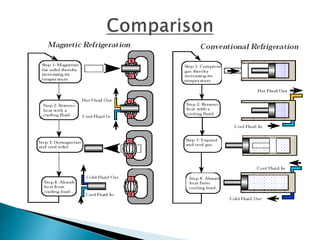
• Process is similar to gas
compression and expansion
cycle as used in regular
refrigeration cycle
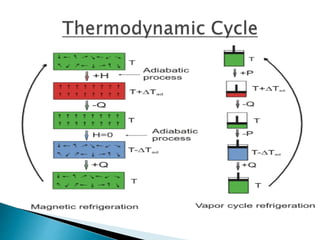
• Steps of thermodynamic Cycle :->
 Adiabatic Magnetization
 Isomagnetic Enthalpy Transfer
Adiabatic demagnetization
Isomagnetic Entropic Transfer
Substance placed in insulated environment
Magnetic field +H increased
This causes the magnetic dipoles of the atoms to align
The net result is that total Entropy of the item is not reduced and
item heats up (T + ΔTad )
Added heat removed by a fluid like water or helium (-Q)
Magnetic Field held constant to prevent the dipoles from
reabsorbing the heat.
After a sufficient cooling Magnetocalric material and coolant are
separated(H=0)
Substance returned to another adiabatic(insulated) condition
Entropy remains constant
Magnetic field is decreased
Thermal Energy causes the Magnetic moments to overcome the
field and sample cools(adiabatic temperature change)
Energy transfers from thermal entropy to magnetic entropy(disorder
of the magnetic dipoles)
 Material is placed in thermal contact with the Environment being
refrigerated.
Magnetic field held constant to prevent material from heating back
up.
Because the working material is cooler than the refrigerated
environment, heat energy migrates into the working material (+Q)
Once the refrigerant and refrigerated environment are in thermal
equilibrium, the cycle continuous.
Components required for
construction :-
 Magnets
 Hot Heat exchanger
 Cold Heat Exchanger
 Drive
 Magneto caloric wheel
 Magnetic Materials
 Regenerators
Super Conducting Magnets
Active Magnetic Regenerators
 MCE is an intrinsic property of a magnetic solid
 Ease of application and removal of magnetic effect is most desired
property of material
Alloys of gadolinium produce 3 to 4 K per tesla of change in
magnetic field are used for magnetic refrigeration or power
generation purposes.
ferrimagnets, antiferromagnets and spin glass systems are not
suitable for this application.
Gd5(SixGe1 − x)4, La(FexSi1 − x)13Hx and MnFeP1 − xAsx alloys are some of
the most promising substitutes for Gadolinium and its alloys
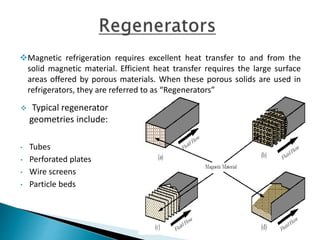
Magnetic refrigeration requires excellent heat transfer to and from the
solid magnetic material. Efficient heat transfer requires the large surface
areas offered by porous materials. When these porous solids are used in
refrigerators, they are referred to as “Regenerators”
 Typical regenerator
geometries include:
• Tubes
• Perforated plates
• Wire screens
• Particle beds
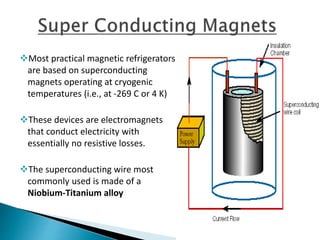
Most practical magnetic refrigerators
are based on superconducting
magnets operating at cryogenic
temperatures (i.e., at -269 C or 4 K)
These devices are electromagnets
that conduct electricity with
essentially no resistive losses.
The superconducting wire most
commonly used is made of a
Niobium-Titanium alloy
A regenerator that undergoes cyclic heat transfer operations and the
magneto caloric effect is called an Active Magnetic Regenerator.
An AMR should be designed to possess the following attributes:-
 High heat transfer rate
 High magneto caloric effect
 Sufficient structural integrity
 Low thermal conduction in the direction of fluid flow
 Affordable materials
 Ease of manufacture
TECHNICAL
• High Efficiency
• Reduced Operating Cost
• Compactness
• Reliability
SOCIO-ECONOMIC
• Competition in Global Market
• Low Capital Cost
• Key Factor to new
technologies
At the present stage of the development of magnetic refrigerators with
permanent magnets, hardly any freezing applications are feasible.
Some of the future applications are:-
Magnetic household refrigeration appliances
Magnetic cooling and air conditioning in buildings and houses
Central cooling system
Refrigeration in medicine
Cooling in food industry and storage
Cooling in transportation
Cooling of electronic equipments
Purchase cost may be high, but running costs are 20% less than the
conventional chillers.
Thus life cycle cost is much less.
Ozone depleting refrigerants are avoided in this system, hence it more
eco-friendly.
Energy conservation and reducing the energy costs are added advantages.
The efficiency of magnetic refrigeration is 60% to 70% as compared to
Carnot cycle.
Magnetic refrigeration is totally maintenance free & mechanically simple
in construction.
As every coin has 2 sides, this technique also posses some
drawbacks to be worked on
 The initial investment is more as compared with conventional
refrigeration.
 The magneto caloric materials are rare earth materials hence their
availability also adds up an disadvantage in MAGNETIC REFRIGERATION.
 It is a technology that has proven to be environmentally safe. Computer
models have shown 25% efficiency improvement over vapor compression
Systems.
 In order to make the magnetic refrigerator commercially Viable, scientists
need to know how to achieve larger temperature swings and also
permanent magnets which can produce strong magnetic fields of order
10 tesla.
 There are still some thermal and magnetic hysteresis problems to be
Solved for the materials that exhibit the MCE to become really useful.
Magnetic refrigeration mechanical

Magnetic refrigeration mechanical

  • 1.
    Presented By:- Aman Agrawal VIIISEM ME 9540278218(Mobile) Department of Mechanical Engineering
  • 2.
    To develop moreefficient and cost-effective small-scale H2 liquefiers as an alternative to vapour-compression cycles using Magnetic refrigeration (adiabatic magnetization) To understand the Principle and mechanism for generating cooling effect using the magnet.
  • 3.
    Magnetic refrigeration isa cooling technology based on the magneto caloric effect. This technique can be used to attain extremely low temperatures (well below 1 Kelvin), as well as the ranges used in common refrigerators, depending on the design of the system. It is a physical process that exploits the magnetic properties of certain solid materials to produce refrigeration. The refrigerant is often a paramagnetic salt, such as cerium magnesium nitrate. It gives cooling nearest to absolute zero than any other method hence it made liquidification of gases easier. At the same time it does not emit any CFC or HCFC compounds hence it never affects our environment specially OZONE layer.
  • 4.
    Magneto caloric effectwas discovered in pure iron in 1881 by E. Warburg. DeDebye (1926) & Giauque (1927) proposed a improved technique of cooling via adiabatic demagnetization independently. The cooling technology was first demonstrated experimentally in 1933 by chemist Nobel Laureate William F.Giauque & his colleague Dr.D.P. MacDougall for cryogenic purposes. In 1997,Prof. Karl A. Gscheidner, Jr. by the lowa State University at Ames Laboratory demonstrated the first near room temperature proof of concept magnetic refrigerator.
  • 5.
    MCE is amagneto-thermodynamic phenomenon in which a reversible change in temperature of a suitable material is caused by exposing the material to changing magnetic field. All magnets bears a property called Currie effect i.e. If a temperature of magnet is increased from lower to higher range at certain temperature magnet looses the magnetic field. Currie temperature Depends on individual property of each material. As Energy input to the magnet is increased the orientation of the magnetic dipoles in a magnet starts loosing orientation. And vice a versa at curie temperature as magnet looses energy to the media it regains the property.
  • 8.
    • Process issimilar to gas compression and expansion cycle as used in regular refrigeration cycle • Steps of thermodynamic Cycle :->  Adiabatic Magnetization  Isomagnetic Enthalpy Transfer Adiabatic demagnetization Isomagnetic Entropic Transfer
  • 9.
    Substance placed ininsulated environment Magnetic field +H increased This causes the magnetic dipoles of the atoms to align The net result is that total Entropy of the item is not reduced and item heats up (T + ΔTad )
  • 10.
    Added heat removedby a fluid like water or helium (-Q) Magnetic Field held constant to prevent the dipoles from reabsorbing the heat. After a sufficient cooling Magnetocalric material and coolant are separated(H=0)
  • 11.
    Substance returned toanother adiabatic(insulated) condition Entropy remains constant Magnetic field is decreased Thermal Energy causes the Magnetic moments to overcome the field and sample cools(adiabatic temperature change) Energy transfers from thermal entropy to magnetic entropy(disorder of the magnetic dipoles)
  • 12.
     Material isplaced in thermal contact with the Environment being refrigerated. Magnetic field held constant to prevent material from heating back up. Because the working material is cooler than the refrigerated environment, heat energy migrates into the working material (+Q) Once the refrigerant and refrigerated environment are in thermal equilibrium, the cycle continuous.
  • 14.
    Components required for construction:-  Magnets  Hot Heat exchanger  Cold Heat Exchanger  Drive  Magneto caloric wheel
  • 15.
     Magnetic Materials Regenerators Super Conducting Magnets Active Magnetic Regenerators
  • 17.
     MCE isan intrinsic property of a magnetic solid  Ease of application and removal of magnetic effect is most desired property of material Alloys of gadolinium produce 3 to 4 K per tesla of change in magnetic field are used for magnetic refrigeration or power generation purposes. ferrimagnets, antiferromagnets and spin glass systems are not suitable for this application. Gd5(SixGe1 − x)4, La(FexSi1 − x)13Hx and MnFeP1 − xAsx alloys are some of the most promising substitutes for Gadolinium and its alloys
  • 18.
    Magnetic refrigeration requiresexcellent heat transfer to and from the solid magnetic material. Efficient heat transfer requires the large surface areas offered by porous materials. When these porous solids are used in refrigerators, they are referred to as “Regenerators”  Typical regenerator geometries include: • Tubes • Perforated plates • Wire screens • Particle beds
  • 19.
    Most practical magneticrefrigerators are based on superconducting magnets operating at cryogenic temperatures (i.e., at -269 C or 4 K) These devices are electromagnets that conduct electricity with essentially no resistive losses. The superconducting wire most commonly used is made of a Niobium-Titanium alloy
  • 20.
    A regenerator thatundergoes cyclic heat transfer operations and the magneto caloric effect is called an Active Magnetic Regenerator. An AMR should be designed to possess the following attributes:-  High heat transfer rate  High magneto caloric effect  Sufficient structural integrity  Low thermal conduction in the direction of fluid flow  Affordable materials  Ease of manufacture
  • 21.
    TECHNICAL • High Efficiency •Reduced Operating Cost • Compactness • Reliability SOCIO-ECONOMIC • Competition in Global Market • Low Capital Cost • Key Factor to new technologies
  • 22.
    At the presentstage of the development of magnetic refrigerators with permanent magnets, hardly any freezing applications are feasible. Some of the future applications are:- Magnetic household refrigeration appliances Magnetic cooling and air conditioning in buildings and houses Central cooling system Refrigeration in medicine Cooling in food industry and storage Cooling in transportation Cooling of electronic equipments
  • 23.
    Purchase cost maybe high, but running costs are 20% less than the conventional chillers. Thus life cycle cost is much less. Ozone depleting refrigerants are avoided in this system, hence it more eco-friendly. Energy conservation and reducing the energy costs are added advantages. The efficiency of magnetic refrigeration is 60% to 70% as compared to Carnot cycle. Magnetic refrigeration is totally maintenance free & mechanically simple in construction.
  • 24.
    As every coinhas 2 sides, this technique also posses some drawbacks to be worked on  The initial investment is more as compared with conventional refrigeration.  The magneto caloric materials are rare earth materials hence their availability also adds up an disadvantage in MAGNETIC REFRIGERATION.
  • 25.
     It isa technology that has proven to be environmentally safe. Computer models have shown 25% efficiency improvement over vapor compression Systems.  In order to make the magnetic refrigerator commercially Viable, scientists need to know how to achieve larger temperature swings and also permanent magnets which can produce strong magnetic fields of order 10 tesla.  There are still some thermal and magnetic hysteresis problems to be Solved for the materials that exhibit the MCE to become really useful.