SEMINAR  ON   MAGNETIC  REFRIGERATION PRESENTED  BY   GANESH  PRALHAD  BHARAMBE UNDER  THE  ABLE  GUIDANCE  OF   PROF.  A. M. PATIL. DEPARTMENT  OF  MECHANICAL  ENGINEERING, PADMABHUSHAN  VASANTRAODADA  PATIL  INSTITUTE  OF  TECHNOLOGY, BUDHAGAON,  DIST.  SANGLI.  MAHARASHTRA.
ACKNOWLEDGEMENT THE AUTHOR OF THIS SEMINAR IS THANKFUL TO PROF. A.M. PATIL AND PROF. DANGE  FROM MECHANICAL DEPARTMENT FOR GIVING VALUABLE GUIDANCE FOR PREPARING THIS SEMINAR. THEIR  INSPIRATIONS HAVE SUCCEEDED IN GIVING A FULL FORM AND SHAPE OF THIS SUBJECT IN DEPTH. GP BHARAMBE
CONTENTS > Basic  principles  of  magnetic  refrigeration >Thermodynamic cycle   > Materials  : Working materials,  Development   in materials and Nano composits    which can play important role in    upgradin the efficiency of materials  >Commercial  aspects >Historical  background
MAGETIC  REFRIGERATION AIMS  OF  SEMINAR :  To understand the principle and mechanism for generating cooling effect using the magnet. Materials  and process  Commercial  aspects . Nano  technology  History Practical  cases of  equipment building
Introduction  :  Principle Mageto  calorific  effect  is the basic  principle  on which the cooling  is achieved. All magnets  bears a property called  Currie  effect  i.e.  If a temperature  of  magnet  is  increased  from lower to higher range at  certain  temperature magnet  looses the magnetic field.  Currie  temperature.  Depends on individual  property of each material. As Energy  input to the magnet  is increased the orientation of the magetic dipoles in a maget starts loosing orientation.  And vice a versa  at currie temperature as maget looses energy to the media it regains the property.
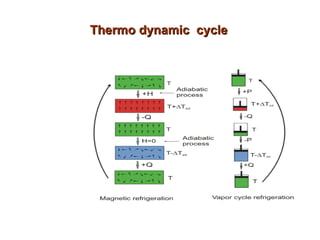
Thermo dynamic  cycle
DETAILS  OF THE THERMODYNAMIC  CYCLE  PROCESS  IS  SIMILAR  TO  GAS  COMPRESSION  AND EXPANSION  CYCLE  AS  USED  IN REGULAR  REFRIGERATION  CYCLE.  Steps  of  thermodynamic  cycle -  Adiabatic  magnetization  Isomagnetic  enthalpic  transfer  Adiabatic  demagnetization  Isomagnetic  entropic  transfer
Adiabatic  magnetization  Procedure  to be followed : > Substance placed in insulated environment.  > Magnetic field +H  increased.  > Magnetic  dipoles of atoms to align, thereby material decreases. > Total  Entropy of the item is not reduced, and item heats up
Isomagnetic  enthalpic  transfer >  Added  heat  removed  by  fluid, gas – gaseous or  liquid helium  > Magnetic  field  held  constant to prevent the dipoles  from  reabsorbing the heat.  > After  a sufficient  cooling  magnetocaloric  material  and  coolant are seperated
Adiabatic  Demagnetization >Substance  returned to another adiabatic  ( insulated ) condition >Entropy  remains  constant >Magnetic  field  is decreased,  >Thermal energy causes the magnetic moments to overcome the field and sample cools ( adiabatic temperature change ) >Energy transfers from thermal entropy to magnetic entropy ( disorder of the magnetic dipoles )
Isomagnetic  entropic  transfer > Material  is  placed  in thermal contact with the environment being refrigerated. > Magnetic  field  held  constant to prevent from heating back up  > Because the working material is cooler than the refrigerated environment, heat energy migrates into the working material ( +Q ) ***** Once the refrigerent and refrigerated environment are in thermal equillibrium, the cycle begins a new
Advantages of Magnetic Refrigeration > Purchase cost may be high, but running costs are 20%  less than the conventional chillers > Thus life cycle cost is much less. > Ozone depleting refrigerants are avoided in this system,  hence it more eco-friendly. > Energy saving would lessen the strain on our household appliances > Energy conservation and reducing the energy costs are added advantages.
Working  Materials > Magneto caloric effect is an intrinsic porperty of magnetic solid.  > Ease of application and removal of magnetic effect  is most desired propery of material.  It is individual  characteristics  and strongly depends on :  Curie temperature,  Degree of freedom for magnetic dipoles during ordering and randomization of particals. >  ferrimagnets, antiferromagnets and spin glass sytems are not suitable for  this application Alloys  of  gadolinium producing 3 to 4 K per tesla of change in magnetic field are used for magnetic refrigeration or power generation purposes.
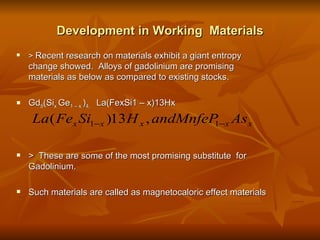
Development in Working  Materials >  Recent research on materials exhibit a giant entropy change showed.  Alloys of gadolinium are promising materials as below as compared to existing stocks. Gd 5 (Si x  Ge 1 – x  ) 4,  La(FexSi1 – x)13Hx  >  These are some of the most promising substitute  for Gadolinium. Such materials are called as magnetocaloric effect materials
Development in Working  Materials Magnetic  refrigeration  works in the vicinity of a material’s Curie temperature The range of operation is =  +/- 20  In 1950’s  MRC  operated near by 1 to 30 K, in 1976 this range had expanded to 80 C around the Curie temperature. 1997 lead this activity to built commecial and industrial use. Using the Ericcson’s cycle system refrigerator was built and used for 1500 hrs continuously. Gd alloys, most notably  Gd alloy, most notably Gd5(Si2Ge2), due to simultaneous magnetic and crystallographic first order transition, the adiabatic temperature rise was 30%  higher than that of Just Gd and 200 – 600 % than  previous refrigerent materials.
Development in Working  Materials Material  Dy0.5Er0.5)Al2 has paramagnetic to ferromagnetic transition at 40 k where the large peak occur.  Similar is Gd5(Si0.33Ge3.67) shows enormous peak It is possible to predict weight to mass ratio of components which produce maximum constant magnetic entropy.  This technique allows one to find a suitable material composition which has a constant slope on MCE vs temperature plot.  It should have good magnetocaloric effect and could withstand the process of cooling.  Gadolinium silicon germanium ternary system ( Gd-Si-Ge ),  with stoichiometry of Gd5(SixGe1-x)4 Transition temperatures of the alloys formed by Gd, Tb, Dy, Ho, Er, Tm and Lu shows transitions with transitions above 180 k.
Development in Working  Materials 10 Amorphous materials  shows high resistivity and improved corrosion resistance which aids the process of magnetic refrigeration. Amorphous alloys may be able to fill up the gaps between  100 to 200  k Gd0.54Er0.46)NiAl  has 11 top effects, is currently being implemented in Erriccson cycle refrigerators.
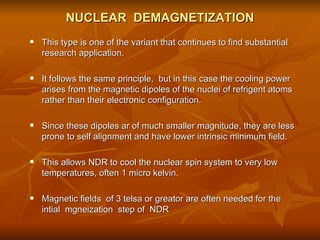
NUCLEAR  DEMAGNETIZATION This type is one of the variant that continues to find substantial research application. It follows the same principle,  but in this case the cooling power  arises from the magnetic dipoles of the nuclei of refrigent atoms rather than their electronic configuration.  Since these dipoles ar of much smaller magnitude, they are less prone to self alignment and have lower intrinsic minimum field.  This allows NDR to cool the nuclear spin system to very low temperatures, often 1 micro kelvin.  Magnetic fields  of 3 telsa or greator are often needed for the intial  mgneization  step of  NDR
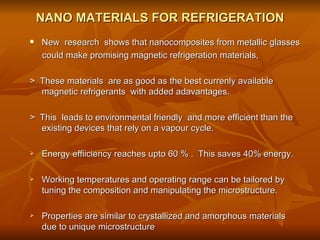
NANO MATERIALS FOR REFRIGERATION New  research  shows that nanocomposites from metallic glasses  could make promising magnetic refrigeration materials, >  These materials  are as good as the best currenly available magnetic refrigerants  with added adavantages. >  This  leads to environmental friendly  and more efficient than the existing devices that rely on a vapour cycle. Energy effiiciency reaches upto 60 % .  This saves 40% energy. Working temperatures and operating range can be tailored by tuning the composition and manipulating the microstructure. Properties are similar to crystallized and amorphous materials due to unique microstructure
NUCLEAR  DEMAGNETIZATION This type is one of the variant that continues to find substantial research application. It follows the same principle,  but in this case the cooling power  arises from the magnetic dipoles of the nuclei of refrigent atoms rather than their electronic configuration.  Since these dipoles ar of much smaller magnitude, they are less prone to self alignment and have lower intrinsic minimum field.  This allows NDR to cool the nuclear spin system to very low temperatures, often 1 micro kelvin.  Magnetic fields  of 3 telsa or greator are often needed for the intial  mgneization  step of  NDR
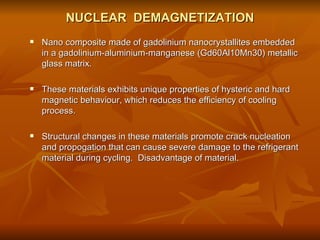
NUCLEAR  DEMAGNETIZATION Nano composite made of gadolinium nanocrystallites embedded in a gadolinium-aluminium-manganese (Gd60Al10Mn30) metallic glass matrix. These materials exhibits unique properties of hysteric and hard magnetic behaviour, which reduces the efficiency of cooling process.  Structural changes in these materials promote crack nucleation and propogation that can cause severe damage to the refrigerant material during cycling.  Disadvantage of material.
Promoting  energy  efficeincy  Thanking you

Seminar On Magnetic Refrigeration

  • 1.
    SEMINAR ON MAGNETIC REFRIGERATION PRESENTED BY GANESH PRALHAD BHARAMBE UNDER THE ABLE GUIDANCE OF PROF. A. M. PATIL. DEPARTMENT OF MECHANICAL ENGINEERING, PADMABHUSHAN VASANTRAODADA PATIL INSTITUTE OF TECHNOLOGY, BUDHAGAON, DIST. SANGLI. MAHARASHTRA.
  • 2.
    ACKNOWLEDGEMENT THE AUTHOROF THIS SEMINAR IS THANKFUL TO PROF. A.M. PATIL AND PROF. DANGE FROM MECHANICAL DEPARTMENT FOR GIVING VALUABLE GUIDANCE FOR PREPARING THIS SEMINAR. THEIR INSPIRATIONS HAVE SUCCEEDED IN GIVING A FULL FORM AND SHAPE OF THIS SUBJECT IN DEPTH. GP BHARAMBE
  • 3.
    CONTENTS > Basic principles of magnetic refrigeration >Thermodynamic cycle > Materials : Working materials, Development in materials and Nano composits which can play important role in upgradin the efficiency of materials >Commercial aspects >Historical background
  • 4.
    MAGETIC REFRIGERATIONAIMS OF SEMINAR : To understand the principle and mechanism for generating cooling effect using the magnet. Materials and process Commercial aspects . Nano technology History Practical cases of equipment building
  • 5.
    Introduction : Principle Mageto calorific effect is the basic principle on which the cooling is achieved. All magnets bears a property called Currie effect i.e. If a temperature of magnet is increased from lower to higher range at certain temperature magnet looses the magnetic field. Currie temperature. Depends on individual property of each material. As Energy input to the magnet is increased the orientation of the magetic dipoles in a maget starts loosing orientation. And vice a versa at currie temperature as maget looses energy to the media it regains the property.
  • 6.
  • 7.
    DETAILS OFTHE THERMODYNAMIC CYCLE PROCESS IS SIMILAR TO GAS COMPRESSION AND EXPANSION CYCLE AS USED IN REGULAR REFRIGERATION CYCLE. Steps of thermodynamic cycle - Adiabatic magnetization Isomagnetic enthalpic transfer Adiabatic demagnetization Isomagnetic entropic transfer
  • 8.
    Adiabatic magnetization Procedure to be followed : > Substance placed in insulated environment. > Magnetic field +H increased. > Magnetic dipoles of atoms to align, thereby material decreases. > Total Entropy of the item is not reduced, and item heats up
  • 9.
    Isomagnetic enthalpic transfer > Added heat removed by fluid, gas – gaseous or liquid helium > Magnetic field held constant to prevent the dipoles from reabsorbing the heat. > After a sufficient cooling magnetocaloric material and coolant are seperated
  • 10.
    Adiabatic Demagnetization>Substance returned to another adiabatic ( insulated ) condition >Entropy remains constant >Magnetic field is decreased, >Thermal energy causes the magnetic moments to overcome the field and sample cools ( adiabatic temperature change ) >Energy transfers from thermal entropy to magnetic entropy ( disorder of the magnetic dipoles )
  • 11.
    Isomagnetic entropic transfer > Material is placed in thermal contact with the environment being refrigerated. > Magnetic field held constant to prevent from heating back up > Because the working material is cooler than the refrigerated environment, heat energy migrates into the working material ( +Q ) ***** Once the refrigerent and refrigerated environment are in thermal equillibrium, the cycle begins a new
  • 12.
    Advantages of MagneticRefrigeration > Purchase cost may be high, but running costs are 20% less than the conventional chillers > Thus life cycle cost is much less. > Ozone depleting refrigerants are avoided in this system, hence it more eco-friendly. > Energy saving would lessen the strain on our household appliances > Energy conservation and reducing the energy costs are added advantages.
  • 13.
    Working Materials> Magneto caloric effect is an intrinsic porperty of magnetic solid. > Ease of application and removal of magnetic effect is most desired propery of material. It is individual characteristics and strongly depends on : Curie temperature, Degree of freedom for magnetic dipoles during ordering and randomization of particals. > ferrimagnets, antiferromagnets and spin glass sytems are not suitable for this application Alloys of gadolinium producing 3 to 4 K per tesla of change in magnetic field are used for magnetic refrigeration or power generation purposes.
  • 14.
    Development in Working Materials > Recent research on materials exhibit a giant entropy change showed. Alloys of gadolinium are promising materials as below as compared to existing stocks. Gd 5 (Si x Ge 1 – x ) 4, La(FexSi1 – x)13Hx > These are some of the most promising substitute for Gadolinium. Such materials are called as magnetocaloric effect materials
  • 15.
    Development in Working Materials Magnetic refrigeration works in the vicinity of a material’s Curie temperature The range of operation is = +/- 20 In 1950’s MRC operated near by 1 to 30 K, in 1976 this range had expanded to 80 C around the Curie temperature. 1997 lead this activity to built commecial and industrial use. Using the Ericcson’s cycle system refrigerator was built and used for 1500 hrs continuously. Gd alloys, most notably Gd alloy, most notably Gd5(Si2Ge2), due to simultaneous magnetic and crystallographic first order transition, the adiabatic temperature rise was 30% higher than that of Just Gd and 200 – 600 % than previous refrigerent materials.
  • 16.
    Development in Working Materials Material Dy0.5Er0.5)Al2 has paramagnetic to ferromagnetic transition at 40 k where the large peak occur. Similar is Gd5(Si0.33Ge3.67) shows enormous peak It is possible to predict weight to mass ratio of components which produce maximum constant magnetic entropy. This technique allows one to find a suitable material composition which has a constant slope on MCE vs temperature plot. It should have good magnetocaloric effect and could withstand the process of cooling. Gadolinium silicon germanium ternary system ( Gd-Si-Ge ), with stoichiometry of Gd5(SixGe1-x)4 Transition temperatures of the alloys formed by Gd, Tb, Dy, Ho, Er, Tm and Lu shows transitions with transitions above 180 k.
  • 17.
    Development in Working Materials 10 Amorphous materials shows high resistivity and improved corrosion resistance which aids the process of magnetic refrigeration. Amorphous alloys may be able to fill up the gaps between 100 to 200 k Gd0.54Er0.46)NiAl has 11 top effects, is currently being implemented in Erriccson cycle refrigerators.
  • 18.
    NUCLEAR DEMAGNETIZATIONThis type is one of the variant that continues to find substantial research application. It follows the same principle, but in this case the cooling power arises from the magnetic dipoles of the nuclei of refrigent atoms rather than their electronic configuration. Since these dipoles ar of much smaller magnitude, they are less prone to self alignment and have lower intrinsic minimum field. This allows NDR to cool the nuclear spin system to very low temperatures, often 1 micro kelvin. Magnetic fields of 3 telsa or greator are often needed for the intial mgneization step of NDR
  • 19.
    NANO MATERIALS FORREFRIGERATION New research shows that nanocomposites from metallic glasses could make promising magnetic refrigeration materials, > These materials are as good as the best currenly available magnetic refrigerants with added adavantages. > This leads to environmental friendly and more efficient than the existing devices that rely on a vapour cycle. Energy effiiciency reaches upto 60 % . This saves 40% energy. Working temperatures and operating range can be tailored by tuning the composition and manipulating the microstructure. Properties are similar to crystallized and amorphous materials due to unique microstructure
  • 20.
    NUCLEAR DEMAGNETIZATIONThis type is one of the variant that continues to find substantial research application. It follows the same principle, but in this case the cooling power arises from the magnetic dipoles of the nuclei of refrigent atoms rather than their electronic configuration. Since these dipoles ar of much smaller magnitude, they are less prone to self alignment and have lower intrinsic minimum field. This allows NDR to cool the nuclear spin system to very low temperatures, often 1 micro kelvin. Magnetic fields of 3 telsa or greator are often needed for the intial mgneization step of NDR
  • 21.
    NUCLEAR DEMAGNETIZATIONNano composite made of gadolinium nanocrystallites embedded in a gadolinium-aluminium-manganese (Gd60Al10Mn30) metallic glass matrix. These materials exhibits unique properties of hysteric and hard magnetic behaviour, which reduces the efficiency of cooling process. Structural changes in these materials promote crack nucleation and propogation that can cause severe damage to the refrigerant material during cycling. Disadvantage of material.
  • 22.
    Promoting energy efficeincy Thanking you