 Introduction
 Refrigeration
 Magnetic refrigeration
 Magneto calorific effect
 Working principle
 Magnetic refrigeration cycle
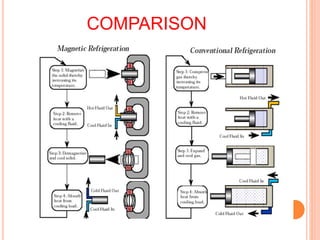
 Comparison
 Components
 Future applications
 Advantages
 Disadvantages
 Magnetic refrigeration under development
 Conclusion
CONTENTs
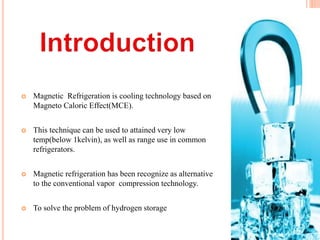
 Magnetic Refrigeration is cooling technology based on
Magneto Caloric Effect(MCE).
 This technique can be used to attained very low
temp(below 1kelvin), as well as range use in common
refrigerators.
 Magnetic refrigeration has been recognize as alternative
to the conventional vapor compression technology.
 To solve the problem of hydrogen storage
REFRIGERATION
 Refrigeration is the process of removing heat from an enclosed space, or
from a substance, and moving it to a place where it is unobjectionable.
 The primary purpose of refrigeration is lowering the temperature of the
enclosed space or substance and then maintaining that lower temperature.
 Cold is the absence of heat, hence in order to decrease a temperature, one
“removes heat", rather than "adding cold."
MAGNETIC
REFRIGERATION
 Magnetic refrigeration, or adiabatic demagnetization, is a cooling
technology based on the magneto caloric effect, an intrinsic property of
magnetic solids.
 A strong magnetic field is applied to the refrigerant, forcing its various
magnetic dipoles to align and putting these degrees of freedom of the
refrigerant into a state of lowered entropy.
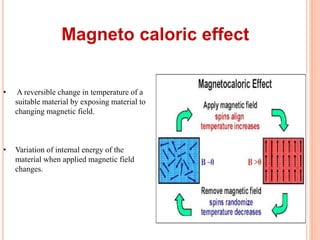
• A reversible change in temperature of a
suitable material by exposing material to
changing magnetic field.
• Variation of internal energy of the
material when applied magnetic field
changes.
WORKING PRINCIPLE
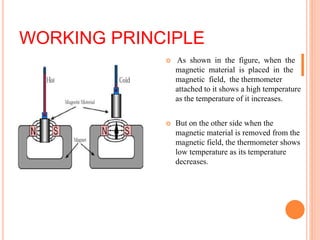
 As shown in the figure, when the
magnetic material is placed in the
magnetic field, the thermometer
attached to it shows a high temperature
as the temperature of it increases.
 But on the other side when the
magnetic material is removed from the
magnetic field, the thermometer shows
low temperature as its temperature
decreases.
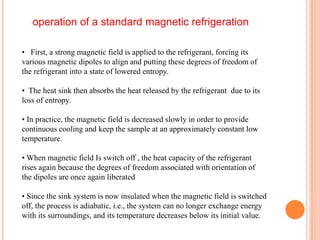
• First, a strong magnetic field is applied to the refrigerant, forcing its
various magnetic dipoles to align and putting these degrees of freedom of
the refrigerant into a state of lowered entropy.
• The heat sink then absorbs the heat released by the refrigerant due to its
loss of entropy.
• In practice, the magnetic field is decreased slowly in order to provide
continuous cooling and keep the sample at an approximately constant low
temperature.
• When magnetic field Is switch off , the heat capacity of the refrigerant
rises again because the degrees of freedom associated with orientation of
the dipoles are once again liberated
• Since the sink system is now insulated when the magnetic field is switched
off, the process is adiabatic, i.e., the system can no longer exchange energy
with its surroundings, and its temperature decreases below its initial value.
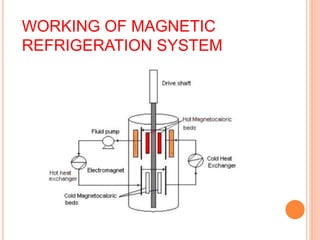
operation of a standard magnetic refrigeration
WORKING OF MAGNETIC
REFRIGERATION SYSTEM
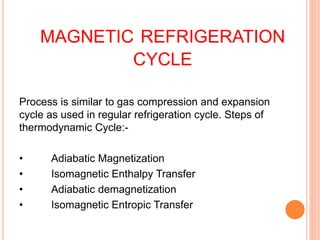
MAGNETIC REFRIGERATION
CYCLE
Process is similar to gas compression and expansion
cycle as used in regular refrigeration cycle. Steps of
thermodynamic Cycle:-
• Adiabatic Magnetization
• Isomagnetic Enthalpy Transfer
• Adiabatic demagnetization
• Isomagnetic Entropic Transfer
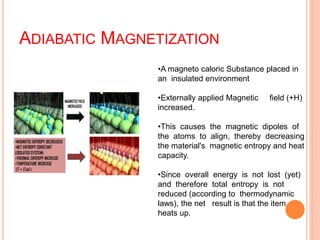
ADIABATIC MAGNETIZATION
•A magneto caloric Substance placed in
an insulated environment
•Externally applied Magnetic field (+H)
increased.
•This causes the magnetic dipoles of
the atoms to align, thereby decreasing
the material's magnetic entropy and heat
capacity.
•Since overall energy is not lost (yet)
and therefore total entropy is not
reduced (according to thermodynamic
laws), the net result is that the item
heats up.
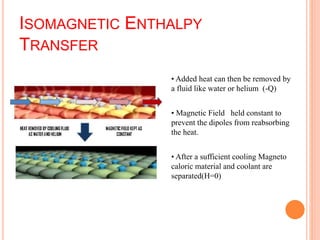
ISOMAGNETIC ENTHALPY
TRANSFER
• Added heat can then be removed by
a fluid like water or helium (-Q)
• Magnetic Field held constant to
prevent the dipoles from reabsorbing
the heat.
• After a sufficient cooling Magneto
caloric material and coolant are
separated(H=0)
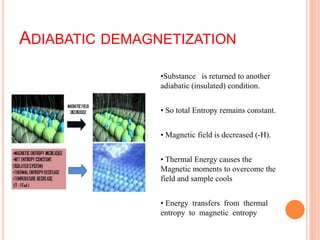
ADIABATIC DEMAGNETIZATION
•Substance is returned to another
adiabatic (insulated) condition.
• So total Entropy remains constant.
• Magnetic field is decreased (-H).
• Thermal Energy causes the
Magnetic moments to overcome the
field and sample cools
• Energy transfers from thermal
entropy to magnetic entropy
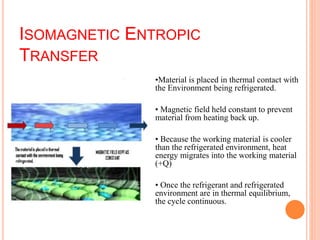
ISOMAGNETIC ENTROPIC
TRANSFER
•Material is placed in thermal contact with
the Environment being refrigerated.
• Magnetic field held constant to prevent
material from heating back up.
• Because the working material is cooler
than the refrigerated environment, heat
energy migrates into the working material
(+Q)
• Once the refrigerant and refrigerated
environment are in thermal equilibrium,
the cycle continuous.
COMPARISON
COMPONENTS
 Magnets
 Hot Heat exchanger
 Cold Heat Exchanger
 Drive
FUTURE APPLICATIONS
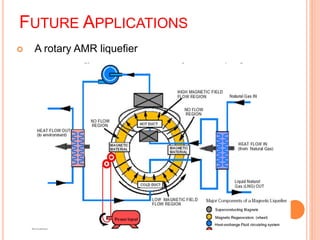
 A rotary AMR liquefier
FUTURE APPLICATIONS
(CONTINUED)
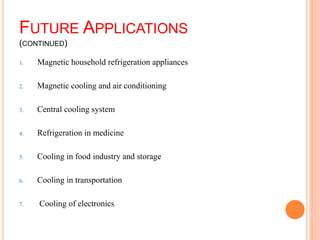
1. Magnetic household refrigeration appliances
2. Magnetic cooling and air conditioning
3. Central cooling system
4. Refrigeration in medicine
5. Cooling in food industry and storage
6. Cooling in transportation
7. Cooling of electronics
ADVANTAGES OVER
VAPOUR COMPRESSION
AND
VAPOUR ABSORPTION CYCLES
1. Compactness, and higher reliability due to solid working materials
instead of a gas.
2. It eliminates the need for the most inefficient part of today's refrigerators,
the compressor.
3. Magnetic refrigeration is seen as an environmentally friendly.
•Purchase cost may be high, but running costs are 20% less than the
conventional chillers. Thus life cycle cost is much less.
•Ozone depleting refrigerants are avoided in this system, hence it more eco-
friendly.
• The efficiency of magnetic refrigeration is 60% to 70% as compared to
Carnot cycle.
•Magnetic refrigeration is totally maintenance free & mechanically simple
in construction.
•“Green” technology, no use of conventional refrigerants
•Noise less technology (no compressor) and higher energy efficiency
•Simple design of machines, e.G. Rotary porous heat exchanger refrigerator
Potential Advantages
DISADVANTAGES
 Initial cost
 Magneto caloric material are rare earth metals
 Temperature span.
 Protection of electronic components from magnetic fields.
 Curie temperature of the magneto caloric material
 Moving machines need high precision
CONCLUSION
 No hazardous chemicals used [Environment friendly]
 Improved efficiency about 25% increase
 Larger temperature span
 Permanent magnet need to produce strong magnetic field over 10tesla
 Some thermal and hysteresis problem
WHY IS IT STILL UNDER CONSTRUCTION?
seminar on Magnetic Refrigeration - Solid refrigerant

seminar on Magnetic Refrigeration - Solid refrigerant

  • 2.
     Introduction  Refrigeration Magnetic refrigeration  Magneto calorific effect  Working principle  Magnetic refrigeration cycle  Comparison  Components  Future applications  Advantages  Disadvantages  Magnetic refrigeration under development  Conclusion CONTENTs
  • 3.
     Magnetic Refrigerationis cooling technology based on Magneto Caloric Effect(MCE).  This technique can be used to attained very low temp(below 1kelvin), as well as range use in common refrigerators.  Magnetic refrigeration has been recognize as alternative to the conventional vapor compression technology.  To solve the problem of hydrogen storage
  • 4.
    REFRIGERATION  Refrigeration isthe process of removing heat from an enclosed space, or from a substance, and moving it to a place where it is unobjectionable.  The primary purpose of refrigeration is lowering the temperature of the enclosed space or substance and then maintaining that lower temperature.  Cold is the absence of heat, hence in order to decrease a temperature, one “removes heat", rather than "adding cold."
  • 5.
    MAGNETIC REFRIGERATION  Magnetic refrigeration,or adiabatic demagnetization, is a cooling technology based on the magneto caloric effect, an intrinsic property of magnetic solids.  A strong magnetic field is applied to the refrigerant, forcing its various magnetic dipoles to align and putting these degrees of freedom of the refrigerant into a state of lowered entropy.
  • 6.
    • A reversiblechange in temperature of a suitable material by exposing material to changing magnetic field. • Variation of internal energy of the material when applied magnetic field changes.
  • 7.
    WORKING PRINCIPLE  Asshown in the figure, when the magnetic material is placed in the magnetic field, the thermometer attached to it shows a high temperature as the temperature of it increases.  But on the other side when the magnetic material is removed from the magnetic field, the thermometer shows low temperature as its temperature decreases.
  • 8.
    • First, astrong magnetic field is applied to the refrigerant, forcing its various magnetic dipoles to align and putting these degrees of freedom of the refrigerant into a state of lowered entropy. • The heat sink then absorbs the heat released by the refrigerant due to its loss of entropy. • In practice, the magnetic field is decreased slowly in order to provide continuous cooling and keep the sample at an approximately constant low temperature. • When magnetic field Is switch off , the heat capacity of the refrigerant rises again because the degrees of freedom associated with orientation of the dipoles are once again liberated • Since the sink system is now insulated when the magnetic field is switched off, the process is adiabatic, i.e., the system can no longer exchange energy with its surroundings, and its temperature decreases below its initial value. operation of a standard magnetic refrigeration
  • 9.
  • 10.
    MAGNETIC REFRIGERATION CYCLE Process issimilar to gas compression and expansion cycle as used in regular refrigeration cycle. Steps of thermodynamic Cycle:- • Adiabatic Magnetization • Isomagnetic Enthalpy Transfer • Adiabatic demagnetization • Isomagnetic Entropic Transfer
  • 11.
    ADIABATIC MAGNETIZATION •A magnetocaloric Substance placed in an insulated environment •Externally applied Magnetic field (+H) increased. •This causes the magnetic dipoles of the atoms to align, thereby decreasing the material's magnetic entropy and heat capacity. •Since overall energy is not lost (yet) and therefore total entropy is not reduced (according to thermodynamic laws), the net result is that the item heats up.
  • 12.
    ISOMAGNETIC ENTHALPY TRANSFER • Addedheat can then be removed by a fluid like water or helium (-Q) • Magnetic Field held constant to prevent the dipoles from reabsorbing the heat. • After a sufficient cooling Magneto caloric material and coolant are separated(H=0)
  • 13.
    ADIABATIC DEMAGNETIZATION •Substance isreturned to another adiabatic (insulated) condition. • So total Entropy remains constant. • Magnetic field is decreased (-H). • Thermal Energy causes the Magnetic moments to overcome the field and sample cools • Energy transfers from thermal entropy to magnetic entropy
  • 14.
    ISOMAGNETIC ENTROPIC TRANSFER •Material isplaced in thermal contact with the Environment being refrigerated. • Magnetic field held constant to prevent material from heating back up. • Because the working material is cooler than the refrigerated environment, heat energy migrates into the working material (+Q) • Once the refrigerant and refrigerated environment are in thermal equilibrium, the cycle continuous.
  • 15.
  • 16.
    COMPONENTS  Magnets  HotHeat exchanger  Cold Heat Exchanger  Drive
  • 17.
    FUTURE APPLICATIONS  Arotary AMR liquefier
  • 18.
    FUTURE APPLICATIONS (CONTINUED) 1. Magnetichousehold refrigeration appliances 2. Magnetic cooling and air conditioning 3. Central cooling system 4. Refrigeration in medicine 5. Cooling in food industry and storage 6. Cooling in transportation 7. Cooling of electronics
  • 19.
    ADVANTAGES OVER VAPOUR COMPRESSION AND VAPOURABSORPTION CYCLES 1. Compactness, and higher reliability due to solid working materials instead of a gas. 2. It eliminates the need for the most inefficient part of today's refrigerators, the compressor. 3. Magnetic refrigeration is seen as an environmentally friendly.
  • 20.
    •Purchase cost maybe high, but running costs are 20% less than the conventional chillers. Thus life cycle cost is much less. •Ozone depleting refrigerants are avoided in this system, hence it more eco- friendly. • The efficiency of magnetic refrigeration is 60% to 70% as compared to Carnot cycle. •Magnetic refrigeration is totally maintenance free & mechanically simple in construction. •“Green” technology, no use of conventional refrigerants •Noise less technology (no compressor) and higher energy efficiency •Simple design of machines, e.G. Rotary porous heat exchanger refrigerator Potential Advantages
  • 21.
    DISADVANTAGES  Initial cost Magneto caloric material are rare earth metals  Temperature span.  Protection of electronic components from magnetic fields.  Curie temperature of the magneto caloric material  Moving machines need high precision
  • 22.
    CONCLUSION  No hazardouschemicals used [Environment friendly]  Improved efficiency about 25% increase  Larger temperature span  Permanent magnet need to produce strong magnetic field over 10tesla  Some thermal and hysteresis problem WHY IS IT STILL UNDER CONSTRUCTION?