Magnetic Effects of Electric
Currents
Prepared by Dept Physics
Sangita Holkar
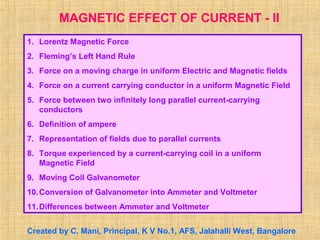
MAGNETIC EFFECT OF CURRENT - II
1. Lorentz Magnetic Force
2. Fleming’s Left Hand Rule
3. Force on a moving charge in uniform Electric and Magnetic fields
4. Force on a current carrying conductor in a uniform Magnetic Field
5. Force between two infinitely long parallel current-carrying
conductors
6. Definition of ampere
7. Representation of fields due to parallel currents
8. Torque experienced by a current-carrying coil in a uniform
Magnetic Field
9. Moving Coil Galvanometer
10.Conversion of Galvanometer into Ammeter and Voltmeter
11.Differences between Ammeter and Voltmeter
Created by C. Mani, Principal, K V No.1, AFS, Jalahalli West, Bangalore
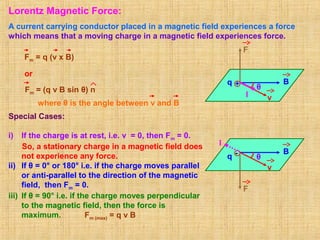
Lorentz Magnetic Force:
A current carrying conductor placed in a magnetic field experiences a force
which means that a moving charge in a magnetic field experiences force.
Fm = q (v x B)
+q B
v
F
I
θ
-q
B
v
F
θ
Fm = (q v B sin θ) n
where θ is the angle between v and B
Special Cases:
i) If the charge is at rest, i.e. v = 0, then Fm = 0.
So, a stationary charge in a magnetic field does
not experience any force.
ii) If θ = 0° or 180° i.e. if the charge moves parallel
or anti-parallel to the direction of the magnetic
field, then Fm = 0.
iii) If θ = 90° i.e. if the charge moves perpendicular
to the magnetic field, then the force is
maximum. Fm (max) = q v B
or
I
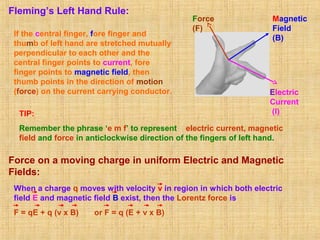
Fleming’s Left Hand Rule:
Force
(F)
Magnetic
Field
(B)
Electric
Current
(I)
If the central finger, fore finger and
thumb of left hand are stretched mutually
perpendicular to each other and the
central finger points to current, fore
finger points to magnetic field, then
thumb points in the direction of motion
(force) on the current carrying conductor.
TIP:
Remember the phrase ‘e m f’ to represent electric current, magnetic
field and force in anticlockwise direction of the fingers of left hand.
Force on a moving charge in uniform Electric and Magnetic
Fields:
When a charge q moves with velocity v in region in which both electric
field E and magnetic field B exist, then the Lorentz force is
F = qE + q (v x B) or F = q (E + v x B)
Force on a current-carrying conductor in a uniform
Magnetic Field:
θ
vd
dl
F
I
I
B
A l
Force experienced by each electron in
the conductor is
f = - e (vd x B)
If n be the number density of electrons,
A be the area of cross section of the
conductor, then no. of electrons in the
element dl is n A dl.
where I = neAvd and -ve sign represents that
the direction of dl is opposite to that of vd)
or F = I l B sin θ
-
Force experienced by the electrons in dl is
dF = n A dl [ - e (vd x B)] = - n e A vd (dl X B)
= I (dl x B)
F = ∫ dF = ∫ I (dl x B)
F = I (l x B)
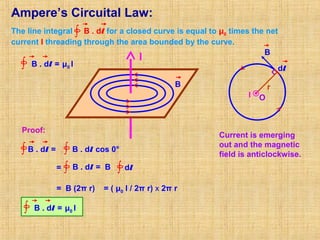
Ampere’s Circuital Law:
The line integral B . dl for a closed curve is equal to μ0 times the net
current I threading through the area bounded by the curve.
∫
∫ B . dl = μ0 I
∫ B . dl = ∫ B . dl cos 0°
∫ B . dl = B= ∫ dl
= B (2π r) = ( μ0 I / 2π r) x 2π r
∫ B . dl = μ0 I
I
B
B
r
O
dl
I
Current is emerging
out and the magnetic
field is anticlockwise.
Proof:
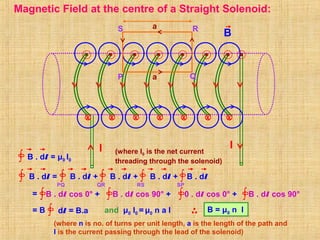
Magnetic Field at the centre of a Straight Solenoid:
I I
xxxxx xx
P Q
RS
∫ B . dl = μ0 I0
(where I0 is the net current
threading through the solenoid)
∫ B . dl = ∫ B . dl +
PQ
∫ B . dl +
QR
∫ B . dl +
RS
∫ B . dl
SP
B
B . dl cos 0° +∫ ∫ B . dl cos 90° + ∫ 0 . dl cos 0° + ∫ B . dl cos 90°=
= B ∫ dl = B.a and μ0 I0 = μ0 n a I
(where n is no. of turns per unit length, a is the length of the path and
I is the current passing through the lead of the solenoid)
a
a
B = μ0 n I
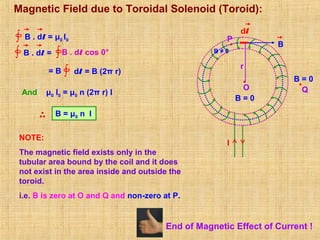
Magnetic Field due to Toroidal Solenoid (Toroid):
I
dl
B
P
O Q
B = 0
B = 0
∫ B . dl = μ0 I0
B . dl cos 0°∫
= B ∫ dl = B (2π r)
r
And μ0 I0 = μ0 n (2π r) I
B = μ0 n I
∫ B . dl =
NOTE:
The magnetic field exists only in the
tubular area bound by the coil and it does
not exist in the area inside and outside the
toroid.
i.e. B is zero at O and Q and non-zero at P.
End of Magnetic Effect of Current !
B ≠ 0
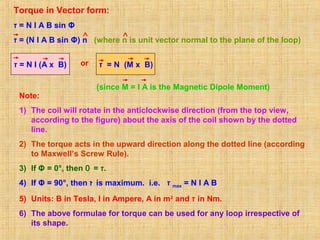
Note:
1) The coil will rotate in the anticlockwise direction (from the top view,
according to the figure) about the axis of the coil shown by the dotted
line.
2) The torque acts in the upward direction along the dotted line (according
to Maxwell’s Screw Rule).
3) If Φ = 0°, then ‫ז‬=0 .
4) If Φ = 90°, then ‫ז‬ is maximum. i.e. ‫ז‬ max = N I A B
5) Units: B in Tesla, I in Ampere, A in m2
and ‫ז‬ in Nm.
6) The above formulae for torque can be used for any loop irrespective of
its shape.
or
(since M = I A is the Magnetic Dipole Moment)
‫ז‬ = N I (A x B) ‫ז‬ = N (M x B)
Torque in Vector form:
‫ז‬ = N I A B sin Φ
‫ז‬ = (N I A B sin Φ) n (where n is unit vector normal to the plane of the loop)
PBW
P S
Q R
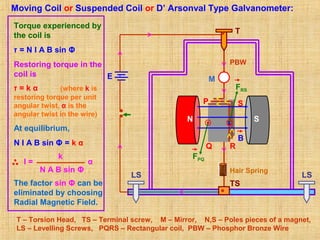
Moving Coil or Suspended Coil or D’ Arsonval Type Galvanometer:
N Sx
T
E
T – Torsion Head, TS – Terminal screw, M – Mirror, N,S – Poles pieces of a magnet,
LS – Levelling Screws, PQRS – Rectangular coil, PBW – Phosphor Bronze Wire
LS LS
B
Torque experienced by
the coil is
‫ז‬ = N I A B sin Φ
Restoring torque in the
coil is
‫ז‬ = k α (where k is
restoring torque per unit
angular twist, α is the
angular twist in the wire)
At equilibrium,
N I A B sin Φ = k α
I =
k
N A B sin Φ
α
The factor sin Φ can be
eliminated by choosing
Radial Magnetic Field.
M
Hair Spring
TS
FRS
FPQ
Lamp
Scale
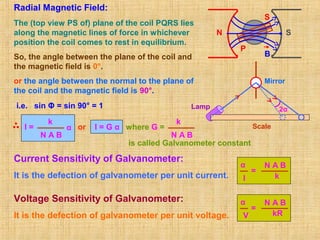
Radial Magnetic Field:
N S
B
P
S
The (top view PS of) plane of the coil PQRS lies
along the magnetic lines of force in whichever
position the coil comes to rest in equilibrium.
So, the angle between the plane of the coil and
the magnetic field is 0°.
or the angle between the normal to the plane of
the coil and the magnetic field is 90°.
i.e. sin Φ = sin 90° = 1
I =
k
N A B
α or I = G α
k
N A B
where G =
is called Galvanometer constant
Current Sensitivity of Galvanometer:
It is the defection of galvanometer per unit current. k
N A B
I
α
=
Voltage Sensitivity of Galvanometer:
It is the defection of galvanometer per unit voltage. kR
N A B
V
α
=
Mirror
2α
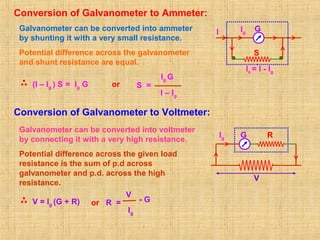
Conversion of Galvanometer to Ammeter:
Galvanometer can be converted into ammeter
by shunting it with a very small resistance.
Potential difference across the galvanometer
and shunt resistance are equal.
(I – Ig ) S = Ig G S =
Ig G
I – Ig
Conversion of Galvanometer to Voltmeter:
Galvanometer can be converted into voltmeter
by connecting it with a very high resistance.
Potential difference across the given load
resistance is the sum of p.d across
galvanometer and p.d. across the high
resistance.
V = Ig (G + R)
GI Ig
Is = I - Ig
S
or R =
V
Ig
- G
GIg R
V
or
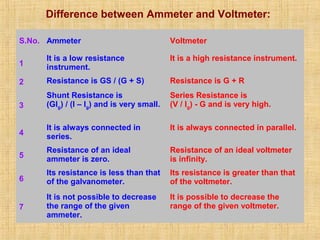
Difference between Ammeter and Voltmeter:
S.No. Ammeter Voltmeter
1
It is a low resistance
instrument.
It is a high resistance instrument.
2 Resistance is GS / (G + S) Resistance is G + R
3
Shunt Resistance is
(GIg) / (I – Ig) and is very small.
Series Resistance is
(V / Ig) - G and is very high.
4
It is always connected in
series.
It is always connected in parallel.
5
Resistance of an ideal
ammeter is zero.
Resistance of an ideal voltmeter
is infinity.
6
Its resistance is less than that
of the galvanometer.
Its resistance is greater than that
of the voltmeter.
7
It is not possible to decrease
the range of the given
ammeter.
It is possible to decrease the
range of the given voltmeter.
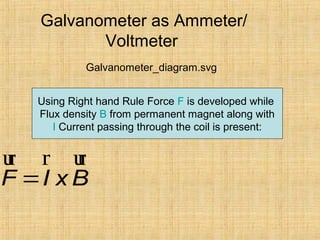
Galvanometer as Ammeter/
Voltmeter
F I x B=
ur r ur
Galvanometer_diagram.svg
Using Right hand Rule Force F is developed while
Flux density B from permanent magnet along with
I Current passing through the coil is present:
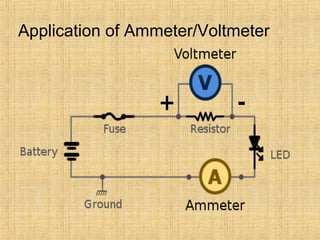
Application of Ammeter/Voltmeter
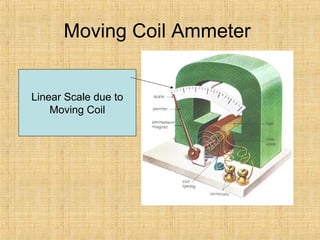
Moving Coil Ammeter
Linear Scale due to
Moving Coil
Moving Iron Ammeter
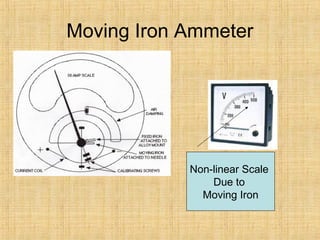
Non-linear Scale
Due to
Moving Iron
Ammeter
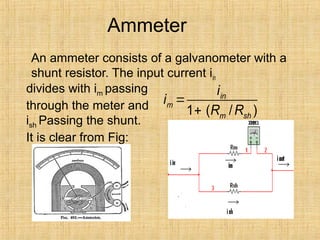
An ammeter consists of a galvanometer with a
shunt resistor. The input current iin
divides with im passing
through the meter and
ish Passing the shunt.
It is clear from Fig:
1 ( / )
in
m
m sh
i
i
R R
=
+
Design of Ammeter
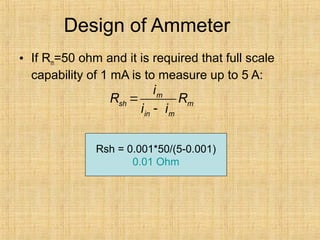
• If Rm=50 ohm and it is required that full scale
capability of 1 mA is to measure up to 5 A:
m
sh m
in m
i
R R
i i
=
-
Rsh = 0.001*50/(5-0.001)
0.01 Ohm
Voltmeter
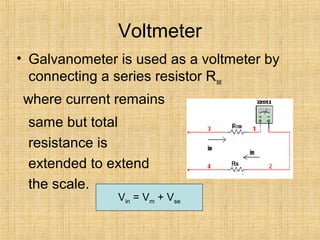
• Galvanometer is used as a voltmeter by
connecting a series resistor Rse
where current remains
same but total
resistance is
extended to extend
the scale.
Vin = Vm + Vse
Design of Voltmeter
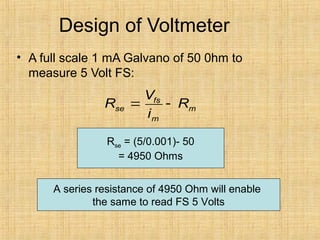
• A full scale 1 mA Galvano of 50 0hm to
measure 5 Volt FS:
fs
se m
m
V
R R
i
= -
Rse = (5/0.001)- 50
= 4950 Ohms
A series resistance of 4950 Ohm will enable
the same to read FS 5 Volts
N
S
D1 D2
+
W
B
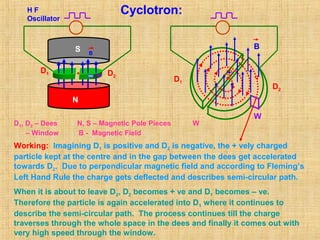
Cyclotron:
D1, D2 – Dees N, S – Magnetic Pole Pieces W
– Window B - Magnetic Field
H F
Oscillator
D2
D1
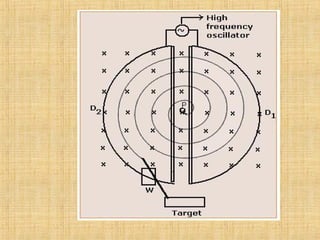
Working: Imagining D1 is positive and D2 is negative, the + vely charged
particle kept at the centre and in the gap between the dees get accelerated
towards D2. Due to perpendicular magnetic field and according to Fleming’s
Left Hand Rule the charge gets deflected and describes semi-circular path.
When it is about to leave D2, D2 becomes + ve and D1 becomes – ve.
Therefore the particle is again accelerated into D1 where it continues to
describe the semi-circular path. The process continues till the charge
traverses through the whole space in the dees and finally it comes out with
very high speed through the window.
W
B
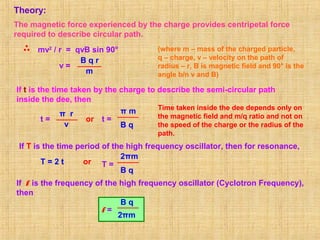
Theory:
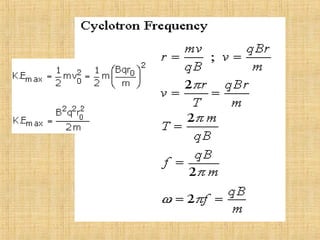
The magnetic force experienced by the charge provides centripetal force
required to describe circular path.
mv2
/ r = qvB sin 90° (where m – mass of the charged particle,
q – charge, v – velocity on the path of
radius – r, B is magnetic field and 90° is the
angle b/n v and B)
v =
B q r
m
If t is the time taken by the charge to describe the semi-circular path
inside the dee, then
t =
π r
v
or t =
π m
B q
Time taken inside the dee depends only on
the magnetic field and m/q ratio and not on
the speed of the charge or the radius of the
path.
If T is the time period of the high frequency oscillator, then for resonance,
T = 2 t or T =
2πm
B q
If f is the frequency of the high frequency oscillator (Cyclotron Frequency),
then
f =
2πm
B q
Maximum Energy of the Particle:
Kinetic Energy of the charged particle is
K.E. = ½ m v2
= ½ m (
B q r
m
)2 = ½
B2
q2
r2
m
Maximum Kinetic Energy of the charged particle is when r = R (radius of the D’s).
= ½
B2
q2
R2
m
K.E. max
The expressions for Time period and Cyclotron frequency only when
m remains constant. (Other quantities are already constant.)
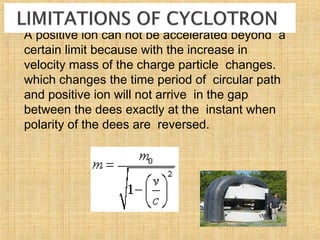
m =
m0
[1 – (v2
/ c2
)]½
If frequency is varied in synchronisation with the variation of mass of the
charged particle (by maintaining B as constant) to have resonance, then the
cyclotron is called synchro – cyclotron.
If magnetic field is varied in synchronisation with the variation of mass of
the charged particle (by maintaining f as constant) to have resonance, then
the cyclotron is called isochronous – cyclotron.
NOTE: Cyclotron can not be used for accelerating neutral particles. Electrons can
not be accelerated because they gain speed very quickly due to their lighter mass
and go out of phase with alternating e.m.f. and get lost within the dees.
But m varies with v according to
Einstein’s Relativistic Principle as per
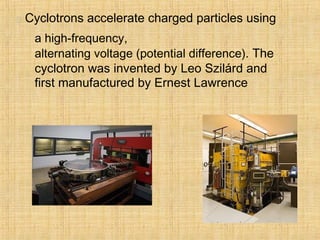
 Cyclotrons accelerate charged particles using
a high-frequency,
alternating voltage (potential difference). The
cyclotron was invented by Leo Szilárd and
first manufactured by Ernest Lawrence
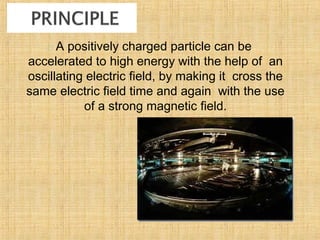
 A positively charged particle can be
accelerated to high energy with the help of an
oscillating electric field, by making it cross the
same electric field time and again with the use
of a strong magnetic field.
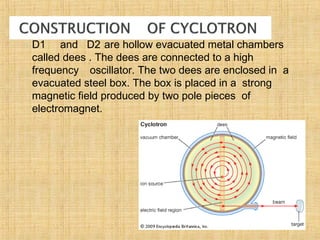
 D1 and D2 are hollow evacuated metal chambers
called dees . The dees are connected to a high
frequency oscillator. The two dees are enclosed in a
evacuated steel box. The box is placed in a strong
magnetic field produced by two pole pieces of
electromagnet.
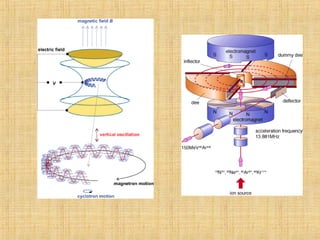
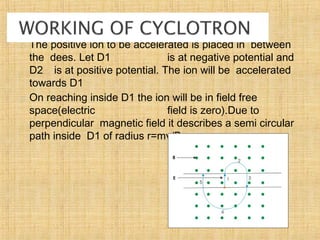
 The positive ion to be accelerated is placed in between
the dees. Let D1 is at negative potential and
D2 is at positive potential. The ion will be accelerated
towards D1
 On reaching inside D1 the ion will be in field free
space(electric field is zero).Due to
perpendicular magnetic field it describes a semi circular
path inside D1 of radius r=mv/Bq.
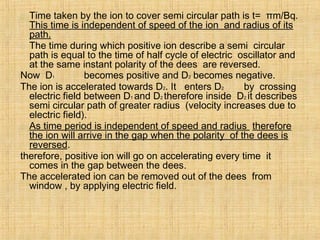
 Time taken by the ion to cover semi circular path is t= πm/Bq.
This time is independent of speed of the ion and radius of its
path.
 The time during which positive ion describe a semi circular
path is equal to the time of half cycle of electric oscillator and
at the same instant polarity of the dees are reversed.
Now D1 becomes positive and D2 becomes negative.
The ion is accelerated towards D2. It enters D2 by crossing
electric field between D1 and D2 therefore inside D2 it describes
semi circular path of greater radius (velocity increases due to
electric field).
 As time period is independent of speed and radius therefore
the ion will arrive in the gap when the polarity of the dees is
reversed.
therefore, positive ion will go on accelerating every time it
comes in the gap between the dees.
The accelerated ion can be removed out of the dees from
window , by applying electric field.
 For several decades, cyclotrons were the best
source of high-energy beams for nuclear physics
experiments.
several cyclotrons are still in use for this type of
research.
 Cyclotrons can be used to treat cancer. Ion beams
from cyclotrons can be used, as in proton therapy, to
penetrate the body and kill tumors by radiation
damage.
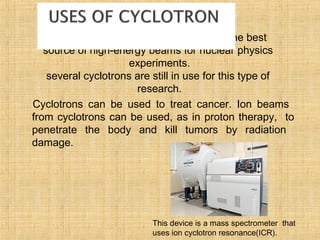
This device is a mass spectrometer that
uses ion cyclotron resonance(ICR).
 A positive ion can not be accelerated beyond a
certain limit because with the increase in
velocity mass of the charge particle changes.
which changes the time period of circular path
and positive ion will not arrive in the gap
between the dees exactly at the instant when
polarity of the dees are reversed.
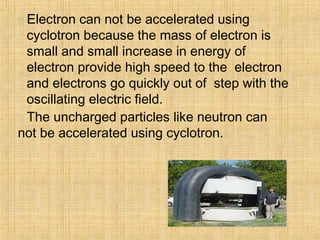
 Electron can not be accelerated using
cyclotron because the mass of electron is
small and small increase in energy of
electron provide high speed to the electron
and electrons go quickly out of step with the
oscillating electric field.
 The uncharged particles like neutron can
not be accelerated using cyclotron.

Magnetic effects

  • 1.
    Magnetic Effects ofElectric Currents Prepared by Dept Physics Sangita Holkar
  • 2.
    MAGNETIC EFFECT OFCURRENT - II 1. Lorentz Magnetic Force 2. Fleming’s Left Hand Rule 3. Force on a moving charge in uniform Electric and Magnetic fields 4. Force on a current carrying conductor in a uniform Magnetic Field 5. Force between two infinitely long parallel current-carrying conductors 6. Definition of ampere 7. Representation of fields due to parallel currents 8. Torque experienced by a current-carrying coil in a uniform Magnetic Field 9. Moving Coil Galvanometer 10.Conversion of Galvanometer into Ammeter and Voltmeter 11.Differences between Ammeter and Voltmeter Created by C. Mani, Principal, K V No.1, AFS, Jalahalli West, Bangalore
  • 3.
    Lorentz Magnetic Force: Acurrent carrying conductor placed in a magnetic field experiences a force which means that a moving charge in a magnetic field experiences force. Fm = q (v x B) +q B v F I θ -q B v F θ Fm = (q v B sin θ) n where θ is the angle between v and B Special Cases: i) If the charge is at rest, i.e. v = 0, then Fm = 0. So, a stationary charge in a magnetic field does not experience any force. ii) If θ = 0° or 180° i.e. if the charge moves parallel or anti-parallel to the direction of the magnetic field, then Fm = 0. iii) If θ = 90° i.e. if the charge moves perpendicular to the magnetic field, then the force is maximum. Fm (max) = q v B or I
  • 4.
    Fleming’s Left HandRule: Force (F) Magnetic Field (B) Electric Current (I) If the central finger, fore finger and thumb of left hand are stretched mutually perpendicular to each other and the central finger points to current, fore finger points to magnetic field, then thumb points in the direction of motion (force) on the current carrying conductor. TIP: Remember the phrase ‘e m f’ to represent electric current, magnetic field and force in anticlockwise direction of the fingers of left hand. Force on a moving charge in uniform Electric and Magnetic Fields: When a charge q moves with velocity v in region in which both electric field E and magnetic field B exist, then the Lorentz force is F = qE + q (v x B) or F = q (E + v x B)
  • 5.
    Force on acurrent-carrying conductor in a uniform Magnetic Field: θ vd dl F I I B A l Force experienced by each electron in the conductor is f = - e (vd x B) If n be the number density of electrons, A be the area of cross section of the conductor, then no. of electrons in the element dl is n A dl. where I = neAvd and -ve sign represents that the direction of dl is opposite to that of vd) or F = I l B sin θ - Force experienced by the electrons in dl is dF = n A dl [ - e (vd x B)] = - n e A vd (dl X B) = I (dl x B) F = ∫ dF = ∫ I (dl x B) F = I (l x B)
  • 6.
    Ampere’s Circuital Law: Theline integral B . dl for a closed curve is equal to μ0 times the net current I threading through the area bounded by the curve. ∫ ∫ B . dl = μ0 I ∫ B . dl = ∫ B . dl cos 0° ∫ B . dl = B= ∫ dl = B (2π r) = ( μ0 I / 2π r) x 2π r ∫ B . dl = μ0 I I B B r O dl I Current is emerging out and the magnetic field is anticlockwise. Proof:
  • 7.
    Magnetic Field atthe centre of a Straight Solenoid: I I xxxxx xx P Q RS ∫ B . dl = μ0 I0 (where I0 is the net current threading through the solenoid) ∫ B . dl = ∫ B . dl + PQ ∫ B . dl + QR ∫ B . dl + RS ∫ B . dl SP B B . dl cos 0° +∫ ∫ B . dl cos 90° + ∫ 0 . dl cos 0° + ∫ B . dl cos 90°= = B ∫ dl = B.a and μ0 I0 = μ0 n a I (where n is no. of turns per unit length, a is the length of the path and I is the current passing through the lead of the solenoid) a a B = μ0 n I
  • 8.
    Magnetic Field dueto Toroidal Solenoid (Toroid): I dl B P O Q B = 0 B = 0 ∫ B . dl = μ0 I0 B . dl cos 0°∫ = B ∫ dl = B (2π r) r And μ0 I0 = μ0 n (2π r) I B = μ0 n I ∫ B . dl = NOTE: The magnetic field exists only in the tubular area bound by the coil and it does not exist in the area inside and outside the toroid. i.e. B is zero at O and Q and non-zero at P. End of Magnetic Effect of Current ! B ≠ 0
  • 9.
    Note: 1) The coilwill rotate in the anticlockwise direction (from the top view, according to the figure) about the axis of the coil shown by the dotted line. 2) The torque acts in the upward direction along the dotted line (according to Maxwell’s Screw Rule). 3) If Φ = 0°, then ‫ז‬=0 . 4) If Φ = 90°, then ‫ז‬ is maximum. i.e. ‫ז‬ max = N I A B 5) Units: B in Tesla, I in Ampere, A in m2 and ‫ז‬ in Nm. 6) The above formulae for torque can be used for any loop irrespective of its shape. or (since M = I A is the Magnetic Dipole Moment) ‫ז‬ = N I (A x B) ‫ז‬ = N (M x B) Torque in Vector form: ‫ז‬ = N I A B sin Φ ‫ז‬ = (N I A B sin Φ) n (where n is unit vector normal to the plane of the loop)
  • 10.
    PBW P S Q R MovingCoil or Suspended Coil or D’ Arsonval Type Galvanometer: N Sx T E T – Torsion Head, TS – Terminal screw, M – Mirror, N,S – Poles pieces of a magnet, LS – Levelling Screws, PQRS – Rectangular coil, PBW – Phosphor Bronze Wire LS LS B Torque experienced by the coil is ‫ז‬ = N I A B sin Φ Restoring torque in the coil is ‫ז‬ = k α (where k is restoring torque per unit angular twist, α is the angular twist in the wire) At equilibrium, N I A B sin Φ = k α I = k N A B sin Φ α The factor sin Φ can be eliminated by choosing Radial Magnetic Field. M Hair Spring TS FRS FPQ
  • 11.
    Lamp Scale Radial Magnetic Field: NS B P S The (top view PS of) plane of the coil PQRS lies along the magnetic lines of force in whichever position the coil comes to rest in equilibrium. So, the angle between the plane of the coil and the magnetic field is 0°. or the angle between the normal to the plane of the coil and the magnetic field is 90°. i.e. sin Φ = sin 90° = 1 I = k N A B α or I = G α k N A B where G = is called Galvanometer constant Current Sensitivity of Galvanometer: It is the defection of galvanometer per unit current. k N A B I α = Voltage Sensitivity of Galvanometer: It is the defection of galvanometer per unit voltage. kR N A B V α = Mirror 2α
  • 12.
    Conversion of Galvanometerto Ammeter: Galvanometer can be converted into ammeter by shunting it with a very small resistance. Potential difference across the galvanometer and shunt resistance are equal. (I – Ig ) S = Ig G S = Ig G I – Ig Conversion of Galvanometer to Voltmeter: Galvanometer can be converted into voltmeter by connecting it with a very high resistance. Potential difference across the given load resistance is the sum of p.d across galvanometer and p.d. across the high resistance. V = Ig (G + R) GI Ig Is = I - Ig S or R = V Ig - G GIg R V or
  • 13.
    Difference between Ammeterand Voltmeter: S.No. Ammeter Voltmeter 1 It is a low resistance instrument. It is a high resistance instrument. 2 Resistance is GS / (G + S) Resistance is G + R 3 Shunt Resistance is (GIg) / (I – Ig) and is very small. Series Resistance is (V / Ig) - G and is very high. 4 It is always connected in series. It is always connected in parallel. 5 Resistance of an ideal ammeter is zero. Resistance of an ideal voltmeter is infinity. 6 Its resistance is less than that of the galvanometer. Its resistance is greater than that of the voltmeter. 7 It is not possible to decrease the range of the given ammeter. It is possible to decrease the range of the given voltmeter.
  • 14.
    Galvanometer as Ammeter/ Voltmeter FI x B= ur r ur Galvanometer_diagram.svg Using Right hand Rule Force F is developed while Flux density B from permanent magnet along with I Current passing through the coil is present:
  • 15.
  • 16.
    Moving Coil Ammeter LinearScale due to Moving Coil
  • 17.
    Moving Iron Ammeter Non-linearScale Due to Moving Iron
  • 18.
    Ammeter An ammeter consistsof a galvanometer with a shunt resistor. The input current iin divides with im passing through the meter and ish Passing the shunt. It is clear from Fig: 1 ( / ) in m m sh i i R R = +
  • 19.
    Design of Ammeter •If Rm=50 ohm and it is required that full scale capability of 1 mA is to measure up to 5 A: m sh m in m i R R i i = - Rsh = 0.001*50/(5-0.001) 0.01 Ohm
  • 20.
    Voltmeter • Galvanometer isused as a voltmeter by connecting a series resistor Rse where current remains same but total resistance is extended to extend the scale. Vin = Vm + Vse
  • 21.
    Design of Voltmeter •A full scale 1 mA Galvano of 50 0hm to measure 5 Volt FS: fs se m m V R R i = - Rse = (5/0.001)- 50 = 4950 Ohms A series resistance of 4950 Ohm will enable the same to read FS 5 Volts
  • 22.
    N S D1 D2 + W B Cyclotron: D1, D2– Dees N, S – Magnetic Pole Pieces W – Window B - Magnetic Field H F Oscillator D2 D1 Working: Imagining D1 is positive and D2 is negative, the + vely charged particle kept at the centre and in the gap between the dees get accelerated towards D2. Due to perpendicular magnetic field and according to Fleming’s Left Hand Rule the charge gets deflected and describes semi-circular path. When it is about to leave D2, D2 becomes + ve and D1 becomes – ve. Therefore the particle is again accelerated into D1 where it continues to describe the semi-circular path. The process continues till the charge traverses through the whole space in the dees and finally it comes out with very high speed through the window. W B
  • 23.
    Theory: The magnetic forceexperienced by the charge provides centripetal force required to describe circular path. mv2 / r = qvB sin 90° (where m – mass of the charged particle, q – charge, v – velocity on the path of radius – r, B is magnetic field and 90° is the angle b/n v and B) v = B q r m If t is the time taken by the charge to describe the semi-circular path inside the dee, then t = π r v or t = π m B q Time taken inside the dee depends only on the magnetic field and m/q ratio and not on the speed of the charge or the radius of the path. If T is the time period of the high frequency oscillator, then for resonance, T = 2 t or T = 2πm B q If f is the frequency of the high frequency oscillator (Cyclotron Frequency), then f = 2πm B q
  • 24.
    Maximum Energy ofthe Particle: Kinetic Energy of the charged particle is K.E. = ½ m v2 = ½ m ( B q r m )2 = ½ B2 q2 r2 m Maximum Kinetic Energy of the charged particle is when r = R (radius of the D’s). = ½ B2 q2 R2 m K.E. max The expressions for Time period and Cyclotron frequency only when m remains constant. (Other quantities are already constant.) m = m0 [1 – (v2 / c2 )]½ If frequency is varied in synchronisation with the variation of mass of the charged particle (by maintaining B as constant) to have resonance, then the cyclotron is called synchro – cyclotron. If magnetic field is varied in synchronisation with the variation of mass of the charged particle (by maintaining f as constant) to have resonance, then the cyclotron is called isochronous – cyclotron. NOTE: Cyclotron can not be used for accelerating neutral particles. Electrons can not be accelerated because they gain speed very quickly due to their lighter mass and go out of phase with alternating e.m.f. and get lost within the dees. But m varies with v according to Einstein’s Relativistic Principle as per
  • 26.
     Cyclotrons acceleratecharged particles using a high-frequency, alternating voltage (potential difference). The cyclotron was invented by Leo Szilárd and first manufactured by Ernest Lawrence
  • 27.
     A positivelycharged particle can be accelerated to high energy with the help of an oscillating electric field, by making it cross the same electric field time and again with the use of a strong magnetic field.
  • 29.
     D1 andD2 are hollow evacuated metal chambers called dees . The dees are connected to a high frequency oscillator. The two dees are enclosed in a evacuated steel box. The box is placed in a strong magnetic field produced by two pole pieces of electromagnet.
  • 31.
     The positiveion to be accelerated is placed in between the dees. Let D1 is at negative potential and D2 is at positive potential. The ion will be accelerated towards D1  On reaching inside D1 the ion will be in field free space(electric field is zero).Due to perpendicular magnetic field it describes a semi circular path inside D1 of radius r=mv/Bq.
  • 32.
     Time takenby the ion to cover semi circular path is t= πm/Bq. This time is independent of speed of the ion and radius of its path.  The time during which positive ion describe a semi circular path is equal to the time of half cycle of electric oscillator and at the same instant polarity of the dees are reversed. Now D1 becomes positive and D2 becomes negative. The ion is accelerated towards D2. It enters D2 by crossing electric field between D1 and D2 therefore inside D2 it describes semi circular path of greater radius (velocity increases due to electric field).  As time period is independent of speed and radius therefore the ion will arrive in the gap when the polarity of the dees is reversed. therefore, positive ion will go on accelerating every time it comes in the gap between the dees. The accelerated ion can be removed out of the dees from window , by applying electric field.
  • 34.
     For severaldecades, cyclotrons were the best source of high-energy beams for nuclear physics experiments. several cyclotrons are still in use for this type of research.  Cyclotrons can be used to treat cancer. Ion beams from cyclotrons can be used, as in proton therapy, to penetrate the body and kill tumors by radiation damage. This device is a mass spectrometer that uses ion cyclotron resonance(ICR).
  • 35.
     A positiveion can not be accelerated beyond a certain limit because with the increase in velocity mass of the charge particle changes. which changes the time period of circular path and positive ion will not arrive in the gap between the dees exactly at the instant when polarity of the dees are reversed.
  • 36.
     Electron cannot be accelerated using cyclotron because the mass of electron is small and small increase in energy of electron provide high speed to the electron and electrons go quickly out of step with the oscillating electric field.  The uncharged particles like neutron can not be accelerated using cyclotron.