
By: Darlene G. Cardinal
General Objectives:
At the end of the discussion,
graduate students will be able to
understand Transcultural Theory
and
its application to nursing
practice.
be able to know the history and source of the
theory
be able to differentiate cultural diversity and
cultural universality
be able to understand the metaparadigm in
nursing
be able to analyze and apply the theory to current
situation
Specific
Objectives:
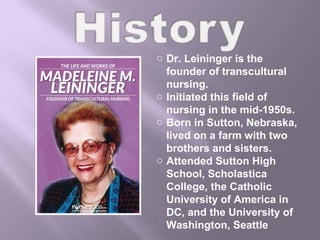
o Dr. Leininger is the
founder of transcultural
nursing.
o Initiated this field of
nursing in the mid-1950s.
o Born in Sutton, Nebraska,
lived on a farm with two
brothers and sisters.
o Attended Sutton High
School, Scholastica
College, the Catholic
University of America in
DC, and the University of
Washington, Seattle
o She brought nursing and anthropology together and
coined the term transcultural nursing as an essential
formal area of study and practice.
o Her Culture Care Diversity & Universality theory was
one of the earliest nursing theories and it remains the
only theory focused specifically on transcultural
nursing with a culture care focus. Her theory is used
worldwide.
o Dr. Leininger was the first professional nurse with a
graduate preparation to complete a PhD in
anthropology.
Theoretical Source:
Derived from the discipline of
Anthropology. Conceptualized the theory to
be relevant to nursing.
Leininger recognized that one of the
most important contributions of
Anthropology to nursing is the realization
that health and illness states are strongly
influenced by culture.
Metaparadigm in nursing
Nursing – care has the greatest meaning which
explains nursing
Person – not only refers to individual but families,
groups and communities
Health – not distinct to nursing as many
disciplines use this term
Environment – included events with
meanings and interpretations given to them in
particular physical, ecological, socio-political, or
cultural setting
Theoritical Assertion/
Major Concepts
Care – assist others with real or anticipated needsto
promotehealth and wellness
Culture – learned, shared, and transmitted values,
beliefs, normsof agroup that influences behavior
Culture Care – aspectsof culturethat influenceor
enableaperson to deal with illnessor death
Culture Care Diversity – differencesin meanings,
values, or careof different groupsof people
Culture Care Universality – common careor
similaritiesamong cultures
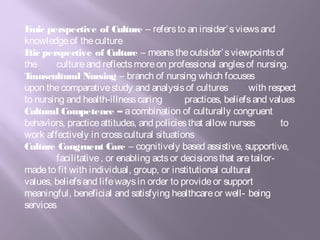
Emic perspective of Culture – refersto an insider’sviewsand
knowledgeof theculture
Etic perspective of Culture – meanstheoutsider’sviewpointsof
the cultureand reflectsmoreon professional anglesof nursing.
Transcultural Nursing – branch of nursing which focuses
upon thecomparativestudy and analysisof cultures with respect
to nursing and health-illnesscaring practices, beliefsand values
Cultural Competence – acombination of culturally congruent
behaviors, practiceattitudes, and policiesthat allow nurses to
work affectively in crosscultural situations
Culture Congruent Care – cognitively based assistive, supportive,
facilitative, or enabling actsor decisionsthat aretailor-
madeto fit with individual, group, or institutional cultural
values, beliefsand lifewaysin order to provideor support
meaningful, beneficial and satisfying healthcareor well- being
services
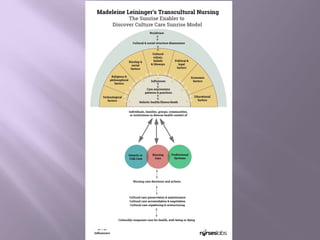
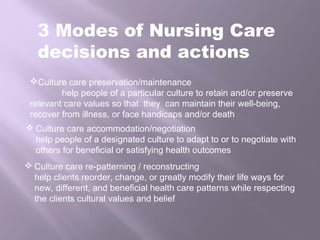
3 Modes of Nursing Care
decisions and actions
Culture care preservation/maintenance
help people of a particular culture to retain and/or preserve
relevant care values so that they can maintain their well-being,
recover from illness, or face handicaps and/or death
 Culture care accommodation/negotiation
help people of a designated culture to adapt to or to negotiate with
others for beneficial or satisfying health outcomes
 Culture care re-patterning / reconstructing
help clients reorder, change, or greatly modify their life ways for
new, different, and beneficial health care patterns while respecting
the clients cultural values and belief
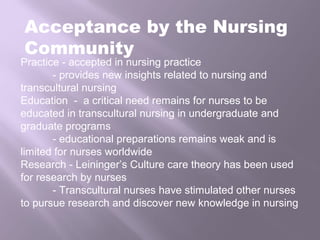
Acceptance by the Nursing
Community
Practice - accepted in nursing practice
- provides new insights related to nursing and
transcultural nursing
Education - a critical need remains for nurses to be
educated in transcultural nursing in undergraduate and
graduate programs
- educational preparations remains weak and is
limited for nurses worldwide
Research - Leininger’s Culture care theory has been used
for research by nurses
- Transcultural nurses have stimulated other nurses
to pursue research and discover new knowledge in nursing
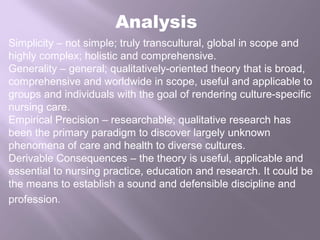
Analysis
Simplicity – not simple; truly transcultural, global in scope and
highly complex; holistic and comprehensive.
Generality – general; qualitatively-oriented theory that is broad,
comprehensive and worldwide in scope, useful and applicable to
groups and individuals with the goal of rendering culture-specific
nursing care.
Empirical Precision – researchable; qualitative research has
been the primary paradigm to discover largely unknown
phenomena of care and health to diverse cultures.
Derivable Consequences – the theory is useful, applicable and
essential to nursing practice, education and research. It could be
the means to establish a sound and defensible discipline and
profession.
Transcultural theory in nursing

Transcultural theory in nursing

  • 1.
  • 2.
    General Objectives: At theend of the discussion, graduate students will be able to understand Transcultural Theory and its application to nursing practice.
  • 3.
    be able toknow the history and source of the theory be able to differentiate cultural diversity and cultural universality be able to understand the metaparadigm in nursing be able to analyze and apply the theory to current situation Specific Objectives:
  • 4.
    o Dr. Leiningeris the founder of transcultural nursing. o Initiated this field of nursing in the mid-1950s. o Born in Sutton, Nebraska, lived on a farm with two brothers and sisters. o Attended Sutton High School, Scholastica College, the Catholic University of America in DC, and the University of Washington, Seattle
  • 5.
    o She broughtnursing and anthropology together and coined the term transcultural nursing as an essential formal area of study and practice. o Her Culture Care Diversity & Universality theory was one of the earliest nursing theories and it remains the only theory focused specifically on transcultural nursing with a culture care focus. Her theory is used worldwide. o Dr. Leininger was the first professional nurse with a graduate preparation to complete a PhD in anthropology.
  • 6.
    Theoretical Source: Derived fromthe discipline of Anthropology. Conceptualized the theory to be relevant to nursing. Leininger recognized that one of the most important contributions of Anthropology to nursing is the realization that health and illness states are strongly influenced by culture.
  • 7.
    Metaparadigm in nursing Nursing– care has the greatest meaning which explains nursing Person – not only refers to individual but families, groups and communities Health – not distinct to nursing as many disciplines use this term Environment – included events with meanings and interpretations given to them in particular physical, ecological, socio-political, or cultural setting
  • 9.
    Theoritical Assertion/ Major Concepts Care– assist others with real or anticipated needsto promotehealth and wellness Culture – learned, shared, and transmitted values, beliefs, normsof agroup that influences behavior Culture Care – aspectsof culturethat influenceor enableaperson to deal with illnessor death Culture Care Diversity – differencesin meanings, values, or careof different groupsof people Culture Care Universality – common careor similaritiesamong cultures
  • 10.
    Emic perspective ofCulture – refersto an insider’sviewsand knowledgeof theculture Etic perspective of Culture – meanstheoutsider’sviewpointsof the cultureand reflectsmoreon professional anglesof nursing. Transcultural Nursing – branch of nursing which focuses upon thecomparativestudy and analysisof cultures with respect to nursing and health-illnesscaring practices, beliefsand values Cultural Competence – acombination of culturally congruent behaviors, practiceattitudes, and policiesthat allow nurses to work affectively in crosscultural situations Culture Congruent Care – cognitively based assistive, supportive, facilitative, or enabling actsor decisionsthat aretailor- madeto fit with individual, group, or institutional cultural values, beliefsand lifewaysin order to provideor support meaningful, beneficial and satisfying healthcareor well- being services
  • 11.
    3 Modes ofNursing Care decisions and actions Culture care preservation/maintenance help people of a particular culture to retain and/or preserve relevant care values so that they can maintain their well-being, recover from illness, or face handicaps and/or death  Culture care accommodation/negotiation help people of a designated culture to adapt to or to negotiate with others for beneficial or satisfying health outcomes  Culture care re-patterning / reconstructing help clients reorder, change, or greatly modify their life ways for new, different, and beneficial health care patterns while respecting the clients cultural values and belief
  • 12.
    Acceptance by theNursing Community Practice - accepted in nursing practice - provides new insights related to nursing and transcultural nursing Education - a critical need remains for nurses to be educated in transcultural nursing in undergraduate and graduate programs - educational preparations remains weak and is limited for nurses worldwide Research - Leininger’s Culture care theory has been used for research by nurses - Transcultural nurses have stimulated other nurses to pursue research and discover new knowledge in nursing
  • 13.
    Analysis Simplicity – notsimple; truly transcultural, global in scope and highly complex; holistic and comprehensive. Generality – general; qualitatively-oriented theory that is broad, comprehensive and worldwide in scope, useful and applicable to groups and individuals with the goal of rendering culture-specific nursing care. Empirical Precision – researchable; qualitative research has been the primary paradigm to discover largely unknown phenomena of care and health to diverse cultures. Derivable Consequences – the theory is useful, applicable and essential to nursing practice, education and research. It could be the means to establish a sound and defensible discipline and profession.