MACRO PRACTICE THEORY
Theory Description Key Terms, Interventions
Organizational
behavior perspective
The study of human and group behavior within
organizational settings. The study of organization behavior
involves looking at the attitudes, interpersonal relationships,
performance, productivity, job satisfaction, and commitment
of employees, as well as levels of organizational
commitment and industrial relations. Organization behavior
can be affected by corporate culture, leadership, and
management style. Organization behavior emerged as a
distinct specialty from organization theory in the late 1950s
and early 1960s through attempts to integrate different
perspectives on human and management problems and
develop an understanding of behavioral dynamics within
organizations. Organizational behavior is concerned with
all aspects of how organizations influence the behavior of
individuals and how individuals in turn influence
organizations.
Change how organization
influences behavior of
individuals, improved
attitudes, interpersonal
relationships, change
management style and
change organization’s
culture.
Learning
Organization
Theory
Organizational Learning Theory has reflected the dual
emphasis of structural technical and social cognitive
systems. A change in the technical system necessarily
impacts on the functioning of the social system, and a
change in the social system has impacts on the technical
system. Peter Senge popularized the Learning
Organization" in The Fifth Discipline: The Art and
Practice of the Learning Organization. He describes the
organization as an organism with the capacity to enhance
its capabilities and shape its own future. A learning
organization is any organization (e.g. school, business,
government agency) that understands itself as a complex,
organic system that has a vision and purpose. It uses
feedback systems and alignment mechanisms to achieve
its goals. It values teams and leadership throughout the
ranks. The technical view assumes that organizational
learning is about the effective pro cessing, interpretation
of, and response to, information both inside and outside
the organization. This information may be quantitative or
qualitative, but is generally explicit and in the public
domain…. The social perspective on organization
learning focuses on the way people make sense of their
experiences at work and learn from social interactions.
Mental models function by activating memories and
responses that were previously
developed to solve earlier problems or to address
previous incidents.
Five disciplines:
System Thinking, Personal
Mastery, Mental Models,
Shared Vision, Team
Learning.
Single and double loop
learning, organizational
change effort,
Intervene in way decisions
are made and in altering
structure.
Social development
perspective
The social development approach seeks to integrate
economic and social policies within a dynamic
development process in order to achieve social welfare
objectives. By adding the developmental dimension,
social development is shown to transcend the dichotomy
between the residualist approach, which concentrates on
targeting resources to the most needy, and the
institutional approach which urges extensive state
involvement in welfare. Links social welfare directly to
economic development and seeks to harmonize
Harmonize economic and
social development objectives
to ensure the benefits of
economic progress reach the
population as a whole
MACRO PRACTICE THEORY
objectives, failure results in distorted development and
social deprivation.
Community
Organization
Theory
Community organization theory has its roots in theories
of social networks and support. It emphasizes active
participation and developing communities that can better
evaluate and solve social problems. Community
organization is the process by which community groups
are helped to identify common problems or goals,
mobilize resources, and develop and implement strategies
for reaching their goals. It has roots in several theoretical
perspectives: the ecological perspective, social systems
perspective, social networks, and social support. Social
workers use a broad cross-section of people in the
community to identify and solve its own problems (focus
groups, task force, committees. It stresses consensus
development, capacity building, and a strong task
orientation; outside practitioners help to coordinate and
enable the community to successfully address its
concerns. Social planning uses tasks and goals, and
addresses substantive problem solving, with expert
practitioners providing technical assistance to benefit
community consumers. Social action aims to increase the
problem-solving ability of the community and to achieve
concrete changes to redress social injustice that is
identified by a disadvantaged or oppressed group.
Social planning, key
informants, community
stakeholders, grass-roots
organizing, mobilizing
resources, engaging in social
action, building collaboration
Human rights
perspective
Rights that are inherent to human nature, without which
we cannot live as human beings. Based on the inherent
worth and dignity of each human being and the idea that
this deserves respect and protection. This includes the
right to life, liberty and security of person, freedom of
association, expression, assembly and movement. Equal
access to education, health and economic opportunities.
The right to the highest attainable standard of health and
well being
Civil and political action,
advocacy, economic and
social development,
challenging forms of
oppression, development of
effective national and
international policies and
laws to bring about social
justice
Ecological theory Focus on inter relational transactions between systems,
and stresses that all existing elements within an
ecosystem play an equal role in maintaining balance of
the whole. This approach can be best understood as
looking at persons, families, cultures, communities, and
policies and to identify and intervene upon strengths and
weaknesses in the transactional processes between these
systems. In this framework the caseworker and client
must understand the interconnectedness of the client to
his or her environment to effectively assess the problem,
design a solution and ensure goal achievement and
sustainability.
Ecological Assessment
Eco-map, address multiple
factors in the environment
General systems
theory
Ludwig von Bertalanffy in 1968 purposed a
system is characterized by the interactions of its
components and the nonlinearity of those interactions.
Focus changed from linear causality to circular causality-
the idea that events are related through a series of
interacting loops or repeating cycles.
A system may be in harmony with an environment, such a
Boundary maintenance, input
or output regulation,
Helping boundaries stay
permeable and flexible so
system can adapt to changing
environment, enhancing
transactions, maintaining or
MACRO PRACTICE THEORY
system may be said to be balanced or homeostatic.
Key concepts:
Set of elements standing in interaction.
Each element is affected by whatever happens to any
other element.
System is only as strong as its weakest part.
System is greater than sum of its parts.
Boundaries are more or less permeable depending on the
amount and type of feedback received.
Systems can be either controlled (cybernetic) or
uncontrolled.
In controlled systems information is sensed, and changes
are effected in response to the information.
Communication and transaction are the only intersystem
interactions. Communication is the exchange of
information, while transaction involves the exchange of
matter-energy. All organizational and social interactions
involve communication and/or transaction to achieve
equilibrium. The boundaries may be permeable or
impermeable – this defines the difference between an
open or closed system. Most systems display
characteristics of both being open and closed, Many
systems are goal directed - that is, interaction with their
environment has some purpose or direction or value or
goal or design.
Open systems have inputs - energy or matter that enters
through the boundaries, and outputs – energy or matter or
"waste" that departs through the boundaries. Through
puts are those things or energies that pass through without
alteration., sensors, and so on.
disrupting
equilibrium/homeostatis.
Interrupting the system is a
means of bringing about
change. First order change
vs. second order change.
Conflict theory conflict theory states that society or an organization
functions so that each individual participant and its
groups struggle to maximize their benefits, which
inevitably contributes to social change such as political
changes and revolutions. The theory is mostly applied to
explain conflict between social classes, proletariat versus
bourgeoisie; and in ideologies, such as capitalism versus
socialism. The emphasis is on capitalism or society or
institutions as the problem, not the individual, group or
community. Here the social worker must also help clients
to cope with capitalism, but, at the same time, he or she
will work to change the society and institutions, and
educate clients about options, and possibility of different
societal relationships.
With this perspective inequality is inherent in the
capitalist society as seen in many areas: gender,
disabilities, race, age, sexual orientation.
Changing society and
institutions through protest,
political activism, organizing
social classes to take action,
educating groups
Social Learning
Theory
Social learning theory (sometimes referred to as
modeling, observational learning, or vicarious learning)
incorporates elements of operant conditioning (or radical
Modeling of organization’s
core values, providing
employee intrinsic and
MACRO PRACTICE THEORY
Social Learning
Theory
behaviorism) and social cognition. People learn behavior
through modeling, through positive and negative
reinforcement. A person is a social being and lives within
a group or a community. Therefore he tends to perform
actions and behave in a manner conducive to community
approval. In Social Learning theory, all behavior is goal
directed and emphasizes expectations of reward and
perceived values of rewards as the basis for modeling
one's behavior on that of others. Social learning includes
concept of “locus of control”, which refers to the view of
internal/external control of reinforcement. Bandura
believed that self-regulation mediated external influences
and provided a basis for action, empowering individuals
to assume responsibility and control for their actions and
motivators. Motivation can occur externally, such as a
promised reward or internally, such as when an individual
feels self pride when a standard is reached. If the
individual believes that they are capable of achieving an
individual or organizational goal, they are more likely to
work hard and achieve the goal. Bandura describes the
second factor of determining the degree of motivation as
effective feedback. Through feedback, individuals are
able to adjust or control their efforts toward achieving a
goal, making the goal more realistic and attainable.
extrinsic rewards for
behavior and performance.
Helping individuals and
groups develop an internal
local of control, i.e. assume
responsibility for their lives,
providing positive feedback,
community approval
Empowerment
theory
Empowerment-“process by which individuals and groups
gain power, access to resources and control over their
own lives. In doing so, they gain the ability to achieve
their highest personal and collective aspirations and
goals” (Robbins, Chatterjee, & Canda, 1998, p.91).
Empowerment resides in the person, not the helper or
social worker. Addresses oppression, stratification and in
equality as social barriers.
Does not blame for lack of resources and power
Rejects that problems develop because of personal
deficiencies. From an organizational perspective, ,
empowerment is promoted in work environments that
provide employees with access to information, resources,
support, and the opportunity to learn and develop. Kluska
et al., (2004) have noted that psychological empowerment
includes feelings of competence, autonomy, job
meaningfulness, and an ability to impact the organization.
Empowerment starts with the
individual, not the helper,
social worker assists
individuals and groups to
access resources and gain
greater control over their
own lives. On a macro level,
this can take the form of
collective action, forming
groups, increasing
public/media awareness, and
lobbying politicians and
community leaders.
Increasing consumer access
to services.
Management theory The major classical management concepts were planning,
organizing, developing, staffing, coordinating, and
budgeting. Later management theory recognized man is
motivated by social needs not just economic need.
In this way managers are expect to develop relationships
and environments that enable people to work together and
respond to change. Such ‘joint performance’ involves
having common goals, common values, the right
structures, and continuing training and development
(Drucker 1988). In management of social service
agencies, issues include ethics in making personnel
decisions, managing finances (diverse sources of funding) ,
maintaining ethical and legal practices (decreasing potential
for liability) planning and maintaining key relationships.
Motivate people by meeting
their social needs, harnessing
their personal goals and
aspirations, inviting employee
and client participation in
decision making and problem
solving, strategic division of
labor / tasks, delegation,
performance appraisals, and
participatory management.

Macro Practice Theories by APU Social Work

  • 1.
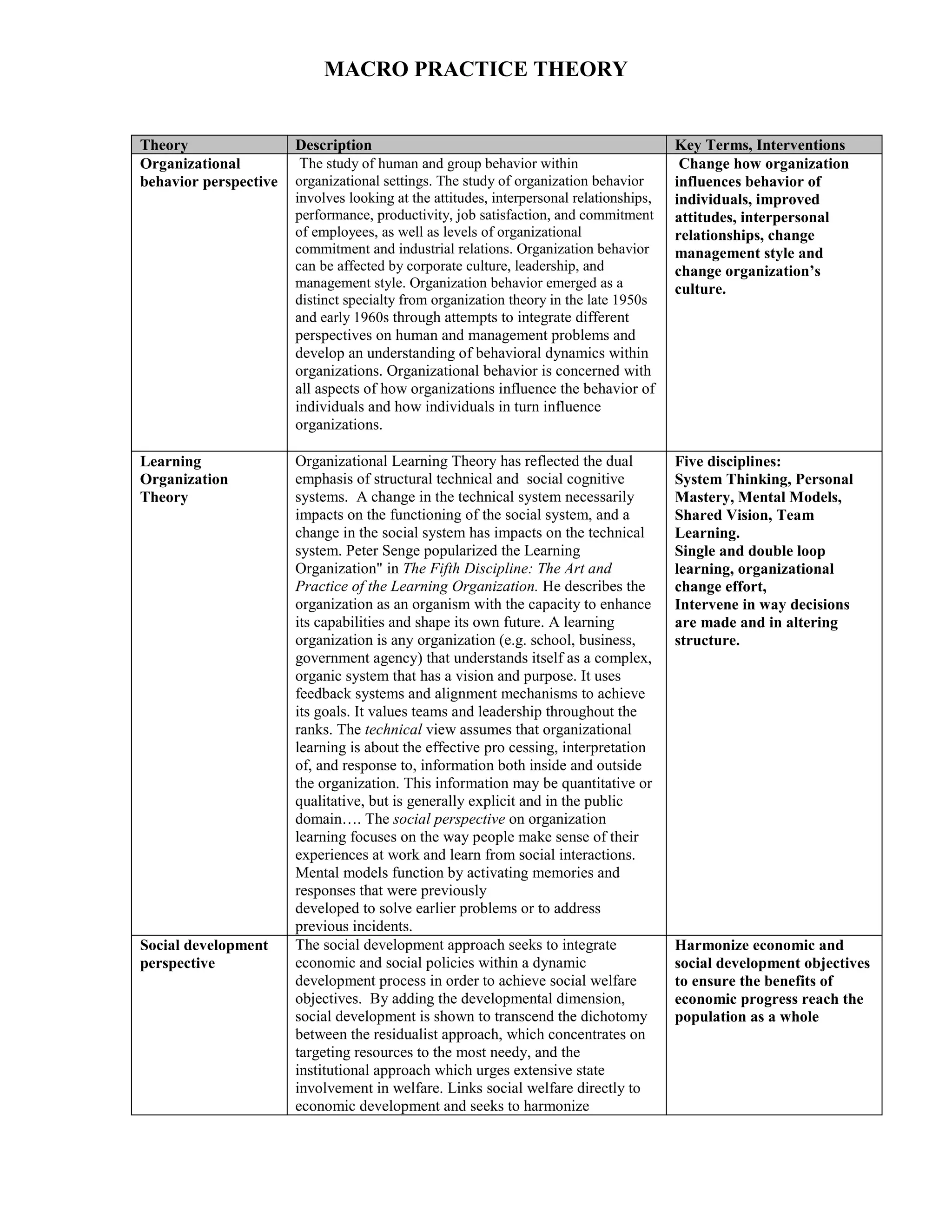
    MACRO PRACTICE THEORY TheoryDescription Key Terms, Interventions Organizational behavior perspective The study of human and group behavior within organizational settings. The study of organization behavior involves looking at the attitudes, interpersonal relationships, performance, productivity, job satisfaction, and commitment of employees, as well as levels of organizational commitment and industrial relations. Organization behavior can be affected by corporate culture, leadership, and management style. Organization behavior emerged as a distinct specialty from organization theory in the late 1950s and early 1960s through attempts to integrate different perspectives on human and management problems and develop an understanding of behavioral dynamics within organizations. Organizational behavior is concerned with all aspects of how organizations influence the behavior of individuals and how individuals in turn influence organizations. Change how organization influences behavior of individuals, improved attitudes, interpersonal relationships, change management style and change organization’s culture. Learning Organization Theory Organizational Learning Theory has reflected the dual emphasis of structural technical and social cognitive systems. A change in the technical system necessarily impacts on the functioning of the social system, and a change in the social system has impacts on the technical system. Peter Senge popularized the Learning Organization" in The Fifth Discipline: The Art and Practice of the Learning Organization. He describes the organization as an organism with the capacity to enhance its capabilities and shape its own future. A learning organization is any organization (e.g. school, business, government agency) that understands itself as a complex, organic system that has a vision and purpose. It uses feedback systems and alignment mechanisms to achieve its goals. It values teams and leadership throughout the ranks. The technical view assumes that organizational learning is about the effective pro cessing, interpretation of, and response to, information both inside and outside the organization. This information may be quantitative or qualitative, but is generally explicit and in the public domain…. The social perspective on organization learning focuses on the way people make sense of their experiences at work and learn from social interactions. Mental models function by activating memories and responses that were previously developed to solve earlier problems or to address previous incidents. Five disciplines: System Thinking, Personal Mastery, Mental Models, Shared Vision, Team Learning. Single and double loop learning, organizational change effort, Intervene in way decisions are made and in altering structure. Social development perspective The social development approach seeks to integrate economic and social policies within a dynamic development process in order to achieve social welfare objectives. By adding the developmental dimension, social development is shown to transcend the dichotomy between the residualist approach, which concentrates on targeting resources to the most needy, and the institutional approach which urges extensive state involvement in welfare. Links social welfare directly to economic development and seeks to harmonize Harmonize economic and social development objectives to ensure the benefits of economic progress reach the population as a whole
  • 2.
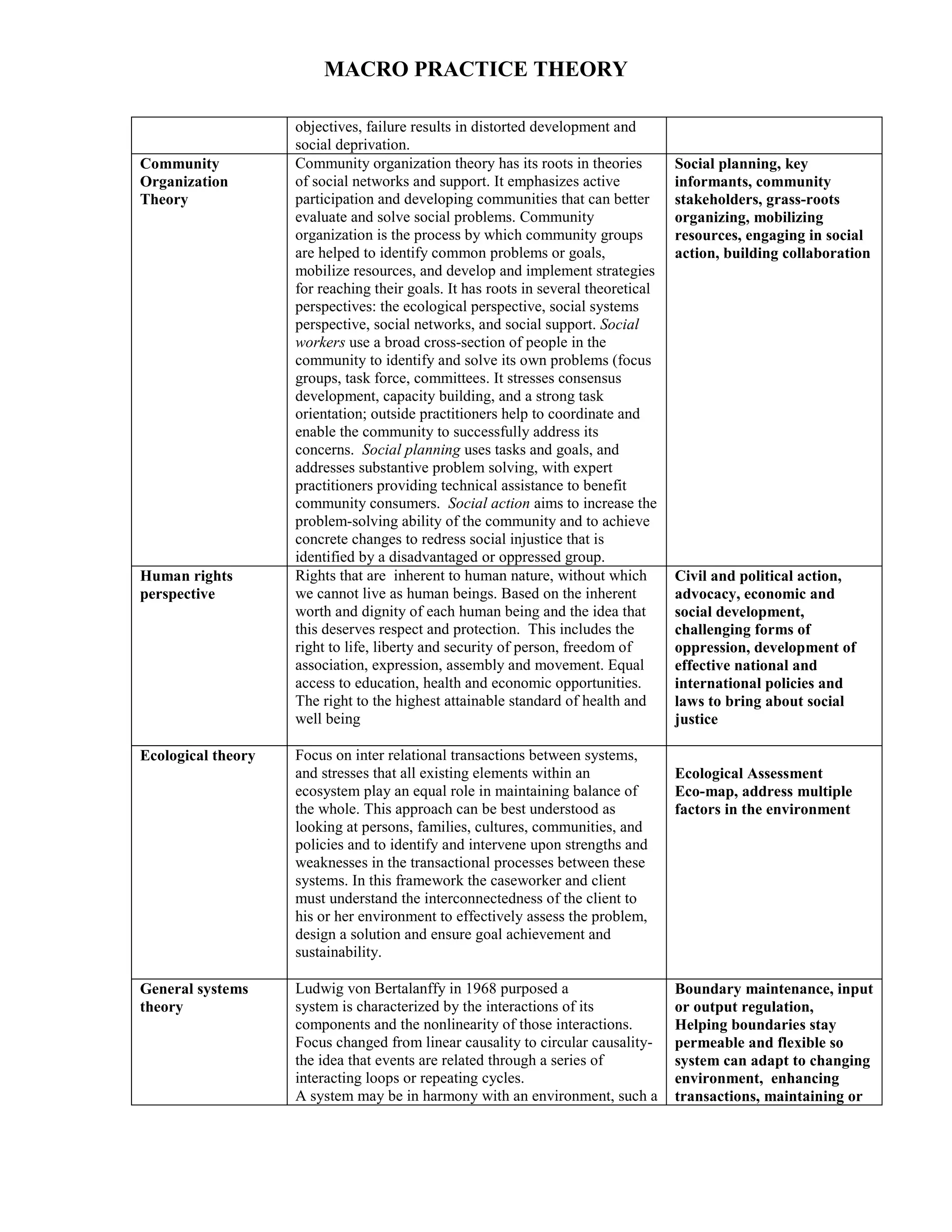
    MACRO PRACTICE THEORY objectives,failure results in distorted development and social deprivation. Community Organization Theory Community organization theory has its roots in theories of social networks and support. It emphasizes active participation and developing communities that can better evaluate and solve social problems. Community organization is the process by which community groups are helped to identify common problems or goals, mobilize resources, and develop and implement strategies for reaching their goals. It has roots in several theoretical perspectives: the ecological perspective, social systems perspective, social networks, and social support. Social workers use a broad cross-section of people in the community to identify and solve its own problems (focus groups, task force, committees. It stresses consensus development, capacity building, and a strong task orientation; outside practitioners help to coordinate and enable the community to successfully address its concerns. Social planning uses tasks and goals, and addresses substantive problem solving, with expert practitioners providing technical assistance to benefit community consumers. Social action aims to increase the problem-solving ability of the community and to achieve concrete changes to redress social injustice that is identified by a disadvantaged or oppressed group. Social planning, key informants, community stakeholders, grass-roots organizing, mobilizing resources, engaging in social action, building collaboration Human rights perspective Rights that are inherent to human nature, without which we cannot live as human beings. Based on the inherent worth and dignity of each human being and the idea that this deserves respect and protection. This includes the right to life, liberty and security of person, freedom of association, expression, assembly and movement. Equal access to education, health and economic opportunities. The right to the highest attainable standard of health and well being Civil and political action, advocacy, economic and social development, challenging forms of oppression, development of effective national and international policies and laws to bring about social justice Ecological theory Focus on inter relational transactions between systems, and stresses that all existing elements within an ecosystem play an equal role in maintaining balance of the whole. This approach can be best understood as looking at persons, families, cultures, communities, and policies and to identify and intervene upon strengths and weaknesses in the transactional processes between these systems. In this framework the caseworker and client must understand the interconnectedness of the client to his or her environment to effectively assess the problem, design a solution and ensure goal achievement and sustainability. Ecological Assessment Eco-map, address multiple factors in the environment General systems theory Ludwig von Bertalanffy in 1968 purposed a system is characterized by the interactions of its components and the nonlinearity of those interactions. Focus changed from linear causality to circular causality- the idea that events are related through a series of interacting loops or repeating cycles. A system may be in harmony with an environment, such a Boundary maintenance, input or output regulation, Helping boundaries stay permeable and flexible so system can adapt to changing environment, enhancing transactions, maintaining or
  • 3.
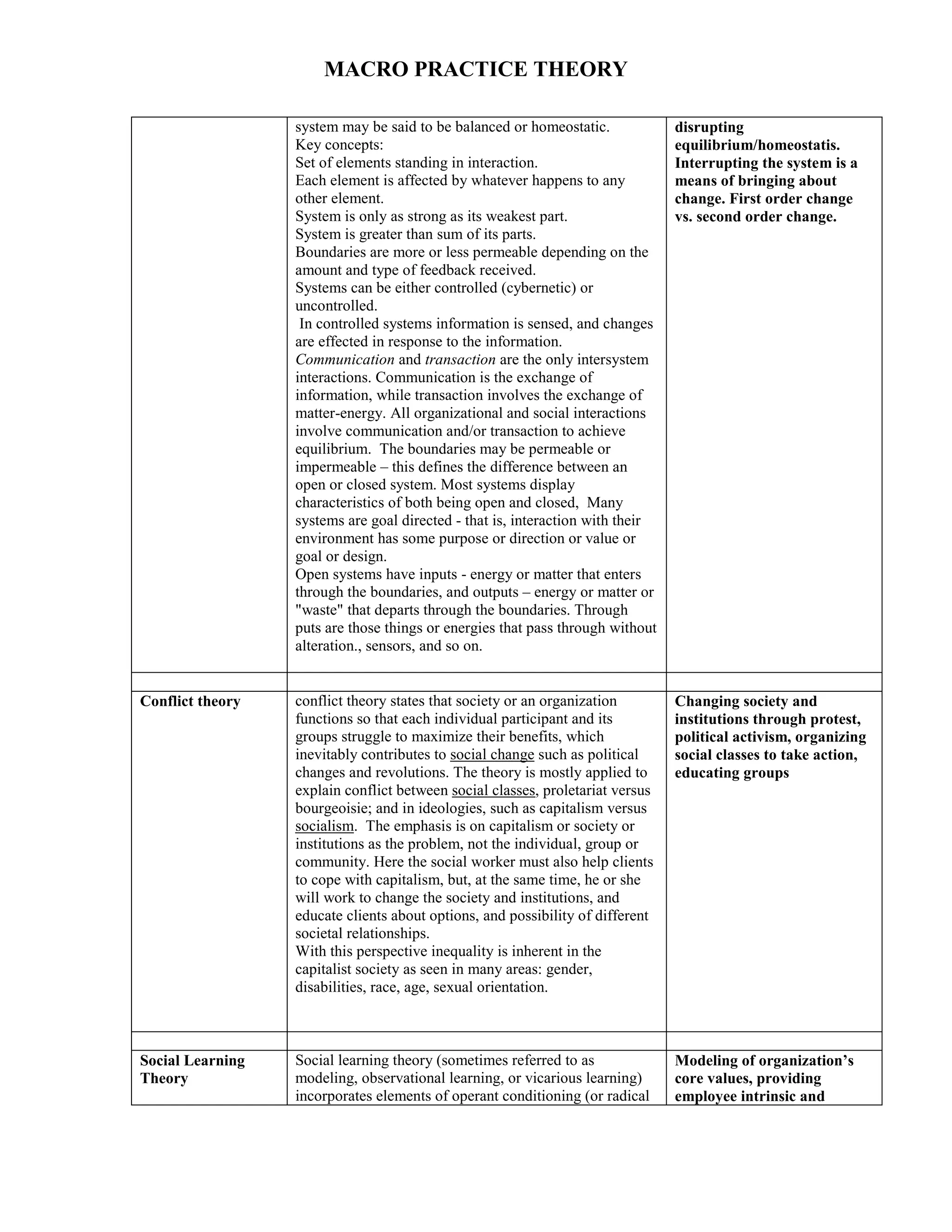
    MACRO PRACTICE THEORY systemmay be said to be balanced or homeostatic. Key concepts: Set of elements standing in interaction. Each element is affected by whatever happens to any other element. System is only as strong as its weakest part. System is greater than sum of its parts. Boundaries are more or less permeable depending on the amount and type of feedback received. Systems can be either controlled (cybernetic) or uncontrolled. In controlled systems information is sensed, and changes are effected in response to the information. Communication and transaction are the only intersystem interactions. Communication is the exchange of information, while transaction involves the exchange of matter-energy. All organizational and social interactions involve communication and/or transaction to achieve equilibrium. The boundaries may be permeable or impermeable – this defines the difference between an open or closed system. Most systems display characteristics of both being open and closed, Many systems are goal directed - that is, interaction with their environment has some purpose or direction or value or goal or design. Open systems have inputs - energy or matter that enters through the boundaries, and outputs – energy or matter or "waste" that departs through the boundaries. Through puts are those things or energies that pass through without alteration., sensors, and so on. disrupting equilibrium/homeostatis. Interrupting the system is a means of bringing about change. First order change vs. second order change. Conflict theory conflict theory states that society or an organization functions so that each individual participant and its groups struggle to maximize their benefits, which inevitably contributes to social change such as political changes and revolutions. The theory is mostly applied to explain conflict between social classes, proletariat versus bourgeoisie; and in ideologies, such as capitalism versus socialism. The emphasis is on capitalism or society or institutions as the problem, not the individual, group or community. Here the social worker must also help clients to cope with capitalism, but, at the same time, he or she will work to change the society and institutions, and educate clients about options, and possibility of different societal relationships. With this perspective inequality is inherent in the capitalist society as seen in many areas: gender, disabilities, race, age, sexual orientation. Changing society and institutions through protest, political activism, organizing social classes to take action, educating groups Social Learning Theory Social learning theory (sometimes referred to as modeling, observational learning, or vicarious learning) incorporates elements of operant conditioning (or radical Modeling of organization’s core values, providing employee intrinsic and
  • 4.
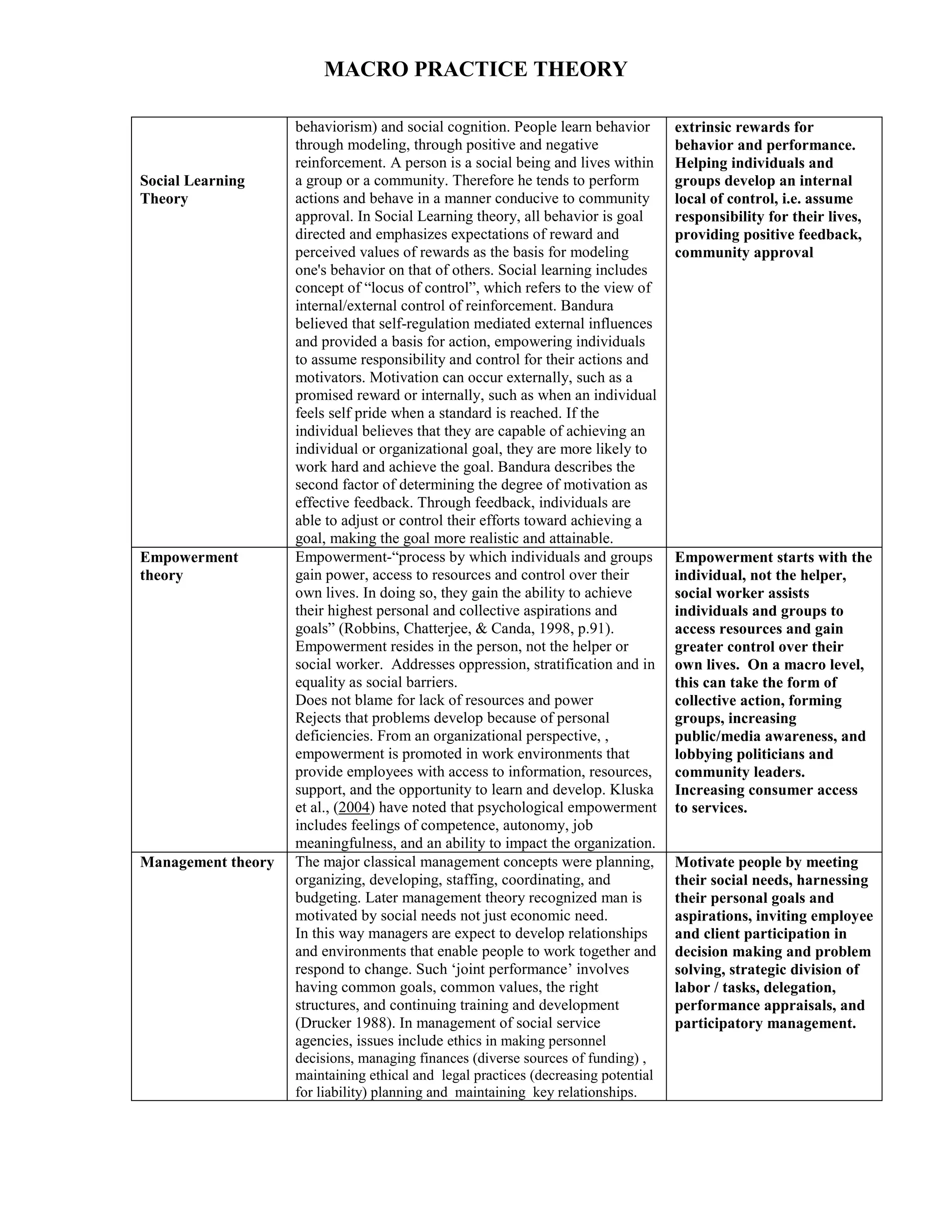
    MACRO PRACTICE THEORY SocialLearning Theory behaviorism) and social cognition. People learn behavior through modeling, through positive and negative reinforcement. A person is a social being and lives within a group or a community. Therefore he tends to perform actions and behave in a manner conducive to community approval. In Social Learning theory, all behavior is goal directed and emphasizes expectations of reward and perceived values of rewards as the basis for modeling one's behavior on that of others. Social learning includes concept of “locus of control”, which refers to the view of internal/external control of reinforcement. Bandura believed that self-regulation mediated external influences and provided a basis for action, empowering individuals to assume responsibility and control for their actions and motivators. Motivation can occur externally, such as a promised reward or internally, such as when an individual feels self pride when a standard is reached. If the individual believes that they are capable of achieving an individual or organizational goal, they are more likely to work hard and achieve the goal. Bandura describes the second factor of determining the degree of motivation as effective feedback. Through feedback, individuals are able to adjust or control their efforts toward achieving a goal, making the goal more realistic and attainable. extrinsic rewards for behavior and performance. Helping individuals and groups develop an internal local of control, i.e. assume responsibility for their lives, providing positive feedback, community approval Empowerment theory Empowerment-“process by which individuals and groups gain power, access to resources and control over their own lives. In doing so, they gain the ability to achieve their highest personal and collective aspirations and goals” (Robbins, Chatterjee, & Canda, 1998, p.91). Empowerment resides in the person, not the helper or social worker. Addresses oppression, stratification and in equality as social barriers. Does not blame for lack of resources and power Rejects that problems develop because of personal deficiencies. From an organizational perspective, , empowerment is promoted in work environments that provide employees with access to information, resources, support, and the opportunity to learn and develop. Kluska et al., (2004) have noted that psychological empowerment includes feelings of competence, autonomy, job meaningfulness, and an ability to impact the organization. Empowerment starts with the individual, not the helper, social worker assists individuals and groups to access resources and gain greater control over their own lives. On a macro level, this can take the form of collective action, forming groups, increasing public/media awareness, and lobbying politicians and community leaders. Increasing consumer access to services. Management theory The major classical management concepts were planning, organizing, developing, staffing, coordinating, and budgeting. Later management theory recognized man is motivated by social needs not just economic need. In this way managers are expect to develop relationships and environments that enable people to work together and respond to change. Such ‘joint performance’ involves having common goals, common values, the right structures, and continuing training and development (Drucker 1988). In management of social service agencies, issues include ethics in making personnel decisions, managing finances (diverse sources of funding) , maintaining ethical and legal practices (decreasing potential for liability) planning and maintaining key relationships. Motivate people by meeting their social needs, harnessing their personal goals and aspirations, inviting employee and client participation in decision making and problem solving, strategic division of labor / tasks, delegation, performance appraisals, and participatory management.