Unit 6: consumption function
• Meaning Consumption function
• Linear consumption function
• Kyenes’ Psychological law of consumption function
• Consumption function in short run and long run
• Average Propensity to consume (APC)
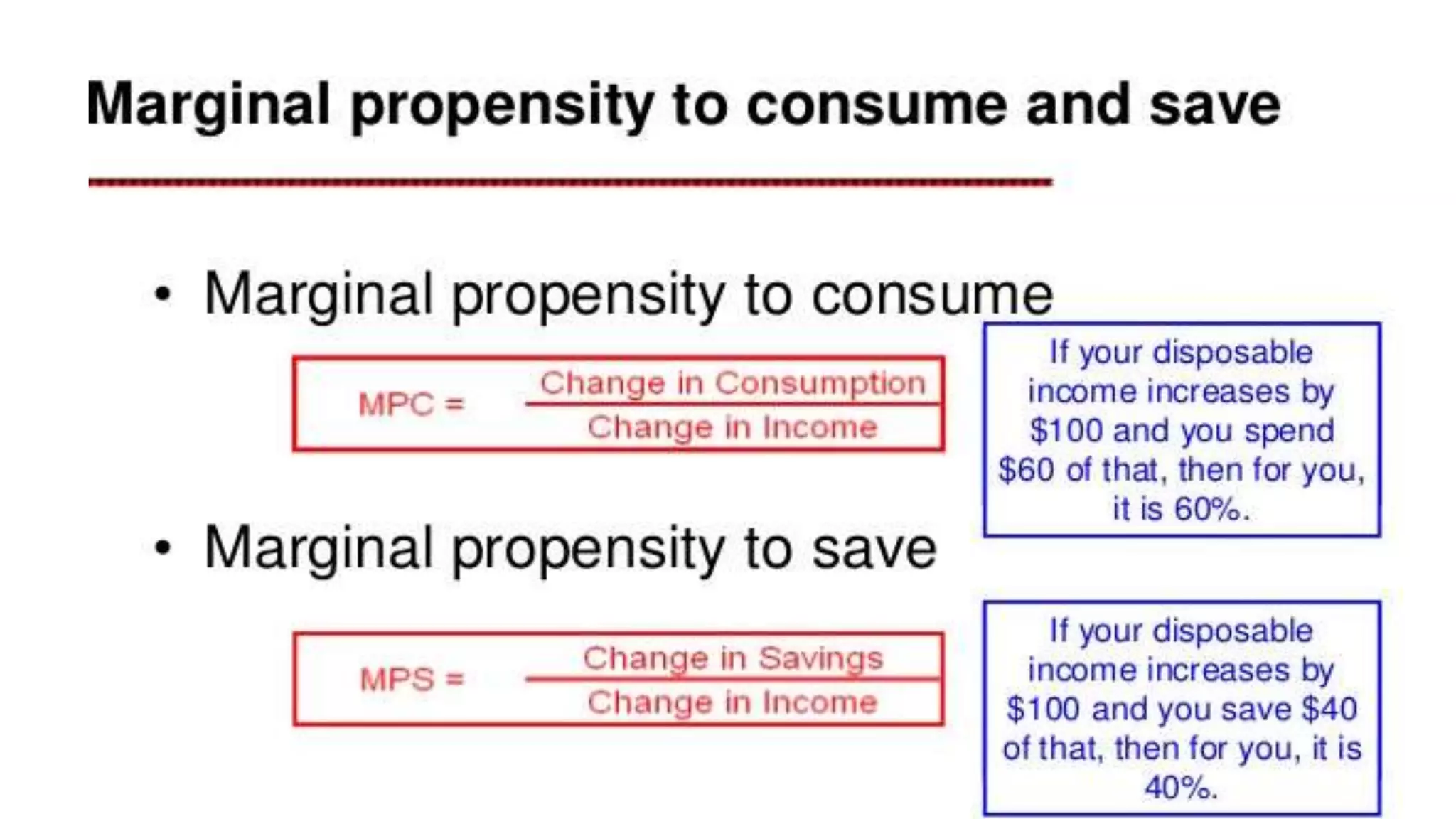
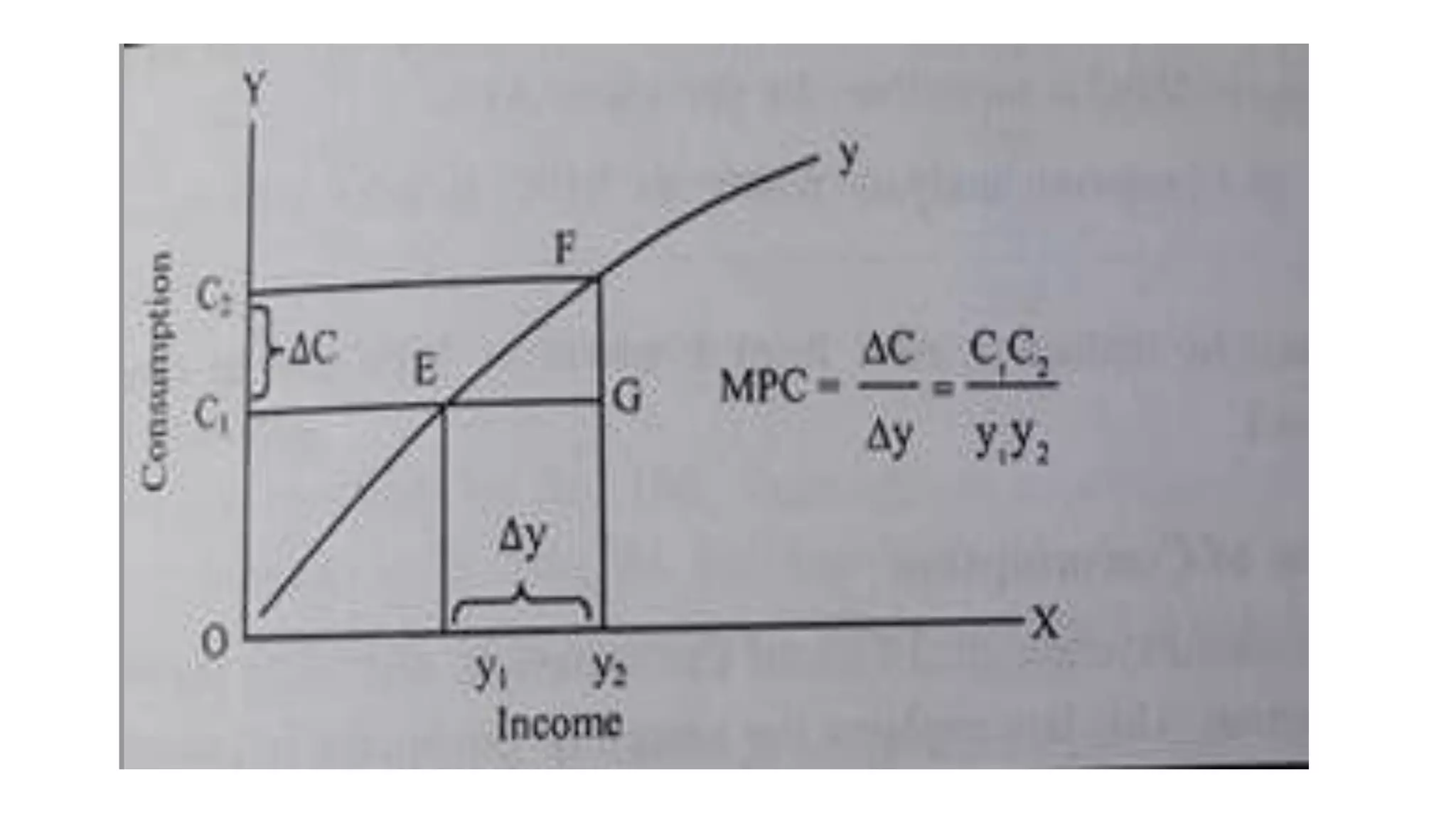
• Marginal Propensity to consume (APC)
• Relationship between APC and MPC
• Factors affecting Consumption Function
• Measures to raise propensity to consume
• Implication of consumption function
What is consumption?
• Consumption is the use of final goods and services to satisfy needs
(wants)
• Consumption is the process of satisfying human wants.
• We make expenditure on goods and services which are needed to
meet our wants.
Consumption Function
• A function showing how the relationship between consumption and
its determinants ( mainly income)
• Consumption function represents amount of consumer expenditure
made at a given level of income whereas the propensity to consume
is a schedule of consumer expenditure at various income levels.
Propensity to consume does not mean a mere desire to consume, but
the actual consumption that place or is expected to take place out of
varying amount.--------- K.K. Kurihara
• Consumption function is nothing more than a statement of the
relationship between consumption expenditure and income
…R.G. Lipsey.
Consumption Function
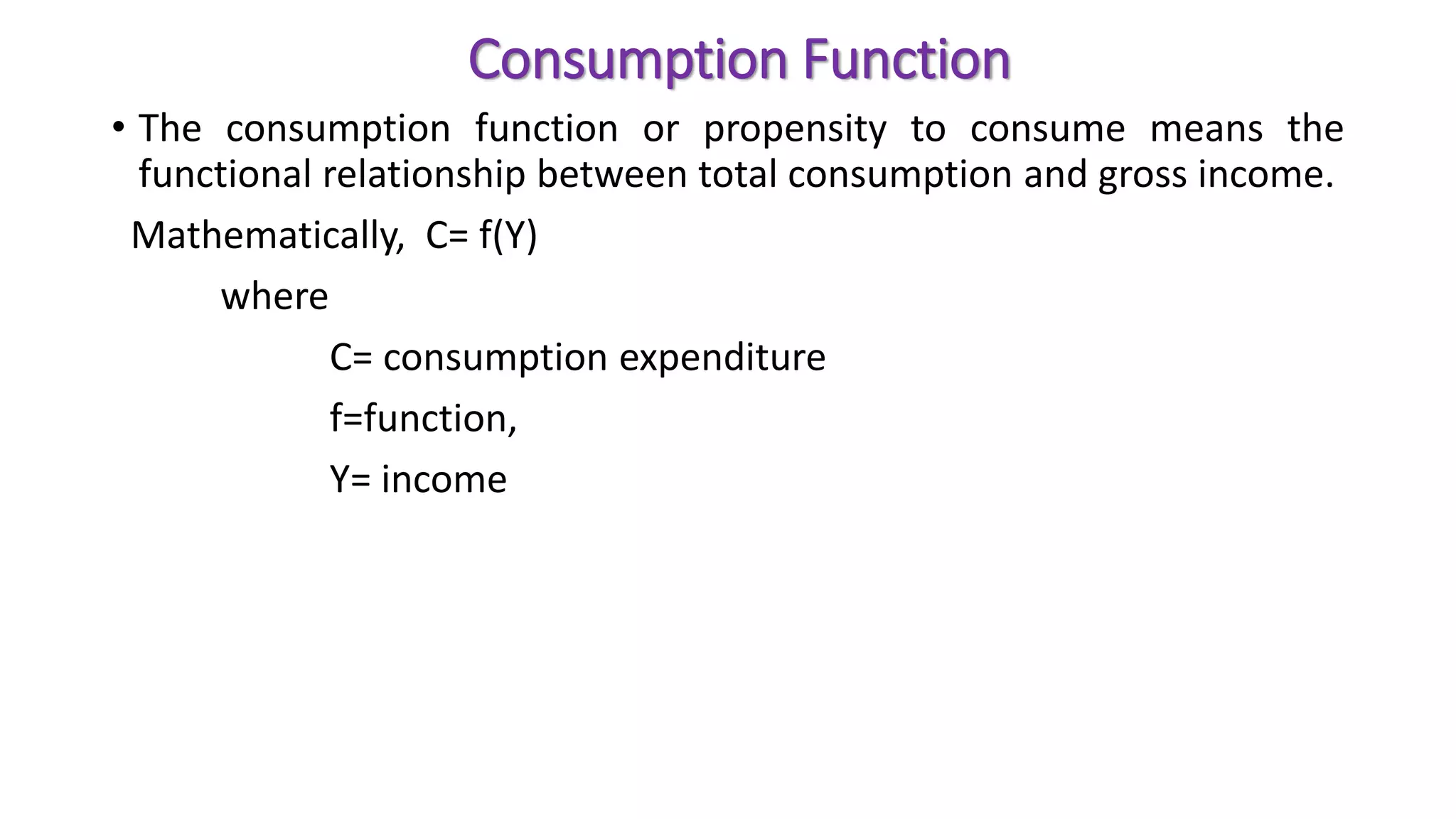
• The consumption function or propensity to consume means the
functional relationship between total consumption and gross income.
Mathematically, C= f(Y)
where
C= consumption expenditure
f=function,
Y= income
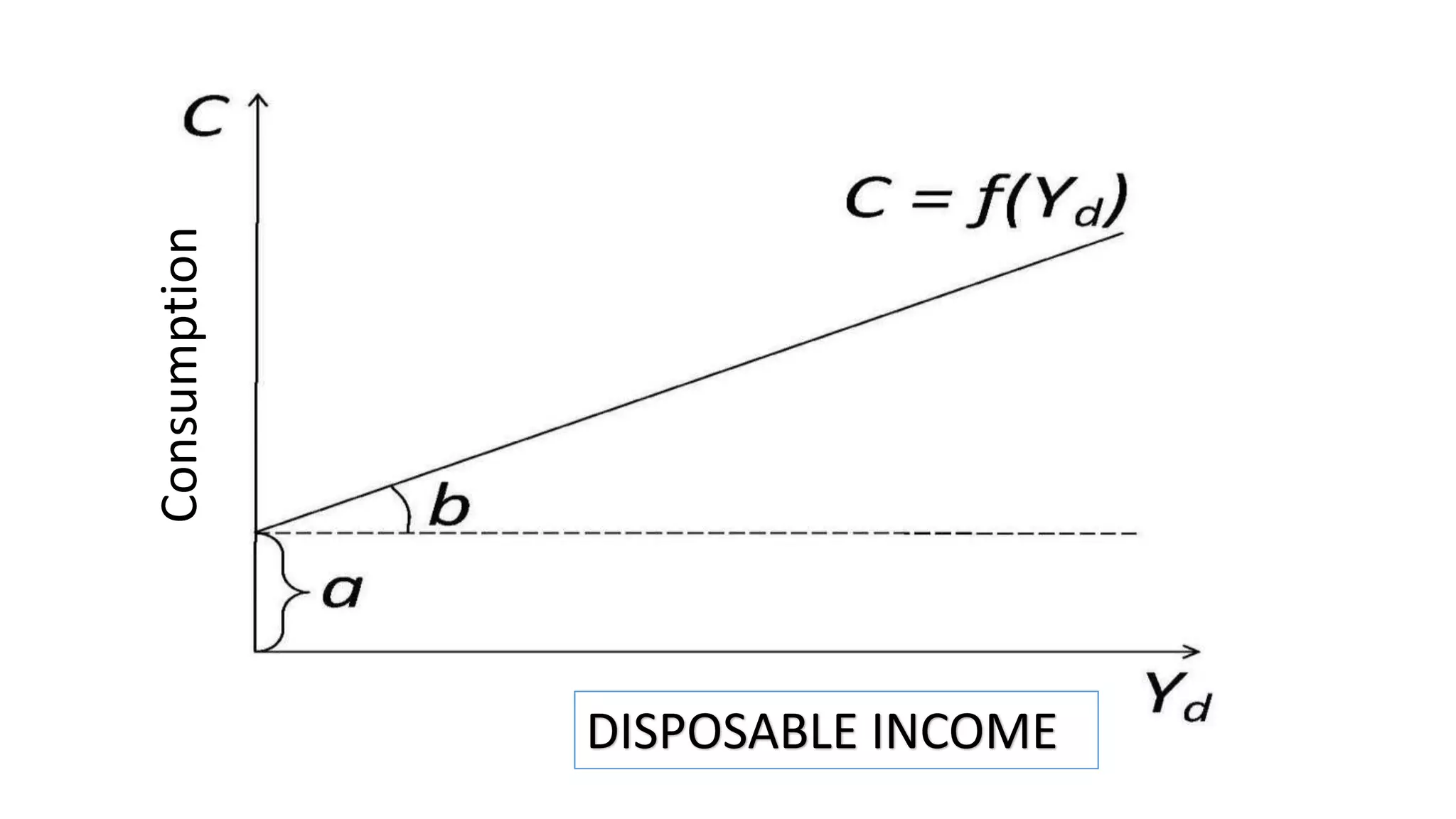
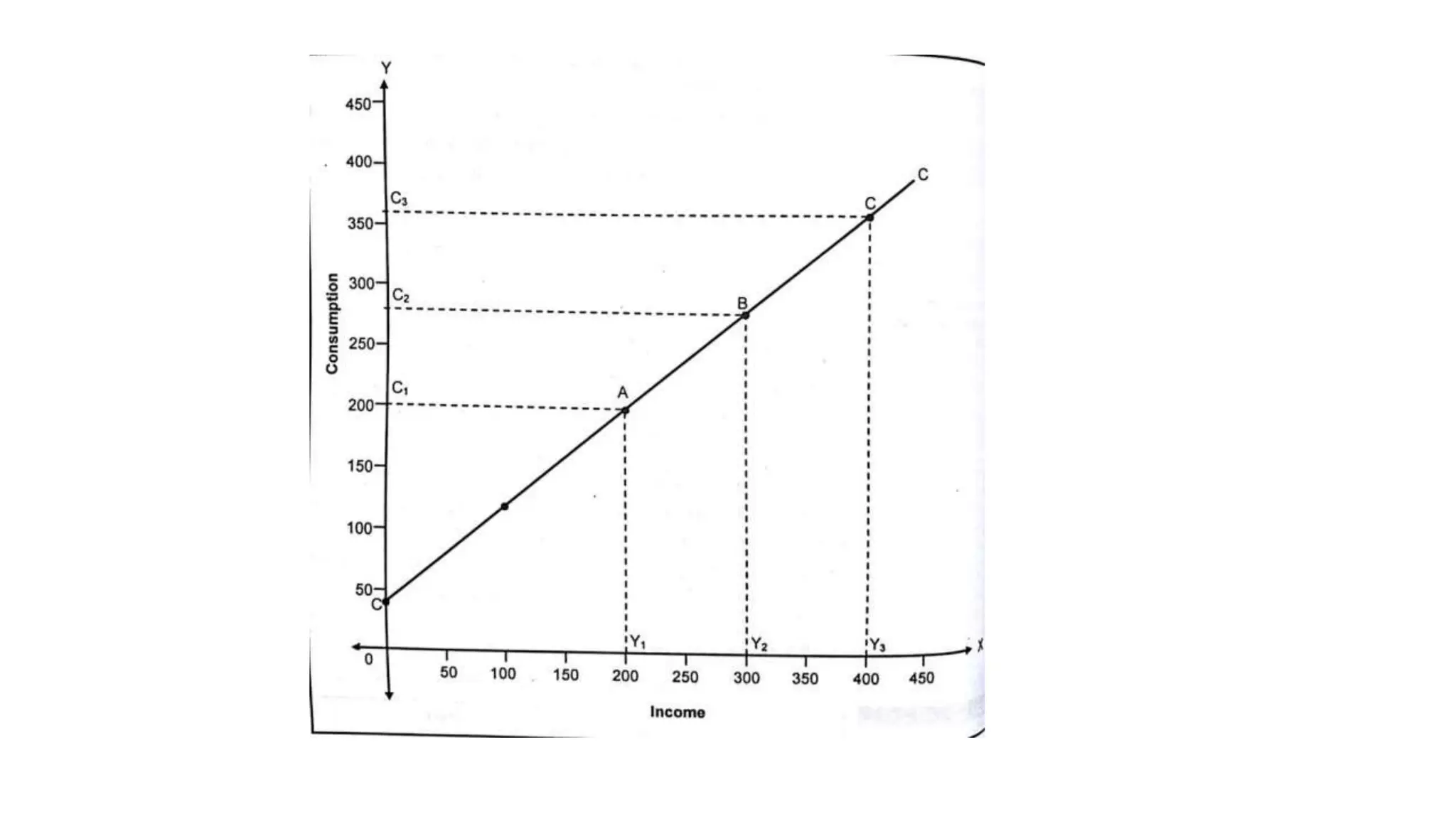
Linear consumption function
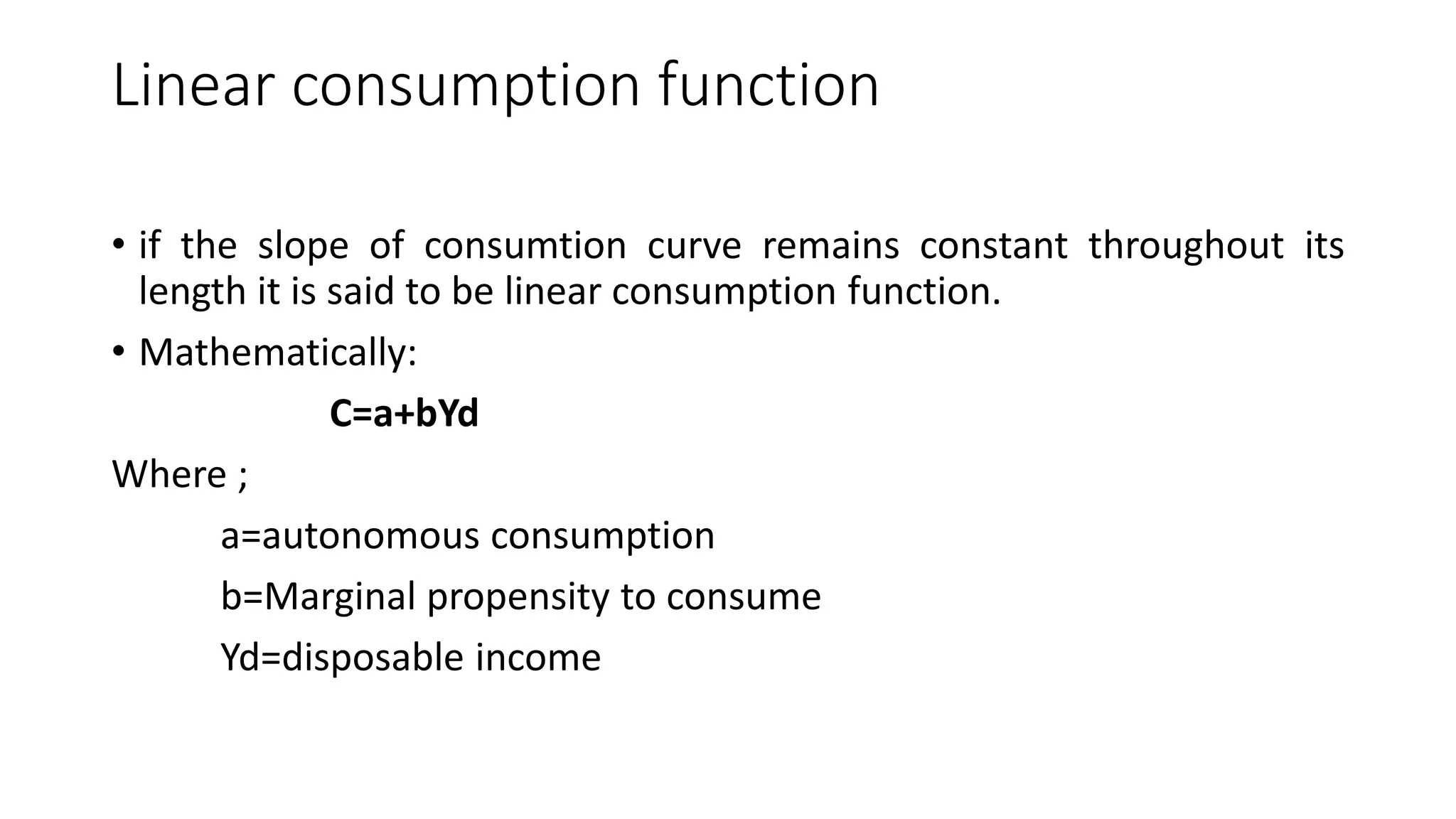
• if the slope of consumtion curve remains constant throughout its
length it is said to be linear consumption function.
• Mathematically:
C=a+bYd
Where ;
a=autonomous consumption
b=Marginal propensity to consume
Yd=disposable income
National Income
(in Rs.)
Consumption
C = 50+0.5Yd
Saving (in Rs.)
S = Yd-C
0 50+0.5*0=50 -50
100 50+0.5*100=100 0
200 50+0.5*200=150 50
300 50+0.5*300=200 100
400 50+0.5*400=250 150
DISPOSABLE INCOME
Consumption
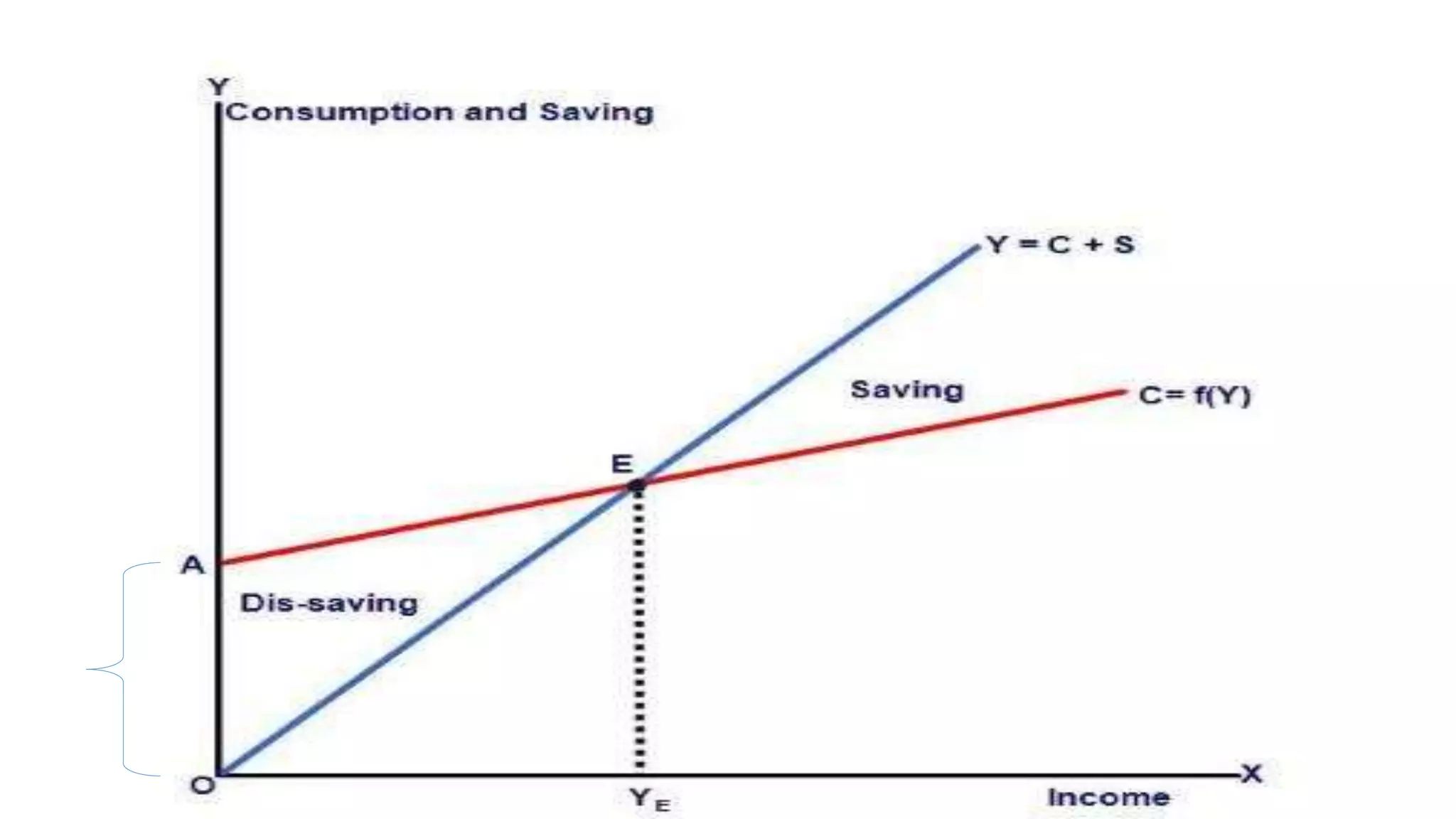
Keynes’Psychological Law of Consumption
• Keynes propounded the psychological law of consumption which
provides foundation to consumption function.
• This law explains the nature of propensity to consume or the nature
of functional relationship between consumption and income.
• This law states that people have tendency of spending less
proportion of increase income on consumption.
• According to Keynes, “The psychology of the community is such that
when aggregate real income increases, aggregate consumption also
increases but not as much as in income”.
Psychological Law of Consumption
This law is based on following propositions
Proposition 1:
• When aggregate income increases , consumption expenditure also increases but by a
smaller amount.
• It means: ∆C<∆Y
Where;
∆C = change in consumption
∆Y = change in income
Proposition 2:
• The increased income will be divided in some ration between consumption and saving ie,
∆Y = ∆C + ∆S
Proposition 3:
• When income increased both consumption and saving also increase.
Assumptions
• No change in factors like desire, behavior, fashion, population etc.
• No government intervention(capitalist economy).
• Normal situation in the economy( no war, natural disaster etc)
• No change in price etc.
Importance/Implication of
Psychological law of consumption
• Makes Say’s law invalid
• Need for Government Intervention
• Existence of Underemployment
• Basis of theory of multiplier
• Nature of Marginal Efficiency of Capital
Consumption function in short run and long
run
• Historical data shows , consumption rises and falls cyclically
(shortrun) less than in proportion to the rise and fall in income
• In longrun , the consumption function doesn't remain constant
• Empirical study done by Kuznet shows that consumption expenditure
increase in the same proportion as increase in income
Properties of MPC
• MPC is greater than 0 and less than 1. 0‹MPC‹1
• Poor people have higher MPC and Rich people have lower MPC.
• MPC in short run is stable because psychological factors/ institutional
factors do not change in short run.
Calculation of APC and MPC
Income (Y) Consumption (C) APC = C/Y MPC = ∆C/∆Y
200 200 200/200 = 1 (100%) 80/100 = 0.8 (80%)
300 280 280/300 = 0.93 (93%)
400 360
500 440
600 520
700 600
800 680
Calculate APC and MPC
Relationship between APC and MPC
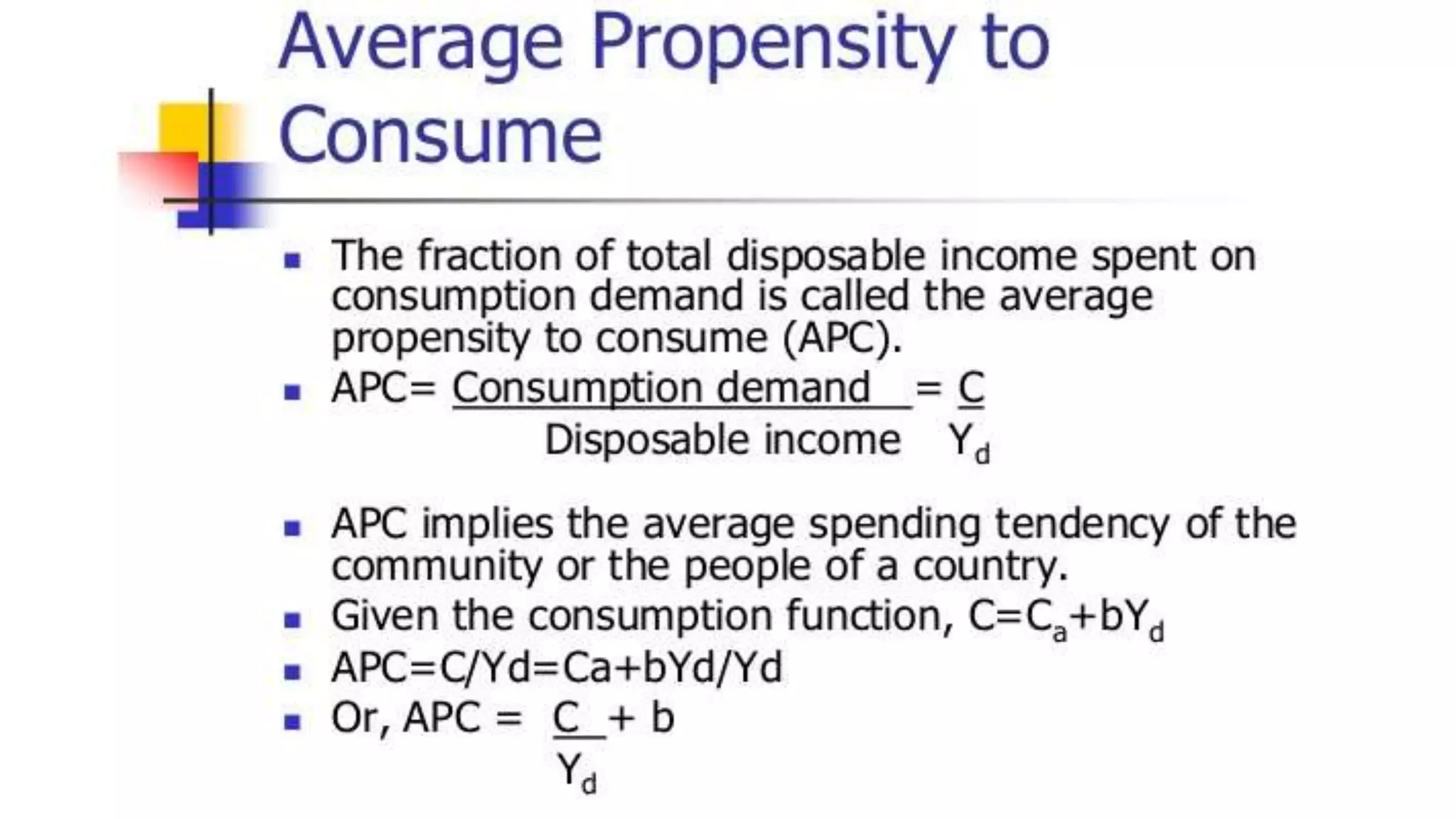
1. APC is the ratio of consumption expenditure to income level
whereas MPC is the ratio of change in consumption expenditure to
change in income level. APC=C/Y MPC=∆C/∆Y
2. When consumption function is linear, as income increases, APC falls
and MPC remains constant.
3. When consumption function is non-linear, as income increases,
both APC and MPC fall but MPC falls faster than APC.
4. APC is related to long-run analysis whereas MPC is related to short-
run analysis.
5. APC=1-APS MPC=1-MPS
Determinants of consumption Function
1. Subjective Factors (endogenous/internal factors)
I. Psychology of human nature
According to Keynes, the psychological factors determine the slope and
position of consumption function. Human values, social practices etc.
affect consumption. People want to reserve for unseen contingencies,
future need, enjoy enlarge future income from investment, be
independent, to possess power and dignity, to carry speculative
activities, to satisfy miserly nature.
II. Institutional Arrangement: Desire to expand business, Liquidity,
Demonstrate successful management, financial care etc.
Determinants of consumption Function
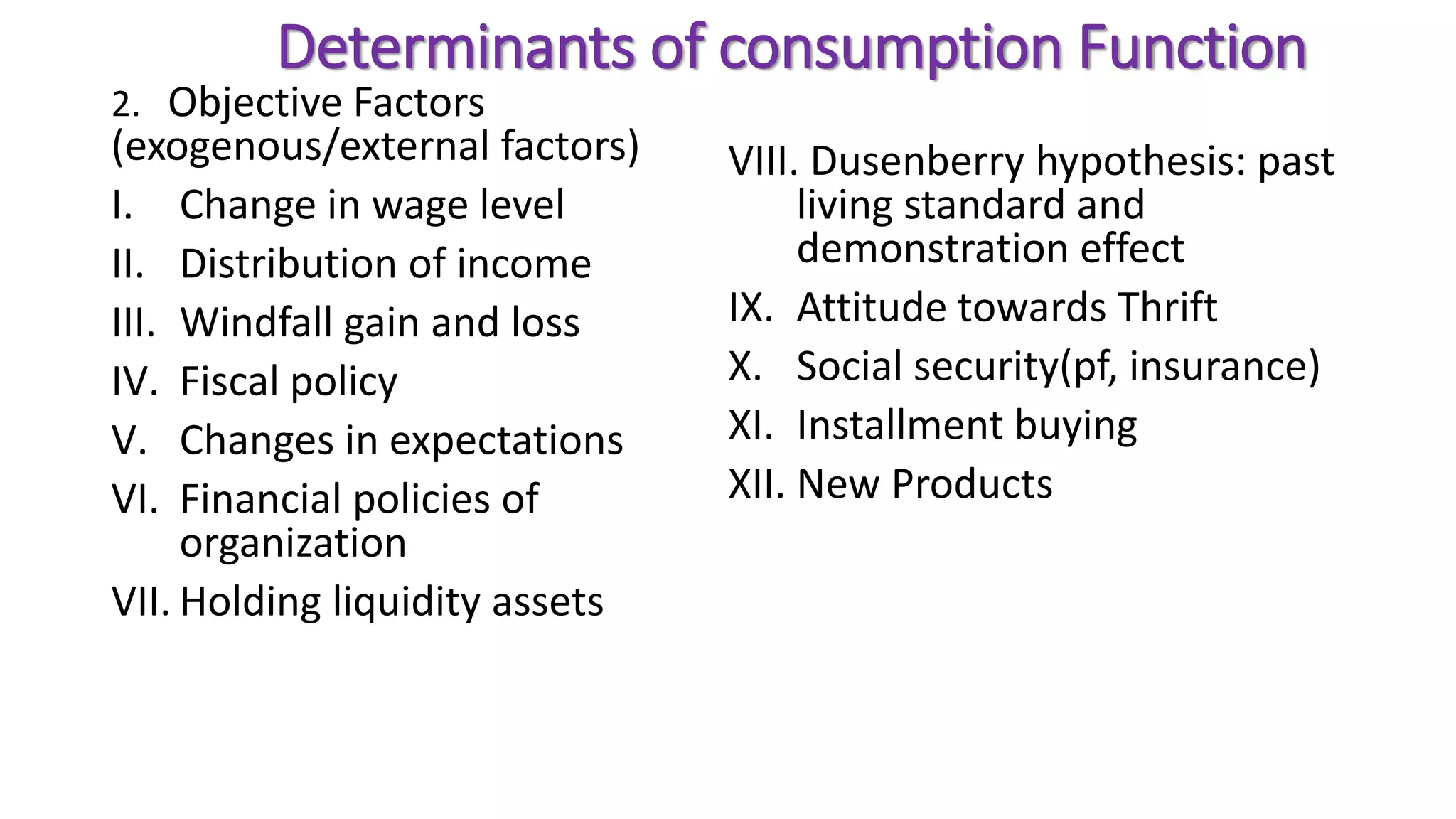
2. Objective Factors
(exogenous/external factors)
I. Change in wage level
II. Distribution of income
III. Windfall gain and loss
IV. Fiscal policy
V. Changes in expectations
VI. Financial policies of
organization
VII. Holding liquidity assets
VIII. Dusenberry hypothesis: past
living standard and
demonstration effect
IX. Attitude towards Thrift
X. Social security(pf, insurance)
XI. Installment buying
XII. New Products

6.1 consumption function

  • 1.
    Unit 6: consumptionfunction • Meaning Consumption function • Linear consumption function • Kyenes’ Psychological law of consumption function • Consumption function in short run and long run • Average Propensity to consume (APC) • Marginal Propensity to consume (APC) • Relationship between APC and MPC • Factors affecting Consumption Function • Measures to raise propensity to consume • Implication of consumption function
  • 2.
    What is consumption? •Consumption is the use of final goods and services to satisfy needs (wants) • Consumption is the process of satisfying human wants. • We make expenditure on goods and services which are needed to meet our wants.
  • 3.
    Consumption Function • Afunction showing how the relationship between consumption and its determinants ( mainly income) • Consumption function represents amount of consumer expenditure made at a given level of income whereas the propensity to consume is a schedule of consumer expenditure at various income levels. Propensity to consume does not mean a mere desire to consume, but the actual consumption that place or is expected to take place out of varying amount.--------- K.K. Kurihara • Consumption function is nothing more than a statement of the relationship between consumption expenditure and income …R.G. Lipsey.
  • 4.
    Consumption Function • Theconsumption function or propensity to consume means the functional relationship between total consumption and gross income. Mathematically, C= f(Y) where C= consumption expenditure f=function, Y= income
  • 5.
    Linear consumption function •if the slope of consumtion curve remains constant throughout its length it is said to be linear consumption function. • Mathematically: C=a+bYd Where ; a=autonomous consumption b=Marginal propensity to consume Yd=disposable income
  • 6.
    National Income (in Rs.) Consumption C= 50+0.5Yd Saving (in Rs.) S = Yd-C 0 50+0.5*0=50 -50 100 50+0.5*100=100 0 200 50+0.5*200=150 50 300 50+0.5*300=200 100 400 50+0.5*400=250 150
  • 7.
  • 8.
    Keynes’Psychological Law ofConsumption • Keynes propounded the psychological law of consumption which provides foundation to consumption function. • This law explains the nature of propensity to consume or the nature of functional relationship between consumption and income. • This law states that people have tendency of spending less proportion of increase income on consumption. • According to Keynes, “The psychology of the community is such that when aggregate real income increases, aggregate consumption also increases but not as much as in income”.
  • 9.
  • 10.
    This law isbased on following propositions Proposition 1: • When aggregate income increases , consumption expenditure also increases but by a smaller amount. • It means: ∆C<∆Y Where; ∆C = change in consumption ∆Y = change in income Proposition 2: • The increased income will be divided in some ration between consumption and saving ie, ∆Y = ∆C + ∆S Proposition 3: • When income increased both consumption and saving also increase.
  • 11.
    Assumptions • No changein factors like desire, behavior, fashion, population etc. • No government intervention(capitalist economy). • Normal situation in the economy( no war, natural disaster etc) • No change in price etc.
  • 14.
    Importance/Implication of Psychological lawof consumption • Makes Say’s law invalid • Need for Government Intervention • Existence of Underemployment • Basis of theory of multiplier • Nature of Marginal Efficiency of Capital
  • 15.
    Consumption function inshort run and long run • Historical data shows , consumption rises and falls cyclically (shortrun) less than in proportion to the rise and fall in income • In longrun , the consumption function doesn't remain constant • Empirical study done by Kuznet shows that consumption expenditure increase in the same proportion as increase in income
  • 20.
    Properties of MPC •MPC is greater than 0 and less than 1. 0‹MPC‹1 • Poor people have higher MPC and Rich people have lower MPC. • MPC in short run is stable because psychological factors/ institutional factors do not change in short run.
  • 21.
    Calculation of APCand MPC Income (Y) Consumption (C) APC = C/Y MPC = ∆C/∆Y 200 200 200/200 = 1 (100%) 80/100 = 0.8 (80%) 300 280 280/300 = 0.93 (93%) 400 360 500 440 600 520 700 600 800 680
  • 23.
  • 24.
    Relationship between APCand MPC 1. APC is the ratio of consumption expenditure to income level whereas MPC is the ratio of change in consumption expenditure to change in income level. APC=C/Y MPC=∆C/∆Y 2. When consumption function is linear, as income increases, APC falls and MPC remains constant. 3. When consumption function is non-linear, as income increases, both APC and MPC fall but MPC falls faster than APC. 4. APC is related to long-run analysis whereas MPC is related to short- run analysis. 5. APC=1-APS MPC=1-MPS
  • 25.
    Determinants of consumptionFunction 1. Subjective Factors (endogenous/internal factors) I. Psychology of human nature According to Keynes, the psychological factors determine the slope and position of consumption function. Human values, social practices etc. affect consumption. People want to reserve for unseen contingencies, future need, enjoy enlarge future income from investment, be independent, to possess power and dignity, to carry speculative activities, to satisfy miserly nature. II. Institutional Arrangement: Desire to expand business, Liquidity, Demonstrate successful management, financial care etc.
  • 26.
    Determinants of consumptionFunction 2. Objective Factors (exogenous/external factors) I. Change in wage level II. Distribution of income III. Windfall gain and loss IV. Fiscal policy V. Changes in expectations VI. Financial policies of organization VII. Holding liquidity assets VIII. Dusenberry hypothesis: past living standard and demonstration effect IX. Attitude towards Thrift X. Social security(pf, insurance) XI. Installment buying XII. New Products