Introduction to Macroeconomics
What is Economics?
“Economics is the science of wealth”.
Adam Smith
“Economics is the study of mankind in the ordinary business of life; it examines that part of individual and social
action which is most closely connected with the attainment, and with the use of the material requisites of well
being”.
Alfred Marshall
“Economics is the science which studies human behaviour as a relationship between ends and scarce means which
have alternative uses”.
John Robbins
This definitions give the essence of what economies is about. But economics
could not be defined precisely because it has ever been a growing science
Why do people Economise?
• Human wants, desires and aspirations are endless.
• Resources are scarce and have alternative uses with different returns.
• People are of optimizing nature.
The Subject Matter of Economics
The subject matter of economics consists of the study of
• Consumer’s behavior
• Producer’s behavior
• Resource owners behavior
• Working mechanism of the market system
• Behavior of the market forces—demand and supply
• Price determination in the market
• Input-output relationship
• Cost-output relationship
• Factor price determination
• The study of economy as whole: Macroeconomics
WHAT IS MACROECONOMICS?
“Macroeconomics is the study of forces or factors that determine the levels of
aggregate production, employment and prices in the economy, and their rate of change
over time.”…. Gardner Ackley
“Macroeconomics is the study of the nature, relationships and behaviour of
aggregates of economic quantities.... Macroeconomics ... deals not with individual
quantities as such, but with aggregates of these quantities … not with individual
incomes, but with the national income, not with individual prices, but with the price
levels, not with individual output, but with the national output”. …..Kenneth E Boulding
“Macroeconomic theory is the theory of income, employment, prices and money”….. J.
M. Culbertson
“Macroeconomics is the study of the behaviour of the economy as a whole. It examines
the overall level of a nation’s output, employment, and prices”…. P. A. Samuelson and
W. D. Nordhaus:
5
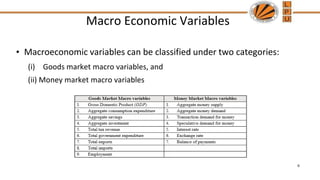
Macro Economic Variables
• Macroeconomic variables can be classified under two categories:
(i) Goods market macro variables, and
(ii) Money market macro variables
6
Macroeconomics as a Theoretical Science
• Explains the behaviour of macroeconomic variables and specifies the nature of
relationship between them;
• Provides framework and analytical tools to analyse the macroeconomic
phenomena;
• Provides an insight into the working of the economy; and
• Provides analytical framework and necessary conditions for the formulation of
appropriate macroeconomic policies to achieve predetermined goals.
Macroeconomics as a Policy Science
• Provides a sound theoretical framework for investigating the causes
and effects of economic problems;
• Provides guidelines for finding appropriate policy measures to solve
the problem, and
• Analyses the working and effectiveness of macroeconomic policies,
especially the monetary and fiscal policies, on the economy.
The Classical view on Macroeconomics
• According to classical school of thought, if market forces of demand
and supply are allowed to work freely, then
i. there will always be full employment in the long run, and unemployment, if any, will be a
short-run phenomenon;
ii. there will be neither over-production nor under-production at the aggregate level; and
iii. the economy will always be in equilibrium in the long run.
• The postulates of classical macroeconomics failed to hold during the great
depression of 1930s. This marked the collapse of the classical macroeconomics.
The Keynesian Macroeconomics are
separate branch of Economies
• Macroeconomics was created by J.M. Keynes after analysing the
causes and consequences of the Great Depression. The central theme
of the keynesian macroeconomics are following-
– The level of output and employment in an economy is determined by the
aggregate demand given the resources.
– Monet market equilibrium is determined by the demand for and supply of
money.
– The unemployment in any country is caused by lack of aggregate demand and
economic fluctuations are caused by demand deficiency.
– The demand deficiency can be removed through compensatory government
spending.
Post-Keynesian Developments in Macroeconomics
• Monetarism: A Counter Revolution,
• Neo-classical macroeconomics,
• Supply-side economics, and
• Neo-Keynesianism.
BASIC CONCEPTS AND APPROACHES TO
MACROECONOMIC ANALYSIS
• Concept of Stock and Flow Variables
• Equilibrium and Disequilibrium
• Partial Equilibrium and General Equilibrium Analysis
• Static, Comparative Static and Dynamic Analyses
12
APPROACHES TO MACROECONOMIC ANALYSIS
1. Static and Comparative Statics Analysis
• Static analysis- When an economy is studied under static conditions,
it is called static analysis. The variables used in this kind of analysis
have no past or future and all variables belong to the same point in
time.
• Comparative statics analysis- Comparative statics is a comparative
study of economic conditions at two static equilibrium positions at
two different points in time.
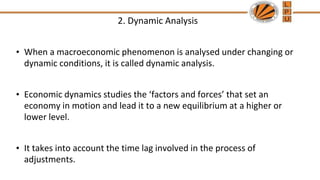
2. Dynamic Analysis
• When a macroeconomic phenomenon is analysed under changing or
dynamic conditions, it is called dynamic analysis.
• Economic dynamics studies the ‘factors and forces’ that set an
economy in motion and lead it to a new equilibrium at a higher or
lower level.
• It takes into account the time lag involved in the process of
adjustments.
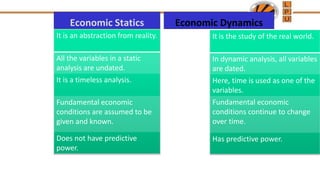
Economic Statics Economic Dynamics
It is an abstraction from reality.
All the variables in a static
analysis are undated.
It is a timeless analysis.
Fundamental economic
conditions are assumed to be
given and known.
Does not have predictive
power.
It is the study of the real world.
In dynamic analysis, all variables
are dated.
Here, time is used as one of the
variables.
Fundamental economic
conditions continue to change
over time.
Has predictive power.
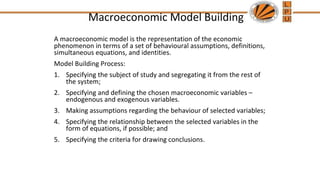
Macroeconomic Model Building
A macroeconomic model is the representation of the economic
phenomenon in terms of a set of behavioural assumptions, definitions,
simultaneous equations, and identities.
Model Building Process:
1. Specifying the subject of study and segregating it from the rest of
the system;
2. Specifying and defining the chosen macroeconomic variables –
endogenous and exogenous variables.
3. Making assumptions regarding the behaviour of selected variables;
4. Specifying the relationship between the selected variables in the
form of equations, if possible; and
5. Specifying the criteria for drawing conclusions.
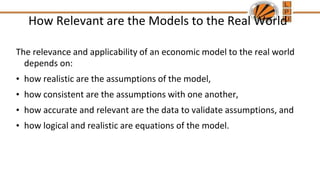
How Relevant are the Models to the Real World
The relevance and applicability of an economic model to the real world
depends on:
• how realistic are the assumptions of the model,
• how consistent are the assumptions with one another,
• how accurate and relevant are the data to validate assumptions, and
• how logical and realistic are equations of the model.
Why Economists Build Models?
• The economic behaviour of the people needs to be studied with the
purpose of both understanding and devising corrective measures
whenever required.
• It is for this purpose that economists create a kind of imaginary or
hypothetical world, approximating to the real world.
Importance of Macroeconomics
• Growing importance of macroeconomic issues: Low growth,
unemployment and inflation
• Persistence of macroeconomic problems causing social, political and
international problems
• Growing complexity of economic system
• Need for government intervention with the market system
• Use of macroeconomics in business management
Limitations of Macroeconomics
• Ignores the structural changes
• Aggregates are not a reality but a picture or approximation of reality
• Some economists consider macroeconomics only as an “intellectual
attraction” without much practical use
Macroeconomic Issues
1. Achieving and maintaining a high rate of economic growth,
2. Preventing business cycles when symptoms come up,
3. Controlling inflation and stabilising price level,
4. Solving the problems of unemployment and poverty,
5. Containing growing budgetary deficits, and
6. Managing international economic issues.
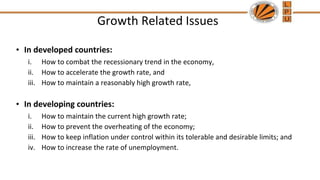
Growth Related Issues
• In developed countries:
i. How to combat the recessionary trend in the economy,
ii. How to accelerate the growth rate, and
iii. How to maintain a reasonably high growth rate,
• In developing countries:
i. How to maintain the current high growth rate;
ii. How to prevent the overheating of the economy;
iii. How to keep inflation under control within its tolerable and desirable limits; and
iv. How to increase the rate of unemployment.
The Issue of Business Cycles
• Business cycle refers to subsequent phases of economic growth and
depression in the economy—high growth in GDP/GNP in one period
followed by a sharp decline in the next period.
• Factors and forces that cause a business cycle are always present in
the growing economies.
• Business cycle has become a big issue after World War II.
The Issue of Inflation
• Inflation is defined as persistent and considerable increase in the
price level over a long period of time.
• Inflation is generally associated with, and is often caused by, the high
growth rate itself.
• Inflation has often emerged as a big issue in most countries, especially
in fast growing countries.
The Issue of Unemployment and Poverty
• Unemployment refers to that part of the labour force, or workforce, which
is willing to work at the prevailing wage rate and is looking for a job but is
not getting employment.
• Unemployment over a period of time—over a period of six months in a
year or for a longer period—results in poverty of the unemployed people.
• Unemployment and poverty have been a perennial problem in both DCs
and LDCs.
The Issue of Budgetary Deficits
• The government budget refers to the annual revenue and expenditure of
the government of a country.
• The use of government revenue and expenditure as weapons to solve
macroeconomic problems of the country and to control and regulate the
economy is called fiscal policy.
• The excess of government spending over its annual revenue is called
budgetary deficit. A high level of budgetary deficit persistent over a long
period emerges as a big for fiscal management for the government.
The International Economic Issues
1. Growing balance of payments deficits,
2. Exchange rate fluctuation, and
3. Excessive inflow or outflow of capital.

Introduction to macroeconomics

  • 1.
  • 2.
    What is Economics? “Economicsis the science of wealth”. Adam Smith “Economics is the study of mankind in the ordinary business of life; it examines that part of individual and social action which is most closely connected with the attainment, and with the use of the material requisites of well being”. Alfred Marshall “Economics is the science which studies human behaviour as a relationship between ends and scarce means which have alternative uses”. John Robbins This definitions give the essence of what economies is about. But economics could not be defined precisely because it has ever been a growing science
  • 3.
    Why do peopleEconomise? • Human wants, desires and aspirations are endless. • Resources are scarce and have alternative uses with different returns. • People are of optimizing nature.
  • 4.
    The Subject Matterof Economics The subject matter of economics consists of the study of • Consumer’s behavior • Producer’s behavior • Resource owners behavior • Working mechanism of the market system • Behavior of the market forces—demand and supply • Price determination in the market • Input-output relationship • Cost-output relationship • Factor price determination • The study of economy as whole: Macroeconomics
  • 5.
    WHAT IS MACROECONOMICS? “Macroeconomicsis the study of forces or factors that determine the levels of aggregate production, employment and prices in the economy, and their rate of change over time.”…. Gardner Ackley “Macroeconomics is the study of the nature, relationships and behaviour of aggregates of economic quantities.... Macroeconomics ... deals not with individual quantities as such, but with aggregates of these quantities … not with individual incomes, but with the national income, not with individual prices, but with the price levels, not with individual output, but with the national output”. …..Kenneth E Boulding “Macroeconomic theory is the theory of income, employment, prices and money”….. J. M. Culbertson “Macroeconomics is the study of the behaviour of the economy as a whole. It examines the overall level of a nation’s output, employment, and prices”…. P. A. Samuelson and W. D. Nordhaus: 5
  • 6.
    Macro Economic Variables •Macroeconomic variables can be classified under two categories: (i) Goods market macro variables, and (ii) Money market macro variables 6
  • 7.
    Macroeconomics as aTheoretical Science • Explains the behaviour of macroeconomic variables and specifies the nature of relationship between them; • Provides framework and analytical tools to analyse the macroeconomic phenomena; • Provides an insight into the working of the economy; and • Provides analytical framework and necessary conditions for the formulation of appropriate macroeconomic policies to achieve predetermined goals.
  • 8.
    Macroeconomics as aPolicy Science • Provides a sound theoretical framework for investigating the causes and effects of economic problems; • Provides guidelines for finding appropriate policy measures to solve the problem, and • Analyses the working and effectiveness of macroeconomic policies, especially the monetary and fiscal policies, on the economy.
  • 9.
    The Classical viewon Macroeconomics • According to classical school of thought, if market forces of demand and supply are allowed to work freely, then i. there will always be full employment in the long run, and unemployment, if any, will be a short-run phenomenon; ii. there will be neither over-production nor under-production at the aggregate level; and iii. the economy will always be in equilibrium in the long run. • The postulates of classical macroeconomics failed to hold during the great depression of 1930s. This marked the collapse of the classical macroeconomics.
  • 10.
    The Keynesian Macroeconomicsare separate branch of Economies • Macroeconomics was created by J.M. Keynes after analysing the causes and consequences of the Great Depression. The central theme of the keynesian macroeconomics are following- – The level of output and employment in an economy is determined by the aggregate demand given the resources. – Monet market equilibrium is determined by the demand for and supply of money. – The unemployment in any country is caused by lack of aggregate demand and economic fluctuations are caused by demand deficiency. – The demand deficiency can be removed through compensatory government spending.
  • 11.
    Post-Keynesian Developments inMacroeconomics • Monetarism: A Counter Revolution, • Neo-classical macroeconomics, • Supply-side economics, and • Neo-Keynesianism.
  • 12.
    BASIC CONCEPTS ANDAPPROACHES TO MACROECONOMIC ANALYSIS • Concept of Stock and Flow Variables • Equilibrium and Disequilibrium • Partial Equilibrium and General Equilibrium Analysis • Static, Comparative Static and Dynamic Analyses 12
  • 13.
    APPROACHES TO MACROECONOMICANALYSIS 1. Static and Comparative Statics Analysis • Static analysis- When an economy is studied under static conditions, it is called static analysis. The variables used in this kind of analysis have no past or future and all variables belong to the same point in time. • Comparative statics analysis- Comparative statics is a comparative study of economic conditions at two static equilibrium positions at two different points in time.
  • 14.
    2. Dynamic Analysis •When a macroeconomic phenomenon is analysed under changing or dynamic conditions, it is called dynamic analysis. • Economic dynamics studies the ‘factors and forces’ that set an economy in motion and lead it to a new equilibrium at a higher or lower level. • It takes into account the time lag involved in the process of adjustments.
  • 15.
    Economic Statics EconomicDynamics It is an abstraction from reality. All the variables in a static analysis are undated. It is a timeless analysis. Fundamental economic conditions are assumed to be given and known. Does not have predictive power. It is the study of the real world. In dynamic analysis, all variables are dated. Here, time is used as one of the variables. Fundamental economic conditions continue to change over time. Has predictive power.
  • 16.
    Macroeconomic Model Building Amacroeconomic model is the representation of the economic phenomenon in terms of a set of behavioural assumptions, definitions, simultaneous equations, and identities. Model Building Process: 1. Specifying the subject of study and segregating it from the rest of the system; 2. Specifying and defining the chosen macroeconomic variables – endogenous and exogenous variables. 3. Making assumptions regarding the behaviour of selected variables; 4. Specifying the relationship between the selected variables in the form of equations, if possible; and 5. Specifying the criteria for drawing conclusions.
  • 17.
    How Relevant arethe Models to the Real World The relevance and applicability of an economic model to the real world depends on: • how realistic are the assumptions of the model, • how consistent are the assumptions with one another, • how accurate and relevant are the data to validate assumptions, and • how logical and realistic are equations of the model.
  • 18.
    Why Economists BuildModels? • The economic behaviour of the people needs to be studied with the purpose of both understanding and devising corrective measures whenever required. • It is for this purpose that economists create a kind of imaginary or hypothetical world, approximating to the real world.
  • 19.
    Importance of Macroeconomics •Growing importance of macroeconomic issues: Low growth, unemployment and inflation • Persistence of macroeconomic problems causing social, political and international problems • Growing complexity of economic system • Need for government intervention with the market system • Use of macroeconomics in business management
  • 20.
    Limitations of Macroeconomics •Ignores the structural changes • Aggregates are not a reality but a picture or approximation of reality • Some economists consider macroeconomics only as an “intellectual attraction” without much practical use
  • 21.
    Macroeconomic Issues 1. Achievingand maintaining a high rate of economic growth, 2. Preventing business cycles when symptoms come up, 3. Controlling inflation and stabilising price level, 4. Solving the problems of unemployment and poverty, 5. Containing growing budgetary deficits, and 6. Managing international economic issues.
  • 22.
    Growth Related Issues •In developed countries: i. How to combat the recessionary trend in the economy, ii. How to accelerate the growth rate, and iii. How to maintain a reasonably high growth rate, • In developing countries: i. How to maintain the current high growth rate; ii. How to prevent the overheating of the economy; iii. How to keep inflation under control within its tolerable and desirable limits; and iv. How to increase the rate of unemployment.
  • 23.
    The Issue ofBusiness Cycles • Business cycle refers to subsequent phases of economic growth and depression in the economy—high growth in GDP/GNP in one period followed by a sharp decline in the next period. • Factors and forces that cause a business cycle are always present in the growing economies. • Business cycle has become a big issue after World War II.
  • 24.
    The Issue ofInflation • Inflation is defined as persistent and considerable increase in the price level over a long period of time. • Inflation is generally associated with, and is often caused by, the high growth rate itself. • Inflation has often emerged as a big issue in most countries, especially in fast growing countries.
  • 25.
    The Issue ofUnemployment and Poverty • Unemployment refers to that part of the labour force, or workforce, which is willing to work at the prevailing wage rate and is looking for a job but is not getting employment. • Unemployment over a period of time—over a period of six months in a year or for a longer period—results in poverty of the unemployed people. • Unemployment and poverty have been a perennial problem in both DCs and LDCs.
  • 26.
    The Issue ofBudgetary Deficits • The government budget refers to the annual revenue and expenditure of the government of a country. • The use of government revenue and expenditure as weapons to solve macroeconomic problems of the country and to control and regulate the economy is called fiscal policy. • The excess of government spending over its annual revenue is called budgetary deficit. A high level of budgetary deficit persistent over a long period emerges as a big for fiscal management for the government.
  • 27.
    The International EconomicIssues 1. Growing balance of payments deficits, 2. Exchange rate fluctuation, and 3. Excessive inflow or outflow of capital.

Editor's Notes

  • #7 This slide is an addition to the existing slides