Dependency Preserving
   Decomposition

        DAVID DENG

          CS157B
       MARCH 23, 2010
Intro

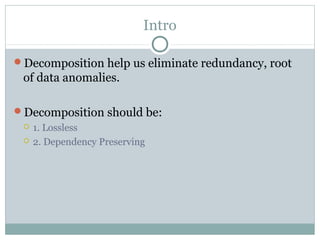
Decomposition help us eliminate redundancy, root
 of data anomalies.

Decomposition should be:
    1. Lossless
    2. Dependency Preserving
What’s Dependency Preservation?

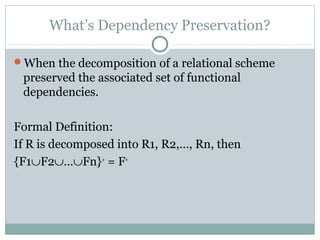
When the decomposition of a relational scheme
 preserved the associated set of functional
 dependencies.

Formal Definition:
If R is decomposed into R1, R2,…, Rn, then
{F1∪F2∪…∪Fn}+ = F+
Algorithm to check for Dependency Preservation

begin;
for each X  Y in F and with R (R1, R2, …, Rn)
{
  let Z = X;
  while there are changes in Z
  {
         from i=1 to n
                Z = Z ∪ ((Z ∩ Ri)+ ∩ Ri) w.r.t to F;
  }
  if Y is a proper subset of Z, current fd is preserved
  else decomposition is not dependency preserving;
}
this is a dependency preserving decomposition;
end;
Explain Algorithm Part 1

1. Choose a functional dependency in set F, say you choose
   X  Y.
2. Let set Z to the “left hand side” of the functional
   dependency, X such Z = X

Starting with R1 in the decomposed set {R1, R2,…Rn)
3. Intersect Z with R1, Z ∩ R1
4. Find the closure of the result from step 3 (Z ∩ R1) using
  original set F
5. Intersect the result from step 4 ((Z ∩ R1)+) with R1 again.
Explain Algorithm Part 2

6. Updated Z with new attribute in the result from step 5.
7. Repeat step 3-6 from R2, R3, …, Rn.
8. If there’s any changes between original Z before step 3
  and after step 7, repeat step 3-7.

9. Check whether Y is a proper subset of current Z. If it is
  not, this decomposition is a violation of dependency
  preservation. You can stop now.
10. If Y is a proper subset of current Z, repeat 1-9 until you
  check ALL functional dependencies in set F.
Another look at Algorithm

Test each X  Y in F for dependency preservation

result = X
while (changes to result) do
        for each Ri in decomposition
               t = (result ∩ Ri)+ ∩ Ri
               result = result ∪ t
if Y ⊆ result, return true;
else, return false;

[Note: If any false is returned for algorithm, whole
  decomposition is not dependency preserving.]
Let’s walk through an example
 of using this algorithm.
Example using Algorithm

Given the following:
R(A,B,C,D,E)
F = {ABC, CE, BD, EA}
R1(B,C,D) R2(A,C,E)

Is this decomposition dependency preserving?
Example

R(A,B,C,D,E)   F = {ABC, CE, BD, EA}
Decomposition: R1(B,C,D) R2(A,C,E)

Z=AB
For Z ∩ R1 = AB ∩ BCD = B
  {B}+ = BD
  {B}+ ∩ R1 = BD ∩ BCD = BD
Update Z = AB ∪ BD = ABD, continue
Example

R(A,B,C,D,E)   F = {ABC, CE, BD, EA}
Decomposition: R1(B,C,D) R2(A,C,E)

Z=ABD
For Z ∩ R2 = ABD ∩ ACE = A
  {A}+ = A
  {A}+ ∩ R2 = A ∩ ACE = A
Update Z, Z is still ABD
Since Z changed, repeat checking R1 to R2.
Example

R(A,B,C,D,E)   F = {ABC, CE, BD, EA}
Decomposition: R1(B,C,D) R2(A,C,E)

Z=ABD
For Z ∩ R1 = ABD ∩ BCD = BD
  {BD}+ = BD
  {BD}+ ∩ R1 = BD ∩ BCD = BD
Update Z = ABD ∪ BD = ABD, so Z hasn’t
changed but you still have to continue.
Example

R(A,B,C,D,E)   F = {ABC, CE, BD, EA}
Decomposition: R1(B,C,D) R2(A,C,E)

Z=ABD and checking R2 was done 2 slides ago
Z will still be ABD.

Since Z hasn’t change, you can conclude ABC
is not preserved.

Let’s practice with other functional
dependencies.
Example

R(A,B,C,D,E)   F = {ABC, CE, BD, EA}
Decomposition: R1(B,C,D) R2(A,C,E)

Z=X=B
For Z ∩ R1 = B ∩ BCD = B
  {B}+ = BD
  {B}+ ∩ R1 = BD ∩ BCD = BD
Update Z = B ∪ BD = BD
Since Y=D is proper subset of BD, BD is
preserved.
Example

R(A,B,C,D,E)   F = {ABC, CE, BD, EA}
Decomposition: R1(B,C,D) R2(A,C,E)

Z=X=C
For Z ∩ R2 = C ∩ ACE = C
  {C}+ = CEA
  {C}+ ∩ R1 = CEA ∩ ACE = ACE
Update Z = C ∪ACE= ACE
Since Y=E is proper subset of ACE, CE is
preserved.
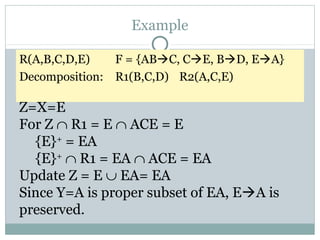
Example

R(A,B,C,D,E)   F = {ABC, CE, BD, EA}
Decomposition: R1(B,C,D) R2(A,C,E)

Z=X=E
For Z ∩ R1 = E ∩ ACE = E
  {E}+ = EA
  {E}+ ∩ R1 = EA ∩ ACE = EA
Update Z = E ∪ EA= EA
Since Y=A is proper subset of EA, EA is
preserved.
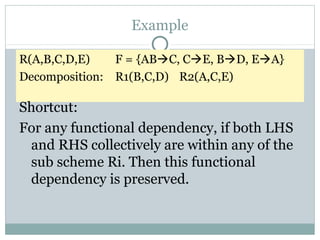
Example

R(A,B,C,D,E)   F = {ABC, CE, BD, EA}
Decomposition: R1(B,C,D) R2(A,C,E)

Shortcut:
For any functional dependency, if both LHS
 and RHS collectively are within any of the
 sub scheme Ri. Then this functional
 dependency is preserved.
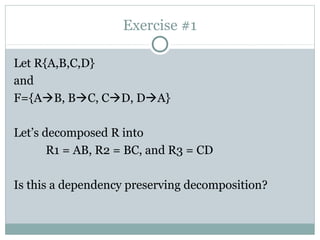
Exercise #1

Let R{A,B,C,D}
and
F={AB, BC, CD, DA}

Let’s decomposed R into
       R1 = AB, R2 = BC, and R3 = CD

Is this a dependency preserving decomposition?
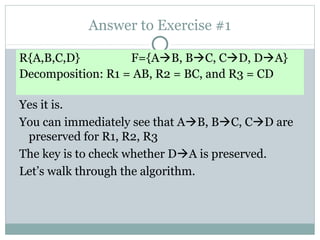
Answer to Exercise #1

R{A,B,C,D}         F={AB, BC, CD, DA}
Decomposition: R1 = AB, R2 = BC, and R3 = CD

Yes it is.
You can immediately see that AB, BC, CD are
 preserved for R1, R2, R3
The key is to check whether DA is preserved.
Let’s walk through the algorithm.
Answer to Exercise #1

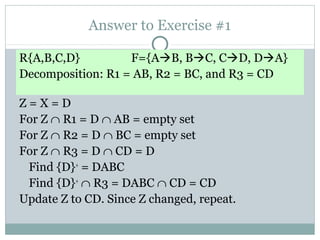
R{A,B,C,D}         F={AB, BC, CD, DA}
Decomposition: R1 = AB, R2 = BC, and R3 = CD

Z=X=D
For Z ∩ R1 = D ∩ AB = empty set
For Z ∩ R2 = D ∩ BC = empty set
For Z ∩ R3 = D ∩ CD = D
 Find {D}+ = DABC
 Find {D}+ ∩ R3 = DABC ∩ CD = CD
Update Z to CD. Since Z changed, repeat.
Answer to Exercise #1

R{A,B,C,D}         F={AB, BC, CD, DA}
Decomposition: R1 = AB, R2 = BC, and R3 = CD

Z = CD
For Z ∩ R1 = CD ∩ AB = empty set
For Z ∩ R2 = CD ∩ BC = C
  Find {C}+ = CDAB
  Find {C}+ ∩ R2 = CDAB ∩ BC = BC
Update Z = CD ∪ BC = BCD
Answer to Exercise #1

R{A,B,C,D}         F={AB, BC, CD, DA}
Decomposition: R1 = AB, R2 = BC, and R3 = CD

Z = BCD
For Z ∩ R3 = BCD ∩ CD = CD
  Find {CD}+ = CDAB
  Find {CD}+ ∩ R3 = CDAB ∩ CD = CD
Update Z is still BCD. Since Z changed, repeat going
  trough R1 to R3.
Answer to Exercise #1

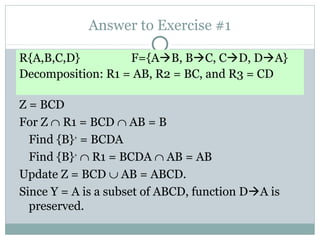
R{A,B,C,D}         F={AB, BC, CD, DA}
Decomposition: R1 = AB, R2 = BC, and R3 = CD

Z = BCD
For Z ∩ R1 = BCD ∩ AB = B
  Find {B}+ = BCDA
  Find {B}+ ∩ R1 = BCDA ∩ AB = AB
Update Z = BCD ∪ AB = ABCD.
Since Y = A is a subset of ABCD, function DA is
  preserved.
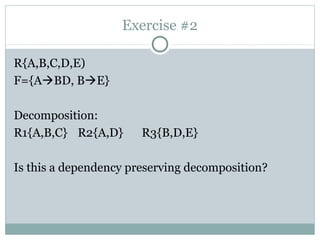
Exercise #2

R{A,B,C,D,E)
F={ABD, BE}

Decomposition:
R1{A,B,C} R2{A,D}      R3{B,D,E}

Is this a dependency preserving decomposition?
Answer to Exercise #2

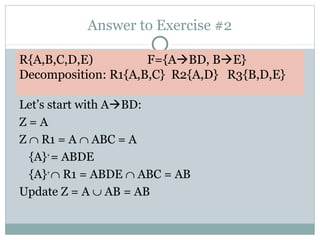
R{A,B,C,D,E)         F={ABD, BE}
Decomposition: R1{A,B,C} R2{A,D} R3{B,D,E}

Let’s start with ABD:
Z=A
Z ∩ R1 = A ∩ ABC = A
  {A}+ = ABDE
  {A}+ ∩ R1 = ABDE ∩ ABC = AB
Update Z = A ∪ AB = AB
Answer to Exercise #2

R{A,B,C,D,E)         F={ABD, BE}
Decomposition: R1{A,B,C} R2{A,D} R3{B,D,E}

Z = AB
Z ∩ R2 = A ∩ AD = A
  {A}+ = ABDE
  {A}+ ∩ R1 = ABDE ∩ AD = AD
Update Z = AB ∪ AD = ABD
Thus A BD preserved
Answer to Exercise #2

R{A,B,C,D,E)         F={ABD, BE}
Decomposition: R1{A,B,C} R2{A,D} R3{B,D,E}

Based on R3, BE is preserved.
Check B  E:
Z=B
Z ∩ R1 = B ∩ ABC = B
  {B}+ = BE
  {B}+ ∩ R1 = BE ∩ ABC = B
Update Z = B still the same
Answer to Exercise #2

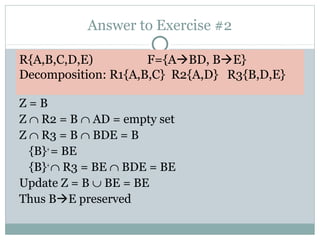
R{A,B,C,D,E)         F={ABD, BE}
Decomposition: R1{A,B,C} R2{A,D} R3{B,D,E}

Z=B
Z ∩ R2 = B ∩ AD = empty set
Z ∩ R3 = B ∩ BDE = B
  {B}+ = BE
  {B}+ ∩ R3 = BE ∩ BDE = BE
Update Z = B ∪ BE = BE
Thus BE preserved
End


Reference:
 Yu Hung Chen, “Decomposition”,
  http://www.cs.sjsu.edu/faculty/lee/cs157/Decomposition_Yu
  HungChen.ppt, SJSU (lol), 2005
 Gary D. Boetticher, “Preserving Dependencies”,
  http://www.youtube.com/watch?v=olgwucI3thI, University
  of Houston Clear Lake, 2009
 Dr. C. C. Chan, “Example of Dependency Preserving
  Decomposition”,
  http://www.cs.uakron.edu/~chan/cs475/Fall2000/Example
  Dp%20decomposition.htm, University of Akron, Fall 2000
 Tang Nan, “Functional Dependency”,
  http://www.se.cuhk.edu.hk/~seg3550/2006/tutorial/t9.ppt

Dependency preserving

  • 1.
    Dependency Preserving Decomposition DAVID DENG CS157B MARCH 23, 2010
  • 2.
    Intro Decomposition help useliminate redundancy, root of data anomalies. Decomposition should be:  1. Lossless  2. Dependency Preserving
  • 3.
    What’s Dependency Preservation? Whenthe decomposition of a relational scheme preserved the associated set of functional dependencies. Formal Definition: If R is decomposed into R1, R2,…, Rn, then {F1∪F2∪…∪Fn}+ = F+
  • 4.
    Algorithm to checkfor Dependency Preservation begin; for each X  Y in F and with R (R1, R2, …, Rn) { let Z = X; while there are changes in Z { from i=1 to n Z = Z ∪ ((Z ∩ Ri)+ ∩ Ri) w.r.t to F; } if Y is a proper subset of Z, current fd is preserved else decomposition is not dependency preserving; } this is a dependency preserving decomposition; end;
  • 5.
    Explain Algorithm Part1 1. Choose a functional dependency in set F, say you choose X  Y. 2. Let set Z to the “left hand side” of the functional dependency, X such Z = X Starting with R1 in the decomposed set {R1, R2,…Rn) 3. Intersect Z with R1, Z ∩ R1 4. Find the closure of the result from step 3 (Z ∩ R1) using original set F 5. Intersect the result from step 4 ((Z ∩ R1)+) with R1 again.
  • 6.
    Explain Algorithm Part2 6. Updated Z with new attribute in the result from step 5. 7. Repeat step 3-6 from R2, R3, …, Rn. 8. If there’s any changes between original Z before step 3 and after step 7, repeat step 3-7. 9. Check whether Y is a proper subset of current Z. If it is not, this decomposition is a violation of dependency preservation. You can stop now. 10. If Y is a proper subset of current Z, repeat 1-9 until you check ALL functional dependencies in set F.
  • 7.
    Another look atAlgorithm Test each X  Y in F for dependency preservation result = X while (changes to result) do for each Ri in decomposition t = (result ∩ Ri)+ ∩ Ri result = result ∪ t if Y ⊆ result, return true; else, return false; [Note: If any false is returned for algorithm, whole decomposition is not dependency preserving.]
  • 8.
    Let’s walk throughan example of using this algorithm.
  • 9.
    Example using Algorithm Giventhe following: R(A,B,C,D,E) F = {ABC, CE, BD, EA} R1(B,C,D) R2(A,C,E) Is this decomposition dependency preserving?
  • 10.
    Example R(A,B,C,D,E) F = {ABC, CE, BD, EA} Decomposition: R1(B,C,D) R2(A,C,E) Z=AB For Z ∩ R1 = AB ∩ BCD = B {B}+ = BD {B}+ ∩ R1 = BD ∩ BCD = BD Update Z = AB ∪ BD = ABD, continue
  • 11.
    Example R(A,B,C,D,E) F = {ABC, CE, BD, EA} Decomposition: R1(B,C,D) R2(A,C,E) Z=ABD For Z ∩ R2 = ABD ∩ ACE = A {A}+ = A {A}+ ∩ R2 = A ∩ ACE = A Update Z, Z is still ABD Since Z changed, repeat checking R1 to R2.
  • 12.
    Example R(A,B,C,D,E) F = {ABC, CE, BD, EA} Decomposition: R1(B,C,D) R2(A,C,E) Z=ABD For Z ∩ R1 = ABD ∩ BCD = BD {BD}+ = BD {BD}+ ∩ R1 = BD ∩ BCD = BD Update Z = ABD ∪ BD = ABD, so Z hasn’t changed but you still have to continue.
  • 13.
    Example R(A,B,C,D,E) F = {ABC, CE, BD, EA} Decomposition: R1(B,C,D) R2(A,C,E) Z=ABD and checking R2 was done 2 slides ago Z will still be ABD. Since Z hasn’t change, you can conclude ABC is not preserved. Let’s practice with other functional dependencies.
  • 14.
    Example R(A,B,C,D,E) F = {ABC, CE, BD, EA} Decomposition: R1(B,C,D) R2(A,C,E) Z=X=B For Z ∩ R1 = B ∩ BCD = B {B}+ = BD {B}+ ∩ R1 = BD ∩ BCD = BD Update Z = B ∪ BD = BD Since Y=D is proper subset of BD, BD is preserved.
  • 15.
    Example R(A,B,C,D,E) F = {ABC, CE, BD, EA} Decomposition: R1(B,C,D) R2(A,C,E) Z=X=C For Z ∩ R2 = C ∩ ACE = C {C}+ = CEA {C}+ ∩ R1 = CEA ∩ ACE = ACE Update Z = C ∪ACE= ACE Since Y=E is proper subset of ACE, CE is preserved.
  • 16.
    Example R(A,B,C,D,E) F = {ABC, CE, BD, EA} Decomposition: R1(B,C,D) R2(A,C,E) Z=X=E For Z ∩ R1 = E ∩ ACE = E {E}+ = EA {E}+ ∩ R1 = EA ∩ ACE = EA Update Z = E ∪ EA= EA Since Y=A is proper subset of EA, EA is preserved.
  • 17.
    Example R(A,B,C,D,E) F = {ABC, CE, BD, EA} Decomposition: R1(B,C,D) R2(A,C,E) Shortcut: For any functional dependency, if both LHS and RHS collectively are within any of the sub scheme Ri. Then this functional dependency is preserved.
  • 18.
    Exercise #1 Let R{A,B,C,D} and F={AB,BC, CD, DA} Let’s decomposed R into R1 = AB, R2 = BC, and R3 = CD Is this a dependency preserving decomposition?
  • 19.
    Answer to Exercise#1 R{A,B,C,D} F={AB, BC, CD, DA} Decomposition: R1 = AB, R2 = BC, and R3 = CD Yes it is. You can immediately see that AB, BC, CD are preserved for R1, R2, R3 The key is to check whether DA is preserved. Let’s walk through the algorithm.
  • 20.
    Answer to Exercise#1 R{A,B,C,D} F={AB, BC, CD, DA} Decomposition: R1 = AB, R2 = BC, and R3 = CD Z=X=D For Z ∩ R1 = D ∩ AB = empty set For Z ∩ R2 = D ∩ BC = empty set For Z ∩ R3 = D ∩ CD = D Find {D}+ = DABC Find {D}+ ∩ R3 = DABC ∩ CD = CD Update Z to CD. Since Z changed, repeat.
  • 21.
    Answer to Exercise#1 R{A,B,C,D} F={AB, BC, CD, DA} Decomposition: R1 = AB, R2 = BC, and R3 = CD Z = CD For Z ∩ R1 = CD ∩ AB = empty set For Z ∩ R2 = CD ∩ BC = C Find {C}+ = CDAB Find {C}+ ∩ R2 = CDAB ∩ BC = BC Update Z = CD ∪ BC = BCD
  • 22.
    Answer to Exercise#1 R{A,B,C,D} F={AB, BC, CD, DA} Decomposition: R1 = AB, R2 = BC, and R3 = CD Z = BCD For Z ∩ R3 = BCD ∩ CD = CD Find {CD}+ = CDAB Find {CD}+ ∩ R3 = CDAB ∩ CD = CD Update Z is still BCD. Since Z changed, repeat going trough R1 to R3.
  • 23.
    Answer to Exercise#1 R{A,B,C,D} F={AB, BC, CD, DA} Decomposition: R1 = AB, R2 = BC, and R3 = CD Z = BCD For Z ∩ R1 = BCD ∩ AB = B Find {B}+ = BCDA Find {B}+ ∩ R1 = BCDA ∩ AB = AB Update Z = BCD ∪ AB = ABCD. Since Y = A is a subset of ABCD, function DA is preserved.
  • 24.
    Exercise #2 R{A,B,C,D,E) F={ABD, BE} Decomposition: R1{A,B,C}R2{A,D} R3{B,D,E} Is this a dependency preserving decomposition?
  • 25.
    Answer to Exercise#2 R{A,B,C,D,E) F={ABD, BE} Decomposition: R1{A,B,C} R2{A,D} R3{B,D,E} Let’s start with ABD: Z=A Z ∩ R1 = A ∩ ABC = A {A}+ = ABDE {A}+ ∩ R1 = ABDE ∩ ABC = AB Update Z = A ∪ AB = AB
  • 26.
    Answer to Exercise#2 R{A,B,C,D,E) F={ABD, BE} Decomposition: R1{A,B,C} R2{A,D} R3{B,D,E} Z = AB Z ∩ R2 = A ∩ AD = A {A}+ = ABDE {A}+ ∩ R1 = ABDE ∩ AD = AD Update Z = AB ∪ AD = ABD Thus A BD preserved
  • 27.
    Answer to Exercise#2 R{A,B,C,D,E) F={ABD, BE} Decomposition: R1{A,B,C} R2{A,D} R3{B,D,E} Based on R3, BE is preserved. Check B  E: Z=B Z ∩ R1 = B ∩ ABC = B {B}+ = BE {B}+ ∩ R1 = BE ∩ ABC = B Update Z = B still the same
  • 28.
    Answer to Exercise#2 R{A,B,C,D,E) F={ABD, BE} Decomposition: R1{A,B,C} R2{A,D} R3{B,D,E} Z=B Z ∩ R2 = B ∩ AD = empty set Z ∩ R3 = B ∩ BDE = B {B}+ = BE {B}+ ∩ R3 = BE ∩ BDE = BE Update Z = B ∪ BE = BE Thus BE preserved
  • 29.
    End Reference:  Yu HungChen, “Decomposition”, http://www.cs.sjsu.edu/faculty/lee/cs157/Decomposition_Yu HungChen.ppt, SJSU (lol), 2005  Gary D. Boetticher, “Preserving Dependencies”, http://www.youtube.com/watch?v=olgwucI3thI, University of Houston Clear Lake, 2009  Dr. C. C. Chan, “Example of Dependency Preserving Decomposition”, http://www.cs.uakron.edu/~chan/cs475/Fall2000/Example Dp%20decomposition.htm, University of Akron, Fall 2000  Tang Nan, “Functional Dependency”, http://www.se.cuhk.edu.hk/~seg3550/2006/tutorial/t9.ppt