By : Karishma Patidar
B.E.(CSE)
Indore Institute of Science and Technology
 B.E. Computer science Engineering
 3rd year 6th sem
 Email: karishmapatidar95@gmail.com
DEFINATIONS
TYPES OF AUTOMATION
AUTOMATION TOOLS
ADVANTAGES OF AUTOMATION
DISADVANTAGES OF AUTOMATION
RECENT AND EMERGING APPLICATIONS
IMPORTANT NEWS RELATED TO AUTOMATION
Automation or automatic control,
is the use of various control systems
for operating equipment such as machinery ,
switching telephone networks, steering and
stabilization of ships , aircraft and
other applications with minimum
Or reduced human intervention .
It is the technique of making an apparatus ,a process
or a system to operate automatically.
The creation and application of technology to
monitor and control the production and delivery of
products and services.
Automation crosses all the functions from installation
,integration and maintenance to design
procurement and management.
It even reaches into the marketing and sales
functions of these industries.
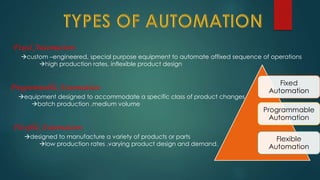
Fixed
Automation
Programmable
Automation
Flexible
Automation
Fixed Automation:
custom –engineered, special purpose equipment to automate affixed sequence of operations
high production rates, inflexible product design
Programmable Automation:
equipment designed to accommodate a specific class of product changes
batch production ,medium volume
Flexible Automation:
designed to manufacture a variety of products or parts
low production rates ,varying product design and demand.
Engineers can now have numerical control over automated devices .
result has been a rapidly expanding range of applications and human
activities . Computer aided technologies now serves as the basis for
mathematical and organizational tools used to create complex
systems.
Different types of Automation tools exist are:
1: ANN: Artificial neural network
2: DCS: Distributed control system
3: HMI: Human machine interface
4: SCADA: Supervisory control and data acquisition
5: PLC: Programmable logic controller
6: Instrumentation
7: Motion control
8: Robotics
 Increased throughput or productivity.
 Improved quality
 Improved robustness (consistency) of processes.
 Increased consistency of output.
 Reduced direct human labour costs and expenses.
 Security threats /vulnerability
 Unpredictable /excessive development costs.
 High initial cost.
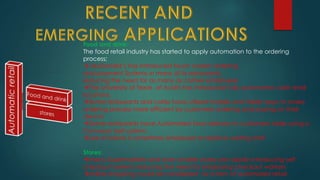
Food and drink:
The food retail industry has started to apply automation to the ordering
process;
 McDonald’s has introduced touch screen ordering
and payment Systems in many of its restaurants,
reducing the need for as many as cashier employees
The University of Texas at Austin has introduced fully automated café retail
locations.
Some restaurants and cafés have utilized mobile and tablet apps to make
ordering process more efficient by customers ordering and paying on their
device
Some restaurants have Automated food delivery to customers table using a
Conveyor belt system.
Use of robots is sometimes employed to replace waiting staff.
Stores:
many Supermarkets and even smaller stores are rapidly introducing self
checkout systems reducing the need for employing checkout workers
online shopping could be considered as a form of automated retail
 Automated video surveillance
The defence Advanced Research Projects Agency(DARPA) has
started the research and development of automated visual
surveillance(AVS) programs ,from 1998 to 2002.
Currently there is major effort underway in the vision community to
develop a fully automated tracking surveillance system.
Automated waste management
Automated waste collection trucks prevent the need for as many
workers as well as the level of labour required to provide the service.
Home Automation(domotics)
this designates an emerging practice of increased automation of
household appliances and features in residential dwellings ,particulary
through electronic means that allows for things impracticable ,overly
expensive or simply not possible in recent past decades.
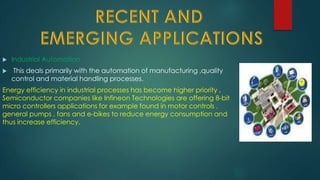
 Industrial Automation
 This deals primarily with the automation of manufacturing ,quality
control and material handling processes.
Energy efficiency in industrial processes has become higher priority .
Semiconductor companies like Infineon Technologies are offering 8-bit
micro controllers applications for example found in motor controls ,
general pumps , fans and e-bikes to reduce energy consumption and
thus increase efficiency.
Important News related to
Automation
 Automation (TM) 2015 , Asia’s leading exhibition showcasing one of
the best available technologically empowered machineries
catering to Industrial Automation ,Factory Automation , Robotics,
Drives and Controls, Logistics , Hydraulic and Pneumastics will be
held at the Bombay Exhibition Centre, Goregon in Hall no.1 from 24th
august to 27th august.
 Top software exporter TCS has introduced a new platform which will
increase the level of automation in underwriting for insurance
business.
Automation

Automation

  • 1.
    By : KarishmaPatidar B.E.(CSE) Indore Institute of Science and Technology  B.E. Computer science Engineering  3rd year 6th sem  Email: karishmapatidar95@gmail.com
  • 2.
    DEFINATIONS TYPES OF AUTOMATION AUTOMATIONTOOLS ADVANTAGES OF AUTOMATION DISADVANTAGES OF AUTOMATION RECENT AND EMERGING APPLICATIONS IMPORTANT NEWS RELATED TO AUTOMATION
  • 3.
    Automation or automaticcontrol, is the use of various control systems for operating equipment such as machinery , switching telephone networks, steering and stabilization of ships , aircraft and other applications with minimum Or reduced human intervention . It is the technique of making an apparatus ,a process or a system to operate automatically.
  • 4.
    The creation andapplication of technology to monitor and control the production and delivery of products and services. Automation crosses all the functions from installation ,integration and maintenance to design procurement and management. It even reaches into the marketing and sales functions of these industries.
  • 5.
    Fixed Automation Programmable Automation Flexible Automation Fixed Automation: custom –engineered,special purpose equipment to automate affixed sequence of operations high production rates, inflexible product design Programmable Automation: equipment designed to accommodate a specific class of product changes batch production ,medium volume Flexible Automation: designed to manufacture a variety of products or parts low production rates ,varying product design and demand.
  • 6.
    Engineers can nowhave numerical control over automated devices . result has been a rapidly expanding range of applications and human activities . Computer aided technologies now serves as the basis for mathematical and organizational tools used to create complex systems. Different types of Automation tools exist are: 1: ANN: Artificial neural network 2: DCS: Distributed control system 3: HMI: Human machine interface 4: SCADA: Supervisory control and data acquisition 5: PLC: Programmable logic controller 6: Instrumentation 7: Motion control 8: Robotics
  • 7.
     Increased throughputor productivity.  Improved quality  Improved robustness (consistency) of processes.  Increased consistency of output.  Reduced direct human labour costs and expenses.
  • 8.
     Security threats/vulnerability  Unpredictable /excessive development costs.  High initial cost.
  • 9.
    Food and drink: Thefood retail industry has started to apply automation to the ordering process;  McDonald’s has introduced touch screen ordering and payment Systems in many of its restaurants, reducing the need for as many as cashier employees The University of Texas at Austin has introduced fully automated café retail locations. Some restaurants and cafés have utilized mobile and tablet apps to make ordering process more efficient by customers ordering and paying on their device Some restaurants have Automated food delivery to customers table using a Conveyor belt system. Use of robots is sometimes employed to replace waiting staff. Stores: many Supermarkets and even smaller stores are rapidly introducing self checkout systems reducing the need for employing checkout workers online shopping could be considered as a form of automated retail
  • 10.
     Automated videosurveillance The defence Advanced Research Projects Agency(DARPA) has started the research and development of automated visual surveillance(AVS) programs ,from 1998 to 2002. Currently there is major effort underway in the vision community to develop a fully automated tracking surveillance system.
  • 11.
    Automated waste management Automatedwaste collection trucks prevent the need for as many workers as well as the level of labour required to provide the service. Home Automation(domotics) this designates an emerging practice of increased automation of household appliances and features in residential dwellings ,particulary through electronic means that allows for things impracticable ,overly expensive or simply not possible in recent past decades.
  • 12.
     Industrial Automation This deals primarily with the automation of manufacturing ,quality control and material handling processes. Energy efficiency in industrial processes has become higher priority . Semiconductor companies like Infineon Technologies are offering 8-bit micro controllers applications for example found in motor controls , general pumps , fans and e-bikes to reduce energy consumption and thus increase efficiency.
  • 13.
    Important News relatedto Automation  Automation (TM) 2015 , Asia’s leading exhibition showcasing one of the best available technologically empowered machineries catering to Industrial Automation ,Factory Automation , Robotics, Drives and Controls, Logistics , Hydraulic and Pneumastics will be held at the Bombay Exhibition Centre, Goregon in Hall no.1 from 24th august to 27th august.  Top software exporter TCS has introduced a new platform which will increase the level of automation in underwriting for insurance business.