Machine
Learning - VI
Time Series
Time Series
 Time series: a series of values of a quantity obtained at successive
times, often with equal intervals between them, in simple words data
is in a series of particular time periods or intervals.
 And the analysis of Time series is a statistical technique that deals with
time series data, or trend analysis.
Example: health applications which require continuous monitoring ,
forecast sales over revenue, stock exchange, weather etc.
It is basically used to understand the systematic pattern of the
underlying structure that produces the observations/events.
Understanding the systematic pattern of time series data helps us to
forecast and develop predictive control measures for the next time
series event.
Rupak Roy
Time Series Components
In General a time series consists of 3 components
• Trend Component: It is the main component of the time series that
moves up or down in a reasonably predictable pattern.
• Seasonal Component: that repeats over a specific period such as a
day, week, month, season, etc due to seasonal factors like sales of
ice- cream is higher in summer than other months.
• Irregular Component: These are sudden changes occurring which
are unlikely to be repeated which cannot be explained by trends,
seasonal or cyclic movements. These variations are sometimes called
residual or random component.
• Cyclic Component: It spans like more than one year like one
complete period = 1cycle. This oscillatory movement are mostly
observed in economical data.
Rupak Roy
Time Series
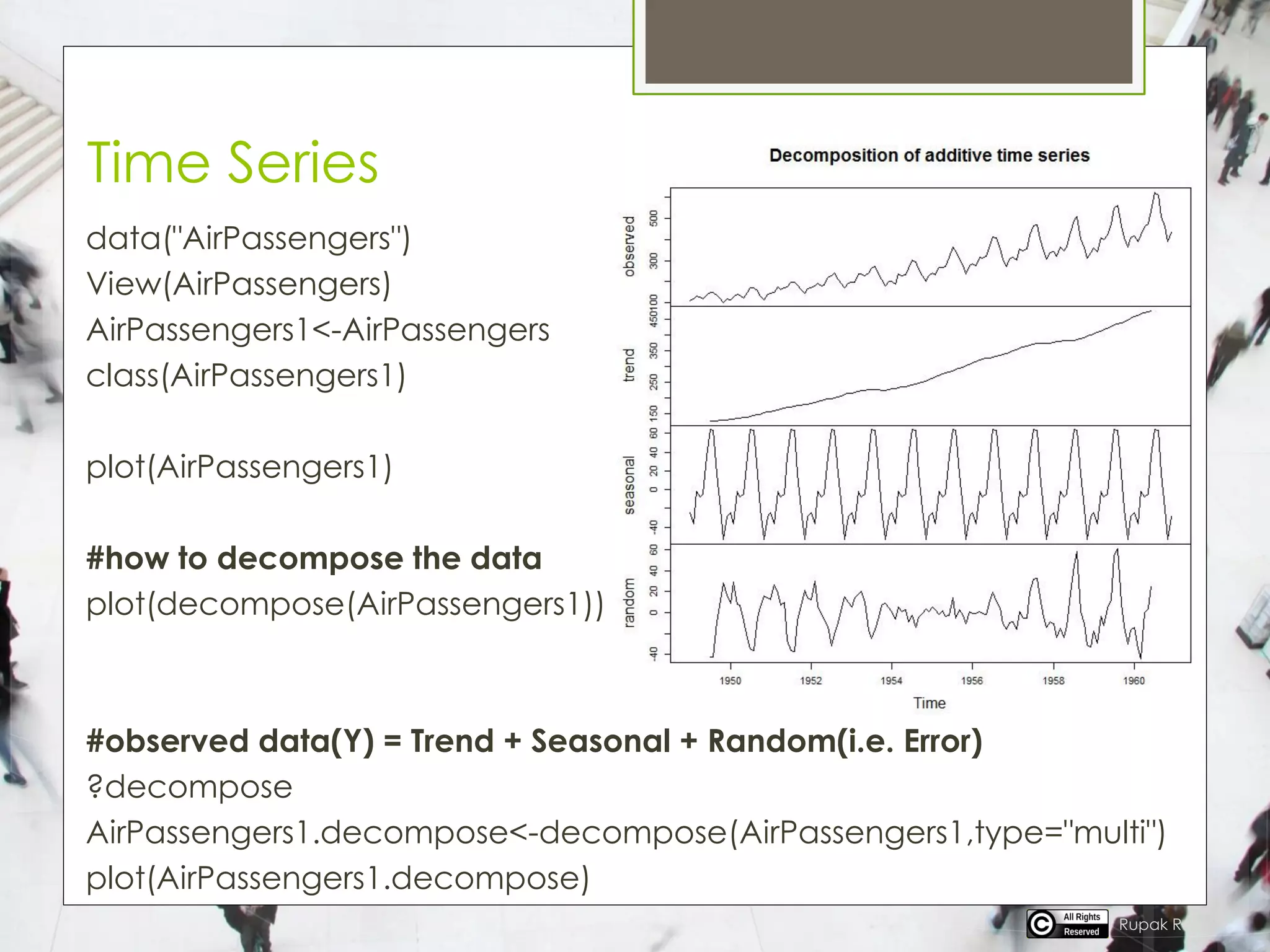
data("AirPassengers")
View(AirPassengers)
AirPassengers1<-AirPassengers
class(AirPassengers1)
plot(AirPassengers1)
#how to decompose the data
plot(decompose(AirPassengers1))
#observed data(Y) = Trend + Seasonal + Random(i.e. Error)
?decompose
AirPassengers1.decompose<-decompose(AirPassengers1,type="multi")
plot(AirPassengers1.decompose)
Rupak Roy
Time Series
#To see the components separately
AirPassengers1.trend<-AirPassengers1.decompose$trend
AirPassengers1.seasonal<-AirPassengers1.decompose$seasonal
#seasonal
#trend
AirPassengers1.seasonal
AirPassengers1.trend
#To plot season and trend together
ts.plot(cbind(AirPassengers1.trend,AirPassengers1.trend*AirPassengers1.
seasonal))
Rupak Roy
Next
Data smoothening methods to reduce noise for time series by Simple
Moving Averages and Exponential Moving Averages.
Rupak Roy

Machine Learning - Time Series

  • 1.
  • 2.
    Time Series  Timeseries: a series of values of a quantity obtained at successive times, often with equal intervals between them, in simple words data is in a series of particular time periods or intervals.  And the analysis of Time series is a statistical technique that deals with time series data, or trend analysis. Example: health applications which require continuous monitoring , forecast sales over revenue, stock exchange, weather etc. It is basically used to understand the systematic pattern of the underlying structure that produces the observations/events. Understanding the systematic pattern of time series data helps us to forecast and develop predictive control measures for the next time series event. Rupak Roy
  • 3.
    Time Series Components InGeneral a time series consists of 3 components • Trend Component: It is the main component of the time series that moves up or down in a reasonably predictable pattern. • Seasonal Component: that repeats over a specific period such as a day, week, month, season, etc due to seasonal factors like sales of ice- cream is higher in summer than other months. • Irregular Component: These are sudden changes occurring which are unlikely to be repeated which cannot be explained by trends, seasonal or cyclic movements. These variations are sometimes called residual or random component. • Cyclic Component: It spans like more than one year like one complete period = 1cycle. This oscillatory movement are mostly observed in economical data. Rupak Roy
  • 4.
    Time Series data("AirPassengers") View(AirPassengers) AirPassengers1<-AirPassengers class(AirPassengers1) plot(AirPassengers1) #how todecompose the data plot(decompose(AirPassengers1)) #observed data(Y) = Trend + Seasonal + Random(i.e. Error) ?decompose AirPassengers1.decompose<-decompose(AirPassengers1,type="multi") plot(AirPassengers1.decompose) Rupak Roy
  • 5.
    Time Series #To seethe components separately AirPassengers1.trend<-AirPassengers1.decompose$trend AirPassengers1.seasonal<-AirPassengers1.decompose$seasonal #seasonal #trend AirPassengers1.seasonal AirPassengers1.trend #To plot season and trend together ts.plot(cbind(AirPassengers1.trend,AirPassengers1.trend*AirPassengers1. seasonal)) Rupak Roy
  • 6.
    Next Data smoothening methodsto reduce noise for time series by Simple Moving Averages and Exponential Moving Averages. Rupak Roy