Presentation
On
Machine Learning
Presented By :
Farhana Mariyam
1. History of Machine Learning.
2. What is Machine Learning.
3. Why ML.
4. Learning System Model.
5. Training and Testing.
6. Performance.
7. Algorithms.
8. Machine Learning Structure.
9. Application.
10. Conclusion.
Outline
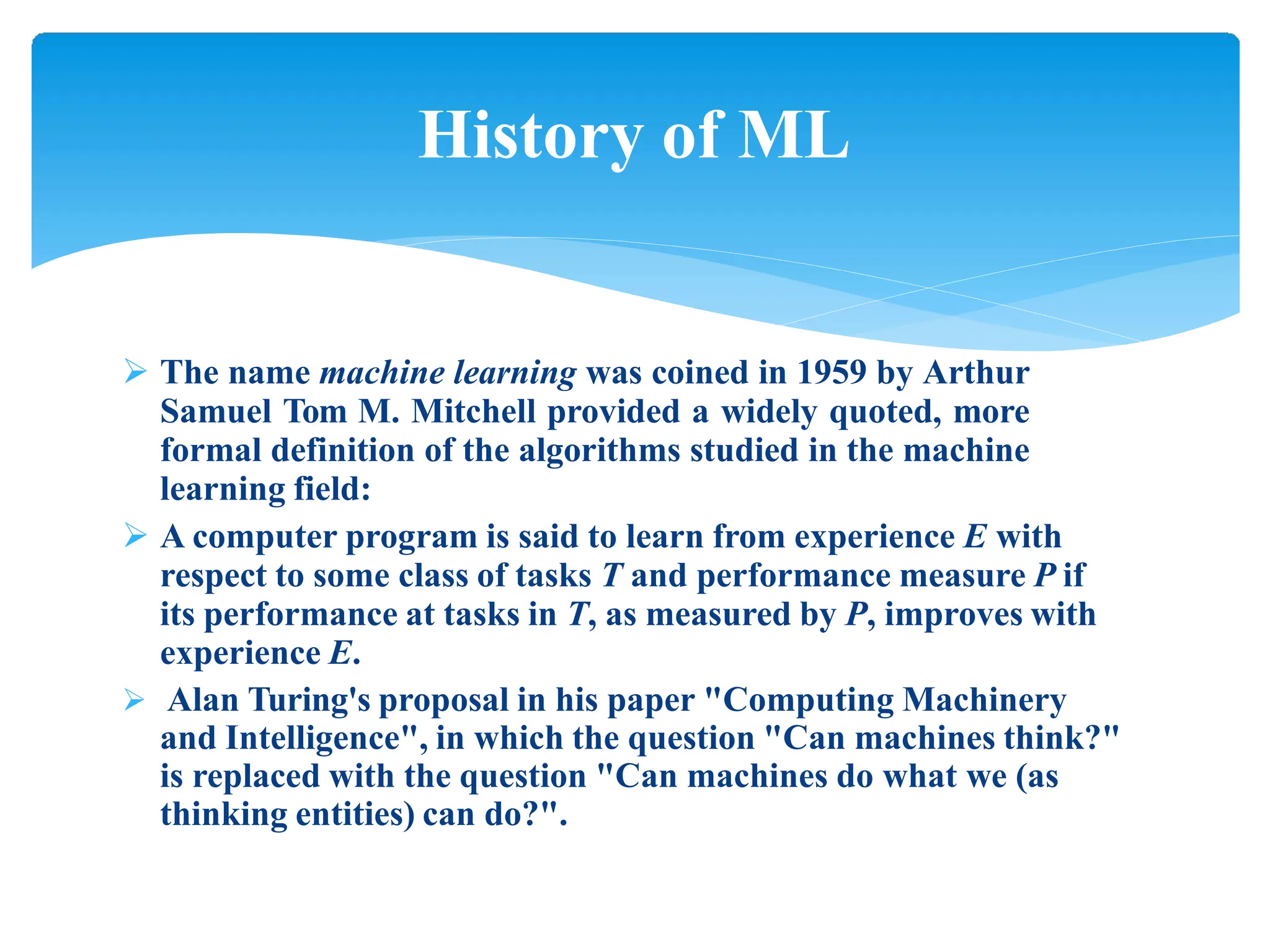
 The name machine learning was coined in 1959 by Arthur
Samuel Tom M. Mitchell provided a widely quoted, more
formal definition of the algorithms studied in the machine
learning field:
 A computer program is said to learn from experience E with
respect to some class of tasks T and performance measure P if
its performance at tasks in T, as measured by P, improves with
experience E.
 Alan Turing's proposal in his paper "Computing Machinery
and Intelligence", in which the question "Can machines think?"
is replaced with the question "Can machines do what we (as
thinking entities) can do?".
History of ML
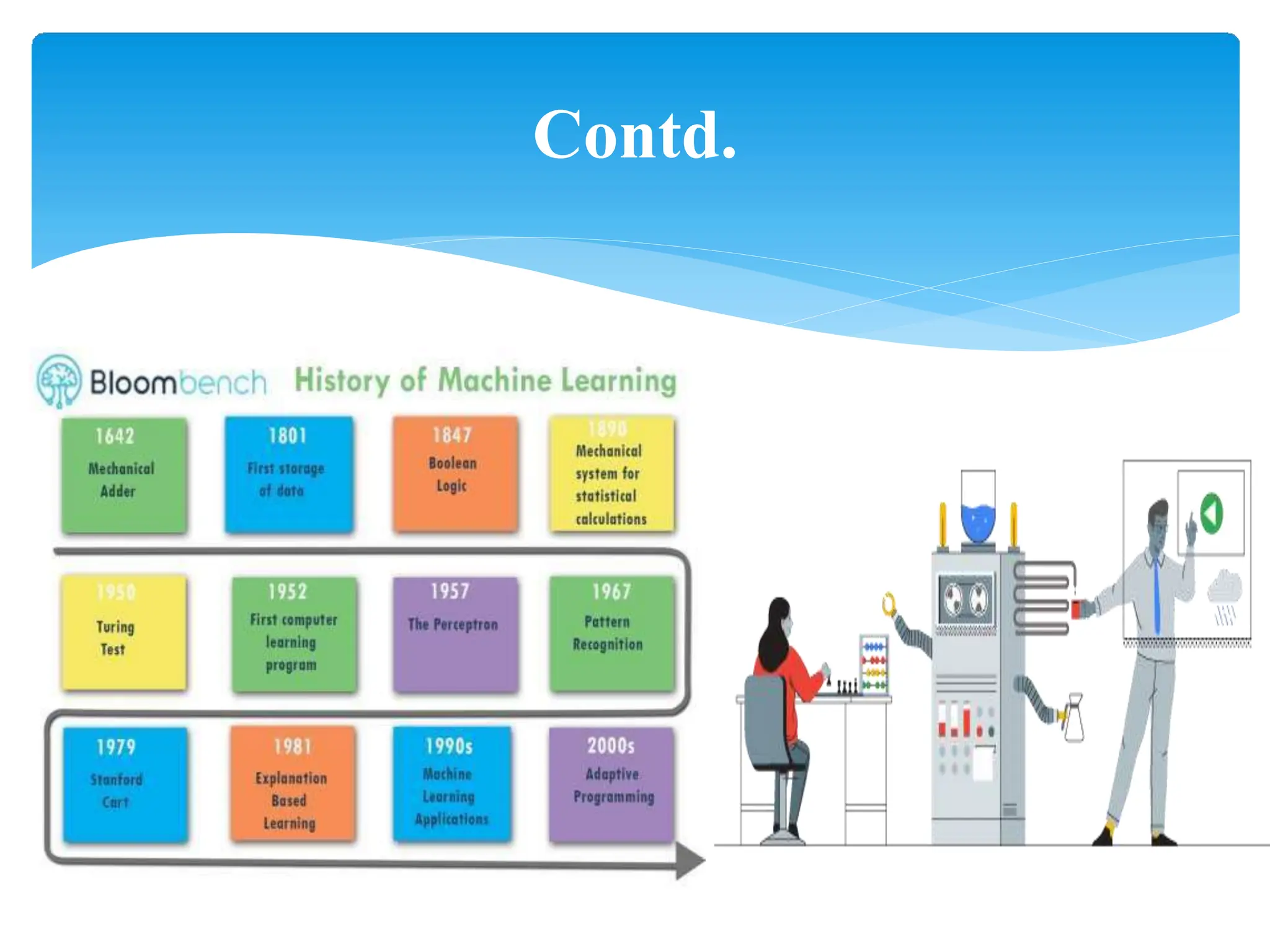
Contd.
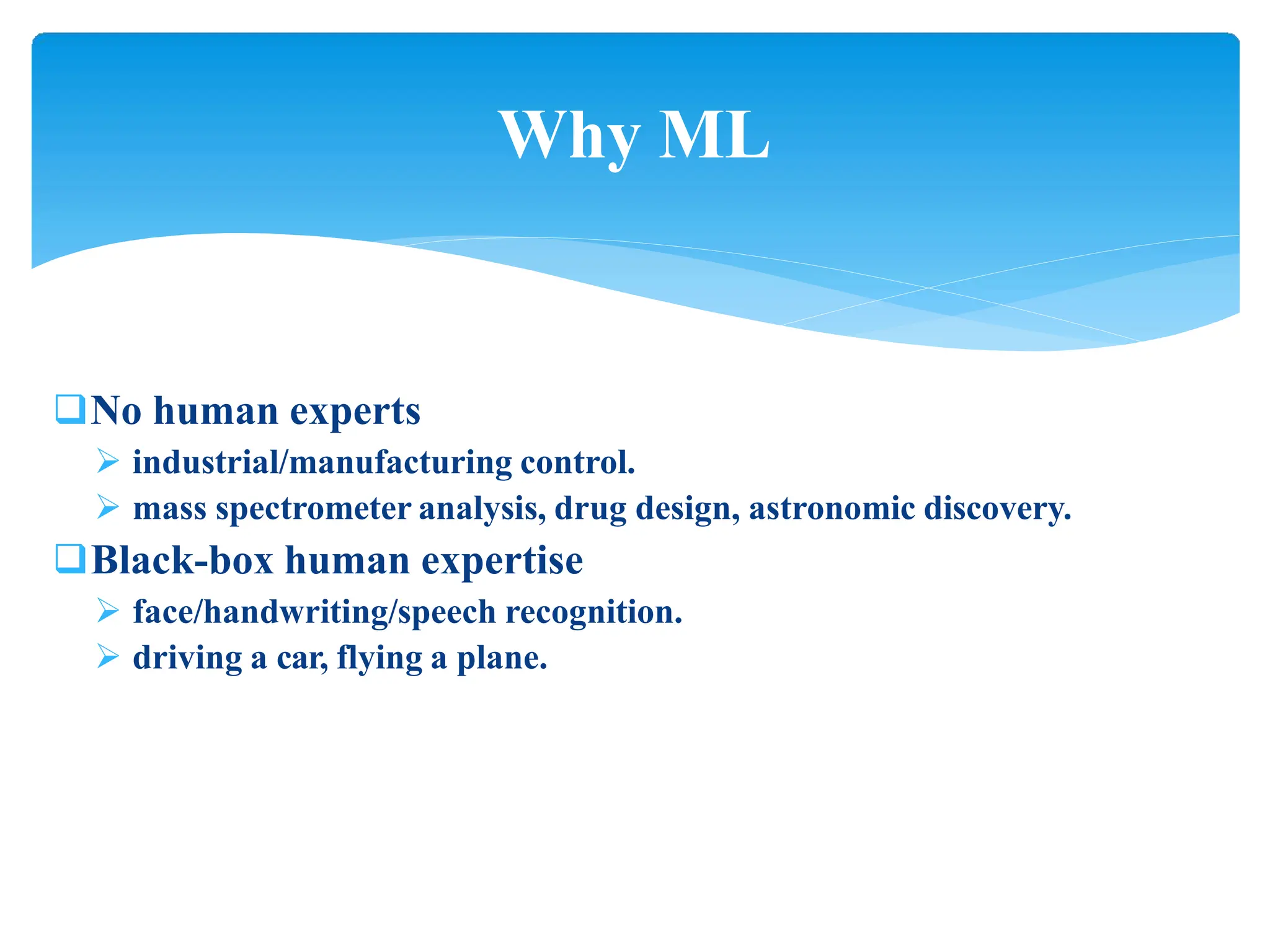
 A branch of artificial intelligence, concerned with the design
and development of algorithms that allow computers to evolve
behaviors based on empirical data.
 As intelligence requires knowledge, it is necessary for the
computers to acquire knowledge.
 Machine learning refers to a system capable of the autonomous
acquisition and integration of knowledge
What is ML
Contd.
No human experts
 industrial/manufacturing control.
 mass spectrometer analysis, drug design, astronomic discovery.
Black-box human expertise
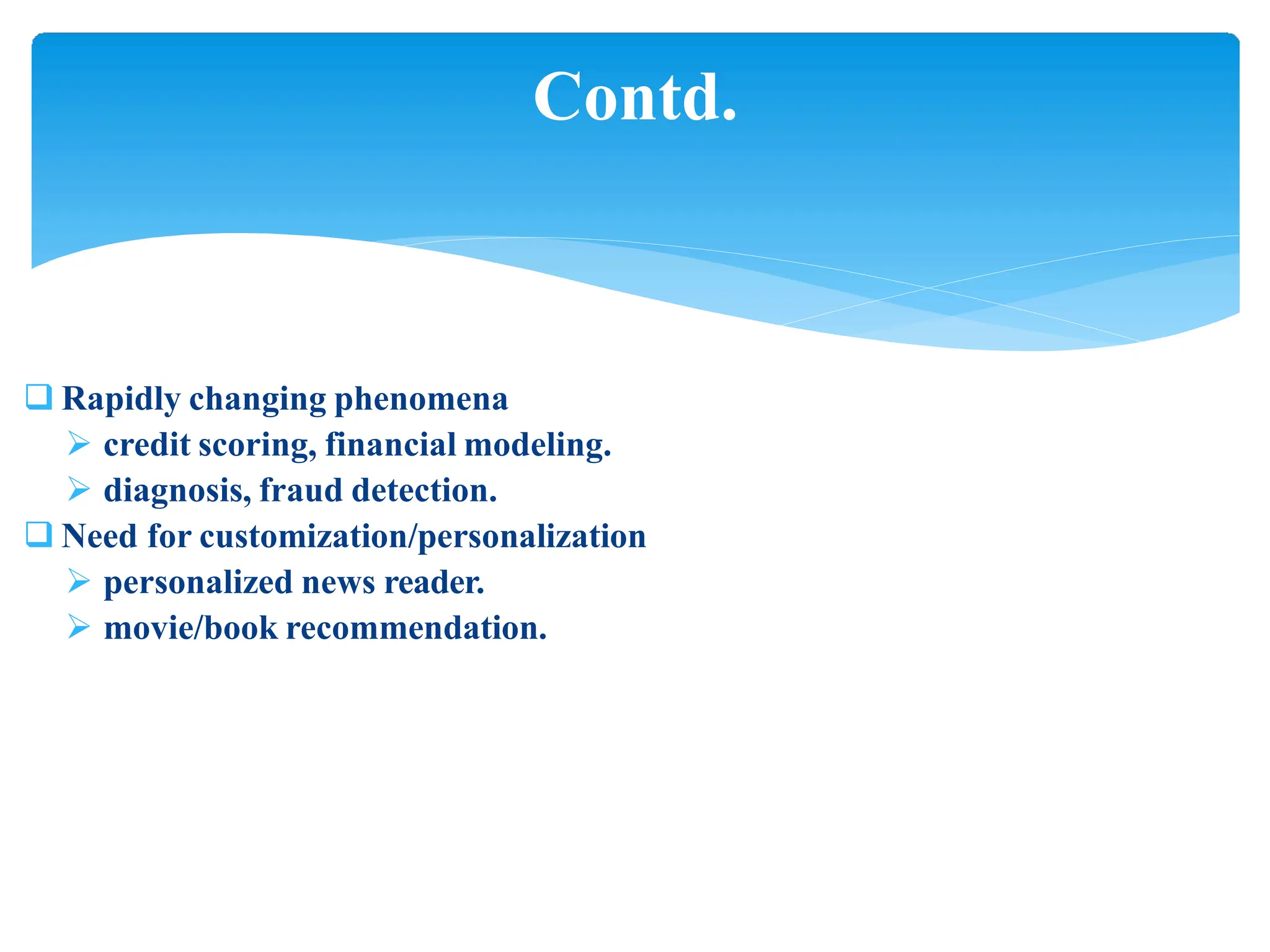
 face/handwriting/speech recognition.
 driving a car, flying a plane.
Why ML
 Rapidly changing phenomena
 credit scoring, financial modeling.
 diagnosis, fraud detection.
 Need for customization/personalization
 personalized news reader.
 movie/book recommendation.
Contd.
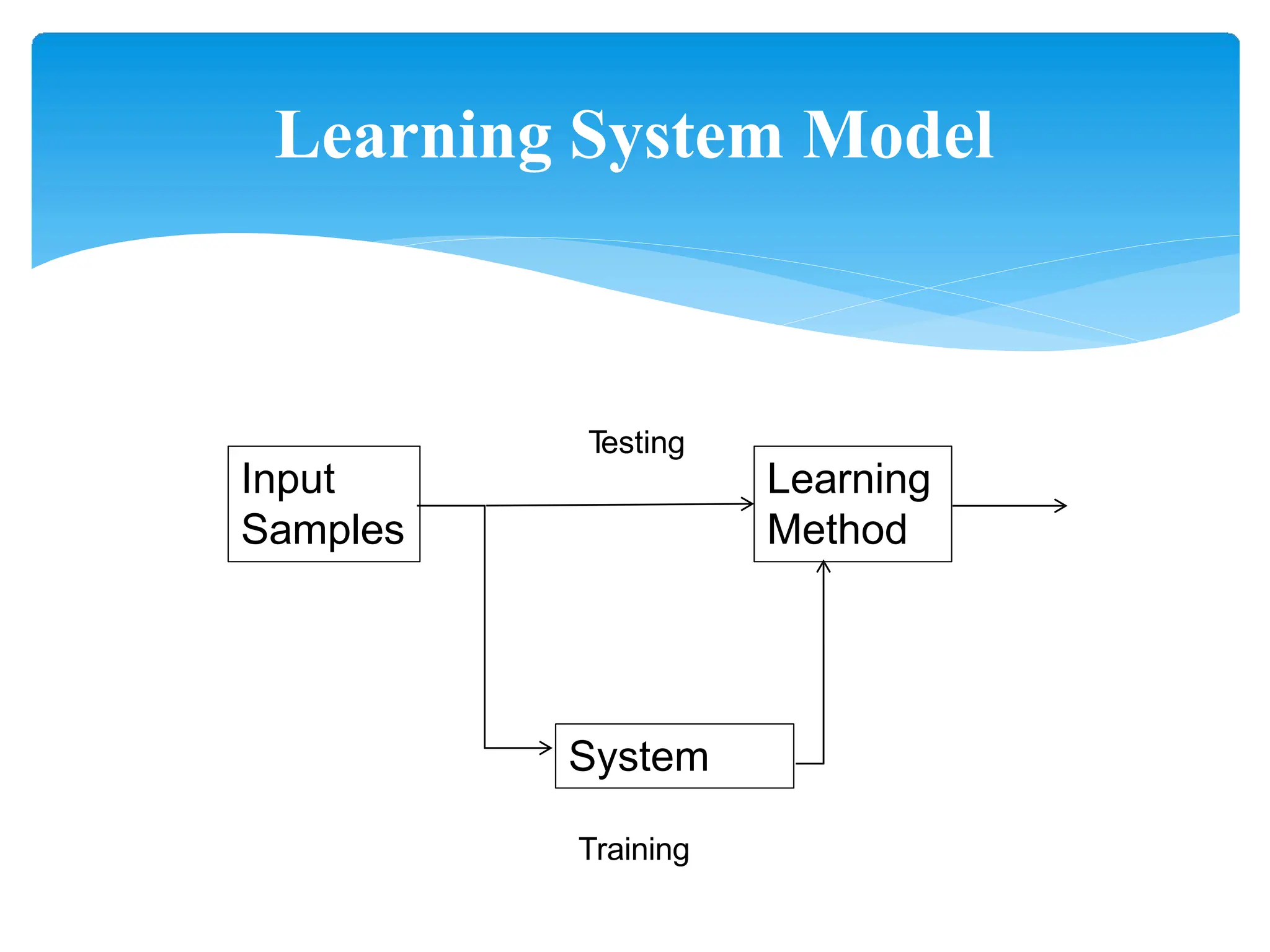
Learning System Model
Input
Samples
Learning
Method
System
T
esting
Training
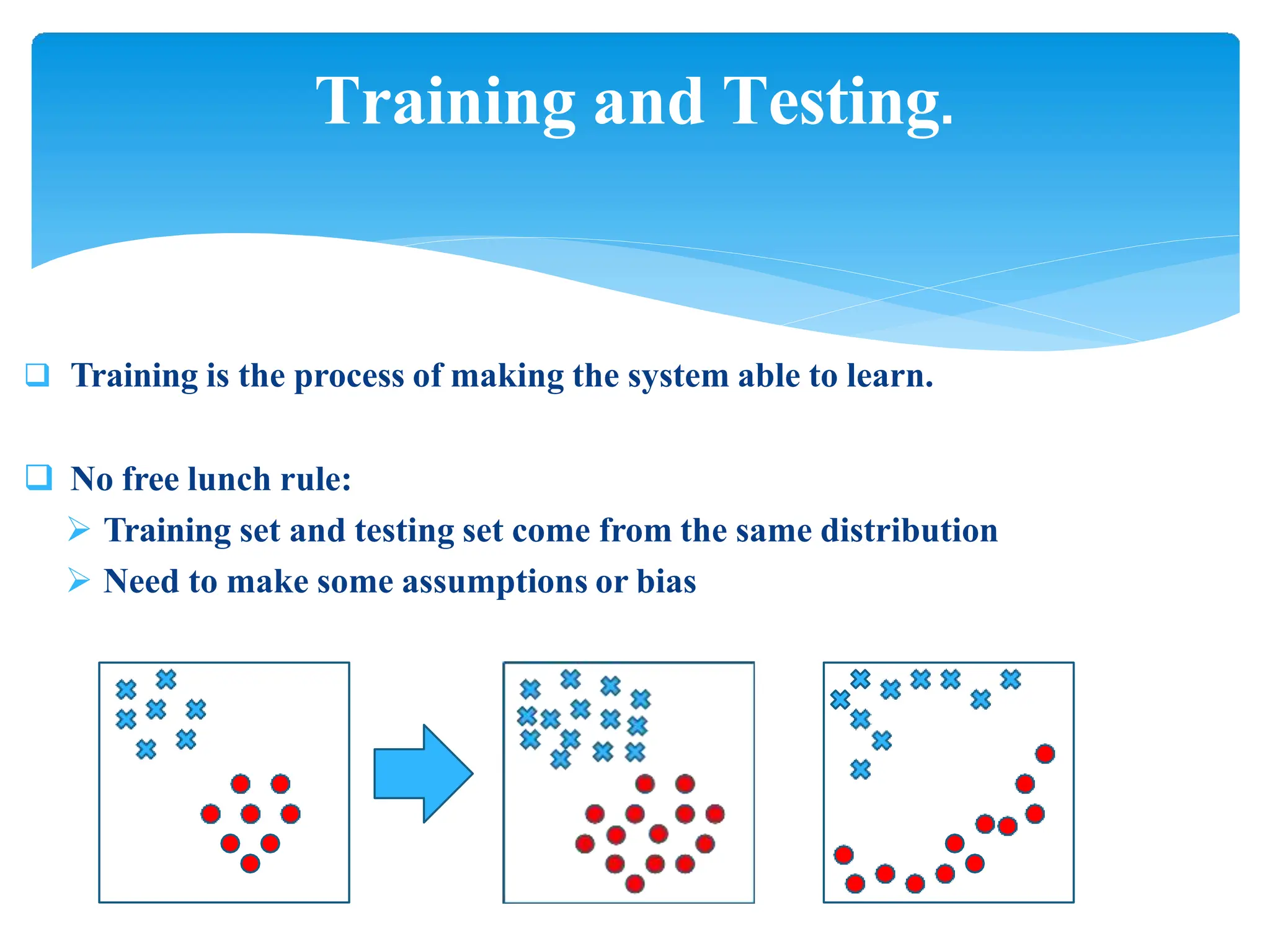
 Training is the process of making the system able to learn.
 No free lunch rule:
 Training set and testing set come from the same distribution
 Need to make some assumptions or bias
Training and Testing.
Contd.
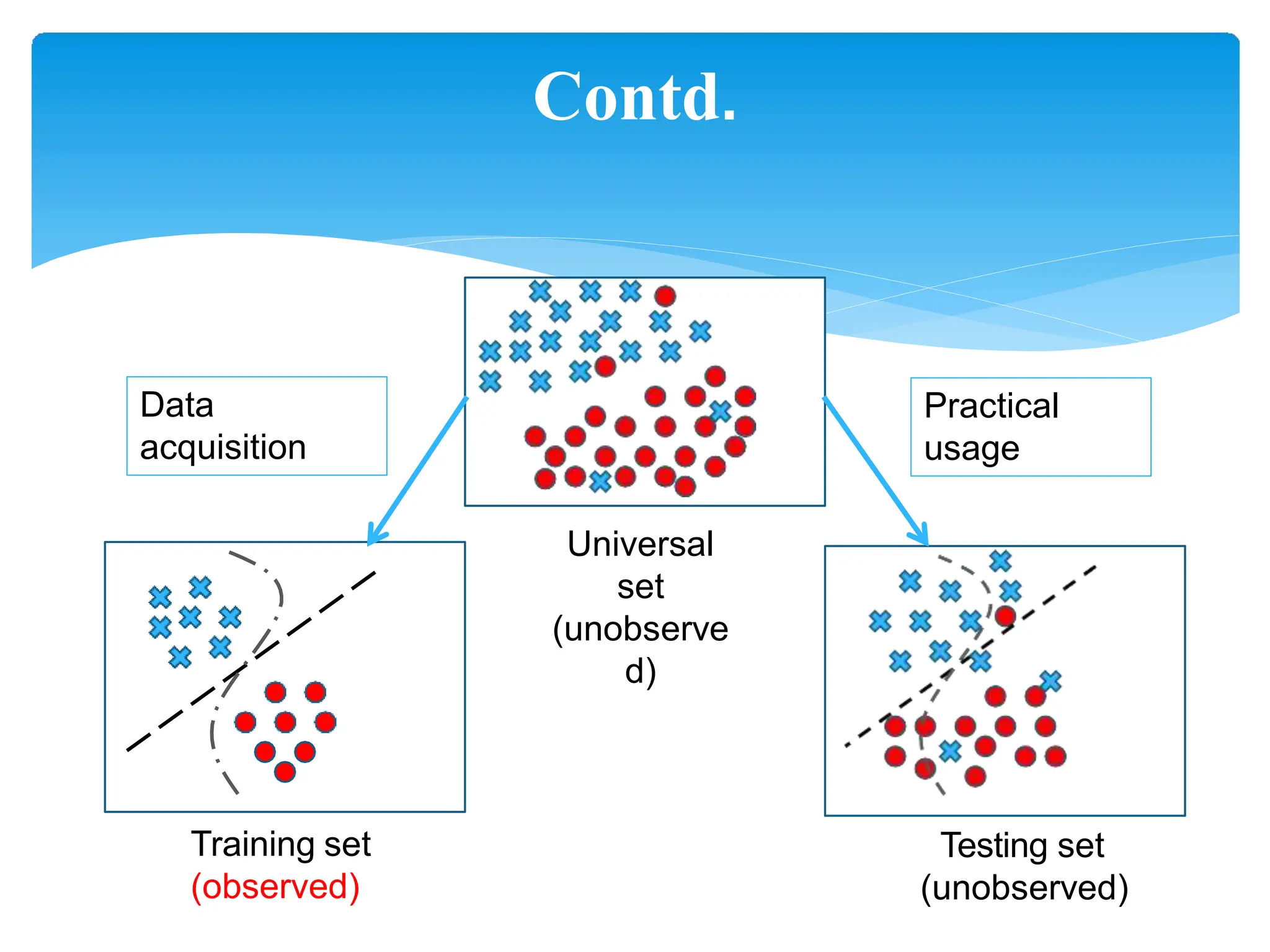
Training set
(observed)
Universal
set
(unobserve
d)
Testing set
(unobserved)
Data
acquisition
Practical
usage
Performance
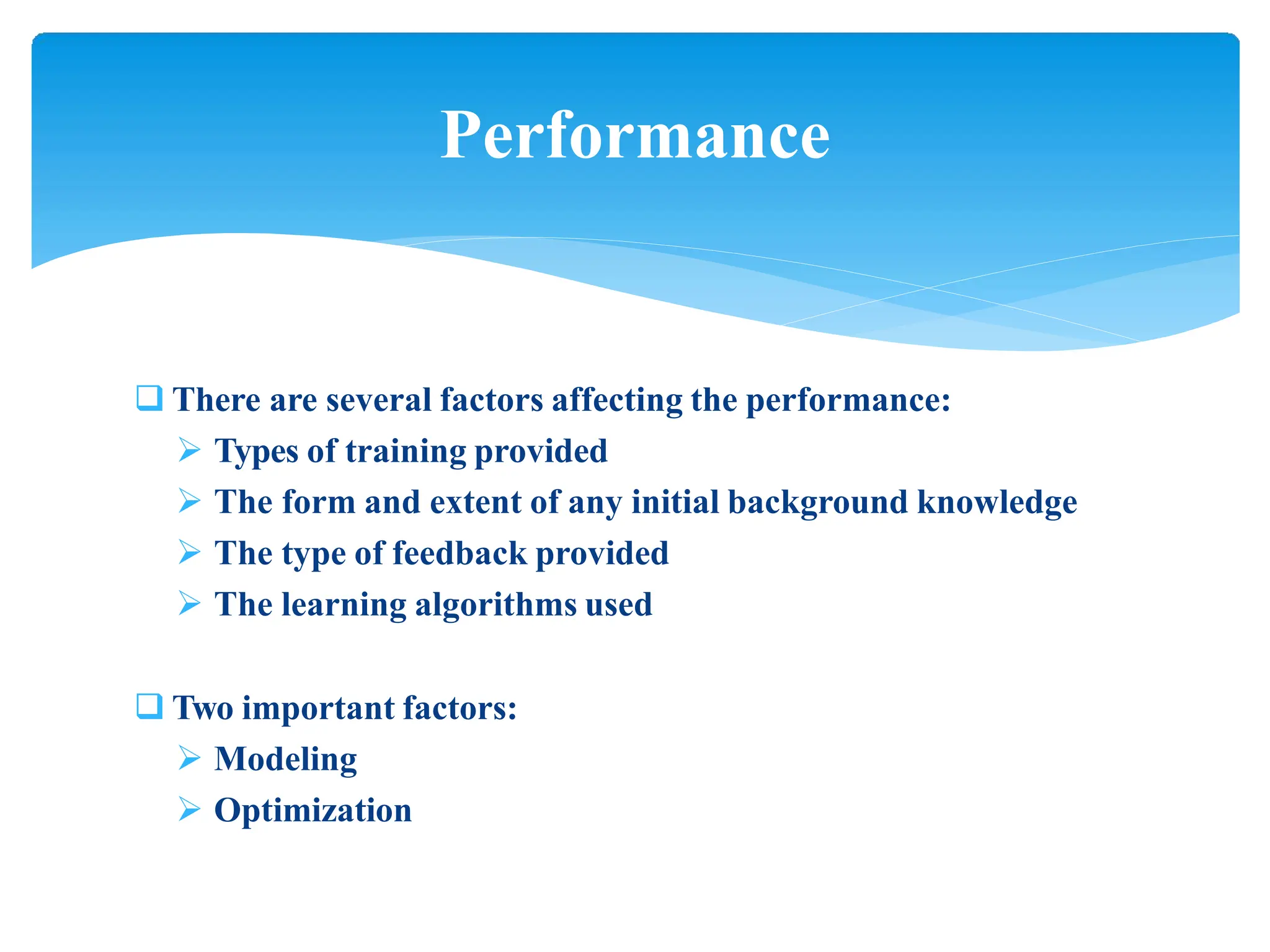
 There are several factors affecting the performance:
 Types of training provided
 The form and extent of any initial background knowledge
 The type of feedback provided
 The learning algorithms used
 Two important factors:
 Modeling
 Optimization
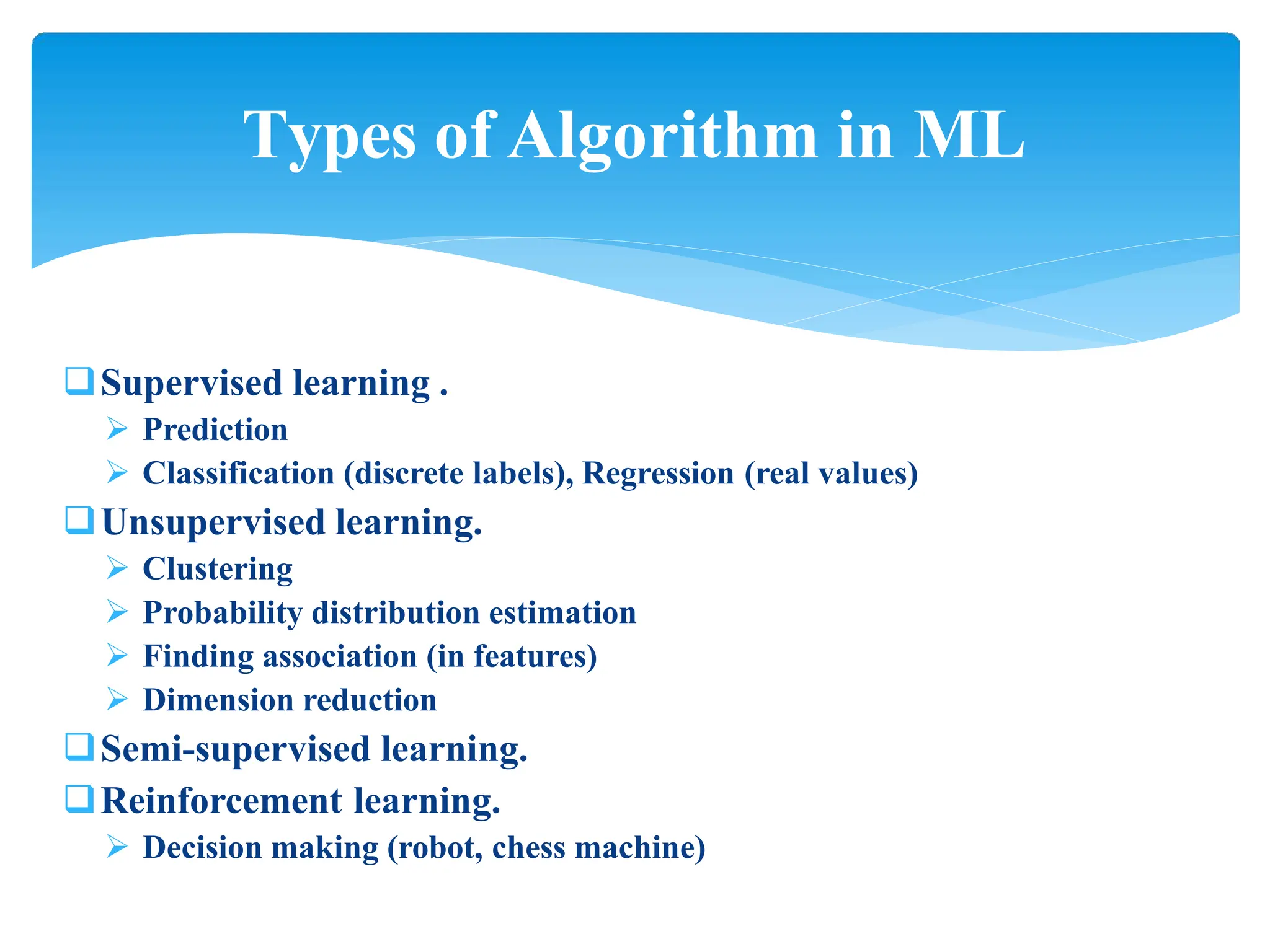
 The success of machine learning system also depends on the algorithms.
 The algorithms control the search to find and build the knowledge structures.
 The learning algorithms should extract useful information from training
examples.
Algorithm
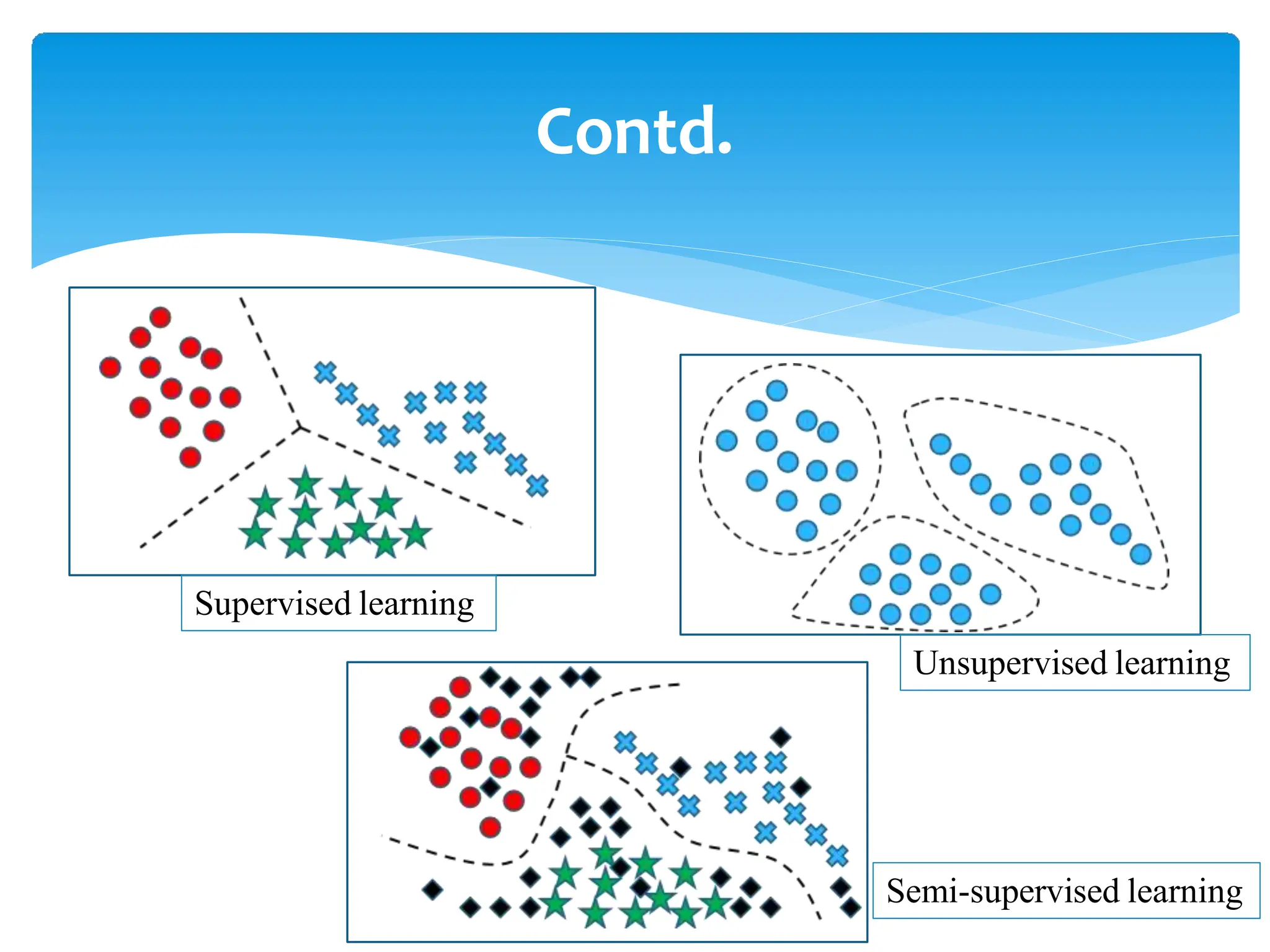
Supervised learning .
 Prediction
 Classification (discrete labels), Regression (real values)
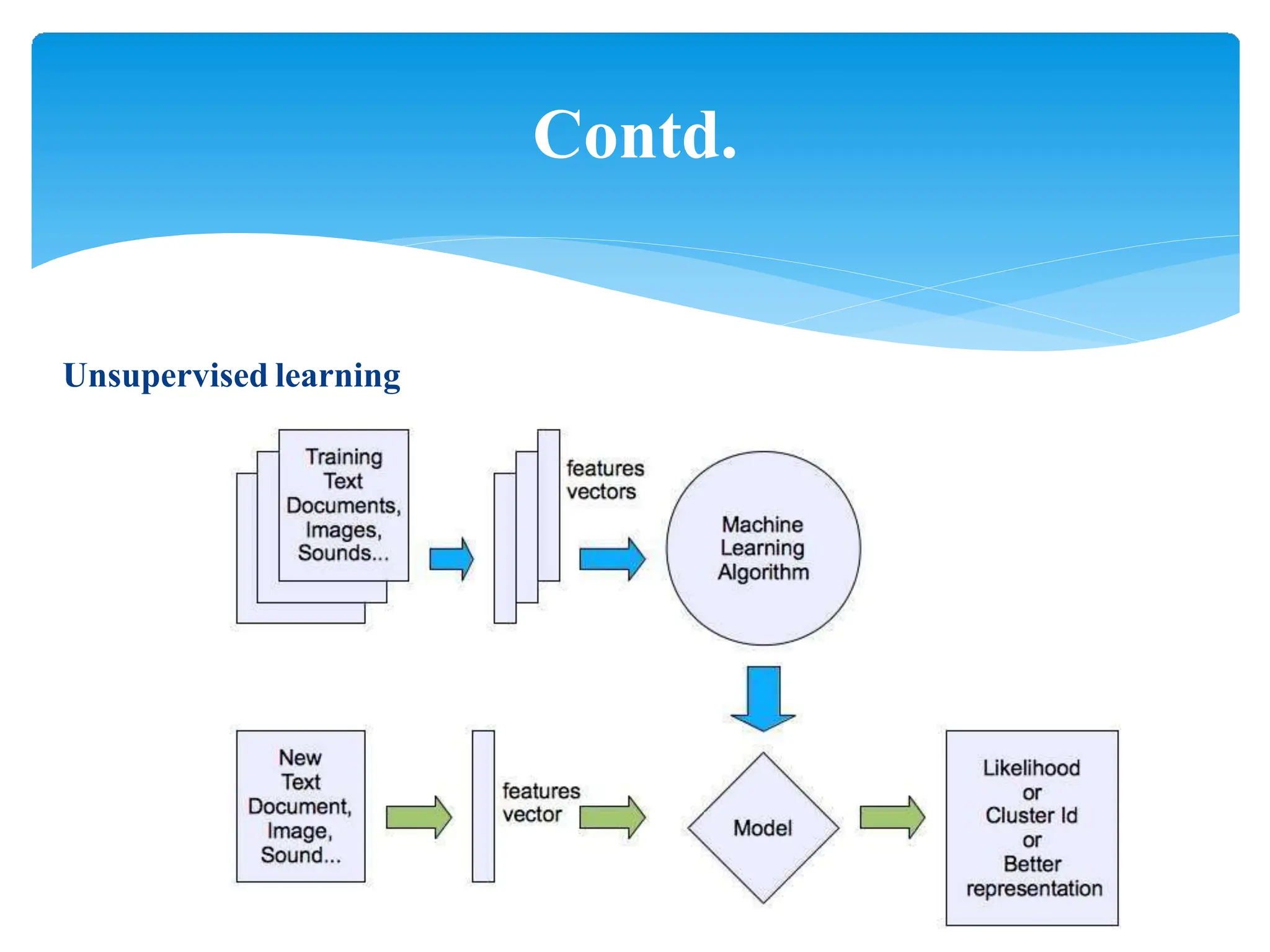
Unsupervised learning.
 Clustering
 Probability distribution estimation
 Finding association (in features)
 Dimension reduction
Semi-supervised learning.
Reinforcement learning.
 Decision making (robot, chess machine)
Types of Algorithm in ML
Contd.
Supervised learning
Unsupervised learning
Semi-supervised learning
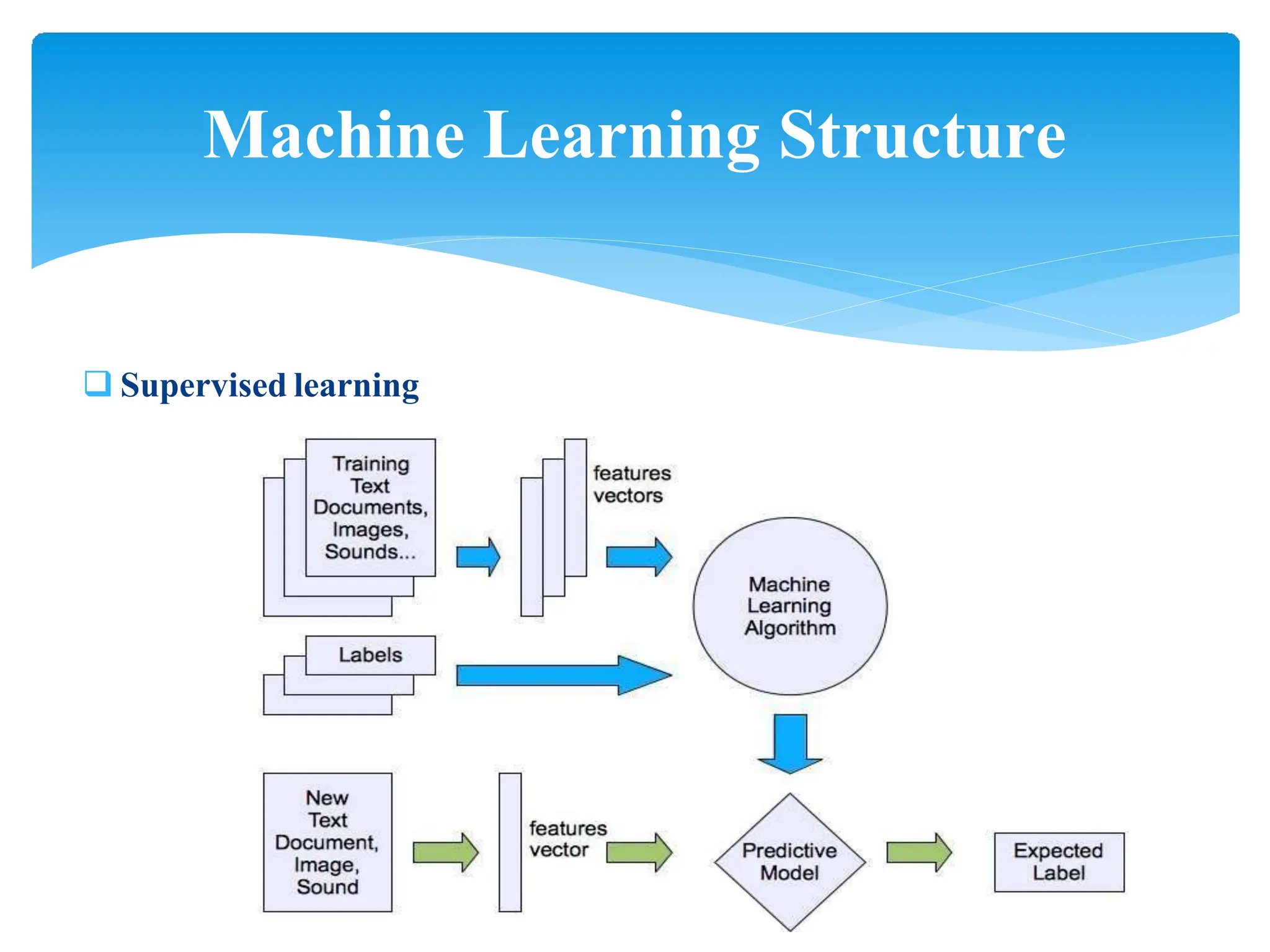
 Supervised learning
Machine Learning Structure
Unsupervised learning
Contd.
 Face detection.
 Object detection and recognition.
 Image segmentation.
 Multimedia event detection.
 Economical and commercial usage.
Application
 We have a simple overview of some techniques and algorithms
in machine learning. Furthermore, there are more and more
techniques apply machine learning as a solution. In the future,
machine learning will play an important role in our daily life.
Conclusion
THANK YOU

Machine Learning for Begineers First .pptx

  • 1.
  • 2.
    1. History ofMachine Learning. 2. What is Machine Learning. 3. Why ML. 4. Learning System Model. 5. Training and Testing. 6. Performance. 7. Algorithms. 8. Machine Learning Structure. 9. Application. 10. Conclusion. Outline
  • 3.
     The namemachine learning was coined in 1959 by Arthur Samuel Tom M. Mitchell provided a widely quoted, more formal definition of the algorithms studied in the machine learning field:  A computer program is said to learn from experience E with respect to some class of tasks T and performance measure P if its performance at tasks in T, as measured by P, improves with experience E.  Alan Turing's proposal in his paper "Computing Machinery and Intelligence", in which the question "Can machines think?" is replaced with the question "Can machines do what we (as thinking entities) can do?". History of ML
  • 4.
  • 5.
     A branchof artificial intelligence, concerned with the design and development of algorithms that allow computers to evolve behaviors based on empirical data.  As intelligence requires knowledge, it is necessary for the computers to acquire knowledge.  Machine learning refers to a system capable of the autonomous acquisition and integration of knowledge What is ML
  • 6.
  • 7.
    No human experts industrial/manufacturing control.  mass spectrometer analysis, drug design, astronomic discovery. Black-box human expertise  face/handwriting/speech recognition.  driving a car, flying a plane. Why ML
  • 8.
     Rapidly changingphenomena  credit scoring, financial modeling.  diagnosis, fraud detection.  Need for customization/personalization  personalized news reader.  movie/book recommendation. Contd.
  • 9.
  • 10.
     Training isthe process of making the system able to learn.  No free lunch rule:  Training set and testing set come from the same distribution  Need to make some assumptions or bias Training and Testing.
  • 11.
  • 12.
    Performance  There areseveral factors affecting the performance:  Types of training provided  The form and extent of any initial background knowledge  The type of feedback provided  The learning algorithms used  Two important factors:  Modeling  Optimization
  • 13.
     The successof machine learning system also depends on the algorithms.  The algorithms control the search to find and build the knowledge structures.  The learning algorithms should extract useful information from training examples. Algorithm
  • 14.
    Supervised learning . Prediction  Classification (discrete labels), Regression (real values) Unsupervised learning.  Clustering  Probability distribution estimation  Finding association (in features)  Dimension reduction Semi-supervised learning. Reinforcement learning.  Decision making (robot, chess machine) Types of Algorithm in ML
  • 15.
  • 16.
  • 17.
  • 18.
     Face detection. Object detection and recognition.  Image segmentation.  Multimedia event detection.  Economical and commercial usage. Application
  • 19.
     We havea simple overview of some techniques and algorithms in machine learning. Furthermore, there are more and more techniques apply machine learning as a solution. In the future, machine learning will play an important role in our daily life. Conclusion
  • 20.