vcMACHINE LEARNING INTRODUCTION
- BY REVATI DEVRAT
PPT PRESENTATION ON INTRODUCTION
TO MACHINE LEARNING
 INTRODUCTION
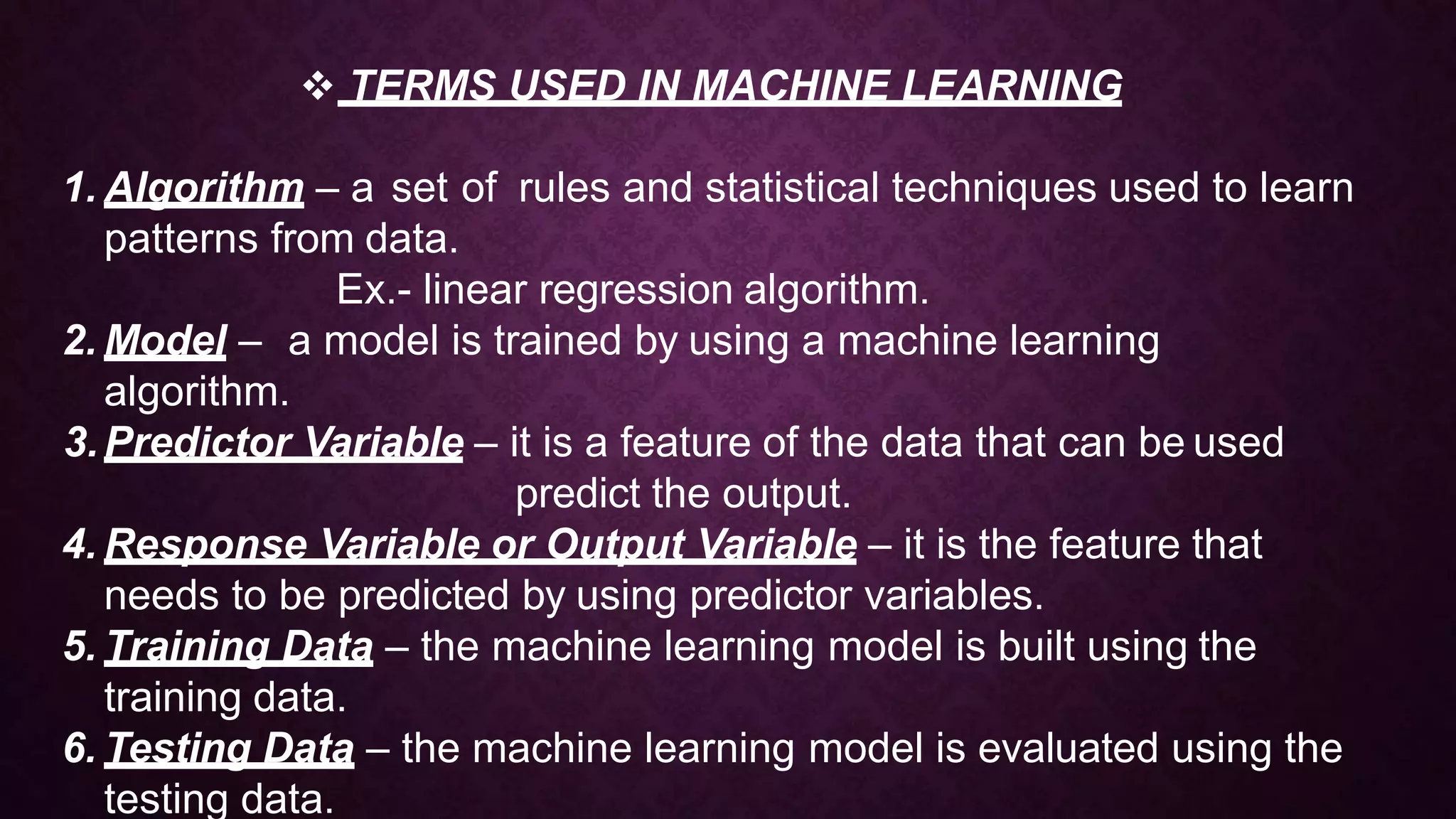
 TERMS USED IN MACHINE LEARNING
 MACHINE LEARNING PROCESS
 TYPES OF MACHINE LEARNING
 SUPERVISED vs UNSUPERVISED vs REINFORCEMENT
LEARNING
TYPES OF PROBLEMS
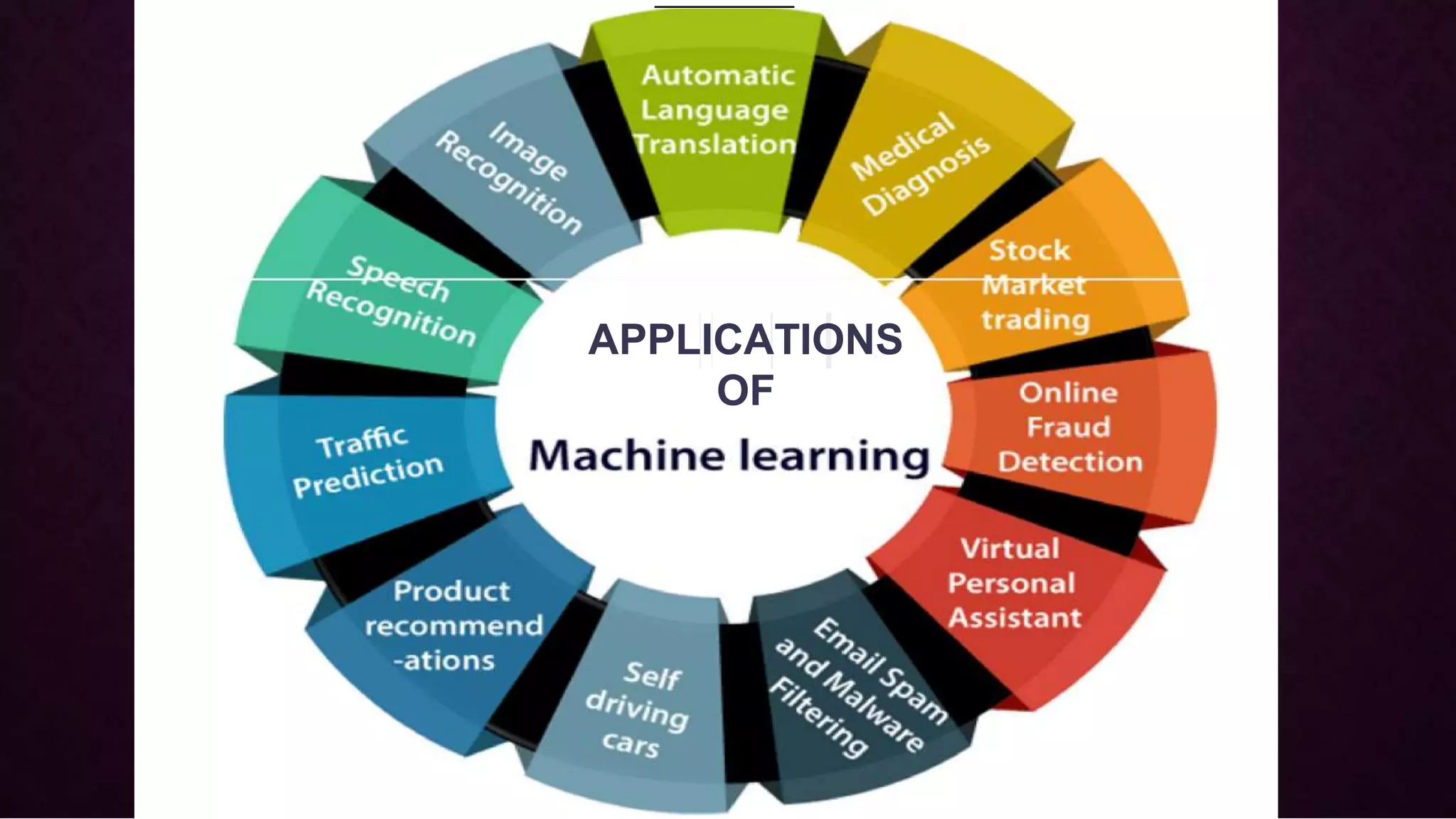
APPLICATIONS OF MACHINE LEARNING
 NEED FOR MACHINE LEARNING :
1) Increased Data generation
2) High demands of machine learning skills
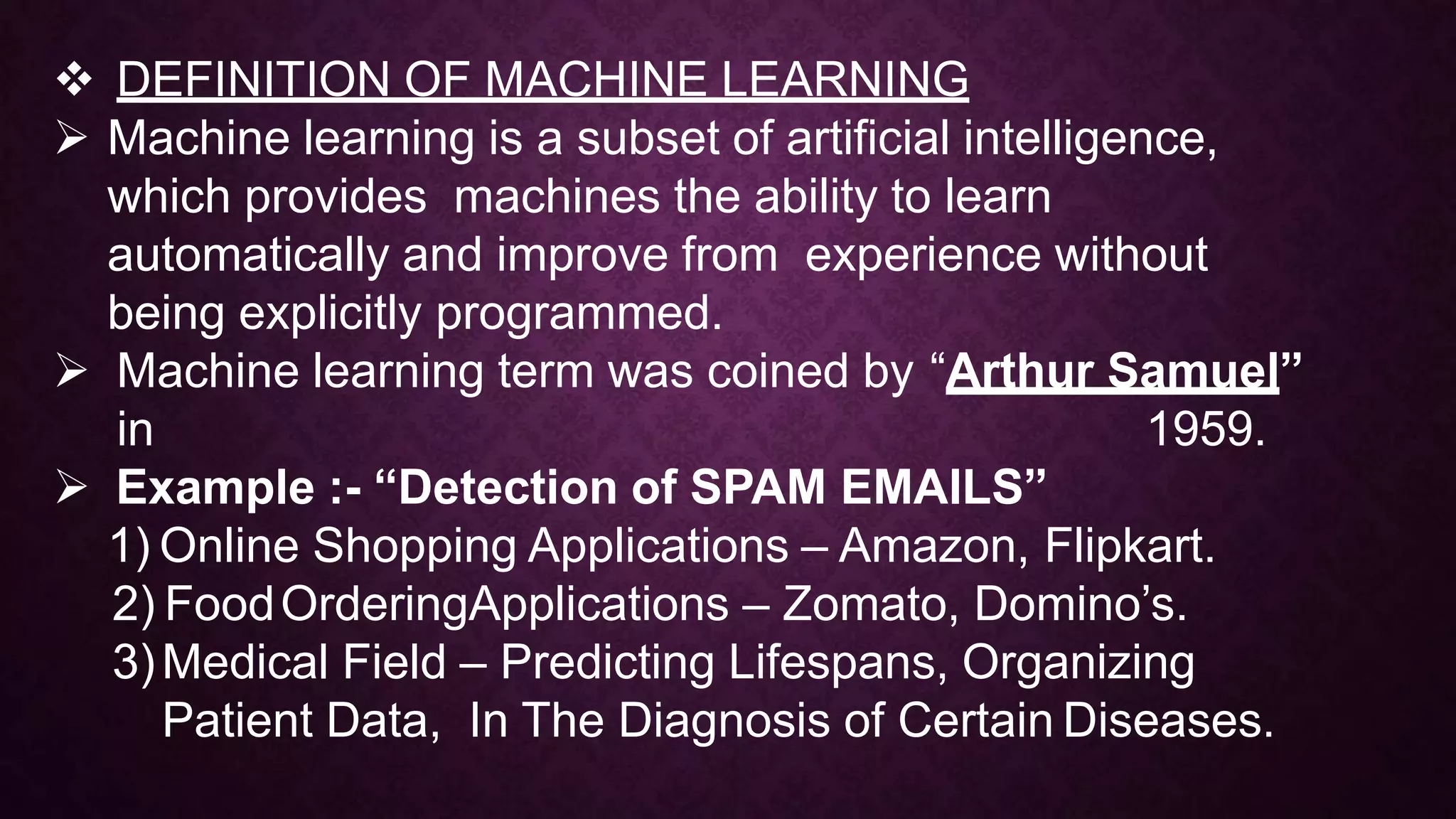
 DEFINITION OF MACHINE LEARNING
 Machine learning is a subset of artificial intelligence,
which provides machines the ability to learn
automatically and improve from experience without
being explicitly programmed.
 Machine learning term was coined by “Arthur Samuel”
in 1959.
 Example :- “Detection of SPAM EMAILS”
1) Online Shopping Applications – Amazon, Flipkart.
2) FoodOrderingApplications – Zomato, Domino’s.
3)Medical Field – Predicting Lifespans, Organizing
Patient Data, In The Diagnosis of Certain Diseases.
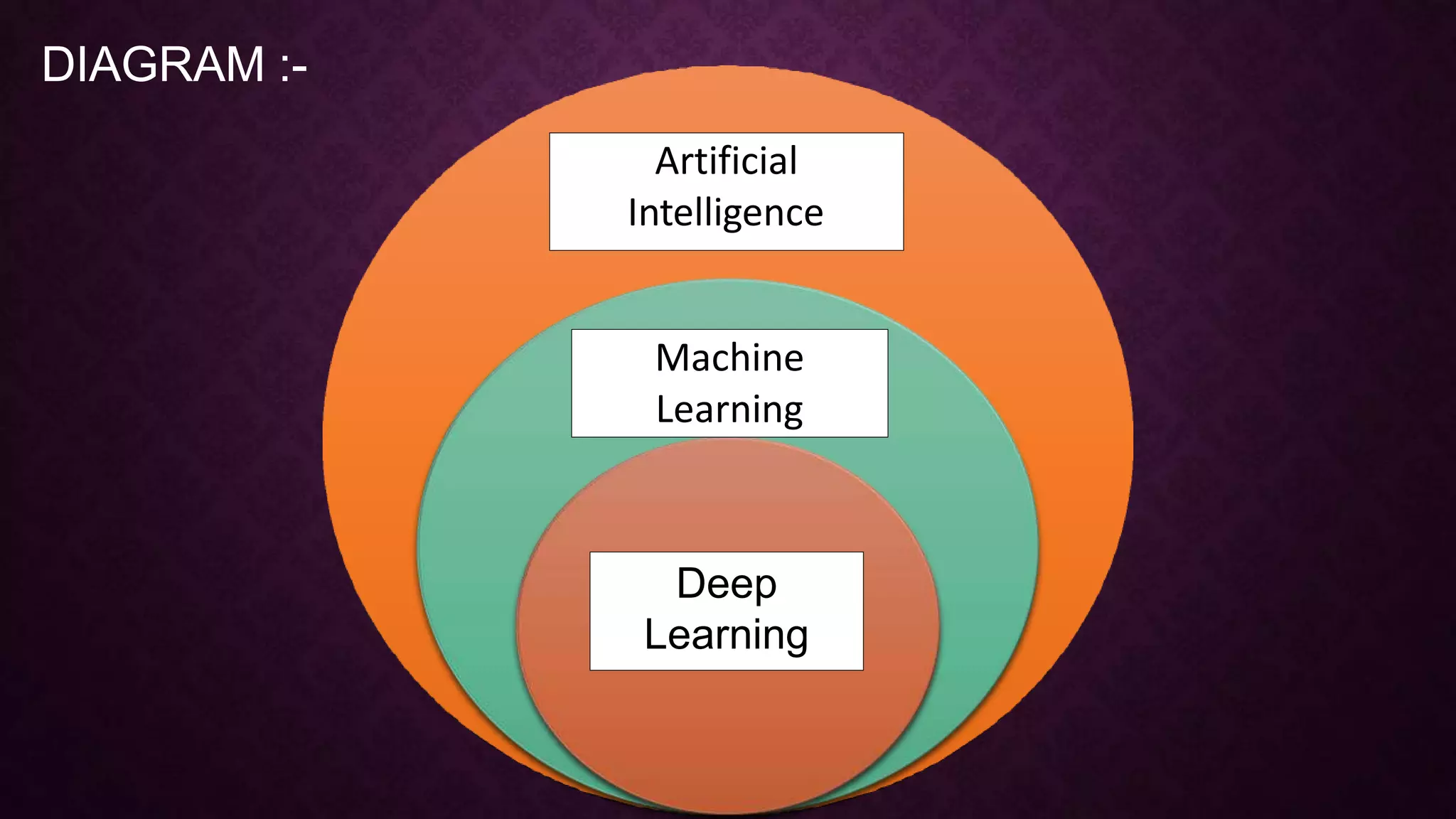
Artificial
Intelligence
Deep
Learning
Machine
Learning
DIAGRAM :-
 TERMS USED IN MACHINE LEARNING
1. Algorithm – a set of rules and statistical techniques used to learn
patterns from data.
Ex.- linear regression algorithm.
2. Model – a model is trained by using a machine learning
algorithm.
3.Predictor Variable – it is a feature of the data that can be used
predict the output.
4. Response Variable or Output Variable – it is the feature that
needs to be predicted by using predictor variables.
5. Training Data – the machine learning model is built using the
training data.
6. Testing Data – the machine learning model is evaluated using the
testing data.
MACHINE LEARNING PROCESS
1. Define Objective
2. Data Gathering
3. Preparing Data
4. Data Exploration
5. Building a Model
6. Model Evaluation
7. Predictions
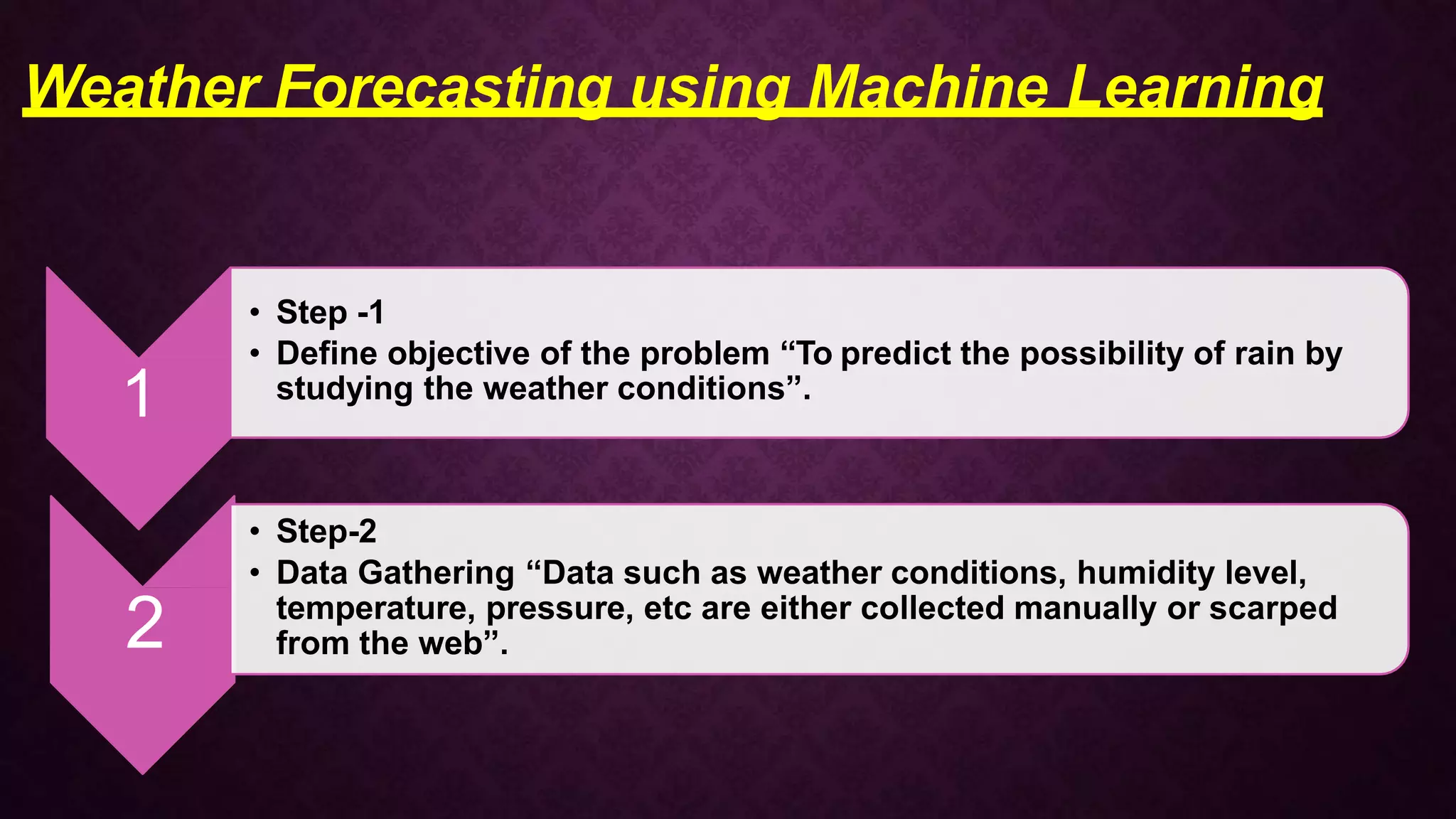
1
• Step -1
• Define objective of the problem “To predict the possibility of rain by
studying the weather conditions”.
2
• Step-2
• Data Gathering “Data such as weather conditions, humidity level,
temperature, pressure, etc are either collected manually or scarped
from the web”.
Weather Forecasting using Machine Learning
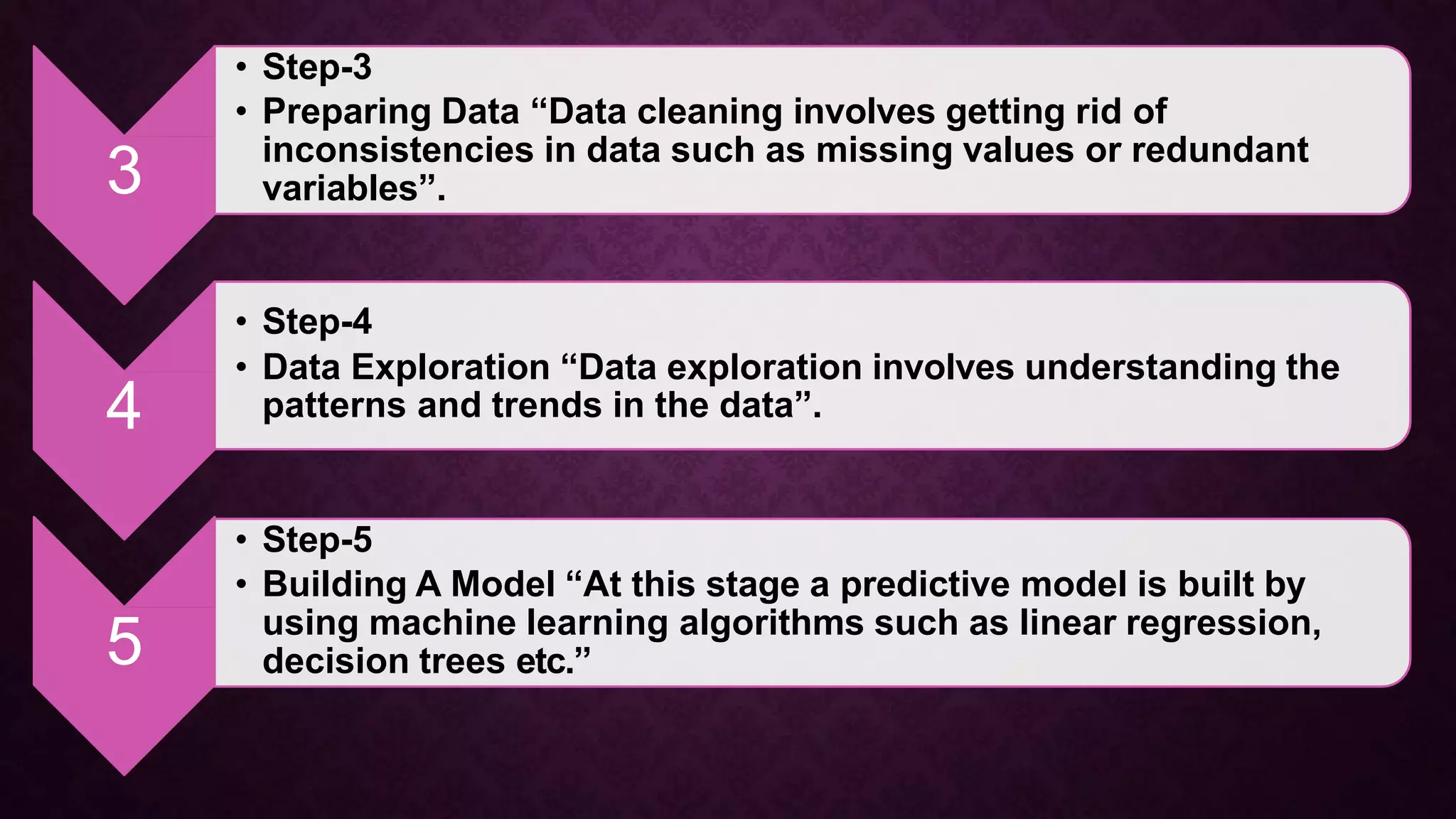
3
• Step-3
• Preparing Data “Data cleaning involves getting rid of
inconsistencies in data such as missing values or redundant
variables”.
4
• Step-4
• Data Exploration “Data exploration involves understanding the
patterns and trends in the data”.
5
• Step-5
• Building A Model “At this stage a predictive model is built by
using machine learning algorithms such as linear regression,
decision trees etc.”
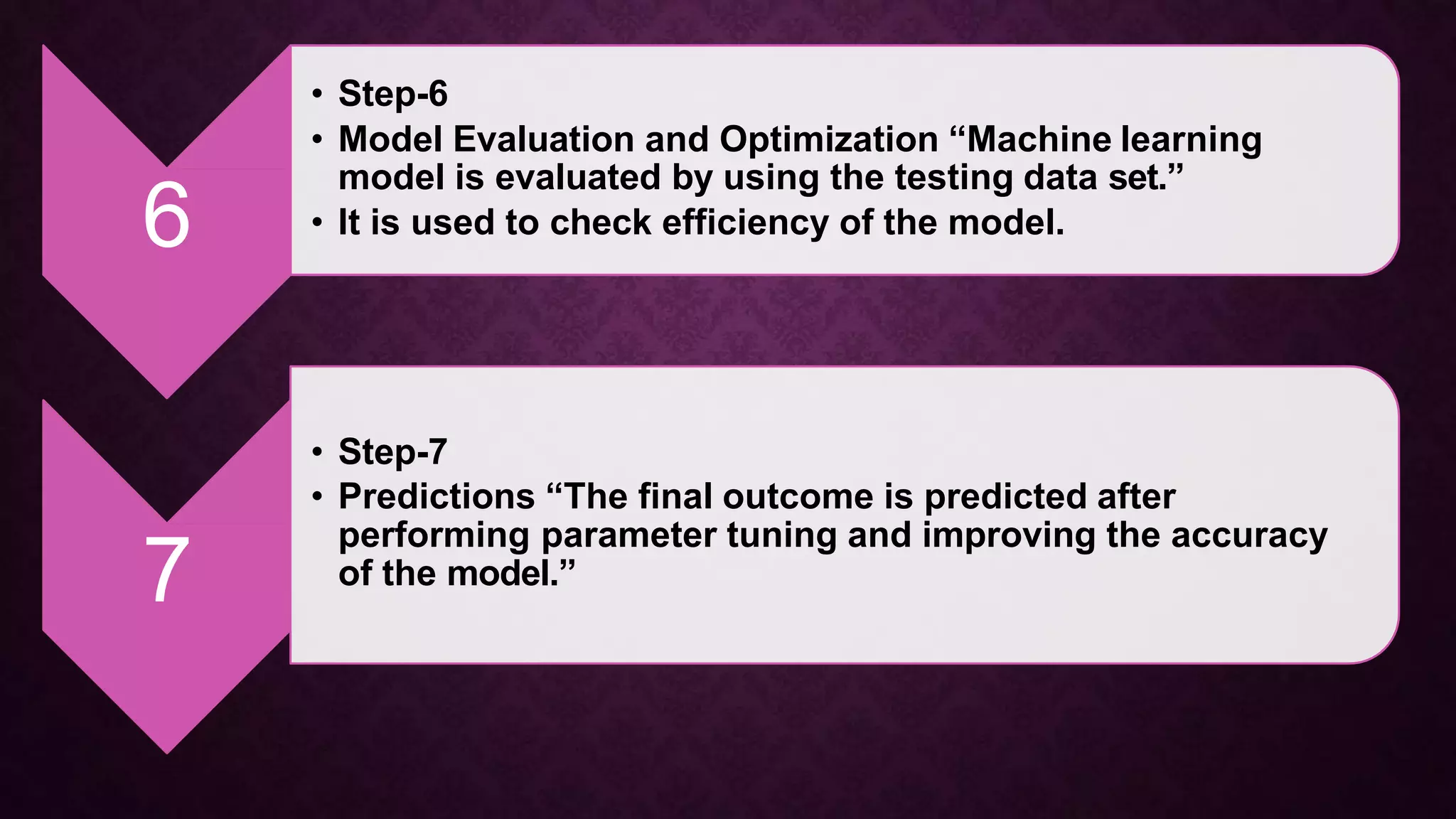
6
• Step-6
• Model Evaluation and Optimization “Machine learning
model is evaluated by using the testing data set.”
• It is used to check efficiency of the model.
7
• Step-7
• Predictions “The final outcome is predicted after
performing parameter tuning and improving the accuracy
of the model.”
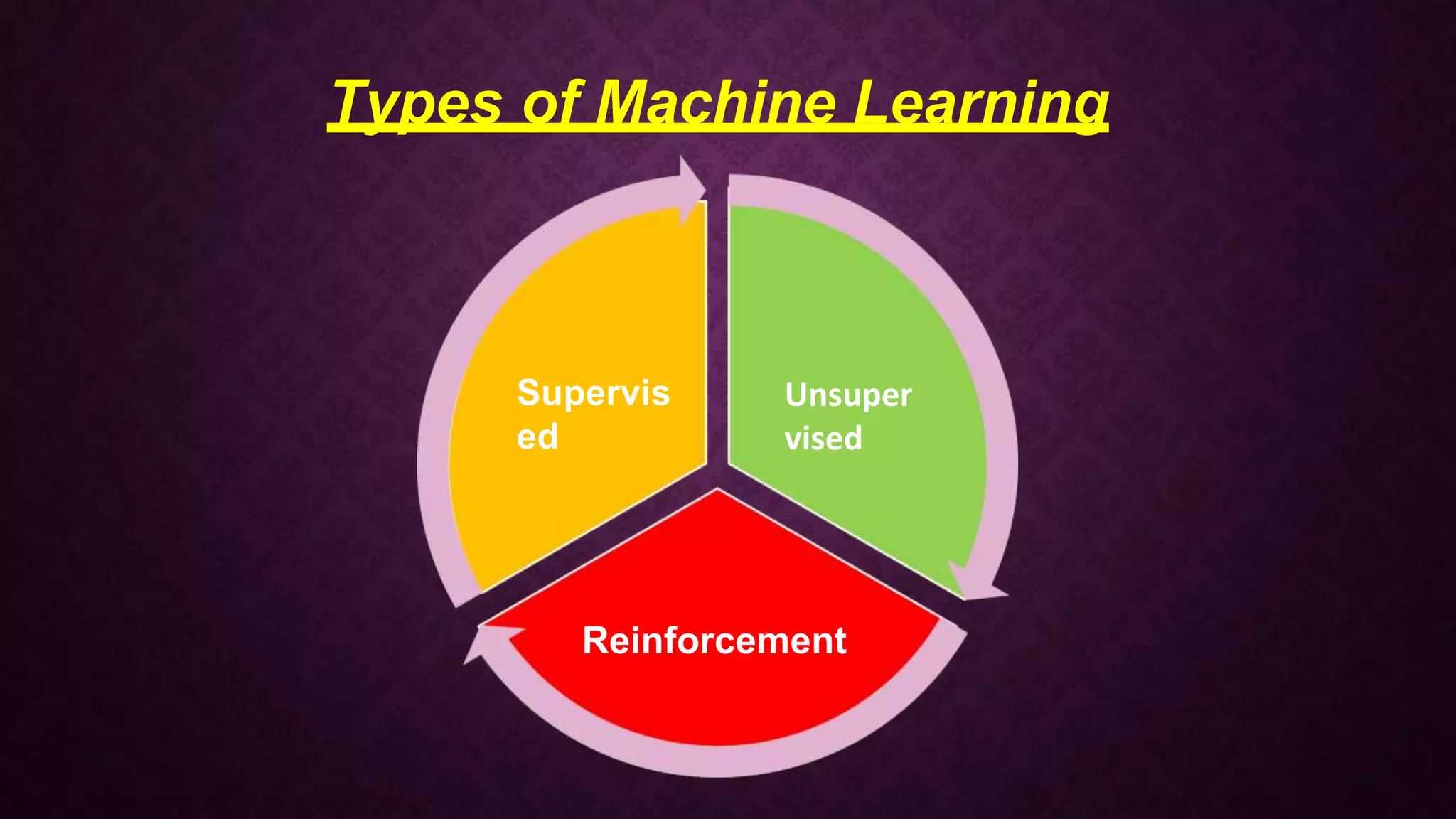
Unsupervised
Reinforcement
Supervis
ed
Types of Machine Learning
Unsuper
vised
Types of machine learning
1.Supervised Machine learning-
Supervised Machine learning is a technique in which we teach or train the
machine using data which is well labelled.
2. Unsupervised Machine learning-
Unsupervised Machine learning is the training of machine using information
that is unlabelled and allowing the algorithm to act on that information without
guidance.
3.Reinforcement Machine learning-
Reinforcement machine learning is a part of machine learning where an agent
is put in an environment and he learns to behave in this environment by
performing certain actions and observing the rewards which it gets from those
actions.
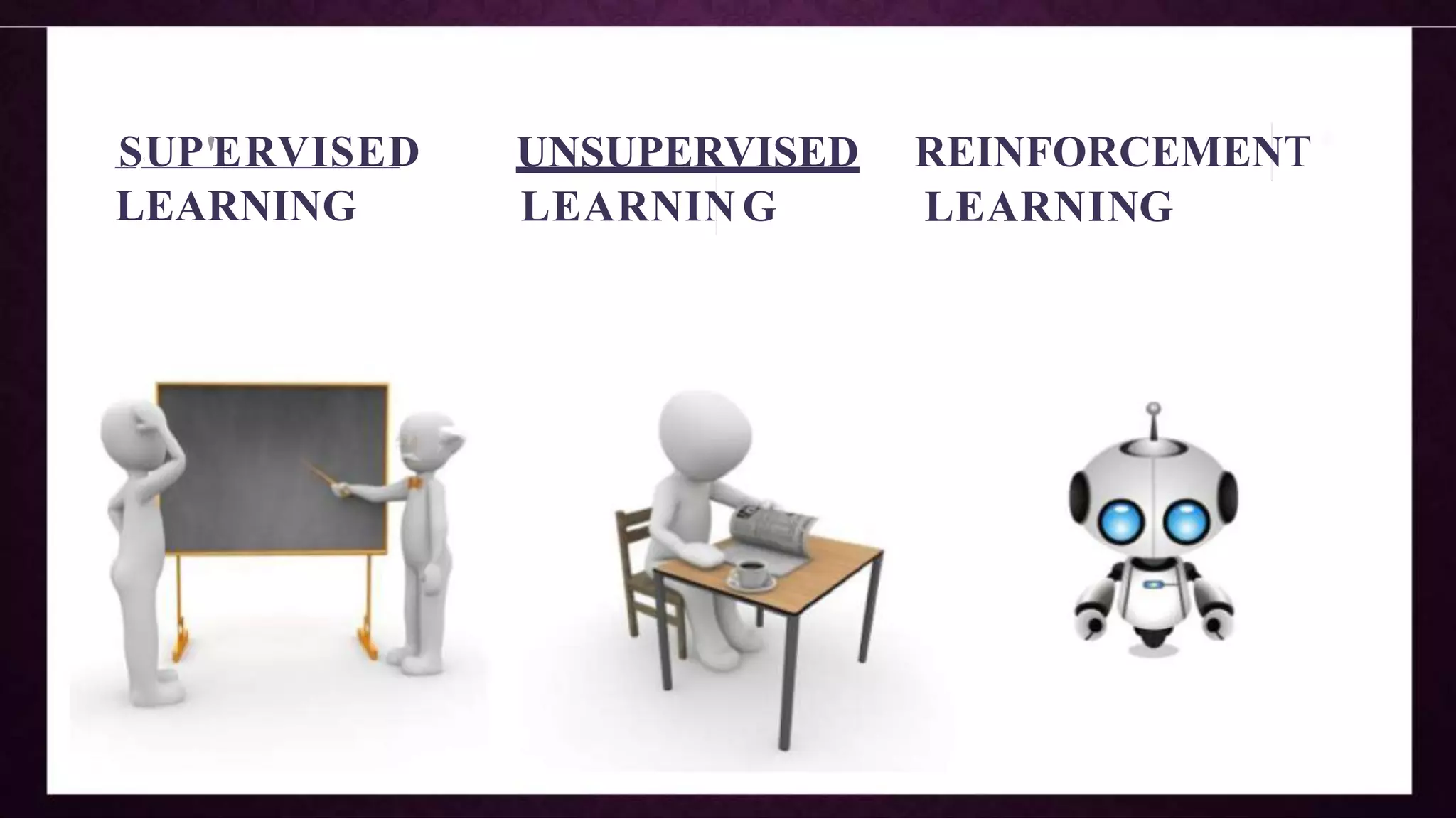
S1
UP'ERVISED
LEARNING
UNSUPERVISED
LEARNING
REINFORCEMENT
LEARNIN1
G
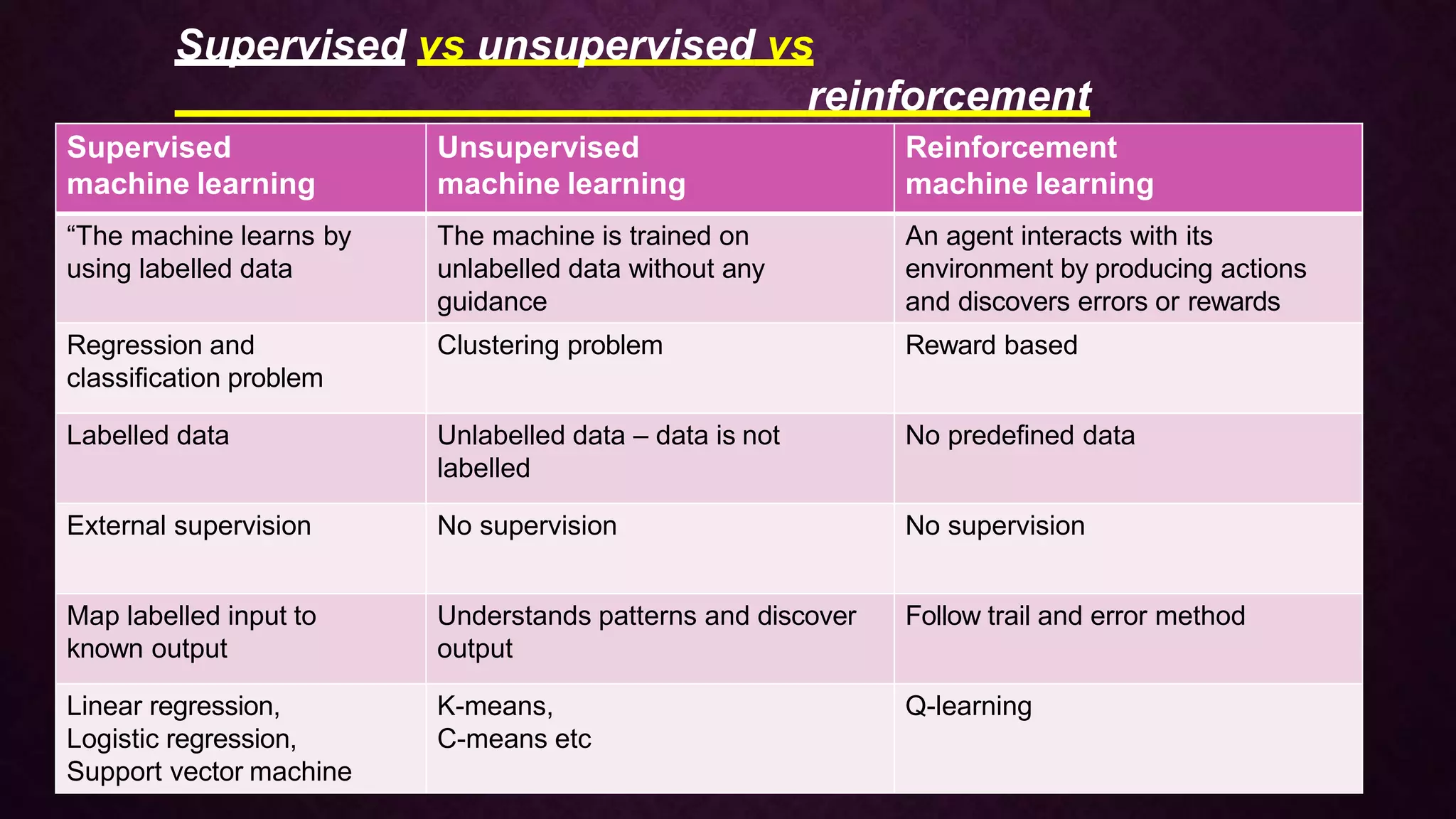
Supervised
machine learning
Unsupervised
machine learning
Reinforcement
machine learning
“The machine learns by
using labelled data
The machine is trained on
unlabelled data without any
guidance
An agent interacts with its
environment by producing actions
and discovers errors or rewards
Regression and
classification problem
Clustering problem Reward based
Labelled data Unlabelled data – data is not
labelled
No predefined data
External supervision No supervision No supervision
Map labelled input to
known output
Understands patterns and discover
output
Follow trail and error method
Linear regression,
Logistic regression,
Support vector machine
K-means,
C-means etc
Q-learning
Supervised vs unsupervised vs
reinforcement
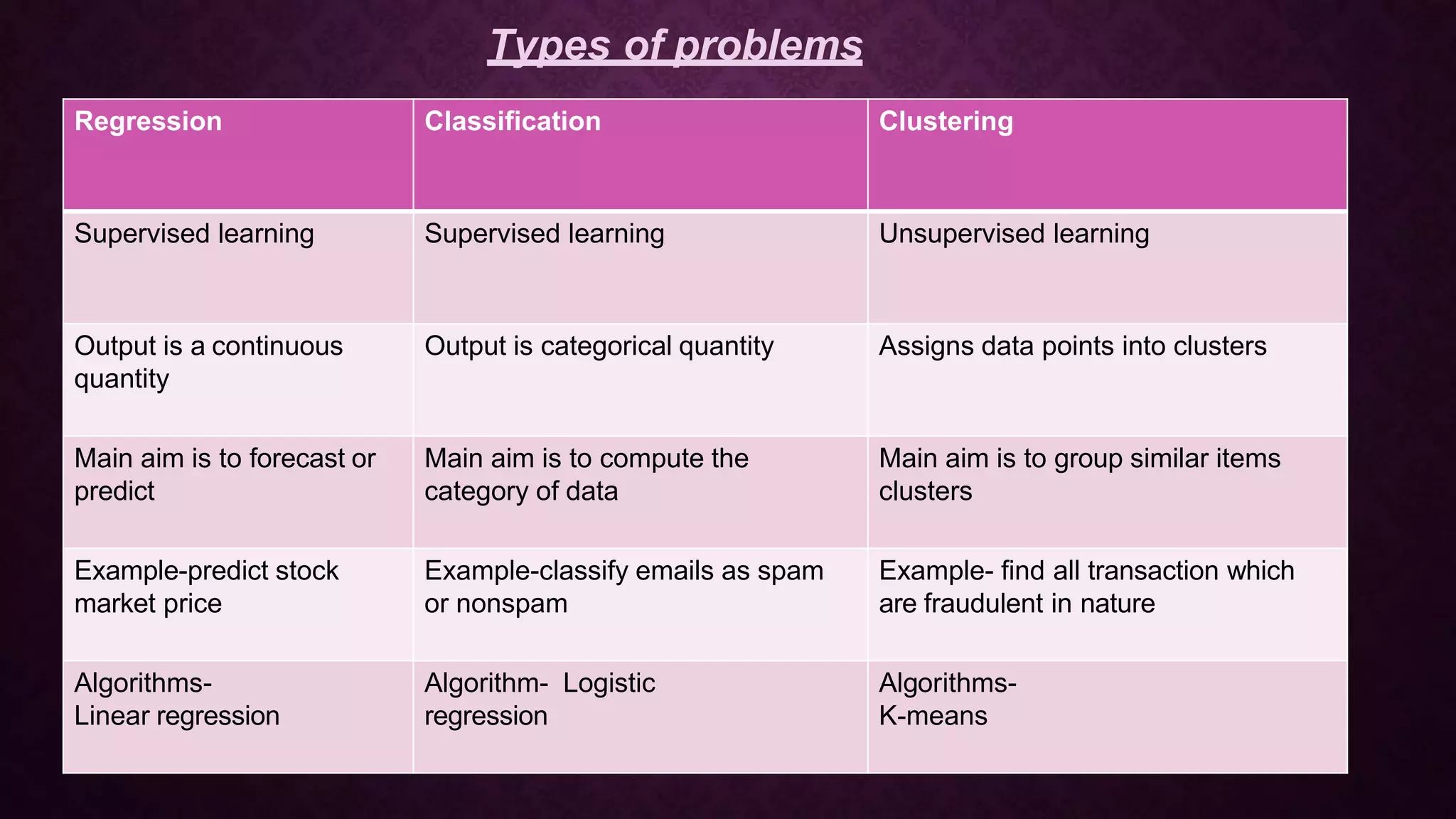
Regression Classification Clustering
Supervised learning Supervised learning Unsupervised learning
Output is a continuous
quantity
Output is categorical quantity Assigns data points into clusters
Main aim is to forecast or
predict
Main aim is to compute the
category of data
Main aim is to group similar items
clusters
Example-predict stock
market price
Example-classify emails as spam
or nonspam
Example- find all transaction which
are fraudulent in nature
Algorithms-
Linear regression
Algorithm- Logistic
regression
Algorithms-
K-means
Types of problems
APPLICATIONS
OF
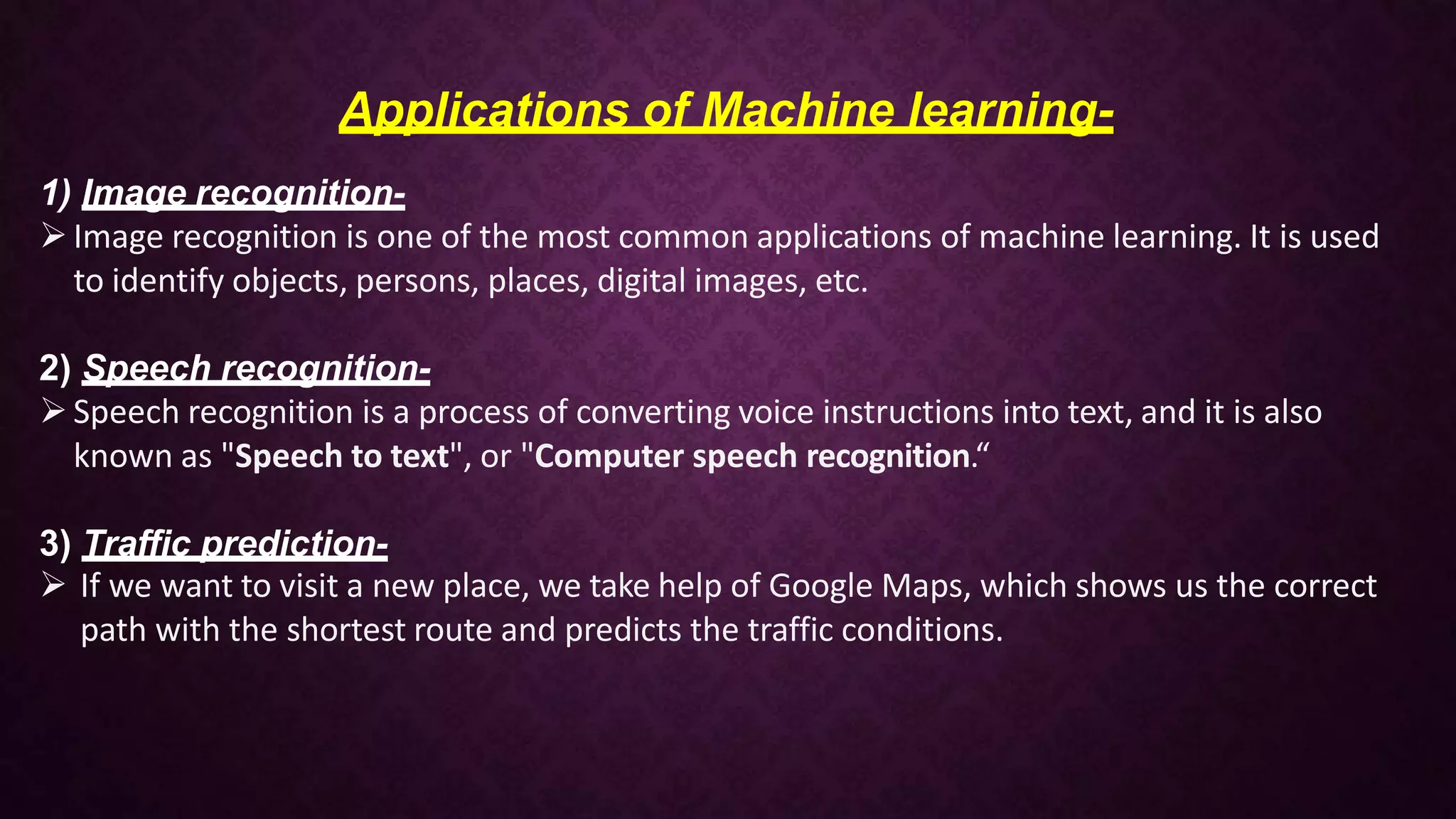
Applications of Machine learning-
1) Image recognition-
Image recognition is one of the most common applications of machine learning. It is used
to identify objects, persons, places, digital images, etc.
2) Speech recognition-
Speech recognition is a process of converting voice instructions into text, and it is also
known as "Speech to text", or "Computer speech recognition.“
3) Traffic prediction-
 If we want to visit a new place, we take help of Google Maps, which shows us the correct
path with the shortest route and predicts the traffic conditions.
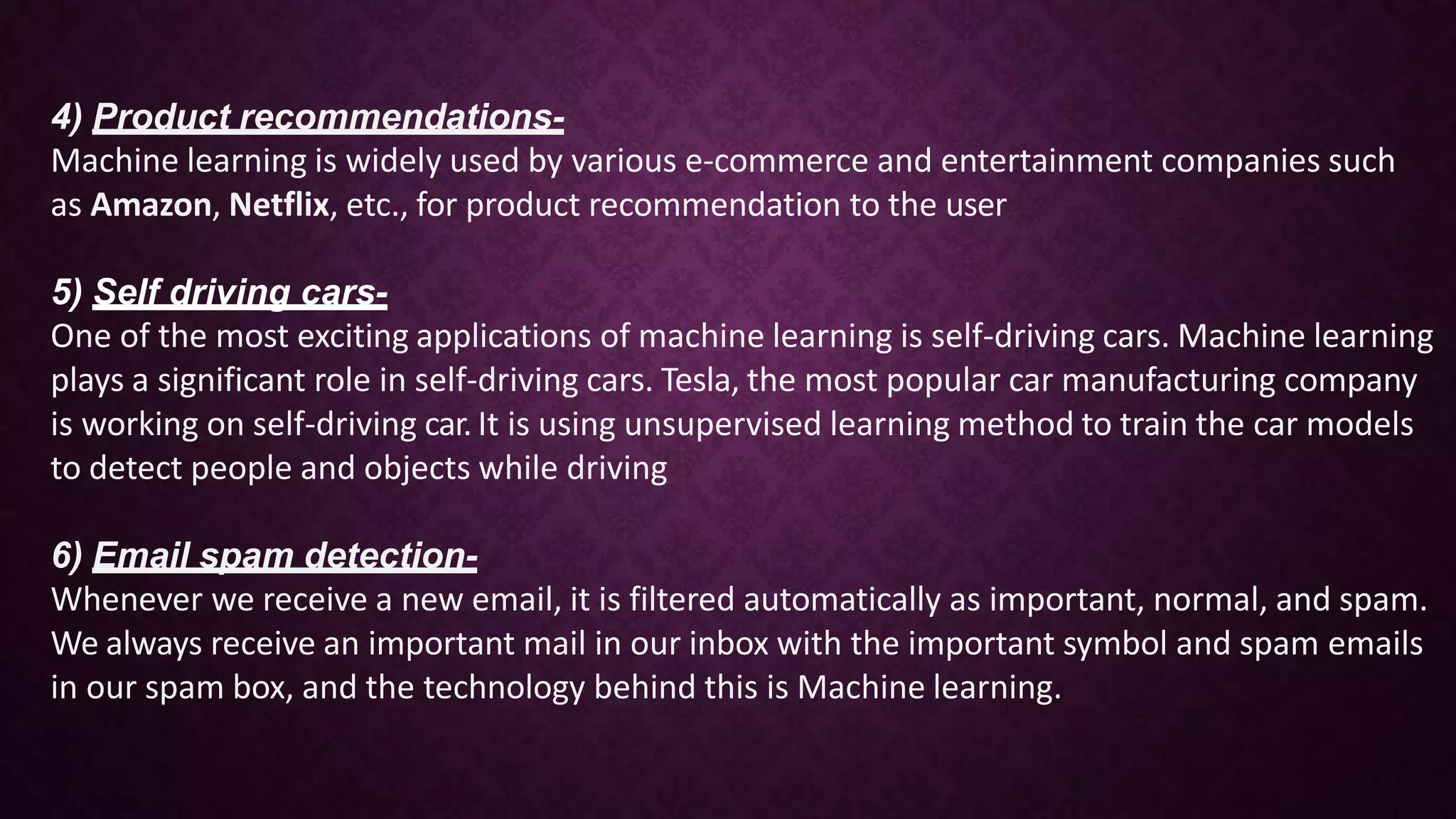
4) Product recommendations-
Machine learning is widely used by various e-commerce and entertainment companies such
as Amazon, Netflix, etc., for product recommendation to the user..
5) Self driving cars-
One of the most exciting applications of machine learning is self-driving cars. Machine learning
plays a significant role in self-driving cars. Tesla, the most popular car manufacturing company
is working on self-driving car. It is using unsupervised learning method to train the car models
to detect people and objects while driving
6) Email spam detection-
Whenever we receive a new email, it is filtered automatically as important, normal, and spam.
We always receive an important mail in our inbox with the important symbol and spam emails
in our spam box, and the technology behind this is Machine learning.
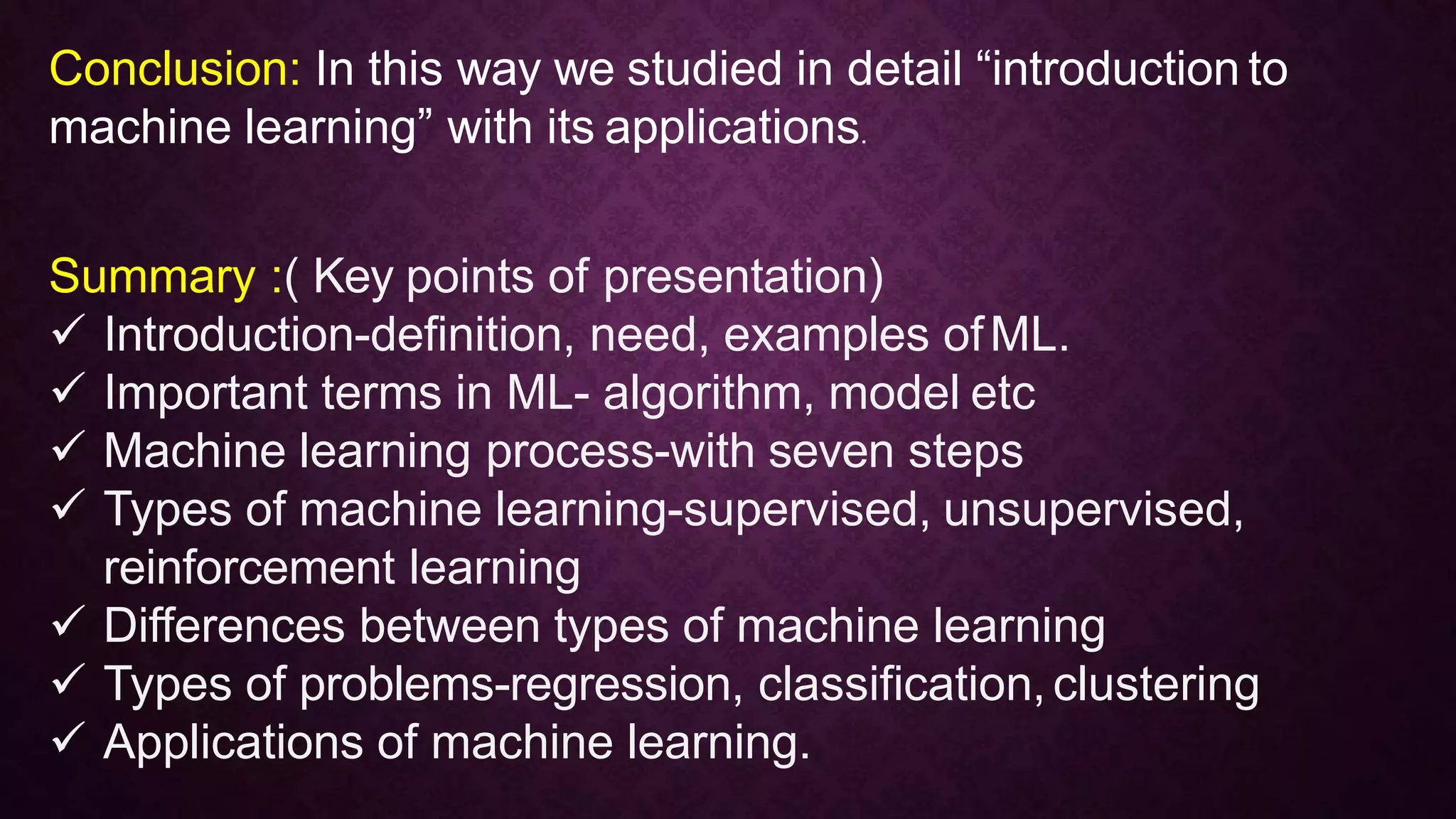
Conclusion: In this way we studied in detail “introduction to
machine learning” with its applications.
Summary :( Key points of presentation)
 Introduction-definition, need, examples ofML.
 Important terms in ML- algorithm, model etc
 Machine learning process-with seven steps
 Types of machine learning-supervised, unsupervised,
reinforcement learning
 Differences between types of machine learning
 Types of problems-regression, classification,clustering
 Applications of machine learning.
ML PPT-1.pptx

ML PPT-1.pptx

  • 1.
  • 2.
    PPT PRESENTATION ONINTRODUCTION TO MACHINE LEARNING  INTRODUCTION  TERMS USED IN MACHINE LEARNING  MACHINE LEARNING PROCESS  TYPES OF MACHINE LEARNING  SUPERVISED vs UNSUPERVISED vs REINFORCEMENT LEARNING TYPES OF PROBLEMS APPLICATIONS OF MACHINE LEARNING
  • 3.
     NEED FORMACHINE LEARNING : 1) Increased Data generation 2) High demands of machine learning skills
  • 4.
     DEFINITION OFMACHINE LEARNING  Machine learning is a subset of artificial intelligence, which provides machines the ability to learn automatically and improve from experience without being explicitly programmed.  Machine learning term was coined by “Arthur Samuel” in 1959.  Example :- “Detection of SPAM EMAILS” 1) Online Shopping Applications – Amazon, Flipkart. 2) FoodOrderingApplications – Zomato, Domino’s. 3)Medical Field – Predicting Lifespans, Organizing Patient Data, In The Diagnosis of Certain Diseases.
  • 5.
  • 6.
     TERMS USEDIN MACHINE LEARNING 1. Algorithm – a set of rules and statistical techniques used to learn patterns from data. Ex.- linear regression algorithm. 2. Model – a model is trained by using a machine learning algorithm. 3.Predictor Variable – it is a feature of the data that can be used predict the output. 4. Response Variable or Output Variable – it is the feature that needs to be predicted by using predictor variables. 5. Training Data – the machine learning model is built using the training data. 6. Testing Data – the machine learning model is evaluated using the testing data.
  • 7.
    MACHINE LEARNING PROCESS 1.Define Objective 2. Data Gathering 3. Preparing Data 4. Data Exploration 5. Building a Model 6. Model Evaluation 7. Predictions
  • 8.
    1 • Step -1 •Define objective of the problem “To predict the possibility of rain by studying the weather conditions”. 2 • Step-2 • Data Gathering “Data such as weather conditions, humidity level, temperature, pressure, etc are either collected manually or scarped from the web”. Weather Forecasting using Machine Learning
  • 9.
    3 • Step-3 • PreparingData “Data cleaning involves getting rid of inconsistencies in data such as missing values or redundant variables”. 4 • Step-4 • Data Exploration “Data exploration involves understanding the patterns and trends in the data”. 5 • Step-5 • Building A Model “At this stage a predictive model is built by using machine learning algorithms such as linear regression, decision trees etc.”
  • 10.
    6 • Step-6 • ModelEvaluation and Optimization “Machine learning model is evaluated by using the testing data set.” • It is used to check efficiency of the model. 7 • Step-7 • Predictions “The final outcome is predicted after performing parameter tuning and improving the accuracy of the model.”
  • 11.
  • 12.
    Types of machinelearning 1.Supervised Machine learning- Supervised Machine learning is a technique in which we teach or train the machine using data which is well labelled. 2. Unsupervised Machine learning- Unsupervised Machine learning is the training of machine using information that is unlabelled and allowing the algorithm to act on that information without guidance. 3.Reinforcement Machine learning- Reinforcement machine learning is a part of machine learning where an agent is put in an environment and he learns to behave in this environment by performing certain actions and observing the rewards which it gets from those actions.
  • 13.
  • 14.
    Supervised machine learning Unsupervised machine learning Reinforcement machinelearning “The machine learns by using labelled data The machine is trained on unlabelled data without any guidance An agent interacts with its environment by producing actions and discovers errors or rewards Regression and classification problem Clustering problem Reward based Labelled data Unlabelled data – data is not labelled No predefined data External supervision No supervision No supervision Map labelled input to known output Understands patterns and discover output Follow trail and error method Linear regression, Logistic regression, Support vector machine K-means, C-means etc Q-learning Supervised vs unsupervised vs reinforcement
  • 15.
    Regression Classification Clustering Supervisedlearning Supervised learning Unsupervised learning Output is a continuous quantity Output is categorical quantity Assigns data points into clusters Main aim is to forecast or predict Main aim is to compute the category of data Main aim is to group similar items clusters Example-predict stock market price Example-classify emails as spam or nonspam Example- find all transaction which are fraudulent in nature Algorithms- Linear regression Algorithm- Logistic regression Algorithms- K-means Types of problems
  • 16.
  • 17.
    Applications of Machinelearning- 1) Image recognition- Image recognition is one of the most common applications of machine learning. It is used to identify objects, persons, places, digital images, etc. 2) Speech recognition- Speech recognition is a process of converting voice instructions into text, and it is also known as "Speech to text", or "Computer speech recognition.“ 3) Traffic prediction-  If we want to visit a new place, we take help of Google Maps, which shows us the correct path with the shortest route and predicts the traffic conditions.
  • 18.
    4) Product recommendations- Machinelearning is widely used by various e-commerce and entertainment companies such as Amazon, Netflix, etc., for product recommendation to the user.. 5) Self driving cars- One of the most exciting applications of machine learning is self-driving cars. Machine learning plays a significant role in self-driving cars. Tesla, the most popular car manufacturing company is working on self-driving car. It is using unsupervised learning method to train the car models to detect people and objects while driving 6) Email spam detection- Whenever we receive a new email, it is filtered automatically as important, normal, and spam. We always receive an important mail in our inbox with the important symbol and spam emails in our spam box, and the technology behind this is Machine learning.
  • 19.
    Conclusion: In thisway we studied in detail “introduction to machine learning” with its applications. Summary :( Key points of presentation)  Introduction-definition, need, examples ofML.  Important terms in ML- algorithm, model etc  Machine learning process-with seven steps  Types of machine learning-supervised, unsupervised, reinforcement learning  Differences between types of machine learning  Types of problems-regression, classification,clustering  Applications of machine learning.