SESSION	ID:	SESSION	ID:	
#RSAC
Zulfikar	Ramzan,	Ph.D	
Machine	Learning:	
Cybersecurity	Boon	or	Boondoggle?	
AIR-W03	
Chief Technology Officer
RSA
@zulfikar_ramzan
#RSAC
Outline	
2	
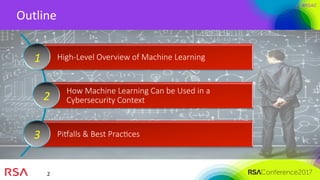
High-Level Overview of Machine Learning
How Machine Learning Can be Used in a
Cybersecurity Context
PiJalls & Best PracMces
1	
2	
3
#RSAC
What is machine learning?
#RSAC
4	
Machine	Learning	Overview	
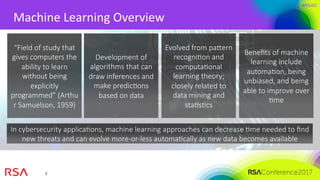
“Field of study that
gives computers the
ability to learn
without being
explicitly
programmed” (Arthu
r Samuelson, 1959)
Development of
algorithms that can
draw inferences and
make predicMons
based on data
Evolved from paern
recogniMon and
computaMonal
learning theory;
closely related to
data mining and
staMsMcs
Benefits of machine
learning include
automaMon, being
unbiased, and being
able to improve over
Mme
In cybersecurity applicaMons, machine learning approaches can decrease Mme needed to find
new threats and can evolve more-or-less automaMcally as new data becomes available
#RSAC
5	
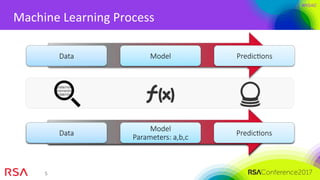
Machine	Learning	Process	
Data
 Model
 PredicMons
Data
Model
Parameters: ?,?,?
PredicMons
Data
Model
Parameters: a,b,c
PredicMons
#RSAC
6	
What	Machine	Learning	is	Not…		
In Kasparov vs. Deep
Blue, the machine’s
programmers (with help
from a team of strong
chess players) explicitly
entered parameters --
and even changed them
between games in the
match!
#RSAC
7	
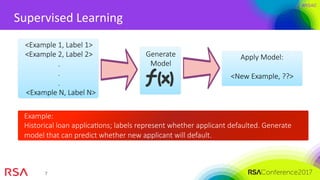
Supervised	Learning	
<Example 1, Label 1>
<Example 2, Label 2>
.
.
.
<Example N, Label N>
Generate
Model
Apply Model:

<New Example, ??>
Example:
Historical loan applicaMons; labels represent whether applicant defaulted. Generate
model that can predict whether new applicant will default.
#RSAC
8	
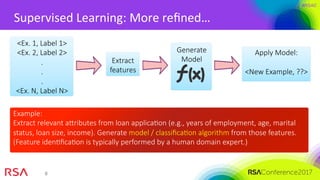
Supervised	Learning:	More	refined…		
<Ex. 1, Label 1>
<Ex. 2, Label 2>
.
.
.
<Ex. N, Label N>
Generate
Model
Apply Model:

<New Example, ??>
Extract
features
Example:
Extract relevant aributes from loan applicaMon (e.g., years of employment, age, marital
status, loan size, income). Generate model / classificaMon algorithm from those features.
(Feature idenMficaMon is typically performed by a human domain expert.)
#RSAC
9	
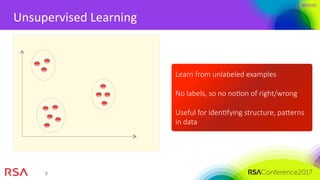
Unsupervised	Learning	
Learn from unlabeled examples

No labels, so no noMon of right/wrong

Useful for idenMfying structure, paerns
in data
#RSAC
How can machine learning be
used in a cybersecurity sejng?
#RSAC
11	
Applying	Supervised	Machine	Learning	to	Security	
Supervised machine learning naturally suited to classificaMon (yes/no) problems;
transacMons can be viewed under a good / bad lens:
Spam: Is a given email message spam?
Online Fraud: Is a given financial transacMon fraudulent?
Malware: Is a given file malware?
Malicious URLs / domains / IPs: Is a network connecMon to a given
URL (resp. domain, IP address) associated with malicious acMvity?
Note these applicaMons are not new; they have been studied in academia and/or
have been implemented in commercial use for many years.
#RSAC
12	
Unsupervised	Machine	Learning	and	Security	
Unsupervised machine learning can be used to cluster data – which can help idenMfy
outliers; e.g., by baselining normal behavior and find instances outside the norm:
Is there an abnormal amount of network traffic from a parMcular host?
Is there a significant increase in failed log-in aempts?
Is a user accessing resources he or she does not normally access (or that would
not be normally accessed by his or her peer group)?
Are there access paerns that are too “regular” to be associated with a human? 
Is a user working during hours outside his or her normal behavior?
Is a user connecMng from or to unusual geographic locaMons (or a set of
geographic locaMons that does not make sense)?
#RSAC
What are the piJalls and best
pracMces when applying machine
learning to cybersecurity?
#RSAC
14	
Challenge:	Good	Data	is	CriQcal	
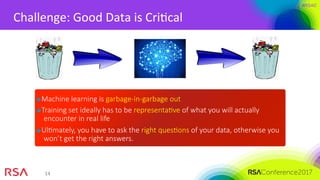
Machine learning is garbage-in-garbage out
Training set ideally has to be representaMve of what you will actually
encounter in real life 
UlMmately, you have to ask the right quesMons of your data, otherwise you
won’t get the right answers.
#RSAC
15	
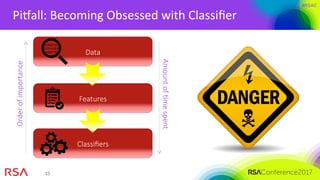
Data
Features
Classifiers
PiRall:	Becoming	Obsessed	with	Classifier	Orderofimportance
AmountofMmespent
#RSAC
16	
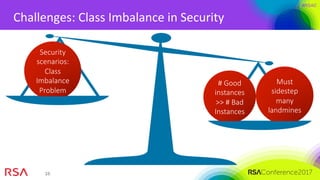
Challenges:	Class	Imbalance	in	Security	
# Good
instances
>> # Bad
Instances
Must
sidestep
many
landmines
Security
scenarios:
Class
Imbalance
Problem
#RSAC
17	
Typical	Metrics	
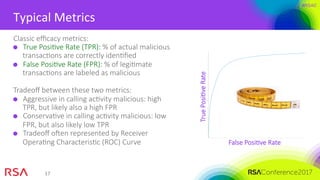
Classic efficacy metrics:
True PosiMve Rate (TPR): % of actual malicious
transacMons are correctly idenMfied
False PosiMve Rate (FPR): % of legiMmate
transacMons are labeled as malicious

Tradeoff between these two metrics:
Aggressive in calling acMvity malicious: high
TPR, but likely also a high FPR 
ConservaMve in calling acMvity malicious: low
FPR, but also likely low TPR
Tradeoff open represented by Receiver
OperaMng CharacterisMc (ROC) Curve 
TruePosi<veRate
False Posi<ve Rate
#RSAC
18	
False	PosiQves	Don’t	Tell	the	Whole	Story	
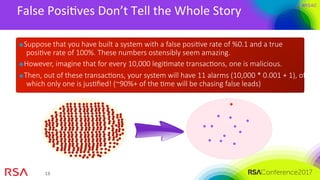
Suppose that you have built a system with a false posiMve rate of %0.1 and a true
posiMve rate of 100%. These numbers ostensibly seem amazing.
However, imagine that for every 10,000 legiMmate transacMons, one is malicious.
Then, out of these transacMons, your system will have 11 alarms (10,000 * 0.001 + 1), of
which only one is jusMfied! (~90%+ of the Mme will be chasing false leads)
#RSAC
19	
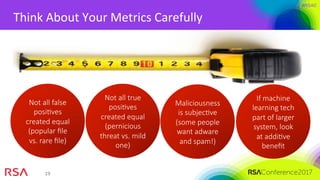
Think	About	Your	Metrics	Carefully	
Not all false
posiMves
created equal
(popular file
vs. rare file)
Not all true
posiMves
created equal
(pernicious
threat vs. mild
one)
Maliciousness
is subjecMve
(some people
want adware
and spam!)
If machine
learning tech
part of larger
system, look
at addiMve
benefit
#RSAC
20	
Machine	Learning	PiRalls:	Adversaries	Adapt		
Threat actors change
behaviors as needed;
Mme to change is
correlated with how
big a threat you are
to their operaMons
Machine learning
algorithms typically
don’t assume
adversarial scenarios
where threat is
acMvely trying to
sabotage the
algorithm
Can address through
careful weighMng of
recent data vs. older
data, rapid
retraining /
relearning, online
learning 
Transfer learning or
inducMve transfer is
area of research
designed for
developing ML
algorithms that try
to use knowledge
gained from solving
one problem
towards different,
but related problem
Much work remains to be done in this areas
#RSAC
21	
Supervised	Learning	PiRalls	
Training set captures what you know about;
inferences from training set expand your
capabiliMes, but don’t help with the “unknown
unknowns”; your model may be a glorified
signature…
Malicious behavior is subjecMve (not everyone
agrees). Further, whether something is
malicious is not so much about acMons, but
more about the intent behind those acMons.
There is sMll some important low-hanging fruit that needs to be picked. Machine Learning can
move the needle, but not always as much as one might hope. It’s easy to miss a new paradigm.
#RSAC
22	
The	importance	of	line	23…
#RSAC
23	
Unsupervised	Learning	PiRalls	
Unsupervised learning
used to find abnormal
behaviors, but that’s not
the same as malicious
behaviors
People open act
abnormally for legiMmate
reasons (travel, deadlines,
new project / role /
promoMon)
It’s not always easy to
measure normal behavior
(e.g., geolocaMon isn’t
always accurate…)
Again, acMons are not the same thing as the intent behind those acMons….
#RSAC
24	
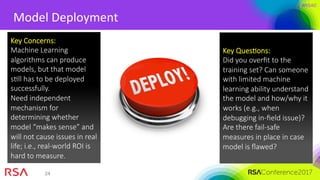
Model	Deployment	
Key Concerns:
Machine Learning
algorithms can produce
models, but that model
sMll has to be deployed
successfully.
Need independent
mechanism for
determining whether
model “makes sense” and
will not cause issues in real
life; i.e., real-world ROI is
hard to measure. 
Key Ques<ons:
Did you overfit to the
training set? Can someone
with limited machine
learning ability understand
the model and how/why it
works (e.g., when
debugging in-field issue)?
Are there fail-safe
measures in place in case
model is flawed?
#RSAC
25	
Best PracMces:
•  Data >> Features >> Classifier
•  Know what success means (not necessarily high TP, low FP)
•  Don’t set it and forget it; adversaries adapt!
•  Think about model deployment; not everyone touching
system will have deep machine learning knowledge
Summary	
Machine Learning is an excellent tool for security applicaMons, but it’s important to
understand when hype fails to reflect reality
#RSAC
Apply	What	You	Have	Learned	(1)	
26	
Next week, you should:
IdenMfy what cybersecurity efficacy metrics maer to you
Develop an efficacy tesMng plan that measures against these metrics and evaluates the
tradeoffs among them 
In the first three months following the presentaMon, you should
Implement your efficacy tesMng plans
IdenMfy the data sources being fed into machine learning systems you use and
determine how representaMve those sources are of real world scenarios
Determine how models are updated for future use
#RSAC
Apply	What	You	Have	Learned	(2)	
27	
What data sources are being fed into their machine learning system?
How is efficacy being measured prior to model deployment? (And is it being
measured independently?)
Do other vendors offer soluMons to address the same problems (including those
that do not leverage machine learning)? If so, are there rigorous third party
tesMng reports to substanMate efficacy claims of ? (If not, why?)
How are models deployed and updated?
If you are considering procuring a third-party machine learning soluMon, develop a vendor
quesMonnaire that asks (at least) the following quesMons:

Machine learning cybersecurity boon or boondoggle

  • 1.
  • 2.
    #RSAC Outline 2 High-Level Overview ofMachine Learning How Machine Learning Can be Used in a Cybersecurity Context PiJalls & Best PracMces 1 2 3
  • 3.
  • 4.
    #RSAC 4 Machine Learning Overview “Field of studythat gives computers the ability to learn without being explicitly programmed” (Arthu r Samuelson, 1959) Development of algorithms that can draw inferences and make predicMons based on data Evolved from paern recogniMon and computaMonal learning theory; closely related to data mining and staMsMcs Benefits of machine learning include automaMon, being unbiased, and being able to improve over Mme In cybersecurity applicaMons, machine learning approaches can decrease Mme needed to find new threats and can evolve more-or-less automaMcally as new data becomes available
  • 5.
    #RSAC 5 Machine Learning Process Data Model PredicMons Data Model Parameters:?,?,? PredicMons Data Model Parameters: a,b,c PredicMons
  • 6.
    #RSAC 6 What Machine Learning is Not… In Kasparov vs.Deep Blue, the machine’s programmers (with help from a team of strong chess players) explicitly entered parameters -- and even changed them between games in the match!
  • 7.
    #RSAC 7 Supervised Learning <Example 1, Label1> <Example 2, Label 2> . . . <Example N, Label N> Generate Model Apply Model: <New Example, ??> Example: Historical loan applicaMons; labels represent whether applicant defaulted. Generate model that can predict whether new applicant will default.
  • 8.
    #RSAC 8 Supervised Learning: More refined… <Ex. 1, Label1> <Ex. 2, Label 2> . . . <Ex. N, Label N> Generate Model Apply Model: <New Example, ??> Extract features Example: Extract relevant aributes from loan applicaMon (e.g., years of employment, age, marital status, loan size, income). Generate model / classificaMon algorithm from those features. (Feature idenMficaMon is typically performed by a human domain expert.)
  • 9.
    #RSAC 9 Unsupervised Learning Learn from unlabeledexamples No labels, so no noMon of right/wrong Useful for idenMfying structure, paerns in data
  • 10.
    #RSAC How can machinelearning be used in a cybersecurity sejng?
  • 11.
    #RSAC 11 Applying Supervised Machine Learning to Security Supervised machine learningnaturally suited to classificaMon (yes/no) problems; transacMons can be viewed under a good / bad lens: Spam: Is a given email message spam? Online Fraud: Is a given financial transacMon fraudulent? Malware: Is a given file malware? Malicious URLs / domains / IPs: Is a network connecMon to a given URL (resp. domain, IP address) associated with malicious acMvity? Note these applicaMons are not new; they have been studied in academia and/or have been implemented in commercial use for many years.
  • 12.
    #RSAC 12 Unsupervised Machine Learning and Security Unsupervised machine learningcan be used to cluster data – which can help idenMfy outliers; e.g., by baselining normal behavior and find instances outside the norm: Is there an abnormal amount of network traffic from a parMcular host? Is there a significant increase in failed log-in aempts? Is a user accessing resources he or she does not normally access (or that would not be normally accessed by his or her peer group)? Are there access paerns that are too “regular” to be associated with a human? Is a user working during hours outside his or her normal behavior? Is a user connecMng from or to unusual geographic locaMons (or a set of geographic locaMons that does not make sense)?
  • 13.
    #RSAC What are thepiJalls and best pracMces when applying machine learning to cybersecurity?
  • 14.
    #RSAC 14 Challenge: Good Data is CriQcal Machine learning isgarbage-in-garbage out Training set ideally has to be representaMve of what you will actually encounter in real life UlMmately, you have to ask the right quesMons of your data, otherwise you won’t get the right answers.
  • 15.
  • 16.
    #RSAC 16 Challenges: Class Imbalance in Security # Good instances >> #Bad Instances Must sidestep many landmines Security scenarios: Class Imbalance Problem
  • 17.
    #RSAC 17 Typical Metrics Classic efficacy metrics: TruePosiMve Rate (TPR): % of actual malicious transacMons are correctly idenMfied False PosiMve Rate (FPR): % of legiMmate transacMons are labeled as malicious Tradeoff between these two metrics: Aggressive in calling acMvity malicious: high TPR, but likely also a high FPR ConservaMve in calling acMvity malicious: low FPR, but also likely low TPR Tradeoff open represented by Receiver OperaMng CharacterisMc (ROC) Curve TruePosi<veRate False Posi<ve Rate
  • 18.
    #RSAC 18 False PosiQves Don’t Tell the Whole Story Suppose that youhave built a system with a false posiMve rate of %0.1 and a true posiMve rate of 100%. These numbers ostensibly seem amazing. However, imagine that for every 10,000 legiMmate transacMons, one is malicious. Then, out of these transacMons, your system will have 11 alarms (10,000 * 0.001 + 1), of which only one is jusMfied! (~90%+ of the Mme will be chasing false leads)
  • 19.
    #RSAC 19 Think About Your Metrics Carefully Not all false posiMves createdequal (popular file vs. rare file) Not all true posiMves created equal (pernicious threat vs. mild one) Maliciousness is subjecMve (some people want adware and spam!) If machine learning tech part of larger system, look at addiMve benefit
  • 20.
    #RSAC 20 Machine Learning PiRalls: Adversaries Adapt Threat actors change behaviorsas needed; Mme to change is correlated with how big a threat you are to their operaMons Machine learning algorithms typically don’t assume adversarial scenarios where threat is acMvely trying to sabotage the algorithm Can address through careful weighMng of recent data vs. older data, rapid retraining / relearning, online learning Transfer learning or inducMve transfer is area of research designed for developing ML algorithms that try to use knowledge gained from solving one problem towards different, but related problem Much work remains to be done in this areas
  • 21.
    #RSAC 21 Supervised Learning PiRalls Training set captureswhat you know about; inferences from training set expand your capabiliMes, but don’t help with the “unknown unknowns”; your model may be a glorified signature… Malicious behavior is subjecMve (not everyone agrees). Further, whether something is malicious is not so much about acMons, but more about the intent behind those acMons. There is sMll some important low-hanging fruit that needs to be picked. Machine Learning can move the needle, but not always as much as one might hope. It’s easy to miss a new paradigm.
  • 22.
  • 23.
    #RSAC 23 Unsupervised Learning PiRalls Unsupervised learning used tofind abnormal behaviors, but that’s not the same as malicious behaviors People open act abnormally for legiMmate reasons (travel, deadlines, new project / role / promoMon) It’s not always easy to measure normal behavior (e.g., geolocaMon isn’t always accurate…) Again, acMons are not the same thing as the intent behind those acMons….
  • 24.
    #RSAC 24 Model Deployment Key Concerns: Machine Learning algorithmscan produce models, but that model sMll has to be deployed successfully. Need independent mechanism for determining whether model “makes sense” and will not cause issues in real life; i.e., real-world ROI is hard to measure. Key Ques<ons: Did you overfit to the training set? Can someone with limited machine learning ability understand the model and how/why it works (e.g., when debugging in-field issue)? Are there fail-safe measures in place in case model is flawed?
  • 25.
    #RSAC 25 Best PracMces: •  Data>> Features >> Classifier •  Know what success means (not necessarily high TP, low FP) •  Don’t set it and forget it; adversaries adapt! •  Think about model deployment; not everyone touching system will have deep machine learning knowledge Summary Machine Learning is an excellent tool for security applicaMons, but it’s important to understand when hype fails to reflect reality
  • 26.
    #RSAC Apply What You Have Learned (1) 26 Next week, youshould: IdenMfy what cybersecurity efficacy metrics maer to you Develop an efficacy tesMng plan that measures against these metrics and evaluates the tradeoffs among them In the first three months following the presentaMon, you should Implement your efficacy tesMng plans IdenMfy the data sources being fed into machine learning systems you use and determine how representaMve those sources are of real world scenarios Determine how models are updated for future use
  • 27.
    #RSAC Apply What You Have Learned (2) 27 What data sourcesare being fed into their machine learning system? How is efficacy being measured prior to model deployment? (And is it being measured independently?) Do other vendors offer soluMons to address the same problems (including those that do not leverage machine learning)? If so, are there rigorous third party tesMng reports to substanMate efficacy claims of ? (If not, why?) How are models deployed and updated? If you are considering procuring a third-party machine learning soluMon, develop a vendor quesMonnaire that asks (at least) the following quesMons: