MV PADMAVATI
BHILAI INSTITUTE OF TECHNOLOGY, DURG, INDIA
MACHINE LEARNING
“Learning denotes changes in a system that ... enable a system to do the
same task … more efficiently the next time.” - Herbert Simon
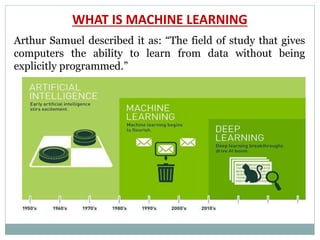
WHAT IS MACHINE LEARNING
Arthur Samuel described it as: “The field of study that gives
computers the ability to learn from data without being
explicitly programmed.”
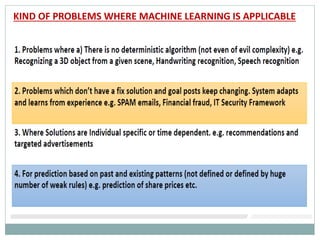
KIND OF PROBLEMS WHERE MACHINE LEARNING IS APPLICABLE
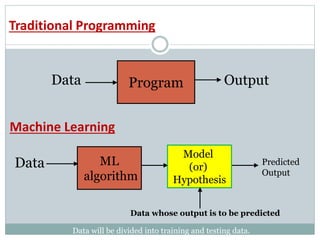
Traditional Programming
ProgramData Output
ML
algorithm
Data
Model
(or)
Hypothesis
Data whose output is to be predicted
Predicted
Output
Machine Learning
Data will be divided into training and testing data.
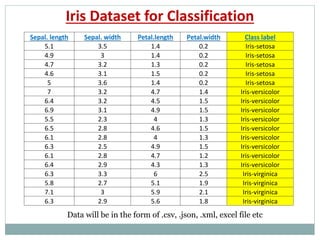
Iris Dataset for Classification
Sepal. length Sepal. width Petal.length Petal.width Class label
5.1 3.5 1.4 0.2 Iris-setosa
4.9 3 1.4 0.2 Iris-setosa
4.7 3.2 1.3 0.2 Iris-setosa
4.6 3.1 1.5 0.2 Iris-setosa
5 3.6 1.4 0.2 Iris-setosa
7 3.2 4.7 1.4 Iris-versicolor
6.4 3.2 4.5 1.5 Iris-versicolor
6.9 3.1 4.9 1.5 Iris-versicolor
5.5 2.3 4 1.3 Iris-versicolor
6.5 2.8 4.6 1.5 Iris-versicolor
6.1 2.8 4 1.3 Iris-versicolor
6.3 2.5 4.9 1.5 Iris-versicolor
6.1 2.8 4.7 1.2 Iris-versicolor
6.4 2.9 4.3 1.3 Iris-versicolor
6.3 3.3 6 2.5 Iris-virginica
5.8 2.7 5.1 1.9 Iris-virginica
7.1 3 5.9 2.1 Iris-virginica
6.3 2.9 5.6 1.8 Iris-virginica
Data will be in the form of .csv, .json, .xml, excel file etc
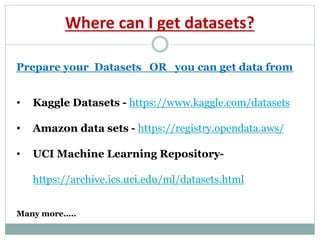
Where can I get datasets?
• Kaggle Datasets - https://www.kaggle.com/datasets
• Amazon data sets - https://registry.opendata.aws/
• UCI Machine Learning Repository-
https://archive.ics.uci.edu/ml/datasets.html
Many more…..
Prepare your Datasets OR you can get data from
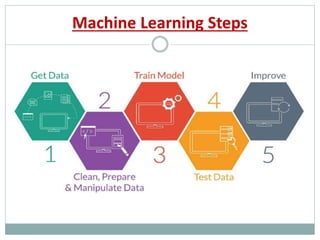
Machine Learning Steps
Machine Learning Tools
• Git and Github
• Python
• Jupyter Notebooks
• Numpy - is mostly used to perform math based operations
during the machine learning process.
• Pandas - to import datasets and manage them
• Matplotlib - We will use this library to plot charts in python.
• scikit-learn is an open source Python machine learning
library
• Many other Python APIs
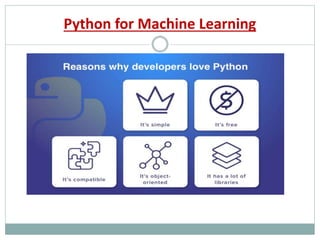
Python for Machine Learning
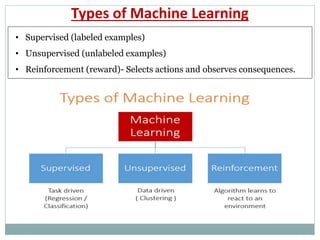
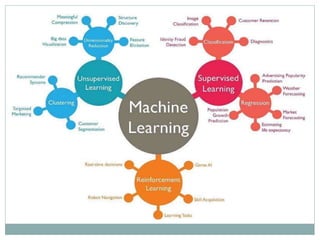
Types of Machine Learning
• Supervised (labeled examples)
• Unsupervised (unlabeled examples)
• Reinforcement (reward)- Selects actions and observes consequences.
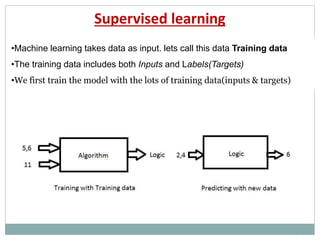
Supervised learning
•Machine learning takes data as input. lets call this data Training data
•The training data includes both Inputs and Labels(Targets)
•We first train the model with the lots of training data(inputs & targets)
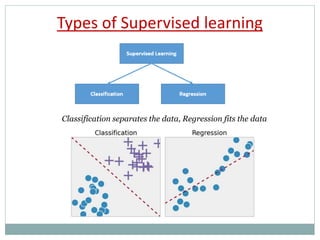
Types of Supervised learning
Classification separates the data, Regression fits the data
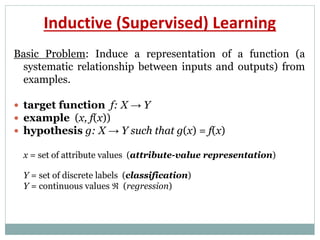
Basic Problem: Induce a representation of a function (a
systematic relationship between inputs and outputs) from
examples.
 target function f: X → Y
 example (x, f(x))
 hypothesis g: X → Y such that g(x) = f(x)
x = set of attribute values (attribute-value representation)
Y = set of discrete labels (classification)
Y = continuous values  (regression)
Inductive (Supervised) Learning
Classification
This is a type of problem where we predict the categorical response value
where the data can be separated into specific “classes” (ex: we predict
one of the values in a set of values).
Some examples are :
1. This mail is spam or not?
2. Will it rain today or not?
3. Is this picture a cat or not?
Basically ‘Yes/No’ type questions called binary classification.
Other examples are :
1. This mail is spam or important or promotion?
2. Is this picture a cat or a dog or a tiger?
This type is called multi-class classification.
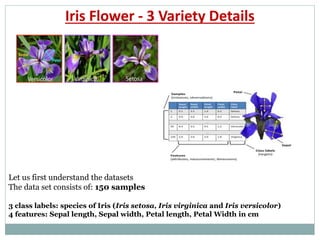
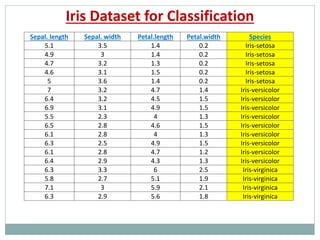
Iris Flower - 3 Variety Details
Let us first understand the datasets
The data set consists of: 150 samples
3 class labels: species of Iris (Iris setosa, Iris virginica and Iris versicolor)
4 features: Sepal length, Sepal width, Petal length, Petal Width in cm
Iris Dataset for Classification
Sepal. length Sepal. width Petal.length Petal.width Species
5.1 3.5 1.4 0.2 Iris-setosa
4.9 3 1.4 0.2 Iris-setosa
4.7 3.2 1.3 0.2 Iris-setosa
4.6 3.1 1.5 0.2 Iris-setosa
5 3.6 1.4 0.2 Iris-setosa
7 3.2 4.7 1.4 Iris-versicolor
6.4 3.2 4.5 1.5 Iris-versicolor
6.9 3.1 4.9 1.5 Iris-versicolor
5.5 2.3 4 1.3 Iris-versicolor
6.5 2.8 4.6 1.5 Iris-versicolor
6.1 2.8 4 1.3 Iris-versicolor
6.3 2.5 4.9 1.5 Iris-versicolor
6.1 2.8 4.7 1.2 Iris-versicolor
6.4 2.9 4.3 1.3 Iris-versicolor
6.3 3.3 6 2.5 Iris-virginica
5.8 2.7 5.1 1.9 Iris-virginica
7.1 3 5.9 2.1 Iris-virginica
6.3 2.9 5.6 1.8 Iris-virginica
Regression
This is a type of problem where we need to predict the continuous
response value (ex : above we predict number which can vary from
infinity to +infinity)
Some examples are
1. What is the price of house in Opava?
2. What is the value of the stock?
3. What can the temperature tomorrow?
etc… there are tons of things we can predict if we wish.
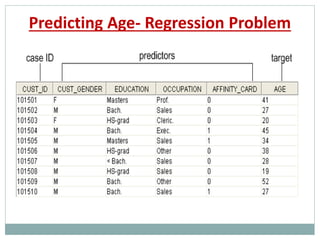
Predicting Age- Regression Problem
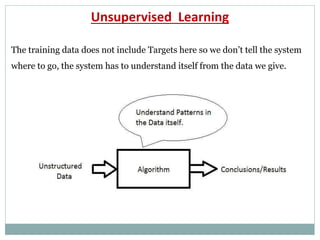
Unsupervised Learning
The training data does not include Targets here so we don’t tell the system
where to go, the system has to understand itself from the data we give.
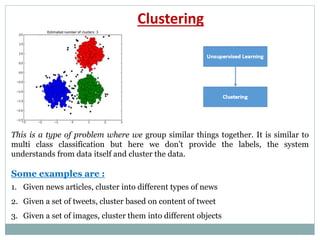
Clustering
This is a type of problem where we group similar things together. It is similar to
multi class classification but here we don’t provide the labels, the system
understands from data itself and cluster the data.
Some examples are :
1. Given news articles, cluster into different types of news
2. Given a set of tweets, cluster based on content of tweet
3. Given a set of images, cluster them into different objects
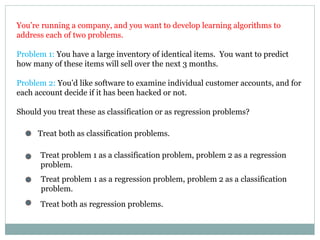
You’re running a company, and you want to develop learning algorithms to
address each of two problems.
Problem 1: You have a large inventory of identical items. You want to predict
how many of these items will sell over the next 3 months.
Problem 2: You’d like software to examine individual customer accounts, and for
each account decide if it has been hacked or not.
Should you treat these as classification or as regression problems?
Treat both as classification problems.
Treat problem 1 as a classification problem, problem 2 as a regression
problem.
Treat problem 1 as a regression problem, problem 2 as a classification
problem.
Treat both as regression problems.
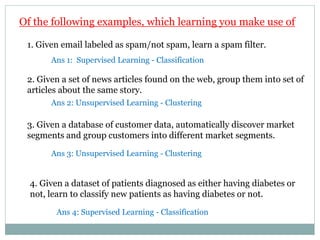
Of the following examples, which learning you make use of
3. Given a database of customer data, automatically discover market
segments and group customers into different market segments.
1. Given email labeled as spam/not spam, learn a spam filter.
2. Given a set of news articles found on the web, group them into set of
articles about the same story.
4. Given a dataset of patients diagnosed as either having diabetes or
not, learn to classify new patients as having diabetes or not.
Ans 1: Supervised Learning - Classification
Ans 2: Unsupervised Learning - Clustering
Ans 3: Unsupervised Learning - Clustering
Ans 4: Supervised Learning - Classification
Different Classifiers (Algorithms)
• Logistic Regression
• Decision Tree Classifier
• Support Vector Machines
• K- Nearest Neighborhood
• Linear discriminant analysis
• Gaussian Naive Bayes
Decision Tree
• Decision tree algorithm falls under the category of the
supervised learning.
• They can be used to solve both regression and classification
problems.
• Learned functions are represented as decision trees (or if-
then-else rules)
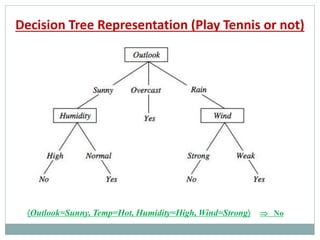
Decision Tree Representation (Play Tennis or not)
Outlook=Sunny, Temp=Hot, Humidity=High, Wind=Strong  No
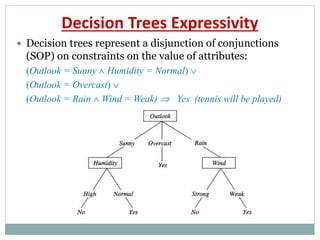
Decision Trees Expressivity
 Decision trees represent a disjunction of conjunctions
(SOP) on constraints on the value of attributes:
(Outlook = Sunny  Humidity = Normal) 
(Outlook = Overcast) 
(Outlook = Rain  Wind = Weak)  Yes (tennis will be played)
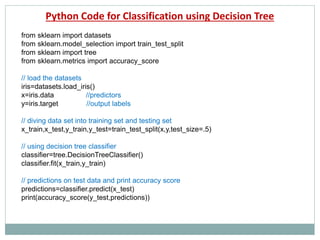
Python Code for Classification using Decision Tree
from sklearn import datasets
from sklearn.model_selection import train_test_split
from sklearn import tree
from sklearn.metrics import accuracy_score
// load the datasets
iris=datasets.load_iris()
x=iris.data //predictors
y=iris.target //output labels
// diving data set into training set and testing set
x_train,x_test,y_train,y_test=train_test_split(x,y,test_size=.5)
// using decision tree classifier
classifier=tree.DecisionTreeClassifier()
classifier.fit(x_train,y_train)
// predictions on test data and print accuracy score
predictions=classifier.predict(x_test)
print(accuracy_score(y_test,predictions))
When to use Decision Trees
 Problem characteristics:
 Instances can be described by attribute value pairs
 Disjunctive hypothesis may be required
 Possibly noisy training data samples
 Robust to errors in training data
 Missing attribute values
 Different classification problems:
 Equipment or medical diagnosis
 Credit risk analysis
Top-down induction of Decision Trees
 The construction of the tree is top-down. The algorithm is
greedy.
 The fundamental question is “which attribute should be tested
next? Which question gives us more information?”
 Select the best attribute
 A descendent node is then created for each possible value of this
attribute and examples are partitioned according to this value
 The process is repeated for each successor node until all the
examples are classified correctly or there are no attributes left
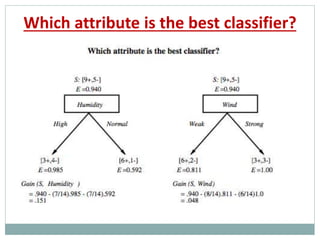
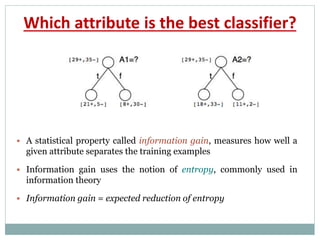
Which attribute is the best classifier?
 A statistical property called information gain, measures how well a
given attribute separates the training examples
 Information gain uses the notion of entropy, commonly used in
information theory
 Information gain = expected reduction of entropy
Decision Tree Induction
(Recursively) partition examples according to the best
attribute.
Key Concepts
 entropy
 impurity of a set of examples (entropy = 0 if perfectly homogeneous)
 (#bits needed to encode class of an arbitrary example)
 information gain
 expected reduction in entropy caused by partitioning
Entropy
• In machine learning sense and especially in this case Entropy is the measure of
homogeneity in the data.
• Its value ranges from 0 to 1.
• Its value is close to 0 if all the example belongs to same class and is close to 1 is
there is almost equal split of the data into different classes.
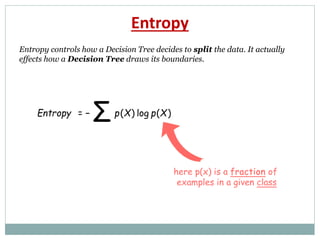
Entropy
Entropy controls how a Decision Tree decides to split the data. It actually
effects how a Decision Tree draws its boundaries.
Entropy in binary classification
Entropy measures the impurity of a collection of examples.
It depends from the distribution of the random variable p.
 S is a collection of training examples
 p+ the proportion of positive examples in S
 p– the proportion of negative examples in S
Entropy (S)  – p+ log2 p+ – p–log2 p–
Entropy ([14+, 0–]) = – 14/14 log2 (14/14) – 0 log2 (0) = 0
Entropy ([9+, 5–]) = – 9/14 log2 (9/14) – 5/14 log2 (5/14) = 0.94
Entropy ([7+, 7– ]) = – 7/14 log2 (7/14) – 7/14 log2 (7/14) = 1/2 + 1/2 = 1
Note: the log of a number < 1 is negative, 0  p  1, 0  entropy  1
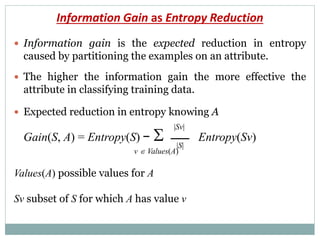
Information Gain as Entropy Reduction
 Information gain is the expected reduction in entropy
caused by partitioning the examples on an attribute.
 The higher the information gain the more effective the
attribute in classifying training data.
 Expected reduction in entropy knowing A
Gain(S, A) = Entropy(S) −  Entropy(Sv)
v  Values(A)
Values(A) possible values for A
Sv subset of S for which A has value v
|Sv|
|S|
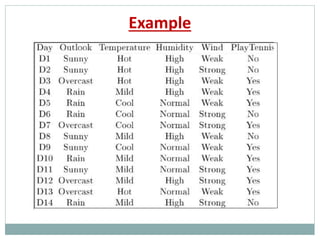
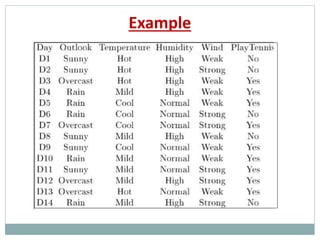
Example
Example: expected information gain
 Let
 Values(Wind) = {Weak, Strong}
 S = [9+, 5−] |S|=14
 SWeak = [6+, 2−] | SWeak |=8
 SStrong = [3+, 3−] | SStrong|=6
Entropy(S)=-9/14 log2(9/14) – 5/14 log (5/14)=0.94
Entropy(SWeak)= -6/8 log2(6/8) – 2/8 log (2/8)=0.811
Entropy(SStrong)= -1/2 log2(1/2) – 1/2 log (1/2)=1
 Information gain due to knowing Wind:
Gain(S, Wind) = Entropy(S) − 8/14 Entropy(SWeak) − 6/14 Entropy(SStrong)
= 0.94 − 8/14  0.811 − 6/14  1.00
= 0.048
Which attribute is the best classifier?
Example
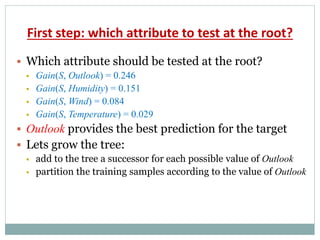
First step: which attribute to test at the root?
 Which attribute should be tested at the root?
 Gain(S, Outlook) = 0.246
 Gain(S, Humidity) = 0.151
 Gain(S, Wind) = 0.084
 Gain(S, Temperature) = 0.029
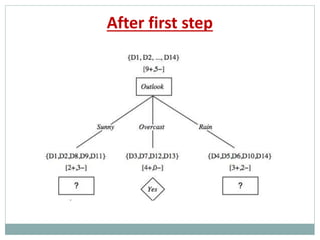
 Outlook provides the best prediction for the target
 Lets grow the tree:
 add to the tree a successor for each possible value of Outlook
 partition the training samples according to the value of Outlook
After first step
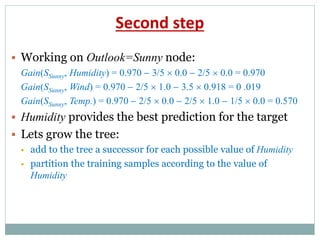
Second step
 Working on Outlook=Sunny node:
Gain(SSunny, Humidity) = 0.970  3/5  0.0  2/5  0.0 = 0.970
Gain(SSunny, Wind) = 0.970  2/5  1.0  3.5  0.918 = 0 .019
Gain(SSunny, Temp.) = 0.970  2/5  0.0  2/5  1.0  1/5  0.0 = 0.570
 Humidity provides the best prediction for the target
 Lets grow the tree:
 add to the tree a successor for each possible value of Humidity
 partition the training samples according to the value of
Humidity
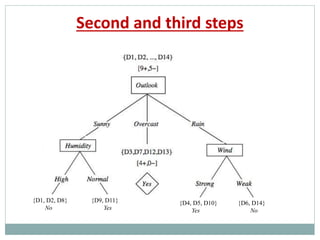
Second and third steps
{D1, D2, D8}
No
{D9, D11}
Yes
{D4, D5, D10}
Yes
{D6, D14}
No
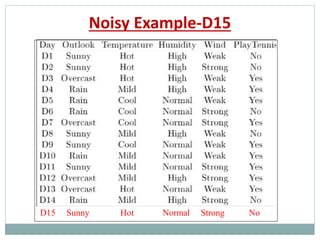
Noisy Example-D15
D15 Sunny Hot Normal Strong No
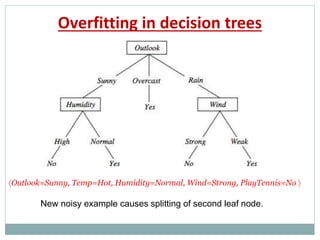
Overfitting in decision trees
Outlook=Sunny, Temp=Hot, Humidity=Normal, Wind=Strong, PlayTennis=No 
New noisy example causes splitting of second leaf node.
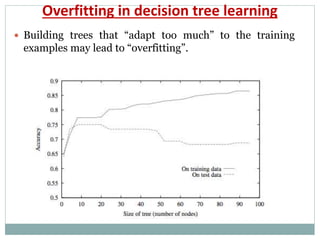
Overfitting in decision tree learning
 Building trees that “adapt too much” to the training
examples may lead to “overfitting”.
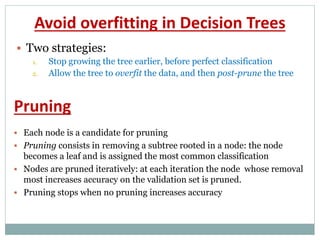
Avoid overfitting in Decision Trees
 Two strategies:
1. Stop growing the tree earlier, before perfect classification
2. Allow the tree to overfit the data, and then post-prune the tree
 Each node is a candidate for pruning
 Pruning consists in removing a subtree rooted in a node: the node
becomes a leaf and is assigned the most common classification
 Nodes are pruned iteratively: at each iteration the node whose removal
most increases accuracy on the validation set is pruned.
 Pruning stops when no pruning increases accuracy
Pruning

Machine learning and decision trees

  • 1.
    MV PADMAVATI BHILAI INSTITUTEOF TECHNOLOGY, DURG, INDIA MACHINE LEARNING “Learning denotes changes in a system that ... enable a system to do the same task … more efficiently the next time.” - Herbert Simon
  • 2.
    WHAT IS MACHINELEARNING Arthur Samuel described it as: “The field of study that gives computers the ability to learn from data without being explicitly programmed.”
  • 3.
    KIND OF PROBLEMSWHERE MACHINE LEARNING IS APPLICABLE
  • 4.
    Traditional Programming ProgramData Output ML algorithm Data Model (or) Hypothesis Datawhose output is to be predicted Predicted Output Machine Learning Data will be divided into training and testing data.
  • 5.
    Iris Dataset forClassification Sepal. length Sepal. width Petal.length Petal.width Class label 5.1 3.5 1.4 0.2 Iris-setosa 4.9 3 1.4 0.2 Iris-setosa 4.7 3.2 1.3 0.2 Iris-setosa 4.6 3.1 1.5 0.2 Iris-setosa 5 3.6 1.4 0.2 Iris-setosa 7 3.2 4.7 1.4 Iris-versicolor 6.4 3.2 4.5 1.5 Iris-versicolor 6.9 3.1 4.9 1.5 Iris-versicolor 5.5 2.3 4 1.3 Iris-versicolor 6.5 2.8 4.6 1.5 Iris-versicolor 6.1 2.8 4 1.3 Iris-versicolor 6.3 2.5 4.9 1.5 Iris-versicolor 6.1 2.8 4.7 1.2 Iris-versicolor 6.4 2.9 4.3 1.3 Iris-versicolor 6.3 3.3 6 2.5 Iris-virginica 5.8 2.7 5.1 1.9 Iris-virginica 7.1 3 5.9 2.1 Iris-virginica 6.3 2.9 5.6 1.8 Iris-virginica Data will be in the form of .csv, .json, .xml, excel file etc
  • 6.
    Where can Iget datasets? • Kaggle Datasets - https://www.kaggle.com/datasets • Amazon data sets - https://registry.opendata.aws/ • UCI Machine Learning Repository- https://archive.ics.uci.edu/ml/datasets.html Many more….. Prepare your Datasets OR you can get data from
  • 7.
  • 8.
    Machine Learning Tools •Git and Github • Python • Jupyter Notebooks • Numpy - is mostly used to perform math based operations during the machine learning process. • Pandas - to import datasets and manage them • Matplotlib - We will use this library to plot charts in python. • scikit-learn is an open source Python machine learning library • Many other Python APIs
  • 9.
  • 10.
    Types of MachineLearning • Supervised (labeled examples) • Unsupervised (unlabeled examples) • Reinforcement (reward)- Selects actions and observes consequences.
  • 11.
    Supervised learning •Machine learningtakes data as input. lets call this data Training data •The training data includes both Inputs and Labels(Targets) •We first train the model with the lots of training data(inputs & targets)
  • 12.
    Types of Supervisedlearning Classification separates the data, Regression fits the data
  • 13.
    Basic Problem: Inducea representation of a function (a systematic relationship between inputs and outputs) from examples.  target function f: X → Y  example (x, f(x))  hypothesis g: X → Y such that g(x) = f(x) x = set of attribute values (attribute-value representation) Y = set of discrete labels (classification) Y = continuous values  (regression) Inductive (Supervised) Learning
  • 14.
    Classification This is atype of problem where we predict the categorical response value where the data can be separated into specific “classes” (ex: we predict one of the values in a set of values). Some examples are : 1. This mail is spam or not? 2. Will it rain today or not? 3. Is this picture a cat or not? Basically ‘Yes/No’ type questions called binary classification. Other examples are : 1. This mail is spam or important or promotion? 2. Is this picture a cat or a dog or a tiger? This type is called multi-class classification.
  • 15.
    Iris Flower -3 Variety Details Let us first understand the datasets The data set consists of: 150 samples 3 class labels: species of Iris (Iris setosa, Iris virginica and Iris versicolor) 4 features: Sepal length, Sepal width, Petal length, Petal Width in cm
  • 16.
    Iris Dataset forClassification Sepal. length Sepal. width Petal.length Petal.width Species 5.1 3.5 1.4 0.2 Iris-setosa 4.9 3 1.4 0.2 Iris-setosa 4.7 3.2 1.3 0.2 Iris-setosa 4.6 3.1 1.5 0.2 Iris-setosa 5 3.6 1.4 0.2 Iris-setosa 7 3.2 4.7 1.4 Iris-versicolor 6.4 3.2 4.5 1.5 Iris-versicolor 6.9 3.1 4.9 1.5 Iris-versicolor 5.5 2.3 4 1.3 Iris-versicolor 6.5 2.8 4.6 1.5 Iris-versicolor 6.1 2.8 4 1.3 Iris-versicolor 6.3 2.5 4.9 1.5 Iris-versicolor 6.1 2.8 4.7 1.2 Iris-versicolor 6.4 2.9 4.3 1.3 Iris-versicolor 6.3 3.3 6 2.5 Iris-virginica 5.8 2.7 5.1 1.9 Iris-virginica 7.1 3 5.9 2.1 Iris-virginica 6.3 2.9 5.6 1.8 Iris-virginica
  • 17.
    Regression This is atype of problem where we need to predict the continuous response value (ex : above we predict number which can vary from infinity to +infinity) Some examples are 1. What is the price of house in Opava? 2. What is the value of the stock? 3. What can the temperature tomorrow? etc… there are tons of things we can predict if we wish.
  • 18.
  • 19.
    Unsupervised Learning The trainingdata does not include Targets here so we don’t tell the system where to go, the system has to understand itself from the data we give.
  • 20.
    Clustering This is atype of problem where we group similar things together. It is similar to multi class classification but here we don’t provide the labels, the system understands from data itself and cluster the data. Some examples are : 1. Given news articles, cluster into different types of news 2. Given a set of tweets, cluster based on content of tweet 3. Given a set of images, cluster them into different objects
  • 22.
    You’re running acompany, and you want to develop learning algorithms to address each of two problems. Problem 1: You have a large inventory of identical items. You want to predict how many of these items will sell over the next 3 months. Problem 2: You’d like software to examine individual customer accounts, and for each account decide if it has been hacked or not. Should you treat these as classification or as regression problems? Treat both as classification problems. Treat problem 1 as a classification problem, problem 2 as a regression problem. Treat problem 1 as a regression problem, problem 2 as a classification problem. Treat both as regression problems.
  • 23.
    Of the followingexamples, which learning you make use of 3. Given a database of customer data, automatically discover market segments and group customers into different market segments. 1. Given email labeled as spam/not spam, learn a spam filter. 2. Given a set of news articles found on the web, group them into set of articles about the same story. 4. Given a dataset of patients diagnosed as either having diabetes or not, learn to classify new patients as having diabetes or not. Ans 1: Supervised Learning - Classification Ans 2: Unsupervised Learning - Clustering Ans 3: Unsupervised Learning - Clustering Ans 4: Supervised Learning - Classification
  • 24.
    Different Classifiers (Algorithms) •Logistic Regression • Decision Tree Classifier • Support Vector Machines • K- Nearest Neighborhood • Linear discriminant analysis • Gaussian Naive Bayes
  • 25.
    Decision Tree • Decisiontree algorithm falls under the category of the supervised learning. • They can be used to solve both regression and classification problems. • Learned functions are represented as decision trees (or if- then-else rules)
  • 26.
    Decision Tree Representation(Play Tennis or not) Outlook=Sunny, Temp=Hot, Humidity=High, Wind=Strong  No
  • 27.
    Decision Trees Expressivity Decision trees represent a disjunction of conjunctions (SOP) on constraints on the value of attributes: (Outlook = Sunny  Humidity = Normal)  (Outlook = Overcast)  (Outlook = Rain  Wind = Weak)  Yes (tennis will be played)
  • 28.
    Python Code forClassification using Decision Tree from sklearn import datasets from sklearn.model_selection import train_test_split from sklearn import tree from sklearn.metrics import accuracy_score // load the datasets iris=datasets.load_iris() x=iris.data //predictors y=iris.target //output labels // diving data set into training set and testing set x_train,x_test,y_train,y_test=train_test_split(x,y,test_size=.5) // using decision tree classifier classifier=tree.DecisionTreeClassifier() classifier.fit(x_train,y_train) // predictions on test data and print accuracy score predictions=classifier.predict(x_test) print(accuracy_score(y_test,predictions))
  • 29.
    When to useDecision Trees  Problem characteristics:  Instances can be described by attribute value pairs  Disjunctive hypothesis may be required  Possibly noisy training data samples  Robust to errors in training data  Missing attribute values  Different classification problems:  Equipment or medical diagnosis  Credit risk analysis
  • 30.
    Top-down induction ofDecision Trees  The construction of the tree is top-down. The algorithm is greedy.  The fundamental question is “which attribute should be tested next? Which question gives us more information?”  Select the best attribute  A descendent node is then created for each possible value of this attribute and examples are partitioned according to this value  The process is repeated for each successor node until all the examples are classified correctly or there are no attributes left
  • 31.
    Which attribute isthe best classifier?  A statistical property called information gain, measures how well a given attribute separates the training examples  Information gain uses the notion of entropy, commonly used in information theory  Information gain = expected reduction of entropy
  • 32.
    Decision Tree Induction (Recursively)partition examples according to the best attribute. Key Concepts  entropy  impurity of a set of examples (entropy = 0 if perfectly homogeneous)  (#bits needed to encode class of an arbitrary example)  information gain  expected reduction in entropy caused by partitioning
  • 33.
    Entropy • In machinelearning sense and especially in this case Entropy is the measure of homogeneity in the data. • Its value ranges from 0 to 1. • Its value is close to 0 if all the example belongs to same class and is close to 1 is there is almost equal split of the data into different classes.
  • 34.
    Entropy Entropy controls howa Decision Tree decides to split the data. It actually effects how a Decision Tree draws its boundaries.
  • 35.
    Entropy in binaryclassification Entropy measures the impurity of a collection of examples. It depends from the distribution of the random variable p.  S is a collection of training examples  p+ the proportion of positive examples in S  p– the proportion of negative examples in S Entropy (S)  – p+ log2 p+ – p–log2 p– Entropy ([14+, 0–]) = – 14/14 log2 (14/14) – 0 log2 (0) = 0 Entropy ([9+, 5–]) = – 9/14 log2 (9/14) – 5/14 log2 (5/14) = 0.94 Entropy ([7+, 7– ]) = – 7/14 log2 (7/14) – 7/14 log2 (7/14) = 1/2 + 1/2 = 1 Note: the log of a number < 1 is negative, 0  p  1, 0  entropy  1
  • 36.
    Information Gain asEntropy Reduction  Information gain is the expected reduction in entropy caused by partitioning the examples on an attribute.  The higher the information gain the more effective the attribute in classifying training data.  Expected reduction in entropy knowing A Gain(S, A) = Entropy(S) −  Entropy(Sv) v  Values(A) Values(A) possible values for A Sv subset of S for which A has value v |Sv| |S|
  • 37.
  • 38.
    Example: expected informationgain  Let  Values(Wind) = {Weak, Strong}  S = [9+, 5−] |S|=14  SWeak = [6+, 2−] | SWeak |=8  SStrong = [3+, 3−] | SStrong|=6 Entropy(S)=-9/14 log2(9/14) – 5/14 log (5/14)=0.94 Entropy(SWeak)= -6/8 log2(6/8) – 2/8 log (2/8)=0.811 Entropy(SStrong)= -1/2 log2(1/2) – 1/2 log (1/2)=1  Information gain due to knowing Wind: Gain(S, Wind) = Entropy(S) − 8/14 Entropy(SWeak) − 6/14 Entropy(SStrong) = 0.94 − 8/14  0.811 − 6/14  1.00 = 0.048
  • 39.
    Which attribute isthe best classifier?
  • 40.
  • 41.
    First step: whichattribute to test at the root?  Which attribute should be tested at the root?  Gain(S, Outlook) = 0.246  Gain(S, Humidity) = 0.151  Gain(S, Wind) = 0.084  Gain(S, Temperature) = 0.029  Outlook provides the best prediction for the target  Lets grow the tree:  add to the tree a successor for each possible value of Outlook  partition the training samples according to the value of Outlook
  • 42.
  • 43.
    Second step  Workingon Outlook=Sunny node: Gain(SSunny, Humidity) = 0.970  3/5  0.0  2/5  0.0 = 0.970 Gain(SSunny, Wind) = 0.970  2/5  1.0  3.5  0.918 = 0 .019 Gain(SSunny, Temp.) = 0.970  2/5  0.0  2/5  1.0  1/5  0.0 = 0.570  Humidity provides the best prediction for the target  Lets grow the tree:  add to the tree a successor for each possible value of Humidity  partition the training samples according to the value of Humidity
  • 44.
    Second and thirdsteps {D1, D2, D8} No {D9, D11} Yes {D4, D5, D10} Yes {D6, D14} No
  • 45.
    Noisy Example-D15 D15 SunnyHot Normal Strong No
  • 46.
    Overfitting in decisiontrees Outlook=Sunny, Temp=Hot, Humidity=Normal, Wind=Strong, PlayTennis=No  New noisy example causes splitting of second leaf node.
  • 47.
    Overfitting in decisiontree learning  Building trees that “adapt too much” to the training examples may lead to “overfitting”.
  • 48.
    Avoid overfitting inDecision Trees  Two strategies: 1. Stop growing the tree earlier, before perfect classification 2. Allow the tree to overfit the data, and then post-prune the tree  Each node is a candidate for pruning  Pruning consists in removing a subtree rooted in a node: the node becomes a leaf and is assigned the most common classification  Nodes are pruned iteratively: at each iteration the node whose removal most increases accuracy on the validation set is pruned.  Pruning stops when no pruning increases accuracy Pruning