Dr.Amitava Halder
Assistant Professor
Computer Science & Engineering Department,
Dr. Sudhir Chandra Sur Institute ofTechnology and Sports Complex
Introduction to Machine
Learning
What is Learning?
“To gain knowledge or understanding of, or skill in by
study, instruction or experience''
 Learning a set of new facts.
 Learning HOW to do something .
 Improving ability of something already learned.
2
 Learning general models from a data of particular examples
 Data is cheap and abundant (data warehouses, data marts);
knowledge is expensive and scarce.
 Example in retail: Customer transactions to consumer
behavior:
People who bought“DaVinci Code”also bought“The Five PeopleYou Meet
in Heaven” (www.amazon.com)
 Build a model that is a good and useful approximation to the
data.
Computer’s Perspective
3
Learning is used when
 Human expertise does not exist (navigating on Mars),
 Humans are unable to explain their expertise (speech recognition)
 Solution changes in time (routing on a computer network)
 Solution needs to be adapted to particular cases (user biometrics)
Why “Learning”?
4
A Few Quotes
 “A breakthrough in machine learning would be worth
ten Microsofts” (Bill Gates, Chairman, Microsoft)
 “Machine learning is the next Internet”
(TonyTether, Director, DARPA)
 Machine learning is the hot new thing”
(John Hennessy, President, Stanford)
 “Web rankings today are mostly a matter of machine learning”
(Prabhakar Raghavan, Dir. Research,Yahoo)
 “Machine learning is going to result in a real revolution” (Greg
Papadopoulos, CTO, Sun)
 “Machine learning is today’s discontinuity”
(JerryYang, CEO,Yahoo)
5
So What Is Machine Learning?
 Machine learning is programming computers to optimize a
performance criterion using example data or past experience.
 Machine Learning is the study of methods for programming
computers to learn.
 Building machines that automatically learn from experience.
 Automating automation
 Getting computers to program themselves
 Writing software is the bottleneck
 Let the data do the work instead!
6
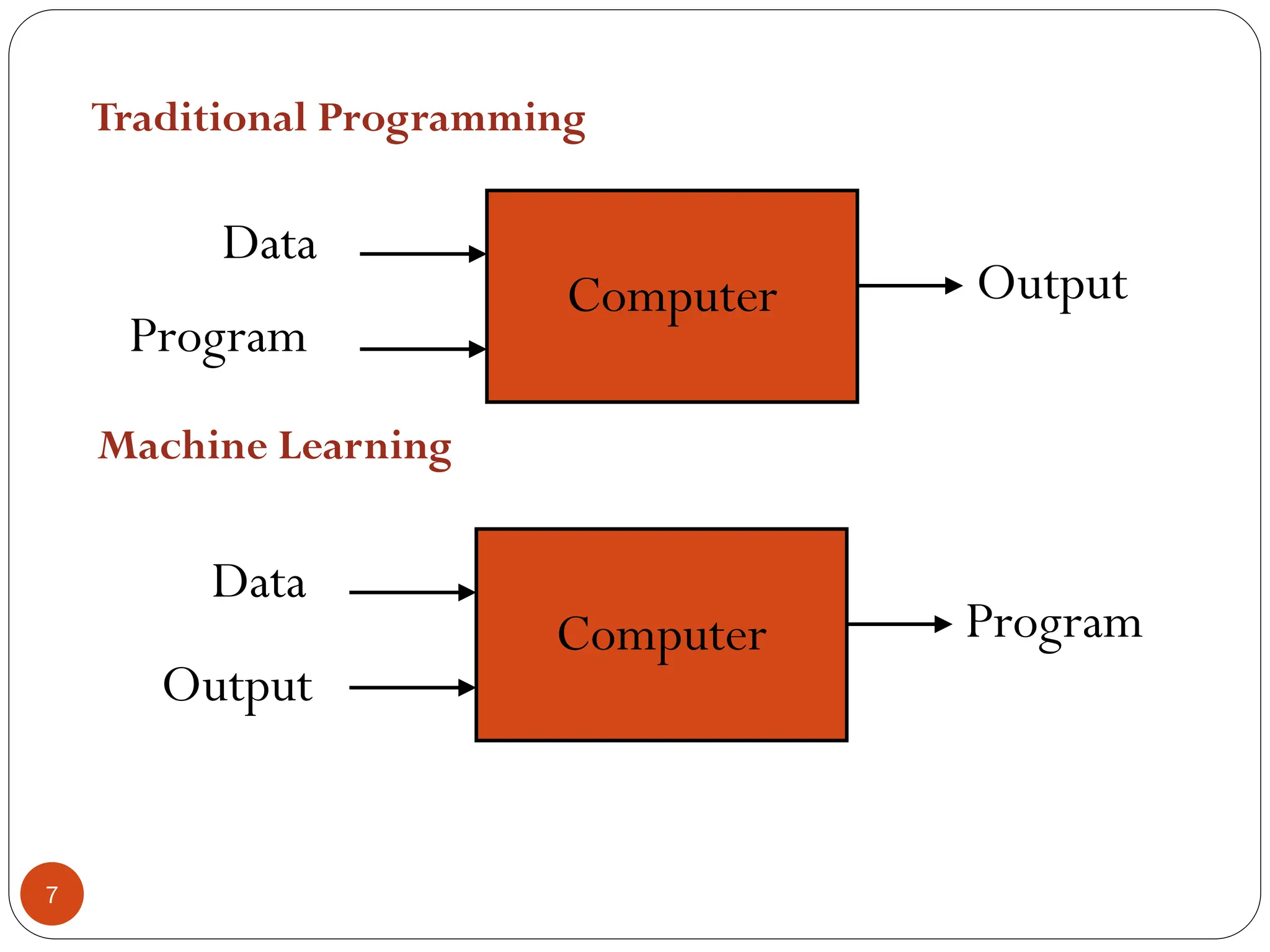
Traditional Programming
Machine Learning
Computer
Data
Program
Output
Computer
Data
Output
Program
7
 We cannot write the program ourselves
 We don’t have the expertise (circuit design)
 We cannot explain how (speech recognition)
 Problem changes over time (packet routing)
 Need customized solutions (spam filtering)
Why use Machine Learning?
8
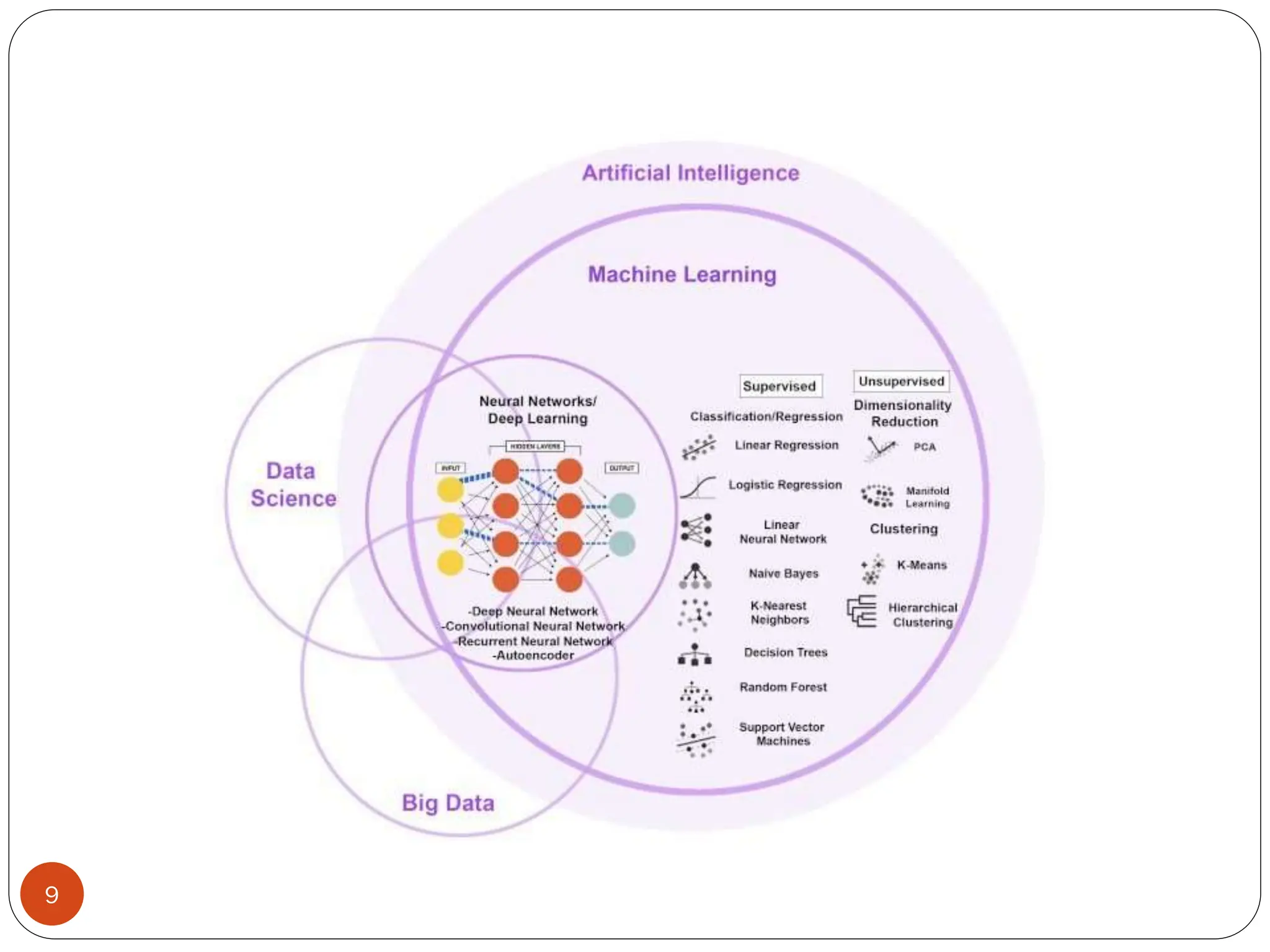
9
 Web mining: Search engines
 Computational biology
 Medicine: Medical diagnosis
 Retail: Market basket analysis, Customer relationship management (CRM)
 Finance: Credit scoring, fraud detection
 Manufacturing: Optimization, troubleshooting
 E-commerce
 Space exploration
 Robotics
 Information extraction
 Social networks
 Debugging
 [Your favorite area]
Sample Applications
10
Drug Discovery
11
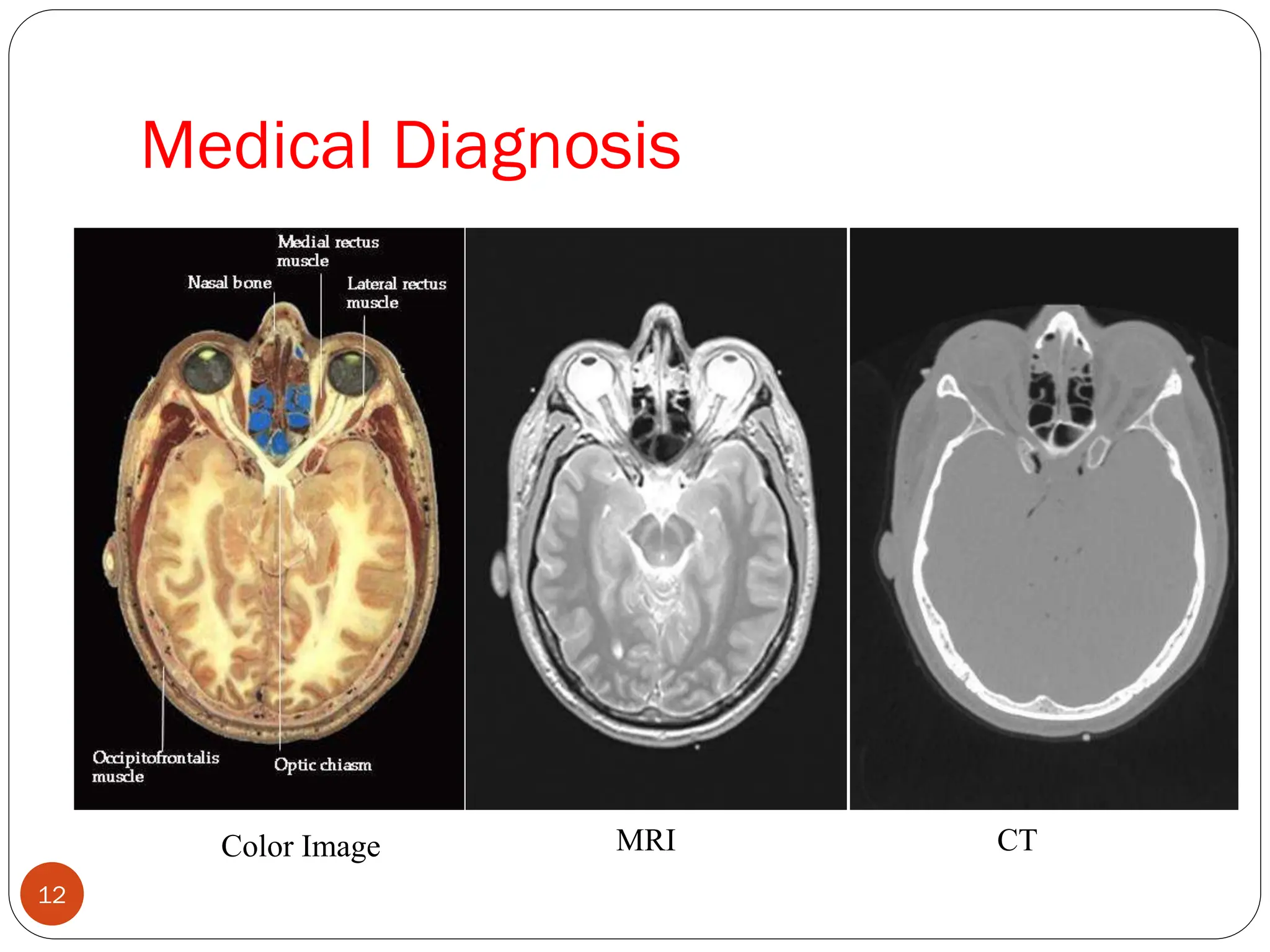
Medical Diagnosis
Color Image MRI CT
12
Iris Verification
13
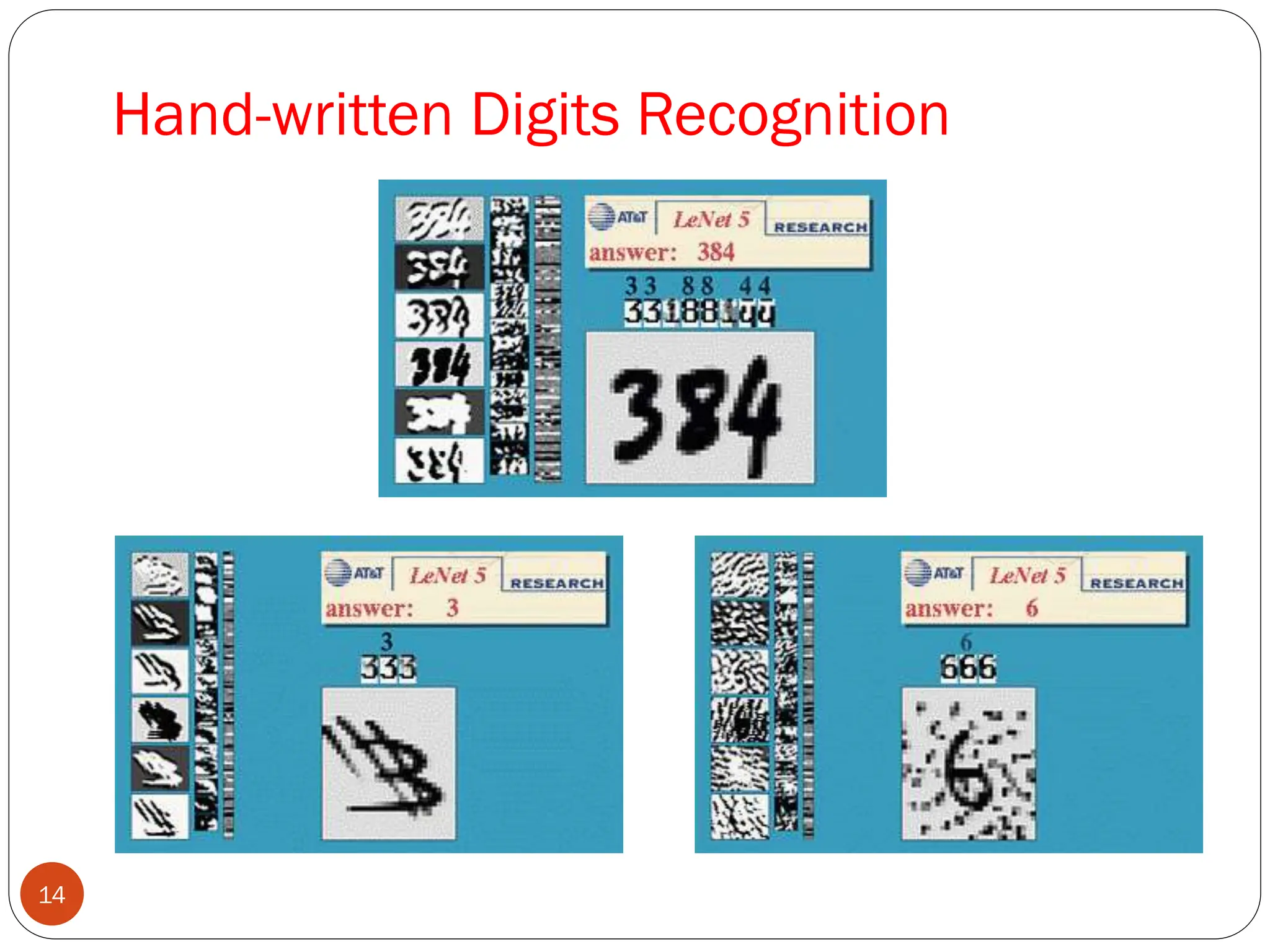
Hand-written Digits Recognition
14
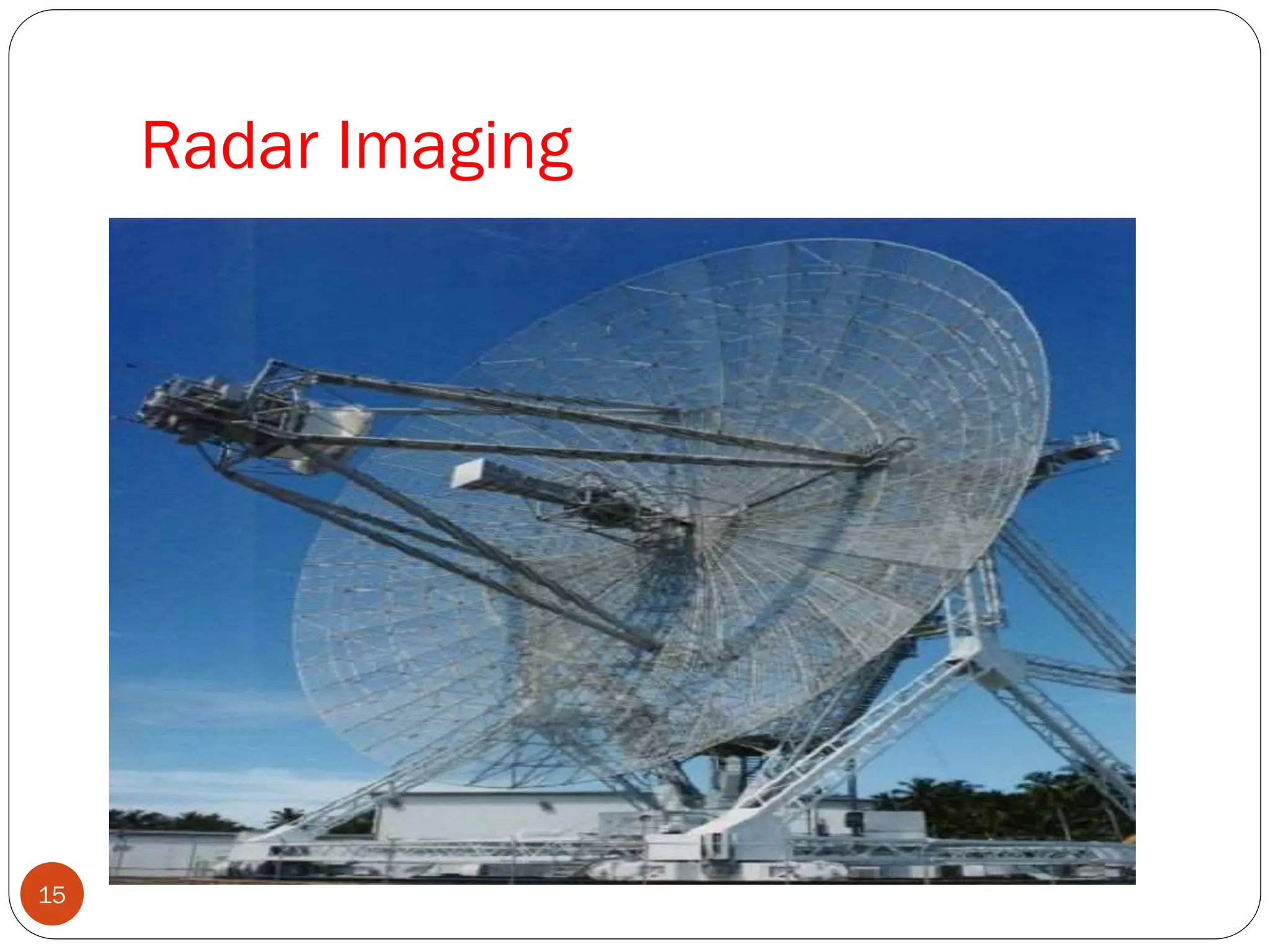
Radar Imaging
15
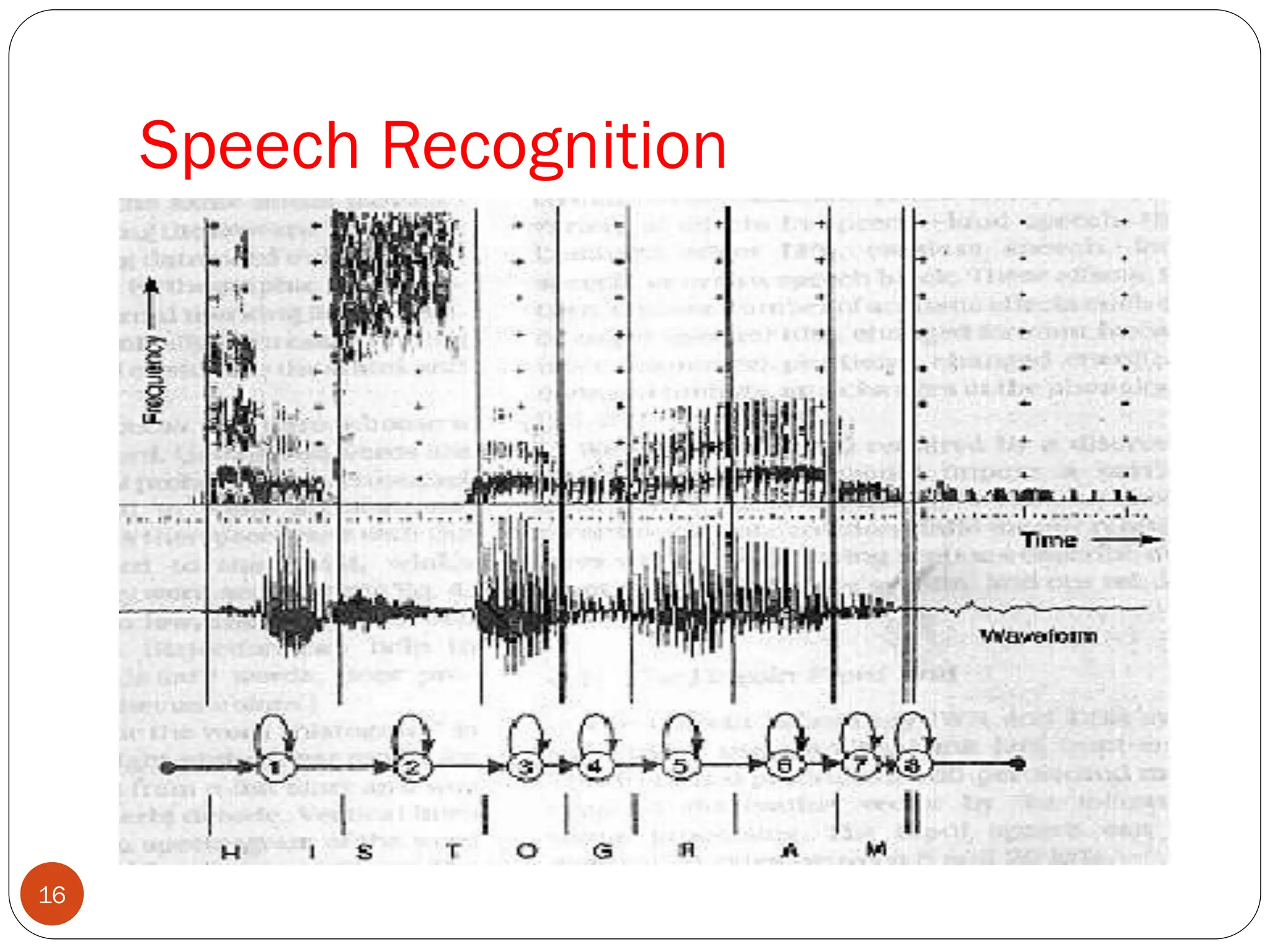
Speech Recognition
16
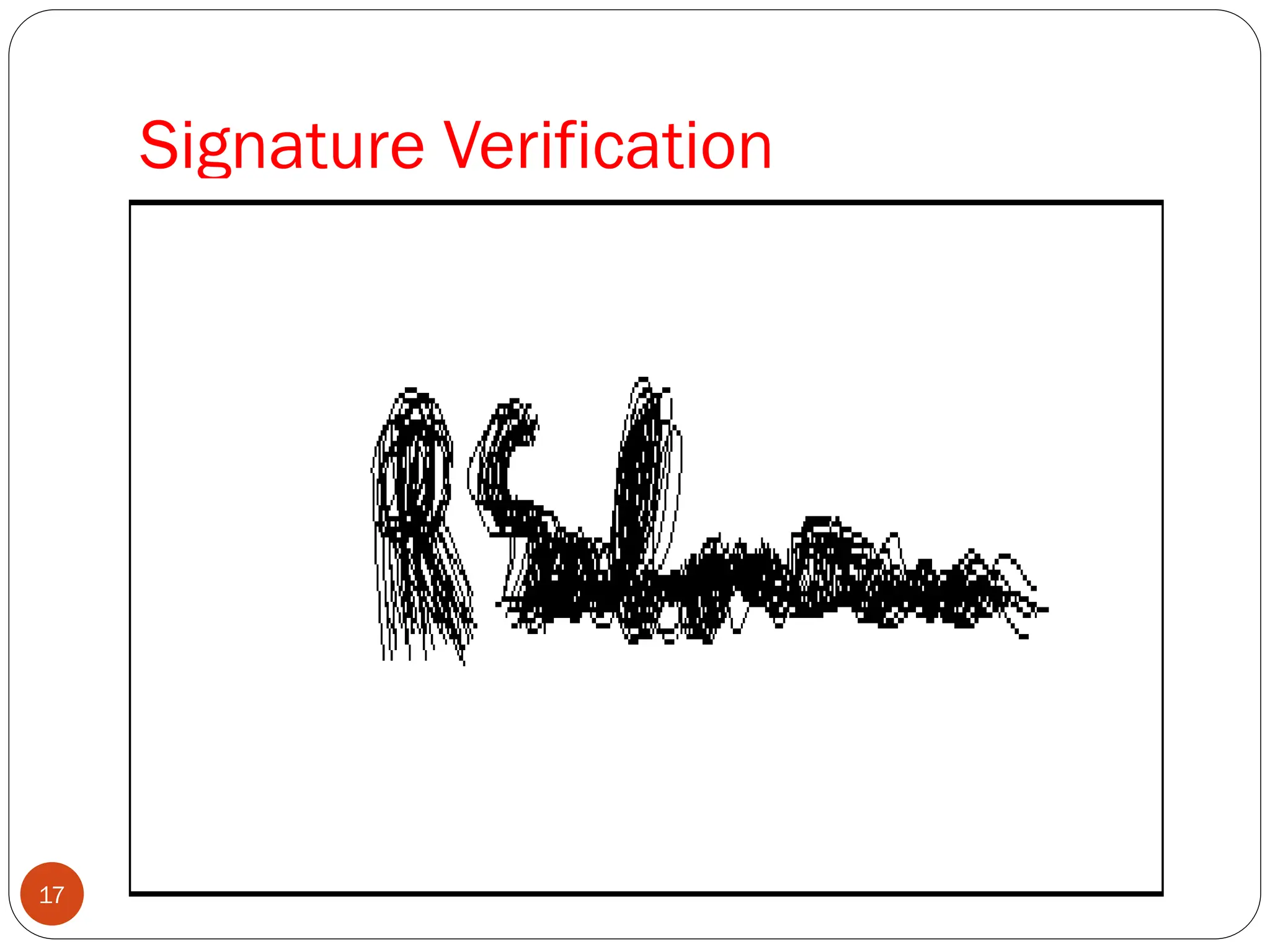
Signature Verification
17
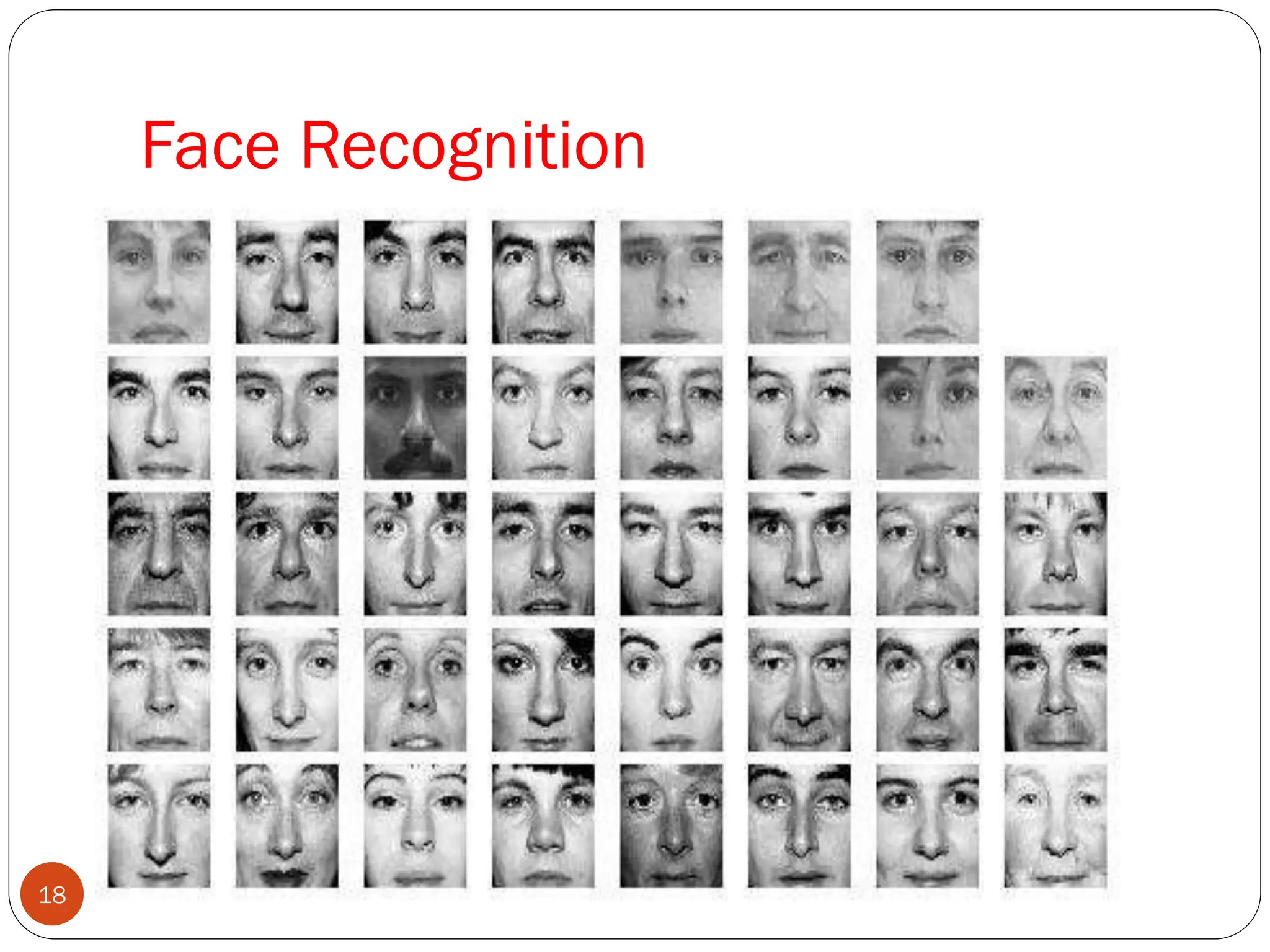
Face Recognition
18
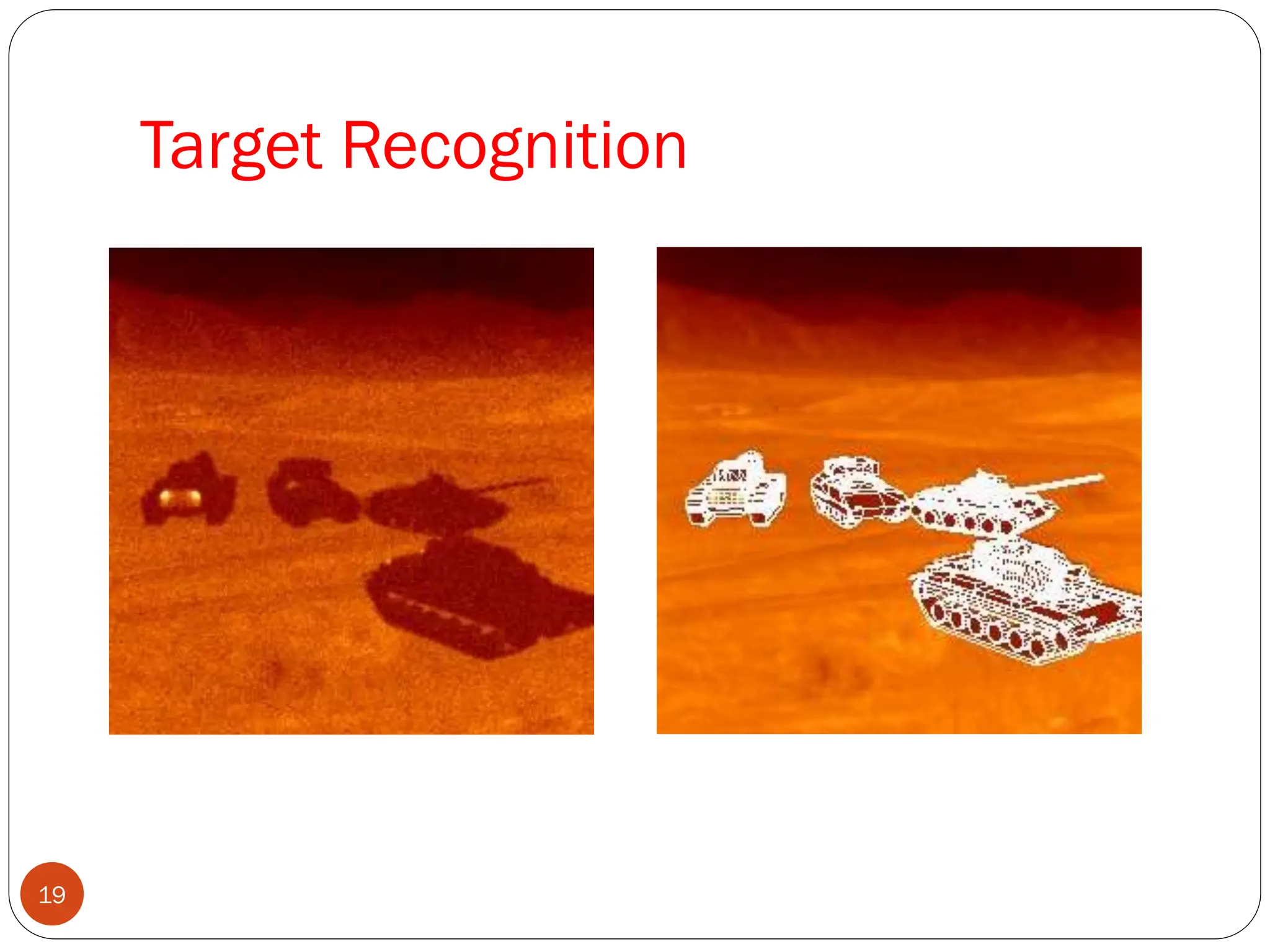
Target Recognition
19
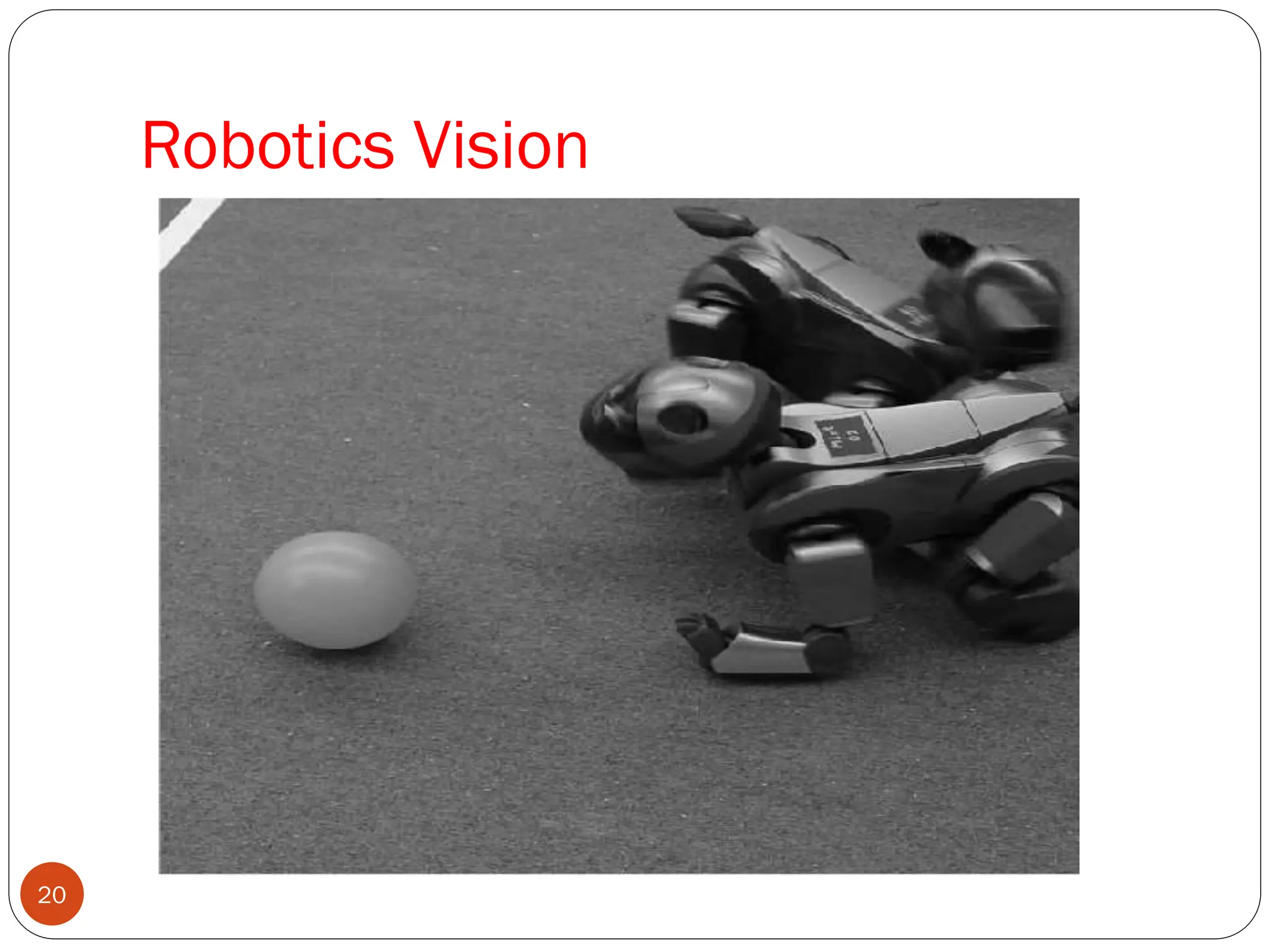
Robotics Vision
20
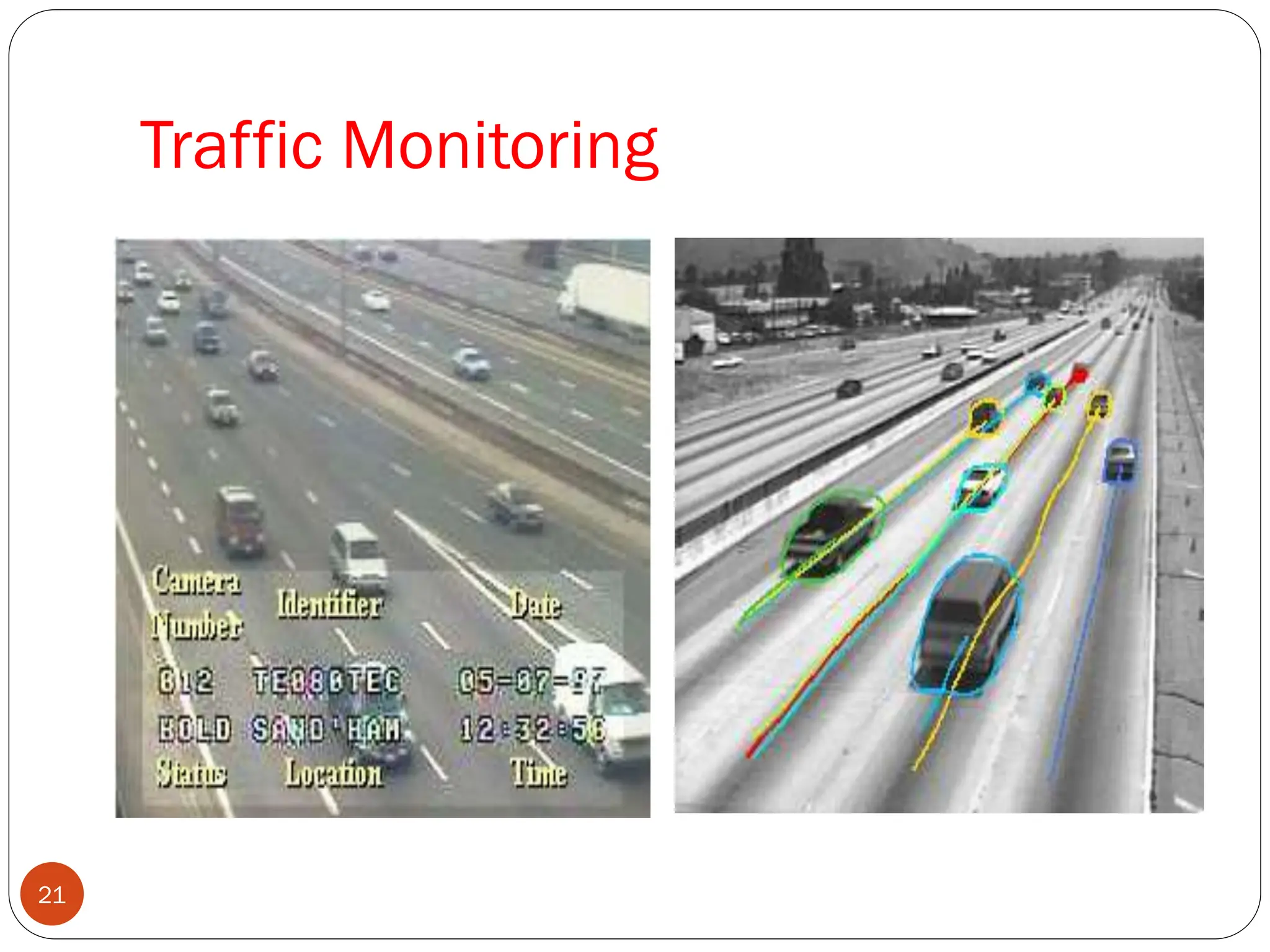
Traffic Monitoring
21
ML in a Nutshell
 Tens of thousands of machine learning algorithms
 Hundreds new every year
 Every machine learning algorithm has three components:
 Representation
 Evaluation
 Optimization
22
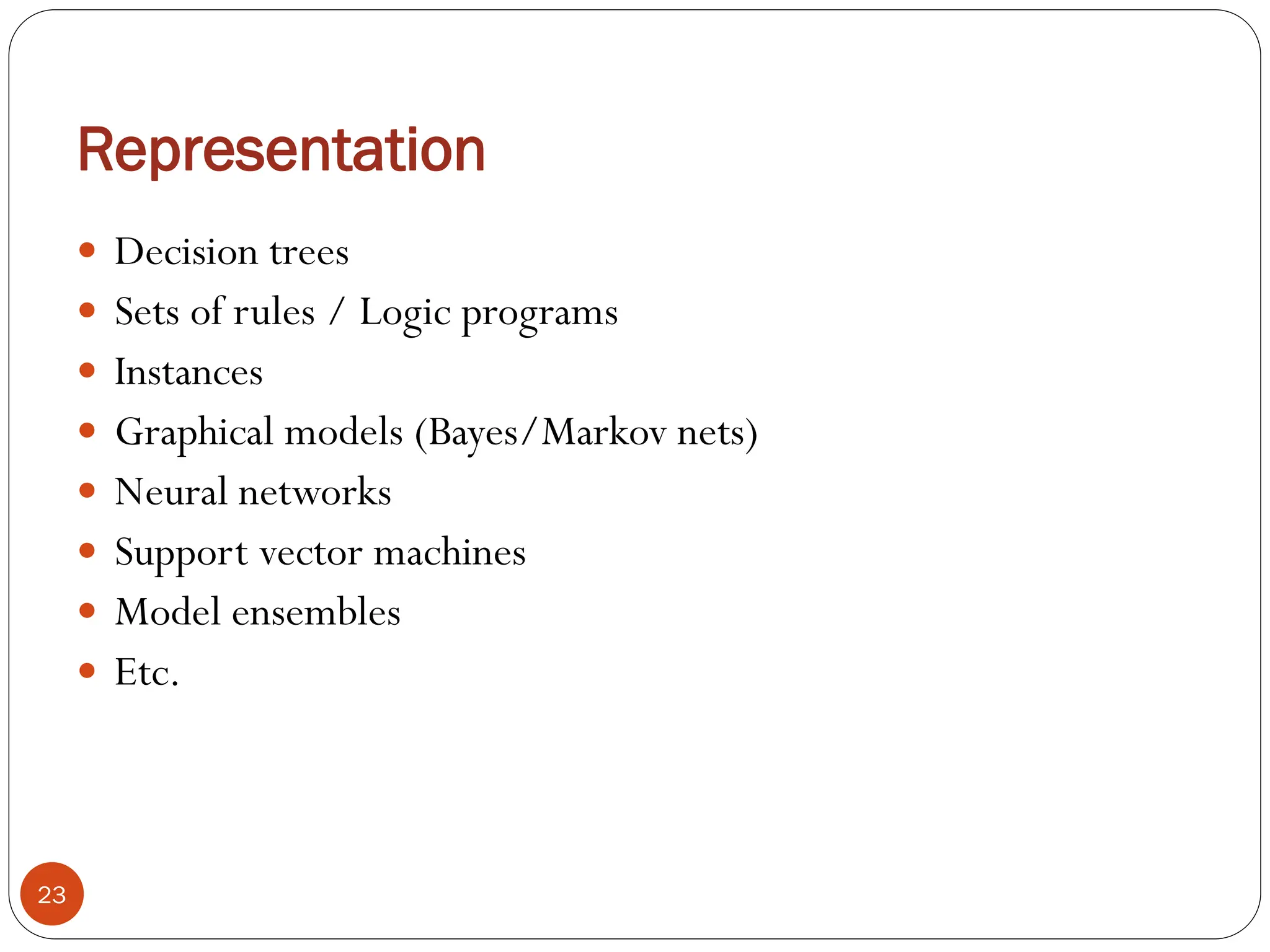
Representation
 Decision trees
 Sets of rules / Logic programs
 Instances
 Graphical models (Bayes/Markov nets)
 Neural networks
 Support vector machines
 Model ensembles
 Etc.
23
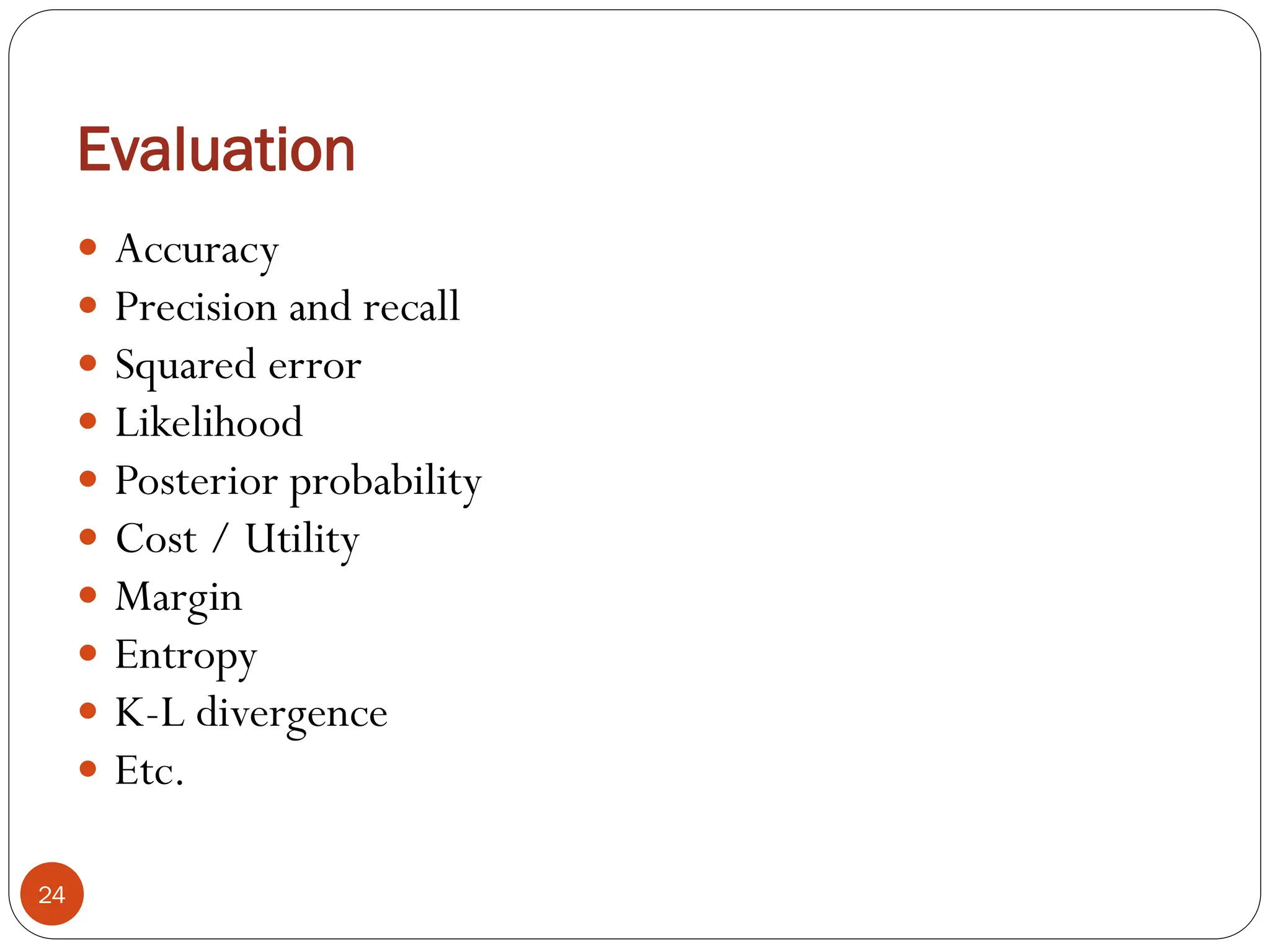
Evaluation
 Accuracy
 Precision and recall
 Squared error
 Likelihood
 Posterior probability
 Cost / Utility
 Margin
 Entropy
 K-L divergence
 Etc.
24
Optimization
 Combinatorial optimization
 E.g.: Greedy search
 Convex optimization
 E.g.: Gradient descent
 Constrained optimization
 E.g.: Linear programming
25
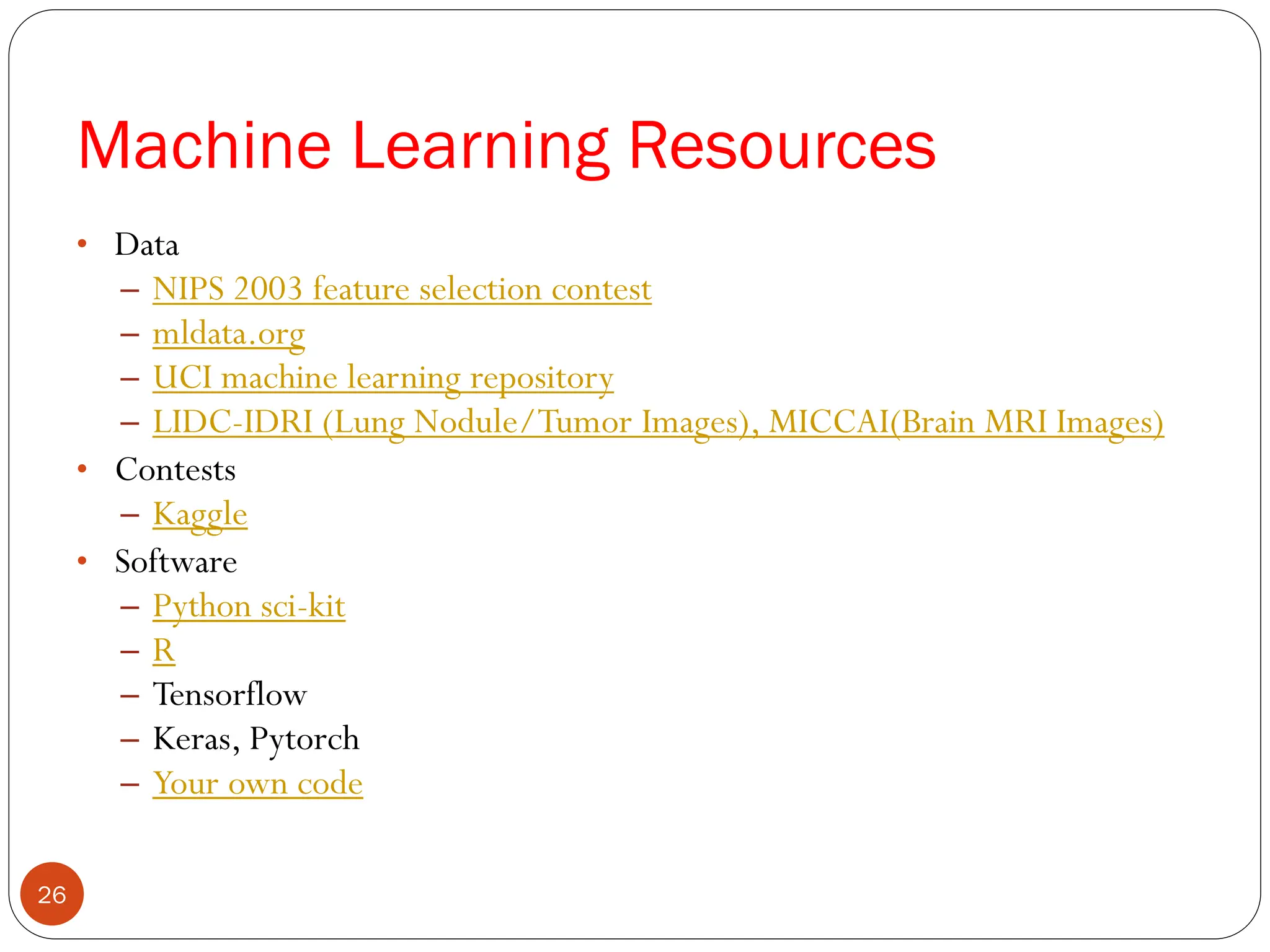
Machine Learning Resources
• Data
– NIPS 2003 feature selection contest
– mldata.org
– UCI machine learning repository
– LIDC-IDRI (Lung Nodule/Tumor Images), MICCAI(Brain MRI Images)
• Contests
– Kaggle
• Software
– Python sci-kit
– R
– Tensorflow
– Keras, Pytorch
– Your own code
26
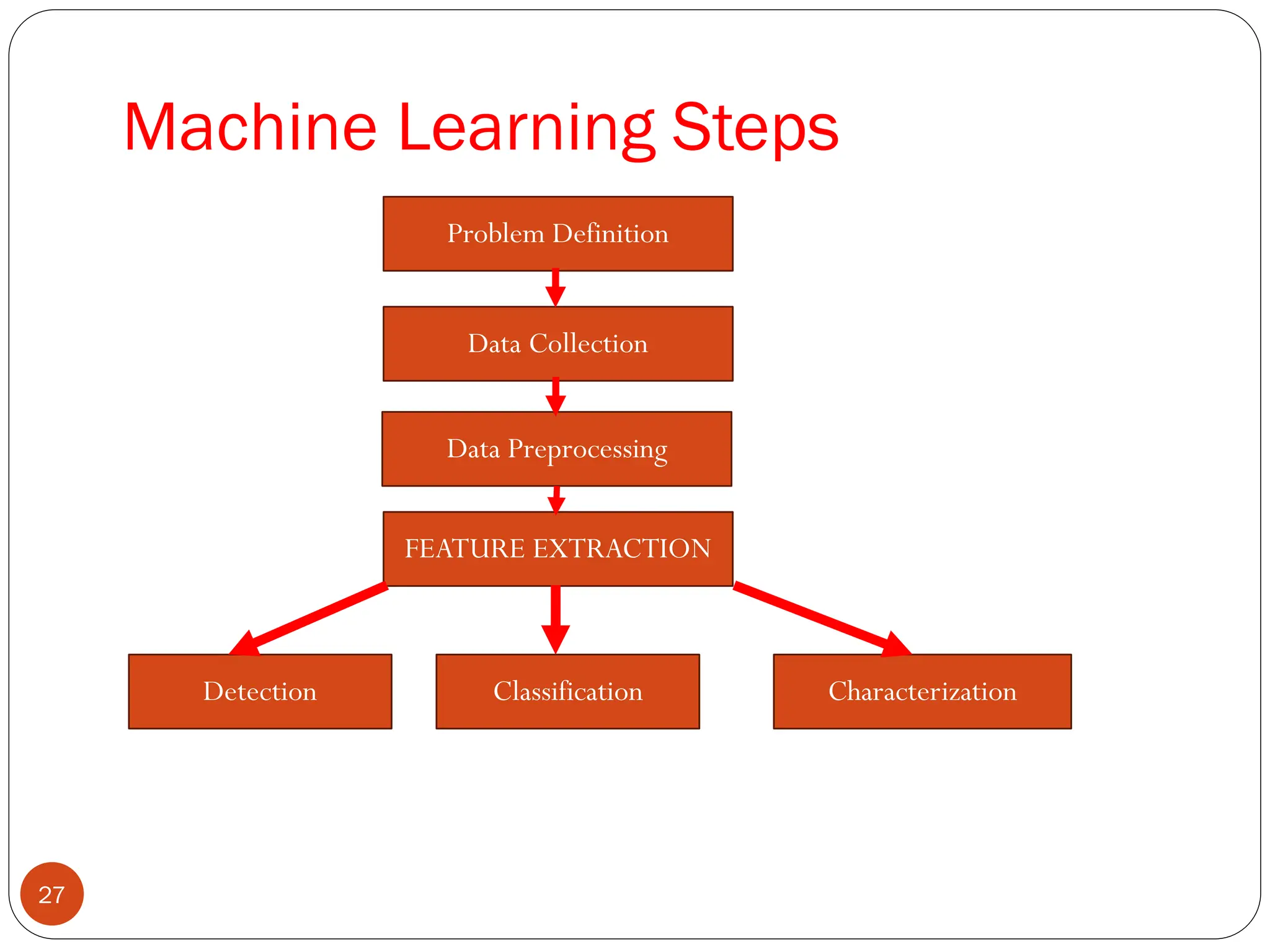
Machine Learning Steps
Problem Definition
Data Collection
Data Preprocessing
FEATURE EXTRACTION
Detection Classification Characterization
27
Example Pipeline.....
Image acquisition and pre-processing
Lung segmentation
Thorax extraction
Lung extraction
Nodule detection
Nodule candidate detection/ Tubular structure
elimination
Feature extraction/ False Positive reduction
Nodule Detection/Classification
Nodule Detection Framework
Problem Definition
Data Collection
Data Preprocessing
FEATURE
EXTRACTION
Detection Classification Characterization
28
Detection vs. Classification vs. Characterization
Typical SPNs for different type (a)Well-
circumscribed nodule, (b) Juxta-vascular nodule, (c)
Nodule with a pleural tail, (d) Juxta-pleural nodule
Benign Malignant
Characterization
Classification
Detection (Finding the location of the ROI)
29
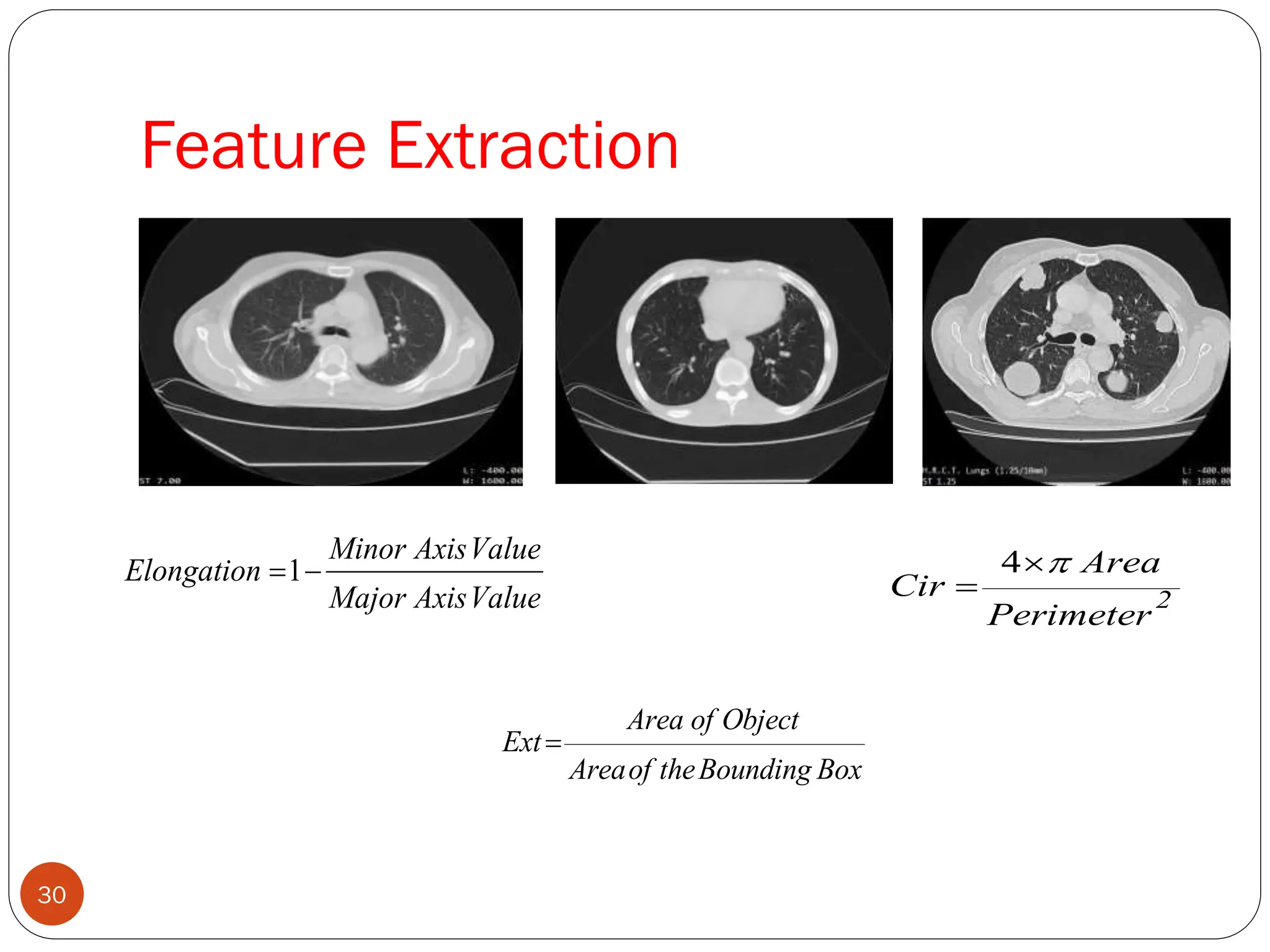
Feature Extraction
1
Minor AxisValue
Elongation
Major AxisValue
  4
2
Area
Cir
Perimeter



Area of Object
Ext
Areaof theBounding Box

30
What about GGO nodule?
31
32
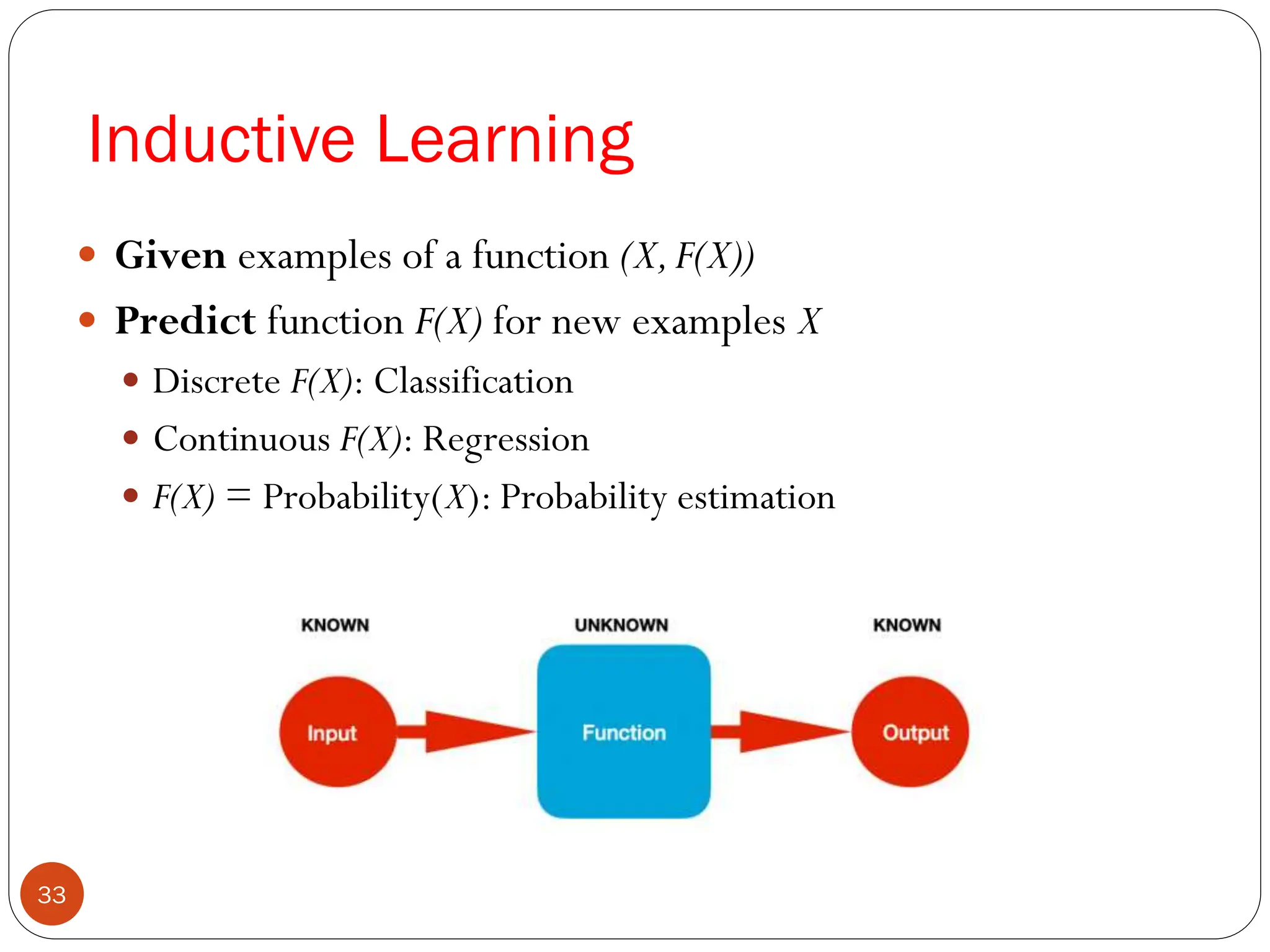
 Given examples of a function (X,F(X))
 Predict function F(X) for new examples X
 Discrete F(X): Classification
 Continuous F(X): Regression
 F(X) = Probability(X): Probability estimation
Inductive Learning
33
34
35
36
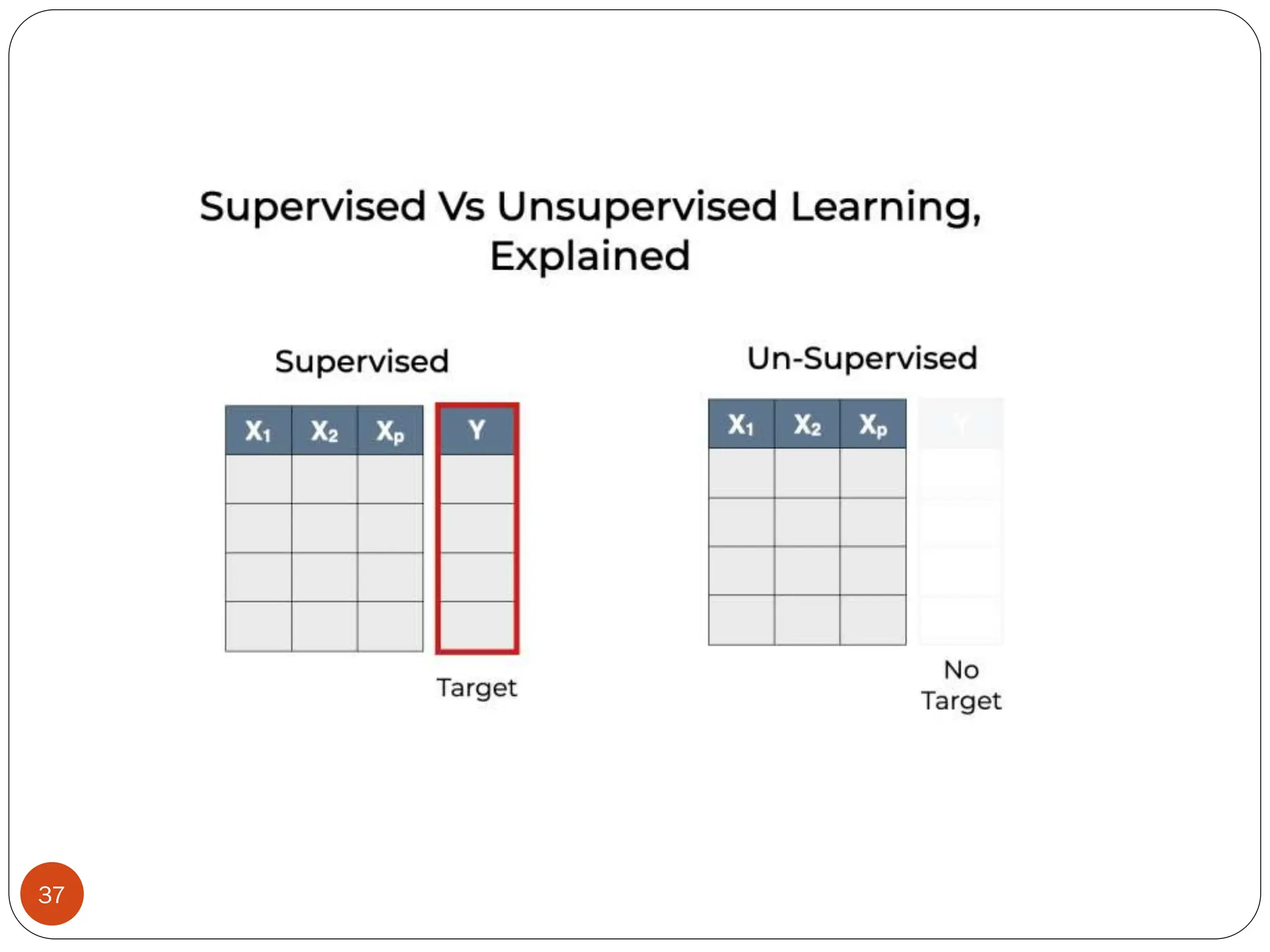
37
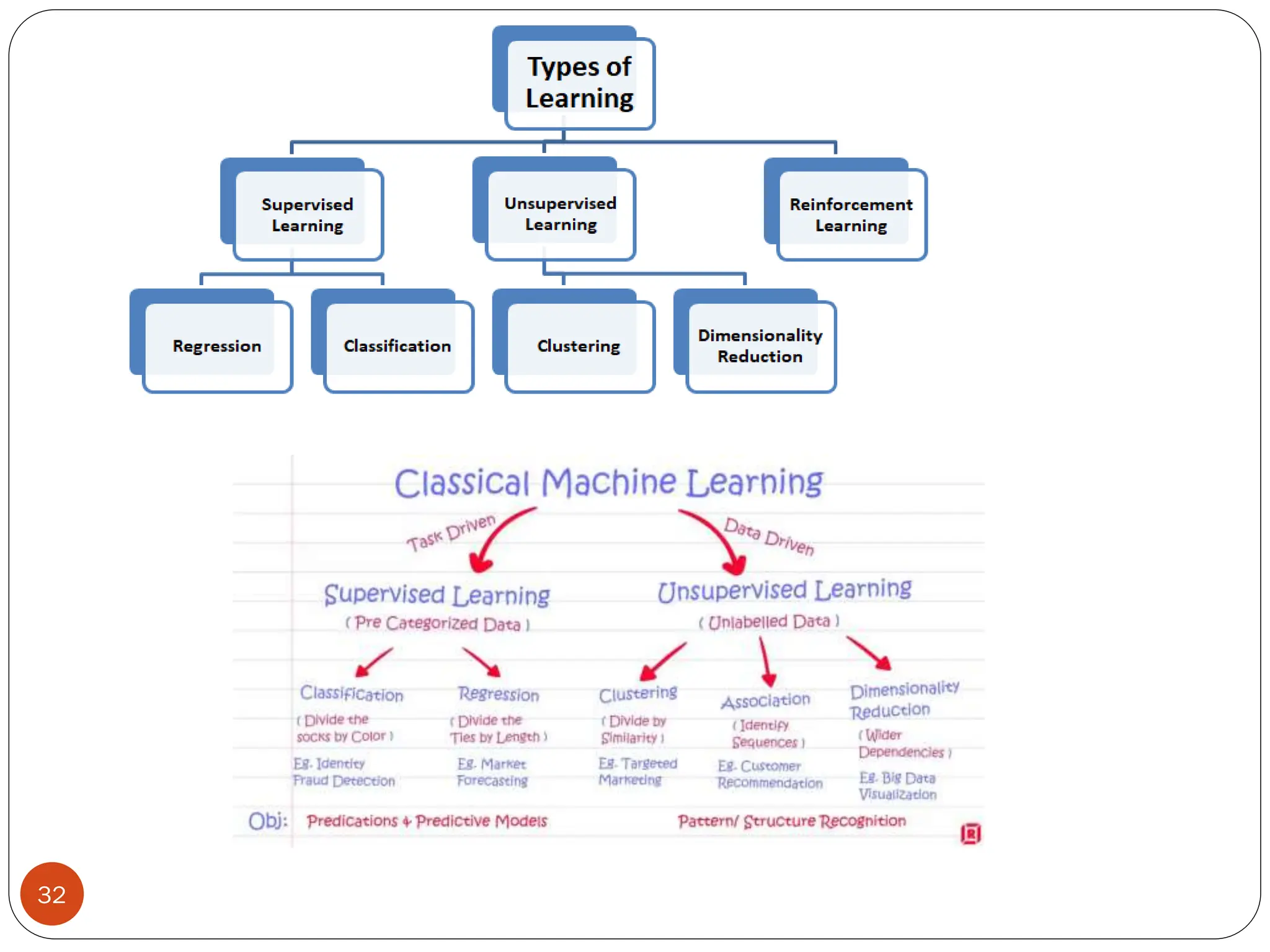
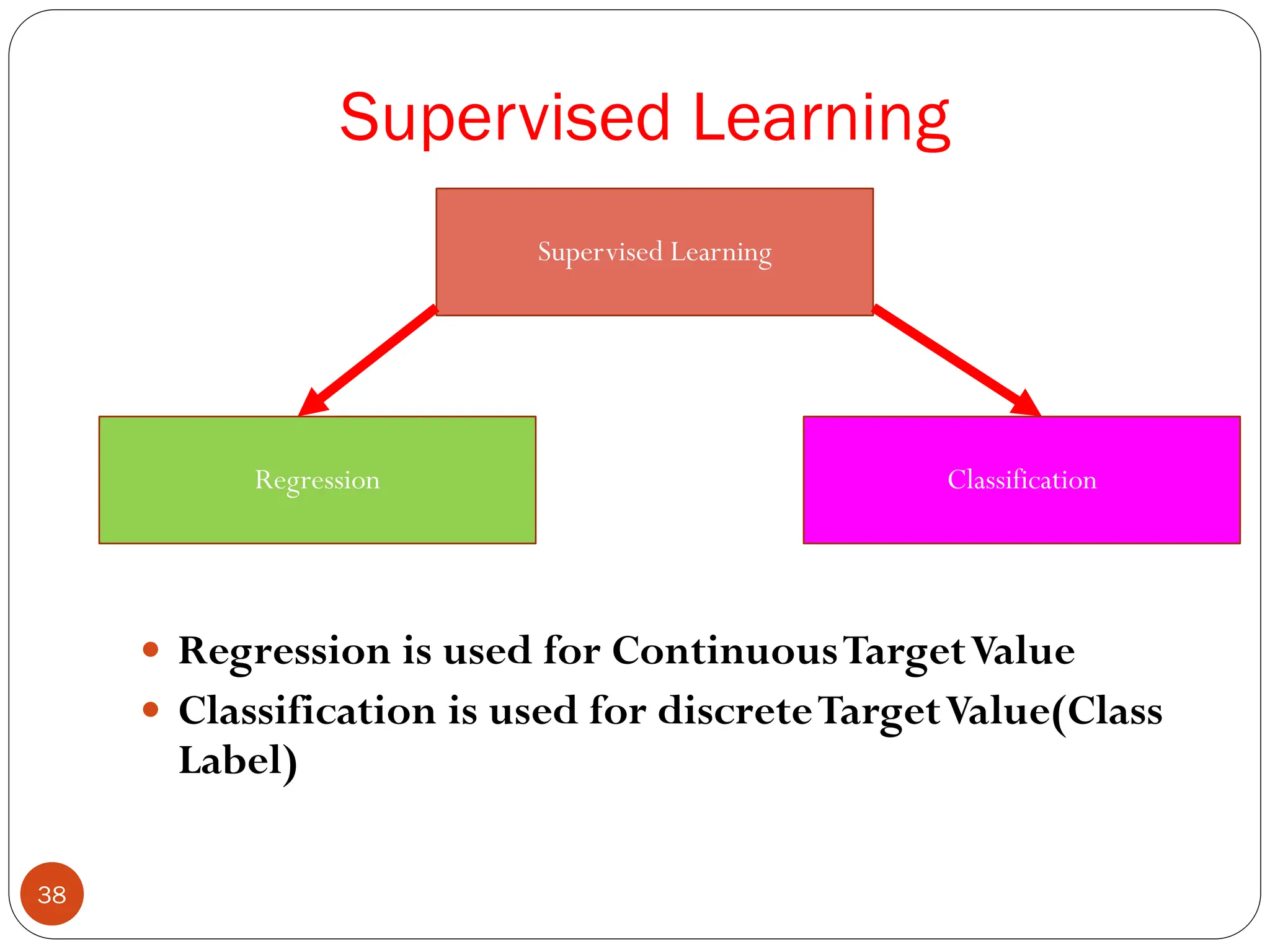
Supervised Learning
 Regression is used for ContinuousTargetValue
 Classification is used for discreteTargetValue(Class
Label)
Supervised Learning
Regression Classification
38
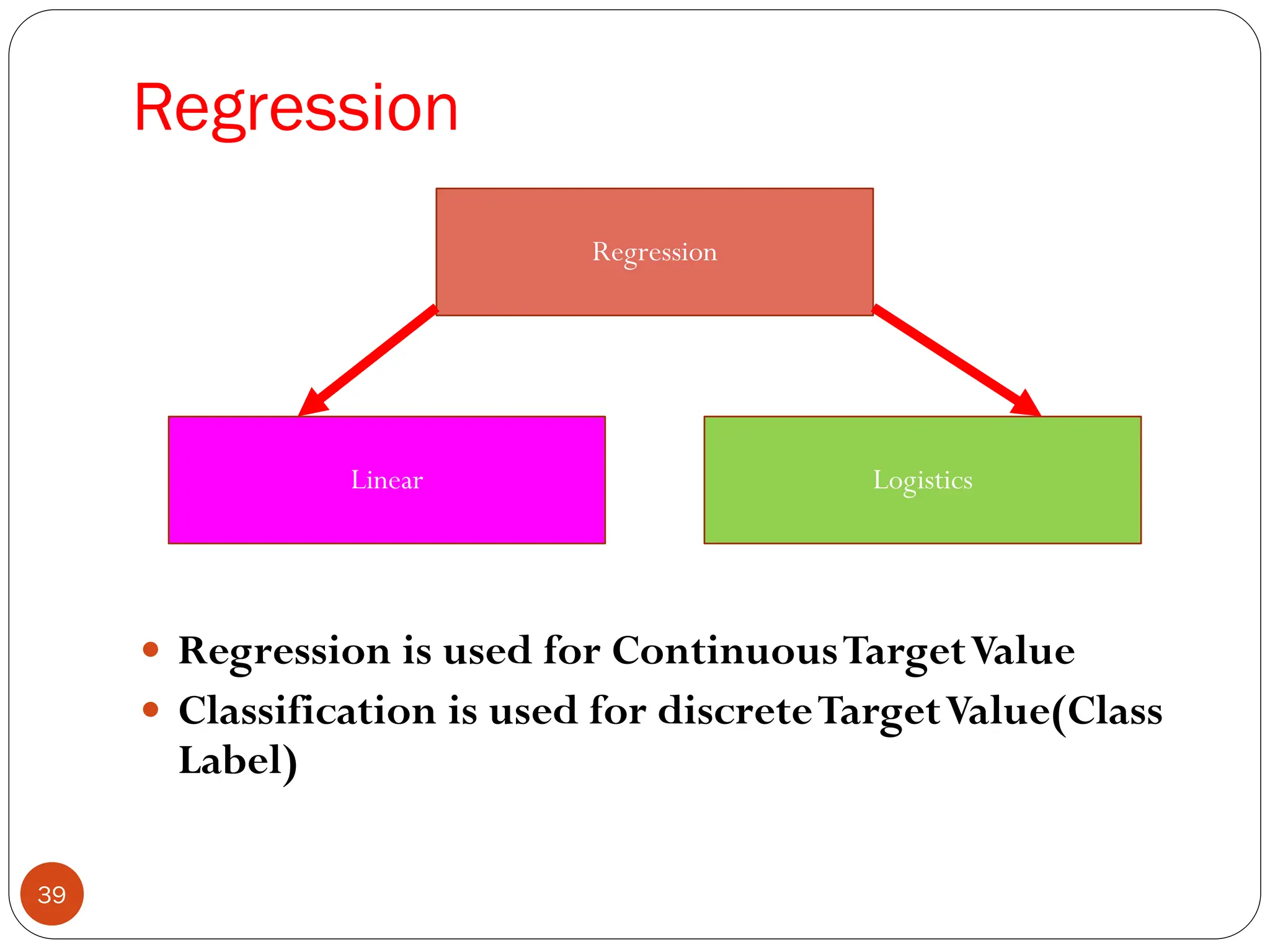
Regression
 Regression is used for ContinuousTargetValue
 Classification is used for discreteTargetValue(Class
Label)
Regression
Logistics
Linear
39
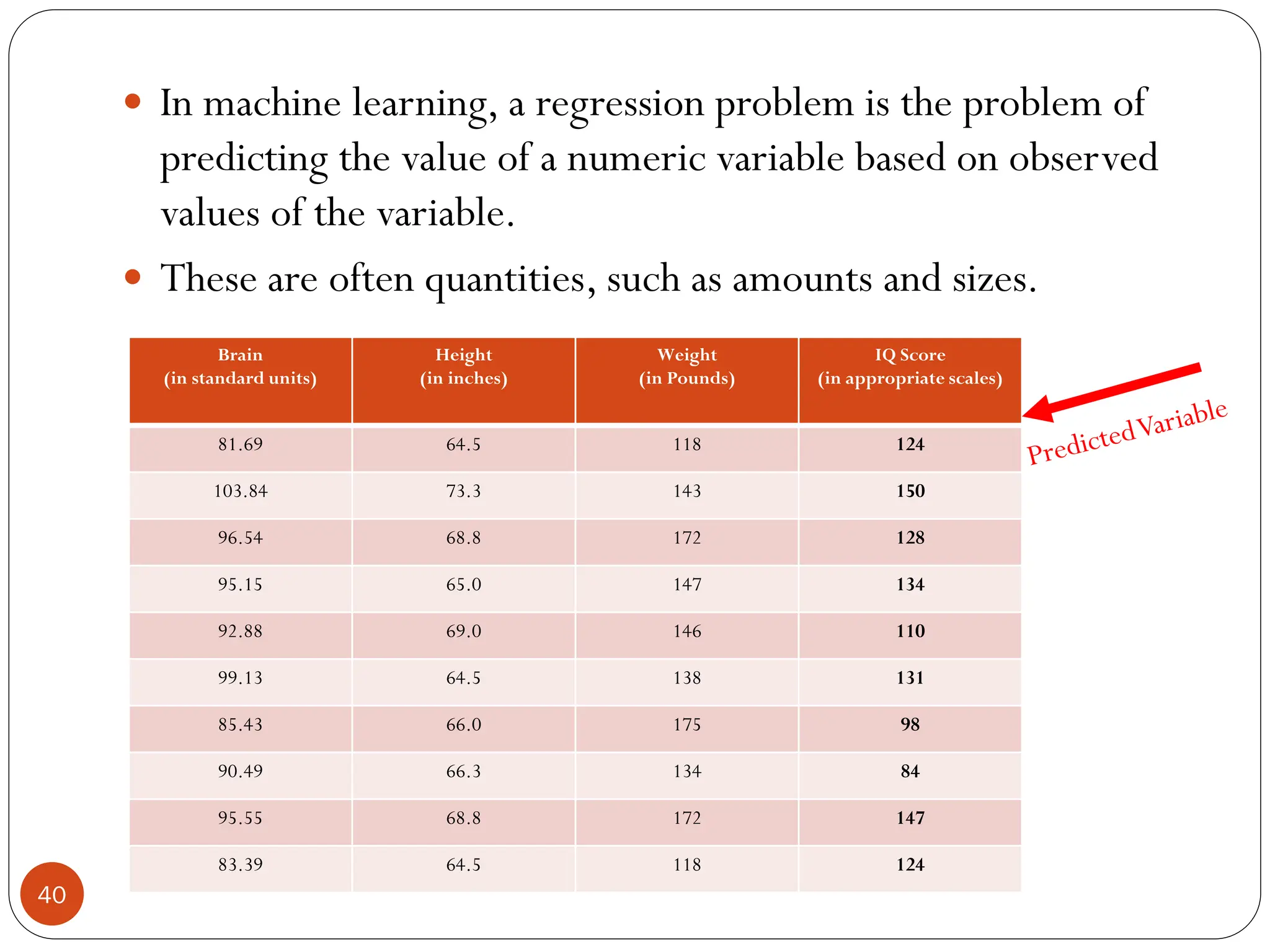
 In machine learning, a regression problem is the problem of
predicting the value of a numeric variable based on observed
values of the variable.
 These are often quantities, such as amounts and sizes.
Brain
(in standard units)
Height
(in inches)
Weight
(in Pounds)
IQ Score
(in appropriate scales)
81.69 64.5 118 124
103.84 73.3 143 150
96.54 68.8 172 128
95.15 65.0 147 134
92.88 69.0 146 110
99.13 64.5 138 131
85.43 66.0 175 98
90.49 66.3 134 84
95.55 68.8 172 147
83.39 64.5 118 124
40
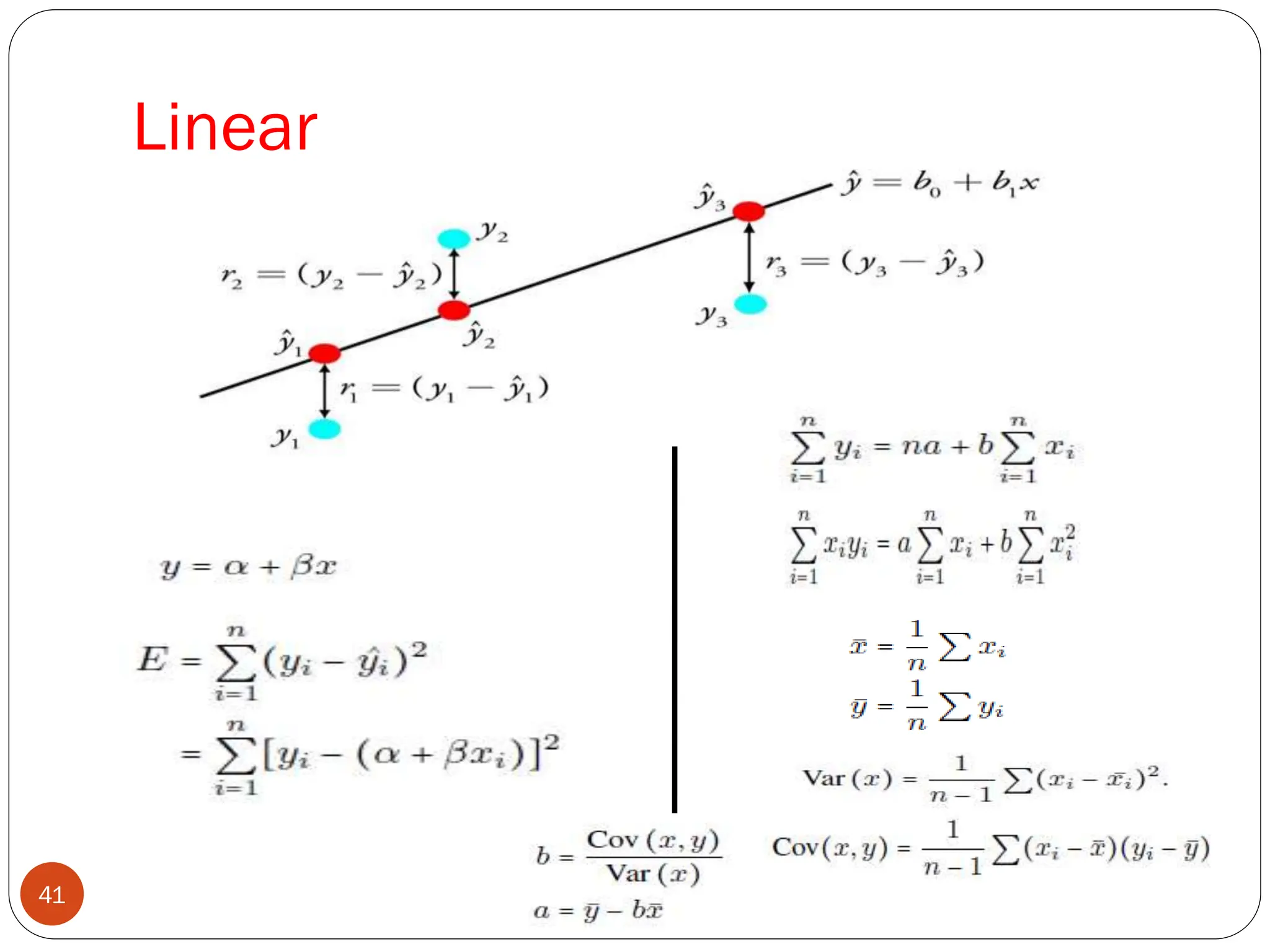
Linear
41
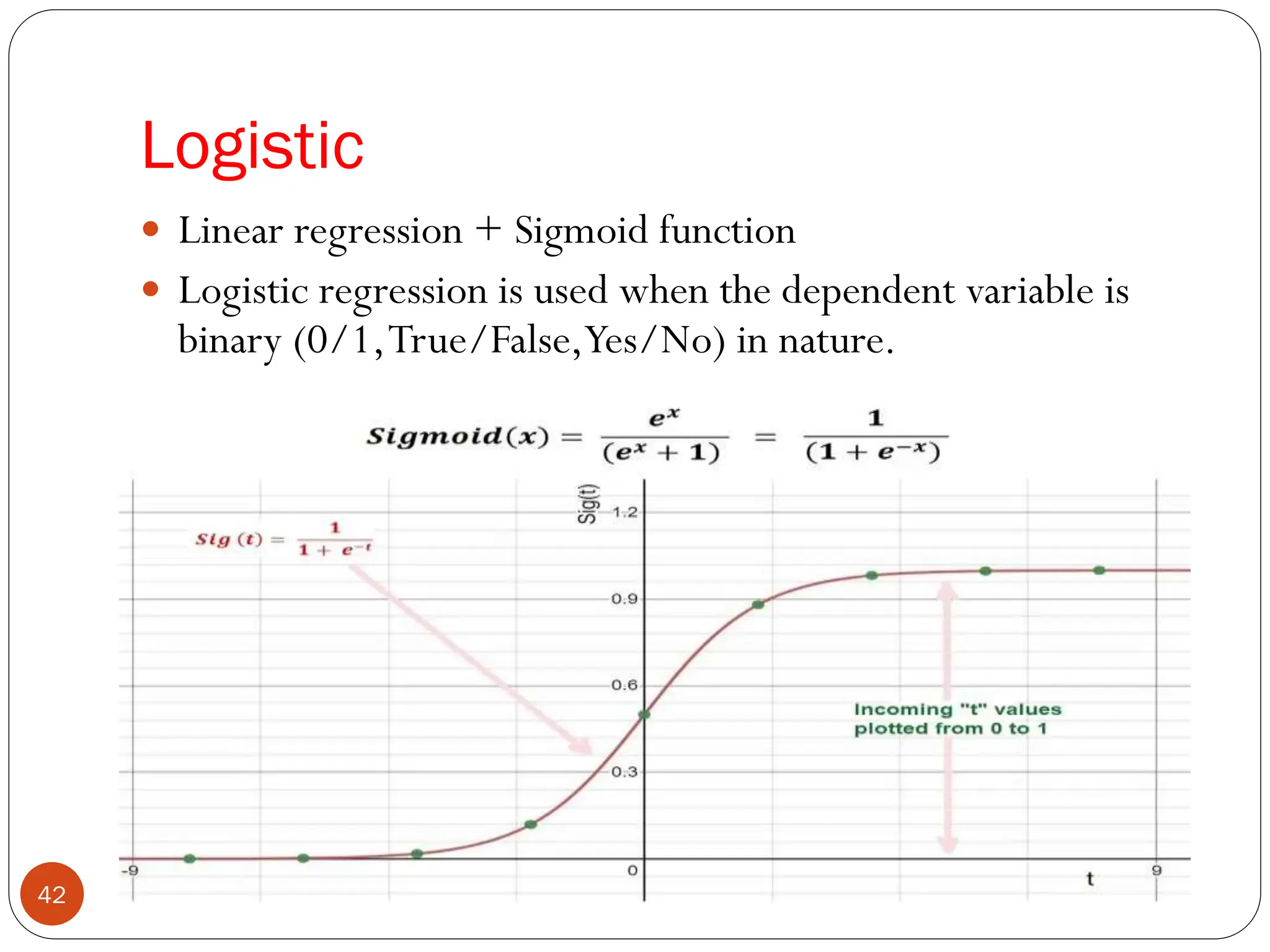
Logistic
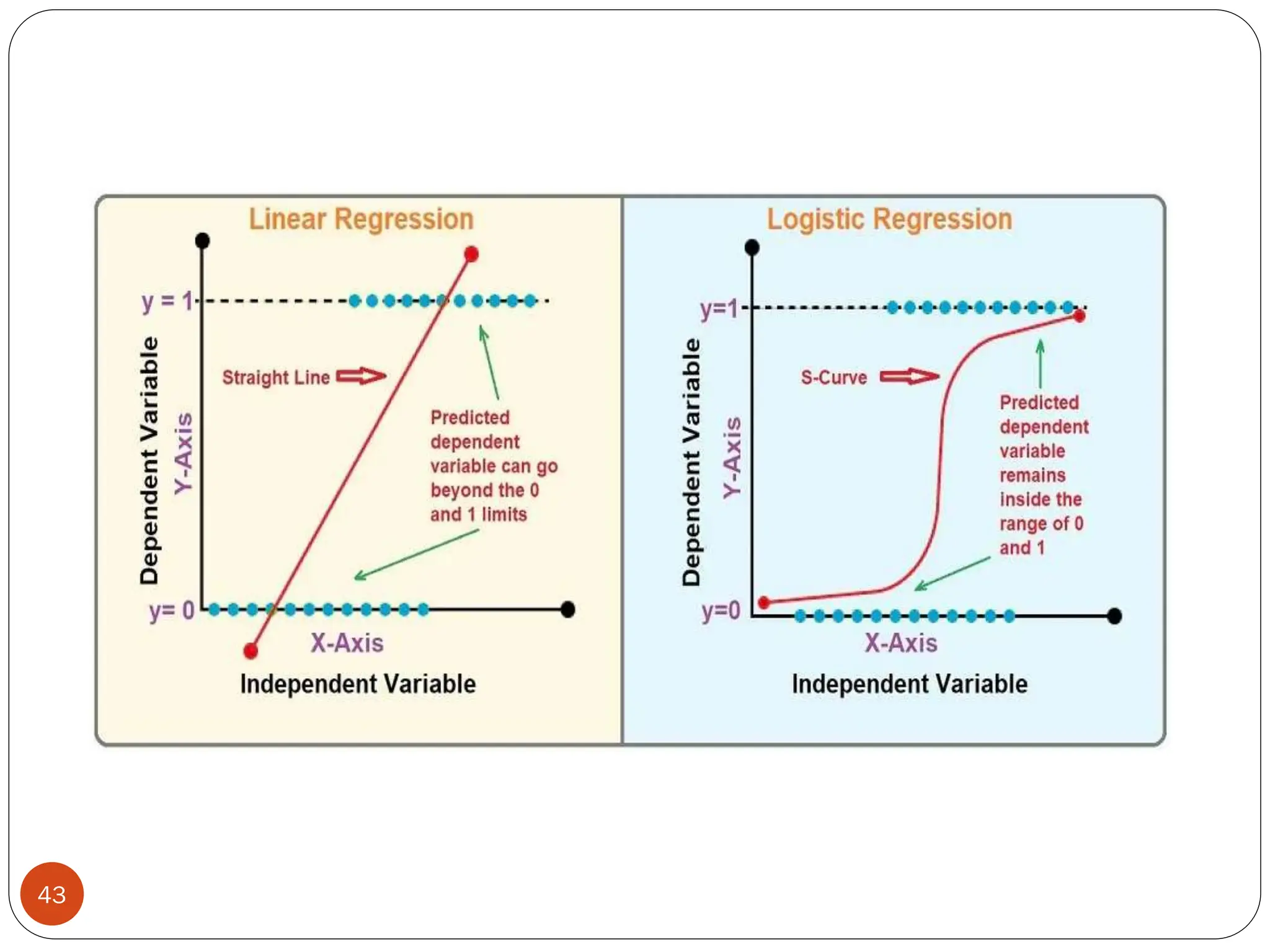
 Linear regression + Sigmoid function
 Logistic regression is used when the dependent variable is
binary (0/1,True/False,Yes/No) in nature.
42
43
Classification
 A classification problem requires that examples be classified
into one of two or more classes.
 A problem with two classes is often called a two-class or
binary classification problem.
 A problem with more than two classes is often called a multi-
class classification problem.
 A problem where an example is assigned multiple classes is
called a multi-label classification problem.
44
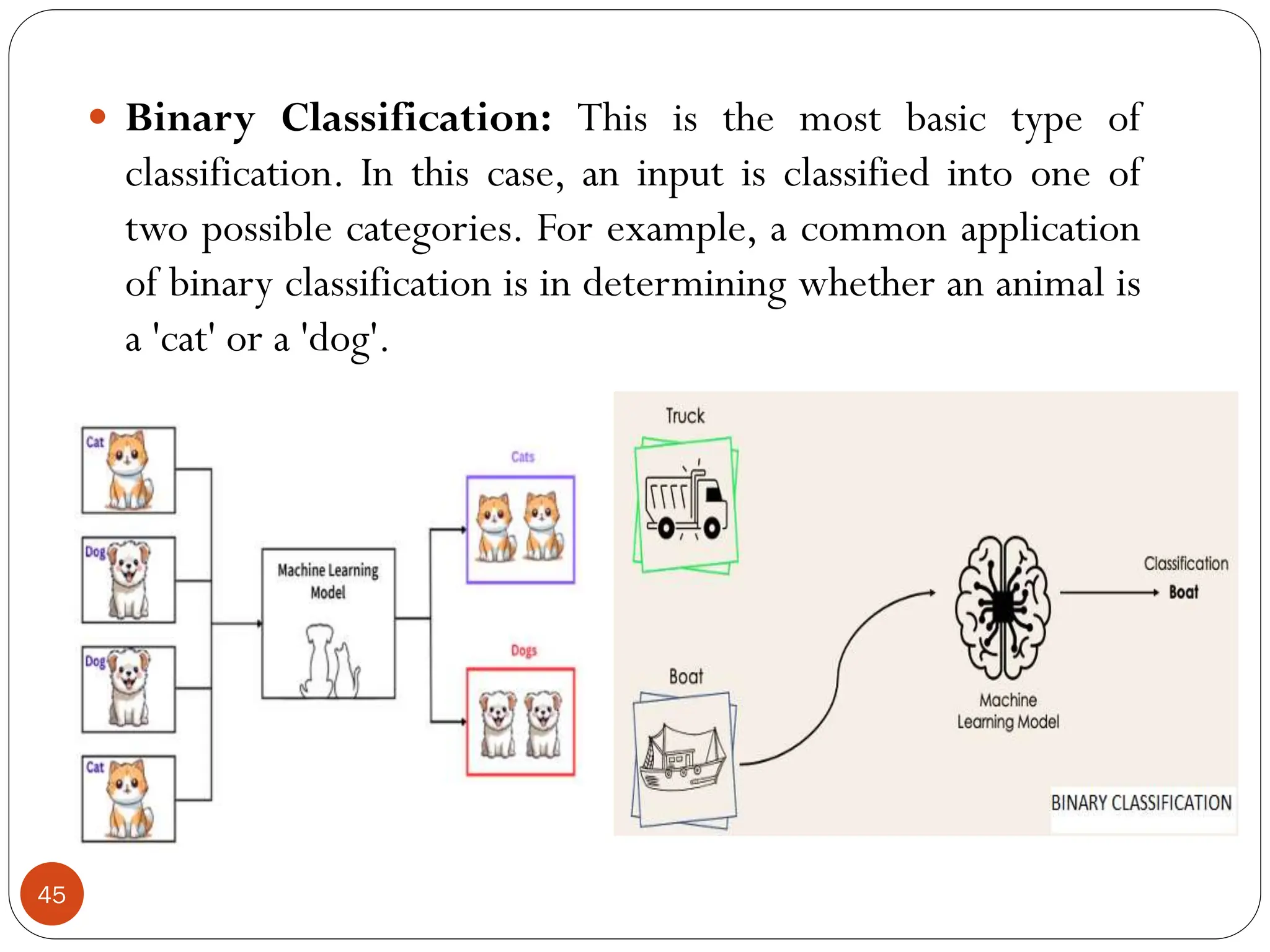
 Binary Classification: This is the most basic type of
classification. In this case, an input is classified into one of
two possible categories. For example, a common application
of binary classification is in determining whether an animal is
a 'cat' or a 'dog'.
45
 Multiclass Classification: This type of classification
involves classifying an input into one of three or more
categories. An example of this is the identifying image, where
an image can be classified as a train, ship, bus, or airplane,
thus involving four different classes.
46
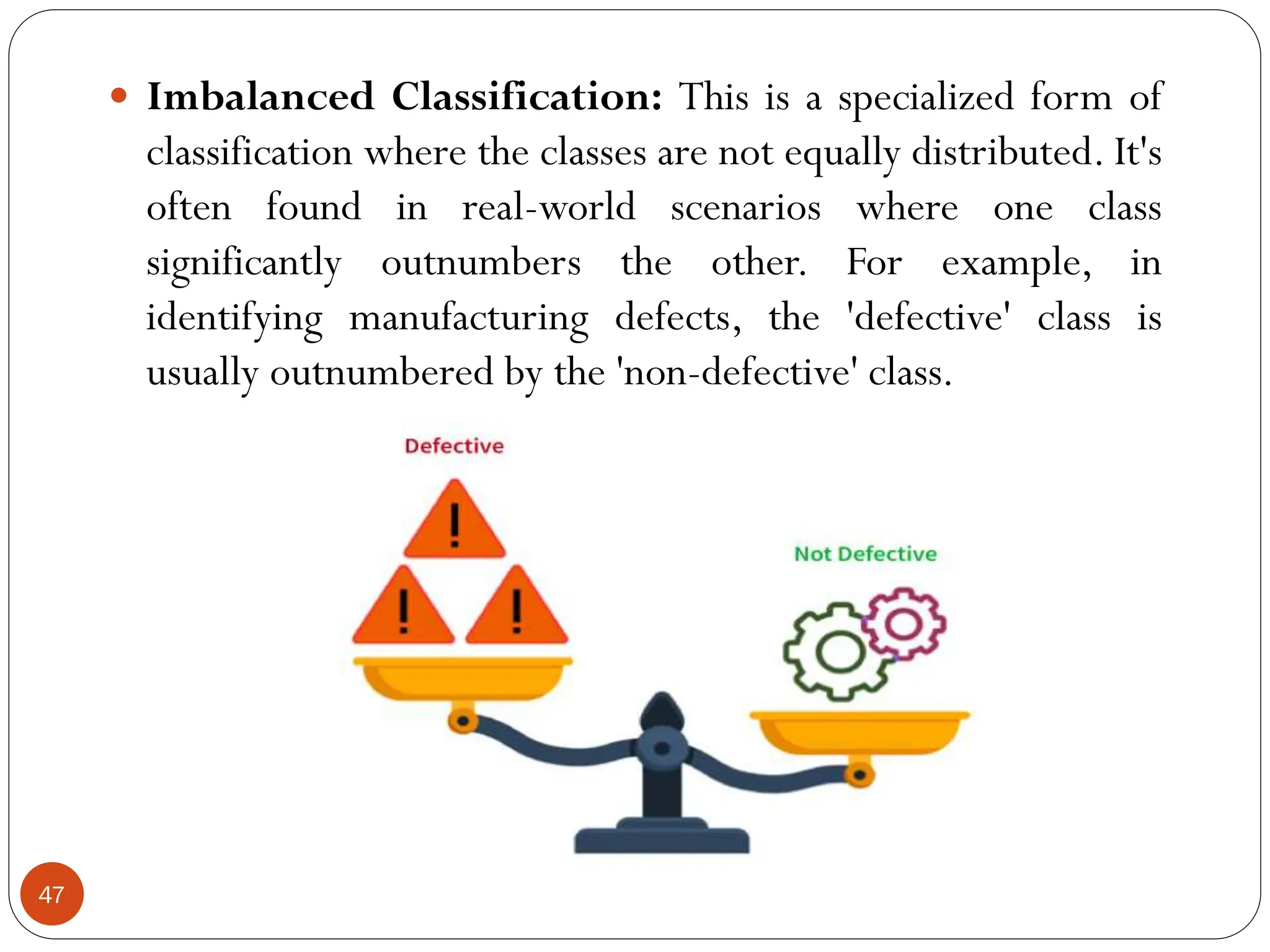
 Imbalanced Classification: This is a specialized form of
classification where the classes are not equally distributed. It's
often found in real-world scenarios where one class
significantly outnumbers the other. For example, in
identifying manufacturing defects, the 'defective' class is
usually outnumbered by the 'non-defective' class.
47
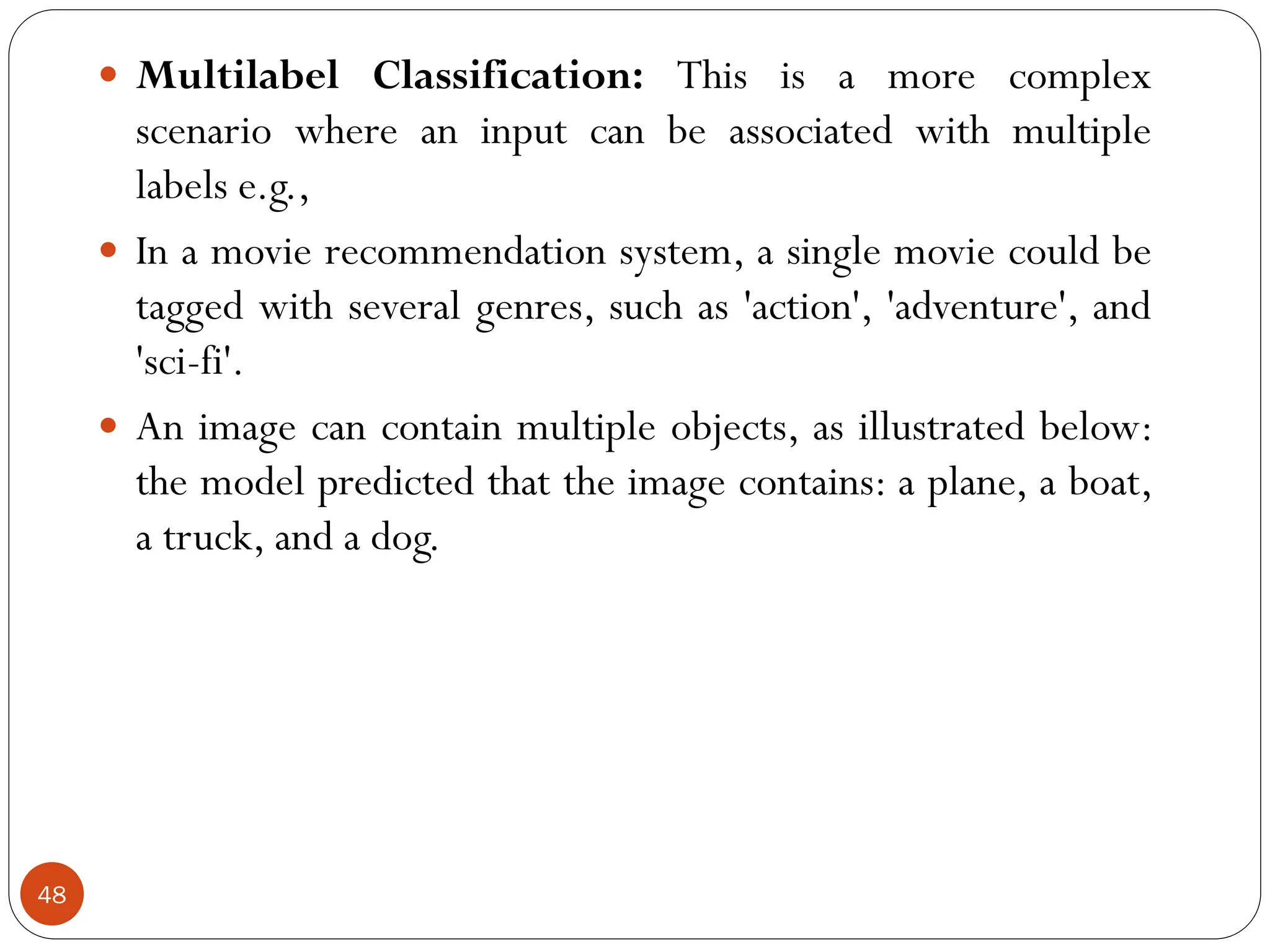
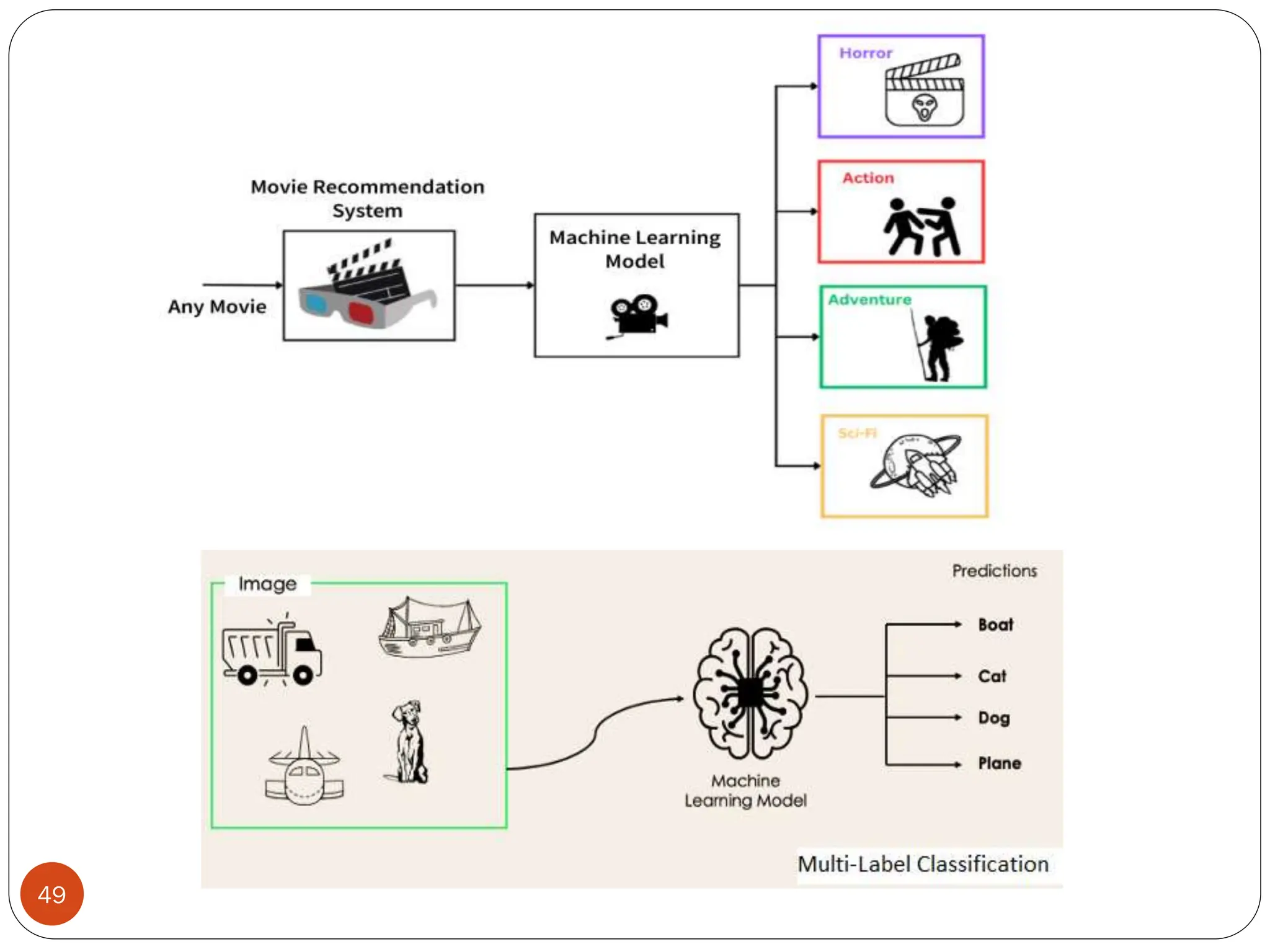
 Multilabel Classification: This is a more complex
scenario where an input can be associated with multiple
labels e.g.,
 In a movie recommendation system, a single movie could be
tagged with several genres, such as 'action', 'adventure', and
'sci-fi'.
 An image can contain multiple objects, as illustrated below:
the model predicted that the image contains: a plane, a boat,
a truck, and a dog.
48
49
Classifier
 Naive Bayes Classifier
 Nearest Neighbor Classifier
 DecisionTree
50
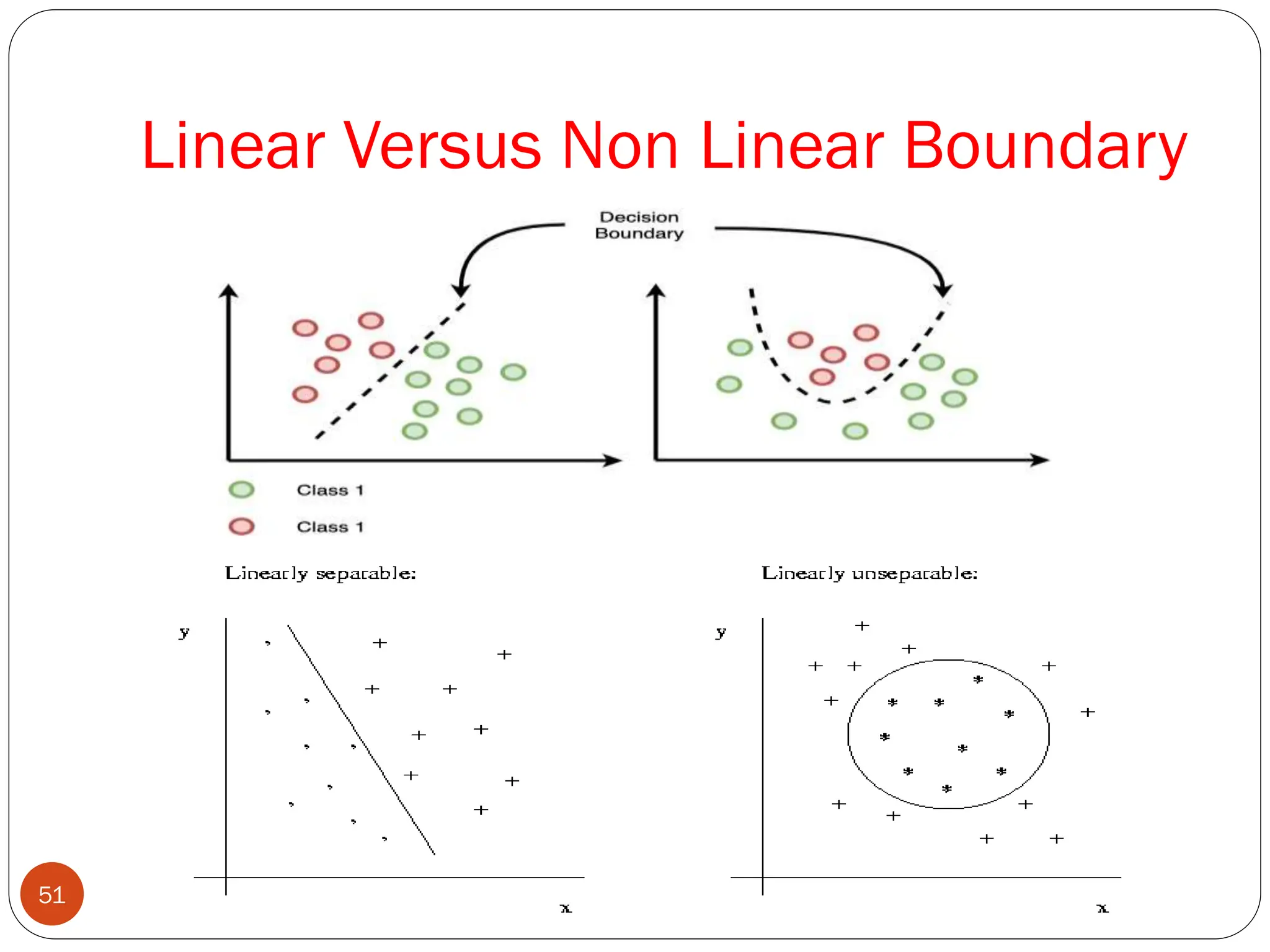
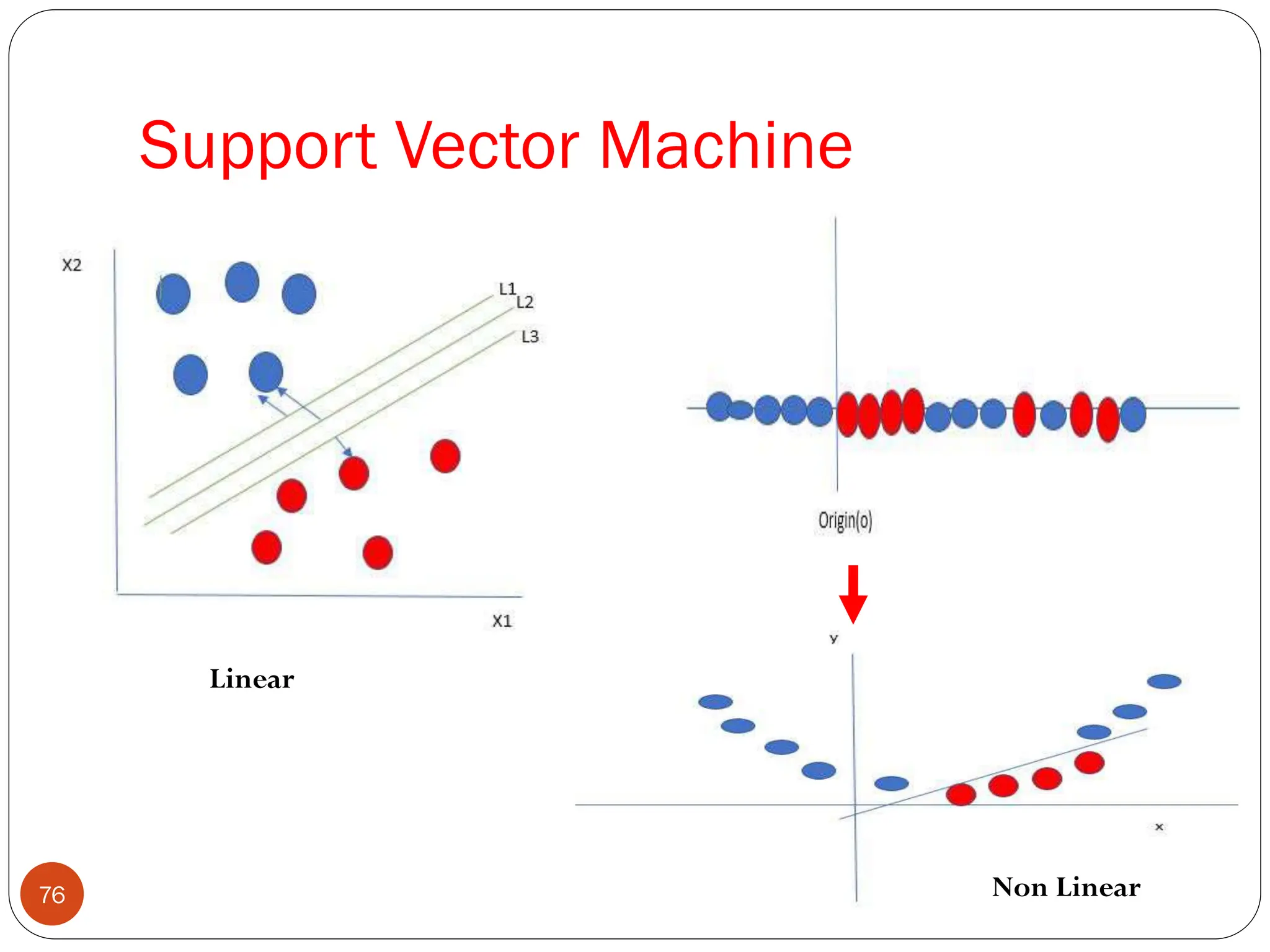
Linear Versus Non Linear Boundary
51
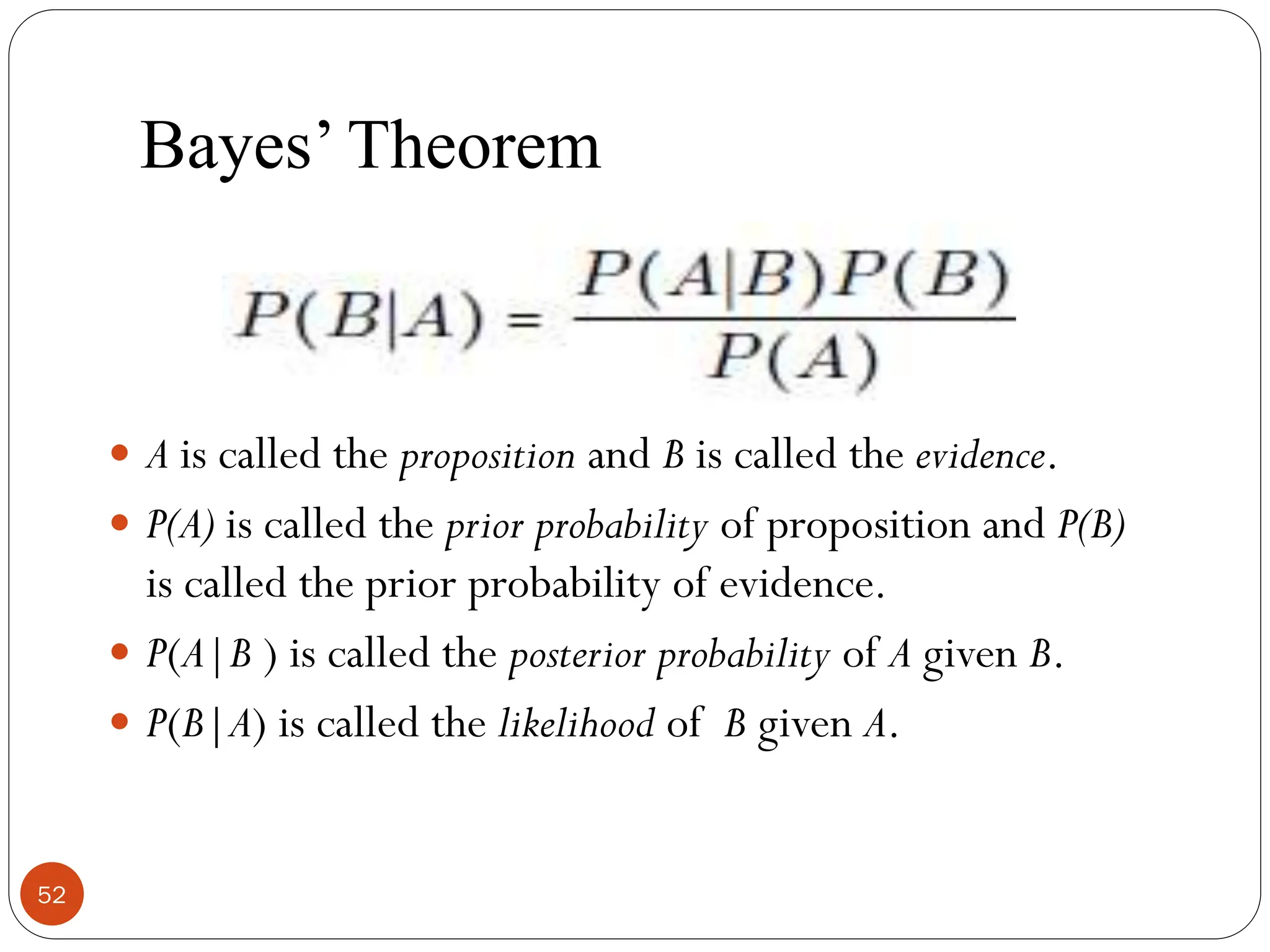
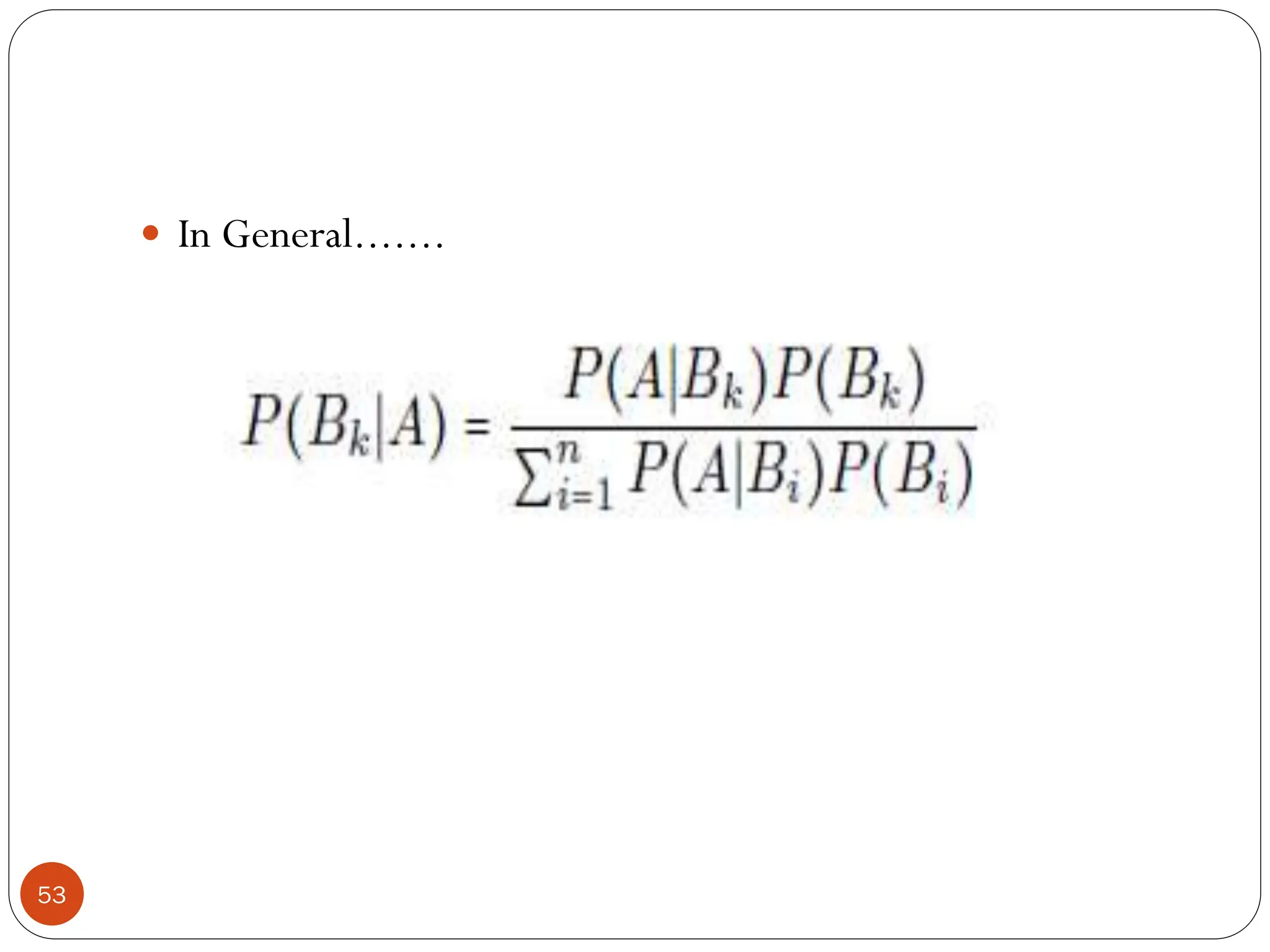
Bayes’ Theorem
 A is called the proposition and B is called the evidence.
 P(A) is called the prior probability of proposition and P(B)
is called the prior probability of evidence.
 P(A|B ) is called the posterior probability of A given B.
 P(B|A) is called the likelihood of B given A.
52
 In General.......
53
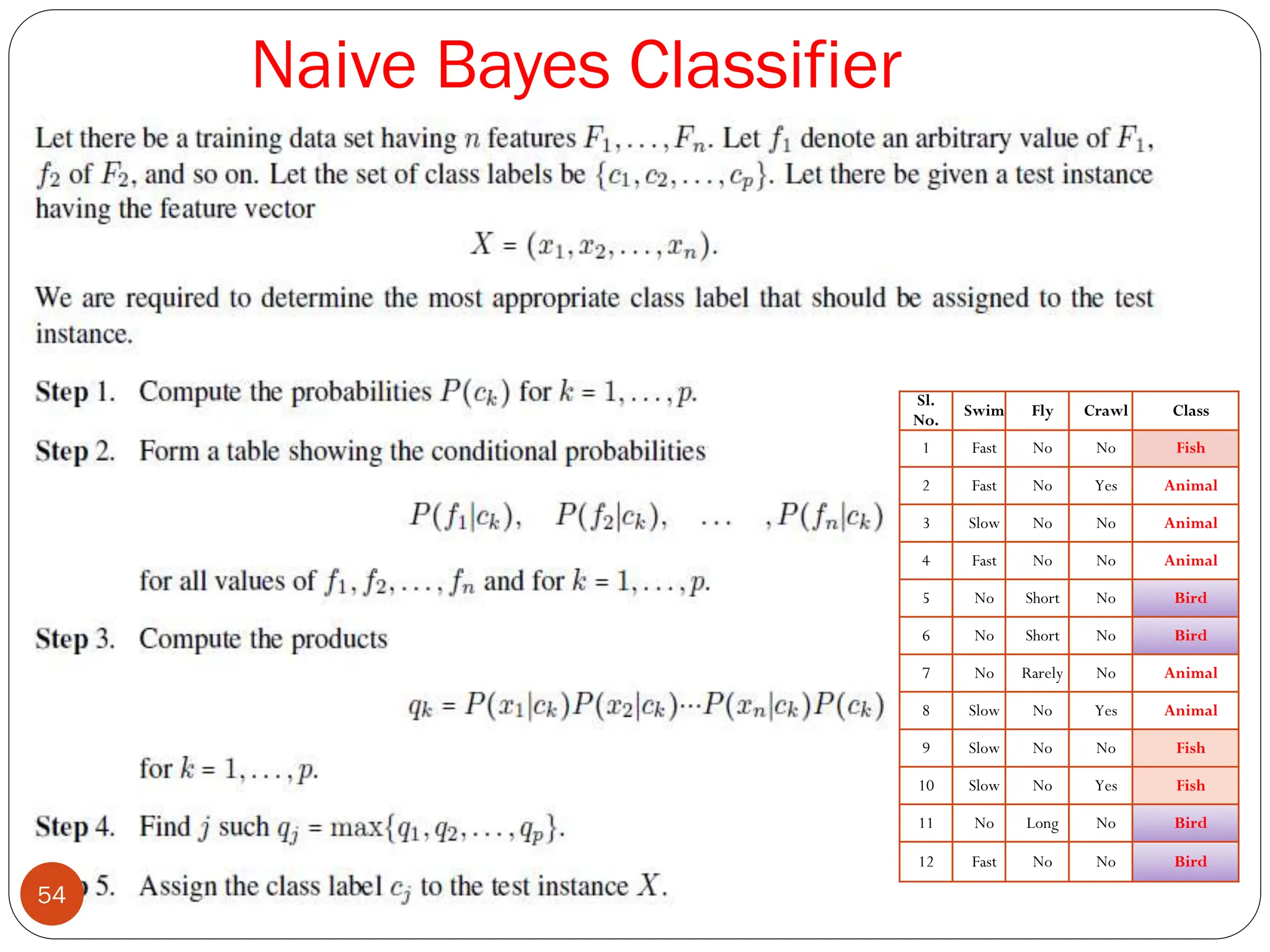
Naive Bayes Classifier
Sl.
No.
Swim Fly Crawl Class
1 Fast No No Fish
2 Fast No Yes Animal
3 Slow No No Animal
4 Fast No No Animal
5 No Short No Bird
6 No Short No Bird
7 No Rarely No Animal
8 Slow No Yes Animal
9 Slow No No Fish
10 Slow No Yes Fish
11 No Long No Bird
12 Fast No No Bird
54
•P(c|x) is the posterior probability of class (target) given predictor (attribute).
•P(c) is the prior probability of class.
•P(x|c) is the likelihood which is the probability of predictor given class.
•P(x) is the prior probability of predictor.
55
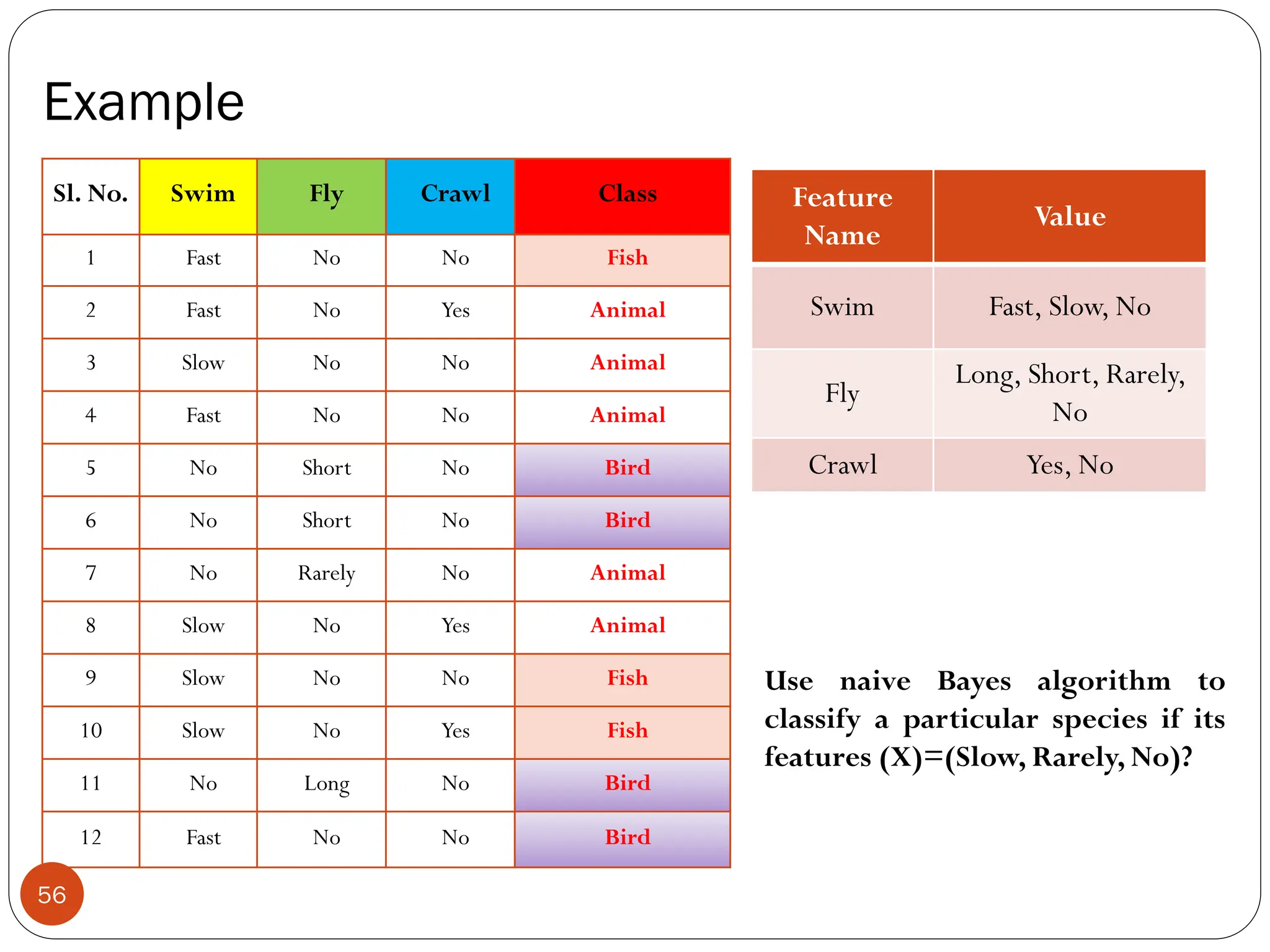
Sl. No. Swim Fly Crawl Class
1 Fast No No Fish
2 Fast No Yes Animal
3 Slow No No Animal
4 Fast No No Animal
5 No Short No Bird
6 No Short No Bird
7 No Rarely No Animal
8 Slow No Yes Animal
9 Slow No No Fish
10 Slow No Yes Fish
11 No Long No Bird
12 Fast No No Bird
Feature
Name
Value
Swim Fast, Slow, No
Fly
Long, Short, Rarely,
No
Crawl Yes, No
Use naive Bayes algorithm to
classify a particular species if its
features (X)=(Slow, Rarely, No)?
Example
56
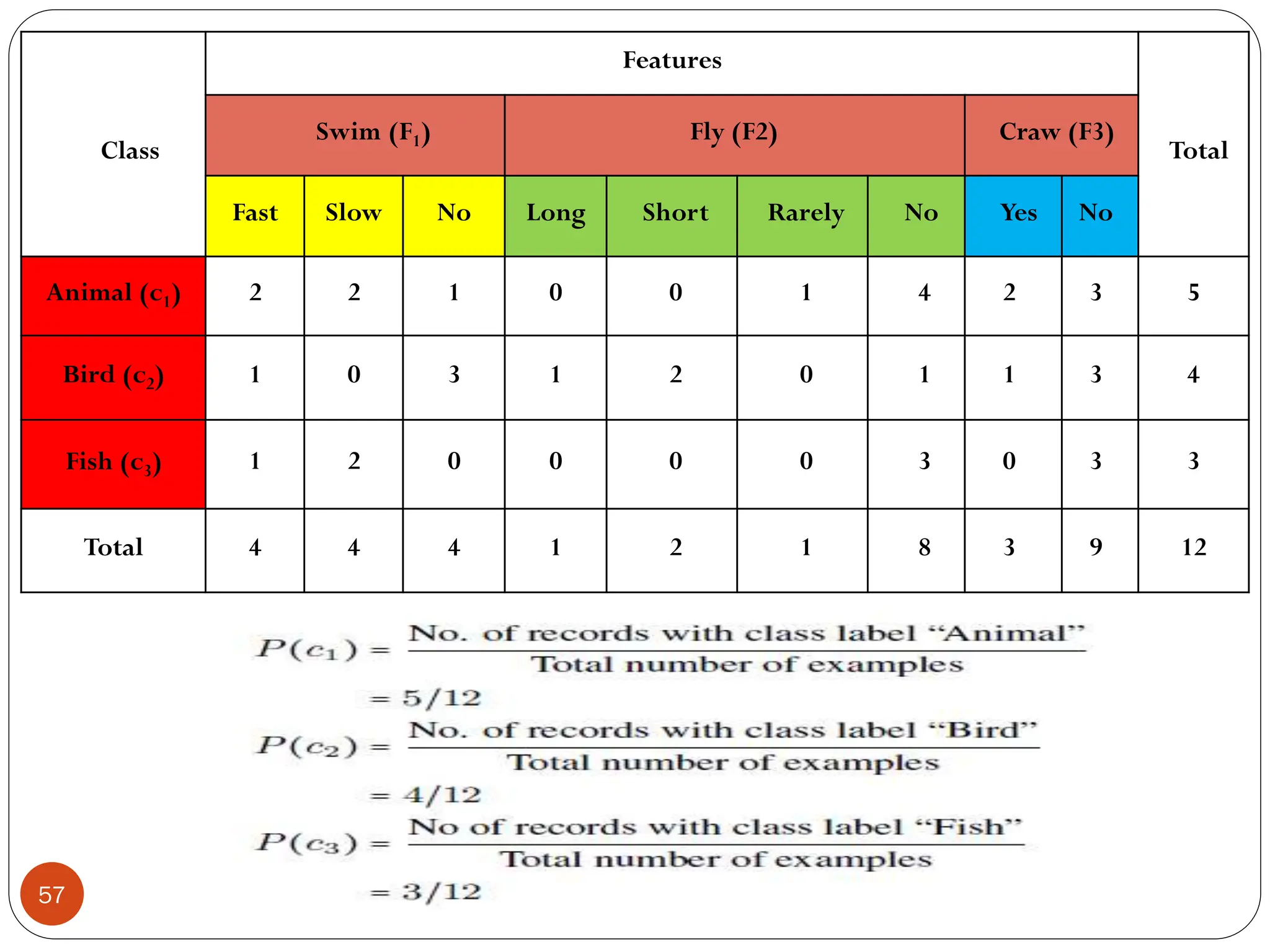
Class
Features
Total
Swim (F1) Fly (F2) Craw (F3)
Fast Slow No Long Short Rarely No Yes No
Animal (c1) 2 2 1 0 0 1 4 2 3 5
Bird (c2) 1 0 3 1 2 0 1 1 3 4
Fish (c3) 1 2 0 0 0 0 3 0 3 3
Total 4 4 4 1 2 1 8 3 9 12
57
Class
Features
Swim (F1) Fly (F2) Craw (F3)
Fast Slow No Long Short Rarely No Yes No
Animal (c1) 2/5 2/5 1/5 0/5 0/5 1/5 4/5 2/5 3/5
Bird (c2) 1/4 0/4 3/4 1/4 2/4 0/4 1/4 1/4 3/4
Fish (c3) 1/3 2/3 0/3 0/3 0/3 0/3 3/3 0/3 3/3
58
max{q1, q2, q3} = 0.02.
59
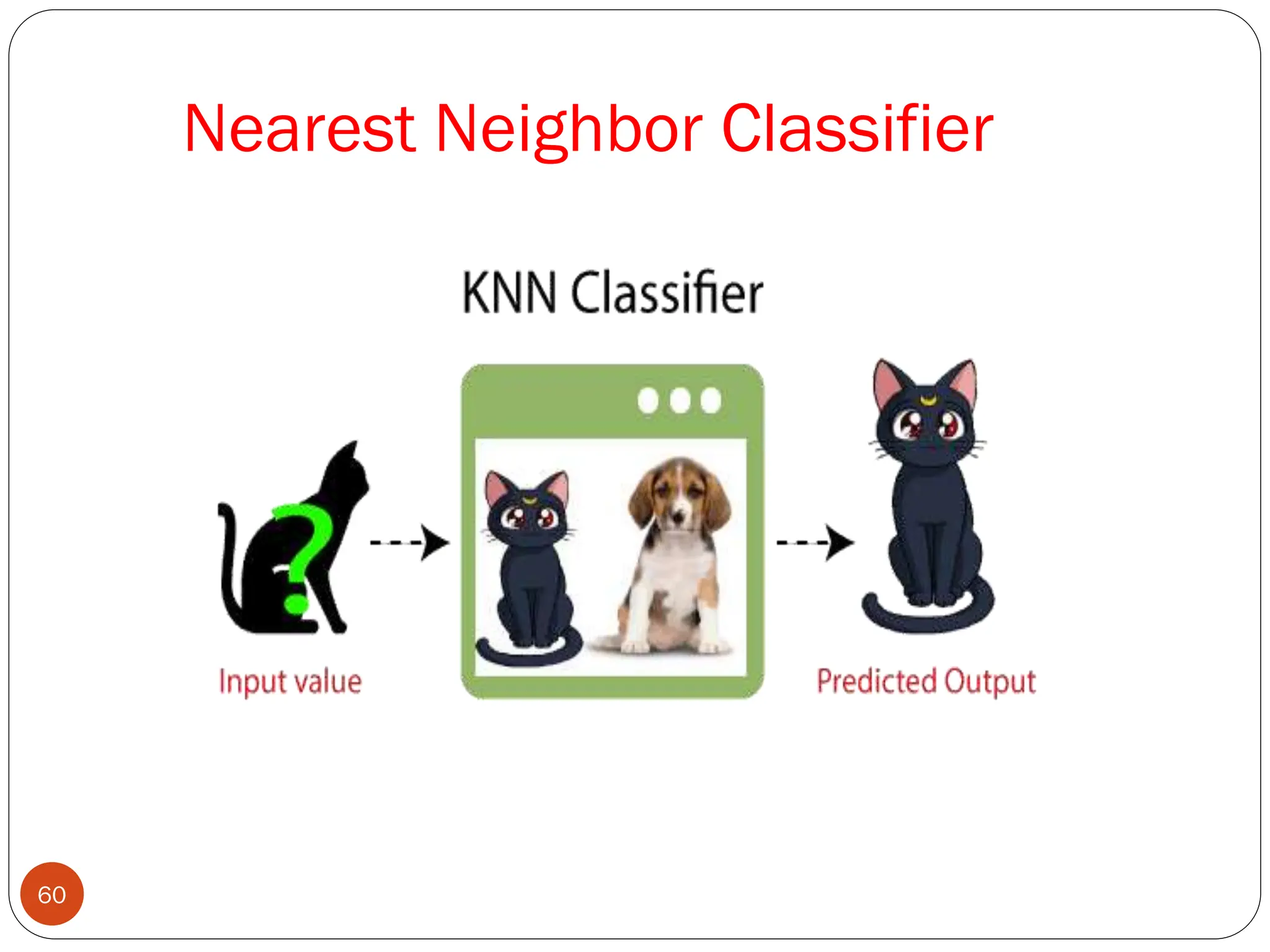
Nearest Neighbor Classifier
60
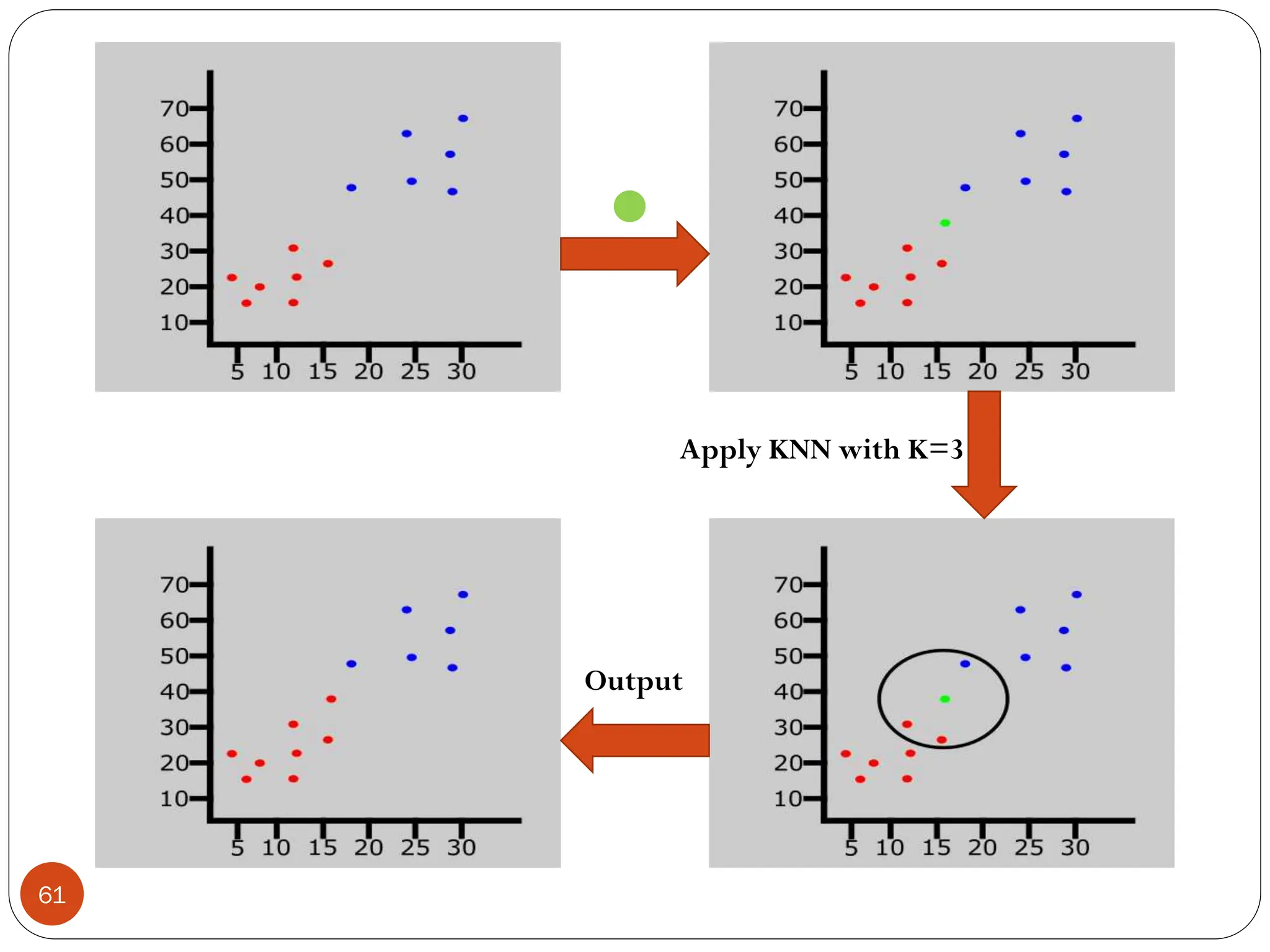
Apply KNN with K=3
Output
61
BRIGHTNESS (X) SATURATION (Y) CLASS LABEL
40 20 Red
50 50 Blue
60 90 Blue
10 25 Red
70 70 Blue
60 10 Red
25 80 Blue
BRIGHTNESS
(Xtest)
SATURATION
(Ytest)
CLASS LABEL
20 35 ?
   
2 2
i test i test
d x x y y
   
d1 = √(20 - 40)² + (35 - 20)²
= √400 + 225
= √625
= 25
62
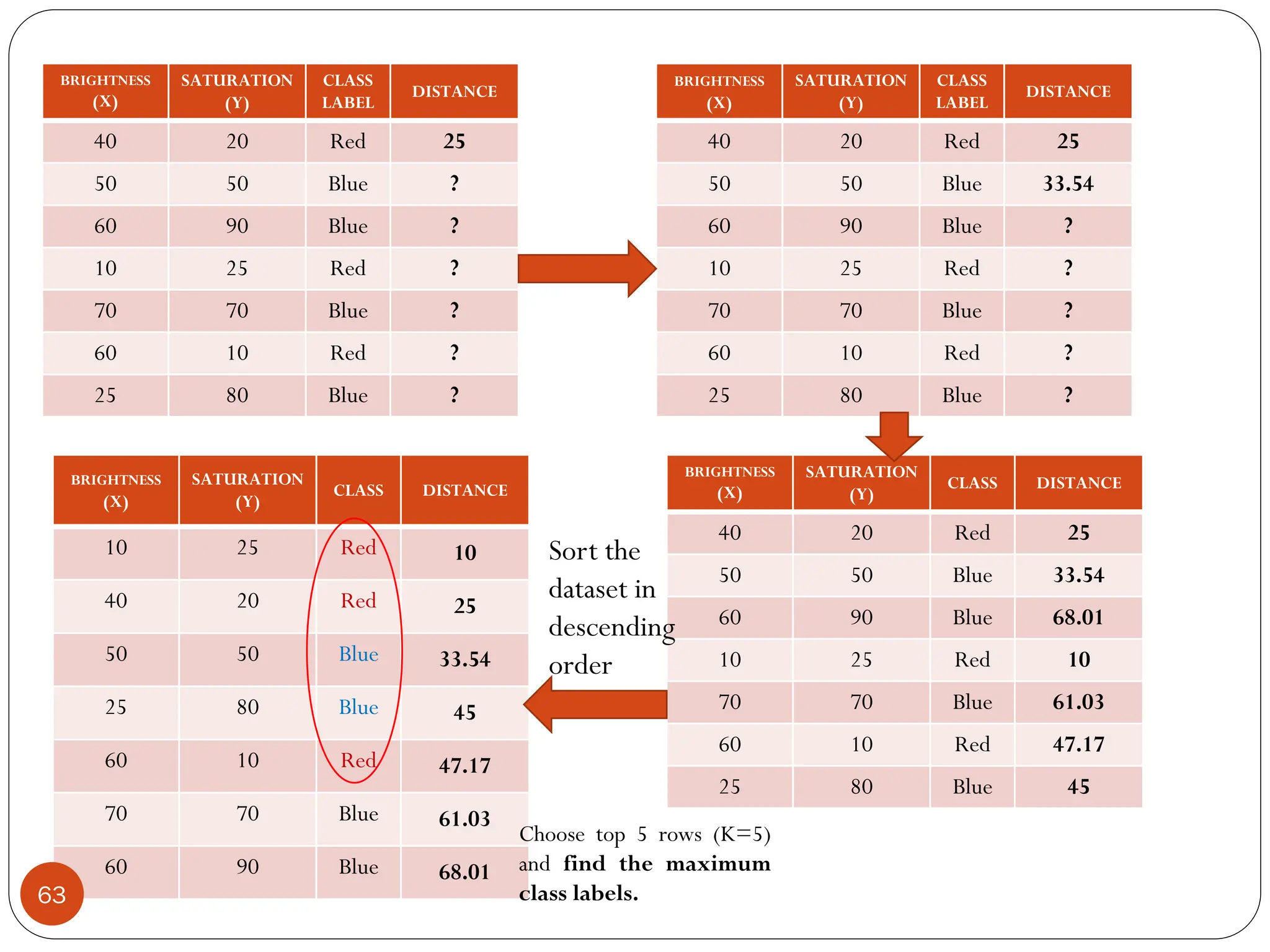
BRIGHTNESS
(X)
SATURATION
(Y)
CLASS
LABEL
DISTANCE
40 20 Red 25
50 50 Blue ?
60 90 Blue ?
10 25 Red ?
70 70 Blue ?
60 10 Red ?
25 80 Blue ?
BRIGHTNESS
(X)
SATURATION
(Y)
CLASS
LABEL
DISTANCE
40 20 Red 25
50 50 Blue 33.54
60 90 Blue ?
10 25 Red ?
70 70 Blue ?
60 10 Red ?
25 80 Blue ?
BRIGHTNESS
(X)
SATURATION
(Y)
CLASS DISTANCE
40 20 Red 25
50 50 Blue 33.54
60 90 Blue 68.01
10 25 Red 10
70 70 Blue 61.03
60 10 Red 47.17
25 80 Blue 45
BRIGHTNESS
(X)
SATURATION
(Y)
CLASS DISTANCE
10 25 Red 10
40 20 Red 25
50 50 Blue 33.54
25 80 Blue 45
60 10 Red 47.17
70 70 Blue 61.03
60 90 Blue 68.01
Sort the
dataset in
descending
order
Choose top 5 rows (K=5)
and find the maximum
class labels.
63
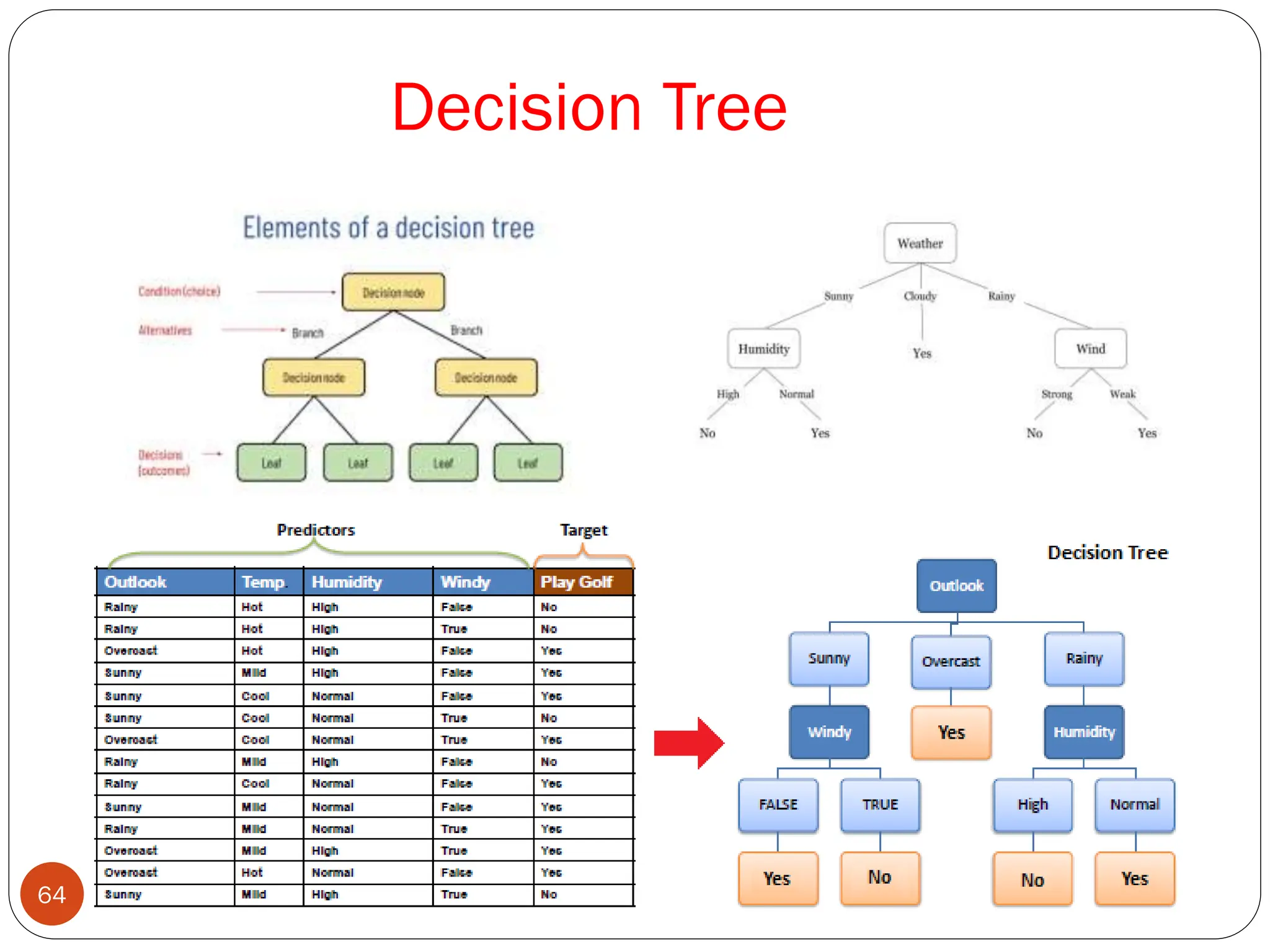
Decision Tree
64
65
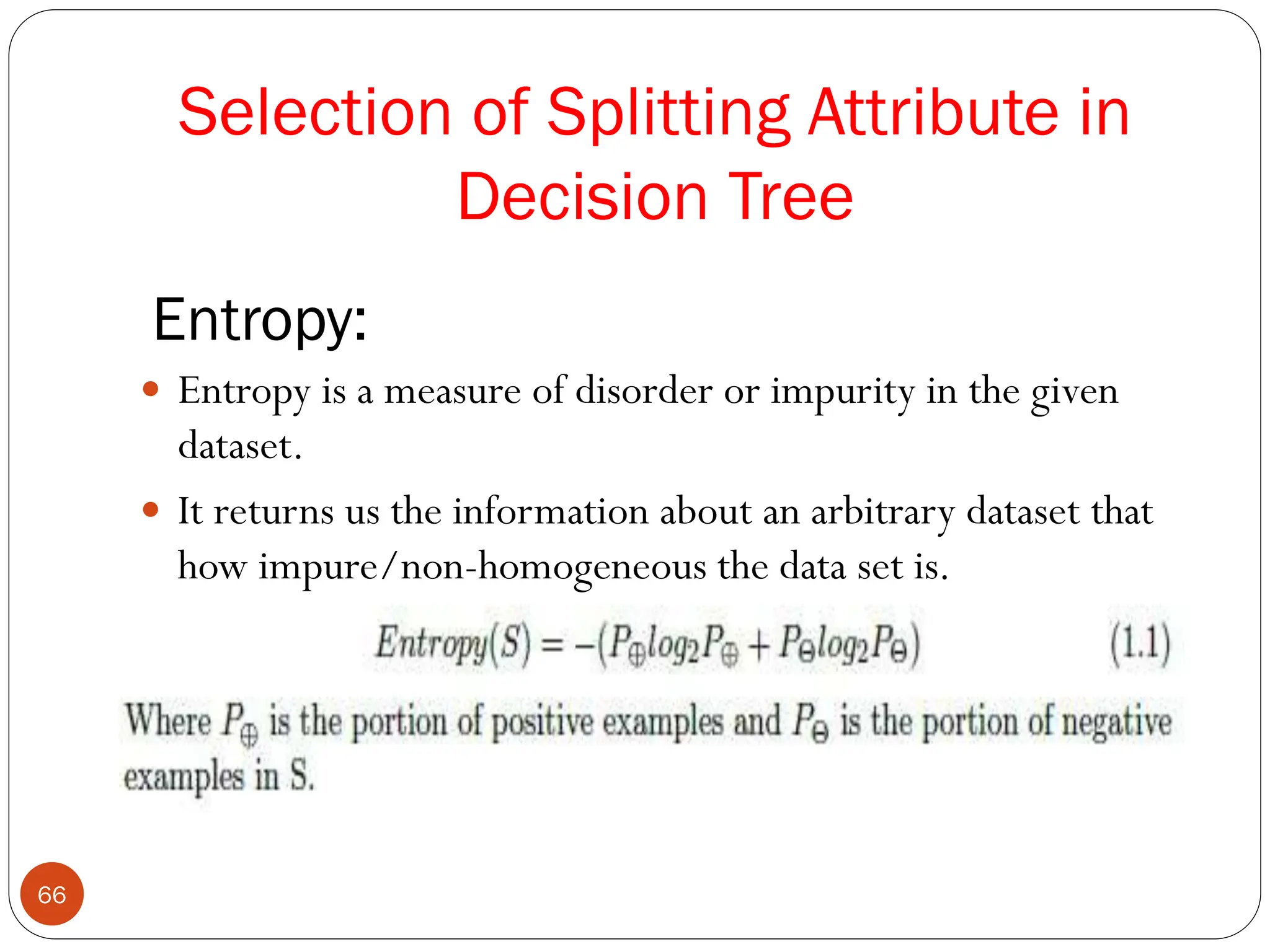
Entropy:
 Entropy is a measure of disorder or impurity in the given
dataset.
 It returns us the information about an arbitrary dataset that
how impure/non-homogeneous the data set is.
Selection of Splitting Attribute in
Decision Tree
66
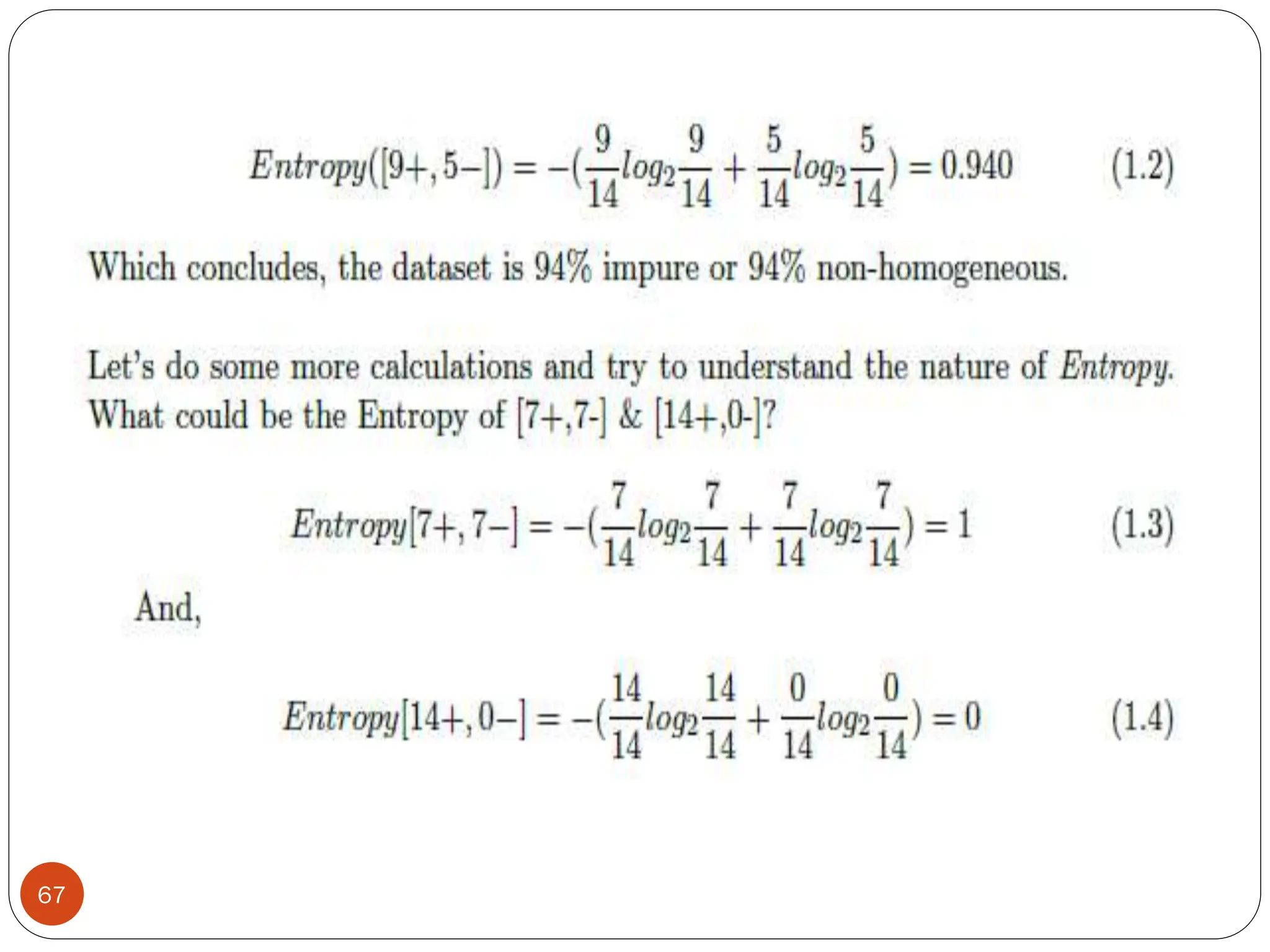
67
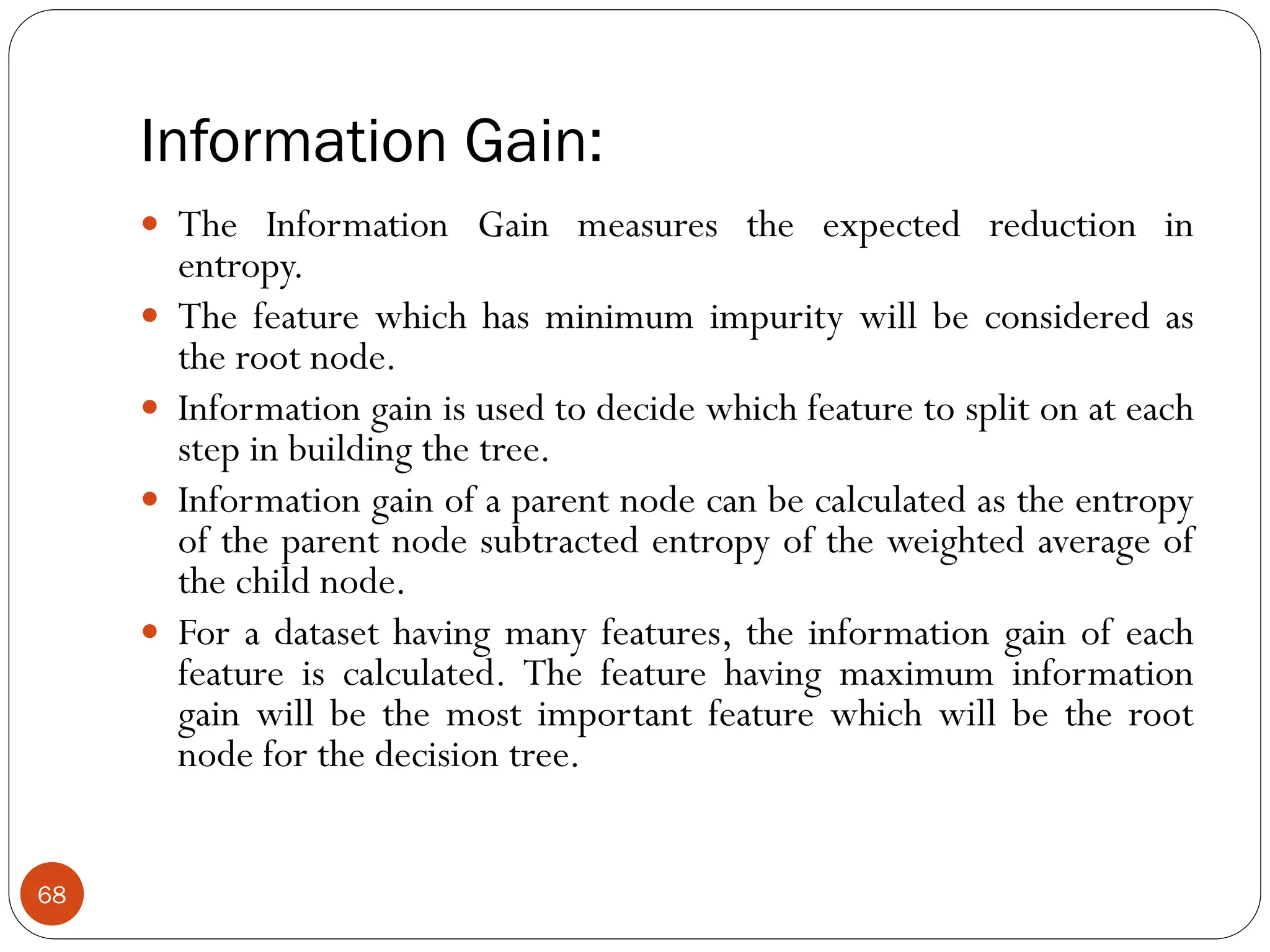
Information Gain:
 The Information Gain measures the expected reduction in
entropy.
 The feature which has minimum impurity will be considered as
the root node.
 Information gain is used to decide which feature to split on at each
step in building the tree.
 Information gain of a parent node can be calculated as the entropy
of the parent node subtracted entropy of the weighted average of
the child node.
 For a dataset having many features, the information gain of each
feature is calculated. The feature having maximum information
gain will be the most important feature which will be the root
node for the decision tree.
68
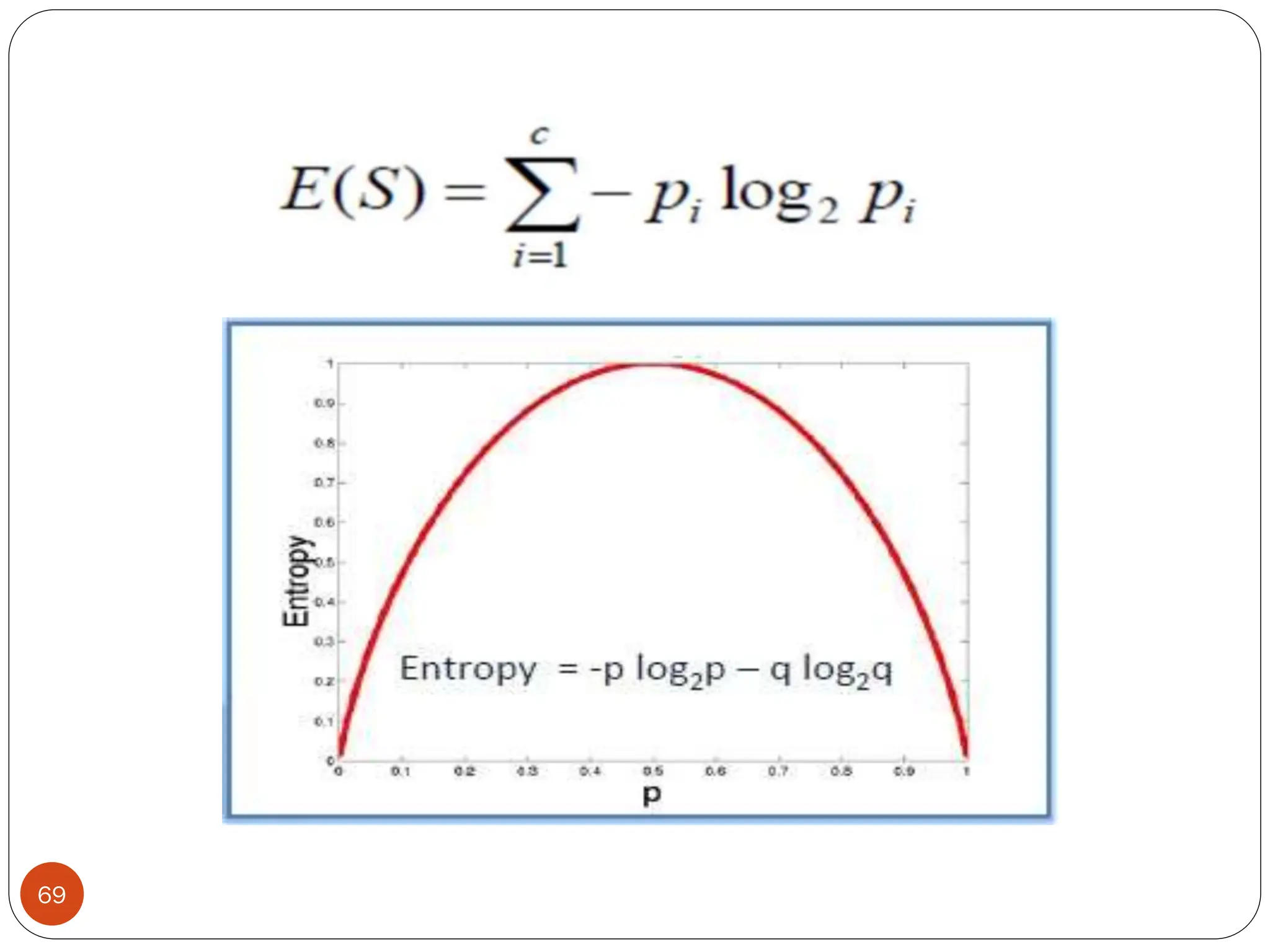
69
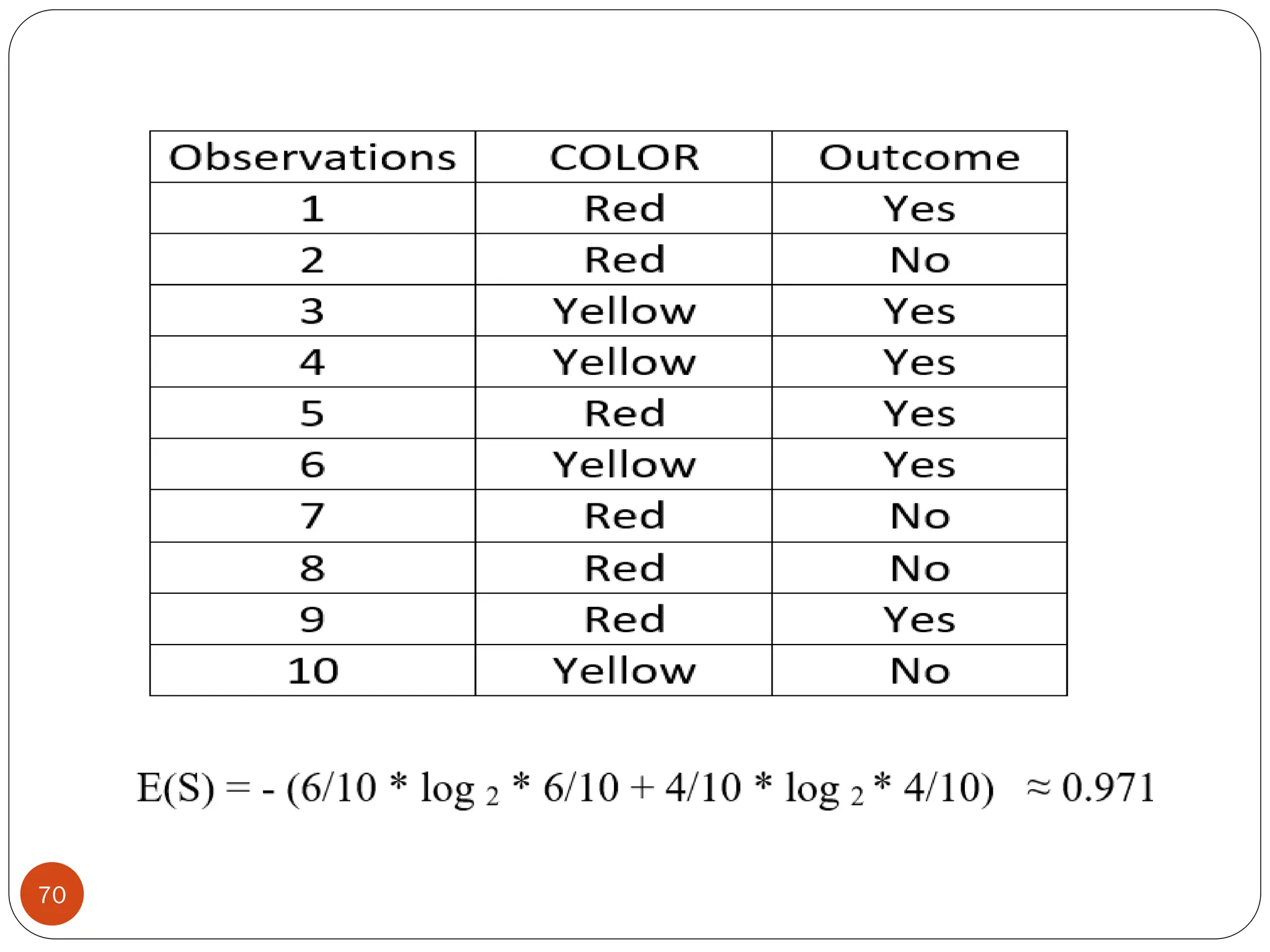
70
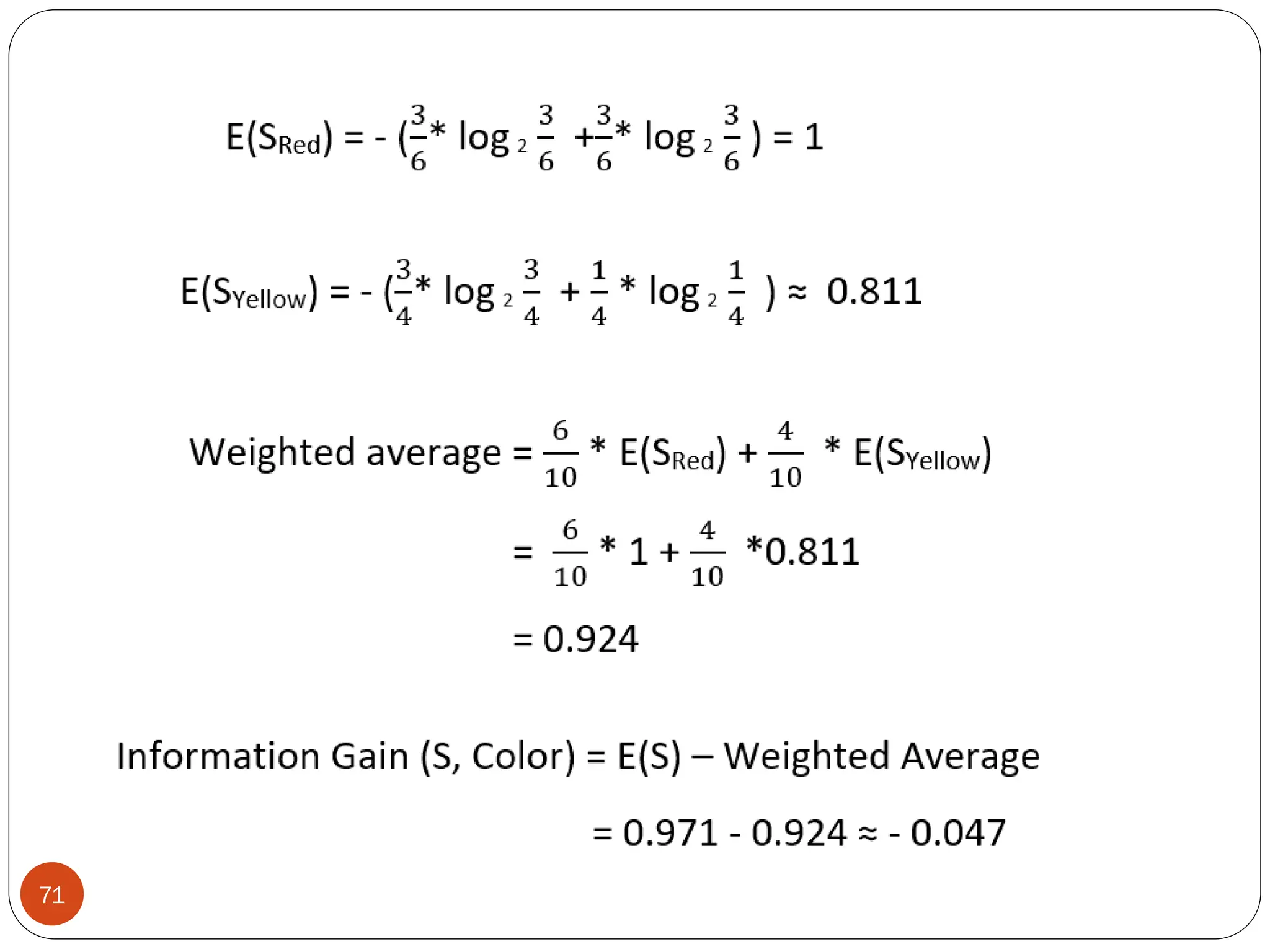
71
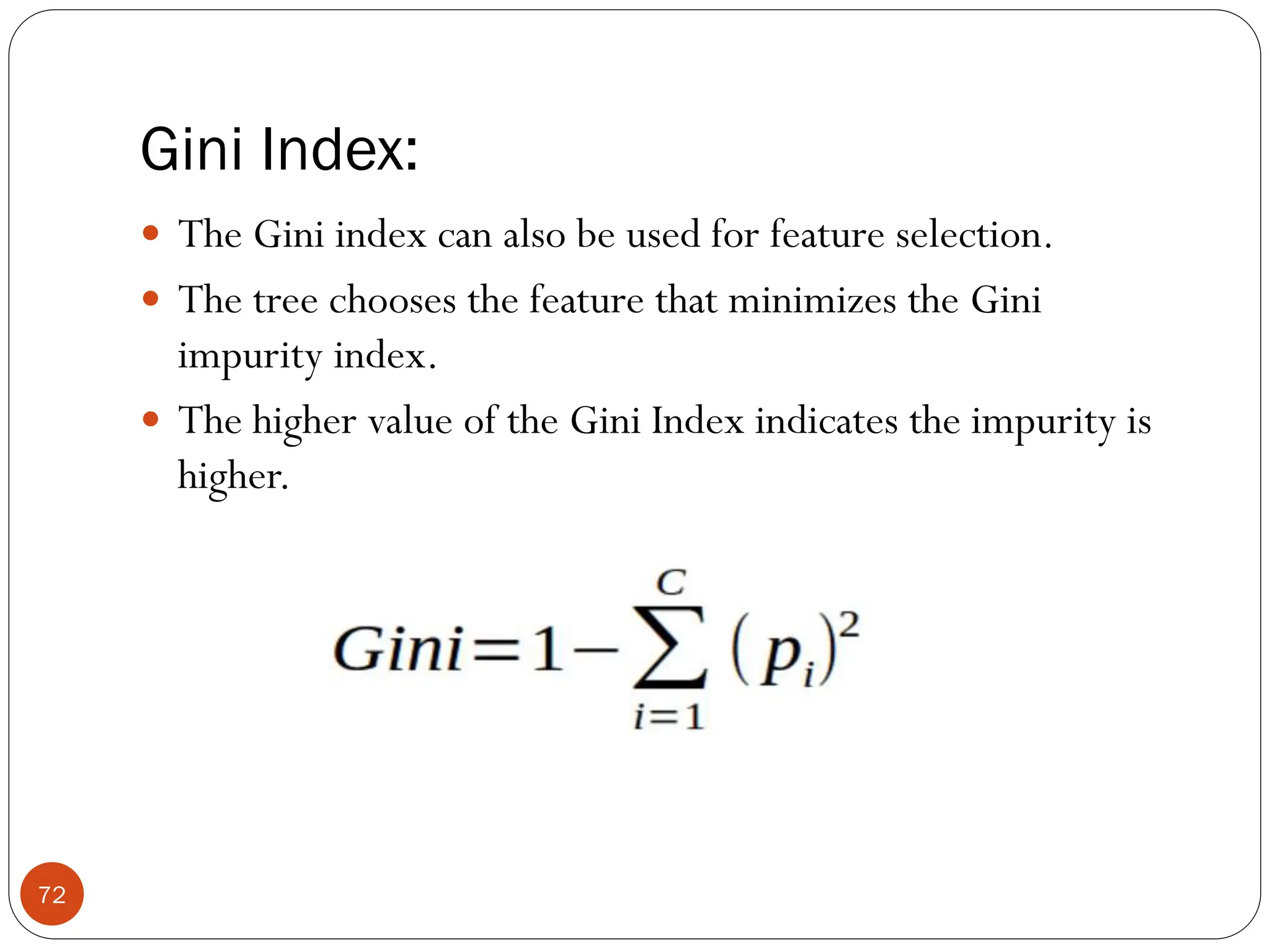
Gini Index:
 The Gini index can also be used for feature selection.
 The tree chooses the feature that minimizes the Gini
impurity index.
 The higher value of the Gini Index indicates the impurity is
higher.
72
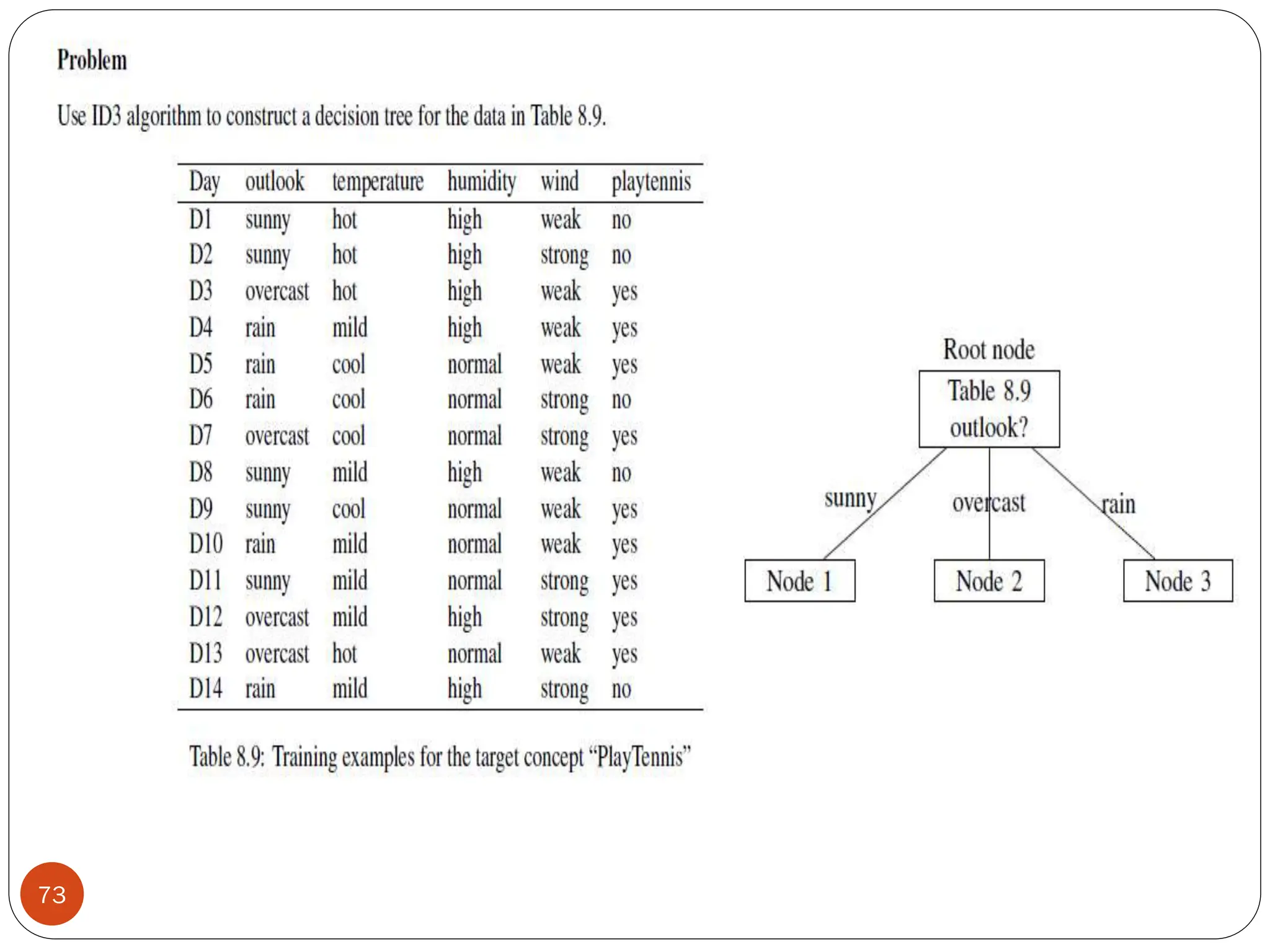
73
74
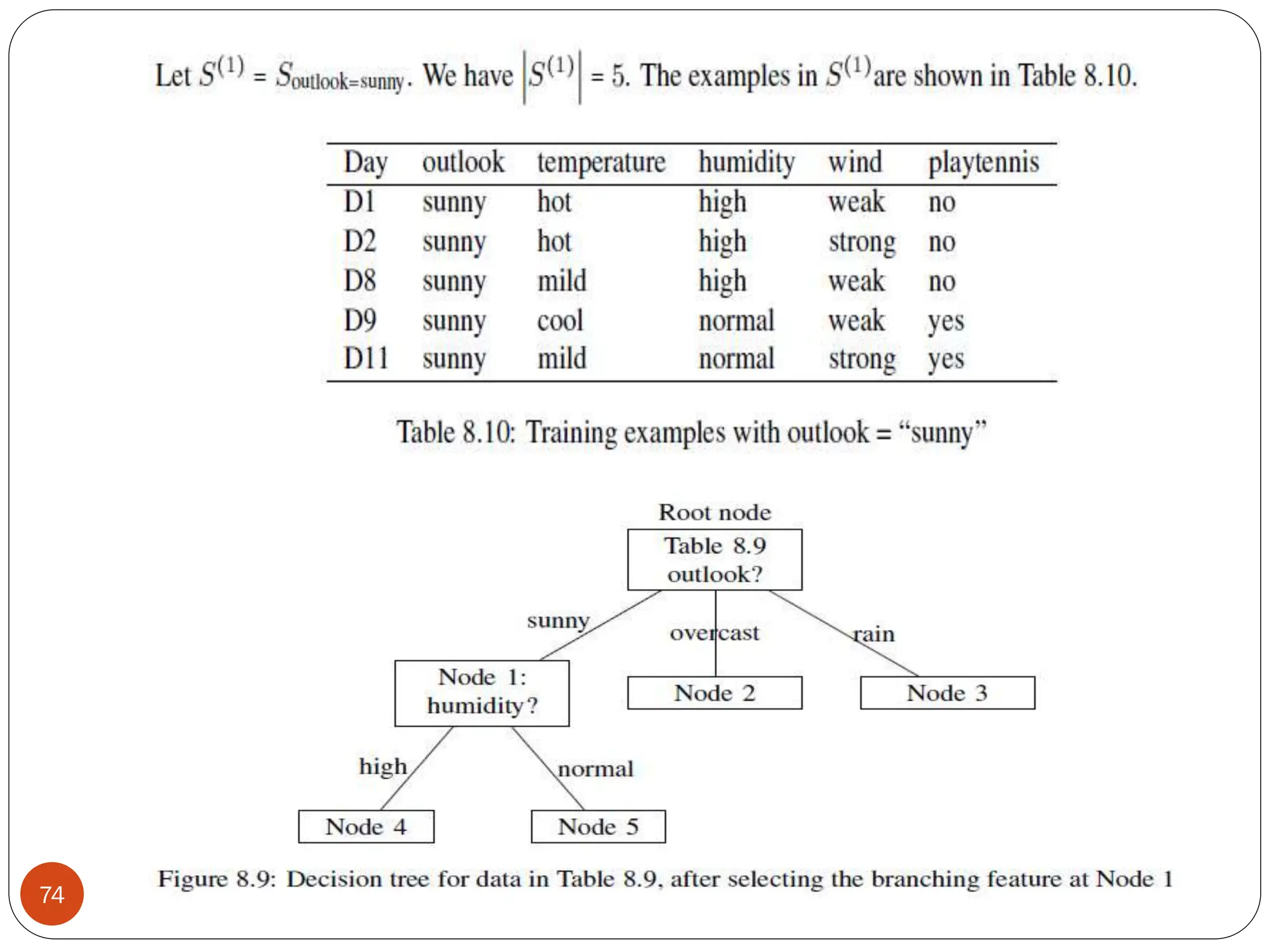
Finally, let = Soutlook = rain.The highest information gain for this data set is
Gain(S(2); humidity).The branches resulting from splitting this node corresponding to the
values “high” and “normal” of “humidity” lead to leaf nodes with class labels “no” and ”yes”.
With these changes, we get the tree in Figure 8.10.
(2)
S
75
Support Vector Machine
Linear
Non Linear
76
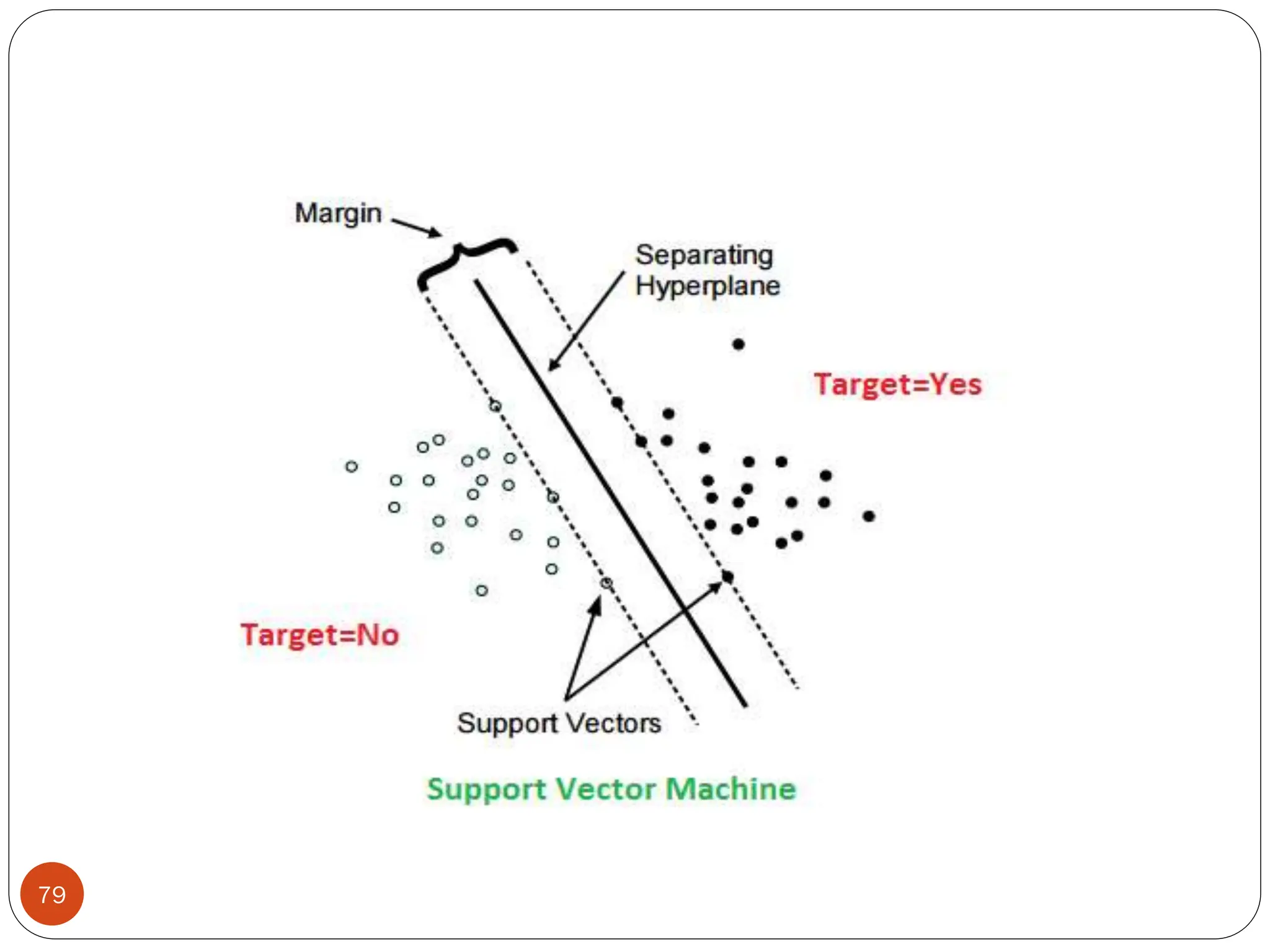
 Hyperplane:
A hyperplane is a decision boundary which separates
between given set of data points having different class labels.
The SVM classifier separates data points using a hyperplane
with the maximum amount of margin. This hyperplane is
known as the maximum margin hyperplane and the linear
classifier it defines is known as the maximum margin
classifier.
77
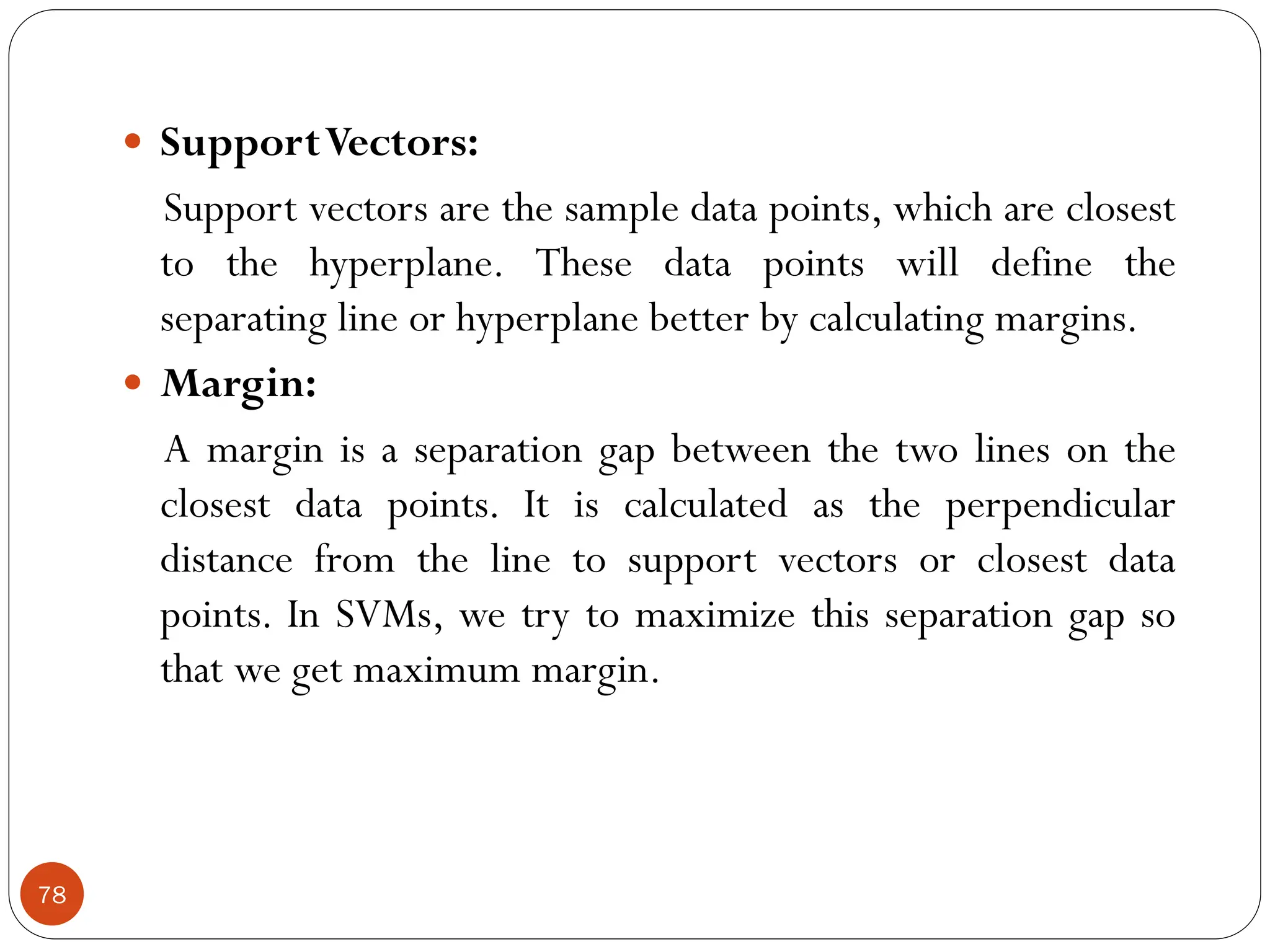
 SupportVectors:
Support vectors are the sample data points, which are closest
to the hyperplane. These data points will define the
separating line or hyperplane better by calculating margins.
 Margin:
A margin is a separation gap between the two lines on the
closest data points. It is calculated as the perpendicular
distance from the line to support vectors or closest data
points. In SVMs, we try to maximize this separation gap so
that we get maximum margin.
78
79
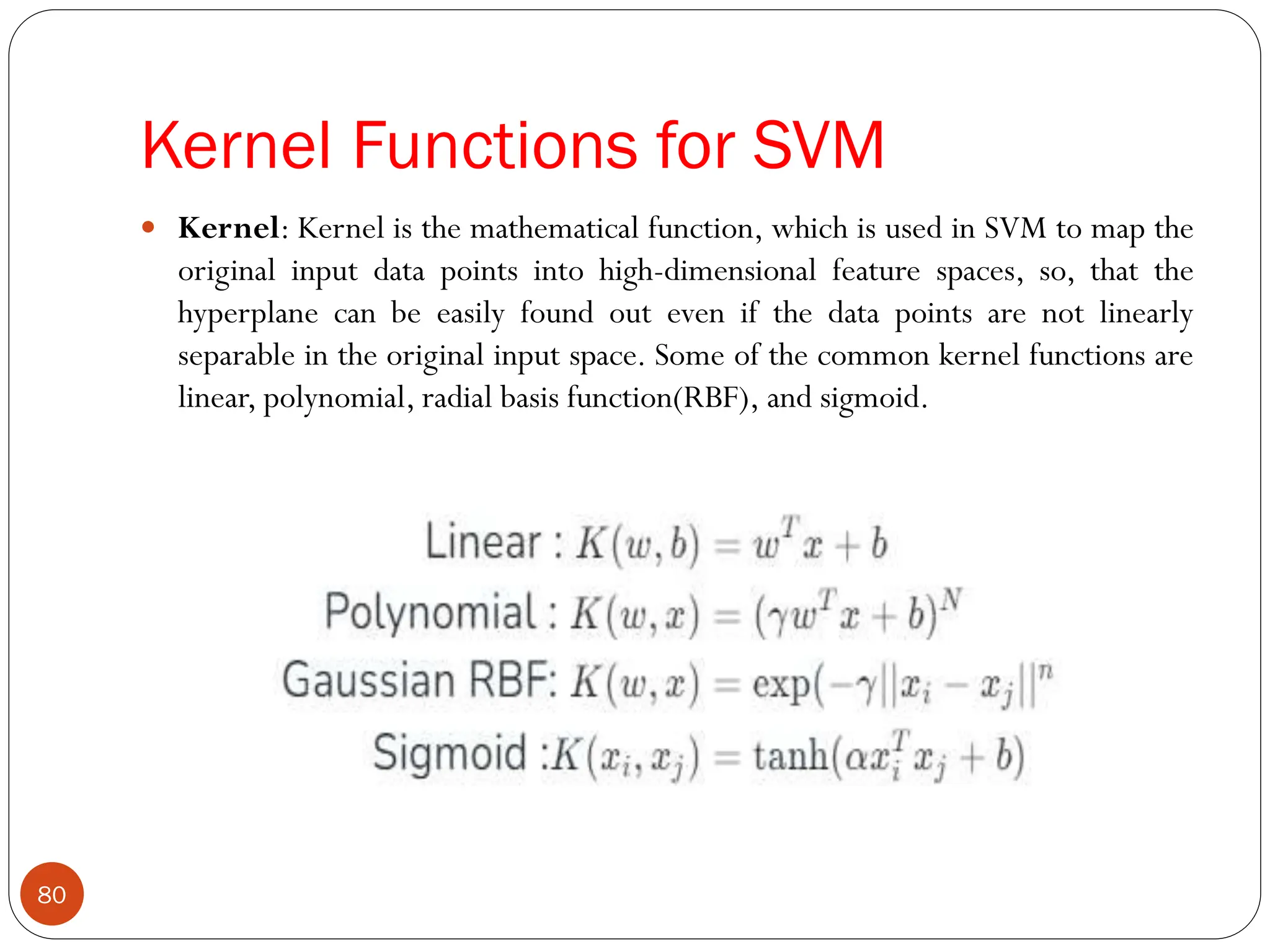
Kernel Functions for SVM
 Kernel: Kernel is the mathematical function, which is used in SVM to map the
original input data points into high-dimensional feature spaces, so, that the
hyperplane can be easily found out even if the data points are not linearly
separable in the original input space. Some of the common kernel functions are
linear, polynomial, radial basis function(RBF), and sigmoid.
80
81
82
83
Overfitting and Underfitting
84
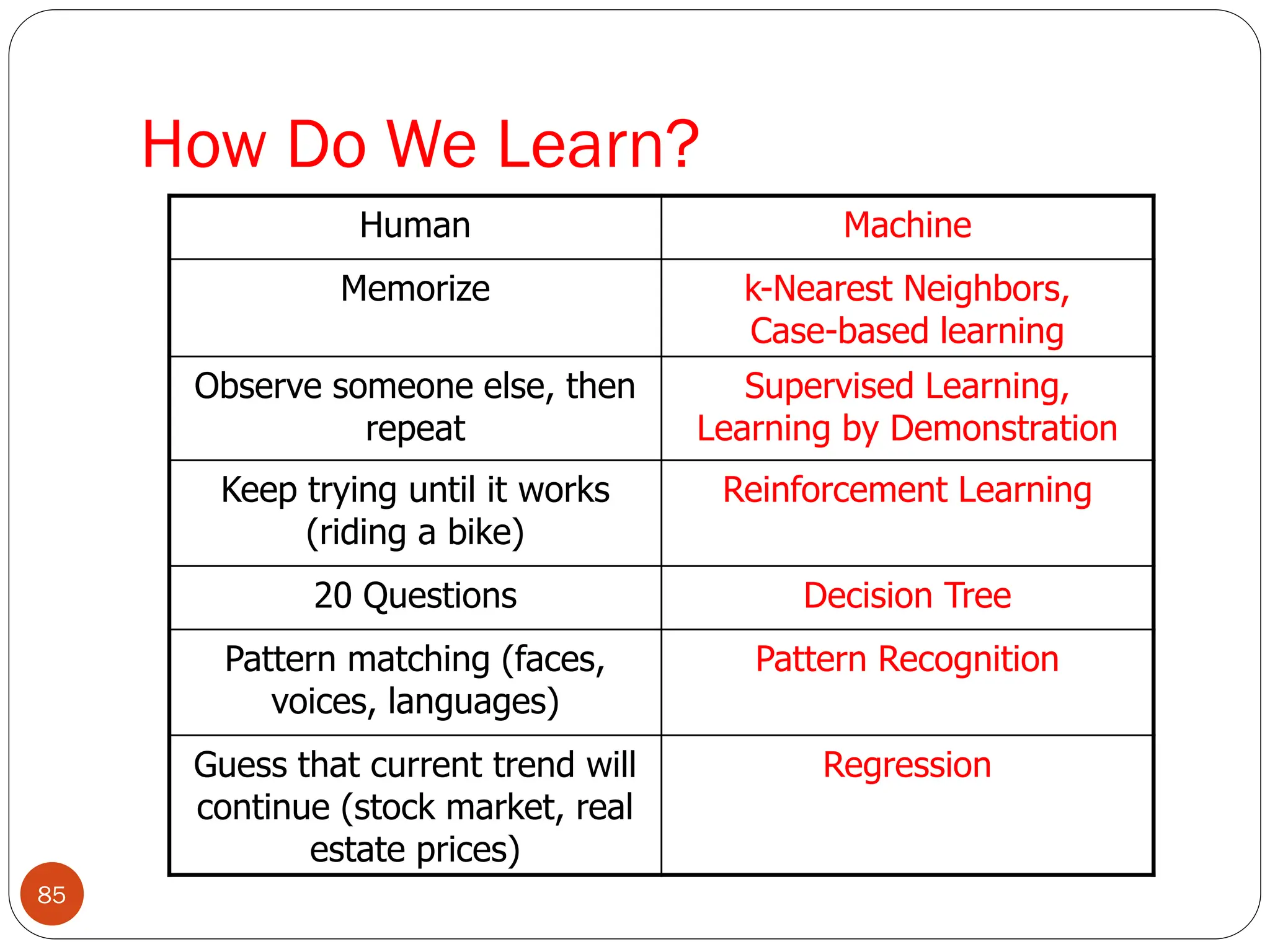
How Do We Learn?
Human Machine
Memorize k-Nearest Neighbors,
Case-based learning
Observe someone else, then
repeat
Supervised Learning,
Learning by Demonstration
Keep trying until it works
(riding a bike)
Reinforcement Learning
20 Questions Decision Tree
Pattern matching (faces,
voices, languages)
Pattern Recognition
Guess that current trend will
continue (stock market, real
estate prices)
Regression
85
Reference Books
 R. Duda, P. Hart & D. Stork, Pattern Classification (2nd ed.),
Wiley (Required)
 T. Mitchell, Machine Learning,McGraw-Hill(Recommended)
 Introduction to Machine Learning by Ethem Alpaydin (2nd edition,
2010, MIT Press).Written by computer scientist and material is
accessible with basic probability and linear algebra background
 Foundations of Machine Learning by Afshin Rostamizadeh,Ameet
Talwalkar, and Mehryar Mohri (2012, MIT Press)
 Learning with Kernels by Scholkopf and Smola (2001, MIT Press)
 Applied predictive modeling by Kuhn and Johnson (2013, Springer).
This book focuses on practical modeling.
86
About Me
 Dr.Amitava Halder
B.Tech. (Wbut), M.Tech. (IIEST formerly BESU), Ph.D.
(Jadavpur University)
 Contact Information:
9831402704/9073310777
 Mail Id: amitava.halder2008@gmail.com
 Google Scholar Id: J-kPvN8AAAAJ
 Research Domain/Interest: Image Processing, Biomedical
Image Processing, Machine Learning, Deep Learning, Pattern
Recognition.
Please cite my works available at Google Scholar!!
87
88
89

Presentation-19.08.2024hvug7gugyvuvugugugugugug

  • 1.
    Dr.Amitava Halder Assistant Professor ComputerScience & Engineering Department, Dr. Sudhir Chandra Sur Institute ofTechnology and Sports Complex Introduction to Machine Learning
  • 2.
    What is Learning? “Togain knowledge or understanding of, or skill in by study, instruction or experience''  Learning a set of new facts.  Learning HOW to do something .  Improving ability of something already learned. 2
  • 3.
     Learning generalmodels from a data of particular examples  Data is cheap and abundant (data warehouses, data marts); knowledge is expensive and scarce.  Example in retail: Customer transactions to consumer behavior: People who bought“DaVinci Code”also bought“The Five PeopleYou Meet in Heaven” (www.amazon.com)  Build a model that is a good and useful approximation to the data. Computer’s Perspective 3
  • 4.
    Learning is usedwhen  Human expertise does not exist (navigating on Mars),  Humans are unable to explain their expertise (speech recognition)  Solution changes in time (routing on a computer network)  Solution needs to be adapted to particular cases (user biometrics) Why “Learning”? 4
  • 5.
    A Few Quotes “A breakthrough in machine learning would be worth ten Microsofts” (Bill Gates, Chairman, Microsoft)  “Machine learning is the next Internet” (TonyTether, Director, DARPA)  Machine learning is the hot new thing” (John Hennessy, President, Stanford)  “Web rankings today are mostly a matter of machine learning” (Prabhakar Raghavan, Dir. Research,Yahoo)  “Machine learning is going to result in a real revolution” (Greg Papadopoulos, CTO, Sun)  “Machine learning is today’s discontinuity” (JerryYang, CEO,Yahoo) 5
  • 6.
    So What IsMachine Learning?  Machine learning is programming computers to optimize a performance criterion using example data or past experience.  Machine Learning is the study of methods for programming computers to learn.  Building machines that automatically learn from experience.  Automating automation  Getting computers to program themselves  Writing software is the bottleneck  Let the data do the work instead! 6
  • 7.
  • 8.
     We cannotwrite the program ourselves  We don’t have the expertise (circuit design)  We cannot explain how (speech recognition)  Problem changes over time (packet routing)  Need customized solutions (spam filtering) Why use Machine Learning? 8
  • 9.
  • 10.
     Web mining:Search engines  Computational biology  Medicine: Medical diagnosis  Retail: Market basket analysis, Customer relationship management (CRM)  Finance: Credit scoring, fraud detection  Manufacturing: Optimization, troubleshooting  E-commerce  Space exploration  Robotics  Information extraction  Social networks  Debugging  [Your favorite area] Sample Applications 10
  • 11.
  • 12.
  • 13.
  • 14.
  • 15.
  • 16.
  • 17.
  • 18.
  • 19.
  • 20.
  • 21.
  • 22.
    ML in aNutshell  Tens of thousands of machine learning algorithms  Hundreds new every year  Every machine learning algorithm has three components:  Representation  Evaluation  Optimization 22
  • 23.
    Representation  Decision trees Sets of rules / Logic programs  Instances  Graphical models (Bayes/Markov nets)  Neural networks  Support vector machines  Model ensembles  Etc. 23
  • 24.
    Evaluation  Accuracy  Precisionand recall  Squared error  Likelihood  Posterior probability  Cost / Utility  Margin  Entropy  K-L divergence  Etc. 24
  • 25.
    Optimization  Combinatorial optimization E.g.: Greedy search  Convex optimization  E.g.: Gradient descent  Constrained optimization  E.g.: Linear programming 25
  • 26.
    Machine Learning Resources •Data – NIPS 2003 feature selection contest – mldata.org – UCI machine learning repository – LIDC-IDRI (Lung Nodule/Tumor Images), MICCAI(Brain MRI Images) • Contests – Kaggle • Software – Python sci-kit – R – Tensorflow – Keras, Pytorch – Your own code 26
  • 27.
    Machine Learning Steps ProblemDefinition Data Collection Data Preprocessing FEATURE EXTRACTION Detection Classification Characterization 27
  • 28.
    Example Pipeline..... Image acquisitionand pre-processing Lung segmentation Thorax extraction Lung extraction Nodule detection Nodule candidate detection/ Tubular structure elimination Feature extraction/ False Positive reduction Nodule Detection/Classification Nodule Detection Framework Problem Definition Data Collection Data Preprocessing FEATURE EXTRACTION Detection Classification Characterization 28
  • 29.
    Detection vs. Classificationvs. Characterization Typical SPNs for different type (a)Well- circumscribed nodule, (b) Juxta-vascular nodule, (c) Nodule with a pleural tail, (d) Juxta-pleural nodule Benign Malignant Characterization Classification Detection (Finding the location of the ROI) 29
  • 30.
    Feature Extraction 1 Minor AxisValue Elongation MajorAxisValue   4 2 Area Cir Perimeter    Area of Object Ext Areaof theBounding Box  30
  • 31.
    What about GGOnodule? 31
  • 32.
  • 33.
     Given examplesof a function (X,F(X))  Predict function F(X) for new examples X  Discrete F(X): Classification  Continuous F(X): Regression  F(X) = Probability(X): Probability estimation Inductive Learning 33
  • 34.
  • 35.
  • 36.
  • 37.
  • 38.
    Supervised Learning  Regressionis used for ContinuousTargetValue  Classification is used for discreteTargetValue(Class Label) Supervised Learning Regression Classification 38
  • 39.
    Regression  Regression isused for ContinuousTargetValue  Classification is used for discreteTargetValue(Class Label) Regression Logistics Linear 39
  • 40.
     In machinelearning, a regression problem is the problem of predicting the value of a numeric variable based on observed values of the variable.  These are often quantities, such as amounts and sizes. Brain (in standard units) Height (in inches) Weight (in Pounds) IQ Score (in appropriate scales) 81.69 64.5 118 124 103.84 73.3 143 150 96.54 68.8 172 128 95.15 65.0 147 134 92.88 69.0 146 110 99.13 64.5 138 131 85.43 66.0 175 98 90.49 66.3 134 84 95.55 68.8 172 147 83.39 64.5 118 124 40
  • 41.
  • 42.
    Logistic  Linear regression+ Sigmoid function  Logistic regression is used when the dependent variable is binary (0/1,True/False,Yes/No) in nature. 42
  • 43.
  • 44.
    Classification  A classificationproblem requires that examples be classified into one of two or more classes.  A problem with two classes is often called a two-class or binary classification problem.  A problem with more than two classes is often called a multi- class classification problem.  A problem where an example is assigned multiple classes is called a multi-label classification problem. 44
  • 45.
     Binary Classification:This is the most basic type of classification. In this case, an input is classified into one of two possible categories. For example, a common application of binary classification is in determining whether an animal is a 'cat' or a 'dog'. 45
  • 46.
     Multiclass Classification:This type of classification involves classifying an input into one of three or more categories. An example of this is the identifying image, where an image can be classified as a train, ship, bus, or airplane, thus involving four different classes. 46
  • 47.
     Imbalanced Classification:This is a specialized form of classification where the classes are not equally distributed. It's often found in real-world scenarios where one class significantly outnumbers the other. For example, in identifying manufacturing defects, the 'defective' class is usually outnumbered by the 'non-defective' class. 47
  • 48.
     Multilabel Classification:This is a more complex scenario where an input can be associated with multiple labels e.g.,  In a movie recommendation system, a single movie could be tagged with several genres, such as 'action', 'adventure', and 'sci-fi'.  An image can contain multiple objects, as illustrated below: the model predicted that the image contains: a plane, a boat, a truck, and a dog. 48
  • 49.
  • 50.
    Classifier  Naive BayesClassifier  Nearest Neighbor Classifier  DecisionTree 50
  • 51.
    Linear Versus NonLinear Boundary 51
  • 52.
    Bayes’ Theorem  Ais called the proposition and B is called the evidence.  P(A) is called the prior probability of proposition and P(B) is called the prior probability of evidence.  P(A|B ) is called the posterior probability of A given B.  P(B|A) is called the likelihood of B given A. 52
  • 53.
  • 54.
    Naive Bayes Classifier Sl. No. SwimFly Crawl Class 1 Fast No No Fish 2 Fast No Yes Animal 3 Slow No No Animal 4 Fast No No Animal 5 No Short No Bird 6 No Short No Bird 7 No Rarely No Animal 8 Slow No Yes Animal 9 Slow No No Fish 10 Slow No Yes Fish 11 No Long No Bird 12 Fast No No Bird 54
  • 55.
    •P(c|x) is theposterior probability of class (target) given predictor (attribute). •P(c) is the prior probability of class. •P(x|c) is the likelihood which is the probability of predictor given class. •P(x) is the prior probability of predictor. 55
  • 56.
    Sl. No. SwimFly Crawl Class 1 Fast No No Fish 2 Fast No Yes Animal 3 Slow No No Animal 4 Fast No No Animal 5 No Short No Bird 6 No Short No Bird 7 No Rarely No Animal 8 Slow No Yes Animal 9 Slow No No Fish 10 Slow No Yes Fish 11 No Long No Bird 12 Fast No No Bird Feature Name Value Swim Fast, Slow, No Fly Long, Short, Rarely, No Crawl Yes, No Use naive Bayes algorithm to classify a particular species if its features (X)=(Slow, Rarely, No)? Example 56
  • 57.
    Class Features Total Swim (F1) Fly(F2) Craw (F3) Fast Slow No Long Short Rarely No Yes No Animal (c1) 2 2 1 0 0 1 4 2 3 5 Bird (c2) 1 0 3 1 2 0 1 1 3 4 Fish (c3) 1 2 0 0 0 0 3 0 3 3 Total 4 4 4 1 2 1 8 3 9 12 57
  • 58.
    Class Features Swim (F1) Fly(F2) Craw (F3) Fast Slow No Long Short Rarely No Yes No Animal (c1) 2/5 2/5 1/5 0/5 0/5 1/5 4/5 2/5 3/5 Bird (c2) 1/4 0/4 3/4 1/4 2/4 0/4 1/4 1/4 3/4 Fish (c3) 1/3 2/3 0/3 0/3 0/3 0/3 3/3 0/3 3/3 58
  • 59.
    max{q1, q2, q3}= 0.02. 59
  • 60.
  • 61.
    Apply KNN withK=3 Output 61
  • 62.
    BRIGHTNESS (X) SATURATION(Y) CLASS LABEL 40 20 Red 50 50 Blue 60 90 Blue 10 25 Red 70 70 Blue 60 10 Red 25 80 Blue BRIGHTNESS (Xtest) SATURATION (Ytest) CLASS LABEL 20 35 ?     2 2 i test i test d x x y y     d1 = √(20 - 40)² + (35 - 20)² = √400 + 225 = √625 = 25 62
  • 63.
    BRIGHTNESS (X) SATURATION (Y) CLASS LABEL DISTANCE 40 20 Red25 50 50 Blue ? 60 90 Blue ? 10 25 Red ? 70 70 Blue ? 60 10 Red ? 25 80 Blue ? BRIGHTNESS (X) SATURATION (Y) CLASS LABEL DISTANCE 40 20 Red 25 50 50 Blue 33.54 60 90 Blue ? 10 25 Red ? 70 70 Blue ? 60 10 Red ? 25 80 Blue ? BRIGHTNESS (X) SATURATION (Y) CLASS DISTANCE 40 20 Red 25 50 50 Blue 33.54 60 90 Blue 68.01 10 25 Red 10 70 70 Blue 61.03 60 10 Red 47.17 25 80 Blue 45 BRIGHTNESS (X) SATURATION (Y) CLASS DISTANCE 10 25 Red 10 40 20 Red 25 50 50 Blue 33.54 25 80 Blue 45 60 10 Red 47.17 70 70 Blue 61.03 60 90 Blue 68.01 Sort the dataset in descending order Choose top 5 rows (K=5) and find the maximum class labels. 63
  • 64.
  • 65.
  • 66.
    Entropy:  Entropy isa measure of disorder or impurity in the given dataset.  It returns us the information about an arbitrary dataset that how impure/non-homogeneous the data set is. Selection of Splitting Attribute in Decision Tree 66
  • 67.
  • 68.
    Information Gain:  TheInformation Gain measures the expected reduction in entropy.  The feature which has minimum impurity will be considered as the root node.  Information gain is used to decide which feature to split on at each step in building the tree.  Information gain of a parent node can be calculated as the entropy of the parent node subtracted entropy of the weighted average of the child node.  For a dataset having many features, the information gain of each feature is calculated. The feature having maximum information gain will be the most important feature which will be the root node for the decision tree. 68
  • 69.
  • 70.
  • 71.
  • 72.
    Gini Index:  TheGini index can also be used for feature selection.  The tree chooses the feature that minimizes the Gini impurity index.  The higher value of the Gini Index indicates the impurity is higher. 72
  • 73.
  • 74.
  • 75.
    Finally, let =Soutlook = rain.The highest information gain for this data set is Gain(S(2); humidity).The branches resulting from splitting this node corresponding to the values “high” and “normal” of “humidity” lead to leaf nodes with class labels “no” and ”yes”. With these changes, we get the tree in Figure 8.10. (2) S 75
  • 76.
  • 77.
     Hyperplane: A hyperplaneis a decision boundary which separates between given set of data points having different class labels. The SVM classifier separates data points using a hyperplane with the maximum amount of margin. This hyperplane is known as the maximum margin hyperplane and the linear classifier it defines is known as the maximum margin classifier. 77
  • 78.
     SupportVectors: Support vectorsare the sample data points, which are closest to the hyperplane. These data points will define the separating line or hyperplane better by calculating margins.  Margin: A margin is a separation gap between the two lines on the closest data points. It is calculated as the perpendicular distance from the line to support vectors or closest data points. In SVMs, we try to maximize this separation gap so that we get maximum margin. 78
  • 79.
  • 80.
    Kernel Functions forSVM  Kernel: Kernel is the mathematical function, which is used in SVM to map the original input data points into high-dimensional feature spaces, so, that the hyperplane can be easily found out even if the data points are not linearly separable in the original input space. Some of the common kernel functions are linear, polynomial, radial basis function(RBF), and sigmoid. 80
  • 81.
  • 82.
  • 83.
  • 84.
  • 85.
    How Do WeLearn? Human Machine Memorize k-Nearest Neighbors, Case-based learning Observe someone else, then repeat Supervised Learning, Learning by Demonstration Keep trying until it works (riding a bike) Reinforcement Learning 20 Questions Decision Tree Pattern matching (faces, voices, languages) Pattern Recognition Guess that current trend will continue (stock market, real estate prices) Regression 85
  • 86.
    Reference Books  R.Duda, P. Hart & D. Stork, Pattern Classification (2nd ed.), Wiley (Required)  T. Mitchell, Machine Learning,McGraw-Hill(Recommended)  Introduction to Machine Learning by Ethem Alpaydin (2nd edition, 2010, MIT Press).Written by computer scientist and material is accessible with basic probability and linear algebra background  Foundations of Machine Learning by Afshin Rostamizadeh,Ameet Talwalkar, and Mehryar Mohri (2012, MIT Press)  Learning with Kernels by Scholkopf and Smola (2001, MIT Press)  Applied predictive modeling by Kuhn and Johnson (2013, Springer). This book focuses on practical modeling. 86
  • 87.
    About Me  Dr.AmitavaHalder B.Tech. (Wbut), M.Tech. (IIEST formerly BESU), Ph.D. (Jadavpur University)  Contact Information: 9831402704/9073310777  Mail Id: amitava.halder2008@gmail.com  Google Scholar Id: J-kPvN8AAAAJ  Research Domain/Interest: Image Processing, Biomedical Image Processing, Machine Learning, Deep Learning, Pattern Recognition. Please cite my works available at Google Scholar!! 87
  • 88.
  • 89.