ELEMENT OF MACHINE
DESIGN (EMD)
UNIT 1
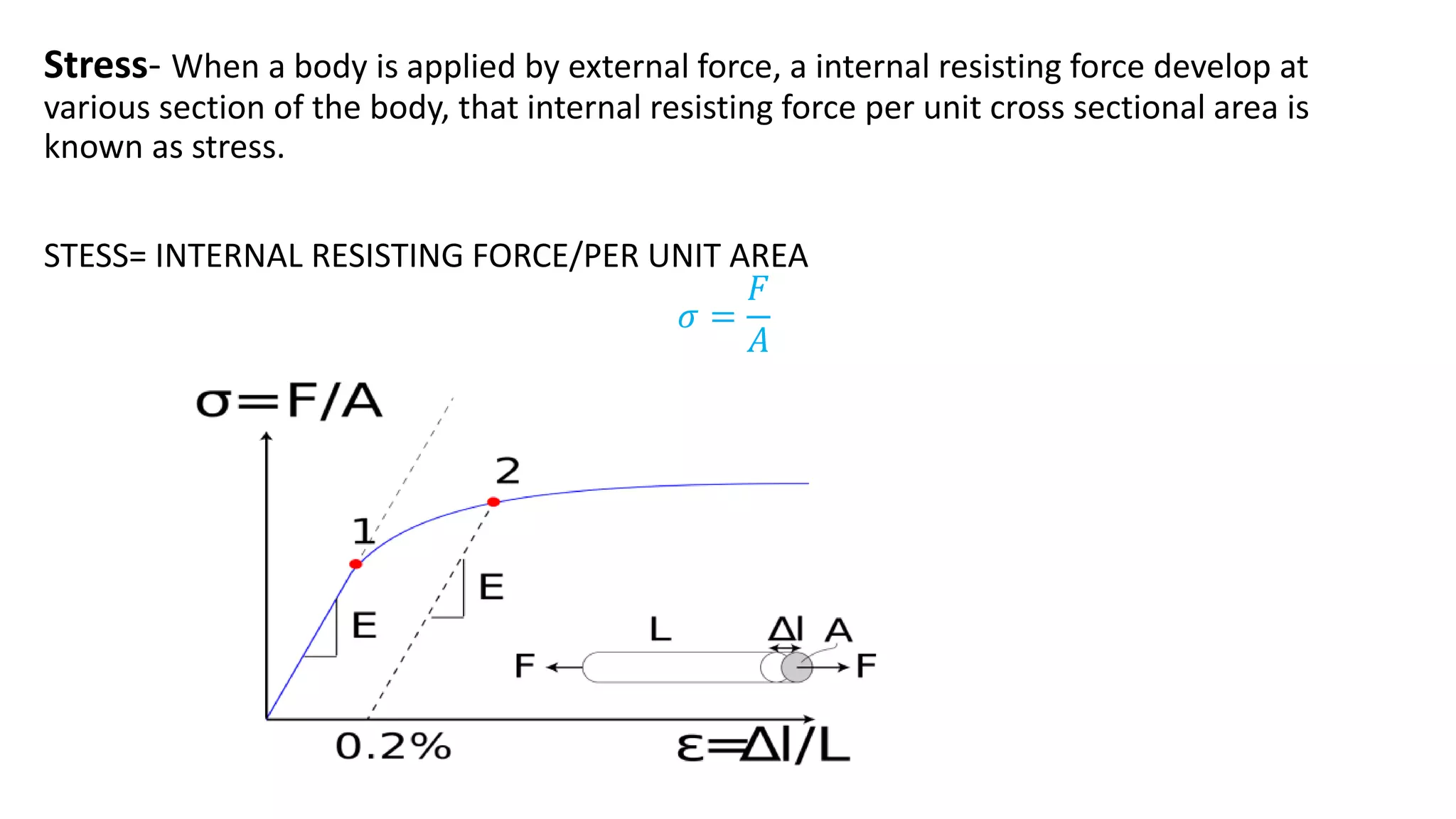
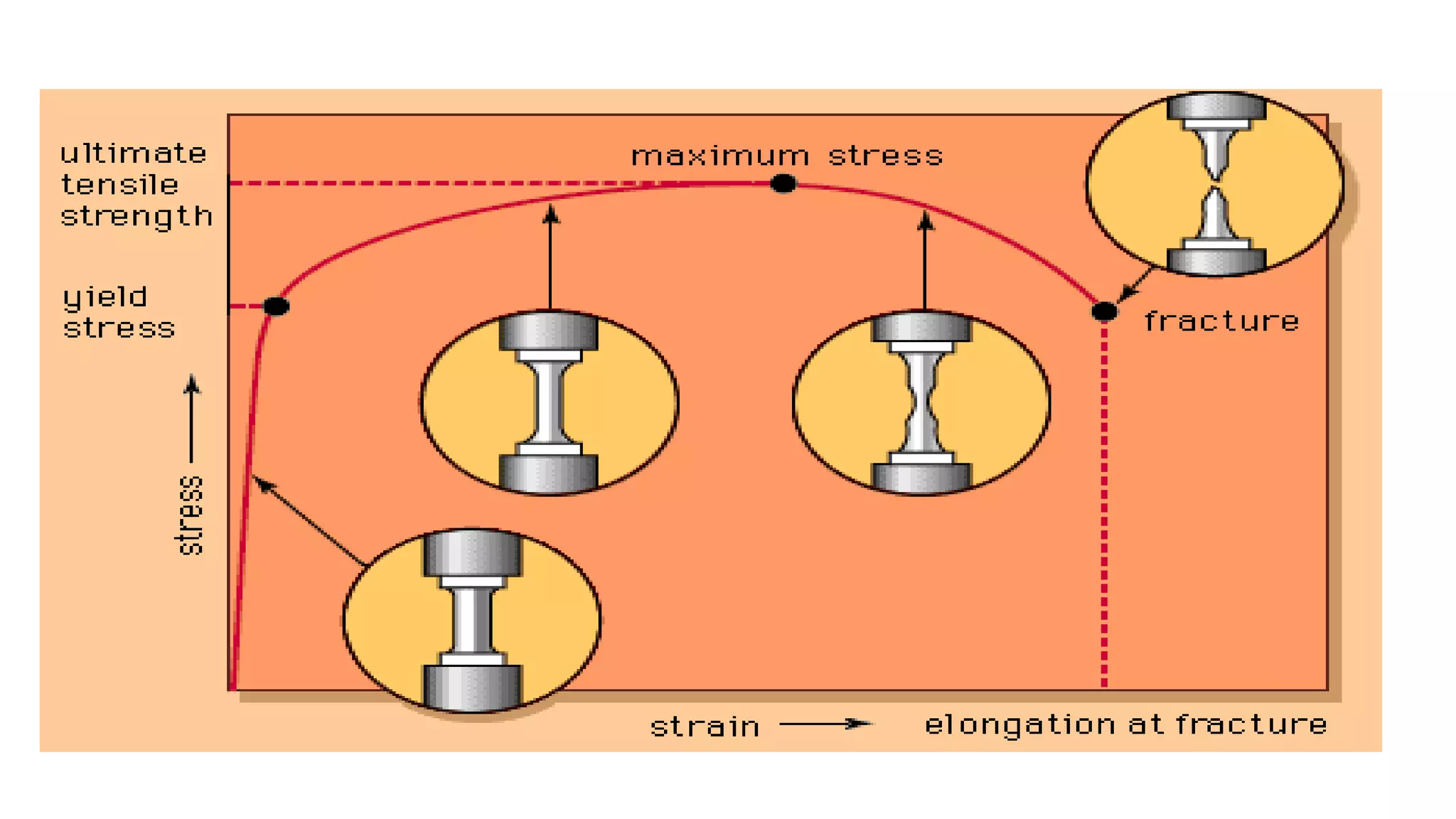
Stress- When a body is applied by external force, a internal resisting force develop at
various section of the body, that internal resisting force per unit cross sectional area is
known as stress.
STESS= INTERNAL RESISTING FORCE/PER UNIT AREA
𝜎 =
𝐹
𝐴
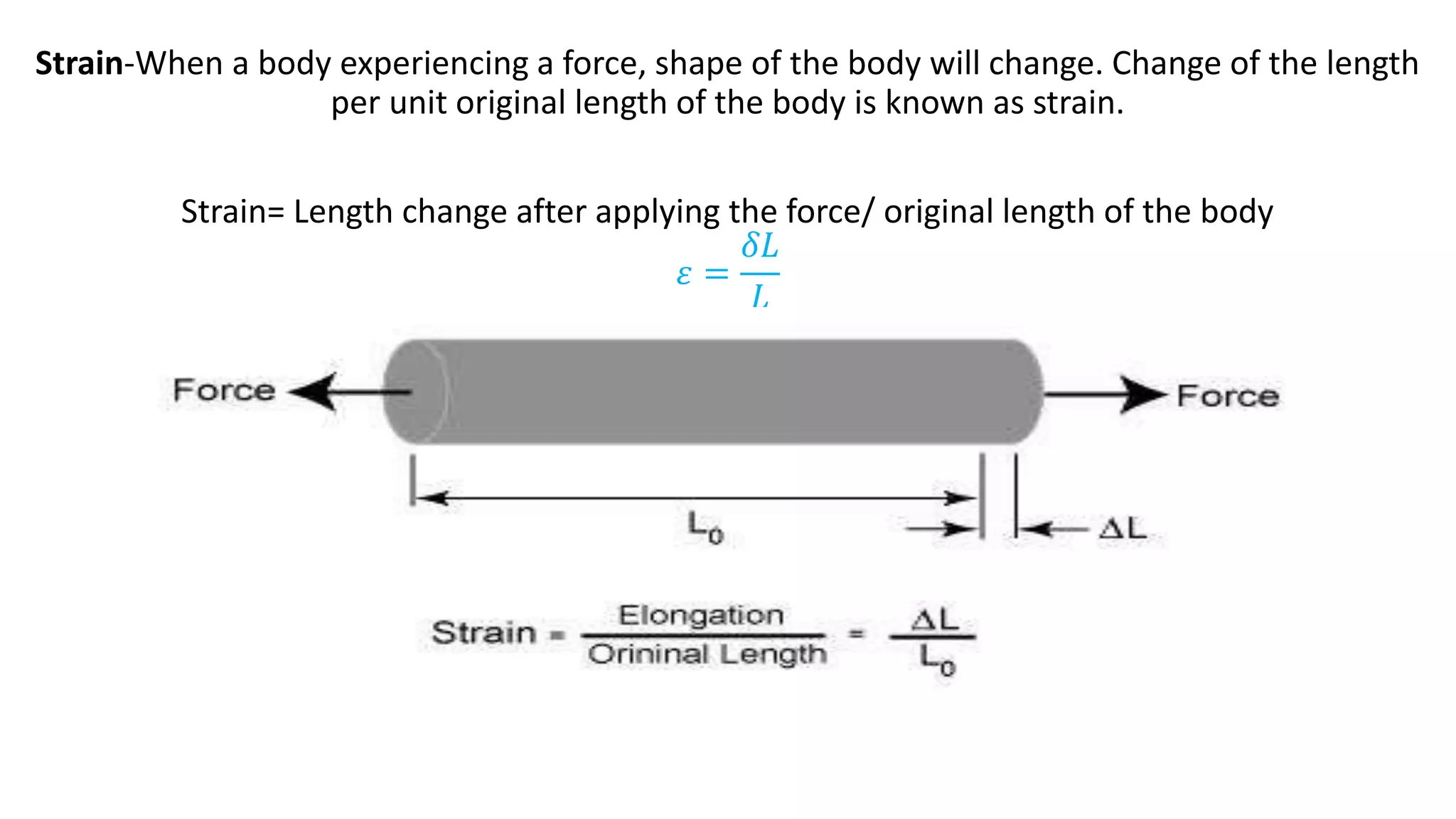
Strain-When a body experiencing a force, shape of the body will change. Change of the length
per unit original length of the body is known as strain.
Strain= Length change after applying the force/ original length of the body
𝜀 =
𝛿𝐿
𝐿
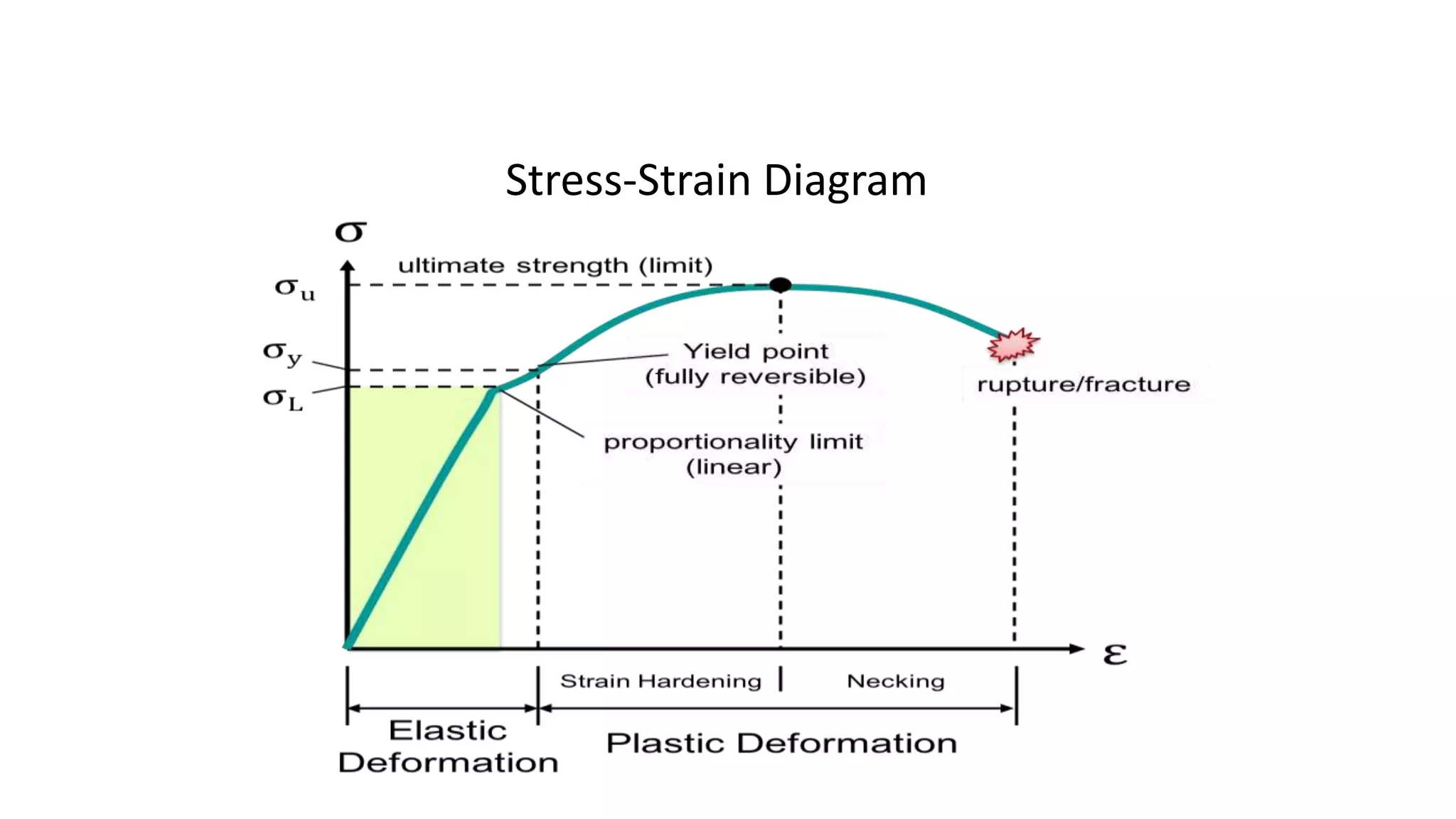
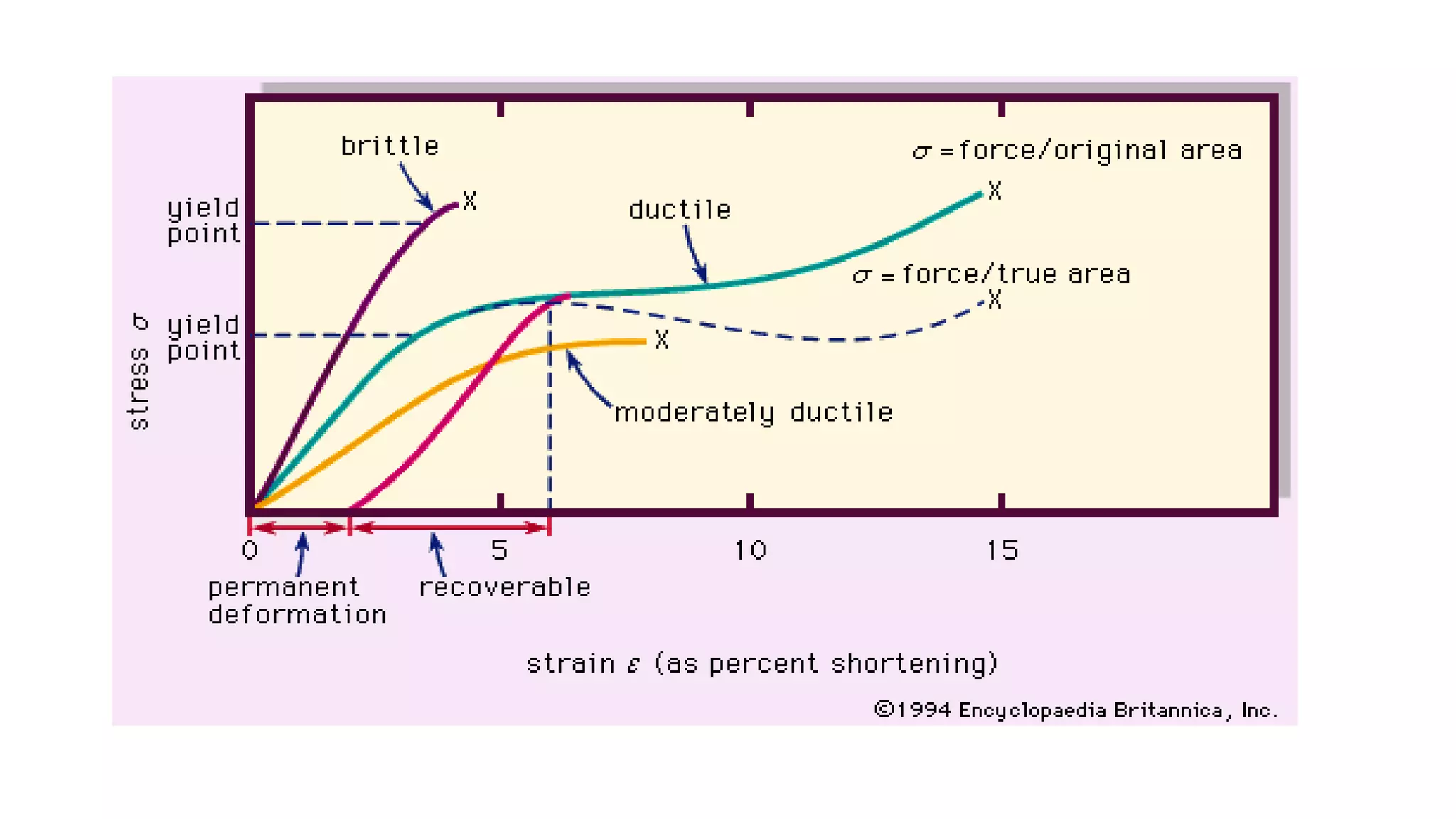
Stress-Strain Diagram
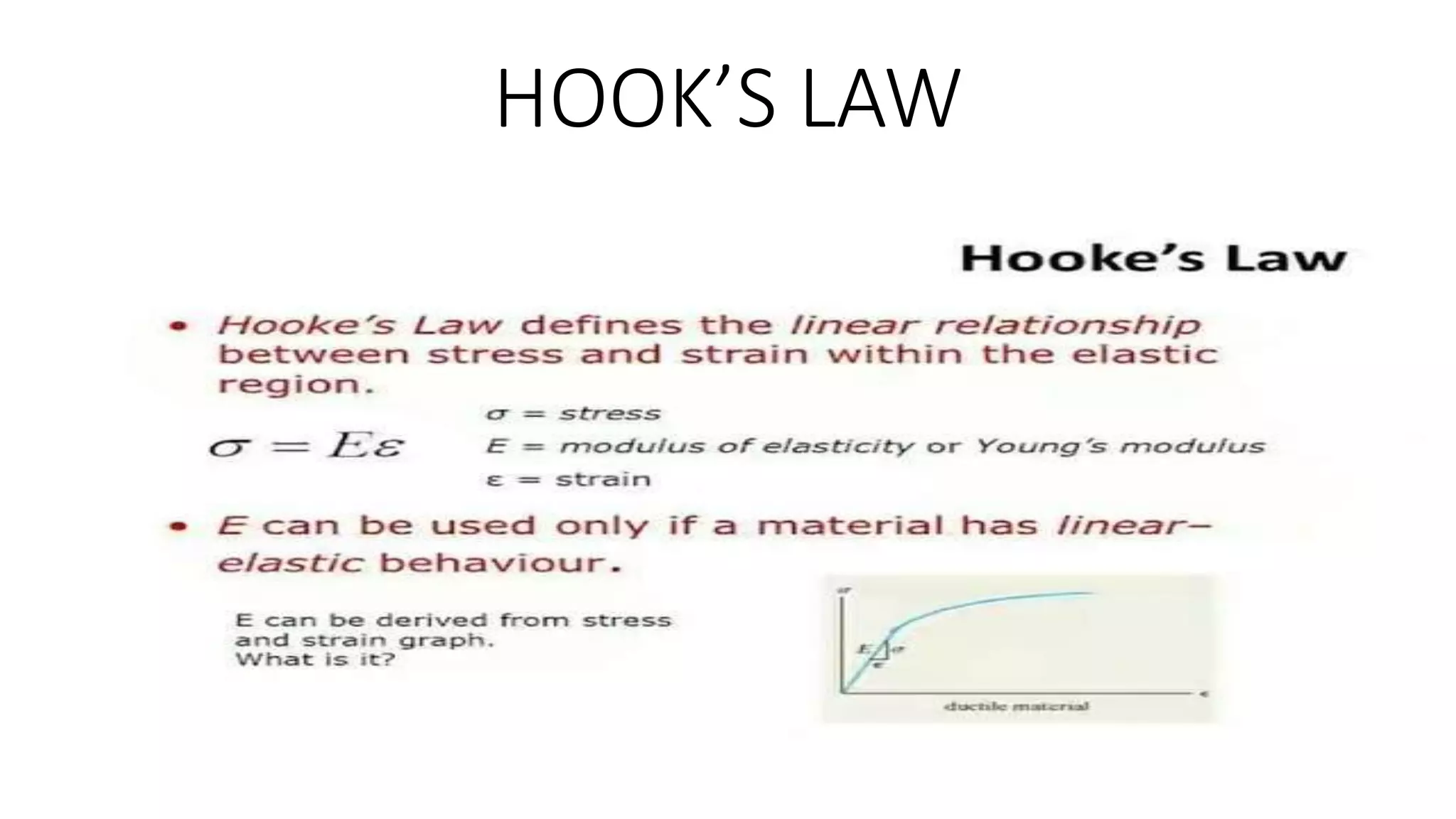
HOOK’S LAW
TYPE OF LOAD
TYPE OF LOADS
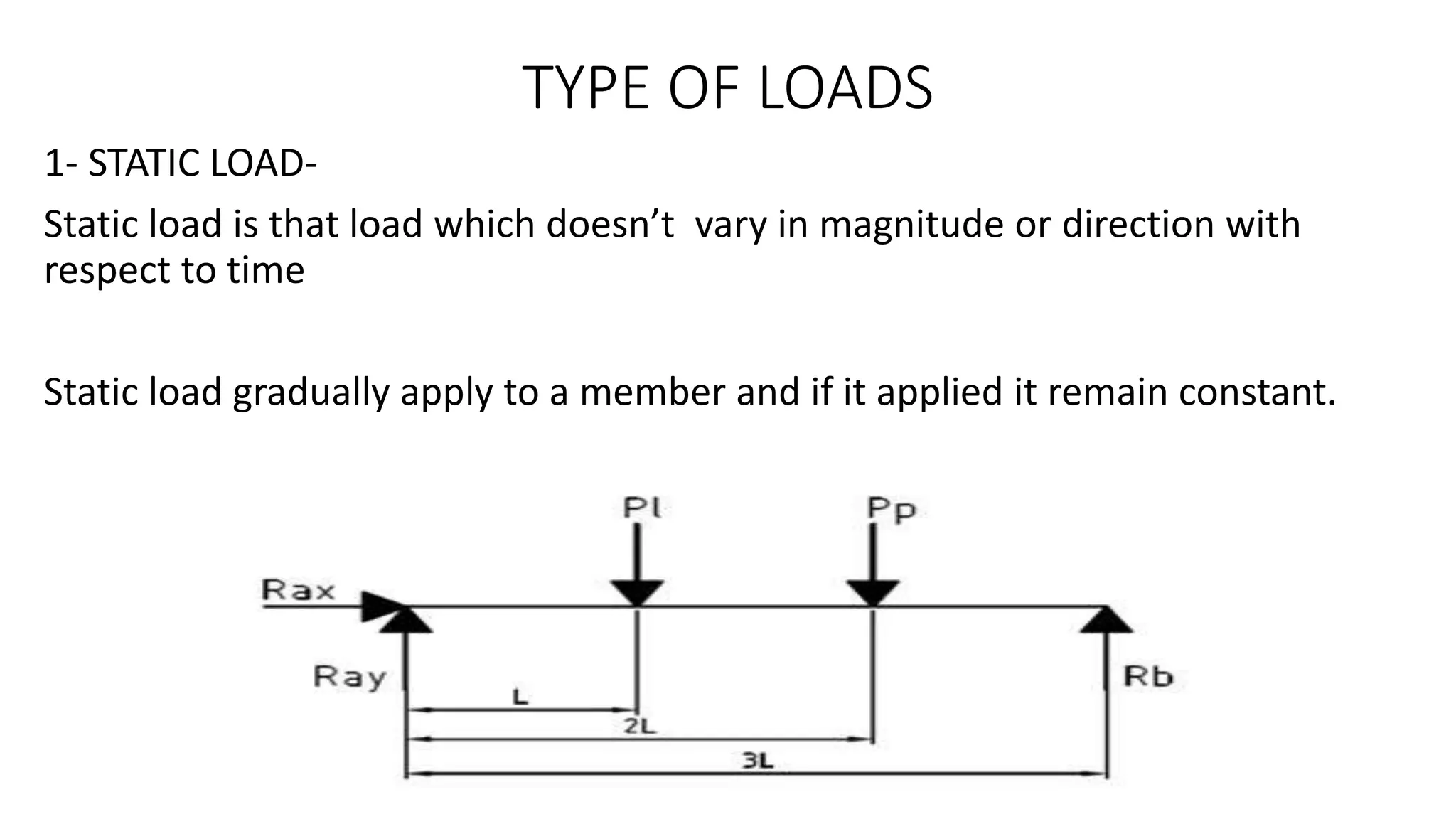
1- STATIC LOAD-
Static load is that load which doesn’t vary in magnitude or direction with
respect to time
Static load gradually apply to a member and if it applied it remain constant.
2- DYNAMIC LOAD-
Dynamic load is such type of load where its magnitude and direction vary with respect to
time.
TWO TYPE OF DYNAMIC LOAD-
CYCLIC LOAD AND IMPACT LOAD
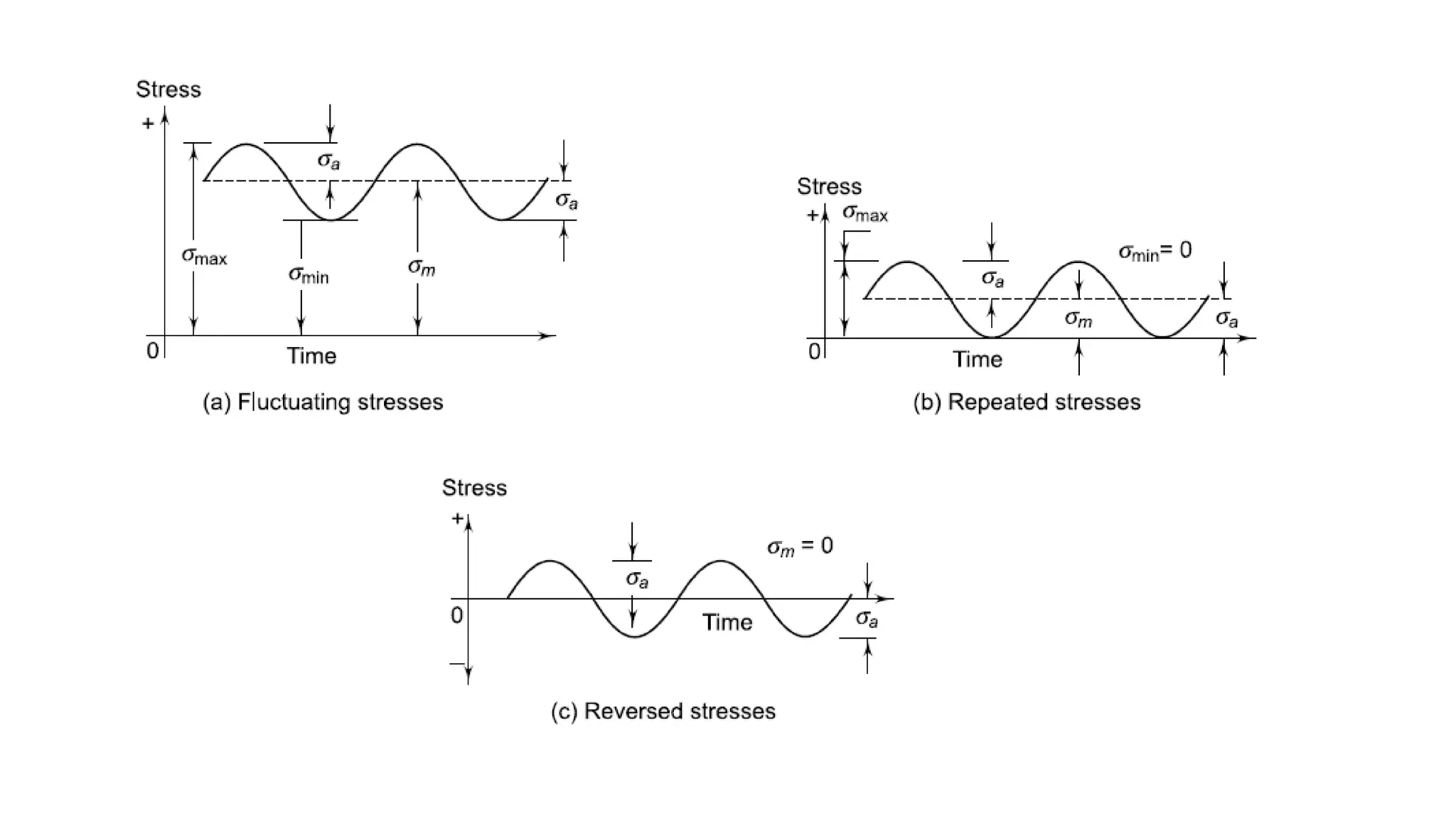
CYCLIC LOAD AND STRESSES
In dynamic loading stresses change with respect to time on the basis of this
there are some cyclic stresses.
-Fluctuating stresses.
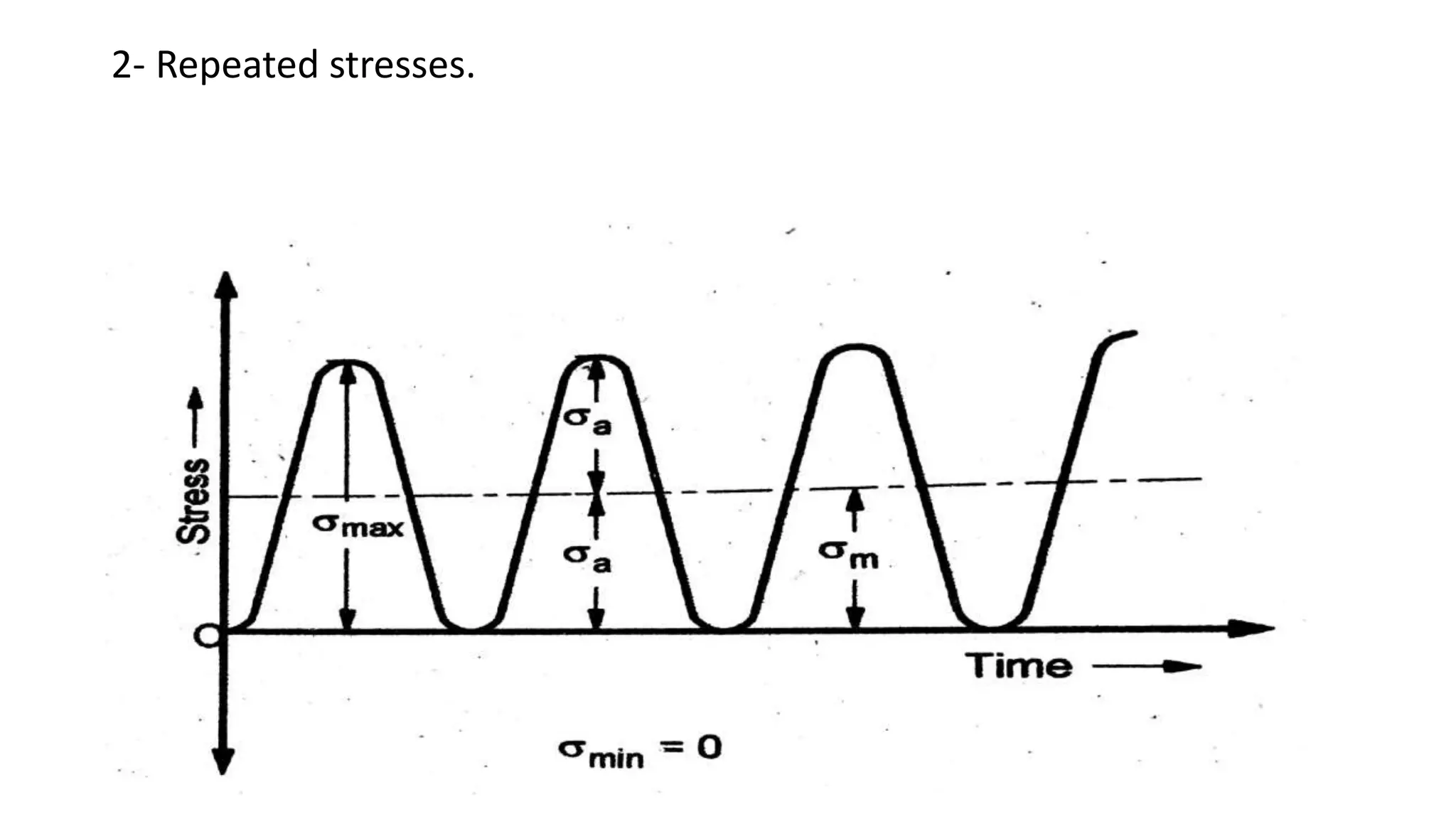
-Repeated Stresses.
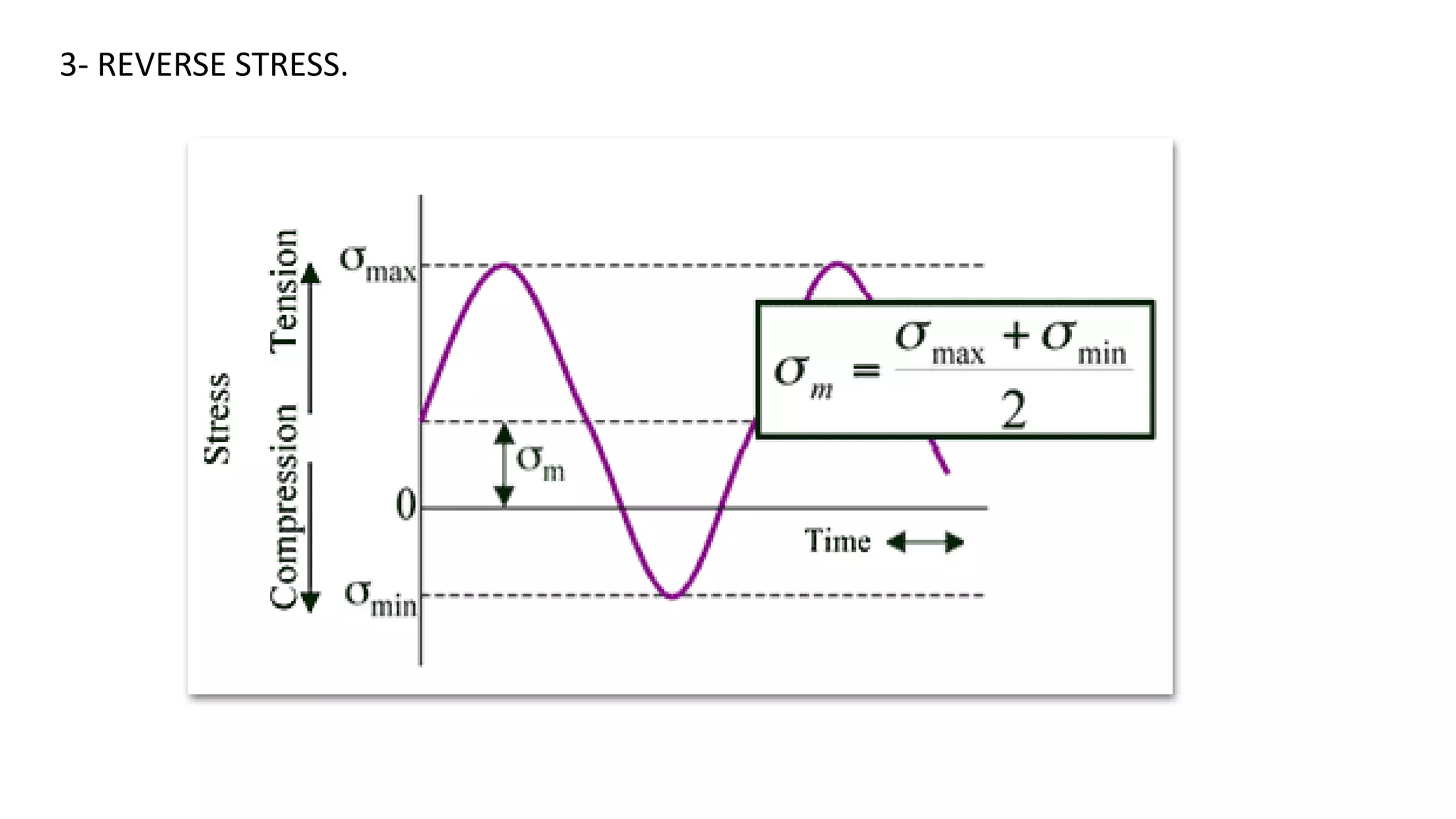
-Reverse stresses.
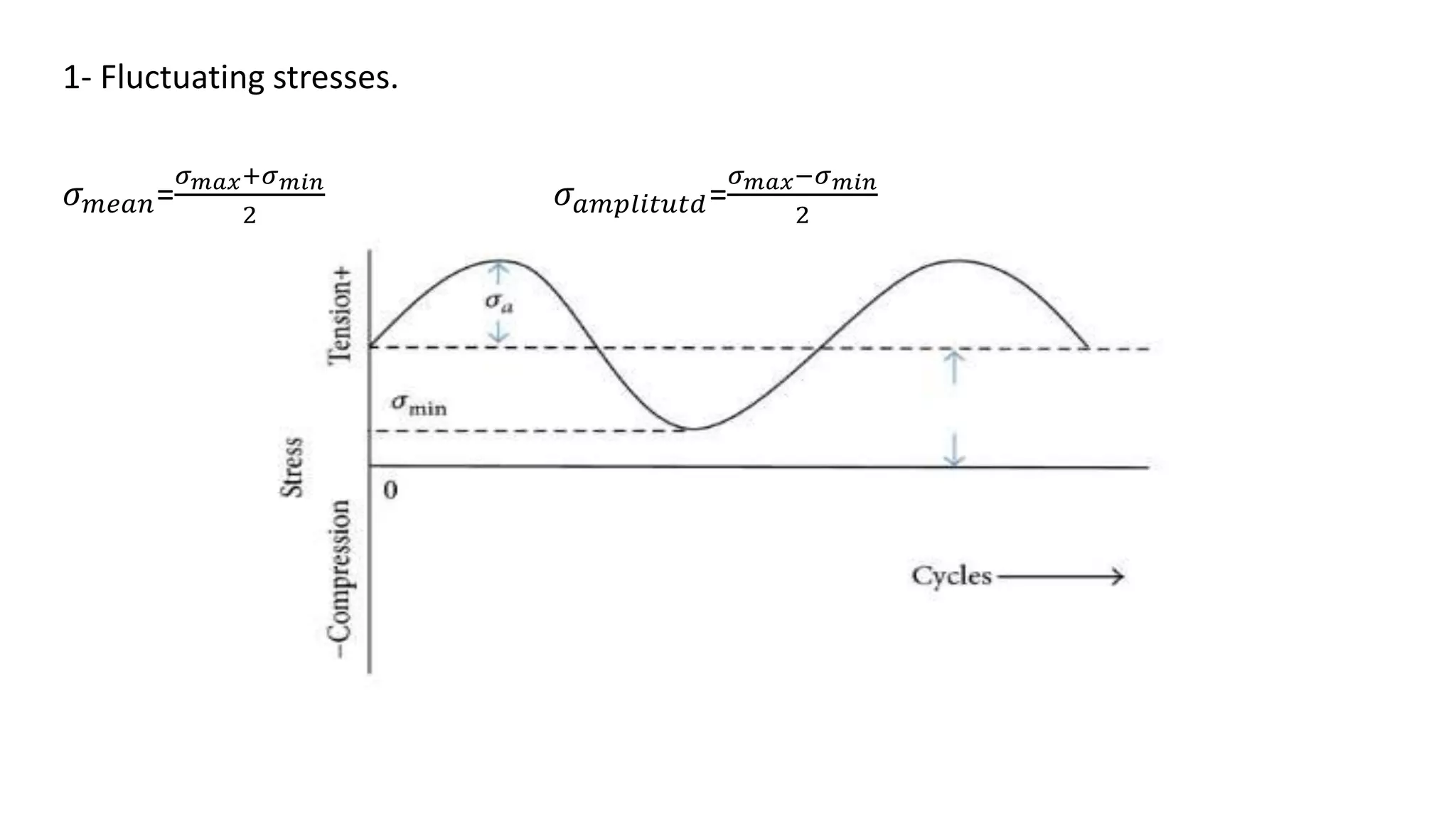
1- Fluctuating stresses.
𝜎𝑚𝑒𝑎𝑛=
𝜎𝑚𝑎𝑥+𝜎𝑚𝑖𝑛
2
𝜎𝑎𝑚𝑝𝑙𝑖𝑡𝑢𝑡𝑑=
𝜎𝑚𝑎𝑥−𝜎𝑚𝑖𝑛
2
2- Repeated stresses.
3- REVERSE STRESS.
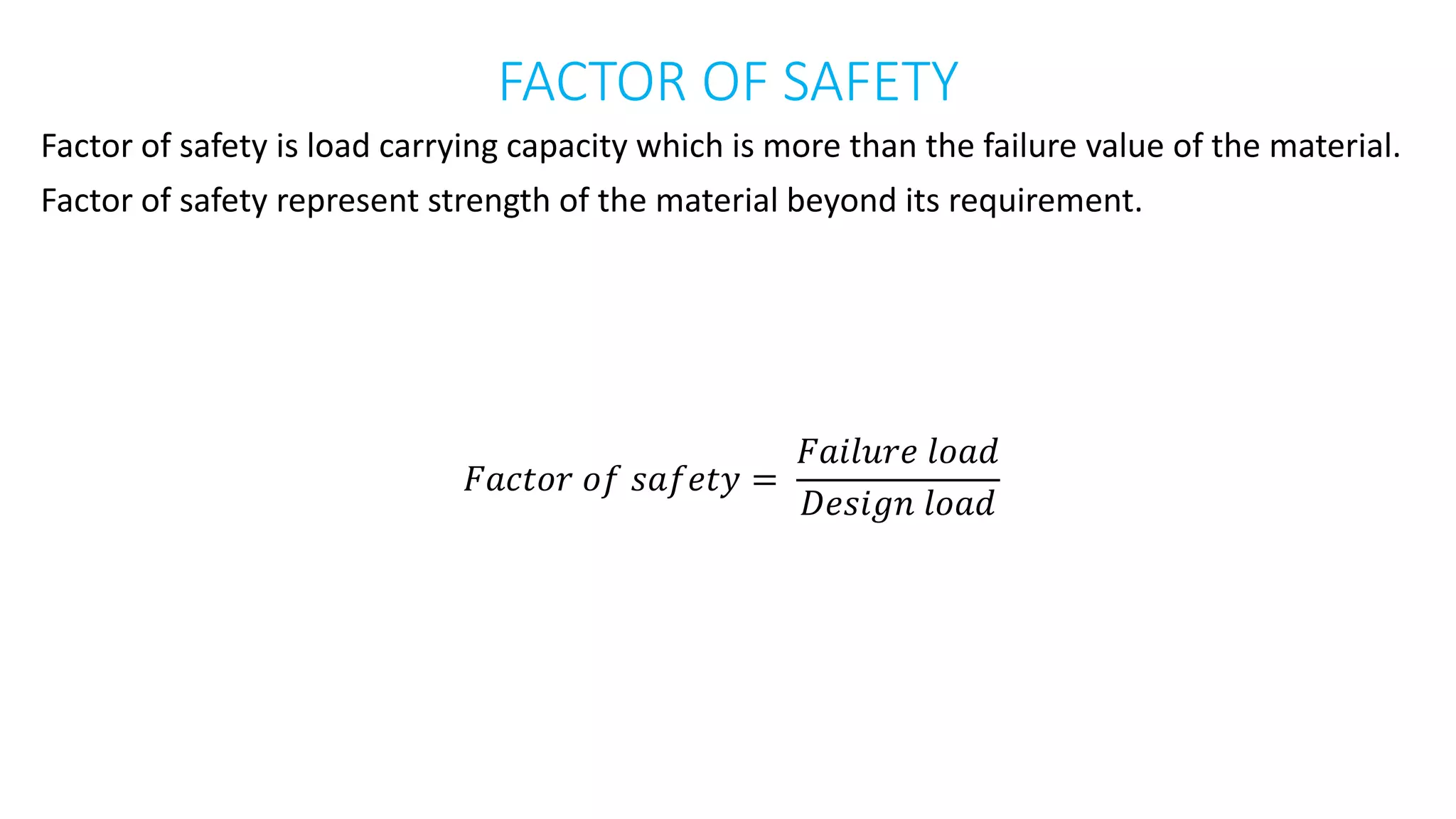
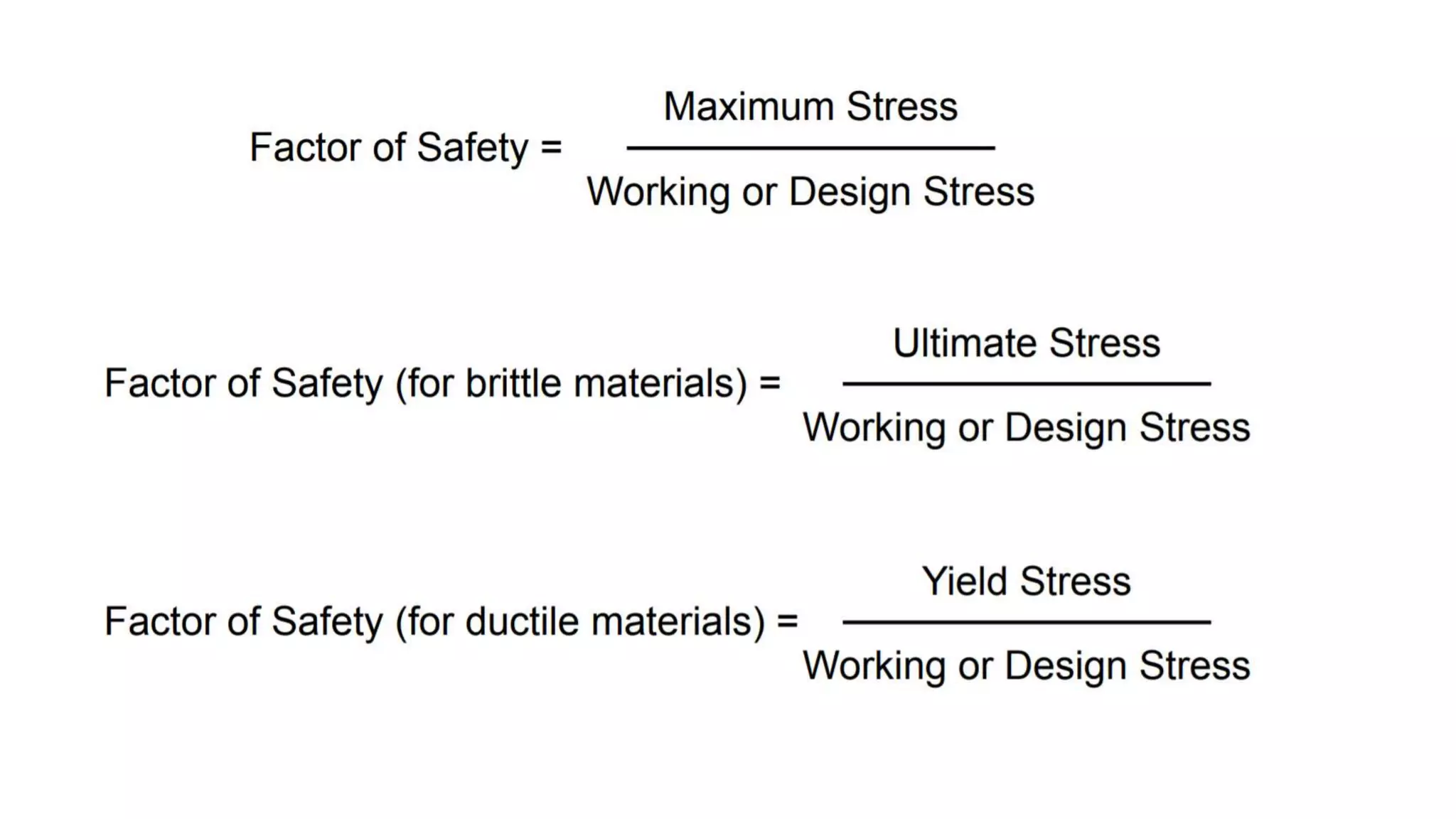
FACTOR OF SAFETY
Factor of safety is load carrying capacity which is more than the failure value of the material.
Factor of safety represent strength of the material beyond its requirement.
𝐹𝑎𝑐𝑡𝑜𝑟 𝑜𝑓 𝑠𝑎𝑓𝑒𝑡𝑦 =
𝐹𝑎𝑖𝑙𝑢𝑟𝑒 𝑙𝑜𝑎𝑑
𝐷𝑒𝑠𝑖𝑔𝑛 𝑙𝑜𝑎𝑑
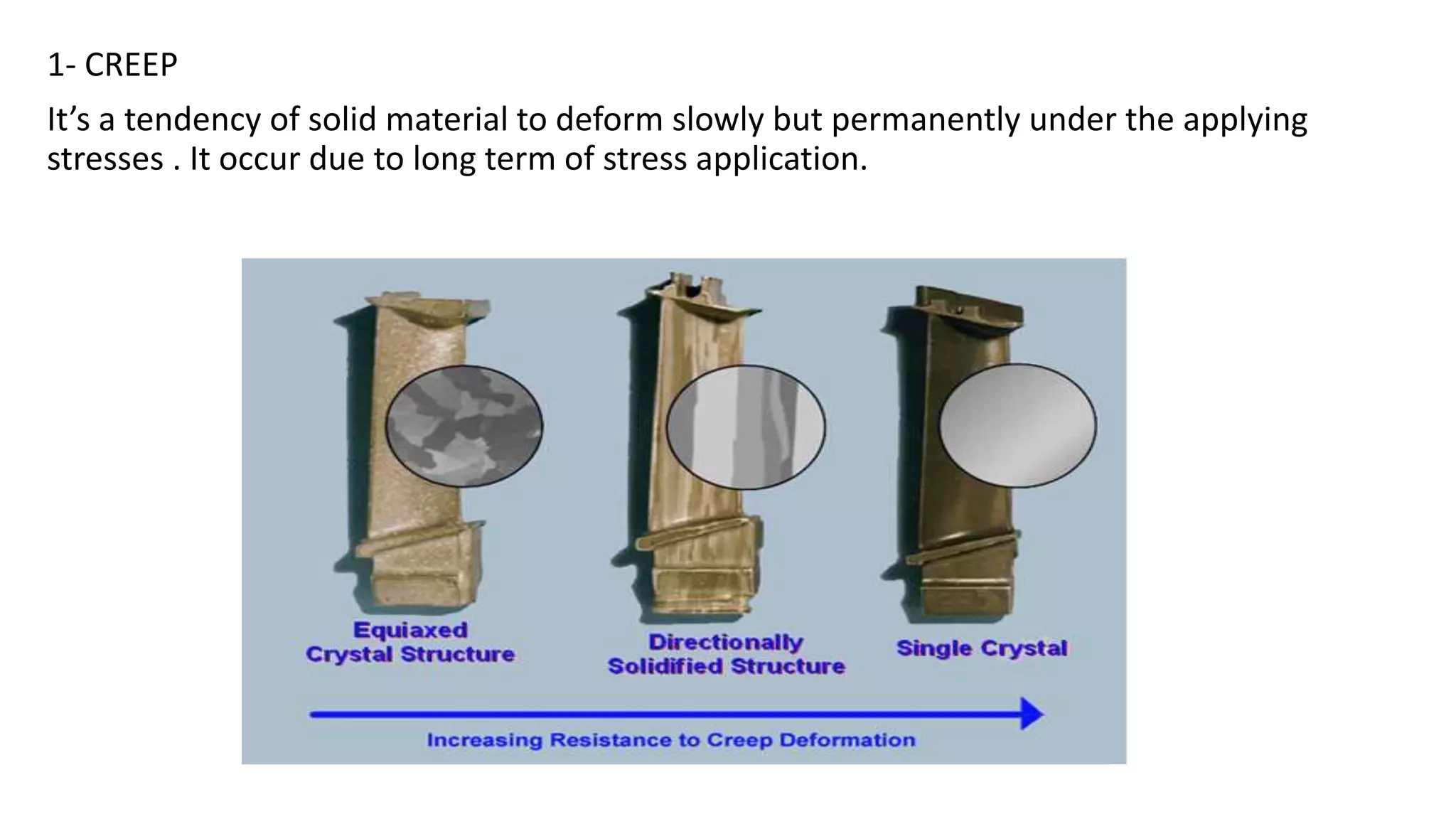
1- CREEP
It’s a tendency of solid material to deform slowly but permanently under the applying
stresses . It occur due to long term of stress application.
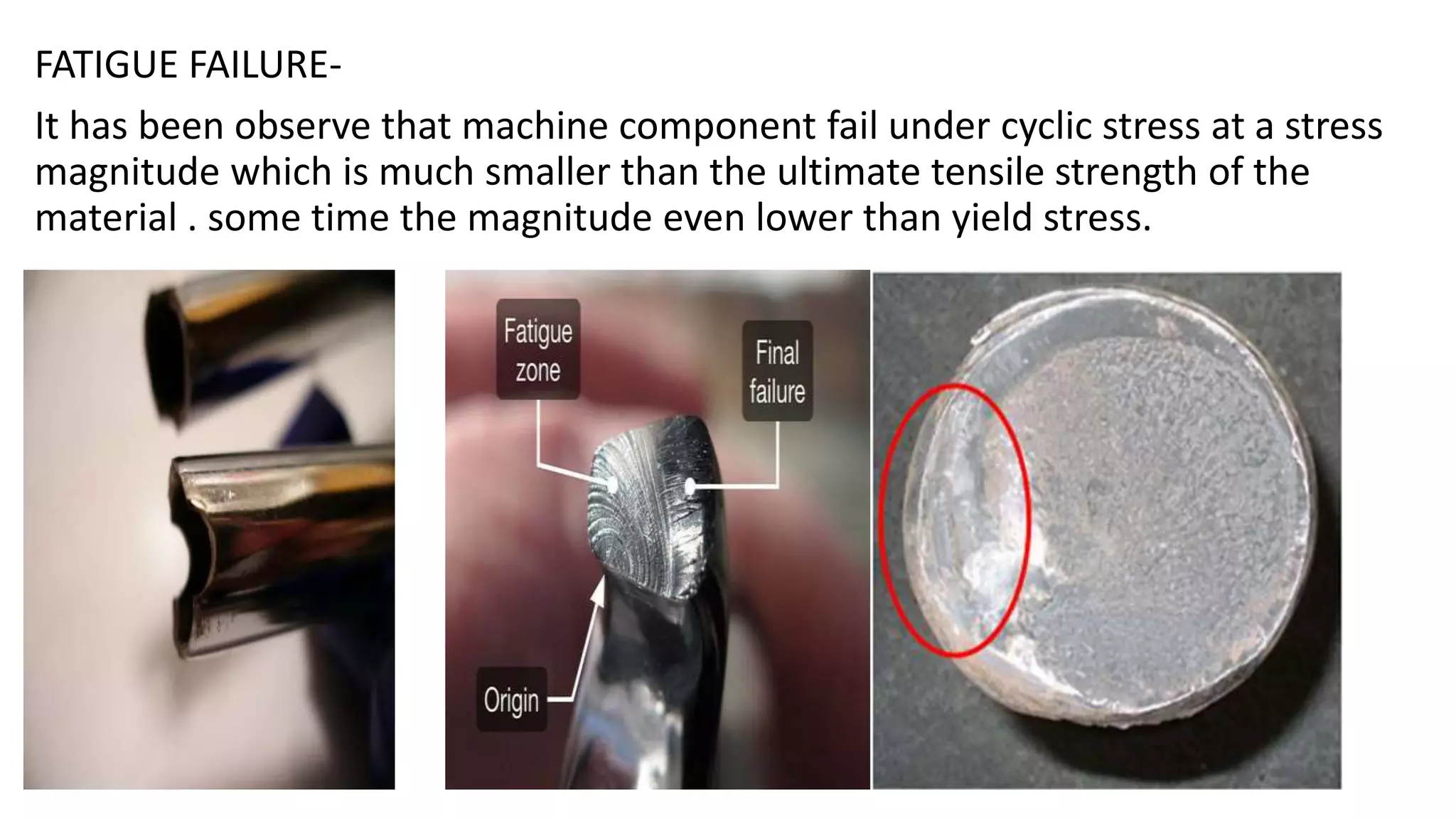
FATIGUE FAILURE-
It has been observe that machine component fail under cyclic stress at a stress
magnitude which is much smaller than the ultimate tensile strength of the
material . some time the magnitude even lower than yield stress.
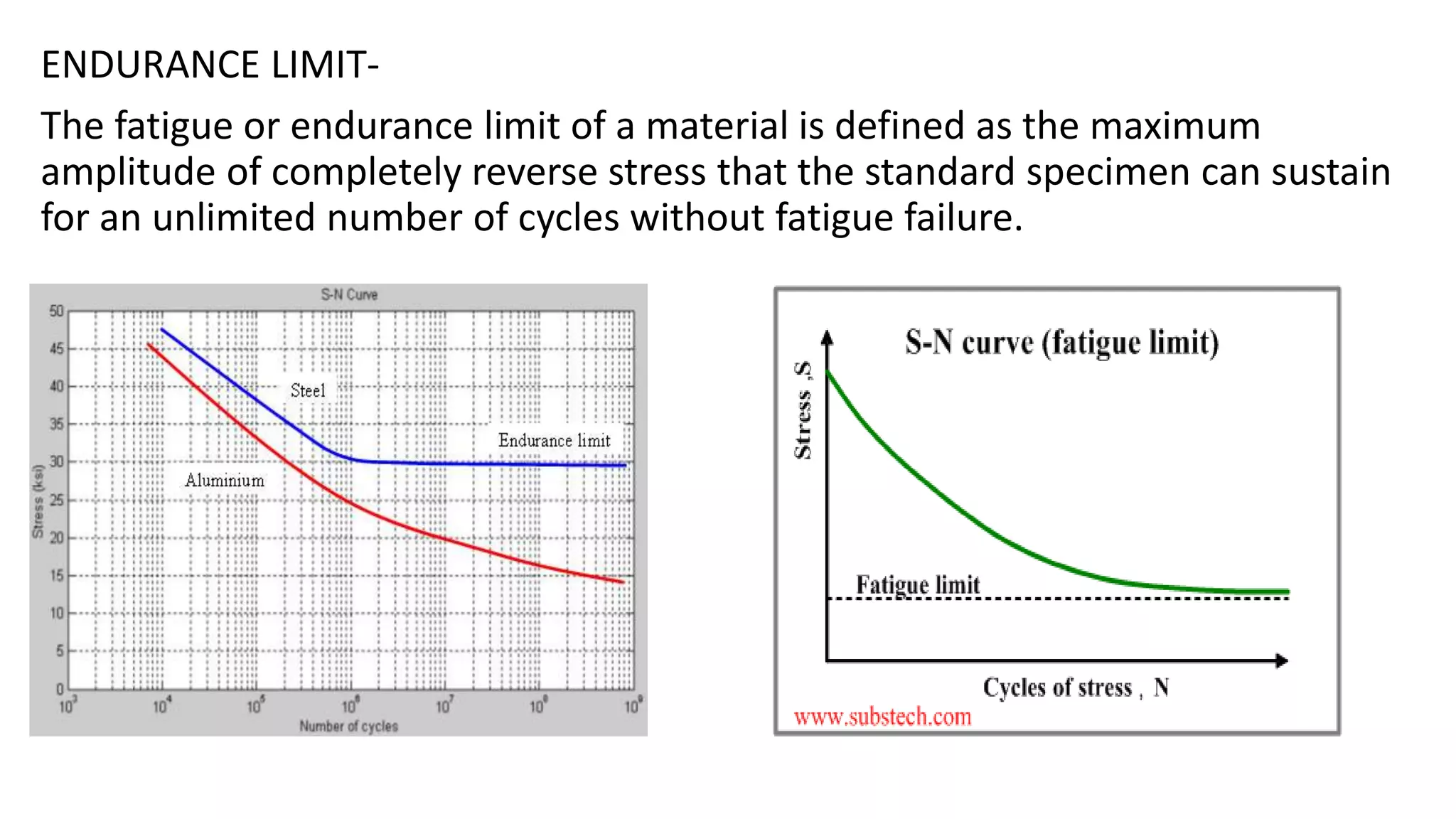
ENDURANCE LIMIT-
The fatigue or endurance limit of a material is defined as the maximum
amplitude of completely reverse stress that the standard specimen can sustain
for an unlimited number of cycles without fatigue failure.
S-N CURVE / Wohler curve
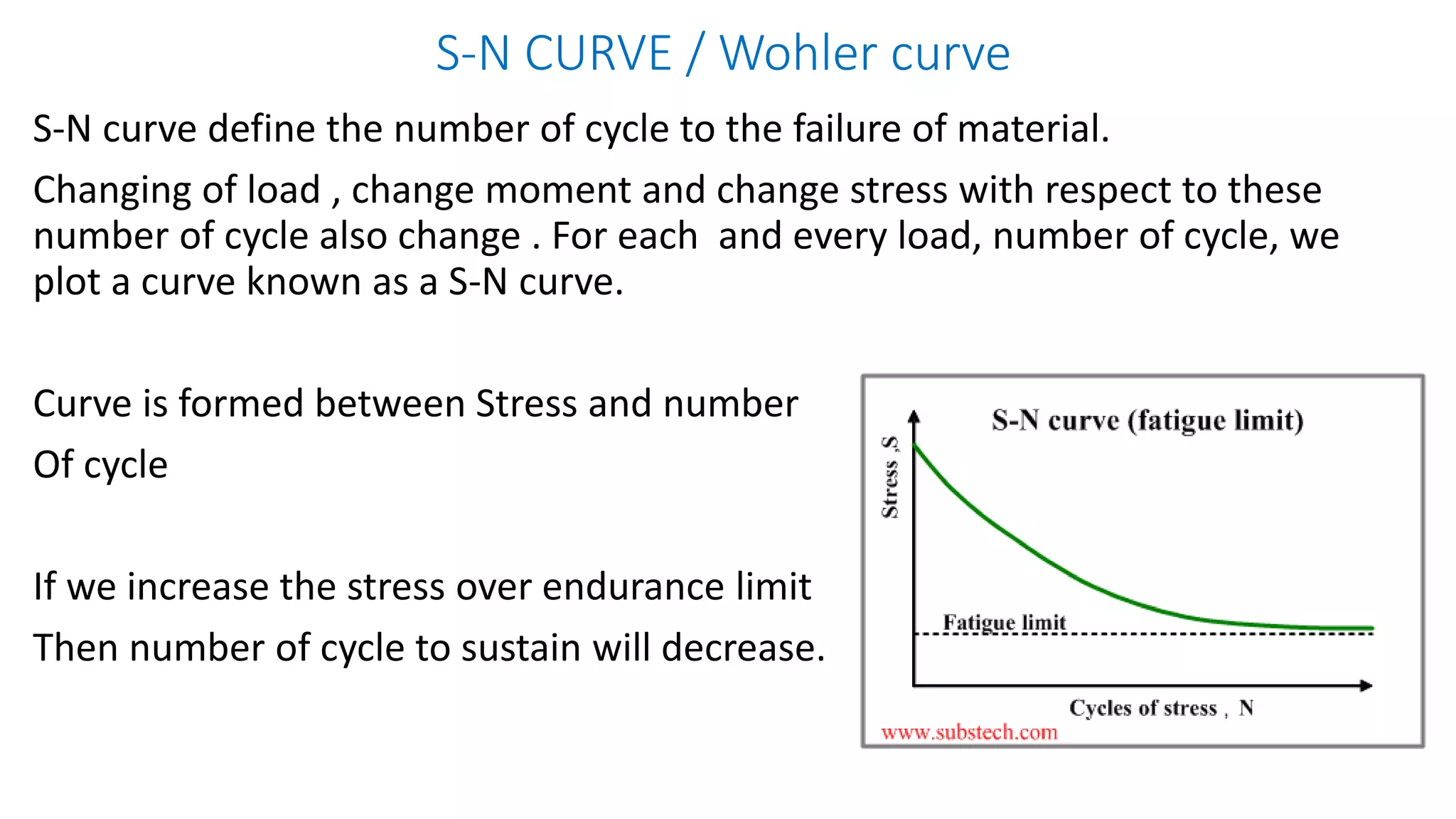
S-N curve define the number of cycle to the failure of material.
Changing of load , change moment and change stress with respect to these
number of cycle also change . For each and every load, number of cycle, we
plot a curve known as a S-N curve.
Curve is formed between Stress and number
Of cycle
If we increase the stress over endurance limit
Then number of cycle to sustain will decrease.
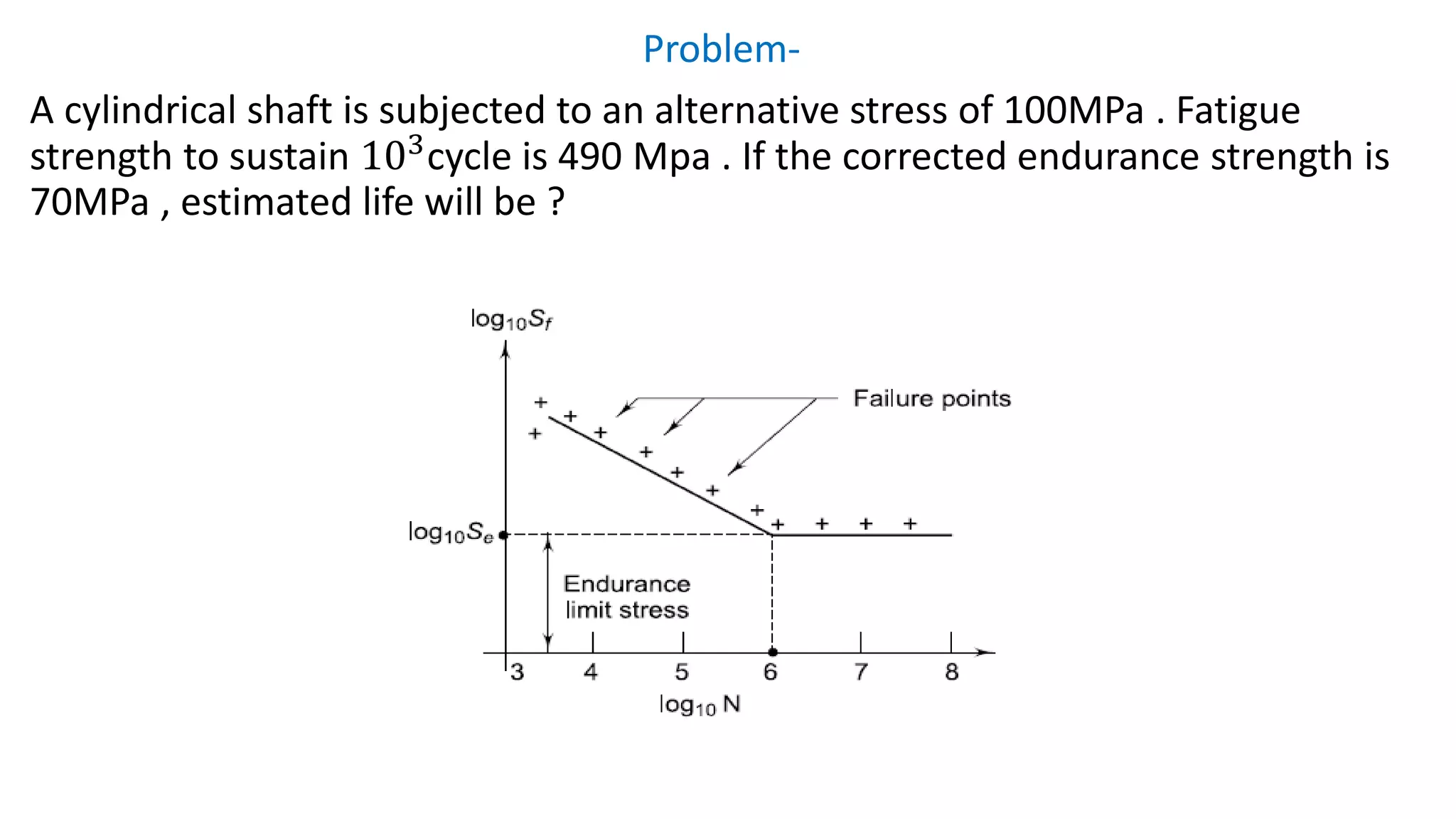
Problem-
A cylindrical shaft is subjected to an alternative stress of 100MPa . Fatigue
strength to sustain 103cycle is 490 Mpa . If the corrected endurance strength is
70MPa , estimated life will be ?
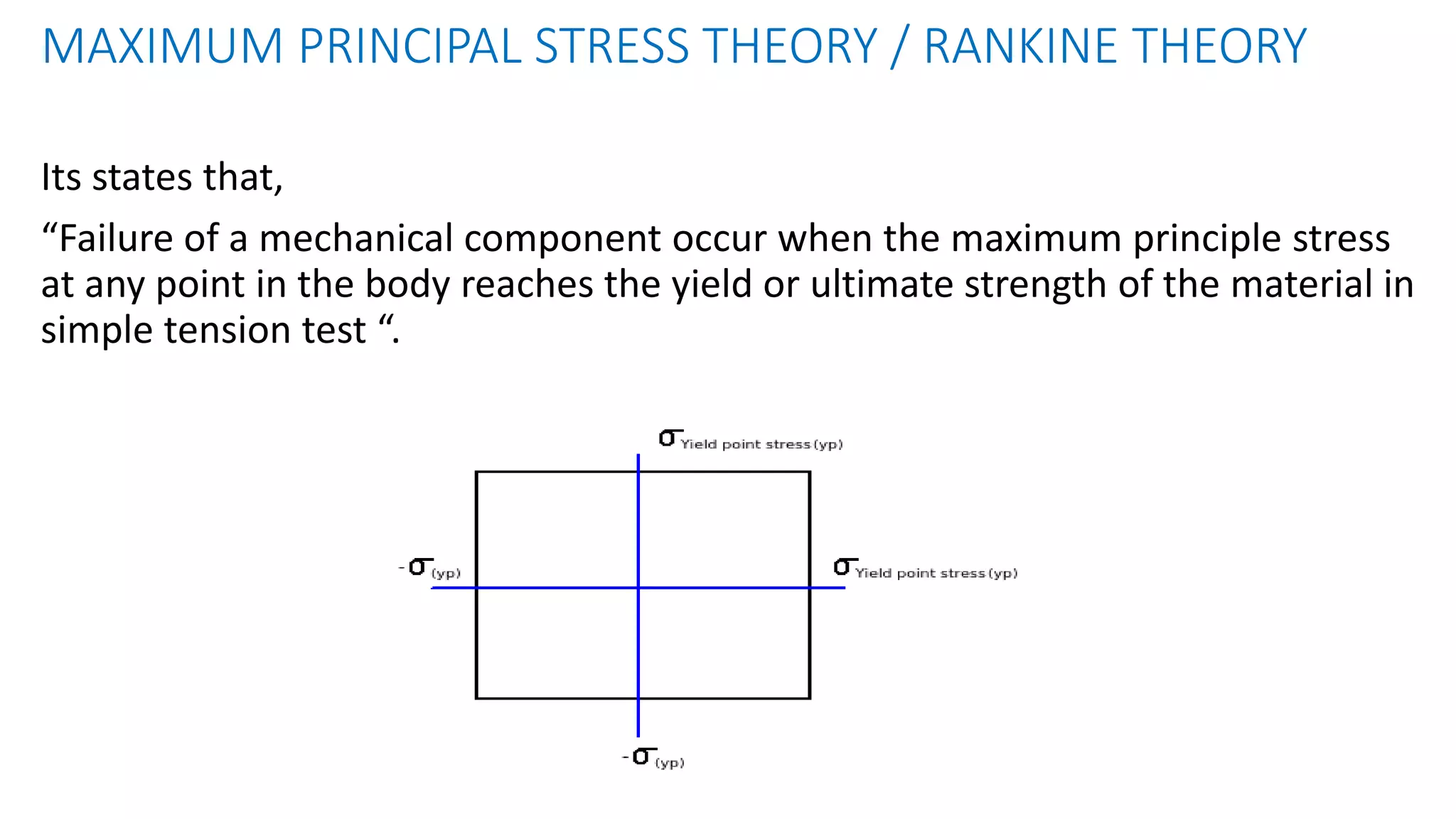
MAXIMUM PRINCIPAL STRESS THEORY / RANKINE THEORY
Its states that,
“Failure of a mechanical component occur when the maximum principle stress
at any point in the body reaches the yield or ultimate strength of the material in
simple tension test “.
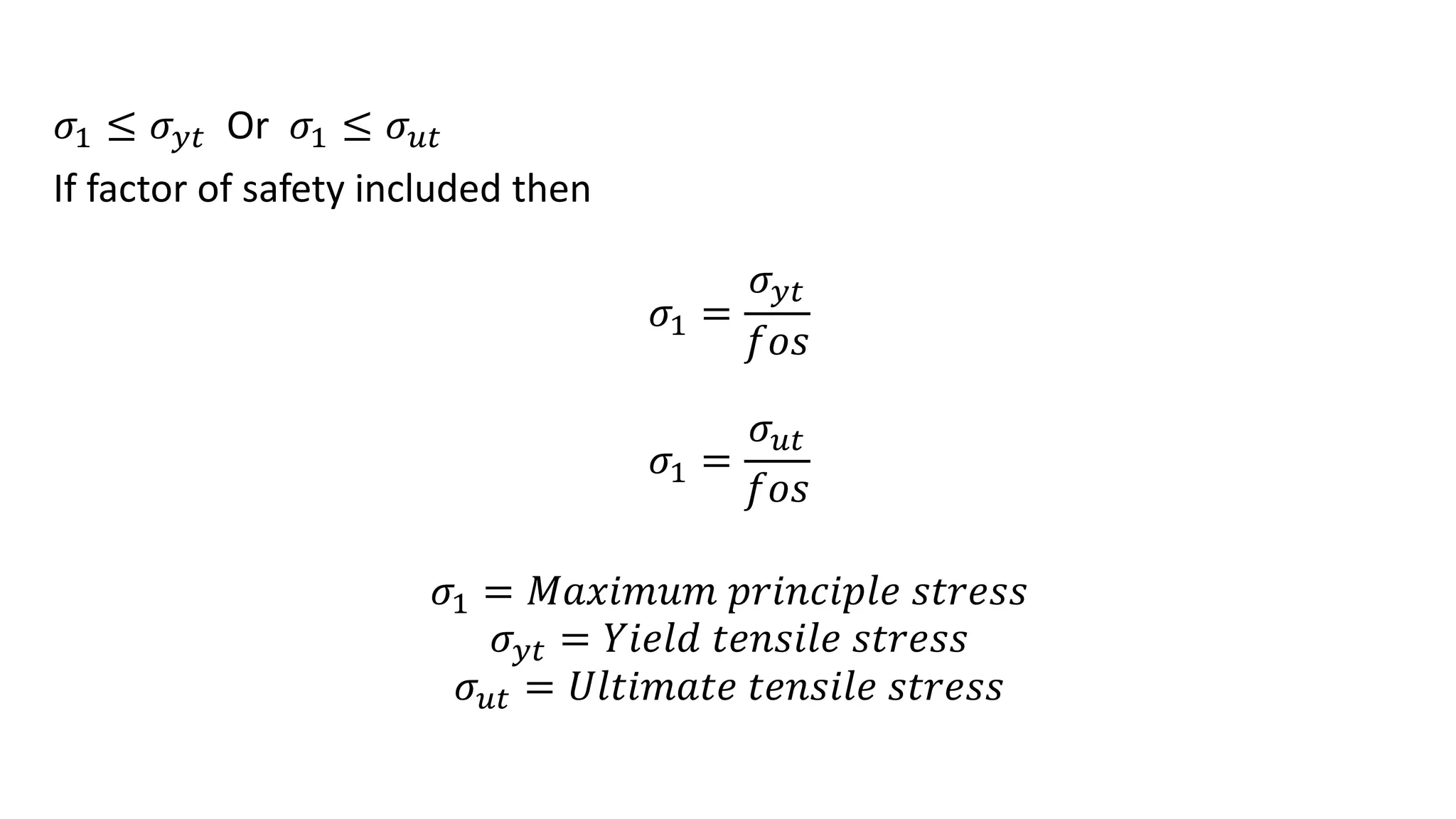
𝜎1 ≤ 𝜎𝑦𝑡 Or 𝜎1 ≤ 𝜎𝑢𝑡
If factor of safety included then
𝜎1 =
𝜎𝑦𝑡
𝑓𝑜𝑠
𝜎1 =
𝜎𝑢𝑡
𝑓𝑜𝑠
𝜎1 = 𝑀𝑎𝑥𝑖𝑚𝑢𝑚 𝑝𝑟𝑖𝑛𝑐𝑖𝑝𝑙𝑒 𝑠𝑡𝑟𝑒𝑠𝑠
𝜎𝑦𝑡 = 𝑌𝑖𝑒𝑙𝑑 𝑡𝑒𝑛𝑠𝑖𝑙𝑒 𝑠𝑡𝑟𝑒𝑠𝑠
𝜎𝑢𝑡 = 𝑈𝑙𝑡𝑖𝑚𝑎𝑡𝑒 𝑡𝑒𝑛𝑠𝑖𝑙𝑒 𝑠𝑡𝑟𝑒𝑠𝑠
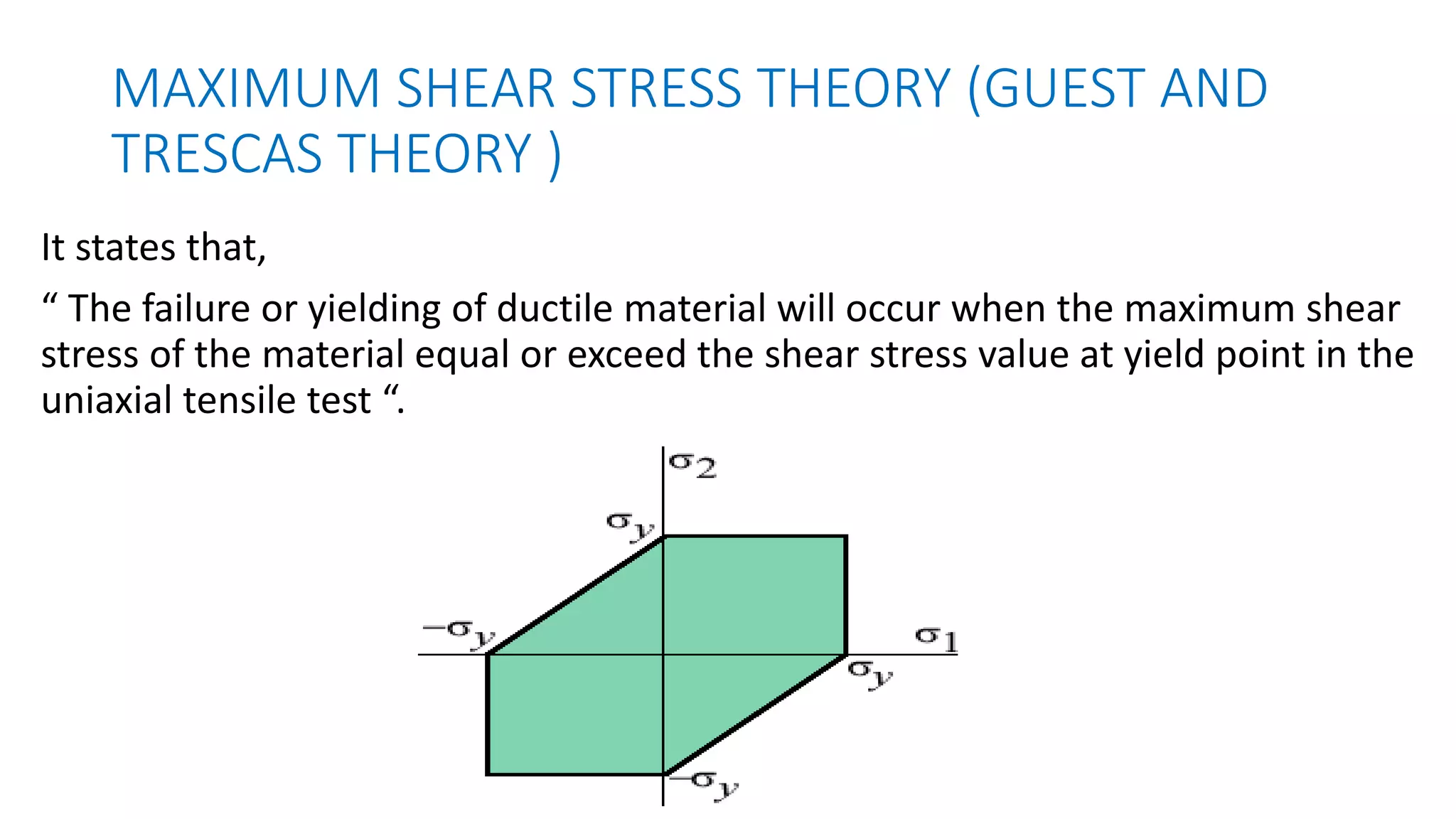
MAXIMUM SHEAR STRESS THEORY (GUEST AND
TRESCAS THEORY )
It states that,
“ The failure or yielding of ductile material will occur when the maximum shear
stress of the material equal or exceed the shear stress value at yield point in the
uniaxial tensile test “.
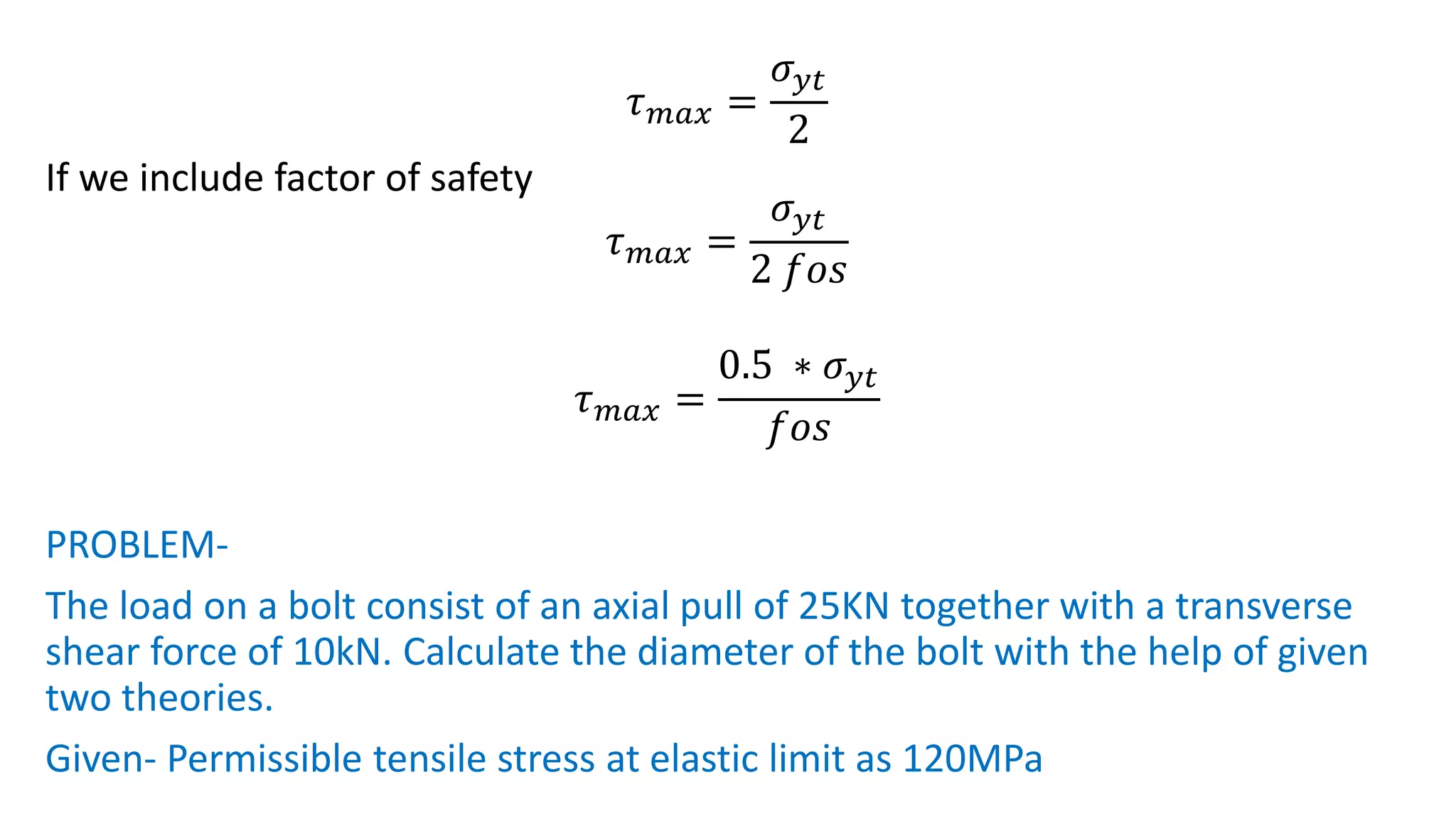
𝜏𝑚𝑎𝑥 =
𝜎𝑦𝑡
2
If we include factor of safety
𝜏𝑚𝑎𝑥 =
𝜎𝑦𝑡
2 𝑓𝑜𝑠
𝜏𝑚𝑎𝑥 =
0.5 ∗ 𝜎𝑦𝑡
𝑓𝑜𝑠
PROBLEM-
The load on a bolt consist of an axial pull of 25KN together with a transverse
shear force of 10kN. Calculate the diameter of the bolt with the help of given
two theories.
Given- Permissible tensile stress at elastic limit as 120MPa
ERGONOMICS IN MACHINE DESIGN
Ergonomics is define as the relationship between man and machine and the
application of the anatomical , psychological principles to solve the problems
arising from man – machine relationship.
Machine design (Polytechnic  unit 1

Machine design (Polytechnic unit 1

  • 1.
  • 2.
    Stress- When abody is applied by external force, a internal resisting force develop at various section of the body, that internal resisting force per unit cross sectional area is known as stress. STESS= INTERNAL RESISTING FORCE/PER UNIT AREA 𝜎 = 𝐹 𝐴
  • 3.
    Strain-When a bodyexperiencing a force, shape of the body will change. Change of the length per unit original length of the body is known as strain. Strain= Length change after applying the force/ original length of the body 𝜀 = 𝛿𝐿 𝐿
  • 4.
  • 7.
  • 8.
  • 9.
    TYPE OF LOADS 1-STATIC LOAD- Static load is that load which doesn’t vary in magnitude or direction with respect to time Static load gradually apply to a member and if it applied it remain constant.
  • 10.
    2- DYNAMIC LOAD- Dynamicload is such type of load where its magnitude and direction vary with respect to time. TWO TYPE OF DYNAMIC LOAD- CYCLIC LOAD AND IMPACT LOAD
  • 11.
    CYCLIC LOAD ANDSTRESSES In dynamic loading stresses change with respect to time on the basis of this there are some cyclic stresses. -Fluctuating stresses. -Repeated Stresses. -Reverse stresses.
  • 12.
  • 13.
  • 14.
  • 16.
    FACTOR OF SAFETY Factorof safety is load carrying capacity which is more than the failure value of the material. Factor of safety represent strength of the material beyond its requirement. 𝐹𝑎𝑐𝑡𝑜𝑟 𝑜𝑓 𝑠𝑎𝑓𝑒𝑡𝑦 = 𝐹𝑎𝑖𝑙𝑢𝑟𝑒 𝑙𝑜𝑎𝑑 𝐷𝑒𝑠𝑖𝑔𝑛 𝑙𝑜𝑎𝑑
  • 18.
    1- CREEP It’s atendency of solid material to deform slowly but permanently under the applying stresses . It occur due to long term of stress application.
  • 19.
    FATIGUE FAILURE- It hasbeen observe that machine component fail under cyclic stress at a stress magnitude which is much smaller than the ultimate tensile strength of the material . some time the magnitude even lower than yield stress.
  • 20.
    ENDURANCE LIMIT- The fatigueor endurance limit of a material is defined as the maximum amplitude of completely reverse stress that the standard specimen can sustain for an unlimited number of cycles without fatigue failure.
  • 21.
    S-N CURVE /Wohler curve S-N curve define the number of cycle to the failure of material. Changing of load , change moment and change stress with respect to these number of cycle also change . For each and every load, number of cycle, we plot a curve known as a S-N curve. Curve is formed between Stress and number Of cycle If we increase the stress over endurance limit Then number of cycle to sustain will decrease.
  • 22.
    Problem- A cylindrical shaftis subjected to an alternative stress of 100MPa . Fatigue strength to sustain 103cycle is 490 Mpa . If the corrected endurance strength is 70MPa , estimated life will be ?
  • 23.
    MAXIMUM PRINCIPAL STRESSTHEORY / RANKINE THEORY Its states that, “Failure of a mechanical component occur when the maximum principle stress at any point in the body reaches the yield or ultimate strength of the material in simple tension test “.
  • 24.
    𝜎1 ≤ 𝜎𝑦𝑡Or 𝜎1 ≤ 𝜎𝑢𝑡 If factor of safety included then 𝜎1 = 𝜎𝑦𝑡 𝑓𝑜𝑠 𝜎1 = 𝜎𝑢𝑡 𝑓𝑜𝑠 𝜎1 = 𝑀𝑎𝑥𝑖𝑚𝑢𝑚 𝑝𝑟𝑖𝑛𝑐𝑖𝑝𝑙𝑒 𝑠𝑡𝑟𝑒𝑠𝑠 𝜎𝑦𝑡 = 𝑌𝑖𝑒𝑙𝑑 𝑡𝑒𝑛𝑠𝑖𝑙𝑒 𝑠𝑡𝑟𝑒𝑠𝑠 𝜎𝑢𝑡 = 𝑈𝑙𝑡𝑖𝑚𝑎𝑡𝑒 𝑡𝑒𝑛𝑠𝑖𝑙𝑒 𝑠𝑡𝑟𝑒𝑠𝑠
  • 25.
    MAXIMUM SHEAR STRESSTHEORY (GUEST AND TRESCAS THEORY ) It states that, “ The failure or yielding of ductile material will occur when the maximum shear stress of the material equal or exceed the shear stress value at yield point in the uniaxial tensile test “.
  • 26.
    𝜏𝑚𝑎𝑥 = 𝜎𝑦𝑡 2 If weinclude factor of safety 𝜏𝑚𝑎𝑥 = 𝜎𝑦𝑡 2 𝑓𝑜𝑠 𝜏𝑚𝑎𝑥 = 0.5 ∗ 𝜎𝑦𝑡 𝑓𝑜𝑠 PROBLEM- The load on a bolt consist of an axial pull of 25KN together with a transverse shear force of 10kN. Calculate the diameter of the bolt with the help of given two theories. Given- Permissible tensile stress at elastic limit as 120MPa
  • 27.
    ERGONOMICS IN MACHINEDESIGN Ergonomics is define as the relationship between man and machine and the application of the anatomical , psychological principles to solve the problems arising from man – machine relationship.