Stephen Maberly, Alex Elliott, Peter Henrys, Ian
Jones, Stephen Thackeray & Ian Winfield
Lake Ecosystems Group
Centre for Ecology & Hydrology, Lancaster, UK
Echoes in the ecosystem: top-down &
bottom-up responses of Windermere to
environmental perturbation
Jonathan Grey & Peter Smyntek
Queen Mary University of London, UK
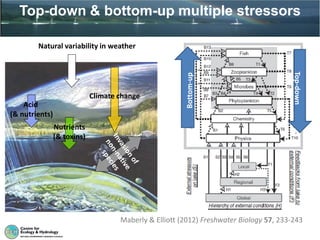
Top-down & bottom-up multiple stressors
Maberly & Elliott (2012) Freshwater Biology 57, 233-243
Nutrients
(& toxins)
Acid
(& nutrients)
Climate change
Natural variability in weather
Bottom-up
Top-down
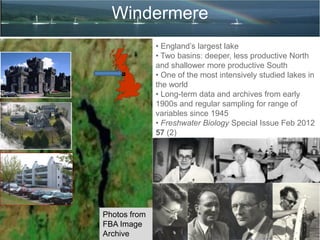
Windermere
Photos from
FBA Image
Archive
• England’s largest lake
• Two basins: deeper, less productive North
and shallower more productive South
• One of the most intensively studied lakes in
the world
• Long-term data and archives from early
1900s and regular sampling for range of
variables since 1945
• Freshwater Biology Special Issue Feb 2012
57 (2)
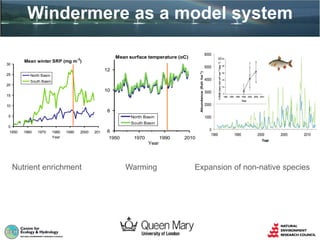
Windermere as a model system
Mean winter SRP (mg m
-3
)
0
5
10
15
20
25
30
1950 1960 1970 1980 1990 2000 2010
Year
North Basin
South Basin
6
8
10
12
1950 1970 1990 2010
Year
Mean surface temperature (oC)
North Basin
South Basin
Nutrient enrichment Warming Expansion of non-native species
0
1000
2000
3000
4000
5000
6000
1990 1995 2000 2005 2010
Abundance(fishha-1)
Year
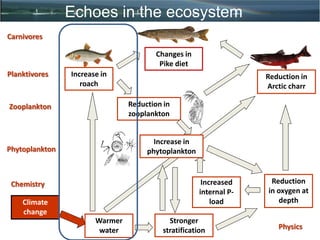
Warmer
water
Reduction in
zooplankton
Increase in
roach
Increase in
phytoplankton
Reduction in
Arctic charr
Reduction
in oxygen at
depth
Stronger
stratification
Increased
internal P-
load
Planktivores
Zooplankton
Phytoplankton
Chemistry
Physics
Changes in
Pike diet
Carnivores
Echoes in the ecosystem
Climate
change
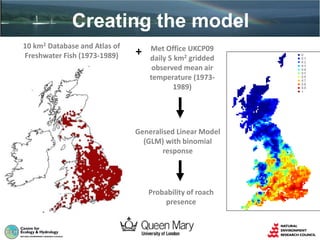
Creating the model
10 km2 Database and Atlas of
Freshwater Fish (1973-1989) + Met Office UKCP09
daily 5 km2 gridded
observed mean air
temperature (1973-
1989)
Generalised Linear Model
(GLM) with binomial
response
Probability of roach
presence
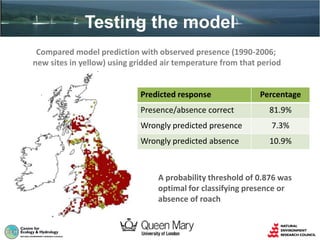
Testing the model
Compared model prediction with observed presence (1990-2006;
new sites in yellow) using gridded air temperature from that period
Predicted response Percentage
Presence/absence correct 81.9%
Wrongly predicted presence 7.3%
Wrongly predicted absence 10.9%
A probability threshold of 0.876 was
optimal for classifying presence or
absence of roach
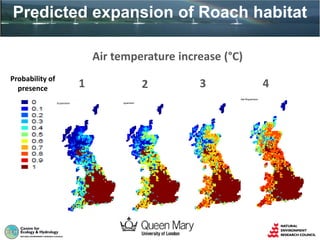
Predicted expansion of Roach habitat
Probability of
presence
Air temperature increase (°C)
1 2 43
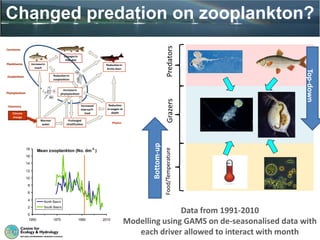
Changed predation on zooplankton?
PredatorsGrazersFood/Temperature
The hypothesis
Climate
change
Warmer
water
Reductionin
zooplankton
Increasein
roach
Increasein
phytoplankton
Reductionin
Arcticcharr
Reduction
in oxygen at
depth
Prolonged
stratification
Increased
internalP-
load
Planktivores
Zooplankton
Phytoplankton
Chemistry
Physics
Changesin
Pike diet
Carnivores
Mean zooplankton (No. dm
-3
)
0
2
4
6
8
10
12
14
16
18
1950 1970 1990 2010
North Basin
South Basin
Bottom-up
Top-down
Data from 1991-2010
Modelling using GAMS on de-seasonalised data with
each driver allowed to interact with month
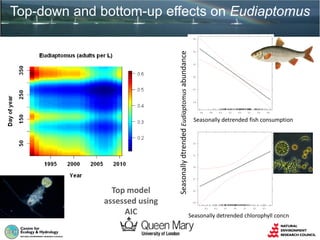
Top-down and bottom-up effects on Eudiaptomus
SeasonallydtrendedEudiaptomusabundance
Seasonally detrended fish consumption
Seasonally detrended chlorophyll concn
Top model
assessed using
AIC
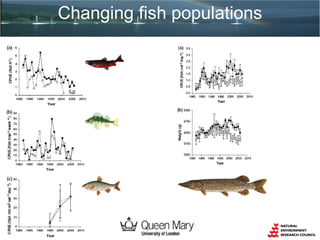
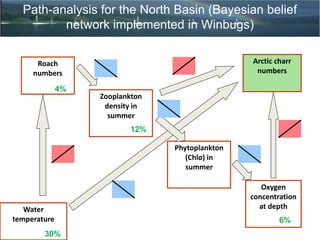
Changing fish populations
Water
temperature
Roach
numbers
Zooplankton
density in
summer
Phytoplankton
(Chla) in
summer
Arctic charr
numbers
Oxygen
concentration
at depth
Arctic charr
numbers
30%
4%
12%
6%
Path-analysis for the North Basin (Bayesian belief
network implemented in Winbugs)
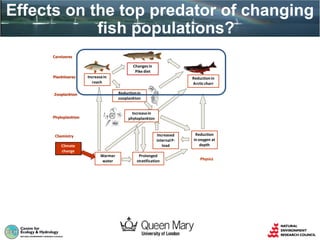
Effects on the top predator of changing
fish populations?
The hypothesis
Climate
change
Warmer
water
Reductionin
zooplankton
Increasein
roach
Increasein
phytoplankton
Reductionin
Arcticcharr
Reduction
in oxygen at
depth
Prolonged
stratification
Increased
internalP-
load
Planktivores
Zooplankton
Phytoplankton
Chemistry
Physics
Changesin
Pike diet
Carnivores
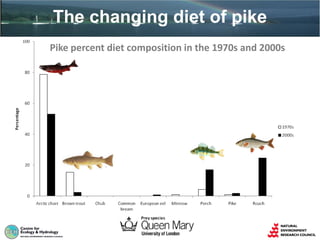
The changing diet of pike
Pike percent diet composition in the 1970s and 2000s
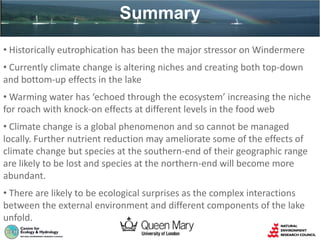
• Historically eutrophication has been the major stressor on Windermere
• Currently climate change is altering niches and creating both top-down
and bottom-up effects in the lake
• Warming water has ‘echoed through the ecosystem’ increasing the niche
for roach with knock-on effects at different levels in the food web
• Climate change is a global phenomenon and so cannot be managed
locally. Further nutrient reduction may ameliorate some of the effects of
climate change but species at the southern-end of their geographic range
are likely to be lost and species at the northern-end will become more
abundant.
• There are likely to be ecological surprises as the complex interactions
between the external environment and different components of the lake
unfold.
Summary
Acknowledgements
• This work was funded by NERC Grant
NE/H000208/1: “Whole lake responses to species
invasion mediated by climate change”
(http://www.windermere-science.org.uk/).
• Many thanks to everyone involved in maintaining
the Cumbrian Lakes long-term monitoring
programme, past and present.
• Thank you for your attention!

Maberly et al 2013 SIL presentation

  • 1.
    Stephen Maberly, AlexElliott, Peter Henrys, Ian Jones, Stephen Thackeray & Ian Winfield Lake Ecosystems Group Centre for Ecology & Hydrology, Lancaster, UK Echoes in the ecosystem: top-down & bottom-up responses of Windermere to environmental perturbation Jonathan Grey & Peter Smyntek Queen Mary University of London, UK
  • 2.
    Top-down & bottom-upmultiple stressors Maberly & Elliott (2012) Freshwater Biology 57, 233-243 Nutrients (& toxins) Acid (& nutrients) Climate change Natural variability in weather Bottom-up Top-down
  • 3.
    Windermere Photos from FBA Image Archive •England’s largest lake • Two basins: deeper, less productive North and shallower more productive South • One of the most intensively studied lakes in the world • Long-term data and archives from early 1900s and regular sampling for range of variables since 1945 • Freshwater Biology Special Issue Feb 2012 57 (2)
  • 4.
    Windermere as amodel system Mean winter SRP (mg m -3 ) 0 5 10 15 20 25 30 1950 1960 1970 1980 1990 2000 2010 Year North Basin South Basin 6 8 10 12 1950 1970 1990 2010 Year Mean surface temperature (oC) North Basin South Basin Nutrient enrichment Warming Expansion of non-native species 0 1000 2000 3000 4000 5000 6000 1990 1995 2000 2005 2010 Abundance(fishha-1) Year
  • 5.
    Warmer water Reduction in zooplankton Increase in roach Increasein phytoplankton Reduction in Arctic charr Reduction in oxygen at depth Stronger stratification Increased internal P- load Planktivores Zooplankton Phytoplankton Chemistry Physics Changes in Pike diet Carnivores Echoes in the ecosystem Climate change
  • 6.
    Creating the model 10km2 Database and Atlas of Freshwater Fish (1973-1989) + Met Office UKCP09 daily 5 km2 gridded observed mean air temperature (1973- 1989) Generalised Linear Model (GLM) with binomial response Probability of roach presence
  • 7.
    Testing the model Comparedmodel prediction with observed presence (1990-2006; new sites in yellow) using gridded air temperature from that period Predicted response Percentage Presence/absence correct 81.9% Wrongly predicted presence 7.3% Wrongly predicted absence 10.9% A probability threshold of 0.876 was optimal for classifying presence or absence of roach
  • 8.
    Predicted expansion ofRoach habitat Probability of presence Air temperature increase (°C) 1 2 43
  • 9.
    Changed predation onzooplankton? PredatorsGrazersFood/Temperature The hypothesis Climate change Warmer water Reductionin zooplankton Increasein roach Increasein phytoplankton Reductionin Arcticcharr Reduction in oxygen at depth Prolonged stratification Increased internalP- load Planktivores Zooplankton Phytoplankton Chemistry Physics Changesin Pike diet Carnivores Mean zooplankton (No. dm -3 ) 0 2 4 6 8 10 12 14 16 18 1950 1970 1990 2010 North Basin South Basin Bottom-up Top-down Data from 1991-2010 Modelling using GAMS on de-seasonalised data with each driver allowed to interact with month
  • 10.
    Top-down and bottom-upeffects on Eudiaptomus SeasonallydtrendedEudiaptomusabundance Seasonally detrended fish consumption Seasonally detrended chlorophyll concn Top model assessed using AIC
  • 11.
  • 12.
    Water temperature Roach numbers Zooplankton density in summer Phytoplankton (Chla) in summer Arcticcharr numbers Oxygen concentration at depth Arctic charr numbers 30% 4% 12% 6% Path-analysis for the North Basin (Bayesian belief network implemented in Winbugs)
  • 13.
    Effects on thetop predator of changing fish populations? The hypothesis Climate change Warmer water Reductionin zooplankton Increasein roach Increasein phytoplankton Reductionin Arcticcharr Reduction in oxygen at depth Prolonged stratification Increased internalP- load Planktivores Zooplankton Phytoplankton Chemistry Physics Changesin Pike diet Carnivores
  • 14.
    The changing dietof pike Pike percent diet composition in the 1970s and 2000s
  • 15.
    • Historically eutrophicationhas been the major stressor on Windermere • Currently climate change is altering niches and creating both top-down and bottom-up effects in the lake • Warming water has ‘echoed through the ecosystem’ increasing the niche for roach with knock-on effects at different levels in the food web • Climate change is a global phenomenon and so cannot be managed locally. Further nutrient reduction may ameliorate some of the effects of climate change but species at the southern-end of their geographic range are likely to be lost and species at the northern-end will become more abundant. • There are likely to be ecological surprises as the complex interactions between the external environment and different components of the lake unfold. Summary
  • 16.
    Acknowledgements • This workwas funded by NERC Grant NE/H000208/1: “Whole lake responses to species invasion mediated by climate change” (http://www.windermere-science.org.uk/). • Many thanks to everyone involved in maintaining the Cumbrian Lakes long-term monitoring programme, past and present. • Thank you for your attention!