SEA TROUT TO STAMFORD:
THE WELLAND SEA TROUT PROJECT Update: January 2018
The Welland Sea Trout Project, launched in 2014, is a partnership between the Environment Agency,
Wild Trout Trust, Guash Fishing Club and Welland Rivers Trust, which aims to restore the sea trout run to
the River Welland and improve the wider ecology of the river. The project is prioritising the restoration of
the sea trout run between the Wash, Stamford and the River Gwash via the Maxey Cut flood relief
channel, which is the shortest and least obstructed route to good habitat. Sea trout are the focus of the
project, but a range of fish, including eels, as well as other species are also benefitting.
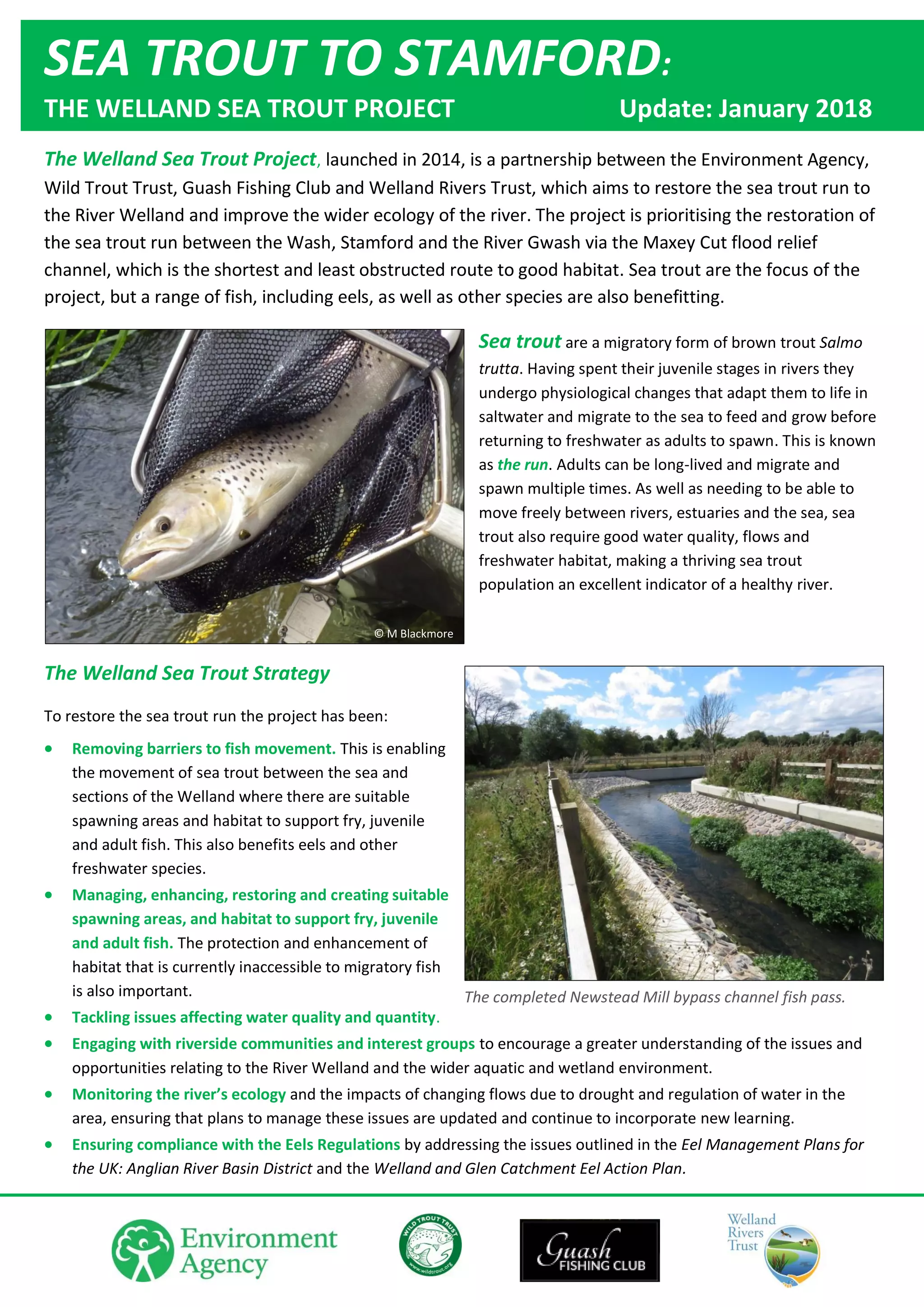
Sea trout are a migratory form of brown trout Salmo
trutta. Having spent their juvenile stages in rivers they
undergo physiological changes that adapt them to life in
saltwater and migrate to the sea to feed and grow before
returning to freshwater as adults to spawn. This is known
as the run. Adults can be long-lived and migrate and
spawn multiple times. As well as needing to be able to
move freely between rivers, estuaries and the sea, sea
trout also require good water quality, flows and
freshwater habitat, making a thriving sea trout
population an excellent indicator of a healthy river.
The Welland Sea Trout Strategy
To restore the sea trout run the project has been:
 Removing barriers to fish movement. This is enabling
the movement of sea trout between the sea and
sections of the Welland where there are suitable
spawning areas and habitat to support fry, juvenile
and adult fish. This also benefits eels and other
freshwater species.
 Managing, enhancing, restoring and creating suitable
spawning areas, and habitat to support fry, juvenile
and adult fish. The protection and enhancement of
habitat that is currently inaccessible to migratory fish
is also important.
 Tackling issues affecting water quality and quantity.
 Engaging with riverside communities and interest groups to encourage a greater understanding of the issues and
opportunities relating to the River Welland and the wider aquatic and wetland environment.
 Monitoring the river’s ecology and the impacts of changing flows due to drought and regulation of water in the
area, ensuring that plans to manage these issues are updated and continue to incorporate new learning.
 Ensuring compliance with the Eels Regulations by addressing the issues outlined in the Eel Management Plans for
the UK: Anglian River Basin District and the Welland and Glen Catchment Eel Action Plan.
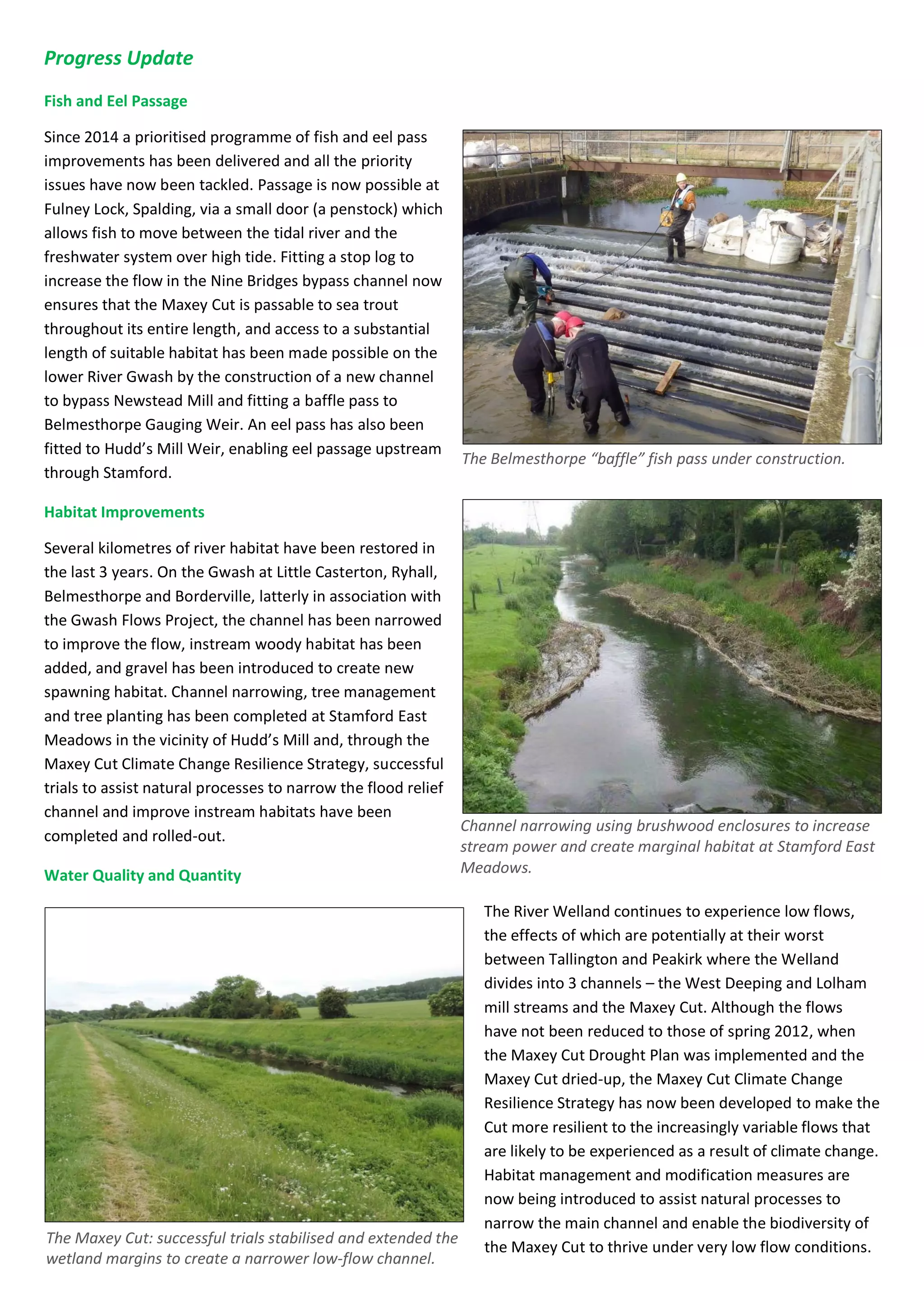
The completed Newstead Mill bypass channel fish pass.
© M Blackmore
Progress Update
Fish and Eel Passage
Since 2014 a prioritised programme of fish and eel pass
improvements has been delivered and all the priority
issues have now been tackled. Passage is now possible at
Fulney Lock, Spalding, via a small door (a penstock) which
allows fish to move between the tidal river and the
freshwater system over high tide. Fitting a stop log to
increase the flow in the Nine Bridges bypass channel now
ensures that the Maxey Cut is passable to sea trout
throughout its entire length, and access to a substantial
length of suitable habitat has been made possible on the
lower River Gwash by the construction of a new channel
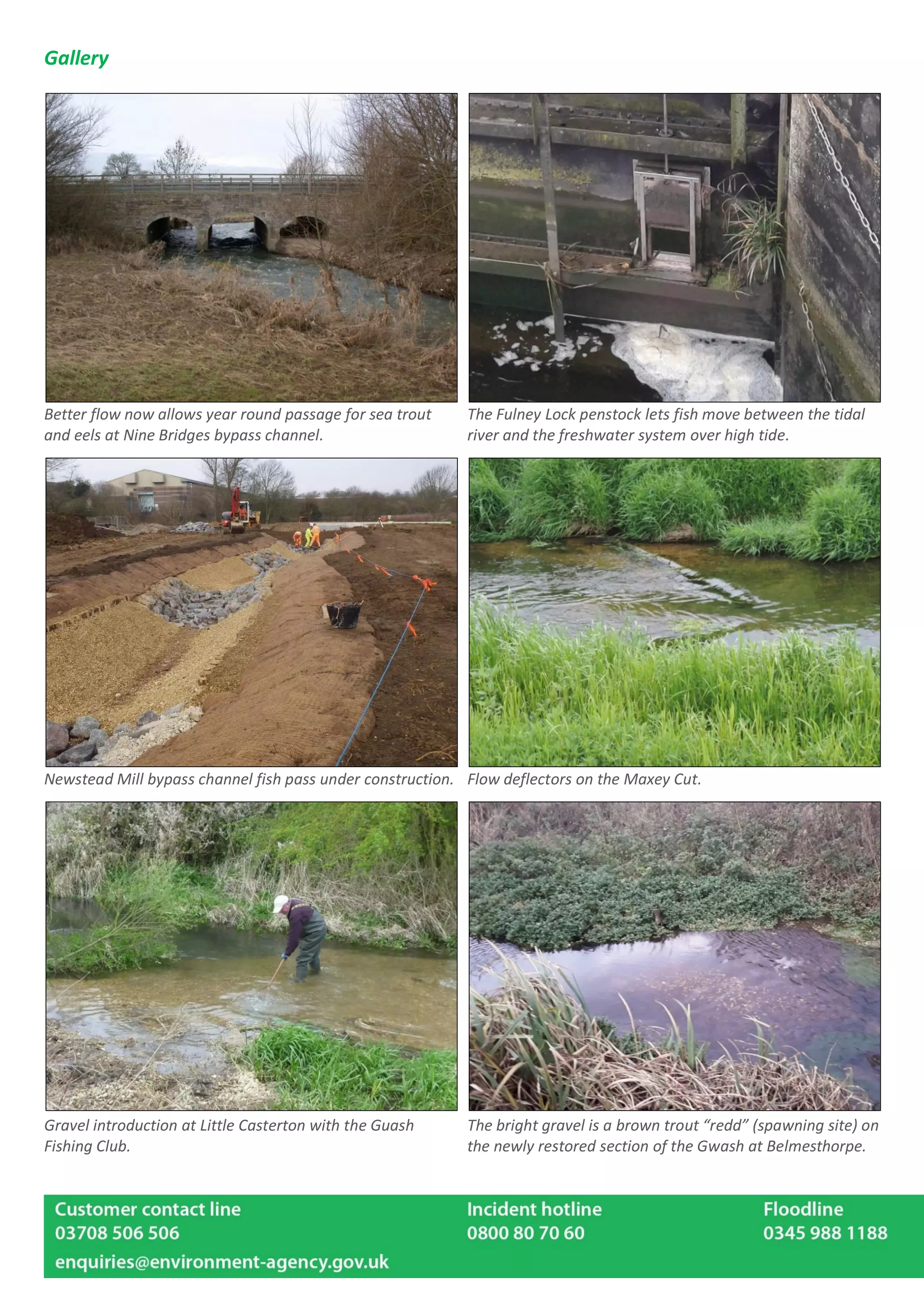
to bypass Newstead Mill and fitting a baffle pass to
Belmesthorpe Gauging Weir. An eel pass has also been
fitted to Hudd’s Mill Weir, enabling eel passage upstream
through Stamford.
Habitat Improvements
Several kilometres of river habitat have been restored in
the last 3 years. On the Gwash at Little Casterton, Ryhall,
Belmesthorpe and Borderville, latterly in association with
the Gwash Flows Project, the channel has been narrowed
to improve the flow, instream woody habitat has been
added, and gravel has been introduced to create new
spawning habitat. Channel narrowing, tree management
and tree planting has been completed at Stamford East
Meadows in the vicinity of Hudd’s Mill and, through the
Maxey Cut Climate Change Resilience Strategy, successful
trials to assist natural processes to narrow the flood relief
channel and improve instream habitats have been
completed and rolled-out.
Water Quality and Quantity
The River Welland continues to experience low flows,
the effects of which are potentially at their worst
between Tallington and Peakirk where the Welland
divides into 3 channels – the West Deeping and Lolham
mill streams and the Maxey Cut. Although the flows
have not been reduced to those of spring 2012, when
the Maxey Cut Drought Plan was implemented and the
Maxey Cut dried-up, the Maxey Cut Climate Change
Resilience Strategy has now been developed to make the
Cut more resilient to the increasingly variable flows that
are likely to be experienced as a result of climate change.
Habitat management and modification measures are
now being introduced to assist natural processes to
narrow the main channel and enable the biodiversity of
the Maxey Cut to thrive under very low flow conditions.
Channel narrowing using brushwood enclosures to increase
stream power and create marginal habitat at Stamford East
Meadows.
The Maxey Cut: successful trials stabilised and extended the
wetland margins to create a narrower low-flow channel.
The Belmesthorpe “baffle” fish pass under construction.
Faster flows and a clean gravel bed have allowed stands of
river water-crowfoot to develop at Stamford East Meadows.
Engaging with Riverside Communities
A practical demonstration day, led by the Wild Trout Trust, was held at Hudds Mill near Stamford to introduce
participants from angling clubs in the catchment to a variety of river restoration techniques, including constructing
brushwood shelves and laying bankside trees to create cover and fish habitat for fish.
The Hudd’s Mill practical Demonstration Day at Stamford
East Meadow.
Stable Isotope Analysis of scale samples is helping partners
to get a better understanding of trout movements.
Monitoring and Research
In addition to the Environment Agency’s routine monitoring, in partnership with the Wild Trout Trust, University of
Lancaster, Queen Mary University of London and local anglers, Scale Stable Isotope Analysis is being undertaken to get a
better understanding of trout movements. Analysis of scales taken from fish, which are then released unharmed, can
determine if any of the larger brown trout in river have been out to sea. Scale samples have been collected and will be
analysed in 2018. If it is found that trout have spent time in salt water it will confirm that the sea trout run has been
restored.
Future Projects
 Maxey Cut (through the Maxey Cut Climate Change
Resilience Strategy) - habitat improvements upstream
of the A15, including further berm stabilisation and
channel narrowing using flow deflectors.
 Maxey Cut - Assessment and resolution of outstanding
eel passage requirements at Lolham Bridges and
Maxey Road Bridge.
 River Gwash - gravel introduction upstream of
Borderville Weir to create new spawning habitat.
 River Gwash - bed-raising at Little Casterton and
Belmesthorpe (through the Gwash Flows Project).
Rock and gravel will be introduced to restore the river
bed level where it has previously been over-deepened.
 Preparation of an action plan to manage riverside
trees and restore instream habitats between Hudd’s
Mill and Tallington Weir.
 A public event to promote the completed river restoration works at Stamford Meadows East/Hudd’s Mill.
Further Information
Contact the Fisheries, Biodiversity and Geomorphology (FBG) Team, Lincs and Northants Area, Lincoln
Gallery
Better flow now allows year round passage for sea trout
and eels at Nine Bridges bypass channel.
The Fulney Lock penstock lets fish move between the tidal
river and the freshwater system over high tide.
Newstead Mill bypass channel fish pass under construction. Flow deflectors on the Maxey Cut.
Gravel introduction at Little Casterton with the Guash
Fishing Club.
The bright gravel is a brown trout “redd” (spawning site) on
the newly restored section of the Gwash at Belmesthorpe.

Welland sea trout project update Jan 2018

  • 1.
    SEA TROUT TOSTAMFORD: THE WELLAND SEA TROUT PROJECT Update: January 2018 The Welland Sea Trout Project, launched in 2014, is a partnership between the Environment Agency, Wild Trout Trust, Guash Fishing Club and Welland Rivers Trust, which aims to restore the sea trout run to the River Welland and improve the wider ecology of the river. The project is prioritising the restoration of the sea trout run between the Wash, Stamford and the River Gwash via the Maxey Cut flood relief channel, which is the shortest and least obstructed route to good habitat. Sea trout are the focus of the project, but a range of fish, including eels, as well as other species are also benefitting. Sea trout are a migratory form of brown trout Salmo trutta. Having spent their juvenile stages in rivers they undergo physiological changes that adapt them to life in saltwater and migrate to the sea to feed and grow before returning to freshwater as adults to spawn. This is known as the run. Adults can be long-lived and migrate and spawn multiple times. As well as needing to be able to move freely between rivers, estuaries and the sea, sea trout also require good water quality, flows and freshwater habitat, making a thriving sea trout population an excellent indicator of a healthy river. The Welland Sea Trout Strategy To restore the sea trout run the project has been:  Removing barriers to fish movement. This is enabling the movement of sea trout between the sea and sections of the Welland where there are suitable spawning areas and habitat to support fry, juvenile and adult fish. This also benefits eels and other freshwater species.  Managing, enhancing, restoring and creating suitable spawning areas, and habitat to support fry, juvenile and adult fish. The protection and enhancement of habitat that is currently inaccessible to migratory fish is also important.  Tackling issues affecting water quality and quantity.  Engaging with riverside communities and interest groups to encourage a greater understanding of the issues and opportunities relating to the River Welland and the wider aquatic and wetland environment.  Monitoring the river’s ecology and the impacts of changing flows due to drought and regulation of water in the area, ensuring that plans to manage these issues are updated and continue to incorporate new learning.  Ensuring compliance with the Eels Regulations by addressing the issues outlined in the Eel Management Plans for the UK: Anglian River Basin District and the Welland and Glen Catchment Eel Action Plan. The completed Newstead Mill bypass channel fish pass. © M Blackmore
  • 2.
    Progress Update Fish andEel Passage Since 2014 a prioritised programme of fish and eel pass improvements has been delivered and all the priority issues have now been tackled. Passage is now possible at Fulney Lock, Spalding, via a small door (a penstock) which allows fish to move between the tidal river and the freshwater system over high tide. Fitting a stop log to increase the flow in the Nine Bridges bypass channel now ensures that the Maxey Cut is passable to sea trout throughout its entire length, and access to a substantial length of suitable habitat has been made possible on the lower River Gwash by the construction of a new channel to bypass Newstead Mill and fitting a baffle pass to Belmesthorpe Gauging Weir. An eel pass has also been fitted to Hudd’s Mill Weir, enabling eel passage upstream through Stamford. Habitat Improvements Several kilometres of river habitat have been restored in the last 3 years. On the Gwash at Little Casterton, Ryhall, Belmesthorpe and Borderville, latterly in association with the Gwash Flows Project, the channel has been narrowed to improve the flow, instream woody habitat has been added, and gravel has been introduced to create new spawning habitat. Channel narrowing, tree management and tree planting has been completed at Stamford East Meadows in the vicinity of Hudd’s Mill and, through the Maxey Cut Climate Change Resilience Strategy, successful trials to assist natural processes to narrow the flood relief channel and improve instream habitats have been completed and rolled-out. Water Quality and Quantity The River Welland continues to experience low flows, the effects of which are potentially at their worst between Tallington and Peakirk where the Welland divides into 3 channels – the West Deeping and Lolham mill streams and the Maxey Cut. Although the flows have not been reduced to those of spring 2012, when the Maxey Cut Drought Plan was implemented and the Maxey Cut dried-up, the Maxey Cut Climate Change Resilience Strategy has now been developed to make the Cut more resilient to the increasingly variable flows that are likely to be experienced as a result of climate change. Habitat management and modification measures are now being introduced to assist natural processes to narrow the main channel and enable the biodiversity of the Maxey Cut to thrive under very low flow conditions. Channel narrowing using brushwood enclosures to increase stream power and create marginal habitat at Stamford East Meadows. The Maxey Cut: successful trials stabilised and extended the wetland margins to create a narrower low-flow channel. The Belmesthorpe “baffle” fish pass under construction.
  • 3.
    Faster flows anda clean gravel bed have allowed stands of river water-crowfoot to develop at Stamford East Meadows. Engaging with Riverside Communities A practical demonstration day, led by the Wild Trout Trust, was held at Hudds Mill near Stamford to introduce participants from angling clubs in the catchment to a variety of river restoration techniques, including constructing brushwood shelves and laying bankside trees to create cover and fish habitat for fish. The Hudd’s Mill practical Demonstration Day at Stamford East Meadow. Stable Isotope Analysis of scale samples is helping partners to get a better understanding of trout movements. Monitoring and Research In addition to the Environment Agency’s routine monitoring, in partnership with the Wild Trout Trust, University of Lancaster, Queen Mary University of London and local anglers, Scale Stable Isotope Analysis is being undertaken to get a better understanding of trout movements. Analysis of scales taken from fish, which are then released unharmed, can determine if any of the larger brown trout in river have been out to sea. Scale samples have been collected and will be analysed in 2018. If it is found that trout have spent time in salt water it will confirm that the sea trout run has been restored. Future Projects  Maxey Cut (through the Maxey Cut Climate Change Resilience Strategy) - habitat improvements upstream of the A15, including further berm stabilisation and channel narrowing using flow deflectors.  Maxey Cut - Assessment and resolution of outstanding eel passage requirements at Lolham Bridges and Maxey Road Bridge.  River Gwash - gravel introduction upstream of Borderville Weir to create new spawning habitat.  River Gwash - bed-raising at Little Casterton and Belmesthorpe (through the Gwash Flows Project). Rock and gravel will be introduced to restore the river bed level where it has previously been over-deepened.  Preparation of an action plan to manage riverside trees and restore instream habitats between Hudd’s Mill and Tallington Weir.  A public event to promote the completed river restoration works at Stamford Meadows East/Hudd’s Mill. Further Information Contact the Fisheries, Biodiversity and Geomorphology (FBG) Team, Lincs and Northants Area, Lincoln
  • 4.
    Gallery Better flow nowallows year round passage for sea trout and eels at Nine Bridges bypass channel. The Fulney Lock penstock lets fish move between the tidal river and the freshwater system over high tide. Newstead Mill bypass channel fish pass under construction. Flow deflectors on the Maxey Cut. Gravel introduction at Little Casterton with the Guash Fishing Club. The bright gravel is a brown trout “redd” (spawning site) on the newly restored section of the Gwash at Belmesthorpe.