Advisory document
Salmonid redd identification
Two trout over a redd (photo coutesy of Rob Mungovan)
1
Background
In the UK, trout and salmon spawning usually occurs between October and
January, when the water is cold and carrying sufficient oxygen to incubate
the eggs. The exact timing is dependent upon day length, temperature and
geographical location as it is vital that the fry hatch out in time to make
maximum use of their first growing season (spring, summer and autumn).
The hen (female) fish initially identifies a site where flow maintains the bed
free from excess silt and water can percolate through the gravel. She then
turns on her side and flexes her body to deflect flow down onto the bed and
create a depression, known as a redd (Fig. 1). River flow naturally sorts the
substrate, with the fine material being swept away downstream and the
larger gravel material depositing to form a permeable mound. Once the
redd is cut, the hen fish lays her eggs into the depression, over which the
cock (male) fish release his milt (sperm). The hen then moves upstream
and displaces more material to cover the eggs, leaving a depression with a
raised area immediately downstream. The process takes anything from
hours up to several days with a single hen fish often laying in several redds.
Figure 1. Hen sea trout on her side cutting a redd (Photo courtesy of Peter Henriksson). A cock fish
is waiting by her side for an opportunity to spawn and will actively defend that position.
Trout favour slopes of 10-40mm diameter gravel towards the tail of a pool,
while salmon favour faster flowing glides and riffles with 20-60+mm
substrate. Large sea trout use similar areas to salmon, whereas the smaller
fish spawn with, and alongside resident trout. Site selection is linked to fish
size, strength and river processes, e.g. the larger substrate favoured by
larger fish is only maintained clear from finer substrate in faster flows. The
following figures show a range of trout, sea trout and possibly salmon redds.
2
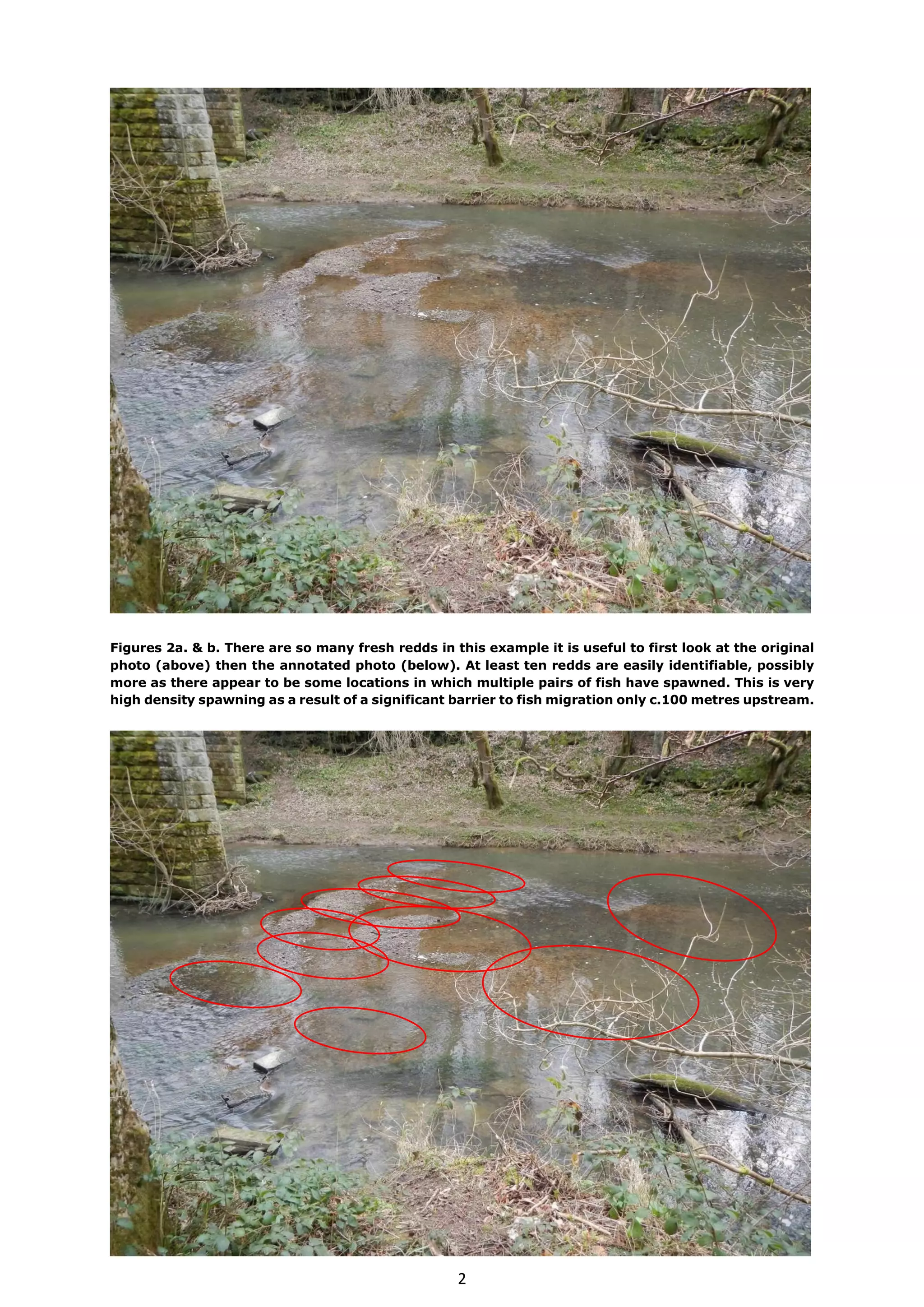
Figures 2a. & b. There are so many fresh redds in this example it is useful to first look at the original
photo (above) then the annotated photo (below). At least ten redds are easily identifiable, possibly
more as there appear to be some locations in which multiple pairs of fish have spawned. This is very
high density spawning as a result of a significant barrier to fish migration only c.100 metres upstream.
3
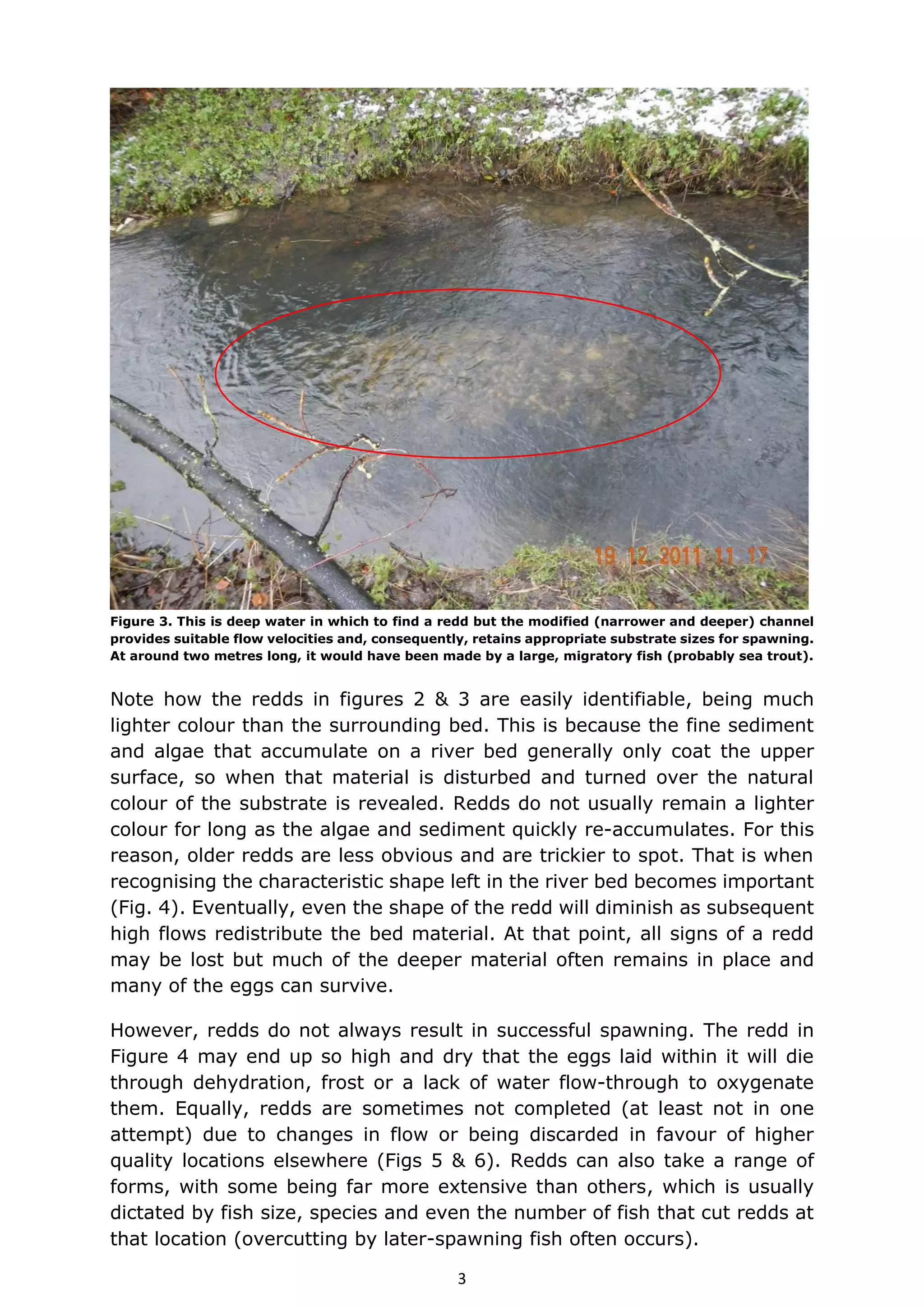
Figure 3. This is deep water in which to find a redd but the modified (narrower and deeper) channel
provides suitable flow velocities and, consequently, retains appropriate substrate sizes for spawning.
At around two metres long, it would have been made by a large, migratory fish (probably sea trout).
Note how the redds in figures 2 & 3 are easily identifiable, being much
lighter colour than the surrounding bed. This is because the fine sediment
and algae that accumulate on a river bed generally only coat the upper
surface, so when that material is disturbed and turned over the natural
colour of the substrate is revealed. Redds do not usually remain a lighter
colour for long as the algae and sediment quickly re-accumulates. For this
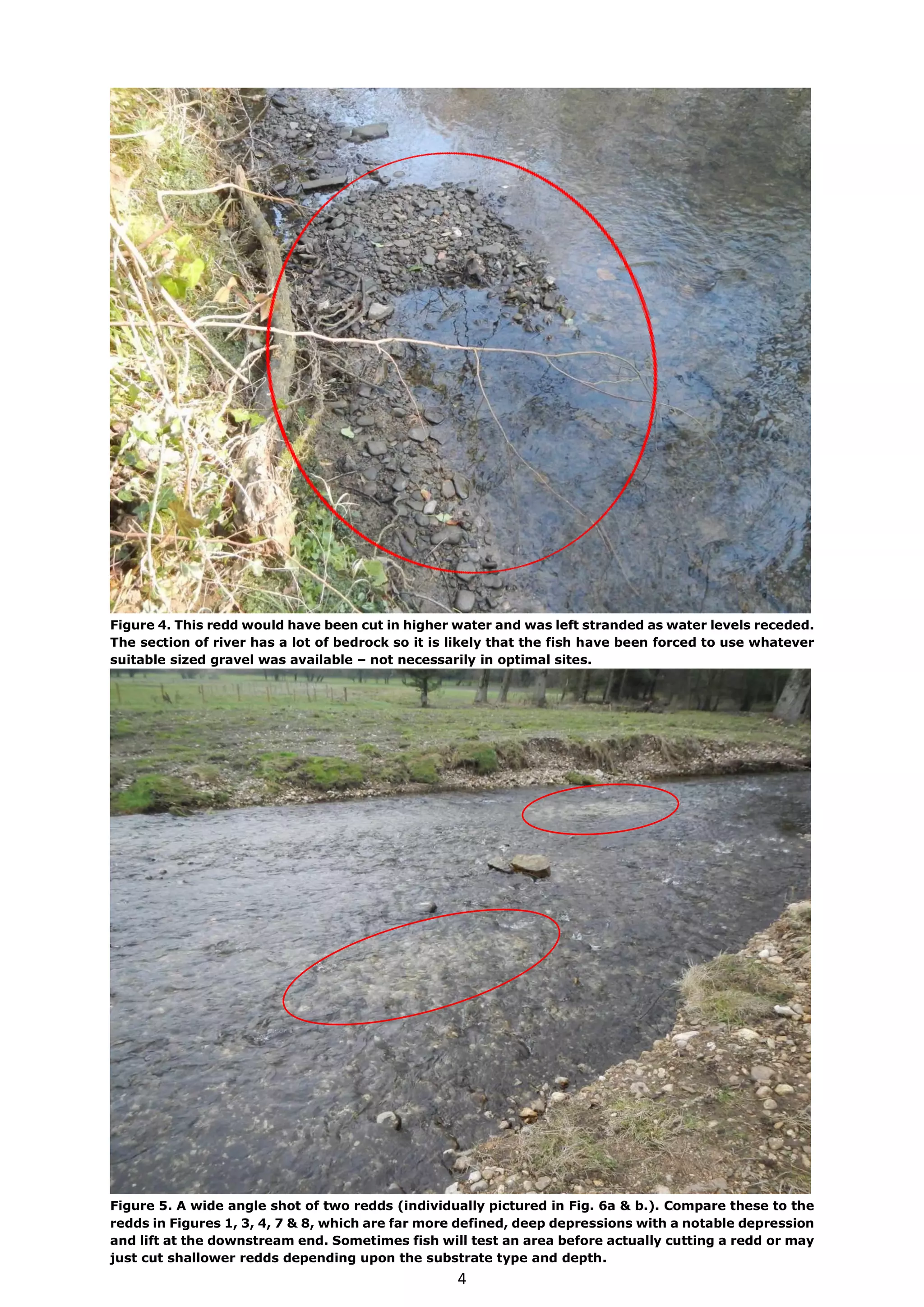
reason, older redds are less obvious and are trickier to spot. That is when
recognising the characteristic shape left in the river bed becomes important
(Fig. 4). Eventually, even the shape of the redd will diminish as subsequent
high flows redistribute the bed material. At that point, all signs of a redd
may be lost but much of the deeper material often remains in place and
many of the eggs can survive.
However, redds do not always result in successful spawning. The redd in
Figure 4 may end up so high and dry that the eggs laid within it will die
through dehydration, frost or a lack of water flow-through to oxygenate
them. Equally, redds are sometimes not completed (at least not in one
attempt) due to changes in flow or being discarded in favour of higher
quality locations elsewhere (Figs 5 & 6). Redds can also take a range of
forms, with some being far more extensive than others, which is usually
dictated by fish size, species and even the number of fish that cut redds at
that location (overcutting by later-spawning fish often occurs).
4
Figure 4. This redd would have been cut in higher water and was left stranded as water levels receded.
The section of river has a lot of bedrock so it is likely that the fish have been forced to use whatever
suitable sized gravel was available – not necessarily in optimal sites.
Figure 5. A wide angle shot of two redds (individually pictured in Fig. 6a & b.). Compare these to the
redds in Figures 1, 3, 4, 7 & 8, which are far more defined, deep depressions with a notable depression
and lift at the downstream end. Sometimes fish will test an area before actually cutting a redd or may
just cut shallower redds depending upon the substrate type and depth.
5
Figure 6a. & b. Attempted redds (above and probably below). Fish will sometimes test the bed to see
if it is suitable spawning substrate; they do not always make a successful redd. On shallow riffles,
fish may even run out of time as water levels drop following a flood. Note the algae on the undisturbed
bed, in contrast to the much brighter, cleaner disturbed material on this limestone river. The picture
below is definitely a redd, whether it was completed is very questionable owing to the limited redd
size in comparison to the large (suitable for larger migratory salmonid) gravel size.
6
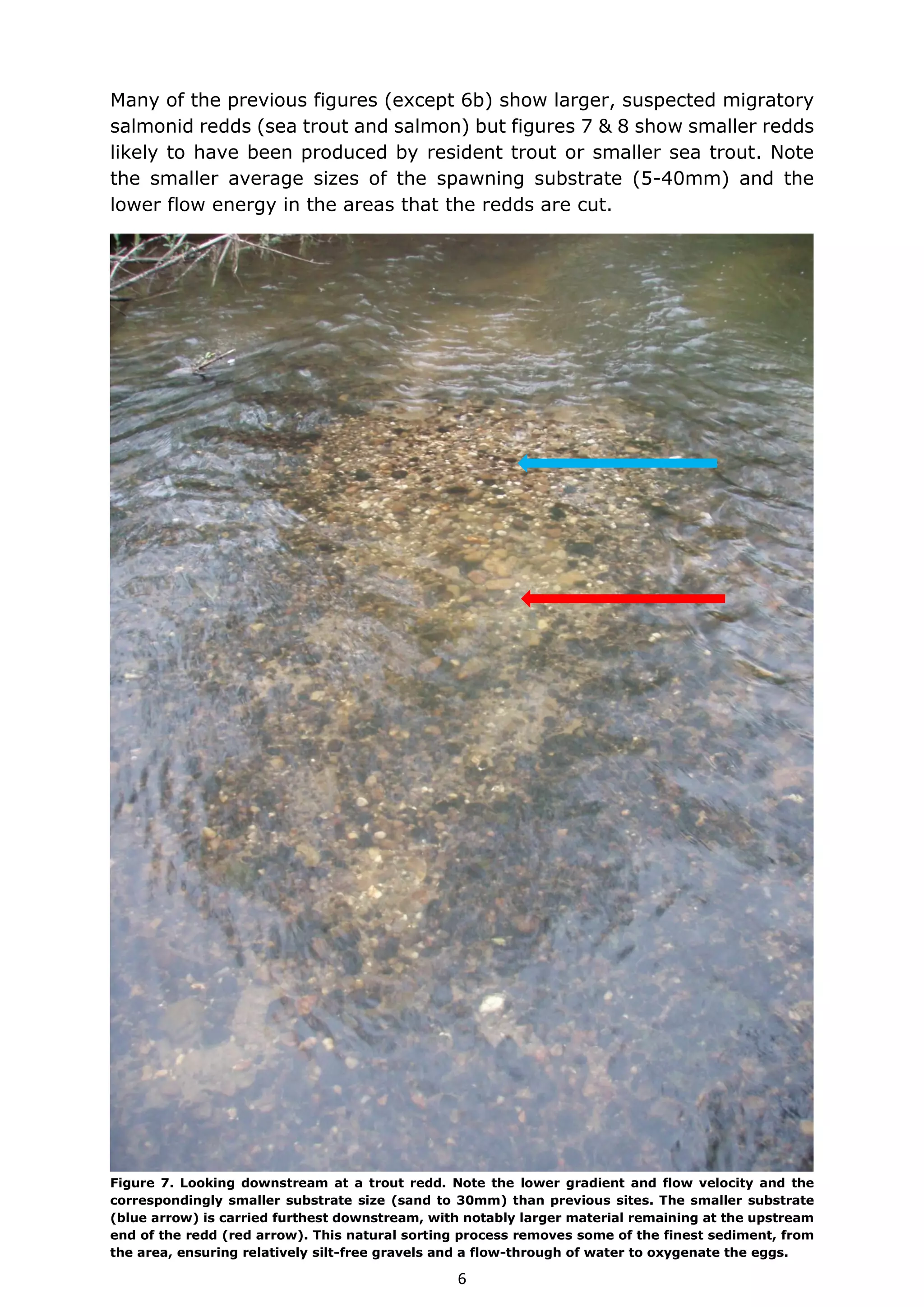
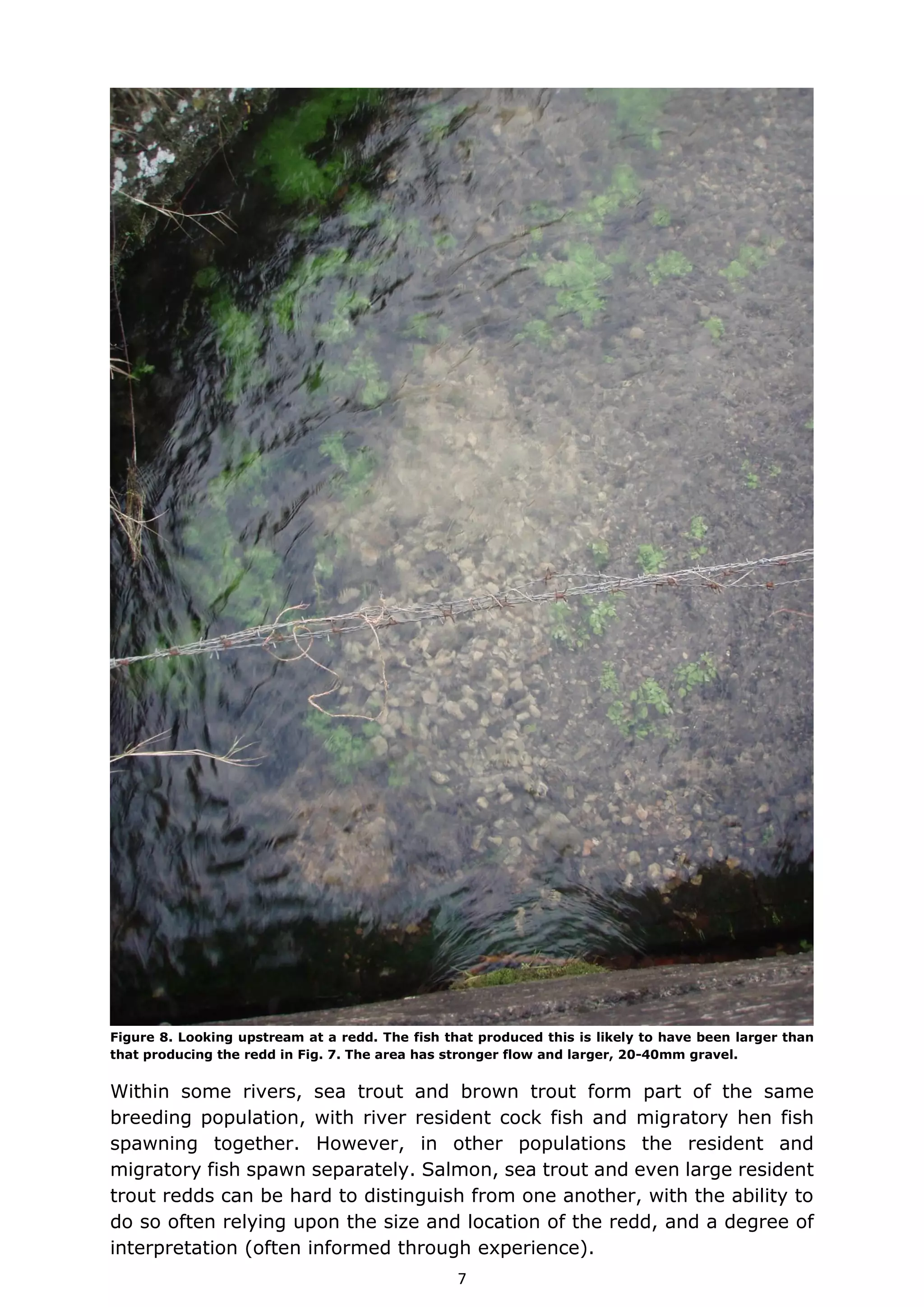
Many of the previous figures (except 6b) show larger, suspected migratory
salmonid redds (sea trout and salmon) but figures 7 & 8 show smaller redds
likely to have been produced by resident trout or smaller sea trout. Note
the smaller average sizes of the spawning substrate (5-40mm) and the
lower flow energy in the areas that the redds are cut.
Figure 7. Looking downstream at a trout redd. Note the lower gradient and flow velocity and the
correspondingly smaller substrate size (sand to 30mm) than previous sites. The smaller substrate
(blue arrow) is carried furthest downstream, with notably larger material remaining at the upstream
end of the redd (red arrow). This natural sorting process removes some of the finest sediment, from
the area, ensuring relatively silt-free gravels and a flow-through of water to oxygenate the eggs.
7
Figure 8. Looking upstream at a redd. The fish that produced this is likely to have been larger than
that producing the redd in Fig. 7. The area has stronger flow and larger, 20-40mm gravel.
Within some rivers, sea trout and brown trout form part of the same
breeding population, with river resident cock fish and migratory hen fish
spawning together. However, in other populations the resident and
migratory fish spawn separately. Salmon, sea trout and even large resident
trout redds can be hard to distinguish from one another, with the ability to
do so often relying upon the size and location of the redd, and a degree of
interpretation (often informed through experience).

Salmonid redd identification

  • 1.
    Advisory document Salmonid reddidentification Two trout over a redd (photo coutesy of Rob Mungovan)
  • 2.
    1 Background In the UK,trout and salmon spawning usually occurs between October and January, when the water is cold and carrying sufficient oxygen to incubate the eggs. The exact timing is dependent upon day length, temperature and geographical location as it is vital that the fry hatch out in time to make maximum use of their first growing season (spring, summer and autumn). The hen (female) fish initially identifies a site where flow maintains the bed free from excess silt and water can percolate through the gravel. She then turns on her side and flexes her body to deflect flow down onto the bed and create a depression, known as a redd (Fig. 1). River flow naturally sorts the substrate, with the fine material being swept away downstream and the larger gravel material depositing to form a permeable mound. Once the redd is cut, the hen fish lays her eggs into the depression, over which the cock (male) fish release his milt (sperm). The hen then moves upstream and displaces more material to cover the eggs, leaving a depression with a raised area immediately downstream. The process takes anything from hours up to several days with a single hen fish often laying in several redds. Figure 1. Hen sea trout on her side cutting a redd (Photo courtesy of Peter Henriksson). A cock fish is waiting by her side for an opportunity to spawn and will actively defend that position. Trout favour slopes of 10-40mm diameter gravel towards the tail of a pool, while salmon favour faster flowing glides and riffles with 20-60+mm substrate. Large sea trout use similar areas to salmon, whereas the smaller fish spawn with, and alongside resident trout. Site selection is linked to fish size, strength and river processes, e.g. the larger substrate favoured by larger fish is only maintained clear from finer substrate in faster flows. The following figures show a range of trout, sea trout and possibly salmon redds.
  • 3.
    2 Figures 2a. &b. There are so many fresh redds in this example it is useful to first look at the original photo (above) then the annotated photo (below). At least ten redds are easily identifiable, possibly more as there appear to be some locations in which multiple pairs of fish have spawned. This is very high density spawning as a result of a significant barrier to fish migration only c.100 metres upstream.
  • 4.
    3 Figure 3. Thisis deep water in which to find a redd but the modified (narrower and deeper) channel provides suitable flow velocities and, consequently, retains appropriate substrate sizes for spawning. At around two metres long, it would have been made by a large, migratory fish (probably sea trout). Note how the redds in figures 2 & 3 are easily identifiable, being much lighter colour than the surrounding bed. This is because the fine sediment and algae that accumulate on a river bed generally only coat the upper surface, so when that material is disturbed and turned over the natural colour of the substrate is revealed. Redds do not usually remain a lighter colour for long as the algae and sediment quickly re-accumulates. For this reason, older redds are less obvious and are trickier to spot. That is when recognising the characteristic shape left in the river bed becomes important (Fig. 4). Eventually, even the shape of the redd will diminish as subsequent high flows redistribute the bed material. At that point, all signs of a redd may be lost but much of the deeper material often remains in place and many of the eggs can survive. However, redds do not always result in successful spawning. The redd in Figure 4 may end up so high and dry that the eggs laid within it will die through dehydration, frost or a lack of water flow-through to oxygenate them. Equally, redds are sometimes not completed (at least not in one attempt) due to changes in flow or being discarded in favour of higher quality locations elsewhere (Figs 5 & 6). Redds can also take a range of forms, with some being far more extensive than others, which is usually dictated by fish size, species and even the number of fish that cut redds at that location (overcutting by later-spawning fish often occurs).
  • 5.
    4 Figure 4. Thisredd would have been cut in higher water and was left stranded as water levels receded. The section of river has a lot of bedrock so it is likely that the fish have been forced to use whatever suitable sized gravel was available – not necessarily in optimal sites. Figure 5. A wide angle shot of two redds (individually pictured in Fig. 6a & b.). Compare these to the redds in Figures 1, 3, 4, 7 & 8, which are far more defined, deep depressions with a notable depression and lift at the downstream end. Sometimes fish will test an area before actually cutting a redd or may just cut shallower redds depending upon the substrate type and depth.
  • 6.
    5 Figure 6a. &b. Attempted redds (above and probably below). Fish will sometimes test the bed to see if it is suitable spawning substrate; they do not always make a successful redd. On shallow riffles, fish may even run out of time as water levels drop following a flood. Note the algae on the undisturbed bed, in contrast to the much brighter, cleaner disturbed material on this limestone river. The picture below is definitely a redd, whether it was completed is very questionable owing to the limited redd size in comparison to the large (suitable for larger migratory salmonid) gravel size.
  • 7.
    6 Many of theprevious figures (except 6b) show larger, suspected migratory salmonid redds (sea trout and salmon) but figures 7 & 8 show smaller redds likely to have been produced by resident trout or smaller sea trout. Note the smaller average sizes of the spawning substrate (5-40mm) and the lower flow energy in the areas that the redds are cut. Figure 7. Looking downstream at a trout redd. Note the lower gradient and flow velocity and the correspondingly smaller substrate size (sand to 30mm) than previous sites. The smaller substrate (blue arrow) is carried furthest downstream, with notably larger material remaining at the upstream end of the redd (red arrow). This natural sorting process removes some of the finest sediment, from the area, ensuring relatively silt-free gravels and a flow-through of water to oxygenate the eggs.
  • 8.
    7 Figure 8. Lookingupstream at a redd. The fish that produced this is likely to have been larger than that producing the redd in Fig. 7. The area has stronger flow and larger, 20-40mm gravel. Within some rivers, sea trout and brown trout form part of the same breeding population, with river resident cock fish and migratory hen fish spawning together. However, in other populations the resident and migratory fish spawn separately. Salmon, sea trout and even large resident trout redds can be hard to distinguish from one another, with the ability to do so often relying upon the size and location of the redd, and a degree of interpretation (often informed through experience).