Disentangling long-term responses of
crustacean zooplankton to multiple
stressors
Stephen J. Thackeray (sjtr@ceh.ac.uk),
Peter Smyntek, Heidrun Feuchtmayr, Ian J. Winfield, Ian D. Jones &
Stephen C. Maberly
Lake Ecosystems Group, Centre for Ecology & Hydrology
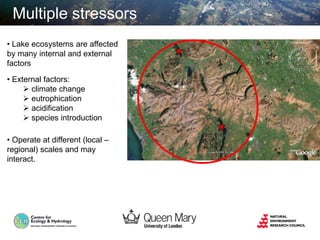
Multiple stressors
• Lake ecosystems are affected
by many internal and external
factors
• External factors:
 climate change
 eutrophication
 acidification
 species introduction
• Operate at different (local –
regional) scales and may
interact.
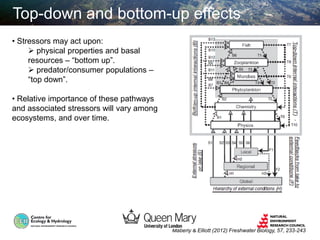
Top-down and bottom-up effects
Maberly & Elliott (2012) Freshwater Biology, 57, 233-243
• Stressors may act upon:
 physical properties and basal
resources – “bottom up”.
 predator/consumer populations –
“top down”.
• Relative importance of these pathways
and associated stressors will vary among
ecosystems, and over time.
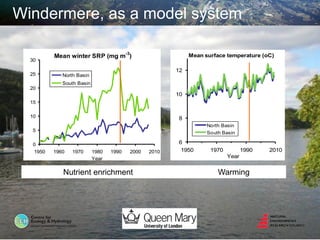
Windermere, as a model system
Mean winter SRP (mg m
-3
)
0
5
10
15
20
25
30
1950 1960 1970 1980 1990 2000 2010
Year
North Basin
South Basin
6
8
10
12
1950 1970 1990 2010
Year
Mean surface temperature (oC)
North Basin
South Basin
Nutrient enrichment Warming
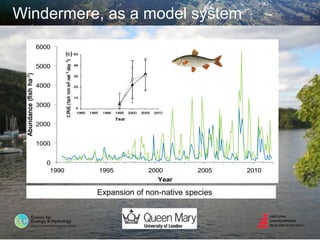
Windermere, as a model system
0
1000
2000
3000
4000
5000
6000
1990 1995 2000 2005 2010
Abundance(fishha-1)
Year
Expansion of non-native species
Focus on crustacean zooplankton
PredatorsGrazersFood/Temperature
• Effects on grazers of long-term
changes in:
 Temperature
 Food (algae)
 Predators (invertebrate)
 Predators (fish)
• Is it possible to detect these
effects on the long-term
dynamics of grazer populations?
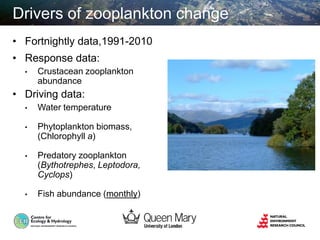
Drivers of zooplankton change
• Fortnightly data,1991-2010
• Response data:
• Crustacean zooplankton
abundance
• Driving data:
• Water temperature
• Phytoplankton biomass,
(Chlorophyll a)
• Predatory zooplankton
(Bythotrephes, Leptodora,
Cyclops)
• Fish abundance (monthly)
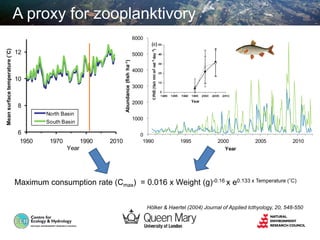
A proxy for zooplanktivory
0
1000
2000
3000
4000
5000
6000
1990 1995 2000 2005 2010
Abundance(fishha-1)
Year
6
8
10
12
1950 1970 1990 2010
Year
Mean surface temperature (oC)
North Basin
South Basin
Meansurfacetemperature(˚C)
Maximum consumption rate (Cmax) = 0.016 x Weight (g)-0.16 x e0.133 x Temperature (˚C)
Hölker & Haertel (2004) Journal of Applied Icthyology, 20, 548-550
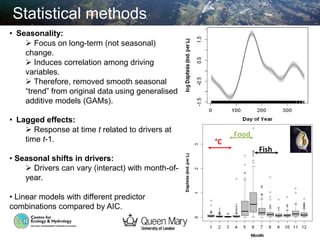
Statistical methods
• Seasonality:
 Focus on long-term (not seasonal)
change.
 Induces correlation among driving
variables.
 Therefore, removed smooth seasonal
“trend” from original data using generalised
additive models (GAMs).
• Lagged effects:
 Response at time t related to drivers at
time t-1.
• Seasonal shifts in drivers:
 Drivers can vary (interact) with month-of-
year.
• Linear models with different predictor
combinations compared by AIC.
°C
Food
Fish
Patterns of change: Eudiaptomus
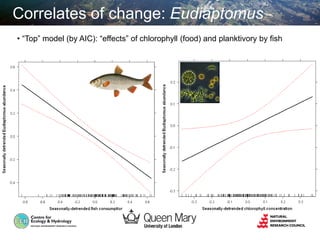
Correlates of change: Eudiaptomus
• “Top” model (by AIC): “effects” of chlorophyll (food) and planktivory by fish
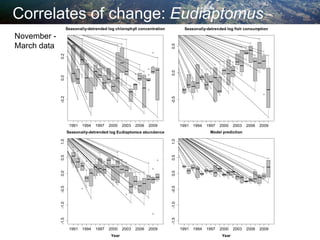
Correlates of change: Eudiaptomus
November -
March data
1991 1994 1997 2000 2003 2006 2009
-0.20.00.2
Seasonally-detrended log chlorophyll concentration
Year
1991 1994 1997 2000 2003 2006 2009
-0.50.00.5
Seasonally-detrended log fish consumption
Year
1991 1994 1997 2000 2003 2006 2009
-1.5-1.0-0.50.00.51.0
Seasonally-detrended log Eudiaptomus abundance
Year
1991 1994 1997 2000 2003 2006 2009
-1.5-1.0-0.50.00.51.0
Model prediction
Year
Summary and next steps
• Can detect a likely effect of increased
planktivory upon Eudiaptomus, though
much unexplained variation.
• Further exploration of the zooplanktivory
“effect”
 sensitivity to parameter choice
 can we apportion planktivory
among fish species?
 is magnitude sufficient to cause
observed population change?
• What about other species?
• Can we see a cascade to the
phytoplankton?
• Independent process modelling studies.
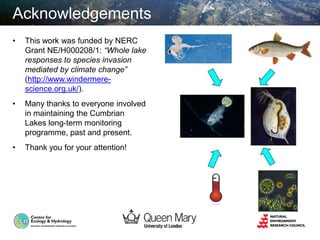
Acknowledgements
• This work was funded by NERC
Grant NE/H000208/1: “Whole lake
responses to species invasion
mediated by climate change”
(http://www.windermere-
science.org.uk/).
• Many thanks to everyone involved
in maintaining the Cumbrian
Lakes long-term monitoring
programme, past and present.
• Thank you for your attention!

Thackeray ehfi sefs8

  • 1.
    Disentangling long-term responsesof crustacean zooplankton to multiple stressors Stephen J. Thackeray (sjtr@ceh.ac.uk), Peter Smyntek, Heidrun Feuchtmayr, Ian J. Winfield, Ian D. Jones & Stephen C. Maberly Lake Ecosystems Group, Centre for Ecology & Hydrology
  • 2.
    Multiple stressors • Lakeecosystems are affected by many internal and external factors • External factors:  climate change  eutrophication  acidification  species introduction • Operate at different (local – regional) scales and may interact.
  • 3.
    Top-down and bottom-upeffects Maberly & Elliott (2012) Freshwater Biology, 57, 233-243 • Stressors may act upon:  physical properties and basal resources – “bottom up”.  predator/consumer populations – “top down”. • Relative importance of these pathways and associated stressors will vary among ecosystems, and over time.
  • 4.
    Windermere, as amodel system Mean winter SRP (mg m -3 ) 0 5 10 15 20 25 30 1950 1960 1970 1980 1990 2000 2010 Year North Basin South Basin 6 8 10 12 1950 1970 1990 2010 Year Mean surface temperature (oC) North Basin South Basin Nutrient enrichment Warming
  • 5.
    Windermere, as amodel system 0 1000 2000 3000 4000 5000 6000 1990 1995 2000 2005 2010 Abundance(fishha-1) Year Expansion of non-native species
  • 6.
    Focus on crustaceanzooplankton PredatorsGrazersFood/Temperature • Effects on grazers of long-term changes in:  Temperature  Food (algae)  Predators (invertebrate)  Predators (fish) • Is it possible to detect these effects on the long-term dynamics of grazer populations?
  • 7.
    Drivers of zooplanktonchange • Fortnightly data,1991-2010 • Response data: • Crustacean zooplankton abundance • Driving data: • Water temperature • Phytoplankton biomass, (Chlorophyll a) • Predatory zooplankton (Bythotrephes, Leptodora, Cyclops) • Fish abundance (monthly)
  • 8.
    A proxy forzooplanktivory 0 1000 2000 3000 4000 5000 6000 1990 1995 2000 2005 2010 Abundance(fishha-1) Year 6 8 10 12 1950 1970 1990 2010 Year Mean surface temperature (oC) North Basin South Basin Meansurfacetemperature(˚C) Maximum consumption rate (Cmax) = 0.016 x Weight (g)-0.16 x e0.133 x Temperature (˚C) Hölker & Haertel (2004) Journal of Applied Icthyology, 20, 548-550
  • 9.
    Statistical methods • Seasonality: Focus on long-term (not seasonal) change.  Induces correlation among driving variables.  Therefore, removed smooth seasonal “trend” from original data using generalised additive models (GAMs). • Lagged effects:  Response at time t related to drivers at time t-1. • Seasonal shifts in drivers:  Drivers can vary (interact) with month-of- year. • Linear models with different predictor combinations compared by AIC. °C Food Fish
  • 10.
  • 11.
    Correlates of change:Eudiaptomus • “Top” model (by AIC): “effects” of chlorophyll (food) and planktivory by fish
  • 12.
    Correlates of change:Eudiaptomus November - March data 1991 1994 1997 2000 2003 2006 2009 -0.20.00.2 Seasonally-detrended log chlorophyll concentration Year 1991 1994 1997 2000 2003 2006 2009 -0.50.00.5 Seasonally-detrended log fish consumption Year 1991 1994 1997 2000 2003 2006 2009 -1.5-1.0-0.50.00.51.0 Seasonally-detrended log Eudiaptomus abundance Year 1991 1994 1997 2000 2003 2006 2009 -1.5-1.0-0.50.00.51.0 Model prediction Year
  • 13.
    Summary and nextsteps • Can detect a likely effect of increased planktivory upon Eudiaptomus, though much unexplained variation. • Further exploration of the zooplanktivory “effect”  sensitivity to parameter choice  can we apportion planktivory among fish species?  is magnitude sufficient to cause observed population change? • What about other species? • Can we see a cascade to the phytoplankton? • Independent process modelling studies.
  • 14.
    Acknowledgements • This workwas funded by NERC Grant NE/H000208/1: “Whole lake responses to species invasion mediated by climate change” (http://www.windermere- science.org.uk/). • Many thanks to everyone involved in maintaining the Cumbrian Lakes long-term monitoring programme, past and present. • Thank you for your attention!