Economic of FTTH – Open Access
Adolfo©
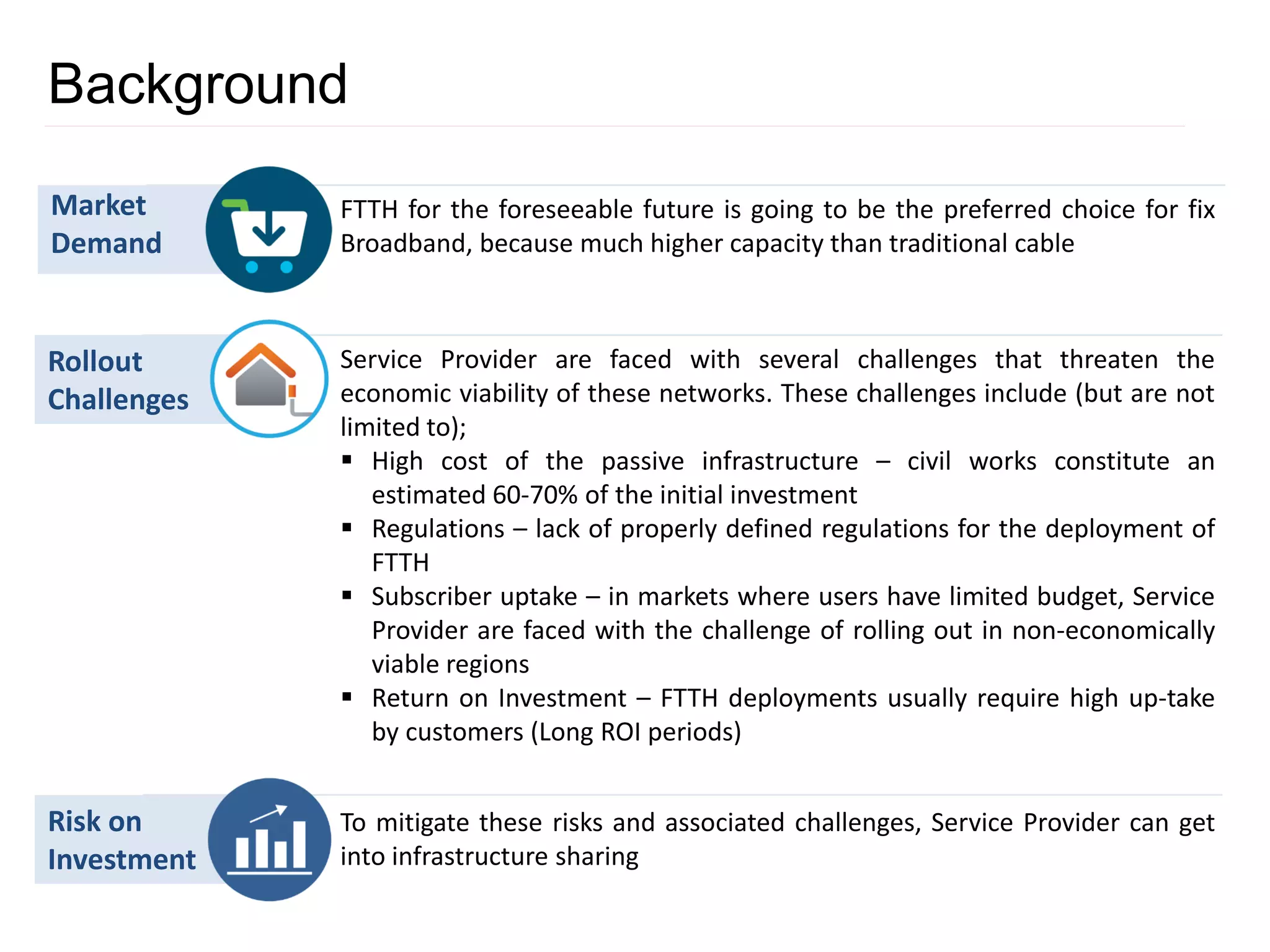
Market
Demand
FTTH for the foreseeable future is going to be the preferred choice for fix
Broadband, because much higher capacity than traditional cable
Background
Rollout
Challenges
Service Provider are faced with several challenges that threaten the
economic viability of these networks. These challenges include (but are not
limited to);
 High cost of the passive infrastructure – civil works constitute an
estimated 60-70% of the initial investment
 Regulations – lack of properly defined regulations for the deployment of
FTTH
 Subscriber uptake – in markets where users have limited budget, Service
Provider are faced with the challenge of rolling out in non-economically
viable regions
 Return on Investment – FTTH deployments usually require high up-take
by customers (Long ROI periods)
Risk on
Investment
To mitigate these risks and associated challenges, Service Provider can get
into infrastructure sharing
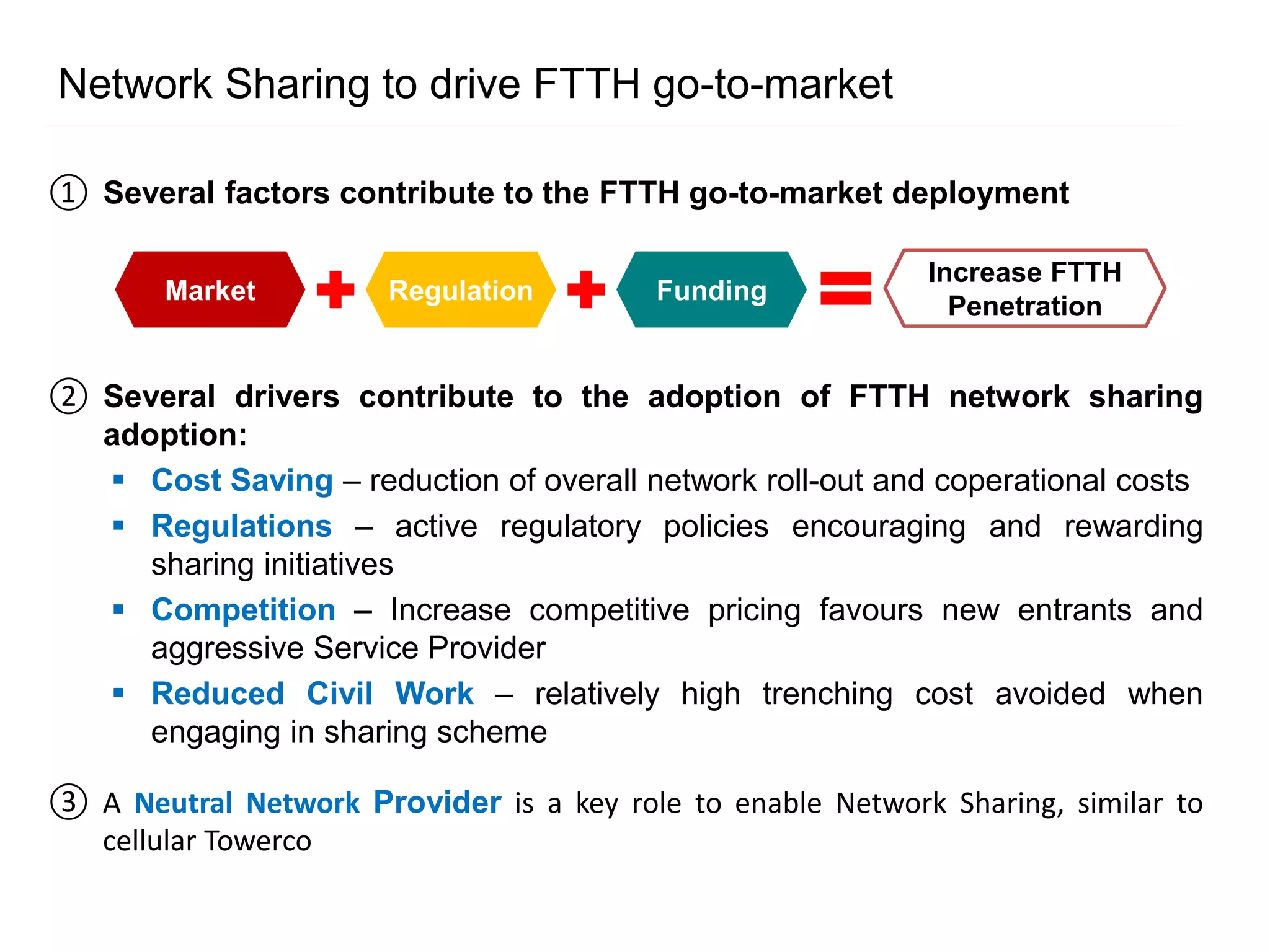
① Several factors contribute to the FTTH go-to-market deployment
Network Sharing to drive FTTH go-to-market
② Several drivers contribute to the adoption of FTTH network sharing
adoption:
 Cost Saving – reduction of overall network roll-out and coperational costs
 Regulations – active regulatory policies encouraging and rewarding
sharing initiatives
 Competition – Increase competitive pricing favours new entrants and
aggressive Service Provider
 Reduced Civil Work – relatively high trenching cost avoided when
engaging in sharing scheme
Market FundingRegulation
Increase FTTH
Penetration
③ A Neutral Network Provider is a key role to enable Network Sharing, similar to
cellular Towerco
Typical FTTH Architecture & Drivers for Investment Required
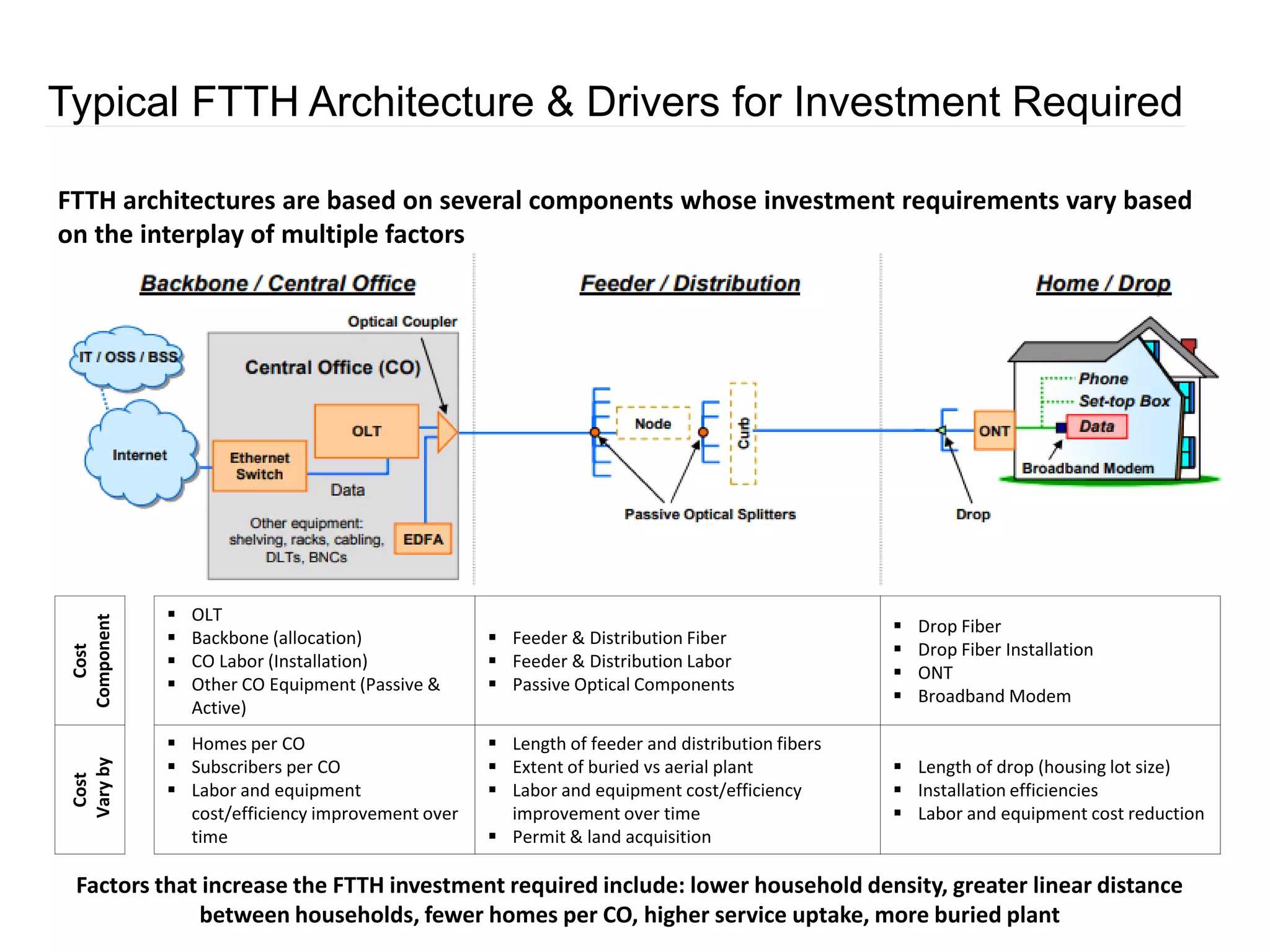
FTTH architectures are based on several components whose investment requirements vary based
on the interplay of multiple factors
Factors that increase the FTTH investment required include: lower household density, greater linear distance
between households, fewer homes per CO, higher service uptake, more buried plant
Cost
Component
 OLT
 Backbone (allocation)
 CO Labor (Installation)
 Other CO Equipment (Passive &
Active)
 Feeder & Distribution Fiber
 Feeder & Distribution Labor
 Passive Optical Components
 Drop Fiber
 Drop Fiber Installation
 ONT
 Broadband Modem
Cost
Varyby
 Homes per CO
 Subscribers per CO
 Labor and equipment
cost/efficiency improvement over
time
 Length of feeder and distribution fibers
 Extent of buried vs aerial plant
 Labor and equipment cost/efficiency
improvement over time
 Permit & land acquisition
 Length of drop (housing lot size)
 Installation efficiencies
 Labor and equipment cost reduction
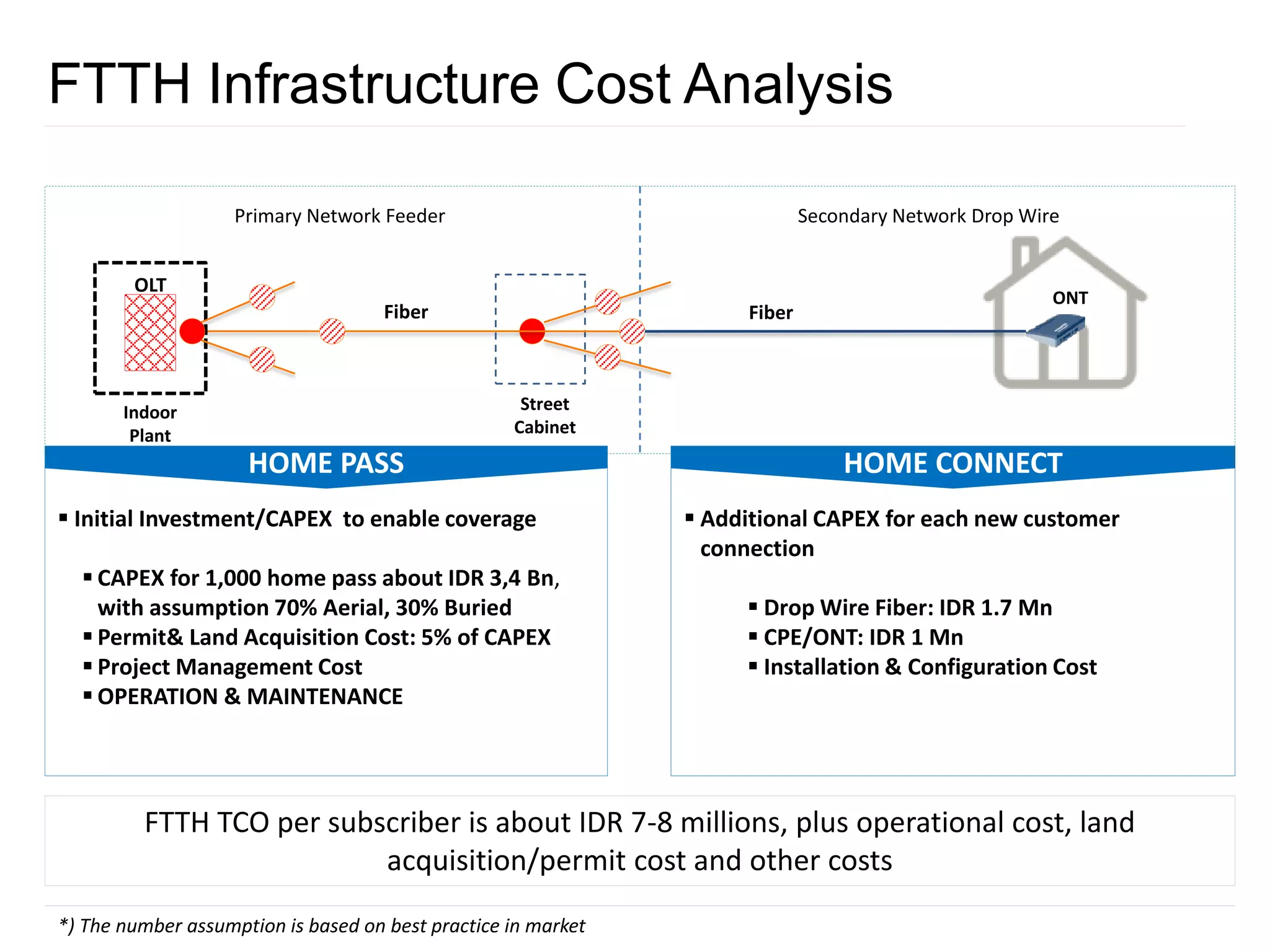
 Additional CAPEX for each new customer
connection
 Drop Wire Fiber: IDR 1.7 Mn
 CPE/ONT: IDR 1 Mn
 Installation & Configuration Cost
FTTH Infrastructure Cost Analysis
OLT
ONT
Primary Network Feeder
HOME CONNECT
 Initial Investment/CAPEX to enable coverage
 CAPEX for 1,000 home pass about IDR 3,4 Bn,
with assumption 70% Aerial, 30% Buried
 Permit& Land Acquisition Cost: 5% of CAPEX
 Project Management Cost
 OPERATION & MAINTENANCE
Street
Cabinet
Fiber Fiber
HOME PASS
Indoor
Plant
Secondary Network Drop Wire
FTTH TCO per subscriber is about IDR 7-8 millions, plus operational cost, land
acquisition/permit cost and other costs
*) The number assumption is based on best practice in market
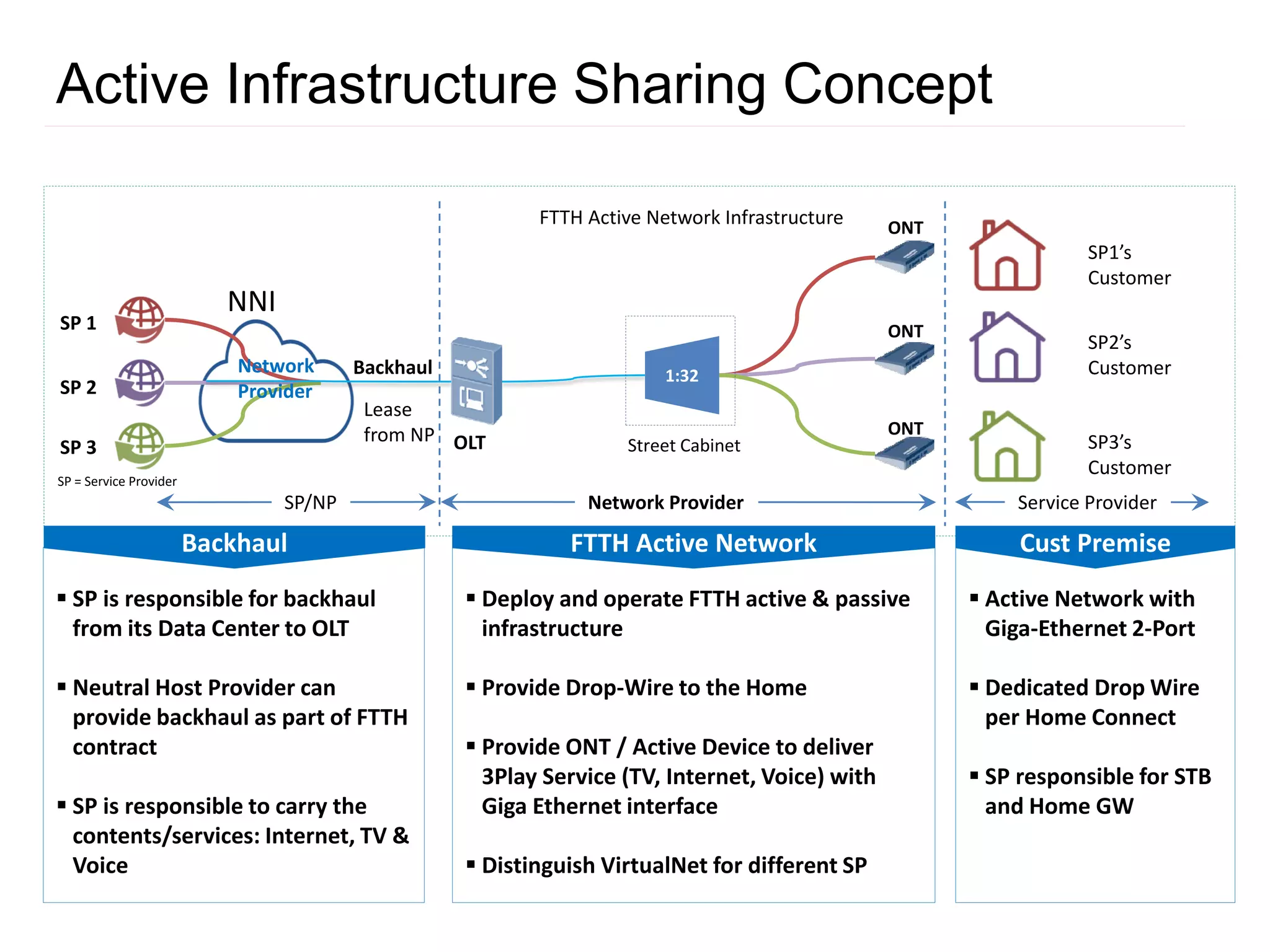
 Active Network with
Giga-Ethernet 2-Port
 Dedicated Drop Wire
per Home Connect
 SP responsible for STB
and Home GW
Active Infrastructure Sharing Concept
OLT
ONT
ONT
ONT
SP 1
SP 2
SP 3
Backhaul
Lease
from NP
SP1’s
Customer
SP/NP Network Provider Service Provider
1:32
SP2’s
Customer
SP3’s
Customer
Street Cabinet
NNI
FTTH Active Network Infrastructure
Cust Premise
 Deploy and operate FTTH active & passive
infrastructure
 Provide Drop-Wire to the Home
 Provide ONT / Active Device to deliver
3Play Service (TV, Internet, Voice) with
Giga Ethernet interface
 Distinguish VirtualNet for different SP
 SP is responsible for backhaul
from its Data Center to OLT
 Neutral Host Provider can
provide backhaul as part of FTTH
contract
 SP is responsible to carry the
contents/services: Internet, TV &
Voice
Backhaul FTTH Active Network
SP = Service Provider
Network
Provider
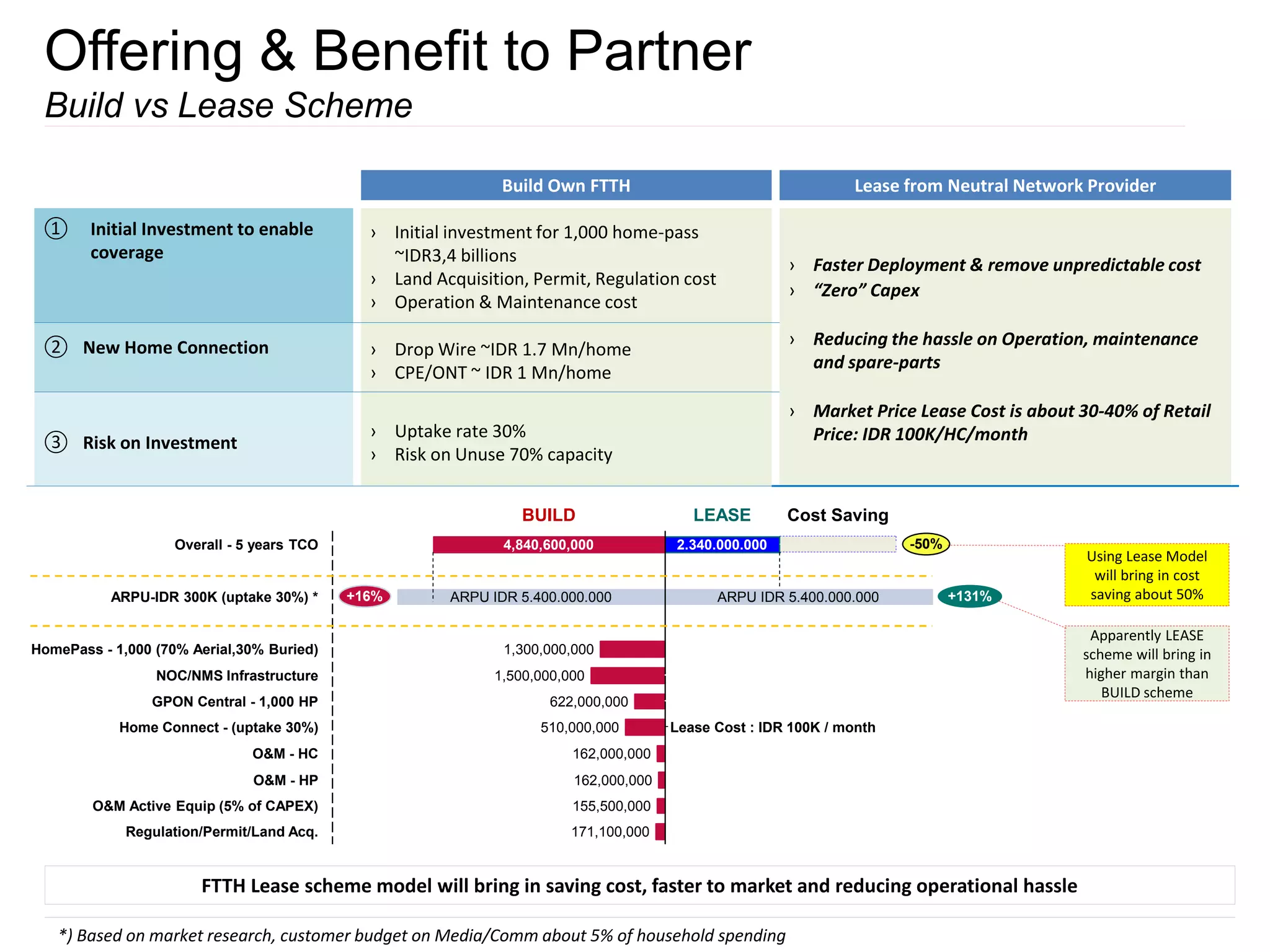
Offering & Benefit to Partner
Build vs Lease Scheme
Build Own FTTH Lease from Neutral Network Provider
① Initial Investment to enable
coverage
› Initial investment for 1,000 home-pass
~IDR3,4 billions
› Land Acquisition, Permit, Regulation cost
› Operation & Maintenance cost
› Faster Deployment & remove unpredictable cost
› “Zero” Capex
› Reducing the hassle on Operation, maintenance
and spare-parts
› Market Price Lease Cost is about 30-40% of Retail
Price: IDR 100K/HC/month
② New Home Connection › Drop Wire ~IDR 1.7 Mn/home
› CPE/ONT ~ IDR 1 Mn/home
③ Risk on Investment
› Uptake rate 30%
› Risk on Unuse 70% capacity
*) Based on market research, customer budget on Media/Comm about 5% of household spending
FTTH Lease scheme model will bring in saving cost, faster to market and reducing operational hassle
GPON Central - 1,000 HP
O&M - HC
ARPU IDR 5.400.000.000
Overall - 5 years TCO 2.340.000.000
1,300,000,000
Home Connect - (uptake 30%)
O&M Active Equip (5% of CAPEX)
ARPU-IDR 300K (uptake 30%) *
NOC/NMS Infrastructure
4,840,600,000
162,000,000
510,000,000 Lease Cost : IDR 100K / month
ARPU IDR 5.400.000.000
LEASE
+16%
Regulation/Permit/Land Acq.
1,500,000,000
171,100,000
155,500,000
+131%
Cost Saving
HomePass - 1,000 (70% Aerial,30% Buried)
BUILD
-50%
622,000,000
162,000,000
O&M - HP
Apparently LEASE
scheme will bring in
higher margin than
BUILD scheme
Using Lease Model
will bring in cost
saving about 50%
END

Economic of FTTH - Open Access Concept

  • 1.
    Economic of FTTH– Open Access Adolfo©
  • 2.
    Market Demand FTTH for theforeseeable future is going to be the preferred choice for fix Broadband, because much higher capacity than traditional cable Background Rollout Challenges Service Provider are faced with several challenges that threaten the economic viability of these networks. These challenges include (but are not limited to);  High cost of the passive infrastructure – civil works constitute an estimated 60-70% of the initial investment  Regulations – lack of properly defined regulations for the deployment of FTTH  Subscriber uptake – in markets where users have limited budget, Service Provider are faced with the challenge of rolling out in non-economically viable regions  Return on Investment – FTTH deployments usually require high up-take by customers (Long ROI periods) Risk on Investment To mitigate these risks and associated challenges, Service Provider can get into infrastructure sharing
  • 3.
    ① Several factorscontribute to the FTTH go-to-market deployment Network Sharing to drive FTTH go-to-market ② Several drivers contribute to the adoption of FTTH network sharing adoption:  Cost Saving – reduction of overall network roll-out and coperational costs  Regulations – active regulatory policies encouraging and rewarding sharing initiatives  Competition – Increase competitive pricing favours new entrants and aggressive Service Provider  Reduced Civil Work – relatively high trenching cost avoided when engaging in sharing scheme Market FundingRegulation Increase FTTH Penetration ③ A Neutral Network Provider is a key role to enable Network Sharing, similar to cellular Towerco
  • 4.
    Typical FTTH Architecture& Drivers for Investment Required FTTH architectures are based on several components whose investment requirements vary based on the interplay of multiple factors Factors that increase the FTTH investment required include: lower household density, greater linear distance between households, fewer homes per CO, higher service uptake, more buried plant Cost Component  OLT  Backbone (allocation)  CO Labor (Installation)  Other CO Equipment (Passive & Active)  Feeder & Distribution Fiber  Feeder & Distribution Labor  Passive Optical Components  Drop Fiber  Drop Fiber Installation  ONT  Broadband Modem Cost Varyby  Homes per CO  Subscribers per CO  Labor and equipment cost/efficiency improvement over time  Length of feeder and distribution fibers  Extent of buried vs aerial plant  Labor and equipment cost/efficiency improvement over time  Permit & land acquisition  Length of drop (housing lot size)  Installation efficiencies  Labor and equipment cost reduction
  • 5.
     Additional CAPEXfor each new customer connection  Drop Wire Fiber: IDR 1.7 Mn  CPE/ONT: IDR 1 Mn  Installation & Configuration Cost FTTH Infrastructure Cost Analysis OLT ONT Primary Network Feeder HOME CONNECT  Initial Investment/CAPEX to enable coverage  CAPEX for 1,000 home pass about IDR 3,4 Bn, with assumption 70% Aerial, 30% Buried  Permit& Land Acquisition Cost: 5% of CAPEX  Project Management Cost  OPERATION & MAINTENANCE Street Cabinet Fiber Fiber HOME PASS Indoor Plant Secondary Network Drop Wire FTTH TCO per subscriber is about IDR 7-8 millions, plus operational cost, land acquisition/permit cost and other costs *) The number assumption is based on best practice in market
  • 6.
     Active Networkwith Giga-Ethernet 2-Port  Dedicated Drop Wire per Home Connect  SP responsible for STB and Home GW Active Infrastructure Sharing Concept OLT ONT ONT ONT SP 1 SP 2 SP 3 Backhaul Lease from NP SP1’s Customer SP/NP Network Provider Service Provider 1:32 SP2’s Customer SP3’s Customer Street Cabinet NNI FTTH Active Network Infrastructure Cust Premise  Deploy and operate FTTH active & passive infrastructure  Provide Drop-Wire to the Home  Provide ONT / Active Device to deliver 3Play Service (TV, Internet, Voice) with Giga Ethernet interface  Distinguish VirtualNet for different SP  SP is responsible for backhaul from its Data Center to OLT  Neutral Host Provider can provide backhaul as part of FTTH contract  SP is responsible to carry the contents/services: Internet, TV & Voice Backhaul FTTH Active Network SP = Service Provider Network Provider
  • 7.
    Offering & Benefitto Partner Build vs Lease Scheme Build Own FTTH Lease from Neutral Network Provider ① Initial Investment to enable coverage › Initial investment for 1,000 home-pass ~IDR3,4 billions › Land Acquisition, Permit, Regulation cost › Operation & Maintenance cost › Faster Deployment & remove unpredictable cost › “Zero” Capex › Reducing the hassle on Operation, maintenance and spare-parts › Market Price Lease Cost is about 30-40% of Retail Price: IDR 100K/HC/month ② New Home Connection › Drop Wire ~IDR 1.7 Mn/home › CPE/ONT ~ IDR 1 Mn/home ③ Risk on Investment › Uptake rate 30% › Risk on Unuse 70% capacity *) Based on market research, customer budget on Media/Comm about 5% of household spending FTTH Lease scheme model will bring in saving cost, faster to market and reducing operational hassle GPON Central - 1,000 HP O&M - HC ARPU IDR 5.400.000.000 Overall - 5 years TCO 2.340.000.000 1,300,000,000 Home Connect - (uptake 30%) O&M Active Equip (5% of CAPEX) ARPU-IDR 300K (uptake 30%) * NOC/NMS Infrastructure 4,840,600,000 162,000,000 510,000,000 Lease Cost : IDR 100K / month ARPU IDR 5.400.000.000 LEASE +16% Regulation/Permit/Land Acq. 1,500,000,000 171,100,000 155,500,000 +131% Cost Saving HomePass - 1,000 (70% Aerial,30% Buried) BUILD -50% 622,000,000 162,000,000 O&M - HP Apparently LEASE scheme will bring in higher margin than BUILD scheme Using Lease Model will bring in cost saving about 50%
  • 8.