Dr Maria Toro-Troconis
                     27th February 2013


Current and future trends in eLearning – Dr Maria Toro-Troconis - @mtorotro
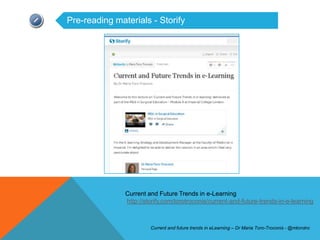
Pre-reading materials - Storify


               Current and Future Trends in e-Learning
               http://storify.com/torotroconis/current-and-future-trends-in-e-learning


                        Current and future trends in eLearning – Dr Maria Toro-Troconis - @mtorotro
Learning Outcomes


By the end of this session you should be able to:

• Identify the main 'disruptive innovations' and 'disruptive technologies' that may have an
impact in teaching and learning in the next 5 years.

• Recognise the effects of these innovations in teaching and learning in medical
education.

• Demonstrate awareness of the benefits and importance of social media use for
healthcare professionals.

• Define Massive Online Open Courses (MOOCs) and recognise its potential impact in
Education.

• Define Digital Literacies and recognise its importance in the future of Education.


                                    Current and future trends in eLearning – Dr Maria Toro-Troconis - @mtorotro
Smart Response Student System - Mentimeter


Please access the following link from you Smart phone, laptop or Tablet:

                           http://www.vot.rs


                              Current and future trends in eLearning – Dr Maria Toro-Troconis - @mtorotro
How much of the Storify provided did you cover?

  1. All of it
  2. Some of it
  3. None


                     Current and future trends in eLearning – Dr Maria Toro-Troconis - @mtorotro
Which of the following best describes your attitude towards digital
technologies like social networks, blogs, collaboration tools, etc.?

          1. Using them is second nature to me
          2. I know how to use them but it is not easy for me
          3. I do not use them but feel the need to learn
          4. I do not use them and do not feel the need to learn how to use them


                                Current and future trends in eLearning – Dr Maria Toro-Troconis - @mtorotro
Disruptive Innovation – Disruptive Technology


‘A disruptive innovation is an innovation that helps create
 a new market and value network, and eventually goes on
to disrupt an existing market and value network (over a few
    years or decades), displacing an earlier technology’.


‘The term disruptive technology has been widely used as a
             synonym of disruptive innovation’.


  Wikipedia Definition of ‘Disruptive Innovation’: http://en.wikipedia.org/wiki/Disruptive_innovation


                                      Current and future trends in eLearning – Dr Maria Toro-Troconis - @mtorotro
Sustaining Innovation


      In contrast to disruptive innovation, a ‟sustaining
innovation’ does not create new markets or value networks but
     rather only evolves existing ones with better value.


     Wikipedia Definition of ‘Disruptive Innovation’: http://en.wikipedia.org/wiki/Disruptive_innovation


                                         Current and future trends in eLearning – Dr Maria Toro-Troconis - @mtorotro
Have ‘CDs and USB Flash Drives’ been a Disruptive Innovation or
                  a Sustainable Innovation?
            Think if they have replaced a market…


                             Current and future trends in eLearning – Dr Maria Toro-Troconis - @mtorotro
Has ‘Downloadable Digital Media’ been a Disruptive Innovation or
                  a Sustainable Innovation?
            Think if they have replaced a market…


                             Current and future trends in eLearning – Dr Maria Toro-Troconis - @mtorotro
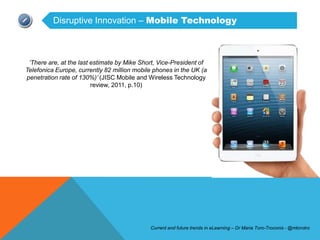
Disruptive Innovation – Mobile Technology


 „There are, at the last estimate by Mike Short, Vice-President of
Telefonica Europe, currently 82 million mobile phones in the UK (a
penetration rate of 130%)‟ (JISC Mobile and Wireless Technology
                         review, 2011, p.10)


                                             Current and future trends in eLearning – Dr Maria Toro-Troconis - @mtorotro
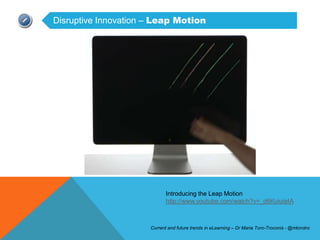
Disruptive Innovation – Leap Motion


                             Introducing the Leap Motion
                             http://www.youtube.com/watch?v=_d6KuiuteIA


                      Current and future trends in eLearning – Dr Maria Toro-Troconis - @mtorotro
What are the main disruptive markets with the penetration of
        mobile devices and touch screen devices?


                           Current and future trends in eLearning – Dr Maria Toro-Troconis - @mtorotro
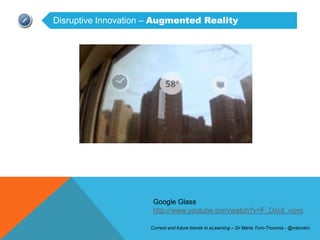
Disruptive Innovation – Augmented Reality


                      Google Glass
                      http://www.youtube.com/watch?v=F_DsUl_vqvo

                     Current and future trends in eLearning – Dr Maria Toro-Troconis - @mtorotro
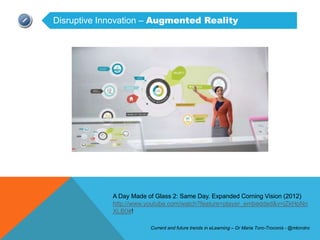
Disruptive Innovation – Augmented Reality


             A Day Made of Glass 2: Same Day. Expanded Corning Vision (2012)
             http://www.youtube.com/watch?feature=player_embedded&v=jZkHpNn
             XLB0#!

                         Current and future trends in eLearning – Dr Maria Toro-Troconis - @mtorotro
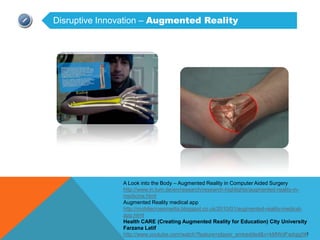
Disruptive Innovation – Augmented Reality


               A Look into the Body – Augmented Reality in Computer Aided Surgery
               http://www.in.tum.de/en/research/research-highlights/augmented-reality-in-
               medicine.html
               Augmented Reality medical app
               http://mobilecrossmedia.blogspot.co.uk/2010/01/augmented-reality-medical-
               app.html
               Health CARE (Creating Augmented Reality for Education) City University
               Farzana Latif
               http://www.youtube.com/watch?feature=player_embedded&v=kMWdFadqjg0#!
Learning is changing


        Current and future trends in eLearning – Dr Maria Toro-Troconis - @mtorotro
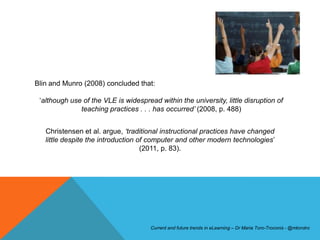
Blin and Munro (2008) concluded that:

 ‘although use of the VLE is widespread within the university, little disruption of
              teaching practices . . . has occurred‟ (2008, p. 488)


   Christensen et al. argue, „traditional instructional practices have changed
   little despite the introduction of computer and other modern technologies’
                                    (2011, p. 83).


                                      Current and future trends in eLearning – Dr Maria Toro-Troconis - @mtorotro
Learning is changing


According to Wheeler (2013), learning is change because:

“ – the pace of technology developments is changing rapidly
- what we can learn no longer has any boundaries.
- learning is also changing because we can contribute to knowledge
on a
 global scale.
- we now have tools at our disposal that enable us to connect to any
  knowledge we want, anywhere, and at any time we prefer‟.”


  Wheeler, S. (2013). ‘Learning is changing’. Learning with 'e's Blog
  http://steve-wheeler.blogspot.co.uk/2013/02/learning-is-changing.html [Accessed 20 February 2013]


                                          Current and future trends in eLearning – Dr Maria Toro-Troconis - @mtorotro
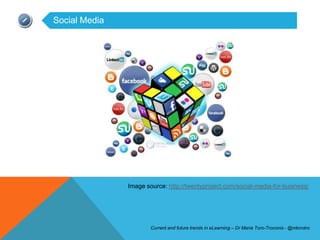
Social Media


               Image source: http://twentyproject.com/social-media-for-business/


                       Current and future trends in eLearning – Dr Maria Toro-Troconis - @mtorotro
Select the social media tools you have you heard of?

                 1.   Twitter
                 2.   Facebook
                 3.   Linkedln
                 4.   WordPress
                 5.   Google+
                 6.   Delicious
                 7.   Khan Academy


                        Current and future trends in eLearning – Dr Maria Toro-Troconis - @mtorotro
Select the social media tools you have used?

             1.   Twitter
             2.   Facebook
             3.   Linkedln
             4.   WordPress
             5.   Google+
             6.   Delicious
             7.   Khan Academy


                    Current and future trends in eLearning – Dr Maria Toro-Troconis - @mtorotro
Discuss in groups what social media tools you have used and/or
      you’re using and how they support your profession.
                           (10 min)


                            Current and future trends in eLearning – Dr Maria Toro-Troconis - @mtorotro
Social Media


• Social media, such as wikis, blogs, Twitter (#hashtag), social bookmarking tools,
  social networking websites, etc. facilitate collaboration and gathering and sharing
  of information.

• Social media can facilitate research dialogues.


                   Minocha, S. and Petre, M. (2012). Handbook of Social Media , The Open University
                   http://www.vitae.ac.uk/CMS/files/upload/Vitae_Innovate_Open_University_Social_Media_
                   Handbook_2012.pdf


                                        Current and future trends in eLearning – Dr Maria Toro-Troconis - @mtorotro
Examples of Social Media sites used by Healthcare Professionals

• Dr. Anne Marie Cunningham’s (Blog) on Medical Education
  http://wishfulthinkinginmedicaleducation.blogspot.co.uk/

• Dr Ronald Kavanagh (Website, Blog, Patient Education, Appointments, etc.)
  http://www.ronankavanagh.ie/

• Medicine and Social Media by Dr Bertalan Mesko
  http://scienceroll.com/medicine-20/

• Medicine, Health and Social Media by Dr. Brian Vartabedian’s (Blog)
  http://www.33charts.com/

• Dr. Wendy Sue Swanson’s use of video technology for sharing information
  (Video Blog)
  http://seattlemamadoc.seattlechildrens.org/

• The Social MEDdia Course
  http://thecourse.webicina.com/


                                         Current and future trends in eLearning – Dr Maria Toro-Troconis - @mtorotro
Twitter Hashtags for Healthcare Professionals


Social Media in Healthcare Hashtags via Symplur

#hcsm
http://www.symplur.com/healthcare-hashtags/hcsm/

#hcsmeu
http://www.symplur.com/healthcare-hashtags/hcsmeu/

 #ukmeded
http://www.symplur.com/?s=%23ukmeded&cat=5


                                Current and future trends in eLearning – Dr Maria Toro-Troconis - @mtorotro
MOOCS – Massively Open Online Courses


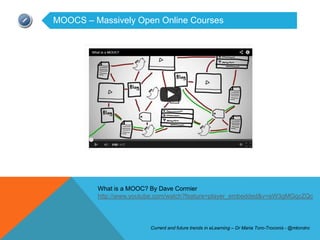
         What is a MOOC? By Dave Cormier
         http://www.youtube.com/watch?feature=player_embedded&v=eW3gMGqcZQc


                         Current and future trends in eLearning – Dr Maria Toro-Troconis - @mtorotro
MOOCS – Massively Open Online Courses


• Edx (MIT, Harvard and University of California Berkeley)

• Coursera (Stanford University, California Institute of
  Technology, University of Washington, among others)

• Udacity – Co-Founders (Sebastian Thrun, David Stavens
  and Mike Sokolsky )

• Future Learn (Open University - UK)

• UnX – Iberoamerican MOOC (Open University Spain)


                           Current and future trends in eLearning – Dr Maria Toro-Troconis - @mtorotro
Connectivism


Connectivism is a learning theory based on the premise that knowledge
      exists in the world rather than in the head of an individual
                           (Siemens, 2005).


            Siemens, G. (2005). Connectivism: A Learning Theory for the Digital Age, International Journal of
            Instructional Technology and Distance Learning, Vol. 2 No. 1
            http://www.itdl.org/Journal/Jan_05/article01.htm

            Downes, S. (2012). The rise of MOOCs. http://www.downes.ca/post/57911 accessed 2012-09-22

            Daniel, J. Making Sense of MOOCs: Musings in a Maze of Myth, Paradox and Possibility
            http://www.tonybates.ca/wp-content/uploads/Making-Sense-of-MOOCs.pdf
Types of MOOCS


cMOOCs – Knowledge creation and generation


xMOOCs – Knowledge duplication


              Subramanian, P.(2013). Towards a massive online education:
              A Business Model Innovation for Elite Universities in the UK.
              MBA Thesis – Imperial College Busines School
              http://prabhus.com/media/Subramanian-P-2012-WEMBA-thesis.pdf

                         Current and future trends in eLearning – Dr Maria Toro-Troconis - @mtorotro
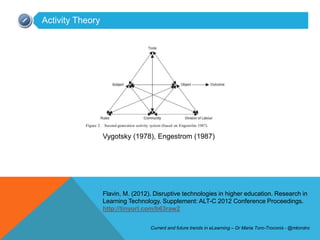
Activity Theory


                  Vygotsky (1978), Engestrom (1987)


                  Flavin, M. (2012). Disruptive technologies in higher education. Research in
                  Learning Technology. Supplement: ALT-C 2012 Conference Proceedings.
                  http://tinyurl.com/b63raw2


                                   Current and future trends in eLearning – Dr Maria Toro-Troconis - @mtorotro
Digital Literacies


„Digital Literacy defines those capabilities which fit an individual for
    living, learning and working in a digital society‟ (JISC, 2009)


                                                     Digital Literacies with Dr Doug Belshaw
                                                     http://www.slideshare.net/dajbelshaw


                               Current and future trends in eLearning – Dr Maria Toro-Troconis - @mtorotro
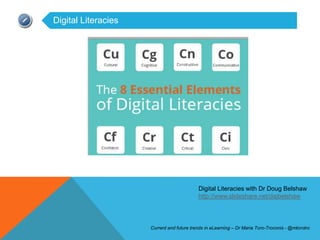
Digital Literacies


                                           Digital Literacies with Dr Doug Belshaw
                                           http://www.slideshare.net/dajbelshaw


                     Current and future trends in eLearning – Dr Maria Toro-Troconis - @mtorotro
Digital Literacies


JISC - Developing Digital Literacies Programme – 2011-13

The programme aims to promote the development of
coherent, inclusive and holistic institutional strategies and
organisational approaches for developing digital literacies for all staff
and students in UK further and higher education.

Digidol – Developing Digital Literacy – Cardiff University


                                Current and future trends in eLearning – Dr Maria Toro-Troconis - @mtorotro
Summary


Topics covered:

• ‘Disruptive innovations' and 'disruptive technologies' and their impact in teaching and
   learning.

• Effects of these innovations in teaching and learning in medical education.

• Benefits and importance of social media use for healthcare professionals.

• Massive Online Open Courses (MOOCs) and its potential impact in Education.

• Digital Literacies and recognise its importance in the future of Education.


                                     Current and future trends in eLearning – Dr Maria Toro-Troconis - @mtorotro
THANK YOU!
 Dr Maria Toro-Troconis
 m.toro@imperial.ac.uk
      @mtorotro


         Current and future trends in eLearning – Dr Maria Toro-Troconis - @mtorotro

Current and Future Trends in e-learning - MEd in Surgical Education - Imperial College London

  • 1.
    Dr Maria Toro-Troconis 27th February 2013 Current and future trends in eLearning – Dr Maria Toro-Troconis - @mtorotro
  • 2.
    Pre-reading materials -Storify Current and Future Trends in e-Learning http://storify.com/torotroconis/current-and-future-trends-in-e-learning Current and future trends in eLearning – Dr Maria Toro-Troconis - @mtorotro
  • 3.
    Learning Outcomes By theend of this session you should be able to: • Identify the main 'disruptive innovations' and 'disruptive technologies' that may have an impact in teaching and learning in the next 5 years. • Recognise the effects of these innovations in teaching and learning in medical education. • Demonstrate awareness of the benefits and importance of social media use for healthcare professionals. • Define Massive Online Open Courses (MOOCs) and recognise its potential impact in Education. • Define Digital Literacies and recognise its importance in the future of Education. Current and future trends in eLearning – Dr Maria Toro-Troconis - @mtorotro
  • 4.
    Smart Response StudentSystem - Mentimeter Please access the following link from you Smart phone, laptop or Tablet: http://www.vot.rs Current and future trends in eLearning – Dr Maria Toro-Troconis - @mtorotro
  • 5.
    How much ofthe Storify provided did you cover? 1. All of it 2. Some of it 3. None Current and future trends in eLearning – Dr Maria Toro-Troconis - @mtorotro
  • 6.
    Which of thefollowing best describes your attitude towards digital technologies like social networks, blogs, collaboration tools, etc.? 1. Using them is second nature to me 2. I know how to use them but it is not easy for me 3. I do not use them but feel the need to learn 4. I do not use them and do not feel the need to learn how to use them Current and future trends in eLearning – Dr Maria Toro-Troconis - @mtorotro
  • 7.
    Disruptive Innovation –Disruptive Technology ‘A disruptive innovation is an innovation that helps create a new market and value network, and eventually goes on to disrupt an existing market and value network (over a few years or decades), displacing an earlier technology’. ‘The term disruptive technology has been widely used as a synonym of disruptive innovation’. Wikipedia Definition of ‘Disruptive Innovation’: http://en.wikipedia.org/wiki/Disruptive_innovation Current and future trends in eLearning – Dr Maria Toro-Troconis - @mtorotro
  • 8.
    Sustaining Innovation In contrast to disruptive innovation, a ‟sustaining innovation’ does not create new markets or value networks but rather only evolves existing ones with better value. Wikipedia Definition of ‘Disruptive Innovation’: http://en.wikipedia.org/wiki/Disruptive_innovation Current and future trends in eLearning – Dr Maria Toro-Troconis - @mtorotro
  • 9.
    Have ‘CDs andUSB Flash Drives’ been a Disruptive Innovation or a Sustainable Innovation? Think if they have replaced a market… Current and future trends in eLearning – Dr Maria Toro-Troconis - @mtorotro
  • 10.
    Has ‘Downloadable DigitalMedia’ been a Disruptive Innovation or a Sustainable Innovation? Think if they have replaced a market… Current and future trends in eLearning – Dr Maria Toro-Troconis - @mtorotro
  • 11.
    Disruptive Innovation –Mobile Technology „There are, at the last estimate by Mike Short, Vice-President of Telefonica Europe, currently 82 million mobile phones in the UK (a penetration rate of 130%)‟ (JISC Mobile and Wireless Technology review, 2011, p.10) Current and future trends in eLearning – Dr Maria Toro-Troconis - @mtorotro
  • 12.
    Disruptive Innovation –Leap Motion Introducing the Leap Motion http://www.youtube.com/watch?v=_d6KuiuteIA Current and future trends in eLearning – Dr Maria Toro-Troconis - @mtorotro
  • 13.
    What are themain disruptive markets with the penetration of mobile devices and touch screen devices? Current and future trends in eLearning – Dr Maria Toro-Troconis - @mtorotro
  • 14.
    Disruptive Innovation –Augmented Reality Google Glass http://www.youtube.com/watch?v=F_DsUl_vqvo Current and future trends in eLearning – Dr Maria Toro-Troconis - @mtorotro
  • 15.
    Disruptive Innovation –Augmented Reality A Day Made of Glass 2: Same Day. Expanded Corning Vision (2012) http://www.youtube.com/watch?feature=player_embedded&v=jZkHpNn XLB0#! Current and future trends in eLearning – Dr Maria Toro-Troconis - @mtorotro
  • 16.
    Disruptive Innovation –Augmented Reality A Look into the Body – Augmented Reality in Computer Aided Surgery http://www.in.tum.de/en/research/research-highlights/augmented-reality-in- medicine.html Augmented Reality medical app http://mobilecrossmedia.blogspot.co.uk/2010/01/augmented-reality-medical- app.html Health CARE (Creating Augmented Reality for Education) City University Farzana Latif http://www.youtube.com/watch?feature=player_embedded&v=kMWdFadqjg0#!
  • 17.
    Learning is changing Current and future trends in eLearning – Dr Maria Toro-Troconis - @mtorotro
  • 18.
    Blin and Munro(2008) concluded that: ‘although use of the VLE is widespread within the university, little disruption of teaching practices . . . has occurred‟ (2008, p. 488) Christensen et al. argue, „traditional instructional practices have changed little despite the introduction of computer and other modern technologies’ (2011, p. 83). Current and future trends in eLearning – Dr Maria Toro-Troconis - @mtorotro
  • 19.
    Learning is changing Accordingto Wheeler (2013), learning is change because: “ – the pace of technology developments is changing rapidly - what we can learn no longer has any boundaries. - learning is also changing because we can contribute to knowledge on a global scale. - we now have tools at our disposal that enable us to connect to any knowledge we want, anywhere, and at any time we prefer‟.” Wheeler, S. (2013). ‘Learning is changing’. Learning with 'e's Blog http://steve-wheeler.blogspot.co.uk/2013/02/learning-is-changing.html [Accessed 20 February 2013] Current and future trends in eLearning – Dr Maria Toro-Troconis - @mtorotro
  • 20.
    Social Media Image source: http://twentyproject.com/social-media-for-business/ Current and future trends in eLearning – Dr Maria Toro-Troconis - @mtorotro
  • 21.
    Select the socialmedia tools you have you heard of? 1. Twitter 2. Facebook 3. Linkedln 4. WordPress 5. Google+ 6. Delicious 7. Khan Academy Current and future trends in eLearning – Dr Maria Toro-Troconis - @mtorotro
  • 22.
    Select the socialmedia tools you have used? 1. Twitter 2. Facebook 3. Linkedln 4. WordPress 5. Google+ 6. Delicious 7. Khan Academy Current and future trends in eLearning – Dr Maria Toro-Troconis - @mtorotro
  • 23.
    Discuss in groupswhat social media tools you have used and/or you’re using and how they support your profession. (10 min) Current and future trends in eLearning – Dr Maria Toro-Troconis - @mtorotro
  • 24.
    Social Media • Socialmedia, such as wikis, blogs, Twitter (#hashtag), social bookmarking tools, social networking websites, etc. facilitate collaboration and gathering and sharing of information. • Social media can facilitate research dialogues. Minocha, S. and Petre, M. (2012). Handbook of Social Media , The Open University http://www.vitae.ac.uk/CMS/files/upload/Vitae_Innovate_Open_University_Social_Media_ Handbook_2012.pdf Current and future trends in eLearning – Dr Maria Toro-Troconis - @mtorotro
  • 25.
    Examples of SocialMedia sites used by Healthcare Professionals • Dr. Anne Marie Cunningham’s (Blog) on Medical Education http://wishfulthinkinginmedicaleducation.blogspot.co.uk/ • Dr Ronald Kavanagh (Website, Blog, Patient Education, Appointments, etc.) http://www.ronankavanagh.ie/ • Medicine and Social Media by Dr Bertalan Mesko http://scienceroll.com/medicine-20/ • Medicine, Health and Social Media by Dr. Brian Vartabedian’s (Blog) http://www.33charts.com/ • Dr. Wendy Sue Swanson’s use of video technology for sharing information (Video Blog) http://seattlemamadoc.seattlechildrens.org/ • The Social MEDdia Course http://thecourse.webicina.com/ Current and future trends in eLearning – Dr Maria Toro-Troconis - @mtorotro
  • 26.
    Twitter Hashtags forHealthcare Professionals Social Media in Healthcare Hashtags via Symplur #hcsm http://www.symplur.com/healthcare-hashtags/hcsm/ #hcsmeu http://www.symplur.com/healthcare-hashtags/hcsmeu/ #ukmeded http://www.symplur.com/?s=%23ukmeded&cat=5 Current and future trends in eLearning – Dr Maria Toro-Troconis - @mtorotro
  • 27.
    MOOCS – MassivelyOpen Online Courses What is a MOOC? By Dave Cormier http://www.youtube.com/watch?feature=player_embedded&v=eW3gMGqcZQc Current and future trends in eLearning – Dr Maria Toro-Troconis - @mtorotro
  • 28.
    MOOCS – MassivelyOpen Online Courses • Edx (MIT, Harvard and University of California Berkeley) • Coursera (Stanford University, California Institute of Technology, University of Washington, among others) • Udacity – Co-Founders (Sebastian Thrun, David Stavens and Mike Sokolsky ) • Future Learn (Open University - UK) • UnX – Iberoamerican MOOC (Open University Spain) Current and future trends in eLearning – Dr Maria Toro-Troconis - @mtorotro
  • 29.
    Connectivism Connectivism is alearning theory based on the premise that knowledge exists in the world rather than in the head of an individual (Siemens, 2005). Siemens, G. (2005). Connectivism: A Learning Theory for the Digital Age, International Journal of Instructional Technology and Distance Learning, Vol. 2 No. 1 http://www.itdl.org/Journal/Jan_05/article01.htm Downes, S. (2012). The rise of MOOCs. http://www.downes.ca/post/57911 accessed 2012-09-22 Daniel, J. Making Sense of MOOCs: Musings in a Maze of Myth, Paradox and Possibility http://www.tonybates.ca/wp-content/uploads/Making-Sense-of-MOOCs.pdf
  • 30.
    Types of MOOCS cMOOCs– Knowledge creation and generation xMOOCs – Knowledge duplication Subramanian, P.(2013). Towards a massive online education: A Business Model Innovation for Elite Universities in the UK. MBA Thesis – Imperial College Busines School http://prabhus.com/media/Subramanian-P-2012-WEMBA-thesis.pdf Current and future trends in eLearning – Dr Maria Toro-Troconis - @mtorotro
  • 31.
    Activity Theory Vygotsky (1978), Engestrom (1987) Flavin, M. (2012). Disruptive technologies in higher education. Research in Learning Technology. Supplement: ALT-C 2012 Conference Proceedings. http://tinyurl.com/b63raw2 Current and future trends in eLearning – Dr Maria Toro-Troconis - @mtorotro
  • 32.
    Digital Literacies „Digital Literacydefines those capabilities which fit an individual for living, learning and working in a digital society‟ (JISC, 2009) Digital Literacies with Dr Doug Belshaw http://www.slideshare.net/dajbelshaw Current and future trends in eLearning – Dr Maria Toro-Troconis - @mtorotro
  • 33.
    Digital Literacies Digital Literacies with Dr Doug Belshaw http://www.slideshare.net/dajbelshaw Current and future trends in eLearning – Dr Maria Toro-Troconis - @mtorotro
  • 34.
    Digital Literacies JISC -Developing Digital Literacies Programme – 2011-13 The programme aims to promote the development of coherent, inclusive and holistic institutional strategies and organisational approaches for developing digital literacies for all staff and students in UK further and higher education. Digidol – Developing Digital Literacy – Cardiff University Current and future trends in eLearning – Dr Maria Toro-Troconis - @mtorotro
  • 35.
    Summary Topics covered: • ‘Disruptiveinnovations' and 'disruptive technologies' and their impact in teaching and learning. • Effects of these innovations in teaching and learning in medical education. • Benefits and importance of social media use for healthcare professionals. • Massive Online Open Courses (MOOCs) and its potential impact in Education. • Digital Literacies and recognise its importance in the future of Education. Current and future trends in eLearning – Dr Maria Toro-Troconis - @mtorotro
  • 36.
    THANK YOU! DrMaria Toro-Troconis m.toro@imperial.ac.uk @mtorotro Current and future trends in eLearning – Dr Maria Toro-Troconis - @mtorotro

Editor's Notes

  • #13 Gesture based interfaces
  • #21 ConnectivismConnectivism is a theory of learning based on the premise that knowledge exists in the world rather than in the head of an individual. Connectivism proposes a perspective similar to Vygotsky'sActivity theory in that it regards knowledge as existing within systems which are accessed through people participating in activities. It bears some similarity with Bandura'sSocial Learning Theory that proposes that people learn through contact. The add-on "a learning theory for the digital age", that appears in Siemens' paper[1] indicates the emphasis it gives to how technology affects how people live, how they communicate and how they learn.
  • #25 ConnectivismConnectivism is a theory of learning based on the premise that knowledge exists in the world rather than in the head of an individual. Connectivism proposes a perspective similar to Vygotsky'sActivity theory in that it regards knowledge as existing within systems which are accessed through people participating in activities. It bears some similarity with Bandura'sSocial Learning Theory that proposes that people learn through contact. The add-on "a learning theory for the digital age", that appears in Siemens' paper[1] indicates the emphasis it gives to how technology affects how people live, how they communicate and how they learn.
  • #26 ConnectivismConnectivism is a theory of learning based on the premise that knowledge exists in the world rather than in the head of an individual. Connectivism proposes a perspective similar to Vygotsky'sActivity theory in that it regards knowledge as existing within systems which are accessed through people participating in activities. It bears some similarity with Bandura'sSocial Learning Theory that proposes that people learn through contact. The add-on "a learning theory for the digital age", that appears in Siemens' paper[1] indicates the emphasis it gives to how technology affects how people live, how they communicate and how they learn.
  • #27 ConnectivismConnectivism is a theory of learning based on the premise that knowledge exists in the world rather than in the head of an individual. Connectivism proposes a perspective similar to Vygotsky'sActivity theory in that it regards knowledge as existing within systems which are accessed through people participating in activities. It bears some similarity with Bandura'sSocial Learning Theory that proposes that people learn through contact. The add-on "a learning theory for the digital age", that appears in Siemens' paper[1] indicates the emphasis it gives to how technology affects how people live, how they communicate and how they learn.
  • #30 ConnectivismConnectivism is a theory of learning based on the premise that knowledge exists in the world rather than in the head of an individual. Connectivism proposes a perspective similar to Vygotsky'sActivity theory in that it regards knowledge as existing within systems which are accessed through people participating in activities. It bears some similarity with Bandura'sSocial Learning Theory that proposes that people learn through contact. The add-on "a learning theory for the digital age", that appears in Siemens' paper[1] indicates the emphasis it gives to how technology affects how people live, how they communicate and how they learn.
  • #32 Vygotsky (1978) represented the first generation model of humanactivity as a simple triangle (Figure 1). Vygotsky’s model illustrates his theory thathuman beings do not interact directly with their environment. Instead, they use tools(including signs and codes as well as physical apparatus) as mediators.Engestro¨m (1987) developed the expanded model of human activity (the activitysystem) to include and highlight the collaborative nature of human activity by addingsocial elements to Vygotsky’s original model of human activity, as shown in Figure 2.The bottom row of the triangle (the layer added by Engestro¨m) features the rules,the community and the division of labour as its nodes. The rules node represents theconventions and regulations shaping an activity (such as assessment within aneducation system). Community refers to those affected by the activity, and thedivision of labour node represents who does what in an activity, thereby illustratingboth the distribution of tasks, and the hierarchy of power.
  • #33 Digital literacies and changing the culture of our academics and teaching practices as well as provide guidance on what learning activities lend themselve to online learning and what lend itself to face to face or collaborative learning.
  • #34 Digital literacies and changing the culture of our academics and teaching practices as well as provide guidance on what learning activities lend themselve to online learning and what lend itself to face to face or collaborative learning.
  • #35 Digital literacies and changing the culture of our academics and teaching practices as well as provide guidance on what learning activities lend themselve to online learning and what lend itself to face to face or collaborative learning.