Welcome

 2012 Conference on the
Growth of the Online Virtual
  Teacher Trainer Sector
Present by

Diane Shawe M.Ed IEBE
            CEO
  Academy of Vocational and
   Professional Training Ltd
Learning Technology Trends To Watch In
                  2012

As the technologies of the 21st century evolve
and mature, we become the beneficiaries of
exciting approaches for designing learning
experiences.

The convergence of informal and social media
learning, combined with the explosion of
smartphone and tablet use, is having a huge
impact on how we think about and deliver
training and education.
Institutions of Higher Learning Embrace
             Online Education
Institutions of higher learning increasingly embrace
online education, with 65.5 percent of chief
academic officers now calling online education
“critical” to their institution’s long-term
strategy, an opinion that’s risen more than 15%
over eight years.

67% believe academic outcomes from online
classes are equivalent to those in face-to-face
learning, but still, one-third of academic leaders
think online classes are inferior.
The Human Reaction to
      Change

            Misconceptions
             Misinformation
             Peer Pressure
          Fear of the unknown
  All cause a chain reaction to change
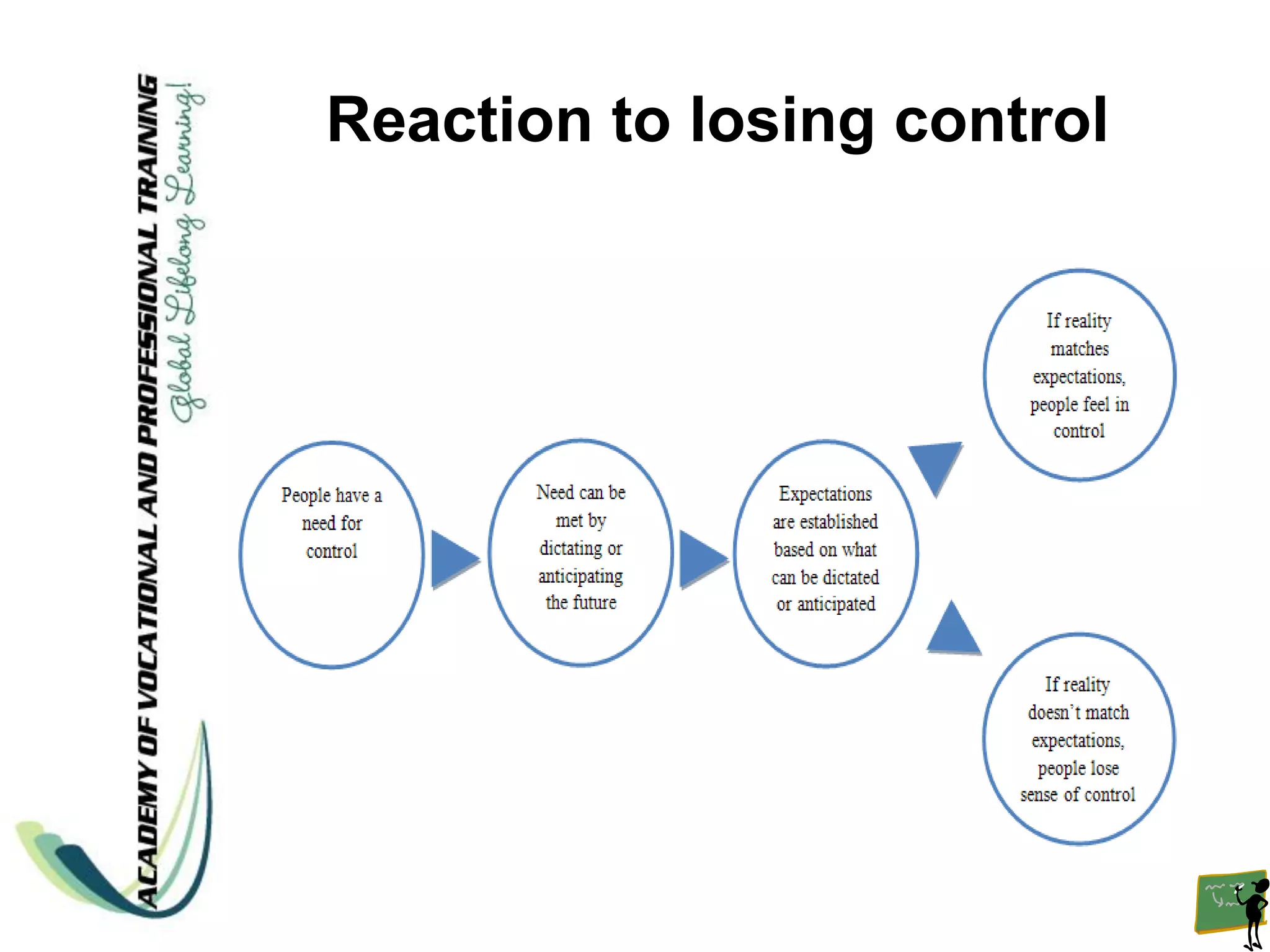
Reaction to losing control
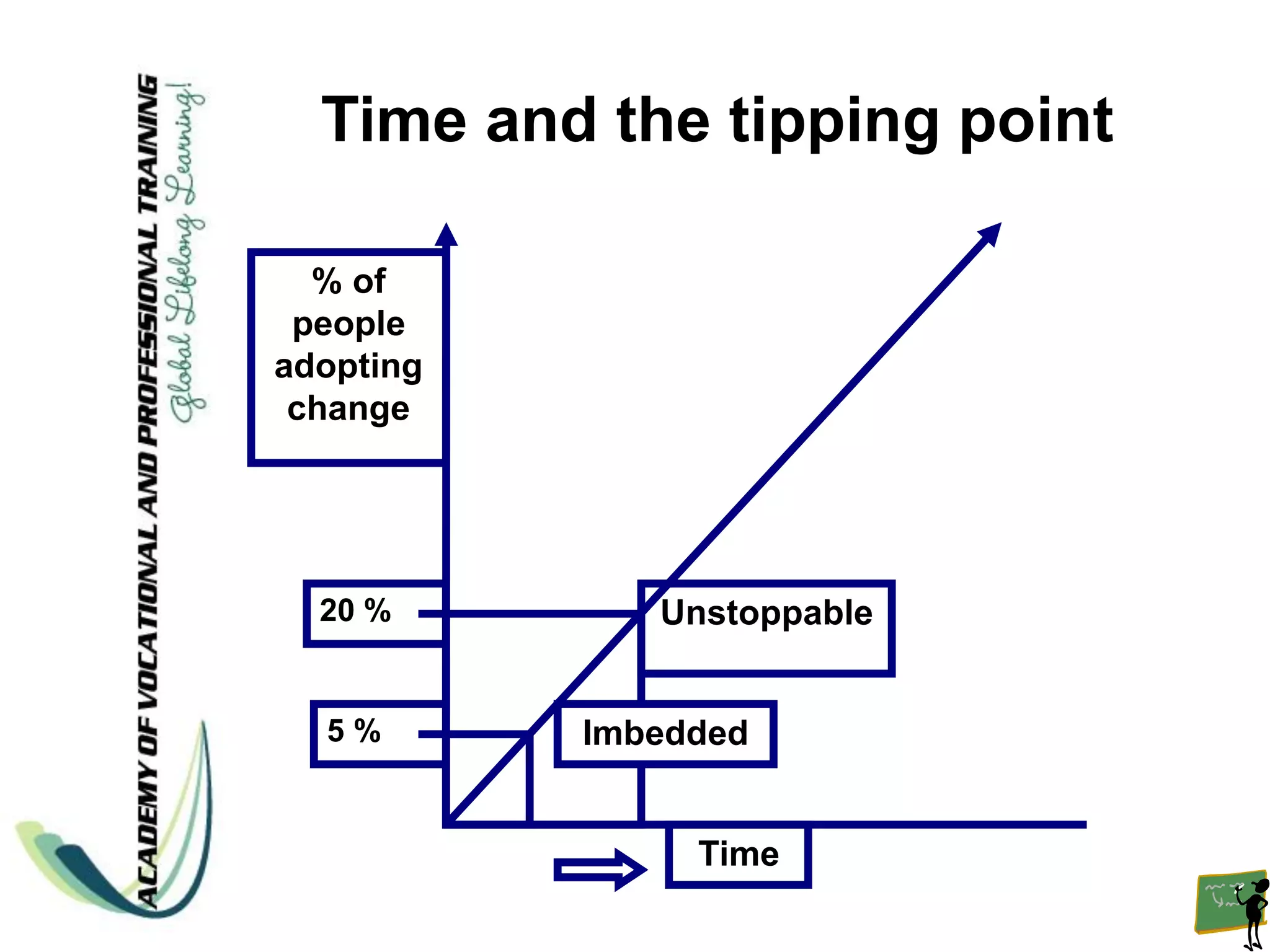
Time and the tipping point

  % of
 people
adopting
 change


  20 %        Unstoppable


  5%       Imbedded


                Time
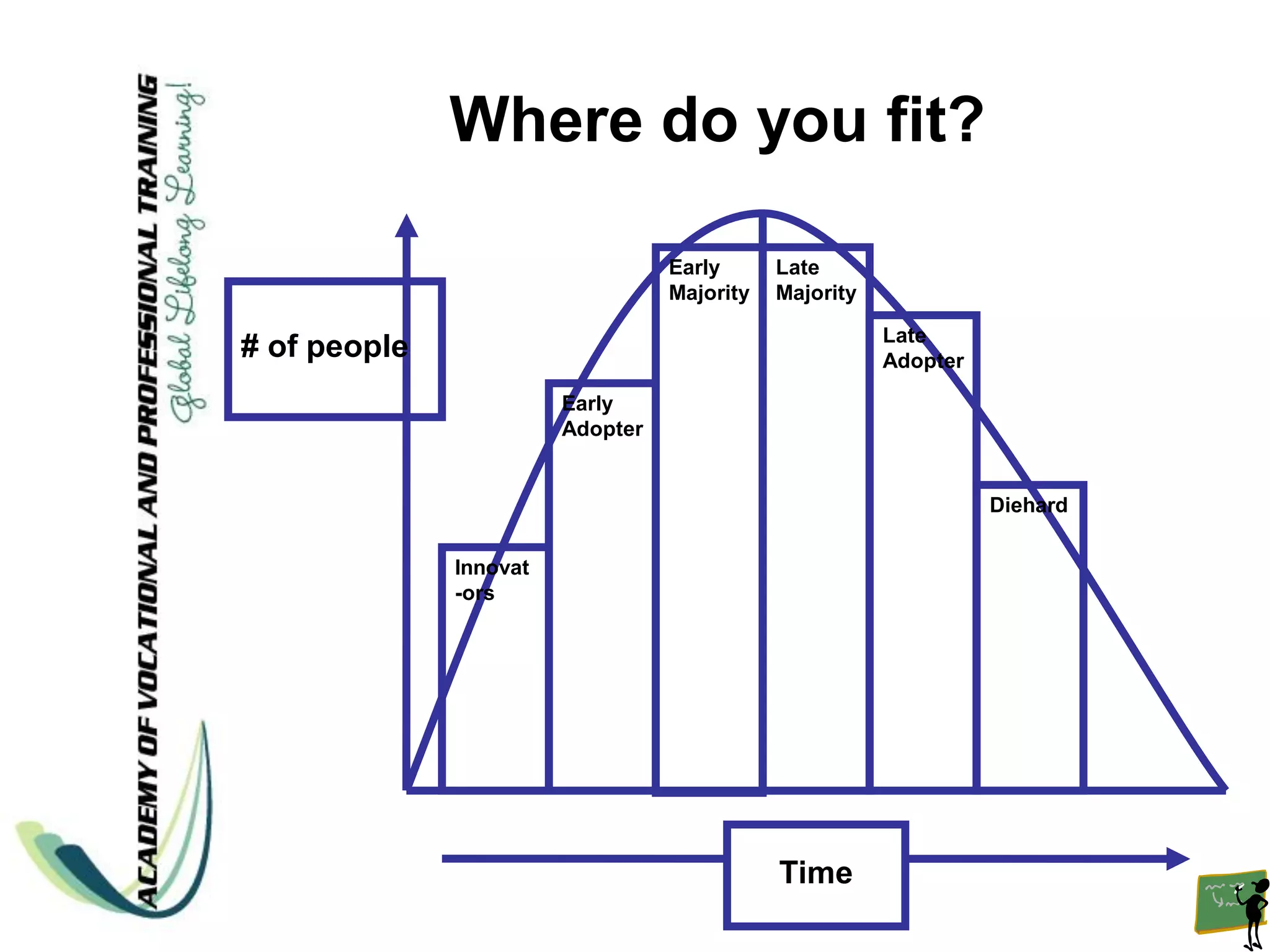
Where do you fit?

                                  Early      Late
                                  Majority   Majority

                                                        Late
# of people                                             Adopter

                        Early
                        Adopter


                                                                  Diehard

              Innovat
              -ors


                                             Time
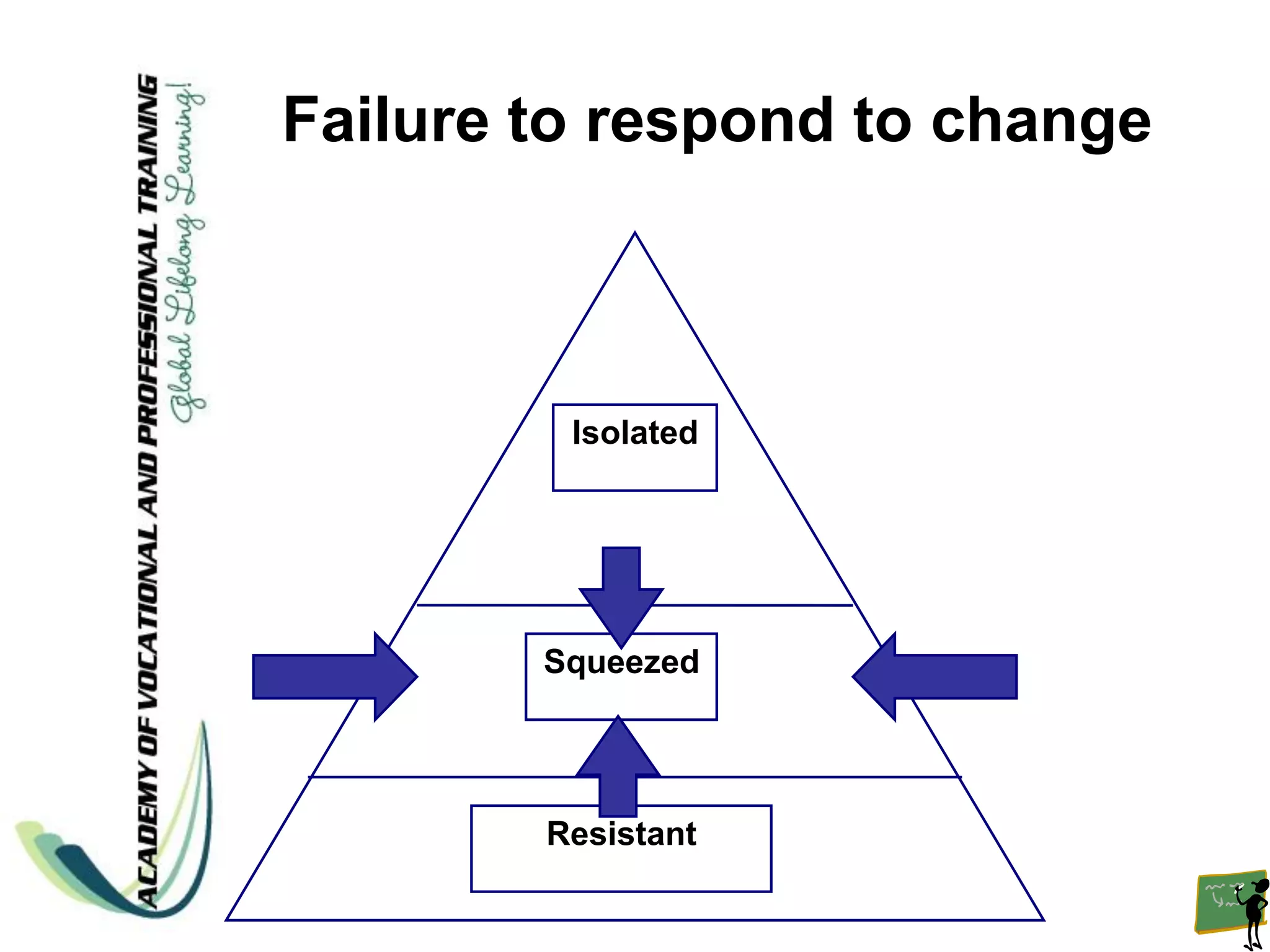
Failure to respond to change


         Isolated


        Squeezed


        Resistant
E-Learning Trends to
       Watch in 2012

TOOLS THAT WILL INFLUENCE
  THE QUALITY OF VIRTUAL
      TUTOR TRAINER
E-Learning Trends to Watch in 2012

   Learning Management Systems
   This year proved to be one of great debate surrounding the future and necessity of the
   Learning Management System. Much of it boils down to whether employee learning
   should be controlled and tracked, particularly when much of workplace learning occurs
   through informal channels.
   Learning Management Systems can enable collaboration, knowledge sharing, and social
   networking.


    Mobile
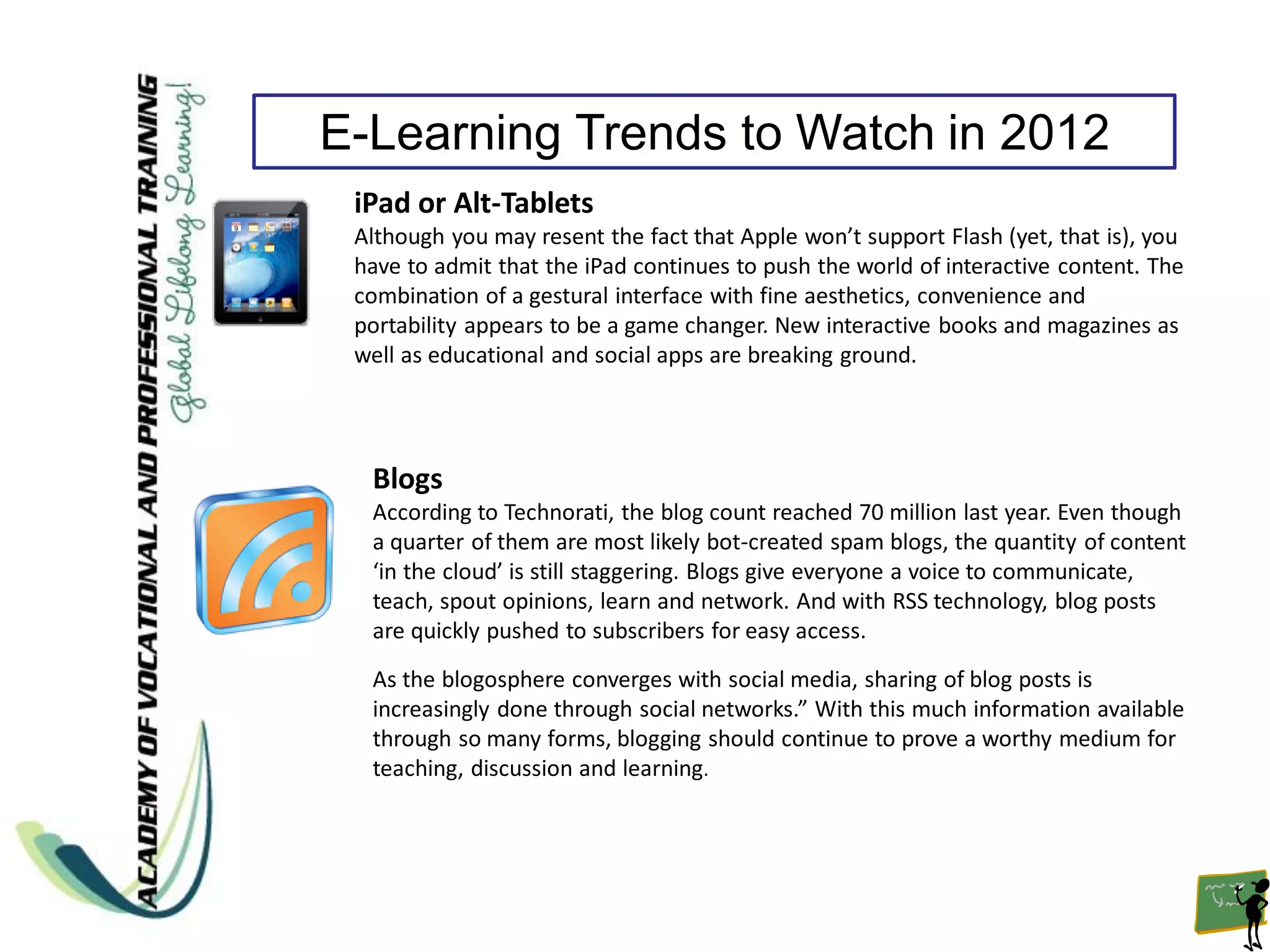
    Due to improved infrastructure, slick mobile operating systems and smartphone market
    penetration, we seemed to hit a tipping point of readiness for mobile content this year. From
    mini-courses to collaboration to performance support, mobile learning could go mainstream in
    the near future.

    In terms of converting legacy courses, it will mean streamlining everything—paring down over-
    sized multimedia elements as well as implementing a ‘less is more’ philosophy. In terms of new
    development, designers will have to manage the limitations of a smaller screen and decreased
    memory capacity. When mobile learning hits critical mass, people of all ages and occupations
    will reap the benefits.
E-Learning Trends to Watch in 2012
 iPad or Alt-Tablets
 Although you may resent the fact that Apple won’t support Flash (yet, that is), you
 have to admit that the iPad continues to push the world of interactive content. The
 combination of a gestural interface with fine aesthetics, convenience and
 portability appears to be a game changer. New interactive books and magazines as
 well as educational and social apps are breaking ground.


  Blogs
  According to Technorati, the blog count reached 70 million last year. Even though
  a quarter of them are most likely bot-created spam blogs, the quantity of content
  ‘in the cloud’ is still staggering. Blogs give everyone a voice to communicate,
  teach, spout opinions, learn and network. And with RSS technology, blog posts
  are quickly pushed to subscribers for easy access.
  As the blogosphere converges with social media, sharing of blog posts is
  increasingly done through social networks.” With this much information available
  through so many forms, blogging should continue to prove a worthy medium for
  teaching, discussion and learning.
E-Learning Trends to Watch in 2012
    eBooks
    The digital book publishing revolution is thriving as a result of improved electronic readers, the
    introduction of the iPad, the open ePub format, and a growing popularity of downloadable
    books in .pdf format sold by authors. With the advent of ‘always on’ devices, eBooks present
    one more path for learning and content distribution.

    In the future, forward thinking training organizations will provide their print materials in
    downloadable formats for employees to study or reference as needed. And as more digital
    readers become Internet-ready, books will hyperlink to other sources of information, providing
    a richer reading experience.


     QR Codes
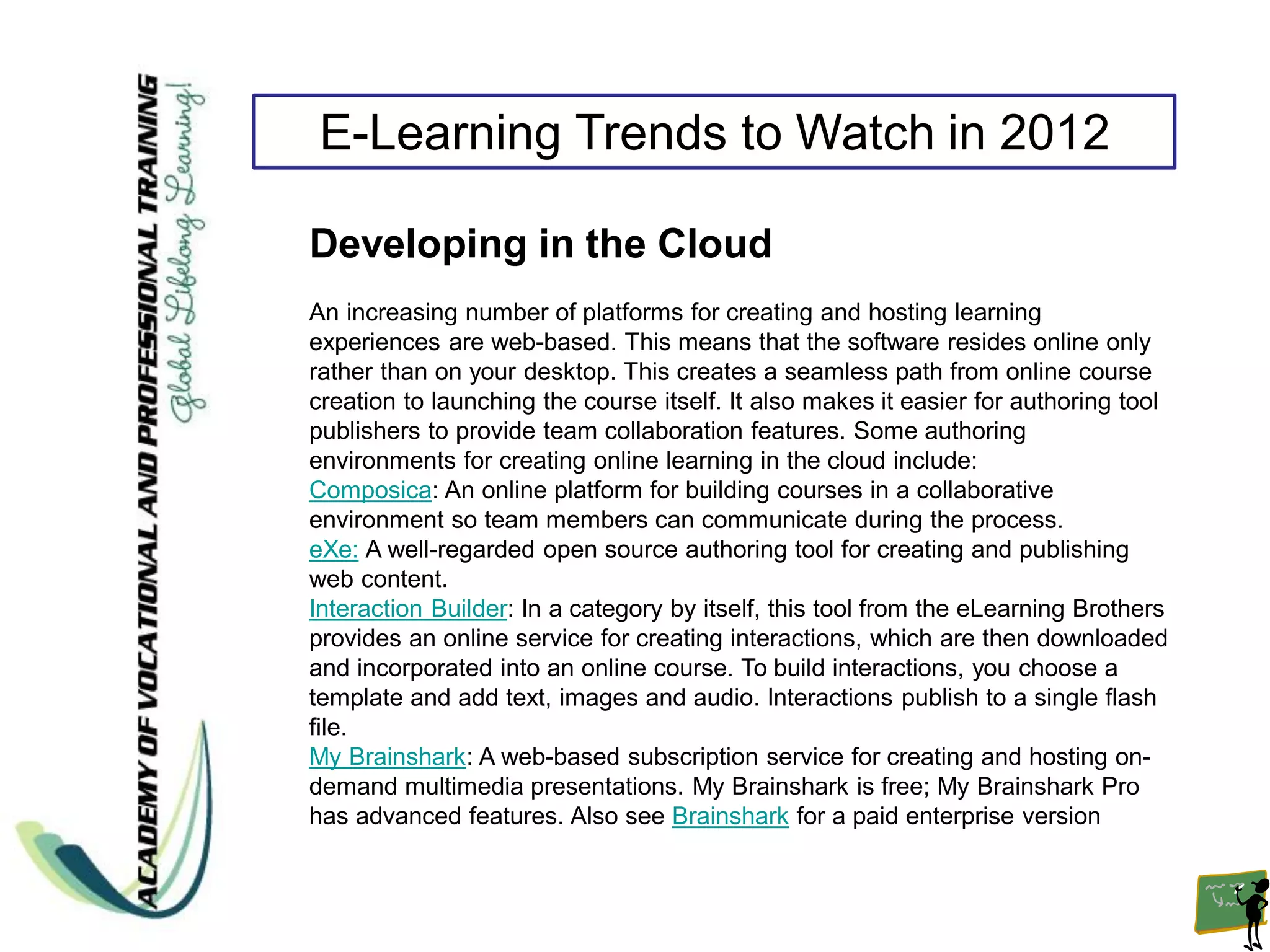
     A QR Code is a type of barcode that can be read by QR scanners and mobile phones with
     cameras, using a QR reader app. Capable of holding text, data and URLs, QR codes have a
     greater capacity than the old fashioned 10-digit barcode because they’re two-dimensional.
     Okay, these weren’t a booming trend in 2010, but we’ll probably see more of them in the
     future.

     Librarians and educators have found inventive uses for bar codes you might find inspiring.
     For example, QR codes containing a hyperlink have been placed on shelves in libraries. The
     code links to additional information about a related subject.
E-Learning Trends to Watch in 2012

Developing in the Cloud
An increasing number of platforms for creating and hosting learning
experiences are web-based. This means that the software resides online only
rather than on your desktop. This creates a seamless path from online course
creation to launching the course itself. It also makes it easier for authoring tool
publishers to provide team collaboration features. Some authoring
environments for creating online learning in the cloud include:
Composica: An online platform for building courses in a collaborative
environment so team members can communicate during the process.
eXe: A well-regarded open source authoring tool for creating and publishing
web content.
Interaction Builder: In a category by itself, this tool from the eLearning Brothers
provides an online service for creating interactions, which are then downloaded
and incorporated into an online course. To build interactions, you choose a
template and add text, images and audio. Interactions publish to a single flash
file.
My Brainshark: A web-based subscription service for creating and hosting on-
demand multimedia presentations. My Brainshark is free; My Brainshark Pro
has advanced features. Also see Brainshark for a paid enterprise version
E-Learning Trends to Watch in 2012
New Blended Learning

Blended or hybrid learning came about because one eLearning
course is often not the solution to an organization’s or an
individual’s learning needs. Until recently, blended referred to a
learning experience that included both instructor-led and online
self-paced components. But that was a long time ago in Internet
Time.

Now that live synchronous instruction frequently occurs online and
that opportunities for individualized learning abound, the definition
of blended learning is expanding to include any number of
strategies, from learning through a community of practice to
mobile performance support. For example, someone might attend
a workplace webinar on how people learn, then participate in a
video-based Google+ hangout with a cognitive psychologist, and
join a LinkedIn community of instructional designers to discuss the
application of these ideas.
E-Learning Trends to Watch in 2012
Augmented Reality
Gary Woodill, Ed.D., a Senior Research Analyst at
Brandon Hall Research and author of The Mobile Learning
Edge, was kind enough to contribute his perspective on the
trends affecting Augmented Reality related to mobile
learning.

According to Dr. Woodlill, “Augmented Reality (AR) is one
of the most disruptive applications for mobile learners. It is
an example of location-based services, where information
is provided to you based on your location, and even the
direction that your phone camera is facing. With that
information, your smartphone can supply additional textual
information about what you are looking at, or can blend
computer generated objects with the video or still image on
your screen.
E-Learning Trends to Watch in 2012
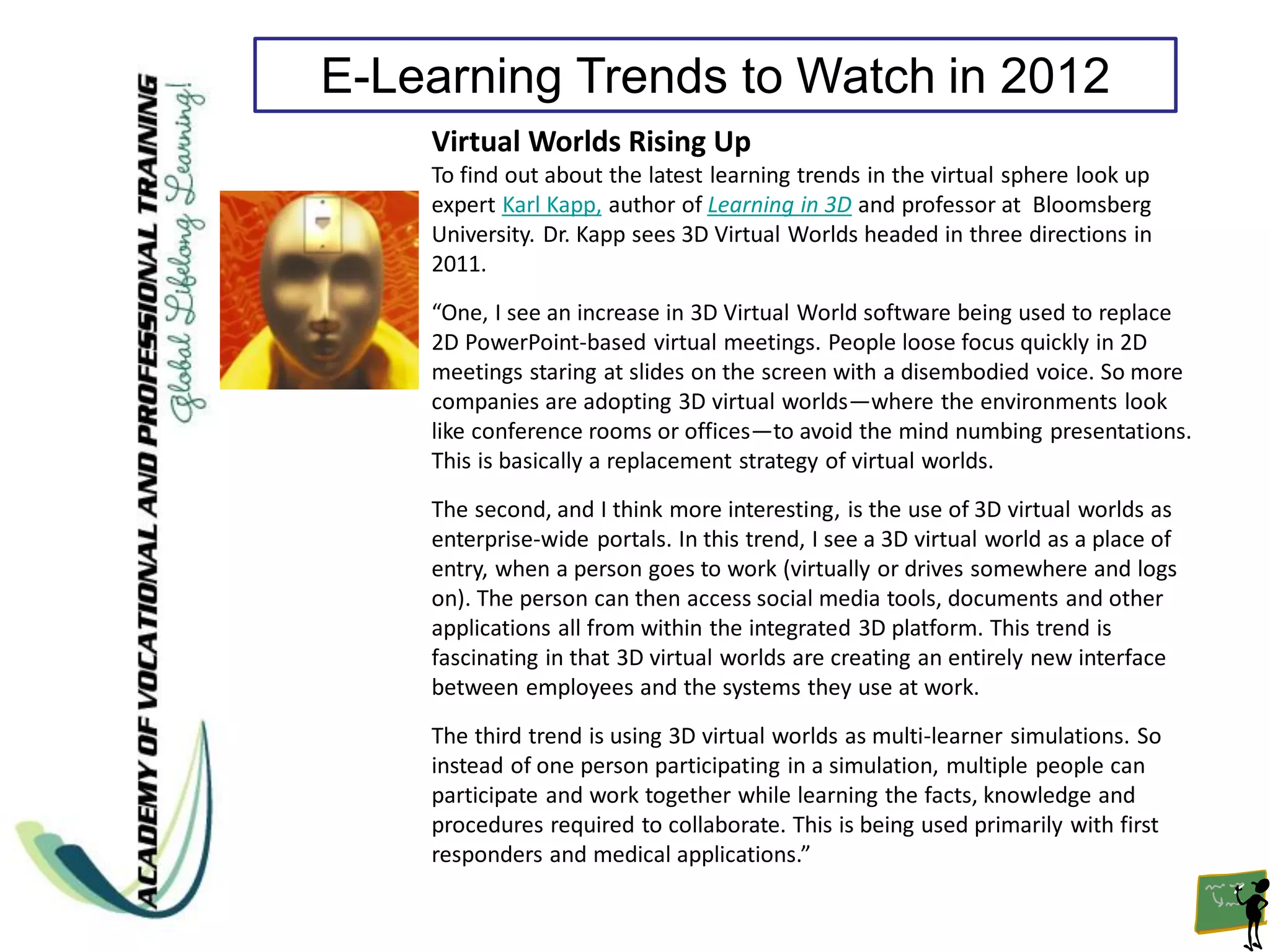
    Virtual Worlds Rising Up
    To find out about the latest learning trends in the virtual sphere look up
    expert Karl Kapp, author of Learning in 3D and professor at Bloomsberg
    University. Dr. Kapp sees 3D Virtual Worlds headed in three directions in
    2011.
    “One, I see an increase in 3D Virtual World software being used to replace
    2D PowerPoint-based virtual meetings. People loose focus quickly in 2D
    meetings staring at slides on the screen with a disembodied voice. So more
    companies are adopting 3D virtual worlds—where the environments look
    like conference rooms or offices—to avoid the mind numbing presentations.
    This is basically a replacement strategy of virtual worlds.
    The second, and I think more interesting, is the use of 3D virtual worlds as
    enterprise-wide portals. In this trend, I see a 3D virtual world as a place of
    entry, when a person goes to work (virtually or drives somewhere and logs
    on). The person can then access social media tools, documents and other
    applications all from within the integrated 3D platform. This trend is
    fascinating in that 3D virtual worlds are creating an entirely new interface
    between employees and the systems they use at work.
    The third trend is using 3D virtual worlds as multi-learner simulations. So
    instead of one person participating in a simulation, multiple people can
    participate and work together while learning the facts, knowledge and
    procedures required to collaborate. This is being used primarily with first
    responders and medical applications.”
E-Learning Trends to Watch in 2012
  Pocket Video Technology
  The ubiquitous presence of video in our connected lives got a serious boost from super-portable
  pocket video technology this year. Started by the Flip and now with many impressive
  competitors, these small, convenient recorders produce HD video, enable easy uploading to
  YouTube and other sharing sites, and run for under $200 US.
  More than ever before, amateur videographers are teaching, demonstrating and sharing their
  knowledge and expertise. With 2 billion videos viewed daily on YouTube, this service has
  become the second largest search engine in the world.

  The demand for video is sure to bring about new online services that enhance how videos are
  integrated into our world for just-in-time, informal learning. According to Ravit Lichtenberg from
  Ustrategy.com, “In the coming year, gaps in our video experience will be filled with the
  integration of filtering, tagging, editing and locating tools into each and every video feed.”
  Sounds good to me.

  Growth of Social Learning
  There are more than 550 million people on Facebook and 65 million daily tweets on Twitter.
  Opportunities for learning through social media technologies abound and should grow ever
  stronger in the coming years. As a growing number of people look outside their training
  departments to meet their professional learning needs via social media, new services will most
  likely emerge to meet the greater demand.

  For example, learning professionals currently use Twitter, LinkedIn, Facebook and other services to
  share links and posts throughout the day and night. Online learning-related chats and discussions
  engage people from around the world, shrinking the geographical and cultural distances between
  us.

  We’re bound to see new services that integrate across all of our devices to improve online
  collaboration, sharing and discussion, and ones that help people form smaller, more intimate
  digital and location-based communities.
Defining a Successful Training
           Program

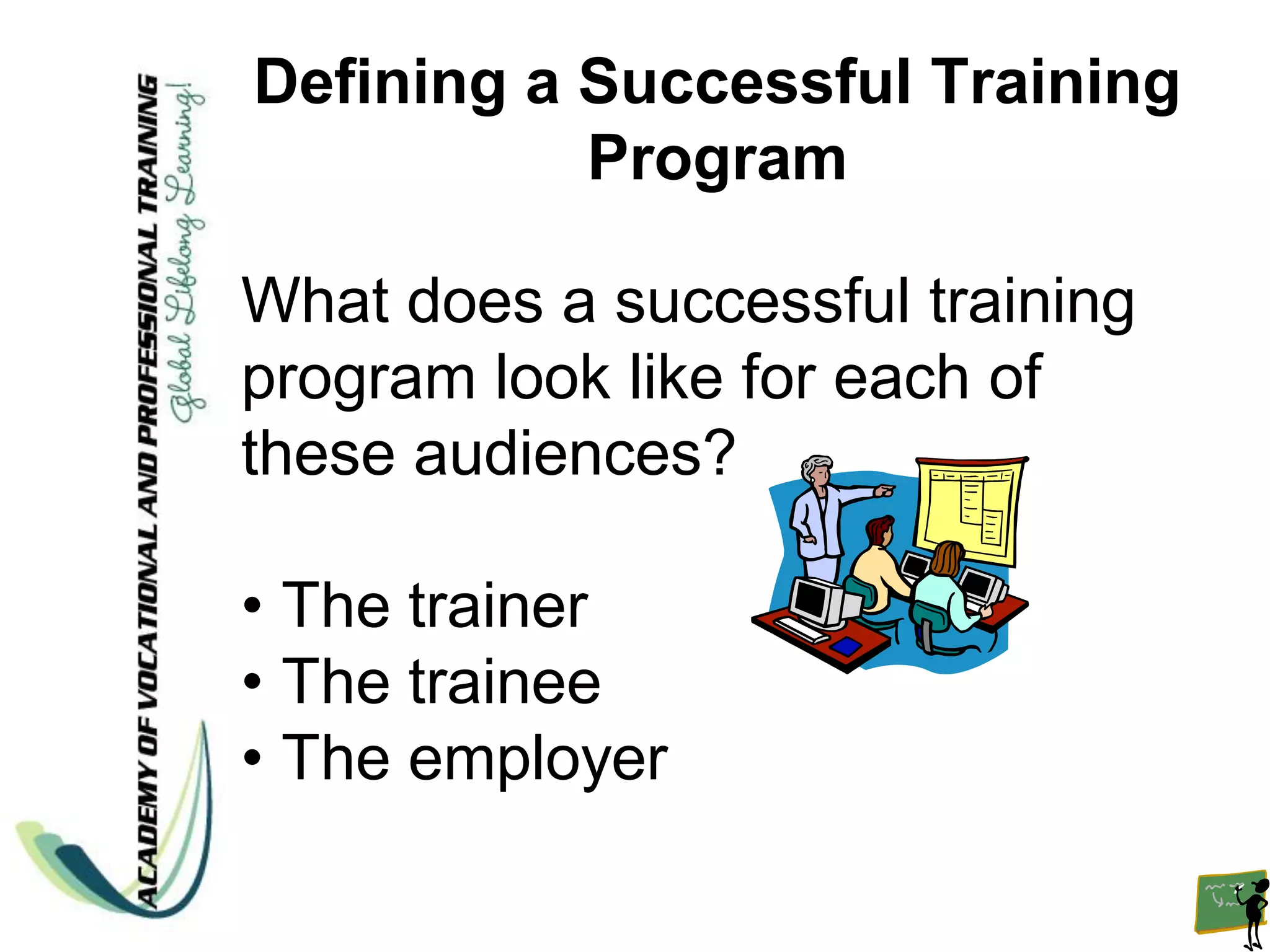
What does a successful training
program look like for each of
these audiences?

• The trainer
• The trainee
• The employer
A Word about Adult Learning
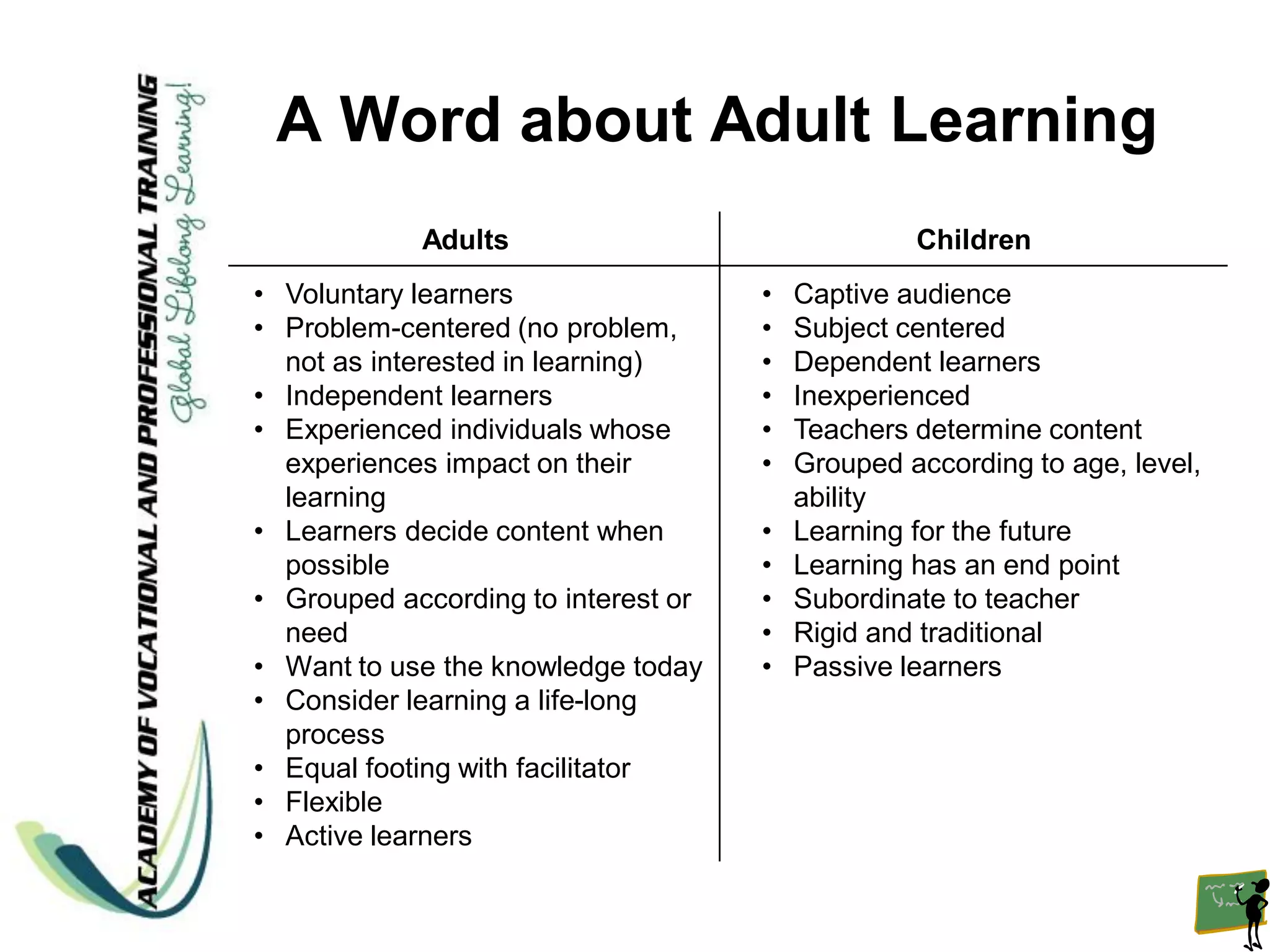
            Adults                                Children
• Voluntary learners                 •   Captive audience
• Problem-centered (no problem,      •   Subject centered
  not as interested in learning)     •   Dependent learners
• Independent learners               •   Inexperienced
• Experienced individuals whose      •   Teachers determine content
  experiences impact on their        •   Grouped according to age, level,
  learning                               ability
• Learners decide content when       •   Learning for the future
  possible                           •   Learning has an end point
• Grouped according to interest or   •   Subordinate to teacher
  need                               •   Rigid and traditional
• Want to use the knowledge today    •   Passive learners
• Consider learning a life-long
  process
• Equal footing with facilitator
• Flexible
• Active learners
Types of Trainers

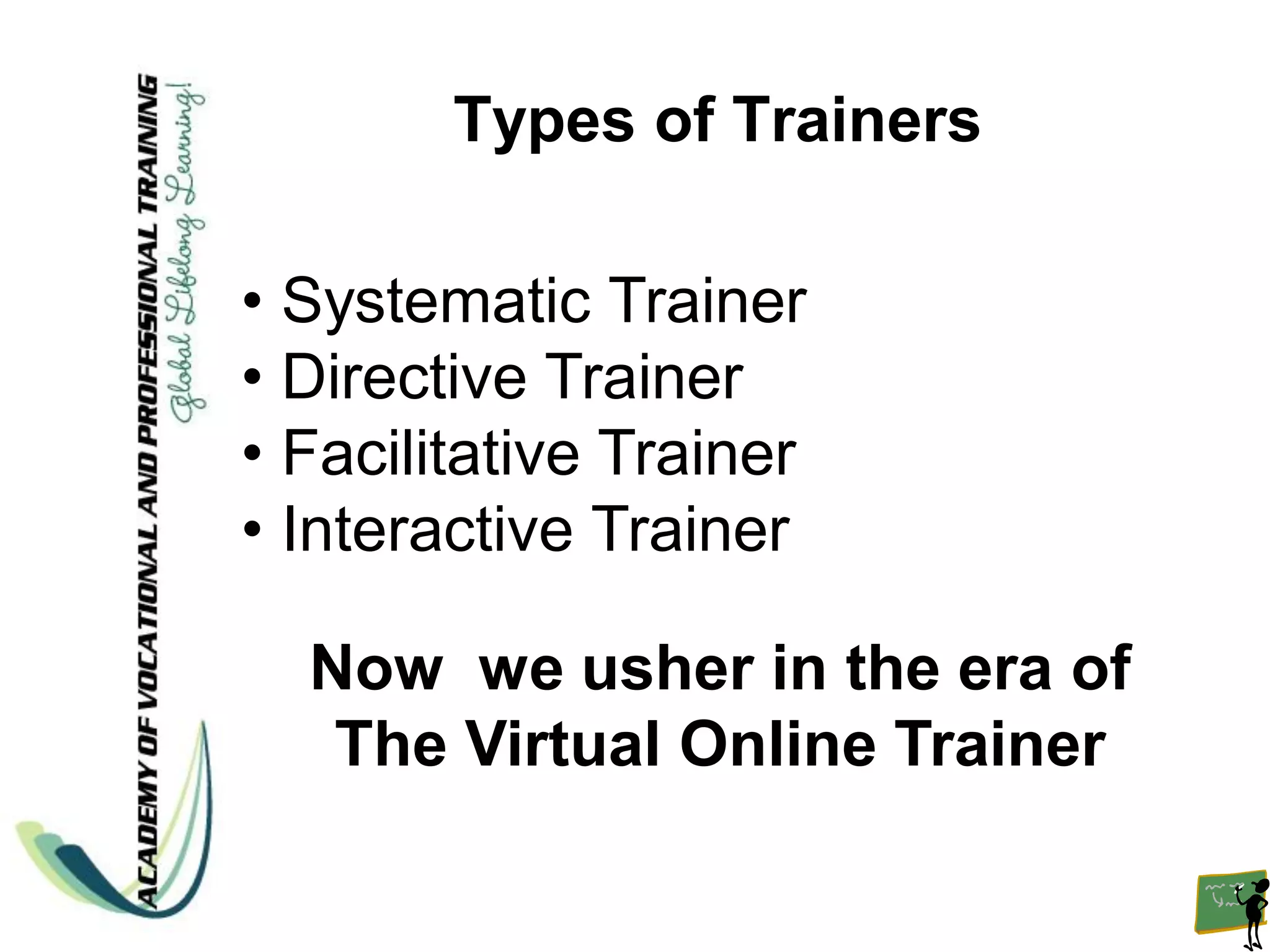
• Systematic Trainer
• Directive Trainer
• Facilitative Trainer
• Interactive Trainer

  Now we usher in the era of
   The Virtual Online Trainer
Who are soft skills for?
Soft Skills Training Courses

   Directory of Courses
THINGS YOU DON’T NEED A
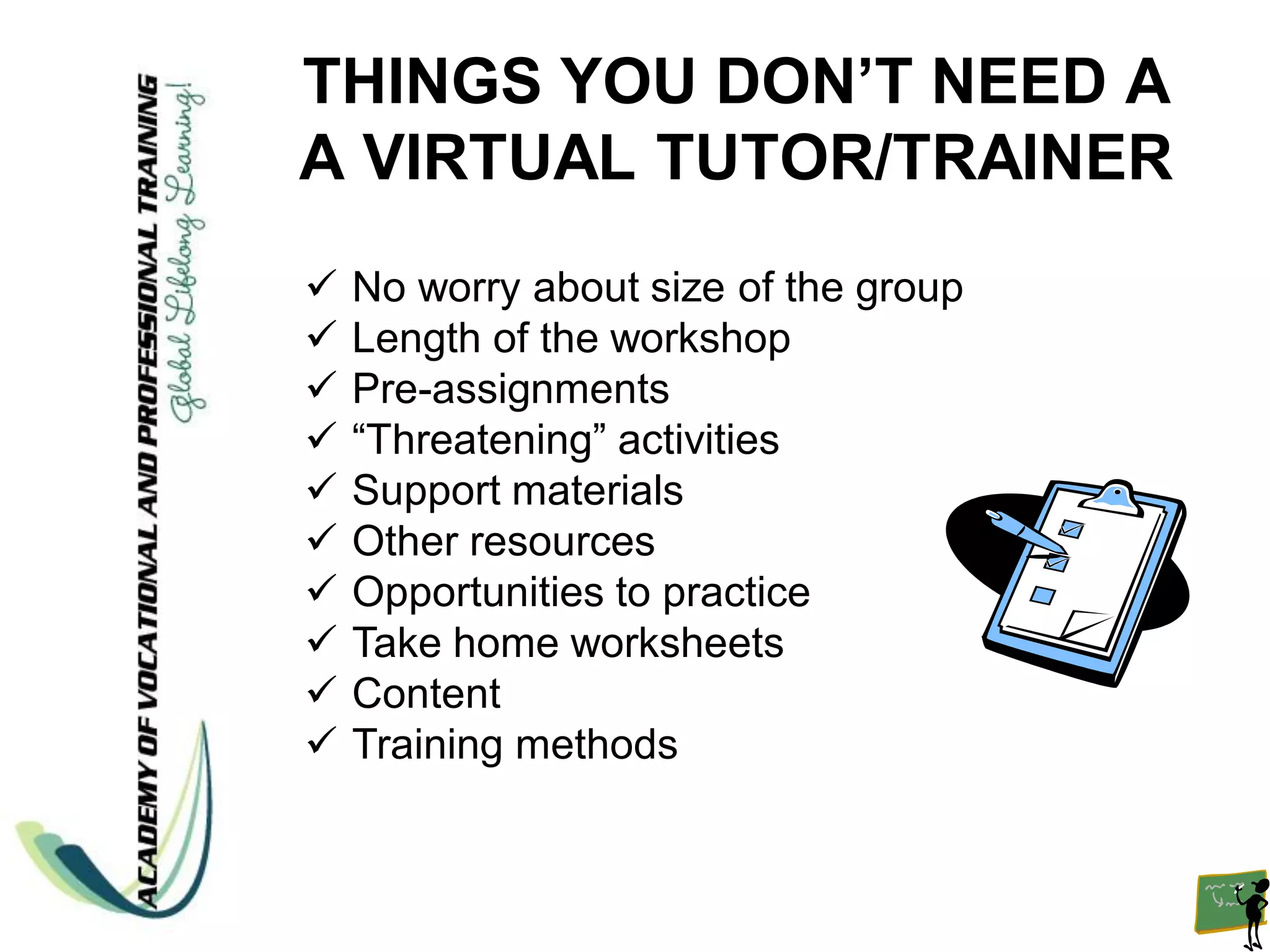
A VIRTUAL TUTOR/TRAINER
   No worry about size of the group
   Length of the workshop
   Pre-assignments
   “Threatening” activities
   Support materials
   Other resources
   Opportunities to practice
   Take home worksheets
   Content
   Training methods
Diminished Constraints

A whole host of environmental constraints
usually influence decisions concerning
methods used, including:
• Money available
• Time
• Expertise
• Support
• Trainer philosophy
• Physical space and equipment
• Availability
Trends 2012
• Recognising the importance of E-Learning
  Trends in 2012, the participants and their
  training needs, including the different e-
  learning styles and adult learning principles.
• Know how to write prepare and respond via
  your online presence and use of technology.
• Develop an effective e-training style, using
  appropriate technical training aids and
  techniques.
• Preview interactive online training course
• Merits of how to develop as a virtual online
  tutor trainer.
ACCREDITATION
What certification will student receive?

  AVPT has been confirmed for Candidacy Global Accreditation Feb 2012?
                      IAO is a member of the following organisations who monitor accrediting organisation in order
                      to ensure they maintain a international high standard.
                      IEAC
                      •    The IEAC is a global watchdog organization devoted to the establishment, maintenance and
                           on-going improvement of standards of accreditation agencies across the globe connected with
                           online education.

                      GESFWA
                      •   GESFWA (Global Education Support Forum for Working Adults) is a not-for-profit mission
                          oriented organization with international chapters. GESFWA is working to standardize and
                          promote the education for working adults worldwide.

                      •    International Accreditation with Regional Recognition
                           IAO's accreditation is international in nature, which means that your educational institute will be
                           recognized and accepted on an international scale. Additionally, it will also enrich your profile
                           on a regional level, resulting in increased student recruitments.

                      •    Endorsement of Students Credentials
                           Your institution's student will also benefit from IAO's Point Profile System for students that are
                           specially designed to endorse their professional credentials to improve their professional
                           profiles. This will help them to achieve their career aspirations
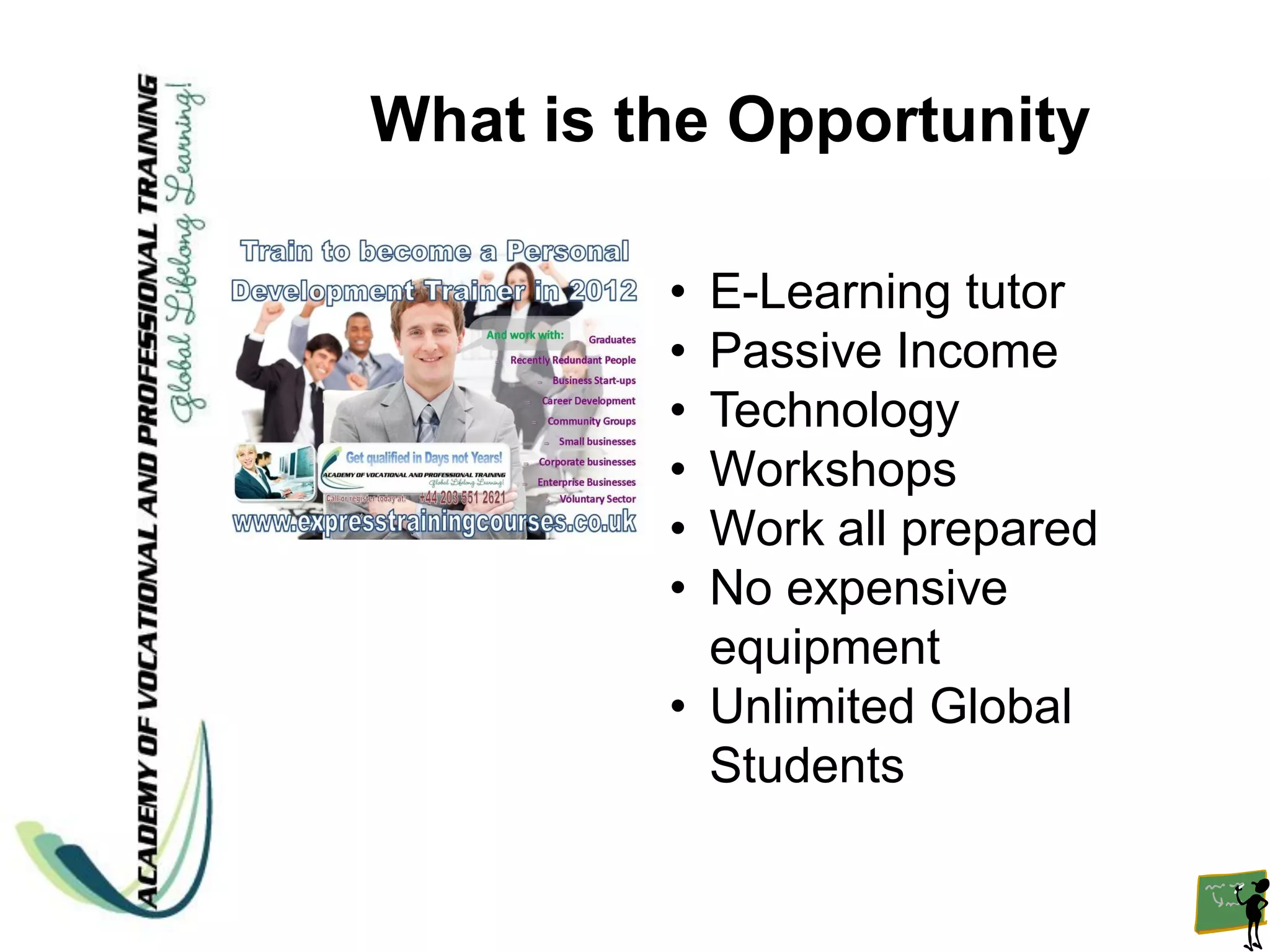
What is the Opportunity

         • E-Learning tutor
         • Passive Income
         • Technology
         • Workshops
         • Work all prepared
         • No expensive
           equipment
         • Unlimited Global
           Students
What to do next

     • Enroll on the Global
       Virtual Trainers Course
     • Associate £399.00
       (2days)
     • Independent £750.00 (3
       days)
     • License + 12 courses
       £4.500 (3 days)
     • Corporate from £6,000
Tutors Fee Paid per student

                                                       Workshop
Payment                                  online                         Block Pay Per
              Fee scale                                Fees No of
Scale                                    Fee %                          Student Rate
                                                         Days
Level 1       £90 - £399                    8%               1          £65.00

Level 2       £400 - £599                  10%               2          £150.00

Level 3       £600 - £999                  12%               3          £270.00

Level 4       £1000 - £2499                14%               5          £310.00

              Online courses run for 20 working days.


      This is a price guide and subject to refinement and change. Jan 2012
Entry Level Explanations
  Enroll to become qualified as a Virtual Trainer
           2 Day intense training course
• Associate £399.00 (Become one of our online Virtual
  Tutors Trainer. Candidate cannot sell courses independently 2
  days)
• Independent £750.00 (Includes above and workshop
  presenter 3 days)
• License + 12 branded courses £4.500 (Virtual
  Tutor Trainer, Workshop Presenter & Promote own courses 3
  days)
• Corporate from £6,000 (One White labeled course for in
  house training ).

Introduction to becoming a Virtual Teacher Facilitator 2012

  • 3.
    Welcome 2012 Conferenceon the Growth of the Online Virtual Teacher Trainer Sector
  • 4.
    Present by Diane ShaweM.Ed IEBE CEO Academy of Vocational and Professional Training Ltd
  • 5.
    Learning Technology TrendsTo Watch In 2012 As the technologies of the 21st century evolve and mature, we become the beneficiaries of exciting approaches for designing learning experiences. The convergence of informal and social media learning, combined with the explosion of smartphone and tablet use, is having a huge impact on how we think about and deliver training and education.
  • 6.
    Institutions of HigherLearning Embrace Online Education Institutions of higher learning increasingly embrace online education, with 65.5 percent of chief academic officers now calling online education “critical” to their institution’s long-term strategy, an opinion that’s risen more than 15% over eight years. 67% believe academic outcomes from online classes are equivalent to those in face-to-face learning, but still, one-third of academic leaders think online classes are inferior.
  • 7.
    The Human Reactionto Change Misconceptions Misinformation Peer Pressure Fear of the unknown All cause a chain reaction to change
  • 8.
  • 9.
    Time and thetipping point % of people adopting change 20 % Unstoppable 5% Imbedded Time
  • 10.
    Where do youfit? Early Late Majority Majority Late # of people Adopter Early Adopter Diehard Innovat -ors Time
  • 11.
    Failure to respondto change Isolated Squeezed Resistant
  • 12.
    E-Learning Trends to Watch in 2012 TOOLS THAT WILL INFLUENCE THE QUALITY OF VIRTUAL TUTOR TRAINER
  • 13.
    E-Learning Trends toWatch in 2012 Learning Management Systems This year proved to be one of great debate surrounding the future and necessity of the Learning Management System. Much of it boils down to whether employee learning should be controlled and tracked, particularly when much of workplace learning occurs through informal channels. Learning Management Systems can enable collaboration, knowledge sharing, and social networking. Mobile Due to improved infrastructure, slick mobile operating systems and smartphone market penetration, we seemed to hit a tipping point of readiness for mobile content this year. From mini-courses to collaboration to performance support, mobile learning could go mainstream in the near future. In terms of converting legacy courses, it will mean streamlining everything—paring down over- sized multimedia elements as well as implementing a ‘less is more’ philosophy. In terms of new development, designers will have to manage the limitations of a smaller screen and decreased memory capacity. When mobile learning hits critical mass, people of all ages and occupations will reap the benefits.
  • 14.
    E-Learning Trends toWatch in 2012 iPad or Alt-Tablets Although you may resent the fact that Apple won’t support Flash (yet, that is), you have to admit that the iPad continues to push the world of interactive content. The combination of a gestural interface with fine aesthetics, convenience and portability appears to be a game changer. New interactive books and magazines as well as educational and social apps are breaking ground. Blogs According to Technorati, the blog count reached 70 million last year. Even though a quarter of them are most likely bot-created spam blogs, the quantity of content ‘in the cloud’ is still staggering. Blogs give everyone a voice to communicate, teach, spout opinions, learn and network. And with RSS technology, blog posts are quickly pushed to subscribers for easy access. As the blogosphere converges with social media, sharing of blog posts is increasingly done through social networks.” With this much information available through so many forms, blogging should continue to prove a worthy medium for teaching, discussion and learning.
  • 15.
    E-Learning Trends toWatch in 2012 eBooks The digital book publishing revolution is thriving as a result of improved electronic readers, the introduction of the iPad, the open ePub format, and a growing popularity of downloadable books in .pdf format sold by authors. With the advent of ‘always on’ devices, eBooks present one more path for learning and content distribution. In the future, forward thinking training organizations will provide their print materials in downloadable formats for employees to study or reference as needed. And as more digital readers become Internet-ready, books will hyperlink to other sources of information, providing a richer reading experience. QR Codes A QR Code is a type of barcode that can be read by QR scanners and mobile phones with cameras, using a QR reader app. Capable of holding text, data and URLs, QR codes have a greater capacity than the old fashioned 10-digit barcode because they’re two-dimensional. Okay, these weren’t a booming trend in 2010, but we’ll probably see more of them in the future. Librarians and educators have found inventive uses for bar codes you might find inspiring. For example, QR codes containing a hyperlink have been placed on shelves in libraries. The code links to additional information about a related subject.
  • 16.
    E-Learning Trends toWatch in 2012 Developing in the Cloud An increasing number of platforms for creating and hosting learning experiences are web-based. This means that the software resides online only rather than on your desktop. This creates a seamless path from online course creation to launching the course itself. It also makes it easier for authoring tool publishers to provide team collaboration features. Some authoring environments for creating online learning in the cloud include: Composica: An online platform for building courses in a collaborative environment so team members can communicate during the process. eXe: A well-regarded open source authoring tool for creating and publishing web content. Interaction Builder: In a category by itself, this tool from the eLearning Brothers provides an online service for creating interactions, which are then downloaded and incorporated into an online course. To build interactions, you choose a template and add text, images and audio. Interactions publish to a single flash file. My Brainshark: A web-based subscription service for creating and hosting on- demand multimedia presentations. My Brainshark is free; My Brainshark Pro has advanced features. Also see Brainshark for a paid enterprise version
  • 17.
    E-Learning Trends toWatch in 2012 New Blended Learning Blended or hybrid learning came about because one eLearning course is often not the solution to an organization’s or an individual’s learning needs. Until recently, blended referred to a learning experience that included both instructor-led and online self-paced components. But that was a long time ago in Internet Time. Now that live synchronous instruction frequently occurs online and that opportunities for individualized learning abound, the definition of blended learning is expanding to include any number of strategies, from learning through a community of practice to mobile performance support. For example, someone might attend a workplace webinar on how people learn, then participate in a video-based Google+ hangout with a cognitive psychologist, and join a LinkedIn community of instructional designers to discuss the application of these ideas.
  • 18.
    E-Learning Trends toWatch in 2012 Augmented Reality Gary Woodill, Ed.D., a Senior Research Analyst at Brandon Hall Research and author of The Mobile Learning Edge, was kind enough to contribute his perspective on the trends affecting Augmented Reality related to mobile learning. According to Dr. Woodlill, “Augmented Reality (AR) is one of the most disruptive applications for mobile learners. It is an example of location-based services, where information is provided to you based on your location, and even the direction that your phone camera is facing. With that information, your smartphone can supply additional textual information about what you are looking at, or can blend computer generated objects with the video or still image on your screen.
  • 19.
    E-Learning Trends toWatch in 2012 Virtual Worlds Rising Up To find out about the latest learning trends in the virtual sphere look up expert Karl Kapp, author of Learning in 3D and professor at Bloomsberg University. Dr. Kapp sees 3D Virtual Worlds headed in three directions in 2011. “One, I see an increase in 3D Virtual World software being used to replace 2D PowerPoint-based virtual meetings. People loose focus quickly in 2D meetings staring at slides on the screen with a disembodied voice. So more companies are adopting 3D virtual worlds—where the environments look like conference rooms or offices—to avoid the mind numbing presentations. This is basically a replacement strategy of virtual worlds. The second, and I think more interesting, is the use of 3D virtual worlds as enterprise-wide portals. In this trend, I see a 3D virtual world as a place of entry, when a person goes to work (virtually or drives somewhere and logs on). The person can then access social media tools, documents and other applications all from within the integrated 3D platform. This trend is fascinating in that 3D virtual worlds are creating an entirely new interface between employees and the systems they use at work. The third trend is using 3D virtual worlds as multi-learner simulations. So instead of one person participating in a simulation, multiple people can participate and work together while learning the facts, knowledge and procedures required to collaborate. This is being used primarily with first responders and medical applications.”
  • 20.
    E-Learning Trends toWatch in 2012 Pocket Video Technology The ubiquitous presence of video in our connected lives got a serious boost from super-portable pocket video technology this year. Started by the Flip and now with many impressive competitors, these small, convenient recorders produce HD video, enable easy uploading to YouTube and other sharing sites, and run for under $200 US. More than ever before, amateur videographers are teaching, demonstrating and sharing their knowledge and expertise. With 2 billion videos viewed daily on YouTube, this service has become the second largest search engine in the world. The demand for video is sure to bring about new online services that enhance how videos are integrated into our world for just-in-time, informal learning. According to Ravit Lichtenberg from Ustrategy.com, “In the coming year, gaps in our video experience will be filled with the integration of filtering, tagging, editing and locating tools into each and every video feed.” Sounds good to me. Growth of Social Learning There are more than 550 million people on Facebook and 65 million daily tweets on Twitter. Opportunities for learning through social media technologies abound and should grow ever stronger in the coming years. As a growing number of people look outside their training departments to meet their professional learning needs via social media, new services will most likely emerge to meet the greater demand. For example, learning professionals currently use Twitter, LinkedIn, Facebook and other services to share links and posts throughout the day and night. Online learning-related chats and discussions engage people from around the world, shrinking the geographical and cultural distances between us. We’re bound to see new services that integrate across all of our devices to improve online collaboration, sharing and discussion, and ones that help people form smaller, more intimate digital and location-based communities.
  • 22.
    Defining a SuccessfulTraining Program What does a successful training program look like for each of these audiences? • The trainer • The trainee • The employer
  • 23.
    A Word aboutAdult Learning Adults Children • Voluntary learners • Captive audience • Problem-centered (no problem, • Subject centered not as interested in learning) • Dependent learners • Independent learners • Inexperienced • Experienced individuals whose • Teachers determine content experiences impact on their • Grouped according to age, level, learning ability • Learners decide content when • Learning for the future possible • Learning has an end point • Grouped according to interest or • Subordinate to teacher need • Rigid and traditional • Want to use the knowledge today • Passive learners • Consider learning a life-long process • Equal footing with facilitator • Flexible • Active learners
  • 24.
    Types of Trainers •Systematic Trainer • Directive Trainer • Facilitative Trainer • Interactive Trainer Now we usher in the era of The Virtual Online Trainer
  • 25.
    Who are softskills for?
  • 26.
    Soft Skills TrainingCourses Directory of Courses
  • 27.
    THINGS YOU DON’TNEED A A VIRTUAL TUTOR/TRAINER  No worry about size of the group  Length of the workshop  Pre-assignments  “Threatening” activities  Support materials  Other resources  Opportunities to practice  Take home worksheets  Content  Training methods
  • 28.
    Diminished Constraints A wholehost of environmental constraints usually influence decisions concerning methods used, including: • Money available • Time • Expertise • Support • Trainer philosophy • Physical space and equipment • Availability
  • 29.
    Trends 2012 • Recognisingthe importance of E-Learning Trends in 2012, the participants and their training needs, including the different e- learning styles and adult learning principles. • Know how to write prepare and respond via your online presence and use of technology. • Develop an effective e-training style, using appropriate technical training aids and techniques. • Preview interactive online training course • Merits of how to develop as a virtual online tutor trainer.
  • 30.
    ACCREDITATION What certification willstudent receive? AVPT has been confirmed for Candidacy Global Accreditation Feb 2012? IAO is a member of the following organisations who monitor accrediting organisation in order to ensure they maintain a international high standard. IEAC • The IEAC is a global watchdog organization devoted to the establishment, maintenance and on-going improvement of standards of accreditation agencies across the globe connected with online education. GESFWA • GESFWA (Global Education Support Forum for Working Adults) is a not-for-profit mission oriented organization with international chapters. GESFWA is working to standardize and promote the education for working adults worldwide. • International Accreditation with Regional Recognition IAO's accreditation is international in nature, which means that your educational institute will be recognized and accepted on an international scale. Additionally, it will also enrich your profile on a regional level, resulting in increased student recruitments. • Endorsement of Students Credentials Your institution's student will also benefit from IAO's Point Profile System for students that are specially designed to endorse their professional credentials to improve their professional profiles. This will help them to achieve their career aspirations
  • 31.
    What is theOpportunity • E-Learning tutor • Passive Income • Technology • Workshops • Work all prepared • No expensive equipment • Unlimited Global Students
  • 32.
    What to donext • Enroll on the Global Virtual Trainers Course • Associate £399.00 (2days) • Independent £750.00 (3 days) • License + 12 courses £4.500 (3 days) • Corporate from £6,000
  • 33.
    Tutors Fee Paidper student Workshop Payment online Block Pay Per Fee scale Fees No of Scale Fee % Student Rate Days Level 1 £90 - £399 8% 1 £65.00 Level 2 £400 - £599 10% 2 £150.00 Level 3 £600 - £999 12% 3 £270.00 Level 4 £1000 - £2499 14% 5 £310.00 Online courses run for 20 working days. This is a price guide and subject to refinement and change. Jan 2012
  • 34.
    Entry Level Explanations Enroll to become qualified as a Virtual Trainer 2 Day intense training course • Associate £399.00 (Become one of our online Virtual Tutors Trainer. Candidate cannot sell courses independently 2 days) • Independent £750.00 (Includes above and workshop presenter 3 days) • License + 12 branded courses £4.500 (Virtual Tutor Trainer, Workshop Presenter & Promote own courses 3 days) • Corporate from £6,000 (One White labeled course for in house training ).