LYOPHLIZATION & ELUTRIATION
Presented to:
Ma’am Ayesha Mehmood
LYOPHLIZATION
LYOPHLIZATION
• Definition:
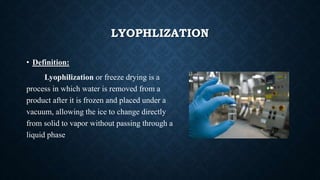
Lyophilization or freeze drying is a
process in which water is removed from a
product after it is frozen and placed under a
vacuum, allowing the ice to change directly
from solid to vapor without passing through a
liquid phase
PRINCIPLE OF LYOPHLIZATION
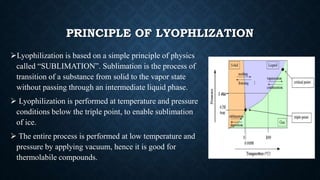
Lyophilization is based on a simple principle of physics
called “SUBLIMATION”. Sublimation is the process of
transition of a substance from solid to the vapor state
without passing through an intermediate liquid phase.
 Lyophilization is performed at temperature and pressure
conditions below the triple point, to enable sublimation
of ice.
 The entire process is performed at low temperature and
pressure by applying vacuum, hence it is good for
thermolabile compounds.
SIGNIFICANCE
 To preserve the Biological activity of product.
 To reduce the product weight so that transport cost can be reduced.
 To extend the shelf life or stability.
 To dry thermolabile materials.
 To eliminate the need for refrigerated storage.
 To get accurate, sterile dosing into the final product container.
STEPS IN LYOPHLIZATION
1 • Freezing Stage
2 • Primary Drying Stage
3
• Secondary Drying Stage
4 • Packing
FREEZING STAGE
 Freezing of product solution to a temperature below its eutectic temperature.
 Decrease the shelf temperature to -50ᵒc.
 Low temperature and low atmospheric pressure is maintained.
 Freons are used as refrigerant.
 Formation of ice crystals occur.
 The rate of ice crystallization define the freezing process and efficiency of
primary drying.
PRIMARY DRYING
 Heat is introduced from shelf to the product under graded control by
electrical resistance coils or circulating silicon's.
 The temperature and pressure should be below triple point of water i.e.,
0.0098 ᵒc and 4.58mmHg.
 The driving force is vapor pressure difference between the evaporating
surface and condenser
 Easily removes water up to 98% to 99%.
SECONDARY DRYING
 The temperature is raised to 50 - 60ᵒc and vacuum is lowered about
50 mmHg.
 Bound water is removed.
 Rate of drying is low.
 It takes about 10-20 hours.
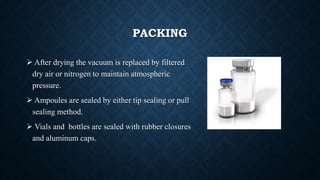
PACKING
 After drying the vacuum is replaced by filtered
dry air or nitrogen to maintain atmospheric
pressure.
 Ampoules are sealed by either tip sealing or pull
sealing method.
 Vials and bottles are sealed with rubber closures
and aluminum caps.
FACTORS AFEECTING
The factors affecting the process of lyophilization are the following:
 Sample size.
 Surface area.
 Thickness.
 Eutectic temperature.
 Solute concentration.
Condenser temperature.
 Vacuum.
APPLICATIONS
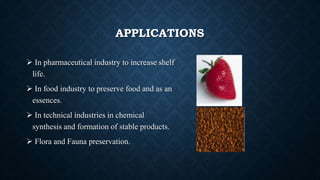
 In pharmaceutical industry to increase shelf
life.
 In food industry to preserve food and as an
essences.
 In technical industries in chemical
synthesis and formation of stable products.
 Flora and Fauna preservation.
ELUTRIATION
ELUTRIATION
Definition:
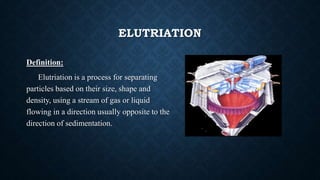
Elutriation is a process for separating
particles based on their size, shape and
density, using a stream of gas or liquid
flowing in a direction usually opposite to the
direction of sedimentation.
EXPLANATION
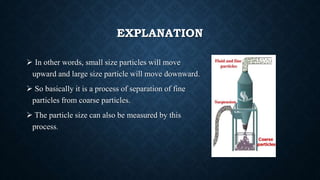
 In other words, small size particles will move
upward and large size particle will move downward.
 So basically it is a process of separation of fine
particles from coarse particles.
 The particle size can also be measured by this
process.
SIGNIFICANCE
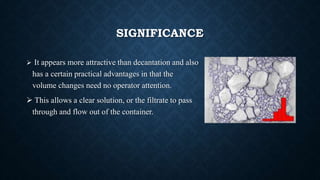
 It appears more attractive than decantation and also
has a certain practical advantages in that the
volume changes need no operator attention.
 This allows a clear solution, or the filtrate to pass
through and flow out of the container.
TYPES OF ELUTRIATIONS
 Gravitational Elutriation:
It is a type of elutriation in which the fluid particles move downwards due to
sedimentation (force of gravity) while the lighter particles remain upward.
 Centrifugal Elutriation:
The one in which the fluid stream to rotate under high centrifugal force to suspend the
particles. These particle which are too large to rotate with direction of fluid, separates out on the
wall of elutriator. However, the fine particles move easily with the direction of fluid.
FACTORS AFFECTING ELUTRIATION
The factors affecting the process of elutriation are as following:
 Velocity of fluid.
 Particle size.
 Position of particle.
 Density of particle.
APPLICATIONS
 Heavy and light Kaolin can be
separated by this process.

Lyophlization & elutriation

  • 1.
    LYOPHLIZATION & ELUTRIATION Presentedto: Ma’am Ayesha Mehmood
  • 2.
  • 3.
    LYOPHLIZATION • Definition: Lyophilization orfreeze drying is a process in which water is removed from a product after it is frozen and placed under a vacuum, allowing the ice to change directly from solid to vapor without passing through a liquid phase
  • 4.
    PRINCIPLE OF LYOPHLIZATION Lyophilizationis based on a simple principle of physics called “SUBLIMATION”. Sublimation is the process of transition of a substance from solid to the vapor state without passing through an intermediate liquid phase.  Lyophilization is performed at temperature and pressure conditions below the triple point, to enable sublimation of ice.  The entire process is performed at low temperature and pressure by applying vacuum, hence it is good for thermolabile compounds.
  • 5.
    SIGNIFICANCE  To preservethe Biological activity of product.  To reduce the product weight so that transport cost can be reduced.  To extend the shelf life or stability.  To dry thermolabile materials.  To eliminate the need for refrigerated storage.  To get accurate, sterile dosing into the final product container.
  • 6.
    STEPS IN LYOPHLIZATION 1• Freezing Stage 2 • Primary Drying Stage 3 • Secondary Drying Stage 4 • Packing
  • 7.
    FREEZING STAGE  Freezingof product solution to a temperature below its eutectic temperature.  Decrease the shelf temperature to -50ᵒc.  Low temperature and low atmospheric pressure is maintained.  Freons are used as refrigerant.  Formation of ice crystals occur.  The rate of ice crystallization define the freezing process and efficiency of primary drying.
  • 8.
    PRIMARY DRYING  Heatis introduced from shelf to the product under graded control by electrical resistance coils or circulating silicon's.  The temperature and pressure should be below triple point of water i.e., 0.0098 ᵒc and 4.58mmHg.  The driving force is vapor pressure difference between the evaporating surface and condenser  Easily removes water up to 98% to 99%.
  • 9.
    SECONDARY DRYING  Thetemperature is raised to 50 - 60ᵒc and vacuum is lowered about 50 mmHg.  Bound water is removed.  Rate of drying is low.  It takes about 10-20 hours.
  • 10.
    PACKING  After dryingthe vacuum is replaced by filtered dry air or nitrogen to maintain atmospheric pressure.  Ampoules are sealed by either tip sealing or pull sealing method.  Vials and bottles are sealed with rubber closures and aluminum caps.
  • 11.
    FACTORS AFEECTING The factorsaffecting the process of lyophilization are the following:  Sample size.  Surface area.  Thickness.  Eutectic temperature.  Solute concentration. Condenser temperature.  Vacuum.
  • 12.
    APPLICATIONS  In pharmaceuticalindustry to increase shelf life.  In food industry to preserve food and as an essences.  In technical industries in chemical synthesis and formation of stable products.  Flora and Fauna preservation.
  • 13.
  • 14.
    ELUTRIATION Definition: Elutriation is aprocess for separating particles based on their size, shape and density, using a stream of gas or liquid flowing in a direction usually opposite to the direction of sedimentation.
  • 15.
    EXPLANATION  In otherwords, small size particles will move upward and large size particle will move downward.  So basically it is a process of separation of fine particles from coarse particles.  The particle size can also be measured by this process.
  • 16.
    SIGNIFICANCE  It appearsmore attractive than decantation and also has a certain practical advantages in that the volume changes need no operator attention.  This allows a clear solution, or the filtrate to pass through and flow out of the container.
  • 17.
    TYPES OF ELUTRIATIONS Gravitational Elutriation: It is a type of elutriation in which the fluid particles move downwards due to sedimentation (force of gravity) while the lighter particles remain upward.  Centrifugal Elutriation: The one in which the fluid stream to rotate under high centrifugal force to suspend the particles. These particle which are too large to rotate with direction of fluid, separates out on the wall of elutriator. However, the fine particles move easily with the direction of fluid.
  • 18.
    FACTORS AFFECTING ELUTRIATION Thefactors affecting the process of elutriation are as following:  Velocity of fluid.  Particle size.  Position of particle.  Density of particle.
  • 19.
    APPLICATIONS  Heavy andlight Kaolin can be separated by this process.