LYOPHILIZATION
TECHNOLOGY
PRESENTED BY
Mr.Madane Vikram Appa
Department-pharmaceutical Quality Assurance
Bharati Vidyapeeth College Of
Pharmacy,kolhapur
Roll No-8
GUIDED BY
Mr.Dhavale R.P
Department-pharmaceutical
Biotechnology
Bharati Vidyapeeth College Of
Pharmacy,kolhapur.
INDEX
 DEFINITION
 HISTORY
 PRINCIPLE
 OBJECTIVES OF LYOPHILIZATION PROCESS
 STEPS INVOLVED IN LYOPHILIZATION
 PROCESSING
• Freezing Stage
• Primary Drying Stage
• Secondary Drying Stage
• Packing
 ADVANTAGES OF LYOPHILIZATION
 DISADVANTAGES OF LYOPHILIZATION
 REFERENCES
2
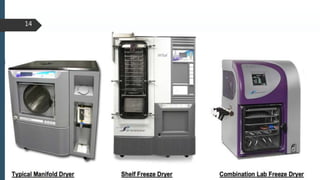
 DIFFERENT EQUIPMENTS
DEFINITION
A stabilizing process in which a substance is first
frozen and then the quantity of the solvent is
reduced, first by sublimation (primary drying
stage) and then desorption (secondary drying
stage) to values that will no longer support
biological activity or chemical reactions.
3
4
HISTORY
 Freeze drying was first actively developed
during WORLD WAR II transport of serum.
 The main aim was to store the products without
refrigeration and to remove moisture from
thermolabile compounds.
 Atlas in 1961 built 6 production freeze drying
cabinet for Nestle group in Germany, Holland.
5
PRINCIPLE
 Lyophilization is carried out using a simple principle of
physics sublimation. Sublimation is the transition of a
substance from the solid to the vapour state, without first
passing through an intermediate liquid phase.
 Lyophilization is performed at temperature and pressure
conditions below the triple point, to enable sublimation of
ice.
 The entire process is performed at low temperature and
pressure by applying vacuum, hence is suited for drying of
thermolabile compounds.
 The concentration gradient of water vapour between the
drying front and condenser is the driving force for removal
of water during lyophilization.
6
OBJECTIVES OF LYOPHILIZATION PROCESS
 To preserve the biological activity of a product.
 To reduce the product weight to lower the
transportation cost.
 To extend the shelf life or stability.
 To dry thermolabile materials.
 To eliminate the need for refrigerated storage.
 To get accurate, sterile dosing into the final
product container.
7
STEPS INVOLVED IN LYOPHILIZATION
1) Freezing Stage
2) Primary Drying Stage
3) Secondary Drying Stage
4) Packing
8
PROCESSING
Fundamental process steps are:
1.Freezing: the product is frozen. This provides a necessary
condition for low temperature.
2.Vacuum: after freezing, the product is placed under vacuum.
This enables the frozen solvent in the product to vaporize without
passing through liquid phase, a process known as SUBLIMATION.
3.Heat: Heat is applied to the frozen product to accelerate
sublimation.
4.Condensation: Low-temperature condenser plates remove
the vaporized solvent from the vacuum chamber by converting it
back to a solid. This completes the process.
9
FREEZE DRYING
Freezing the product solution to a temperature
below its eutectic temperature.
Decrease the shelf temperature to -50˚c.
Low temperature and low atmospheric pressure
are maintained.
Freons are used as refrigerant.
Formation of ice crystals occurs.
The rate of ice crystallization define the
freezing process and efficiency of primary
drying.
10
PRIMARY DRYING (SUBLIMATION)
Heat is introduced from shelf to the product under
graded control by electrical resistance coils or
circulating silicone.
The temperature and pressure should be below
the triple point of water i.e. 0.0098°C and
4.58mmHg.
The driving force is vapor pressure difference
between the evaporating surface and the
condenser.
Easily removes moisture up to 98% to 99%.
11
SECONDARY DRYING (DESORPTION)
The temperature is raised to 50°C – 60°C and
vacuum is lowered about 50mmHg.
Bound water is removed.
Rate of drying is low.
It takes about 10-20 hrs.
12
PACKING
 After drying the vacuum is replaced by
filtered dry air or nitrogen to establish
atmospheric pressure.
 Ampoules are sealed by either tip sealing
or pull sealing method.
 Vials and bottles are sealed with rubber
closures and aluminum caps.
13
14
15
Advantages of Lyophilization
 Removal of water at low temperature.
 Thermolabile materials can be dried.
 Compatible with aseptic operations.
 More precise fill weight control.
 Sterility can be maintained.
 Reconstitution is easy.
16
DISADVANTAGES OF LYOPHILIZATION
 Many biological molecules are damaged by the stress associated with
freezing, freeze-drying, or both.
 The product is prone to oxidation, due to high porosity and large
surface area. Therefore the product should be packed in vacuum or
using inert gas or in a container impervious to gases.
 Cost may be an issue, depending on the product.
 Long time process.
17
REFERENCES
 The Theory And Practice of Industrial Pharmacy by Leon Lachmann,
Herbert.A.Lieberman and Joseph I. Kanig, 1991. Pg 62-64, 672-674.
 Pharmaceutial Engineering – Priniciples and Practices by C.V.S.
Subramanyam, J. Thimma Setty, Sarasija Suresh and V. Kusum Devi. Pg
401-405.
 Aulton’s Pharmaceutics – The Design And Manufacture Of Medicines by
Micheal E. Aulton, 2009. Pg 195.
 The Lyophilization of Pharmaceuticals: A Literature Review by N.A.
Williams* and G.P. Polli. Journal of Pharmaceutical science and
Technology.
18
19

Lyophilization technology

  • 1.
    LYOPHILIZATION TECHNOLOGY PRESENTED BY Mr.Madane VikramAppa Department-pharmaceutical Quality Assurance Bharati Vidyapeeth College Of Pharmacy,kolhapur Roll No-8 GUIDED BY Mr.Dhavale R.P Department-pharmaceutical Biotechnology Bharati Vidyapeeth College Of Pharmacy,kolhapur.
  • 2.
    INDEX  DEFINITION  HISTORY PRINCIPLE  OBJECTIVES OF LYOPHILIZATION PROCESS  STEPS INVOLVED IN LYOPHILIZATION  PROCESSING • Freezing Stage • Primary Drying Stage • Secondary Drying Stage • Packing  ADVANTAGES OF LYOPHILIZATION  DISADVANTAGES OF LYOPHILIZATION  REFERENCES 2  DIFFERENT EQUIPMENTS
  • 3.
    DEFINITION A stabilizing processin which a substance is first frozen and then the quantity of the solvent is reduced, first by sublimation (primary drying stage) and then desorption (secondary drying stage) to values that will no longer support biological activity or chemical reactions. 3
  • 4.
  • 5.
    HISTORY  Freeze dryingwas first actively developed during WORLD WAR II transport of serum.  The main aim was to store the products without refrigeration and to remove moisture from thermolabile compounds.  Atlas in 1961 built 6 production freeze drying cabinet for Nestle group in Germany, Holland. 5
  • 6.
    PRINCIPLE  Lyophilization iscarried out using a simple principle of physics sublimation. Sublimation is the transition of a substance from the solid to the vapour state, without first passing through an intermediate liquid phase.  Lyophilization is performed at temperature and pressure conditions below the triple point, to enable sublimation of ice.  The entire process is performed at low temperature and pressure by applying vacuum, hence is suited for drying of thermolabile compounds.  The concentration gradient of water vapour between the drying front and condenser is the driving force for removal of water during lyophilization. 6
  • 7.
    OBJECTIVES OF LYOPHILIZATIONPROCESS  To preserve the biological activity of a product.  To reduce the product weight to lower the transportation cost.  To extend the shelf life or stability.  To dry thermolabile materials.  To eliminate the need for refrigerated storage.  To get accurate, sterile dosing into the final product container. 7
  • 8.
    STEPS INVOLVED INLYOPHILIZATION 1) Freezing Stage 2) Primary Drying Stage 3) Secondary Drying Stage 4) Packing 8
  • 9.
    PROCESSING Fundamental process stepsare: 1.Freezing: the product is frozen. This provides a necessary condition for low temperature. 2.Vacuum: after freezing, the product is placed under vacuum. This enables the frozen solvent in the product to vaporize without passing through liquid phase, a process known as SUBLIMATION. 3.Heat: Heat is applied to the frozen product to accelerate sublimation. 4.Condensation: Low-temperature condenser plates remove the vaporized solvent from the vacuum chamber by converting it back to a solid. This completes the process. 9
  • 10.
    FREEZE DRYING Freezing theproduct solution to a temperature below its eutectic temperature. Decrease the shelf temperature to -50˚c. Low temperature and low atmospheric pressure are maintained. Freons are used as refrigerant. Formation of ice crystals occurs. The rate of ice crystallization define the freezing process and efficiency of primary drying. 10
  • 11.
    PRIMARY DRYING (SUBLIMATION) Heatis introduced from shelf to the product under graded control by electrical resistance coils or circulating silicone. The temperature and pressure should be below the triple point of water i.e. 0.0098°C and 4.58mmHg. The driving force is vapor pressure difference between the evaporating surface and the condenser. Easily removes moisture up to 98% to 99%. 11
  • 12.
    SECONDARY DRYING (DESORPTION) Thetemperature is raised to 50°C – 60°C and vacuum is lowered about 50mmHg. Bound water is removed. Rate of drying is low. It takes about 10-20 hrs. 12
  • 13.
    PACKING  After dryingthe vacuum is replaced by filtered dry air or nitrogen to establish atmospheric pressure.  Ampoules are sealed by either tip sealing or pull sealing method.  Vials and bottles are sealed with rubber closures and aluminum caps. 13
  • 14.
  • 15.
  • 16.
    Advantages of Lyophilization Removal of water at low temperature.  Thermolabile materials can be dried.  Compatible with aseptic operations.  More precise fill weight control.  Sterility can be maintained.  Reconstitution is easy. 16
  • 17.
    DISADVANTAGES OF LYOPHILIZATION Many biological molecules are damaged by the stress associated with freezing, freeze-drying, or both.  The product is prone to oxidation, due to high porosity and large surface area. Therefore the product should be packed in vacuum or using inert gas or in a container impervious to gases.  Cost may be an issue, depending on the product.  Long time process. 17
  • 18.
    REFERENCES  The TheoryAnd Practice of Industrial Pharmacy by Leon Lachmann, Herbert.A.Lieberman and Joseph I. Kanig, 1991. Pg 62-64, 672-674.  Pharmaceutial Engineering – Priniciples and Practices by C.V.S. Subramanyam, J. Thimma Setty, Sarasija Suresh and V. Kusum Devi. Pg 401-405.  Aulton’s Pharmaceutics – The Design And Manufacture Of Medicines by Micheal E. Aulton, 2009. Pg 195.  The Lyophilization of Pharmaceuticals: A Literature Review by N.A. Williams* and G.P. Polli. Journal of Pharmaceutical science and Technology. 18
  • 19.