School of Medicine
Medical Laboratory Science
MML206:Biochemical
Techniques
Lyophilization/ Freeze Drying
Definition
• A stabilizing process in which a substance is first frozen and then the
quantity of the solvent is reduced, first by sublimation (primary drying
stage) and then desorption (secondary drying stage) to values that
will no longer support biological activity or chemical reactions.
• Lyophilization and freeze-drying are terms that are used
interchangeably depending on the industry and location where the
drying is taking place. Controlled freeze-drying keeps the product
temperature low enough during the process to avoid changes in the
dried product appearance and characteristics. It is an excellent
method for preserving a wide variety of heat-sensitive materials such
as proteins, microbes, pharmaceuticals, tissues & plasma.
Principle
• Lyophilization is carried out using a simple principle of sublimation.
Lyophilization, also known as freeze-drying, operates on the principle
of removing water from a substance by freezing it and then subjecting
it to a vacuum. This process involves three main steps: freezing,
primary drying, and secondary drying. By freezing the material, water
is solidified, and under vacuum, it sublimates directly from solid to
vapor, bypassing the liquid phase. This gentle dehydration preserves
the structure and properties of the substance, making it suitable for
pharmaceuticals, food preservation, and biological sample
conservation. Lyophilization maintains the integrity of sensitive
molecules, extends shelf life, and facilitates easy reconstitution when
needed, ensuring product stability.
• Lyophilization is performed at a temperature and pressure conditions
below the triple point, to enable sublimation of ice. The entire
process is performed at low temperatures, and pressure by applying a
vacuum, hence is suited for drying thermolabile compounds. The
concentration gradient of water vapor between the drying front, and
condenser is the driving force for the removal of water during
lyophilization.
Objectives of the Lyophilization Process
• To preserve the biological activity of a product.
• To reduce the product weight to lower the transportation.
• To extend the life or stability.
• To dry thermolabile materials.
• To eliminate the need for refrigerated storage.
• To get accurate, sterile dosing into the final product container.
Basic Components of a Lyophilizer
• A lyophilizer is a complex piece of equipment with several key
components. Each of these components plays a crucial role in the
freeze-drying process.
• Here are the basic components of a lyophilizer and their functions:
Condenser
• The condenser is responsible for removing heat from the system. This
allows for the sublimation and condensation of the solvent, which are key
steps in the freeze-drying process.
Vacuum Pump
• The vacuum system consists of a separate vacuum pump connected to an
airtight condenser and an attached product chamber. Vacuum pumps can
be oil-lubricated (rotary-vane) style, or they can be “dry” scroll in design.
Rotary-vane vacuum pumps require the use of an oil mist eliminator (OME)
to capture oil particles in the exhaust stream, or the exhaust can be vented
to outside. They require frequent oil changes based on usage conditions.
Drying Chamber/Manifold
• The drying chamber is where the samples to be freeze-dried are placed.
The manifold holds the containers with the samples and is the location
where the sublimation process occurs.
Refrigeration System
• The refrigeration system cools the (ice) condenser located inside the freeze
dryer, with refrigerant routed through a coil in the condenser. This is known
as “direct expansion” (DX) refrigerant cooling. DX refrigeration is
uncontrolled by design, and when running continuously, the system will
eventually reach its coldest “bottom out” temperature in the condenser.
Control System
• The control system manages the operation of the lyophilizer. This includes
controlling the vacuum, the temperature of the shelf, and the temperature
of the condenser.
Shelves/Trays
• These are used to hold the product containers. The shelves or trays can be
cooled or heated to control the rate of sublimation, which can impact the
quality of the final product.
Vacuum Gauge
• The vacuum gauge measures the pressure within the system. This is
important for monitoring the freeze-drying process and ensuring that
it is proceeding correctly.
Product Container
• These containers hold the samples that are to be freeze-dried. They
are placed on the shelves or trays in the drying chamber. Product
chambers are designed to withstand pressure differentials for full
vacuum conditions. They can be either square/rectangular or
round/cylindrical in design. Product shelves can be either fixed in
place or moveable. Moveable shelves can have a hydraulic or
pneumatic ram added for the ability to stop vials at the end of the
process.
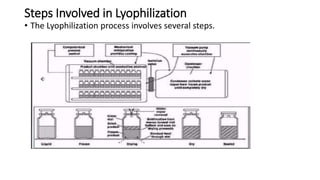
Steps Involved in Lyophilization
• The Lyophilization process involves several steps.
• 1. Pretreatment / Formulation
• The product to be freeze-dried is prepared. This may involve the
addition of certain excipients to the formulation to affect the thermal
characteristics of the product and its ability to be freeze-dried in a
reasonable amount of time. This step is crucial to ensure the
product's stability and quality during the freeze-drying process.
• 2. Loading / Container
• The product is loaded into a suitable container. This could be a bulk
container, flask, or vials. The container is chosen based on the
product characteristics and the application requirements. This step is
important to ensure the product is properly contained and protected
during the freeze-drying process.
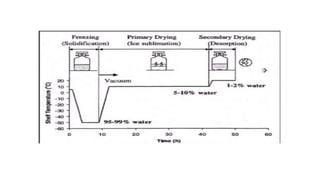
3. Freezing (Thermal Treatment) at Atmospheric Pressure
• The product is completely frozen, usually in a vial, flask, or tray. This is done
at atmospheric pressure. The freezing process is crucial as it affects the
subsequent drying process. It ensures the product's structure is preserved
and prepares it for the sublimation process.
Process involved
• Freezing the product solution to a temperature below its eutectic
temperature
• Decrease the shelf temperature to -50oc
• Low temperature and low atmospheric pressure are maintained
• Freaons are used as refrigerant
• The formation of ice crystals occurs
• The rate of ice crystallization define the freezing process and efficiency of
primary drying.
4. Primary Drying (Sublimation) Under Vacuum
• The product is then placed under a deep vacuum, well below the triple
point of water. Heat energy is then added to the product causing the ice to
sublime. This is the primary drying phase where the bulk of water is
removed from the product. This step is important as it removes the
majority of the water content from the product without causing it to melt.
Process Involved
• Heat is introduced from the shelf to the product under graded control by
electrical resistance coils or circulating silicone.
• The temperature and pressure should be below the triple point of water
i.e., 0.0098oc and 4.58mmHg
• The driving force is the vapor pressure difference between the evaporating
surface and the condenser.
• Easily removes moisture up to 98% to 99%
• Sublimation
• Sublimation is when a solid (ice) changes directly to a vapor without
first going through a liquid (water) phase. Thoroughly understanding
the concept of sublimation is a key building block to gaining
knowledge of freeze-drying. Sublimation is a phase change and heat
energy must be added to the frozen product for it to occur.
• Sublimation in the freeze drying process can be described simply as:
• FREEZE - The product is completely frozen, usually in a vial, flask or
tray
• VACUUM - The product is then placed under a deep vacuum, well
below the triple point of water
• DRY – Heat energy is then added to the product causing the
• 5. Secondary Drying (Desorption) Under Vacuum
• After primary drying, the product still contains some amount of water
molecules that are bound to the product. These are removed in the
secondary drying phase. The product temperature can be increased
considerably during this phase without fear of melting or collapse.
This step is crucial to ensure all residual moisture is removed,
enhancing the product's stability and shelf life.
Processes Involved
• The temperature is raised to 50oc-60oc and the vacuum is lowered
about 50mmHg.
• Bound water is removed.
• The rate of drying is low .
• It takes about 10-20 hrs.
• 6. Backfill & Stoppering (For Product in Vials) Under Partial Vacuum
• After drying, the product is extremely hydroscopic and must be
sealed in airtight containers to prevent rehydration from atmospheric
exposure. This is typically done under partial vacuum and often
involves backfilling with an inert gas such as dry nitrogen. This step is
important to protect the product from moisture and maintain its
quality during storage.
• 7. Removal of Dried Product from Freeze Dryer
• Finally, the dried product is removed from the freeze dryer. The
product is now ready for storage or further processing. This step
marks the completion of the freeze-drying process and prepares the
product for its intended use.
Advantages of Lyophilization
• 1. Preservation of Material Characteristics: Lyophilization preserves the
physical structure and biochemical characteristics of the products, making
it ideal for preserving sensitive materials.
• 2. Long-term Storage: Lyophilized products can be stored for a long time
without refrigeration. This is particularly beneficial for pharmaceuticals and
biological samples that need to be stored and transported.
• 3. Reconstitution: The process allows for easy reconstitution of the
product. Once water is added, the product regains its original properties.
• 4. Sterility: The process can be carried out in a sterile environment, which is
crucial for pharmaceutical and medical applications.
• 5. Reduction in Weight and Volume: Lyophilization reduces the weight and
volume of the product, making it easier and more cost-effective to
transport.
Disadvantages of Lyophilization
• 1. Cost: The main disadvantage of lyophilization is the high cost. The
equipment is expensive and the process is energy-intensive.
• 2. Time-Consuming: The process is slow and can take anywhere from
a few hours to several days to complete.
• 3. Complex Process: Lyophilization is a complex process that requires
careful control of temperature and pressure conditions. It requires
skilled operators and careful process design and control.
• 4. Product Specificity: Not all products are suitable for lyophilization.
Some products may not retain their activity after freeze-drying.
• 5. Risk of Oxidation: There is a risk of oxidation if the product comes
into contact with oxygen during the process. This can lead to
degradation of the product.
Applications
• Lyophilization is a process with wide-ranging applications in various
fields due to its ability to preserve the quality and characteristics of
sensitive materials. Here are some of its applications:
• 1. Pharmaceuticals: Lyophilization is used to stabilize and preserve
pharmaceuticals, especially those sensitive to heat. It allows for long-
term storage of these products without the need for refrigeration.
• 2. Biotechnology: In the biotech industry, lyophilization is used to
preserve biological samples such as proteins, microbes, tissues, and
plasma. It helps maintain the integrity and viability of these samples.
• 3. Food Industry: Freeze drying is used in the food industry to
preserve and extend the shelf life of food products. It helps maintain
the nutritional value, flavor, and texture of the food.
• 4. Nanotechnology: Lyophilization is used in the preparation of
nanoparticles for drug delivery systems. It helps in the preservation and
storage of these nanoparticles.
• 5. Diagnostics: In the field of diagnostics, lyophilization is used to stabilize
diagnostic reagents. It helps in the long-term storage of these reagents
without the need for refrigeration.
• 6. Archaeology and Paleontology: Lyophilization is used in the preservation
of historical and prehistoric specimens such as artifacts and fossils.
• 7. Document Recovery: Freeze-drying is used in the recovery and
restoration of water-damaged documents and books.
• 8. Floral Preservation: Lyophilization is used in the preservation of flowers
for decorative purposes. It helps maintain the color and shape of the
flowers.
References
• The science and Practice of Pharmacy by Remington, 21 edition, vol-
1. pg 828-831
• The Theory And Practice of Industrial Pharmacology by Leon
Lachmann, Herbert.A.Lieberman and Joseph i9. Kanig, 1991. pg 62-
64, 672-674
• Pharmaceutical Engineering-Principles and Practices by C.V.S.
Subramanyam, J. Thimma Setty, Sarasija Suresh and V. Kusum Devi. Pg
401-405.
• Aulton’s Pharmaceutics- The Design And Manufacture Of Medicines
by Micheal E. Aulton, 2009. pg 195.
• The lyophilization of Pharmaceuticals: A literature Review by N.A
Williams* and G.P Polli. Journal of Pharmaceutical science and
Technology.

Lyophilization , Biochemical tchnique/ Freeze drying

  • 1.
    School of Medicine MedicalLaboratory Science MML206:Biochemical Techniques
  • 2.
    Lyophilization/ Freeze Drying Definition •A stabilizing process in which a substance is first frozen and then the quantity of the solvent is reduced, first by sublimation (primary drying stage) and then desorption (secondary drying stage) to values that will no longer support biological activity or chemical reactions. • Lyophilization and freeze-drying are terms that are used interchangeably depending on the industry and location where the drying is taking place. Controlled freeze-drying keeps the product temperature low enough during the process to avoid changes in the dried product appearance and characteristics. It is an excellent method for preserving a wide variety of heat-sensitive materials such as proteins, microbes, pharmaceuticals, tissues & plasma.
  • 3.
    Principle • Lyophilization iscarried out using a simple principle of sublimation. Lyophilization, also known as freeze-drying, operates on the principle of removing water from a substance by freezing it and then subjecting it to a vacuum. This process involves three main steps: freezing, primary drying, and secondary drying. By freezing the material, water is solidified, and under vacuum, it sublimates directly from solid to vapor, bypassing the liquid phase. This gentle dehydration preserves the structure and properties of the substance, making it suitable for pharmaceuticals, food preservation, and biological sample conservation. Lyophilization maintains the integrity of sensitive molecules, extends shelf life, and facilitates easy reconstitution when needed, ensuring product stability.
  • 4.
    • Lyophilization isperformed at a temperature and pressure conditions below the triple point, to enable sublimation of ice. The entire process is performed at low temperatures, and pressure by applying a vacuum, hence is suited for drying thermolabile compounds. The concentration gradient of water vapor between the drying front, and condenser is the driving force for the removal of water during lyophilization.
  • 5.
    Objectives of theLyophilization Process • To preserve the biological activity of a product. • To reduce the product weight to lower the transportation. • To extend the life or stability. • To dry thermolabile materials. • To eliminate the need for refrigerated storage. • To get accurate, sterile dosing into the final product container.
  • 6.
    Basic Components ofa Lyophilizer • A lyophilizer is a complex piece of equipment with several key components. Each of these components plays a crucial role in the freeze-drying process. • Here are the basic components of a lyophilizer and their functions:
  • 7.
    Condenser • The condenseris responsible for removing heat from the system. This allows for the sublimation and condensation of the solvent, which are key steps in the freeze-drying process. Vacuum Pump • The vacuum system consists of a separate vacuum pump connected to an airtight condenser and an attached product chamber. Vacuum pumps can be oil-lubricated (rotary-vane) style, or they can be “dry” scroll in design. Rotary-vane vacuum pumps require the use of an oil mist eliminator (OME) to capture oil particles in the exhaust stream, or the exhaust can be vented to outside. They require frequent oil changes based on usage conditions. Drying Chamber/Manifold • The drying chamber is where the samples to be freeze-dried are placed. The manifold holds the containers with the samples and is the location where the sublimation process occurs.
  • 8.
    Refrigeration System • Therefrigeration system cools the (ice) condenser located inside the freeze dryer, with refrigerant routed through a coil in the condenser. This is known as “direct expansion” (DX) refrigerant cooling. DX refrigeration is uncontrolled by design, and when running continuously, the system will eventually reach its coldest “bottom out” temperature in the condenser. Control System • The control system manages the operation of the lyophilizer. This includes controlling the vacuum, the temperature of the shelf, and the temperature of the condenser. Shelves/Trays • These are used to hold the product containers. The shelves or trays can be cooled or heated to control the rate of sublimation, which can impact the quality of the final product.
  • 9.
    Vacuum Gauge • Thevacuum gauge measures the pressure within the system. This is important for monitoring the freeze-drying process and ensuring that it is proceeding correctly. Product Container • These containers hold the samples that are to be freeze-dried. They are placed on the shelves or trays in the drying chamber. Product chambers are designed to withstand pressure differentials for full vacuum conditions. They can be either square/rectangular or round/cylindrical in design. Product shelves can be either fixed in place or moveable. Moveable shelves can have a hydraulic or pneumatic ram added for the ability to stop vials at the end of the process.
  • 10.
    Steps Involved inLyophilization • The Lyophilization process involves several steps.
  • 11.
    • 1. Pretreatment/ Formulation • The product to be freeze-dried is prepared. This may involve the addition of certain excipients to the formulation to affect the thermal characteristics of the product and its ability to be freeze-dried in a reasonable amount of time. This step is crucial to ensure the product's stability and quality during the freeze-drying process. • 2. Loading / Container • The product is loaded into a suitable container. This could be a bulk container, flask, or vials. The container is chosen based on the product characteristics and the application requirements. This step is important to ensure the product is properly contained and protected during the freeze-drying process.
  • 12.
    3. Freezing (ThermalTreatment) at Atmospheric Pressure • The product is completely frozen, usually in a vial, flask, or tray. This is done at atmospheric pressure. The freezing process is crucial as it affects the subsequent drying process. It ensures the product's structure is preserved and prepares it for the sublimation process. Process involved • Freezing the product solution to a temperature below its eutectic temperature • Decrease the shelf temperature to -50oc • Low temperature and low atmospheric pressure are maintained • Freaons are used as refrigerant • The formation of ice crystals occurs • The rate of ice crystallization define the freezing process and efficiency of primary drying.
  • 14.
    4. Primary Drying(Sublimation) Under Vacuum • The product is then placed under a deep vacuum, well below the triple point of water. Heat energy is then added to the product causing the ice to sublime. This is the primary drying phase where the bulk of water is removed from the product. This step is important as it removes the majority of the water content from the product without causing it to melt. Process Involved • Heat is introduced from the shelf to the product under graded control by electrical resistance coils or circulating silicone. • The temperature and pressure should be below the triple point of water i.e., 0.0098oc and 4.58mmHg • The driving force is the vapor pressure difference between the evaporating surface and the condenser. • Easily removes moisture up to 98% to 99%
  • 15.
    • Sublimation • Sublimationis when a solid (ice) changes directly to a vapor without first going through a liquid (water) phase. Thoroughly understanding the concept of sublimation is a key building block to gaining knowledge of freeze-drying. Sublimation is a phase change and heat energy must be added to the frozen product for it to occur. • Sublimation in the freeze drying process can be described simply as: • FREEZE - The product is completely frozen, usually in a vial, flask or tray • VACUUM - The product is then placed under a deep vacuum, well below the triple point of water • DRY – Heat energy is then added to the product causing the
  • 16.
    • 5. SecondaryDrying (Desorption) Under Vacuum • After primary drying, the product still contains some amount of water molecules that are bound to the product. These are removed in the secondary drying phase. The product temperature can be increased considerably during this phase without fear of melting or collapse. This step is crucial to ensure all residual moisture is removed, enhancing the product's stability and shelf life. Processes Involved • The temperature is raised to 50oc-60oc and the vacuum is lowered about 50mmHg. • Bound water is removed. • The rate of drying is low . • It takes about 10-20 hrs.
  • 17.
    • 6. Backfill& Stoppering (For Product in Vials) Under Partial Vacuum • After drying, the product is extremely hydroscopic and must be sealed in airtight containers to prevent rehydration from atmospheric exposure. This is typically done under partial vacuum and often involves backfilling with an inert gas such as dry nitrogen. This step is important to protect the product from moisture and maintain its quality during storage. • 7. Removal of Dried Product from Freeze Dryer • Finally, the dried product is removed from the freeze dryer. The product is now ready for storage or further processing. This step marks the completion of the freeze-drying process and prepares the product for its intended use.
  • 18.
    Advantages of Lyophilization •1. Preservation of Material Characteristics: Lyophilization preserves the physical structure and biochemical characteristics of the products, making it ideal for preserving sensitive materials. • 2. Long-term Storage: Lyophilized products can be stored for a long time without refrigeration. This is particularly beneficial for pharmaceuticals and biological samples that need to be stored and transported. • 3. Reconstitution: The process allows for easy reconstitution of the product. Once water is added, the product regains its original properties. • 4. Sterility: The process can be carried out in a sterile environment, which is crucial for pharmaceutical and medical applications. • 5. Reduction in Weight and Volume: Lyophilization reduces the weight and volume of the product, making it easier and more cost-effective to transport.
  • 19.
    Disadvantages of Lyophilization •1. Cost: The main disadvantage of lyophilization is the high cost. The equipment is expensive and the process is energy-intensive. • 2. Time-Consuming: The process is slow and can take anywhere from a few hours to several days to complete. • 3. Complex Process: Lyophilization is a complex process that requires careful control of temperature and pressure conditions. It requires skilled operators and careful process design and control. • 4. Product Specificity: Not all products are suitable for lyophilization. Some products may not retain their activity after freeze-drying. • 5. Risk of Oxidation: There is a risk of oxidation if the product comes into contact with oxygen during the process. This can lead to degradation of the product.
  • 20.
    Applications • Lyophilization isa process with wide-ranging applications in various fields due to its ability to preserve the quality and characteristics of sensitive materials. Here are some of its applications: • 1. Pharmaceuticals: Lyophilization is used to stabilize and preserve pharmaceuticals, especially those sensitive to heat. It allows for long- term storage of these products without the need for refrigeration. • 2. Biotechnology: In the biotech industry, lyophilization is used to preserve biological samples such as proteins, microbes, tissues, and plasma. It helps maintain the integrity and viability of these samples. • 3. Food Industry: Freeze drying is used in the food industry to preserve and extend the shelf life of food products. It helps maintain the nutritional value, flavor, and texture of the food.
  • 21.
    • 4. Nanotechnology:Lyophilization is used in the preparation of nanoparticles for drug delivery systems. It helps in the preservation and storage of these nanoparticles. • 5. Diagnostics: In the field of diagnostics, lyophilization is used to stabilize diagnostic reagents. It helps in the long-term storage of these reagents without the need for refrigeration. • 6. Archaeology and Paleontology: Lyophilization is used in the preservation of historical and prehistoric specimens such as artifacts and fossils. • 7. Document Recovery: Freeze-drying is used in the recovery and restoration of water-damaged documents and books. • 8. Floral Preservation: Lyophilization is used in the preservation of flowers for decorative purposes. It helps maintain the color and shape of the flowers.
  • 22.
    References • The scienceand Practice of Pharmacy by Remington, 21 edition, vol- 1. pg 828-831 • The Theory And Practice of Industrial Pharmacology by Leon Lachmann, Herbert.A.Lieberman and Joseph i9. Kanig, 1991. pg 62- 64, 672-674 • Pharmaceutical Engineering-Principles and Practices by C.V.S. Subramanyam, J. Thimma Setty, Sarasija Suresh and V. Kusum Devi. Pg 401-405. • Aulton’s Pharmaceutics- The Design And Manufacture Of Medicines by Micheal E. Aulton, 2009. pg 195.
  • 23.
    • The lyophilizationof Pharmaceuticals: A literature Review by N.A Williams* and G.P Polli. Journal of Pharmaceutical science and Technology.