
Group number: 02
Course: Physical Pharmacy
Course Code: 311
EMULSIONS
Presented by
(Dr) Kahnu Charan Panigrahi
Asst. Professor, Research Scholar,
Roland Institute of Pharmaceutical Sciences,
(Affiliated to BPUT)
Web of Science Researcher ID: AAK-3095-2020
12/14/2021 KC PANIGRAHI 1
INTRODUCTION
• An emulsion is a mixture of two or more liquids that
are normally immiscible
• Emulsion should be considered when both the
dispersed and the continuous phase are liquids.
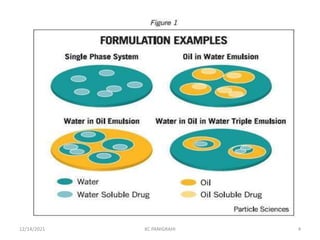
1-Oil in water emulsions
2- Water in oil emulsions
3 Multiple emulsions (O/W/O) or (W/O/W)
4 Microemulsions.
TYPES OF EMULSIONS:
12/14/2021 KC PANIGRAHI 2
MULTIPLE EMULSIONS:
• Multiple emulsions are the emulsion system in which
the dispersed phase contain smaller droplets that have
the same composition as the external phase.
• The multiple emulsions are also considered to be of two
types:
Oil-in-Water-in-Oil (O/W/O) emulsion system
Water-in-Oil-In-Water (W/O/W) emulsion system
12/14/2021 KC PANIGRAHI 3
12/14/2021 KC PANIGRAHI 4
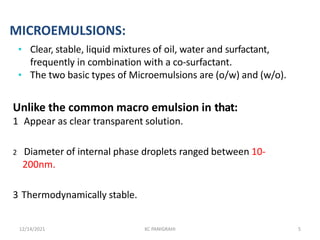
MICROEMULSIONS:
• Clear, stable, liquid mixtures of oil, water and surfactant,
frequently in combination with a co-surfactant.
• The two basic types of Microemulsions are (o/w) and (w/o).
Unlike the common macro emulsion in that:
1 Appear as clear transparent solution.
2 Diameter of internal phase droplets ranged between 10-
200nm.
3 Thermodynamically stable.
12/14/2021 KC PANIGRAHI 5
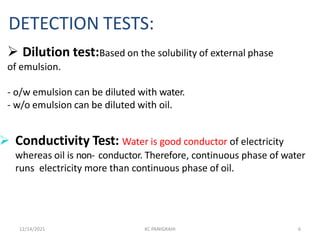
DETECTION TESTS:
 Dilution test:Based on the solubility of external phase
of emulsion.
- o/w emulsion can be diluted with water.
- w/o emulsion can be diluted with oil.
12/14/2021 KC PANIGRAHI 6
 Conductivity Test: Water is good conductor of electricity
whereas oil is non- conductor. Therefore, continuous phase of water
runs electricity more than continuous phase of oil.
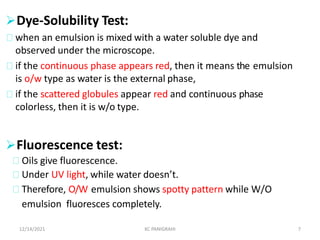
Dye-Solubility Test:
when an emulsion is mixed with a water soluble dye and
observed under the microscope.
if the continuous phase appears red, then it means the emulsion
is o/w type as water is the external phase,
if the scattered globules appear red and continuous phase
colorless, then it is w/o type.
12/14/2021 KC PANIGRAHI 7
Fluorescence test:
Oils give fluorescence.
Under UV light, while water doesn’t.
Therefore, O/W emulsion shows spotty pattern while W/O
emulsion fluoresces completely.
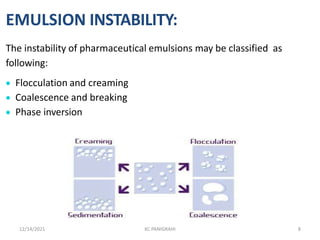
EMULSION INSTABILITY:
The instability of pharmaceutical emulsions may be classified as
following:
 Flocculation and creaming
 Coalescence and breaking
 Phase inversion
12/14/2021 KC PANIGRAHI 8
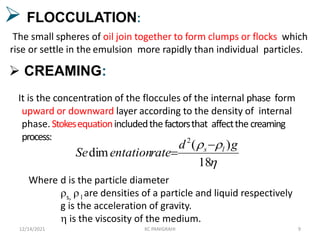
 FLOCCULATION:
The small spheres of oil join together to form clumps or flocks which
rise or settle in the emulsion more rapidly than individual particles.
12/14/2021 KC PANIGRAHI 9
 CREAMING:
It is the concentration of the floccules of the internal phase form
upward or downward layer according to the density of internal
phase. Stokesequationincludedthe factorsthat affectthe creaming
process:



18
)
(
dim
2
g
d
rate
entation
Se l
s 

Where d is the particle diameter
s, l are densities of a particle and liquid respectively
g is the acceleration of gravity.
 is the viscosity of the medium.
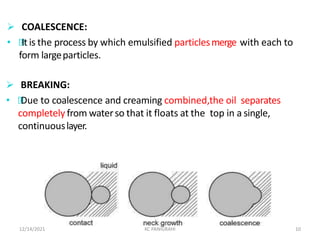
 COALESCENCE:
• Itis the process by which emulsified particlesmerge with each to
form largeparticles.
12/14/2021 KC PANIGRAHI 10
 BREAKING:
• Due to coalescence and creaming combined,the oil separates
completely from waterso that it floats at the top in a single,
continuouslayer.
12/14/2021 KC PANIGRAHI 11
Cracking of emulsion can be due to:
1-addition of an incompatible emulsifying agent:
e.g. monovalent soap + divalent soap
2-chemical or microbial decomposition of emulsifying agent:
e.g. alkali soap decompose by acid.
3-exposure to increased or reduced temperature
4-addition of common solvent.
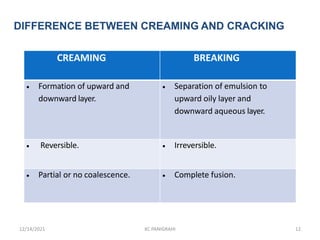
DIFFERENCE BETWEEN CREAMING AND CRACKING
CREAMING BREAKING
 Formation of upward and
downward layer.
 Separation of emulsion to
upward oily layer and
downward aqueous layer.
 Reversible.  Irreversible.
 Partial or no coalescence.  Complete fusion.
12/14/2021 KC PANIGRAHI 12
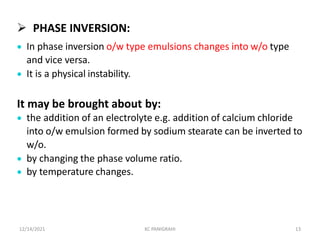
 PHASE INVERSION:
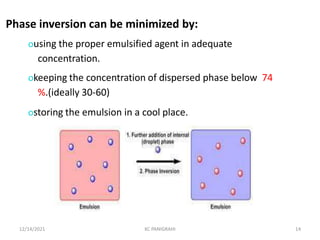
 In phase inversion o/w type emulsions changes into w/o type
and vice versa.
 It is a physical instability.
It may be brought about by:
 the addition of an electrolyte e.g. addition of calcium chloride
into o/w emulsion formed by sodium stearate can be inverted to
w/o.
 by changing the phase volume ratio.
 by temperature changes.
12/14/2021 KC PANIGRAHI 13
Phase inversion can be minimized by:
ousing the proper emulsified agent in adequate
concentration.
okeeping the concentration of dispersed phase below 74
%.(ideally 30-60)
ostoring the emulsion in a cool place.
12/14/2021 KC PANIGRAHI 14
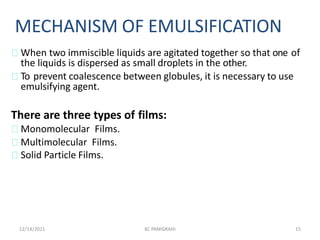
When two immiscible liquids are agitated together so that one of
the liquids is dispersed as small droplets in the other.
To prevent coalescence between globules, it is necessary to use
emulsifying agent.
There are three types of films:
Monomolecular Films.
Multimolecular Films.
Solid Particle Films.
MECHANISM OF EMULSIFICATION
12/14/2021 KC PANIGRAHI 15
1. Monomolecular Film:
Coherent monomolecular film.
Flexible film formed.
Can prepare O/W or W/O emulsion.
Lower surface tension and increase stability of emulsions.
Examples:
Potassium Laurate
Polyoxyethylene sorbitan monooleate
12/14/2021 KC PANIGRAHI 16
2. Multi-molecular Film:
o Strong rigid film formed.
o mostly by the hydrocolloid.
o Produce o/w emulsion.
o Have low effect on surface tension
o Formed by viscosity enhancement
Examples:
o Acacia
o Gelatin
12/14/2021 KC PANIGRAHI 17
3. Solid Particle Film:
o Film formed by solid particles that are small in size compared to
the droplet of the dispersed phase.
o Can form o/w and w/o emulsions.
o Particles must be wetted by both phases in order to remain
at the interface and form stable film.
Examples:
o Bentonite
o Graphite
o Magnesium Hydroxide
12/14/2021 KC PANIGRAHI 18
METHODS OF PREPARATION:
 Continental or Dry Gum Method:
• Emulsifier is triturated with the oil in perfectly dry porcelain mortar
and water is added
• Triturate immediately, rapidly and continuously (until get a clicking
sound and thick white cream is formed, this is primary emulsion.
• oil:water:gum is 4:2:1
• The remaining quantity of water is slowly added to form the final
emulsion
12/14/2021 KC PANIGRAHI 19
 English or Wet Gum Method:
• Triturate gum with water in a mortar to form a mucilage.
• Oil is added slowly in portions the mixture is triturated.
• After adding all of the oil, thoroughly mixed for several minute to
form the primary emulsion.
• oil:water:gum is 4:2:1
• Once the primary emulsion has been formed remaining quantity of
water is added to make the final emulsion.
12/14/2021 KC PANIGRAHI 20
Bottle or Forbes Bottle Method:
• It is extemporaneous preparation for volatile oils or oil with low
viscosity.
• gum + oil (dry bottle)
• water (volume equal to oil) is added in same amount as oil with
vigorous shakeing to form primary emulsion.
• Ratio of oil:water:gum is (4:4:2)
• Remaining quantity of water is added to make the final emulsion.
12/14/2021 KC PANIGRAHI 21
QUALITY CONTROL TEST OF
EMULSION
• Appearance
• Clarity testing
• pH value
• Viscosity
• Rheology
• Drug content uniformity
• Globule size distribution
• Densities of phases
12/14/2021 KC PANIGRAHI 22
WHAT ARE SEDDS ?
• SEDDS or self-emulsifying formulations (SEF) are
defined as Isotropic mixtures of natural or synthetic oils,
surfactants and co-solvents/co-surfactants. (Porter C.J. et
al 2008)
• Self-emulsification is a term used to describe
emulsification which occurs with little or no input of
energy. The process may be spontaneous or may
require low levels of shear.
• These systems form fine oil-in-water (o/w) emulsions or
micro emulsions (SMEDDS) or nano emulsion
(SNEDDS) upon mild agitation followed by dilution in
aqueous media, such as gastrointestinal (GI) fluids.
23
12/14/2021 KC PANIGRAHI
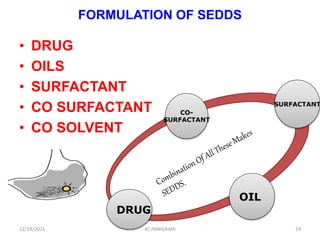
FORMULATION OF SEDDS
• DRUG
• OILS
• SURFACTANT
• CO SURFACTANT
• CO SOLVENT
24
CO-
SURFACTANT
DRUG
OIL
SURFACTANT
12/14/2021 KC PANIGRAHI
KC PANIGRAHI 25
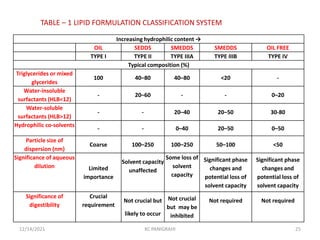
Increasing hydrophilic content →
OIL SEDDS SMEDDS SMEDDS OIL FREE
TYPE I TYPE II TYPE IIIA TYPE IIIB TYPE IV
Typical composition (%)
Triglycerides or mixed
glycerides
100 40–80 40–80 <20 -
Water-insoluble
surfactants (HLB<12)
- 20–60 - - 0–20
Water-soluble
surfactants (HLB>12)
- - 20–40 20–50 30-80
Hydrophilic co-solvents
- - 0–40 20–50 0–50
Particle size of
dispersion (nm)
Coarse 100–250 100–250 50–100 <50
Significance of aqueous
dilution Limited
importance
Solvent capacity
unaffected
Some loss of
solvent
capacity
Significant phase
changes and
potential loss of
solvent capacity
Significant phase
changes and
potential loss of
solvent capacity
Significance of
digestibility
Crucial
requirement
Not crucial but
likely to occur
Not crucial
but may be
inhibited
Not required Not required
12/14/2021
TABLE – 1 LIPID FORMULATION CLASSIFICATION SYSTEM
OILS
• Oils can solubilise the lipophilic drug in a specific amount and facilitate
self-emulsification.
• Increase the fraction of lipophilic drug transported via the intestinal
lymphatic system, thereby increasing absorption from the GI tract.
• Long-chain triglyceride and medium-chain triglyceride oils with different
degrees of saturation have been used in the design of SEDDSs. (Charman
SA et al 1992)
e.g. Tocopherol, Corn oil, Olive oil, Oleic acid, Sesame oil, Hydrogenated
vegetable oils, Soyabean oil, Peanut oil, Beeswax
26
DRUG
Drugs which have high lipophillicity, low melting point, low bioavailability and
poor solubility in water are selected for SEDDS.
12/14/2021 KC PANIGRAHI
SURFACTANT
Surfactants with high hydrophilic Lipophilic Balance (HLB) values are used
in formulation of SEDDS.
e.g.Tween, Labrasol, Labrafac CM 10, Cremophore etc.
27
CO SOLVENTS/CO SURFACTANT
Organic solvents suitable for oral administration may help to dissolve
large amounts of either the hydrophilic surfactant or the drug in the lipid
base and can act as co-surfactant .
e.g. ethanol, propylene glycol (PG) polyethylene glycol (PEG), etc
12/14/2021 KC PANIGRAHI
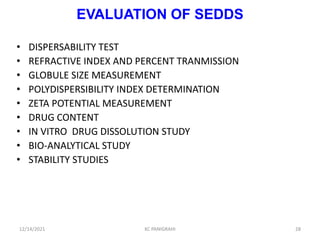
EVALUATION OF SEDDS
• DISPERSABILITY TEST
• REFRACTIVE INDEX AND PERCENT TRANMISSION
• GLOBULE SIZE MEASUREMENT
• POLYDISPERSIBILITY INDEX DETERMINATION
• ZETA POTENTIAL MEASUREMENT
• DRUG CONTENT
• IN VITRO DRUG DISSOLUTION STUDY
• BIO-ANALYTICAL STUDY
• STABILITY STUDIES
28
12/14/2021 KC PANIGRAHI
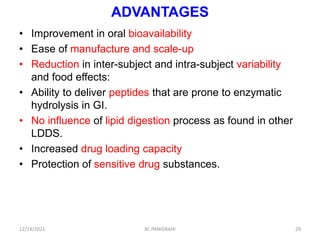
ADVANTAGES
• Improvement in oral bioavailability
• Ease of manufacture and scale-up
• Reduction in inter-subject and intra-subject variability
and food effects:
• Ability to deliver peptides that are prone to enzymatic
hydrolysis in GI.
• No influence of lipid digestion process as found in other
LDDS.
• Increased drug loading capacity
• Protection of sensitive drug substances.
29
12/14/2021 KC PANIGRAHI
12/14/2021 KC PANIGRAHI 30
THANK YOU

Pharmaceutical Emulsion

  • 1.
    Group number: 02 Course:Physical Pharmacy Course Code: 311 EMULSIONS Presented by (Dr) Kahnu Charan Panigrahi Asst. Professor, Research Scholar, Roland Institute of Pharmaceutical Sciences, (Affiliated to BPUT) Web of Science Researcher ID: AAK-3095-2020 12/14/2021 KC PANIGRAHI 1
  • 2.
    INTRODUCTION • An emulsionis a mixture of two or more liquids that are normally immiscible • Emulsion should be considered when both the dispersed and the continuous phase are liquids. 1-Oil in water emulsions 2- Water in oil emulsions 3 Multiple emulsions (O/W/O) or (W/O/W) 4 Microemulsions. TYPES OF EMULSIONS: 12/14/2021 KC PANIGRAHI 2
  • 3.
    MULTIPLE EMULSIONS: • Multipleemulsions are the emulsion system in which the dispersed phase contain smaller droplets that have the same composition as the external phase. • The multiple emulsions are also considered to be of two types: Oil-in-Water-in-Oil (O/W/O) emulsion system Water-in-Oil-In-Water (W/O/W) emulsion system 12/14/2021 KC PANIGRAHI 3
  • 4.
  • 5.
    MICROEMULSIONS: • Clear, stable,liquid mixtures of oil, water and surfactant, frequently in combination with a co-surfactant. • The two basic types of Microemulsions are (o/w) and (w/o). Unlike the common macro emulsion in that: 1 Appear as clear transparent solution. 2 Diameter of internal phase droplets ranged between 10- 200nm. 3 Thermodynamically stable. 12/14/2021 KC PANIGRAHI 5
  • 6.
    DETECTION TESTS:  Dilutiontest:Based on the solubility of external phase of emulsion. - o/w emulsion can be diluted with water. - w/o emulsion can be diluted with oil. 12/14/2021 KC PANIGRAHI 6  Conductivity Test: Water is good conductor of electricity whereas oil is non- conductor. Therefore, continuous phase of water runs electricity more than continuous phase of oil.
  • 7.
    Dye-Solubility Test: when anemulsion is mixed with a water soluble dye and observed under the microscope. if the continuous phase appears red, then it means the emulsion is o/w type as water is the external phase, if the scattered globules appear red and continuous phase colorless, then it is w/o type. 12/14/2021 KC PANIGRAHI 7 Fluorescence test: Oils give fluorescence. Under UV light, while water doesn’t. Therefore, O/W emulsion shows spotty pattern while W/O emulsion fluoresces completely.
  • 8.
    EMULSION INSTABILITY: The instabilityof pharmaceutical emulsions may be classified as following:  Flocculation and creaming  Coalescence and breaking  Phase inversion 12/14/2021 KC PANIGRAHI 8
  • 9.
     FLOCCULATION: The smallspheres of oil join together to form clumps or flocks which rise or settle in the emulsion more rapidly than individual particles. 12/14/2021 KC PANIGRAHI 9  CREAMING: It is the concentration of the floccules of the internal phase form upward or downward layer according to the density of internal phase. Stokesequationincludedthe factorsthat affectthe creaming process:    18 ) ( dim 2 g d rate entation Se l s   Where d is the particle diameter s, l are densities of a particle and liquid respectively g is the acceleration of gravity.  is the viscosity of the medium.
  • 10.
     COALESCENCE: • Itisthe process by which emulsified particlesmerge with each to form largeparticles. 12/14/2021 KC PANIGRAHI 10  BREAKING: • Due to coalescence and creaming combined,the oil separates completely from waterso that it floats at the top in a single, continuouslayer.
  • 11.
    12/14/2021 KC PANIGRAHI11 Cracking of emulsion can be due to: 1-addition of an incompatible emulsifying agent: e.g. monovalent soap + divalent soap 2-chemical or microbial decomposition of emulsifying agent: e.g. alkali soap decompose by acid. 3-exposure to increased or reduced temperature 4-addition of common solvent.
  • 12.
    DIFFERENCE BETWEEN CREAMINGAND CRACKING CREAMING BREAKING  Formation of upward and downward layer.  Separation of emulsion to upward oily layer and downward aqueous layer.  Reversible.  Irreversible.  Partial or no coalescence.  Complete fusion. 12/14/2021 KC PANIGRAHI 12
  • 13.
     PHASE INVERSION: In phase inversion o/w type emulsions changes into w/o type and vice versa.  It is a physical instability. It may be brought about by:  the addition of an electrolyte e.g. addition of calcium chloride into o/w emulsion formed by sodium stearate can be inverted to w/o.  by changing the phase volume ratio.  by temperature changes. 12/14/2021 KC PANIGRAHI 13
  • 14.
    Phase inversion canbe minimized by: ousing the proper emulsified agent in adequate concentration. okeeping the concentration of dispersed phase below 74 %.(ideally 30-60) ostoring the emulsion in a cool place. 12/14/2021 KC PANIGRAHI 14
  • 15.
    When two immiscibleliquids are agitated together so that one of the liquids is dispersed as small droplets in the other. To prevent coalescence between globules, it is necessary to use emulsifying agent. There are three types of films: Monomolecular Films. Multimolecular Films. Solid Particle Films. MECHANISM OF EMULSIFICATION 12/14/2021 KC PANIGRAHI 15
  • 16.
    1. Monomolecular Film: Coherentmonomolecular film. Flexible film formed. Can prepare O/W or W/O emulsion. Lower surface tension and increase stability of emulsions. Examples: Potassium Laurate Polyoxyethylene sorbitan monooleate 12/14/2021 KC PANIGRAHI 16
  • 17.
    2. Multi-molecular Film: oStrong rigid film formed. o mostly by the hydrocolloid. o Produce o/w emulsion. o Have low effect on surface tension o Formed by viscosity enhancement Examples: o Acacia o Gelatin 12/14/2021 KC PANIGRAHI 17
  • 18.
    3. Solid ParticleFilm: o Film formed by solid particles that are small in size compared to the droplet of the dispersed phase. o Can form o/w and w/o emulsions. o Particles must be wetted by both phases in order to remain at the interface and form stable film. Examples: o Bentonite o Graphite o Magnesium Hydroxide 12/14/2021 KC PANIGRAHI 18
  • 19.
    METHODS OF PREPARATION: Continental or Dry Gum Method: • Emulsifier is triturated with the oil in perfectly dry porcelain mortar and water is added • Triturate immediately, rapidly and continuously (until get a clicking sound and thick white cream is formed, this is primary emulsion. • oil:water:gum is 4:2:1 • The remaining quantity of water is slowly added to form the final emulsion 12/14/2021 KC PANIGRAHI 19
  • 20.
     English orWet Gum Method: • Triturate gum with water in a mortar to form a mucilage. • Oil is added slowly in portions the mixture is triturated. • After adding all of the oil, thoroughly mixed for several minute to form the primary emulsion. • oil:water:gum is 4:2:1 • Once the primary emulsion has been formed remaining quantity of water is added to make the final emulsion. 12/14/2021 KC PANIGRAHI 20
  • 21.
    Bottle or ForbesBottle Method: • It is extemporaneous preparation for volatile oils or oil with low viscosity. • gum + oil (dry bottle) • water (volume equal to oil) is added in same amount as oil with vigorous shakeing to form primary emulsion. • Ratio of oil:water:gum is (4:4:2) • Remaining quantity of water is added to make the final emulsion. 12/14/2021 KC PANIGRAHI 21
  • 22.
    QUALITY CONTROL TESTOF EMULSION • Appearance • Clarity testing • pH value • Viscosity • Rheology • Drug content uniformity • Globule size distribution • Densities of phases 12/14/2021 KC PANIGRAHI 22
  • 23.
    WHAT ARE SEDDS? • SEDDS or self-emulsifying formulations (SEF) are defined as Isotropic mixtures of natural or synthetic oils, surfactants and co-solvents/co-surfactants. (Porter C.J. et al 2008) • Self-emulsification is a term used to describe emulsification which occurs with little or no input of energy. The process may be spontaneous or may require low levels of shear. • These systems form fine oil-in-water (o/w) emulsions or micro emulsions (SMEDDS) or nano emulsion (SNEDDS) upon mild agitation followed by dilution in aqueous media, such as gastrointestinal (GI) fluids. 23 12/14/2021 KC PANIGRAHI
  • 24.
    FORMULATION OF SEDDS •DRUG • OILS • SURFACTANT • CO SURFACTANT • CO SOLVENT 24 CO- SURFACTANT DRUG OIL SURFACTANT 12/14/2021 KC PANIGRAHI
  • 25.
    KC PANIGRAHI 25 Increasinghydrophilic content → OIL SEDDS SMEDDS SMEDDS OIL FREE TYPE I TYPE II TYPE IIIA TYPE IIIB TYPE IV Typical composition (%) Triglycerides or mixed glycerides 100 40–80 40–80 <20 - Water-insoluble surfactants (HLB<12) - 20–60 - - 0–20 Water-soluble surfactants (HLB>12) - - 20–40 20–50 30-80 Hydrophilic co-solvents - - 0–40 20–50 0–50 Particle size of dispersion (nm) Coarse 100–250 100–250 50–100 <50 Significance of aqueous dilution Limited importance Solvent capacity unaffected Some loss of solvent capacity Significant phase changes and potential loss of solvent capacity Significant phase changes and potential loss of solvent capacity Significance of digestibility Crucial requirement Not crucial but likely to occur Not crucial but may be inhibited Not required Not required 12/14/2021 TABLE – 1 LIPID FORMULATION CLASSIFICATION SYSTEM
  • 26.
    OILS • Oils cansolubilise the lipophilic drug in a specific amount and facilitate self-emulsification. • Increase the fraction of lipophilic drug transported via the intestinal lymphatic system, thereby increasing absorption from the GI tract. • Long-chain triglyceride and medium-chain triglyceride oils with different degrees of saturation have been used in the design of SEDDSs. (Charman SA et al 1992) e.g. Tocopherol, Corn oil, Olive oil, Oleic acid, Sesame oil, Hydrogenated vegetable oils, Soyabean oil, Peanut oil, Beeswax 26 DRUG Drugs which have high lipophillicity, low melting point, low bioavailability and poor solubility in water are selected for SEDDS. 12/14/2021 KC PANIGRAHI
  • 27.
    SURFACTANT Surfactants with highhydrophilic Lipophilic Balance (HLB) values are used in formulation of SEDDS. e.g.Tween, Labrasol, Labrafac CM 10, Cremophore etc. 27 CO SOLVENTS/CO SURFACTANT Organic solvents suitable for oral administration may help to dissolve large amounts of either the hydrophilic surfactant or the drug in the lipid base and can act as co-surfactant . e.g. ethanol, propylene glycol (PG) polyethylene glycol (PEG), etc 12/14/2021 KC PANIGRAHI
  • 28.
    EVALUATION OF SEDDS •DISPERSABILITY TEST • REFRACTIVE INDEX AND PERCENT TRANMISSION • GLOBULE SIZE MEASUREMENT • POLYDISPERSIBILITY INDEX DETERMINATION • ZETA POTENTIAL MEASUREMENT • DRUG CONTENT • IN VITRO DRUG DISSOLUTION STUDY • BIO-ANALYTICAL STUDY • STABILITY STUDIES 28 12/14/2021 KC PANIGRAHI
  • 29.
    ADVANTAGES • Improvement inoral bioavailability • Ease of manufacture and scale-up • Reduction in inter-subject and intra-subject variability and food effects: • Ability to deliver peptides that are prone to enzymatic hydrolysis in GI. • No influence of lipid digestion process as found in other LDDS. • Increased drug loading capacity • Protection of sensitive drug substances. 29 12/14/2021 KC PANIGRAHI
  • 30.