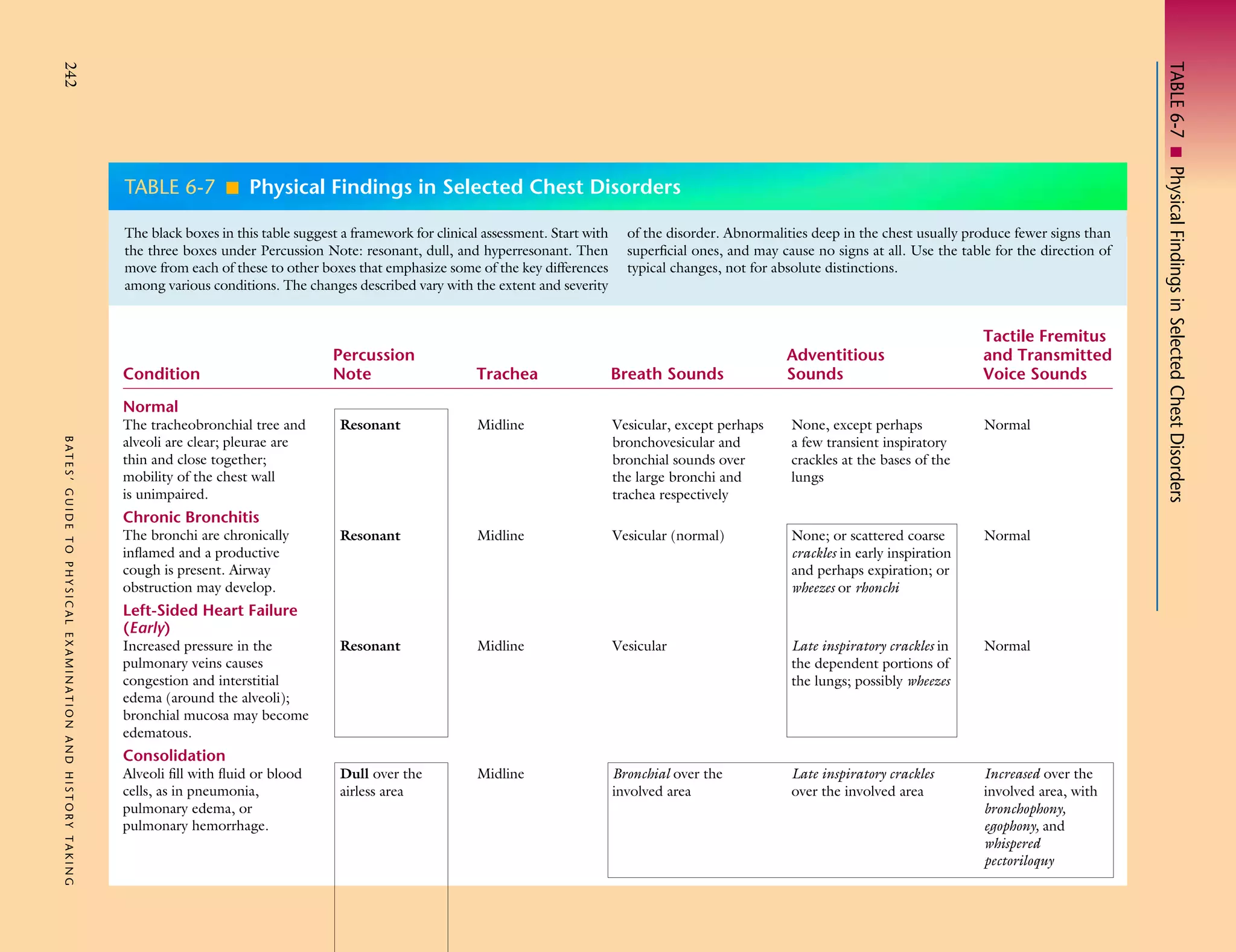
The black boxes in this table suggest a framework for clinical assessment. Start with
the three boxes under Percussion Note: resonant, dull, and hyperresonant. Then
move from each of these to other boxes that emphasize some of the key differences
among various conditions. The changes described vary with the extent and severity

Condition
Normal
BATES’ GUIDE TO PHYSICAL EXAMINATION AND HISTORY TAKING

The tracheobronchial tree and
alveoli are clear; pleurae are
thin and close together;
mobility of the chest wall
is unimpaired.

Chronic Bronchitis

The bronchi are chronically
inflamed and a productive
cough is present. Airway
obstruction may develop.

Left-Sided Heart Failure
(Early)

Increased pressure in the
pulmonary veins causes
congestion and interstitial
edema (around the alveoli);
bronchial mucosa may become
edematous.

Consolidation

Alveoli fill with fluid or blood
cells, as in pneumonia,
pulmonary edema, or
pulmonary hemorrhage.

Percussion
Note

of the disorder. Abnormalities deep in the chest usually produce fewer signs than
superficial ones, and may cause no signs at all. Use the table for the direction of
typical changes, not for absolute distinctions.

Adventitious
Sounds

Tactile Fremitus
and Transmitted
Voice Sounds

Trachea

Breath Sounds

Resonant

Midline

Vesicular, except perhaps
bronchovesicular and
bronchial sounds over
the large bronchi and
trachea respectively

None, except perhaps
a few transient inspiratory
crackles at the bases of the
lungs

Normal

Resonant

Midline

Vesicular (normal)

None; or scattered coarse
crackles in early inspiration
and perhaps expiration; or
wheezes or rhonchi

Normal

Resonant

Midline

Vesicular

Late inspiratory crackles in
the dependent portions of
the lungs; possibly wheezes

Normal

Dull over the
airless area

Midline

Bronchial over the
involved area

Late inspiratory crackles
over the involved area

Increased over the
involved area, with
bronchophony,
egophony, and
whispered
pectoriloquy

TABLE 6-7 I Physical Findings in Selected Chest Disorders

242

TABLE 6-7 I Physical Findings in Selected Chest Disorders
CHAPTER 6

Atelectasis
(Lobar Obstruction)

I
THE THORAX AND LUNGS

When a plug in a mainstem
bronchus (as from mucus or a
foreign object) obstructs air
flow, affected lung tissue
collapses into an airless state.

Pleural Effusion

Fluid accumulates in the
pleural space, separates airfilled lung from the chest wall,
blocking the transmission of
sound.

Pneumothorax

Chronic Obstructive
Pulmonary Disease
(COPD)

Slowly progressive disorder in
which the distal air spaces
enlarge and lungs become
hyperinflated. Chronic
bronchitis is often associated.

Asthma

Widespread narrowing of the
tracheobronchial tree
diminishes airflow to a
fluctuating degree. During
attacks, airflow decreases
further and lungs hyperinflate.

May be shifted
toward involved
side

Usually absent when
bronchial plug persists.
Exceptions include right
upper lobe atelectasis,
where adjacent tracheal
sounds may be
transmitted.

None

Usually absent when
the bronchial plug
persists. In
exceptions, e.g.,
right upper lobe
atelectasis, may be
increased

Dull to flat
over the fluid

Shifted toward
opposite side in a
large effusion

Decreased to absent, but
bronchial breath sounds
may be heard near top of
large effusion.

None, except a possible
pleural rub

Decreased to absent,
but may be increased
toward the top of a
large effusion

Hyperresonant
or tympanitic
over the pleural
air

Shifted toward
opposite side if
much air

Decreased to absent over
the pleural air

None, except a possible
pleural rub

Decreased to absent
over the pleural air

Diffusely
hyperresonant

Midline

Decreased to absent

None, or the crackles,
wheezes, and rhonchi of
associated chronic
bronchitis

Decreased

Resonant to
diffusely
hyperresonant

Midline

Often obscured by wheezes

Wheezes, possibly crackles

Decreased

243

TABLE 6-7 I Physical Findings in Selected Chest Disorders

When air leaks into the pleural
space, usually unilaterally, the
lung recoils from the chest
wall. Pleural air blocks
transmission of sound.

Dull over the
airless area

Lung exambates

  • 1.
    The black boxesin this table suggest a framework for clinical assessment. Start with the three boxes under Percussion Note: resonant, dull, and hyperresonant. Then move from each of these to other boxes that emphasize some of the key differences among various conditions. The changes described vary with the extent and severity Condition Normal BATES’ GUIDE TO PHYSICAL EXAMINATION AND HISTORY TAKING The tracheobronchial tree and alveoli are clear; pleurae are thin and close together; mobility of the chest wall is unimpaired. Chronic Bronchitis The bronchi are chronically inflamed and a productive cough is present. Airway obstruction may develop. Left-Sided Heart Failure (Early) Increased pressure in the pulmonary veins causes congestion and interstitial edema (around the alveoli); bronchial mucosa may become edematous. Consolidation Alveoli fill with fluid or blood cells, as in pneumonia, pulmonary edema, or pulmonary hemorrhage. Percussion Note of the disorder. Abnormalities deep in the chest usually produce fewer signs than superficial ones, and may cause no signs at all. Use the table for the direction of typical changes, not for absolute distinctions. Adventitious Sounds Tactile Fremitus and Transmitted Voice Sounds Trachea Breath Sounds Resonant Midline Vesicular, except perhaps bronchovesicular and bronchial sounds over the large bronchi and trachea respectively None, except perhaps a few transient inspiratory crackles at the bases of the lungs Normal Resonant Midline Vesicular (normal) None; or scattered coarse crackles in early inspiration and perhaps expiration; or wheezes or rhonchi Normal Resonant Midline Vesicular Late inspiratory crackles in the dependent portions of the lungs; possibly wheezes Normal Dull over the airless area Midline Bronchial over the involved area Late inspiratory crackles over the involved area Increased over the involved area, with bronchophony, egophony, and whispered pectoriloquy TABLE 6-7 I Physical Findings in Selected Chest Disorders 242 TABLE 6-7 I Physical Findings in Selected Chest Disorders
  • 2.
    CHAPTER 6 Atelectasis (Lobar Obstruction) I THETHORAX AND LUNGS When a plug in a mainstem bronchus (as from mucus or a foreign object) obstructs air flow, affected lung tissue collapses into an airless state. Pleural Effusion Fluid accumulates in the pleural space, separates airfilled lung from the chest wall, blocking the transmission of sound. Pneumothorax Chronic Obstructive Pulmonary Disease (COPD) Slowly progressive disorder in which the distal air spaces enlarge and lungs become hyperinflated. Chronic bronchitis is often associated. Asthma Widespread narrowing of the tracheobronchial tree diminishes airflow to a fluctuating degree. During attacks, airflow decreases further and lungs hyperinflate. May be shifted toward involved side Usually absent when bronchial plug persists. Exceptions include right upper lobe atelectasis, where adjacent tracheal sounds may be transmitted. None Usually absent when the bronchial plug persists. In exceptions, e.g., right upper lobe atelectasis, may be increased Dull to flat over the fluid Shifted toward opposite side in a large effusion Decreased to absent, but bronchial breath sounds may be heard near top of large effusion. None, except a possible pleural rub Decreased to absent, but may be increased toward the top of a large effusion Hyperresonant or tympanitic over the pleural air Shifted toward opposite side if much air Decreased to absent over the pleural air None, except a possible pleural rub Decreased to absent over the pleural air Diffusely hyperresonant Midline Decreased to absent None, or the crackles, wheezes, and rhonchi of associated chronic bronchitis Decreased Resonant to diffusely hyperresonant Midline Often obscured by wheezes Wheezes, possibly crackles Decreased 243 TABLE 6-7 I Physical Findings in Selected Chest Disorders When air leaks into the pleural space, usually unilaterally, the lung recoils from the chest wall. Pleural air blocks transmission of sound. Dull over the airless area