Sayantika Dhar


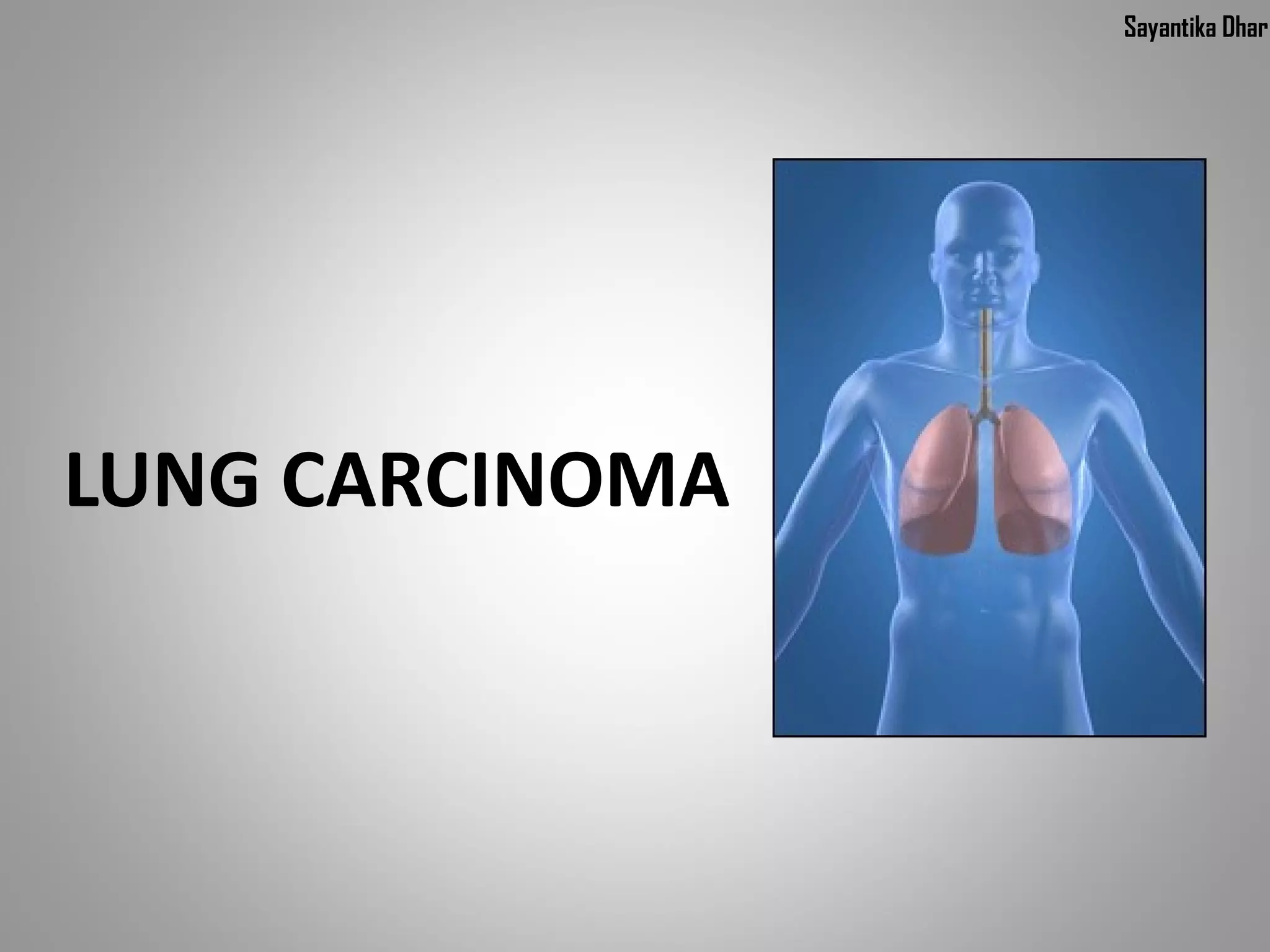
LUNG CARCINOMA
Sayantika Dhar


                DEFINITION
• Lung cancer is a disease characterized by
  uncontrolled cell growth in tissues of the lung.

• If left untreated, this growth can spread
  beyond the lung in a process
  called metastasis into nearby tissue and,
  eventually, into other parts of the body.
Sayantika Dhar


             Epidemiology:
Worldwide, lung cancer is the most common
 cause of cancer-related death in men and
 women, and is responsible for 1.3 million
 deaths annually, as of 2004.

Ref: WHO (February 2006). "Cancer". World
  Health Organization. Retrieved 2007-06-25.
Sayantika Dhar


         Signs and symptoms:
• dyspnea (shortness of breath)
• hemoptysis (coughing up blood)
• chronic coughing or change in regular coughing
  pattern
• wheezing
• chest pain or pain in the abdomen
• cachexia (weight loss), fatigue, and loss
  of appetite
• dysphonia (hoarse voice)
• clubbing of the fingernails (uncommon)
• dysphagia (difficulty swallowing)
Sayantika Dhar


                   Causes:
Smoking
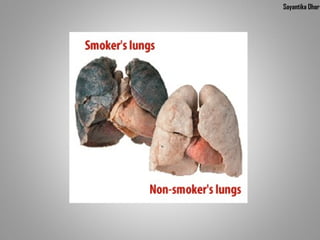
• Smoking, particularly of cigarettes, is by far
  the main contributor to lung cancer. Cigarette
  smoke contains over 60 known carcinogens.
• Additionally, nicotine appears to depress the
  immune response to malignant growths in
  exposed tissue.
Sayantika Dhar


• Passive smoking—the inhalation of smoke
  from another's smoking—is a cause of lung
  cancer in nonsmokers.
• Studies from the U.S., Europe, the UK, and
  Australia have consistently shown a significant
  increase in relative risk among those exposed
  to passive smoke.
• 10–15% of lung cancer patients have never
  smoked.
Sayantika Dhar
Sayantika Dhar


Radon gas
• Radon is a colorless and
  odorless gas generated by the breakdown of
  radioactive radium, found in the Earth's crust.
• The radiation decay products ionize genetic
  material, causing mutations that sometimes
  turn cancerous. Radon exposure is the second
  major cause of lung cancer in the general
  population, after smoking.
Sayantika Dhar


Asbestos
• Asbestos can cause a variety of lung diseases,
  including lung cancer.
• Asbestos can also cause cancer of the pleura,
  called mesothelioma(which is different from
  lung cancer).
Sayantika Dhar


Viruses
• Viruses are known to cause lung cancer in 
  animals, and recent evidence suggests similar 
  potential in humans.
• These viruses may affect the cell cycle and 
  inhibit apoptosis, allowing uncontrolled cell 
  division.
• Implicated viruses include:
  –  human papillomavirus, 
  – JC virus, simian virus 40 (SV40), 
  – BK virus, and 
  – cytomegalovirus. 
Sayantika Dhar


Particulate matter
• Studies of the American Cancer Society cohort 
  directly link the exposure to particulate 
  matter with lung cancer. For example, if the 
  concentration of particles in the air increases 
  by only 1%, the risk of developing a lung 
  cancer increases by 14%.
Krewski D, Burnett R, Jerrett M, Pope CA, Rainham D, Calle E, 
   Thurston G, Thun M (2005 Jul 9-23). "Mortality and long-term 
   exposure to ambient air pollution: ongoing analyses based on 
   the American Cancer Society cohort". J Toxicol Environ Health
   A 68 (13–14): 1093–109.
Sayantika Dhar


               Pathogenesis:
• Oncogenes:
       – activation of oncogenes or inactivation 
         of tumor suppressor genes.
       – Proto-oncogenes are believed to turn into 
         oncogenes when exposed to particular 
         carcinogens.
       – Mutations in the K-ras proto-oncogene are 
         responsible for 10–30% of lung 
         adenocarcinoma.
Sayantika Dhar


• Epidermal Growth Factor Receptor (EGFR)
     – EGFR regulates cell 
       proliferation, apoptosis, angiogenesis, and 
       tumor invasion 
     – Mutations and amplification of EGFR can lead 
       to cancerous growth, esp. non-small-cell lung 
       cancer (basis for the treatment with EGFR-
       Inhibitors)
Sayantika Dhar


•  Chromosomal damage:
       –  Chromosomal damage can lead to loss of 
         heterozygosity
       – This can cause inactivation of tumor suppressor 
         genes.
       –  Damage to chromosomes 3p, 5q, 13q, and 17p are 
         particularly common in small-cell lung carcinoma.
       –  The p53 tumor suppressor gene, located on 
         chromosome 17p, is affected in 60-75% of cases.
Sayantika Dhar


• Genetic polymorphisms
       – People with genetic polymorphisms are more likely 
         to develop lung cancer after exposure 
         to carcinogens.
       – These include polymorphisms in genes coding for
           »  interleukin-1, 
           » cytochrome P450, 
           » apoptosis promoters such as caspase-8,and 
           » DNA repair molecules such as XRCC1
Sayantika Dhar


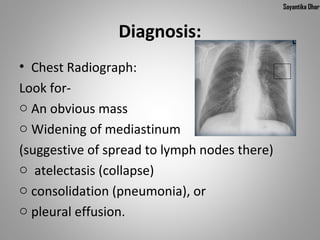
                Diagnosis:
• Chest Radiograph:
Look for- 
o An obvious mass
o Widening of mediastinum
(suggestive of spread to lymph nodes there)
o  atelectasis (collapse)
o consolidation (pneumonia), or 
o pleural effusion.
Sayantika Dhar


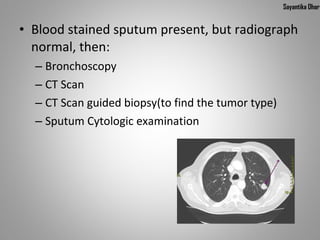
• Blood stained sputum present, but radiograph 
  normal, then:
  – Bronchoscopy
  – CT Scan
  – CT Scan guided biopsy(to find the tumor type)
  – Sputum Cytologic examination
Sayantika Dhar


        Differential Diagnosis:
• Abnormalities on chest radiograph:
  –  infectious causes such as tuberculosis or 
    pneumonia,
  – inflammatory conditions such as sarcoidosis
  – mediastinal lymphadenopathy or lung nodules, 
    sometimes mimic lung cancers
Sayantika Dhar


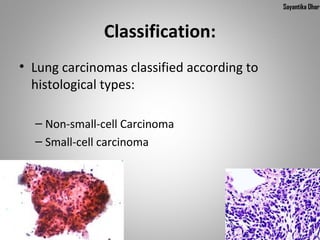
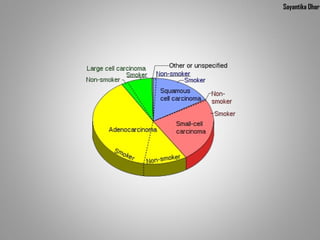
              Classification:
• Lung carcinomas classified according to
  histological types:

  – Non-small-cell Carcinoma
  – Small-cell carcinoma
Sayantika Dhar


• Non-small-cell carcinoma:
  – squamous cell lung carcinoma
  – adenocarcinoma, and
  – large-cell lung carcinoma.
Sayantika Dhar


                         Others
• Currently, the most widely recognized and utilized lung
  cancer classification system is the 4th revision of the
  Histological Typing of Lung and Pleural Tumours, published in
  2004 as a cooperative effort by the World Health
  Organization and the International Association for the Study
  of Lung Cancer.
• It recognizes numerous other distinct histopathological
  entities into several subtypes.
Sayantika Dhar
Sayantika Dhar


                Metastasis:
• The lung is a common place for metastasis of
  tumors from other parts of the body.
• Secondary cancers are classified by the site of
  origin; e.g., breast cancer that has spread to
  the lung is called breast cancer.
• Metastases often have a characteristic round
  appearance on chest radiograph.
Sayantika Dhar


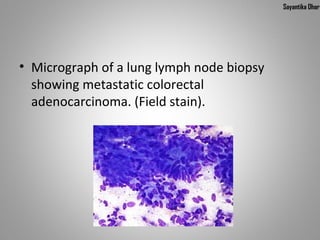
• Micrograph of a lung lymph node biopsy
  showing metastatic colorectal
  adenocarcinoma. (Field stain).
Sayantika Dhar


         Lung Cancer Staging:
• Staging is the process of determining how
  much cancer there is in the body and where it
  is located.
• Staging information which is obtained prior to
  surgery, for example by x-rays and endoscopic
  ultrasound, is called clinical staging and
  staging by surgery is known as pathological
  staging.
Sayantika Dhar

  TNM Classification of Malignant
        Tumours (TNM):
• T describes the size of the tumor and whether
  it has invaded nearby tissue,
• N describes regional lymph nodes that are
  involved,
• M describes distant metastasis
Sayantika Dhar


T: size or direct extent of the primary tumor

• T- CIS
• T0
• T 1-4
Sayantika Dhar


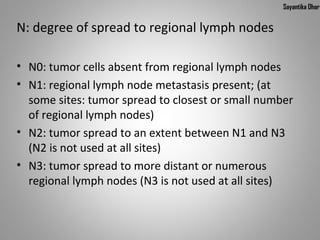
N: degree of spread to regional lymph nodes

• N0: tumor cells absent from regional lymph nodes
• N1: regional lymph node metastasis present; (at
  some sites: tumor spread to closest or small number
  of regional lymph nodes)
• N2: tumor spread to an extent between N1 and N3
  (N2 is not used at all sites)
• N3: tumor spread to more distant or numerous
  regional lymph nodes (N3 is not used at all sites)
Sayantika Dhar


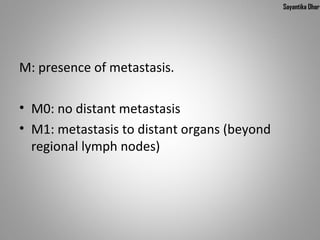
M: presence of metastasis.

• M0: no distant metastasis
• M1: metastasis to distant organs (beyond
  regional lymph nodes)
Sayantika Dhar


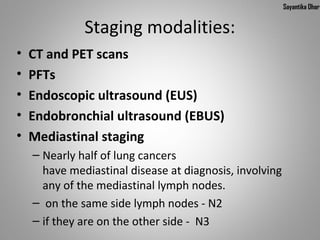
              Staging modalities:
•   CT and PET scans
•   PFTs
•   Endoscopic ultrasound (EUS)
•   Endobronchial ultrasound (EBUS)
•   Mediastinal staging
    – Nearly half of lung cancers
      have mediastinal disease at diagnosis, involving
      any of the mediastinal lymph nodes.
    – on the same side lymph nodes - N2
    – if they are on the other side - N3
Sayantika Dhar


             Management:
• Non-surgical
  – Radiotherapy
  – Chemotherapy


• Surgical
Sayantika Dhar


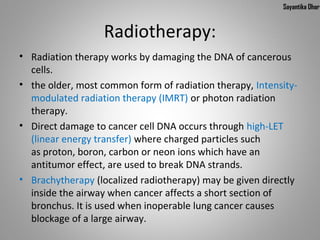
                  Radiotherapy:
• Radiation therapy works by damaging the DNA of cancerous
  cells.
• the older, most common form of radiation therapy, Intensity-
  modulated radiation therapy (IMRT) or photon radiation
  therapy.
• Direct damage to cancer cell DNA occurs through high-LET
  (linear energy transfer) where charged particles such
  as proton, boron, carbon or neon ions which have an
  antitumor effect, are used to break DNA strands.
• Brachytherapy (localized radiotherapy) may be given directly
  inside the airway when cancer affects a short section of
  bronchus. It is used when inoperable lung cancer causes
  blockage of a large airway.
Sayantika Dhar


                  Chemotherapy:
• The chemotherapy regimen depends on the tumor type.
• Small-cell lung carcinoma
   – Even if relatively early stage, small-cell lung carcinoma is
     treated primarily with chemotherapy and radiation.
   – Cisplatin and Etoposide are most commonly used.
• Non-small-cell lung carcinoma
   – Advanced non-small-cell lung carcinoma is often treated
     with Cisplatin or Carboplatin, in combination
     with Gemcitabine.
   – For adenocarcinoma and large-cell lung cancer, Cisplatin
     with Pemetrexed-more beneficial than cisplatin and
     gemcitabine.
   – Bronchoalveolar carcinoma may respond to Gefitinib
     and Erlotinib.
Sayantika Dhar


       Surgical Management
 Wedge resection: If the patient does not have
  enough functional lung, this technique is
  preferred.
 Segmentectomy
 Lobectomy: In patients with adequate respiratory
  reserve this is preferred, as this minimizes the
  chance of local recurrence.
 Pneumonectomy
Sayantika Dhar


Pneumonectomy specimen containing a squamous
cell carcinoma, seen as a white area near the
bronchi.
Sayantika Dhar


THANK YOU

Lung Carcinoma

  • 1.
  • 2.
    Sayantika Dhar DEFINITION • Lung cancer is a disease characterized by uncontrolled cell growth in tissues of the lung. • If left untreated, this growth can spread beyond the lung in a process called metastasis into nearby tissue and, eventually, into other parts of the body.
  • 3.
    Sayantika Dhar Epidemiology: Worldwide, lung cancer is the most common cause of cancer-related death in men and women, and is responsible for 1.3 million deaths annually, as of 2004. Ref: WHO (February 2006). "Cancer". World Health Organization. Retrieved 2007-06-25.
  • 4.
    Sayantika Dhar Signs and symptoms: • dyspnea (shortness of breath) • hemoptysis (coughing up blood) • chronic coughing or change in regular coughing pattern • wheezing • chest pain or pain in the abdomen • cachexia (weight loss), fatigue, and loss of appetite • dysphonia (hoarse voice) • clubbing of the fingernails (uncommon) • dysphagia (difficulty swallowing)
  • 5.
    Sayantika Dhar Causes: Smoking • Smoking, particularly of cigarettes, is by far the main contributor to lung cancer. Cigarette smoke contains over 60 known carcinogens. • Additionally, nicotine appears to depress the immune response to malignant growths in exposed tissue.
  • 6.
    Sayantika Dhar • Passivesmoking—the inhalation of smoke from another's smoking—is a cause of lung cancer in nonsmokers. • Studies from the U.S., Europe, the UK, and Australia have consistently shown a significant increase in relative risk among those exposed to passive smoke. • 10–15% of lung cancer patients have never smoked.
  • 7.
  • 8.
    Sayantika Dhar Radon gas •Radon is a colorless and odorless gas generated by the breakdown of radioactive radium, found in the Earth's crust. • The radiation decay products ionize genetic material, causing mutations that sometimes turn cancerous. Radon exposure is the second major cause of lung cancer in the general population, after smoking.
  • 9.
    Sayantika Dhar Asbestos • Asbestoscan cause a variety of lung diseases, including lung cancer. • Asbestos can also cause cancer of the pleura, called mesothelioma(which is different from lung cancer).
  • 10.
    Sayantika Dhar Viruses • Viruses are known to cause lung cancer in  animals, and recent evidence suggests similar  potential in humans. • These viruses may affect the cell cycle and  inhibit apoptosis, allowing uncontrolled cell  division. • Implicated viruses include: –  human papillomavirus,  – JC virus, simian virus 40 (SV40),  – BK virus, and  – cytomegalovirus. 
  • 11.
    Sayantika Dhar Particulate matter •Studies of the American Cancer Society cohort  directly link the exposure to particulate  matter with lung cancer. For example, if the  concentration of particles in the air increases  by only 1%, the risk of developing a lung  cancer increases by 14%. Krewski D, Burnett R, Jerrett M, Pope CA, Rainham D, Calle E,  Thurston G, Thun M (2005 Jul 9-23). "Mortality and long-term  exposure to ambient air pollution: ongoing analyses based on  the American Cancer Society cohort". J Toxicol Environ Health A 68 (13–14): 1093–109.
  • 12.
    Sayantika Dhar Pathogenesis: • Oncogenes: – activation of oncogenes or inactivation  of tumor suppressor genes. – Proto-oncogenes are believed to turn into  oncogenes when exposed to particular  carcinogens. – Mutations in the K-ras proto-oncogene are  responsible for 10–30% of lung  adenocarcinoma.
  • 13.
    Sayantika Dhar • Epidermal Growth Factor Receptor (EGFR) – EGFR regulates cell  proliferation, apoptosis, angiogenesis, and  tumor invasion  – Mutations and amplification of EGFR can lead  to cancerous growth, esp. non-small-cell lung  cancer (basis for the treatment with EGFR- Inhibitors)
  • 14.
    Sayantika Dhar •  Chromosomal damage: –  Chromosomal damage can lead to loss of  heterozygosity – This can cause inactivation of tumor suppressor  genes. –  Damage to chromosomes 3p, 5q, 13q, and 17p are  particularly common in small-cell lung carcinoma. –  The p53 tumor suppressor gene, located on  chromosome 17p, is affected in 60-75% of cases.
  • 15.
    Sayantika Dhar • Genetic polymorphisms – People with genetic polymorphisms are more likely  to develop lung cancer after exposure  to carcinogens. – These include polymorphisms in genes coding for »  interleukin-1,  » cytochrome P450,  » apoptosis promoters such as caspase-8,and  » DNA repair molecules such as XRCC1
  • 16.
    Sayantika Dhar Diagnosis: • Chest Radiograph: Look for-  o An obvious mass o Widening of mediastinum (suggestive of spread to lymph nodes there) o  atelectasis (collapse) o consolidation (pneumonia), or  o pleural effusion.
  • 17.
    Sayantika Dhar • Blood stained sputum present, but radiograph  normal, then: – Bronchoscopy – CT Scan – CT Scan guided biopsy(to find the tumor type) – Sputum Cytologic examination
  • 18.
    Sayantika Dhar Differential Diagnosis: • Abnormalities on chest radiograph: –  infectious causes such as tuberculosis or  pneumonia, – inflammatory conditions such as sarcoidosis – mediastinal lymphadenopathy or lung nodules,  sometimes mimic lung cancers
  • 19.
    Sayantika Dhar Classification: • Lung carcinomas classified according to histological types: – Non-small-cell Carcinoma – Small-cell carcinoma
  • 20.
    Sayantika Dhar • Non-small-cellcarcinoma: – squamous cell lung carcinoma – adenocarcinoma, and – large-cell lung carcinoma.
  • 21.
    Sayantika Dhar Others • Currently, the most widely recognized and utilized lung cancer classification system is the 4th revision of the Histological Typing of Lung and Pleural Tumours, published in 2004 as a cooperative effort by the World Health Organization and the International Association for the Study of Lung Cancer. • It recognizes numerous other distinct histopathological entities into several subtypes.
  • 22.
  • 23.
    Sayantika Dhar Metastasis: • The lung is a common place for metastasis of tumors from other parts of the body. • Secondary cancers are classified by the site of origin; e.g., breast cancer that has spread to the lung is called breast cancer. • Metastases often have a characteristic round appearance on chest radiograph.
  • 24.
    Sayantika Dhar • Micrographof a lung lymph node biopsy showing metastatic colorectal adenocarcinoma. (Field stain).
  • 25.
    Sayantika Dhar Lung Cancer Staging: • Staging is the process of determining how much cancer there is in the body and where it is located. • Staging information which is obtained prior to surgery, for example by x-rays and endoscopic ultrasound, is called clinical staging and staging by surgery is known as pathological staging.
  • 26.
    Sayantika Dhar TNM Classification of Malignant Tumours (TNM): • T describes the size of the tumor and whether it has invaded nearby tissue, • N describes regional lymph nodes that are involved, • M describes distant metastasis
  • 27.
    Sayantika Dhar T: sizeor direct extent of the primary tumor • T- CIS • T0 • T 1-4
  • 28.
    Sayantika Dhar N: degreeof spread to regional lymph nodes • N0: tumor cells absent from regional lymph nodes • N1: regional lymph node metastasis present; (at some sites: tumor spread to closest or small number of regional lymph nodes) • N2: tumor spread to an extent between N1 and N3 (N2 is not used at all sites) • N3: tumor spread to more distant or numerous regional lymph nodes (N3 is not used at all sites)
  • 29.
    Sayantika Dhar M: presenceof metastasis. • M0: no distant metastasis • M1: metastasis to distant organs (beyond regional lymph nodes)
  • 30.
    Sayantika Dhar Staging modalities: • CT and PET scans • PFTs • Endoscopic ultrasound (EUS) • Endobronchial ultrasound (EBUS) • Mediastinal staging – Nearly half of lung cancers have mediastinal disease at diagnosis, involving any of the mediastinal lymph nodes. – on the same side lymph nodes - N2 – if they are on the other side - N3
  • 31.
    Sayantika Dhar Management: • Non-surgical – Radiotherapy – Chemotherapy • Surgical
  • 32.
    Sayantika Dhar Radiotherapy: • Radiation therapy works by damaging the DNA of cancerous cells. • the older, most common form of radiation therapy, Intensity- modulated radiation therapy (IMRT) or photon radiation therapy. • Direct damage to cancer cell DNA occurs through high-LET (linear energy transfer) where charged particles such as proton, boron, carbon or neon ions which have an antitumor effect, are used to break DNA strands. • Brachytherapy (localized radiotherapy) may be given directly inside the airway when cancer affects a short section of bronchus. It is used when inoperable lung cancer causes blockage of a large airway.
  • 33.
    Sayantika Dhar Chemotherapy: • The chemotherapy regimen depends on the tumor type. • Small-cell lung carcinoma – Even if relatively early stage, small-cell lung carcinoma is treated primarily with chemotherapy and radiation. – Cisplatin and Etoposide are most commonly used. • Non-small-cell lung carcinoma – Advanced non-small-cell lung carcinoma is often treated with Cisplatin or Carboplatin, in combination with Gemcitabine. – For adenocarcinoma and large-cell lung cancer, Cisplatin with Pemetrexed-more beneficial than cisplatin and gemcitabine. – Bronchoalveolar carcinoma may respond to Gefitinib and Erlotinib.
  • 34.
    Sayantika Dhar Surgical Management  Wedge resection: If the patient does not have enough functional lung, this technique is preferred.  Segmentectomy  Lobectomy: In patients with adequate respiratory reserve this is preferred, as this minimizes the chance of local recurrence.  Pneumonectomy
  • 35.
    Sayantika Dhar Pneumonectomy specimencontaining a squamous cell carcinoma, seen as a white area near the bronchi.
  • 36.