PREPARED BY
RAJNI SHRESTHA
Lecturer of Bheri Nursing College
Lung Abscess and
Occupation Lung Diseases
Lung Abscess
• A lung abscess is a bacterial infection that 
occurs in the lung tissue. 
•The infection causes tissue to die, and pus 
collects in that space. 
•A lung abscess can be challenging to treat, 
and it can be life-threatening.
Etiology of Lung Abscess:
 In many cases the causes & pathogenesis is similar to 
pneumonia
 The more commonest causes is aspiration of materials 
into the lung &
Risk Factors Are:
 Alcoholism, seizures disorders,  drug overdose, 
 Infections: Klebsiella, S. aurous, anaerobic bacilli.
 Secondary result from hematogenously: pulmonary 
embolism, malignant growth, TB & fungus & parasitic 
diseases of lung
Pathophysiology of Lung Abscess
Clinical Manifestation of Lung Abscess
 On P/E: dullness on percussion, decrease breath 
sound on auscultation
 Muco purulent cough (brown color) with foul 
smelling
 Hemoptysis especially at the time of abscess 
rupture
 Fever, chill
 Pleuritic pain, dyspnea, cough & weight loss
 Crackle may present
 Oral infection: dental caries, gringivitis
Diagnosis of Lung abscess
History taking/Physical Examination
Chest X-ray
Sputum C/S
Bronchoscopy
Ct Scan
 MRI
Medical Management of Lung Abscess
 Antibiotics: Penicillin G, Pen-V & clindamycin
 If antibiotic is failed & fever and other symptoms continue 
after 10-14 days of after treatment & x-ray shows abscess 
is not shrinking surgical treatment is needed.
 In surgical treatment removal of abscess of insertion of tube 
to drain the abscess.
 Chest physiotherapy & postural drainage
 Maintain oral hygiene, rest & good nutrition
 Adequate fluid intake
Nursing Management Of Lung Abscess
1. Assessment:
Cough with smell, color, odor
Pain
Temperature, malaise
Breathing patterns
Oral hygiene
Nutritional level
Sleeping patterns
Activity intolerance
Nursing Diagnosis of Lung Abscess
 Hyperthermia related to direct effects of circulating
endotoxin on the hypothalamus
 Ineffective airway clearance related to bronchoconstriction,
increased production of secretions, retained secretion
 Impaired gas exchange related to oxygen disruption &
damage to the alveoli
 Pain related to pulmonary parenchymal inflammation,
retained cough
 Activity intolerance related to imbalance between supply &
demand of oxygen, general weakness
 Knowledge deficit related to lack of information,
misunderstanding about information, cognitive limitation
Occupational Lung Diseases
• Occupational or environmental lung disease result
from inhaled dust or chemicals.
•The duration of exposure & amount of inhalation
has a major influence whether the individual will
have lung damage & another factors is the
susceptibility of host.
Etiology of Occupational lung diseases
 Blue collar workers (Labor jobs) than white collar-
workers (office setting jobs)
 Industrial area than the rural areas
 Small & medium sized business than in large
industrial plants
 Fungi & bacteria: working in swimming pool,spa
 Farmers, mushroom workers,
Types of occupational lung diseases
 The pneumoconiosis (black lung disease)
 Asbsestos-related lung diseases
 Hypersensitivity diseases
 Byssinosis (brown Lung diseases)
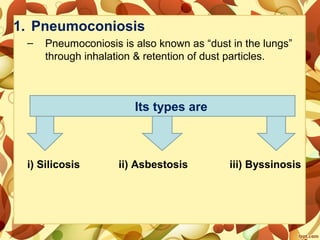
1. Pneumoconiosis
– Pneumoconiosis is also known as “dust in the lungs”
through inhalation & retention of dust particles.
i) Silicosis ii) Asbestosis iii) Byssinosis
Its types are
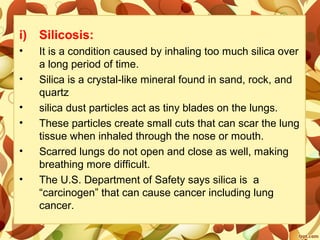
i) Silicosis:
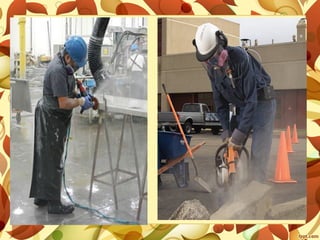
• It is a condition caused by inhaling too much silica over
a long period of time.
• Silica is a crystal-like mineral found in sand, rock, and
quartz
• silica dust particles act as tiny blades on the lungs.
• These particles create small cuts that can scar the lung
tissue when inhaled through the nose or mouth.
• Scarred lungs do not open and close as well, making
breathing more difficult.
• The U.S. Department of Safety says silica is a
“carcinogen” that can cause cancer including lung
cancer.
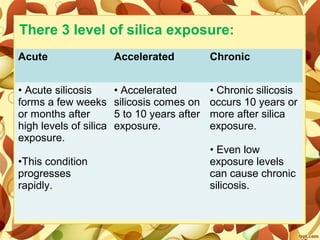
There 3 level of silica exposure:
Acute Accelerated Chronic
• Acute silicosis
forms a few weeks
or months after
high levels of silica
exposure.
•This condition
progresses
rapidly.
• Accelerated
silicosis comes on
5 to 10 years after
exposure.

• Chronic silicosis
occurs 10 years or
more after silica
exposure.
• Even low
exposure levels
can cause chronic
silicosis.
Clinical Feturses of silicosis
 Breathlessness, weakness, chest pain, productive
cough
 May die due to corpulmonale & respiratory failure
Prevention of silicosis
Use of special suits and breathing apparatus
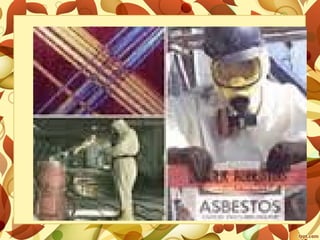
2. Asbestos-related lung diseases
(Asbestosis)
• A soft, greyish-white material that does not burn,
used especially in the in buildings, clothing, protection
against fire.
• Asbestosis is a chronic inflammatory & fibrotic condition
which affects lung tissues caused by inhalation & retention of
asbestos fibers.
• It commonly seen in people who works in mining,
manufacturing, handling or removal of asbestos.
• Asbestos caused lung cancer, malignant mesothelioma( CA
of pleura and peritoneal membrane) cancer of the larynx, &
certain gastrointestinal cancer.
Clinical Features of Asbestosis
 Shortness of breath during physical activities
 May lead respiratory failure
 Reduce vital capacity (total lung capacity)
 Right side heart failure
 Cor-pulmonale
 Low O2 capacity in the blood arteries.
Prevention of Asbestosis
 Use of protective mask during work
 Pneumonia vaccine: help in the reduction of lung infection.
 Using the vacuum cleaner or wet rags rather than
sweeping
 Using protective face mask
Hypersensitivity Diseases
• It is also called as hypersensitivity reaction or intolerance.
• It is a set of undesirable reaction produced by normal
immune systems including allergies, occur in bronchi,
bronchioles or alveoli.
a)Occupational Asthma
•Hypersensitivity reaction caused by histamine & caused
bronchoconstriction & increased mucus production.
•Repeated attack, if caused unrecognised & asthma is
untreated may lead to COPD.
Risk Factors of occupational Asthma
 House dust, cigarette smoke
 Working in: animals handler, veterinarians, millers e.g.
cereal, grains, carpet maker, carpenters, hairdressers,
health care workers, pharmaceutical worker
Sign & symptoms:
 Fatigue, wheezing during night
 Coughing, SOB, chest tightness
 Runny nose, nasal congestion
 Eye irritation & tearing
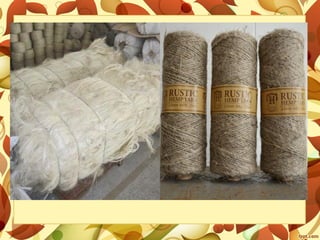
Byssinosis (Brown lung diseases)
•It is also called "brown lung disease" or “Monday
fever",
• It is an occupational lung disease caused by
exposure to cotton dust in inadequately ventilated
working environments.
• It's caused by the inhalation of raw flax, hemp,
cotton dust, and similar materials.
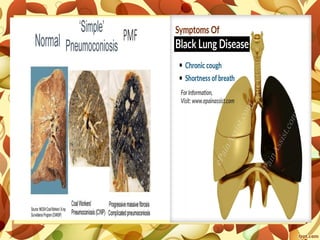
Coal worker's pneumoconiosis or black
lung disease
• This disease is caused by inhaling coal dust.
• It causes inflammation and scarring of the lungs.
• This can cause permanent lung damage and
shortness of breath.
Diagnosis
• Chest X-ray
• Pulmonary function tests (PFTs)
• Bronchoscopy: this test uses to view the bronchi & helps
to diagnose lung problems, for blockages.
• Lung biopsy
• Blood tests
• CT scan: it can be used to diagnose lung diseases,
monitor disease progression, and evaluate response to
treatment.
Management of occupational lung
diseases
 There is no specific treatment for occupational lung
diseases treatment is based on sign & symptoms
 The best approach to management is to prevent
environmental or occupational risks
 Effective ventilation, wearing mask, protective measures
 Cigarette smoking must be avoided
 Early diagnosis and treatment
 Periodic chest x-ray and pulmonary function test for
vulnerable people
Lung abscess & occupation lung diseases

Lung abscess & occupation lung diseases

  • 1.
    PREPARED BY RAJNI SHRESTHA Lecturerof Bheri Nursing College Lung Abscess and Occupation Lung Diseases
  • 2.
  • 3.
    Etiology of LungAbscess:  In many cases the causes & pathogenesis is similar to  pneumonia  The more commonest causes is aspiration of materials  into the lung & Risk Factors Are:  Alcoholism, seizures disorders,  drug overdose,   Infections: Klebsiella, S. aurous, anaerobic bacilli.  Secondary result from hematogenously: pulmonary  embolism, malignant growth, TB & fungus & parasitic  diseases of lung
  • 4.
  • 5.
    Clinical Manifestation ofLung Abscess  On P/E: dullness on percussion, decrease breath  sound on auscultation  Muco purulent cough (brown color) with foul  smelling  Hemoptysis especially at the time of abscess  rupture  Fever, chill  Pleuritic pain, dyspnea, cough & weight loss  Crackle may present  Oral infection: dental caries, gringivitis
  • 6.
    Diagnosis of Lungabscess History taking/Physical Examination Chest X-ray Sputum C/S Bronchoscopy Ct Scan  MRI
  • 7.
    Medical Management ofLung Abscess  Antibiotics: Penicillin G, Pen-V & clindamycin  If antibiotic is failed & fever and other symptoms continue  after 10-14 days of after treatment & x-ray shows abscess  is not shrinking surgical treatment is needed.  In surgical treatment removal of abscess of insertion of tube  to drain the abscess.  Chest physiotherapy & postural drainage  Maintain oral hygiene, rest & good nutrition  Adequate fluid intake
  • 8.
    Nursing Management OfLung Abscess 1. Assessment: Cough with smell, color, odor Pain Temperature, malaise Breathing patterns Oral hygiene Nutritional level Sleeping patterns Activity intolerance
  • 9.
    Nursing Diagnosis ofLung Abscess  Hyperthermia related to direct effects of circulating endotoxin on the hypothalamus  Ineffective airway clearance related to bronchoconstriction, increased production of secretions, retained secretion  Impaired gas exchange related to oxygen disruption & damage to the alveoli  Pain related to pulmonary parenchymal inflammation, retained cough  Activity intolerance related to imbalance between supply & demand of oxygen, general weakness  Knowledge deficit related to lack of information, misunderstanding about information, cognitive limitation
  • 10.
    Occupational Lung Diseases •Occupational or environmental lung disease result from inhaled dust or chemicals. •The duration of exposure & amount of inhalation has a major influence whether the individual will have lung damage & another factors is the susceptibility of host.
  • 11.
    Etiology of Occupationallung diseases  Blue collar workers (Labor jobs) than white collar- workers (office setting jobs)  Industrial area than the rural areas  Small & medium sized business than in large industrial plants  Fungi & bacteria: working in swimming pool,spa  Farmers, mushroom workers,
  • 12.
    Types of occupationallung diseases  The pneumoconiosis (black lung disease)  Asbsestos-related lung diseases  Hypersensitivity diseases  Byssinosis (brown Lung diseases)
  • 13.
    1. Pneumoconiosis – Pneumoconiosisis also known as “dust in the lungs” through inhalation & retention of dust particles. i) Silicosis ii) Asbestosis iii) Byssinosis Its types are
  • 14.
    i) Silicosis: • Itis a condition caused by inhaling too much silica over a long period of time. • Silica is a crystal-like mineral found in sand, rock, and quartz • silica dust particles act as tiny blades on the lungs. • These particles create small cuts that can scar the lung tissue when inhaled through the nose or mouth. • Scarred lungs do not open and close as well, making breathing more difficult. • The U.S. Department of Safety says silica is a “carcinogen” that can cause cancer including lung cancer.
  • 17.
    There 3 levelof silica exposure: Acute Accelerated Chronic • Acute silicosis forms a few weeks or months after high levels of silica exposure. •This condition progresses rapidly. • Accelerated silicosis comes on 5 to 10 years after exposure. • Chronic silicosis occurs 10 years or more after silica exposure. • Even low exposure levels can cause chronic silicosis.
  • 18.
    Clinical Feturses ofsilicosis  Breathlessness, weakness, chest pain, productive cough  May die due to corpulmonale & respiratory failure Prevention of silicosis Use of special suits and breathing apparatus
  • 19.
    2. Asbestos-related lungdiseases (Asbestosis) • A soft, greyish-white material that does not burn, used especially in the in buildings, clothing, protection against fire. • Asbestosis is a chronic inflammatory & fibrotic condition which affects lung tissues caused by inhalation & retention of asbestos fibers. • It commonly seen in people who works in mining, manufacturing, handling or removal of asbestos. • Asbestos caused lung cancer, malignant mesothelioma( CA of pleura and peritoneal membrane) cancer of the larynx, & certain gastrointestinal cancer.
  • 20.
    Clinical Features ofAsbestosis  Shortness of breath during physical activities  May lead respiratory failure  Reduce vital capacity (total lung capacity)  Right side heart failure  Cor-pulmonale  Low O2 capacity in the blood arteries. Prevention of Asbestosis  Use of protective mask during work  Pneumonia vaccine: help in the reduction of lung infection.  Using the vacuum cleaner or wet rags rather than sweeping  Using protective face mask
  • 22.
    Hypersensitivity Diseases • Itis also called as hypersensitivity reaction or intolerance. • It is a set of undesirable reaction produced by normal immune systems including allergies, occur in bronchi, bronchioles or alveoli. a)Occupational Asthma •Hypersensitivity reaction caused by histamine & caused bronchoconstriction & increased mucus production. •Repeated attack, if caused unrecognised & asthma is untreated may lead to COPD.
  • 23.
    Risk Factors ofoccupational Asthma  House dust, cigarette smoke  Working in: animals handler, veterinarians, millers e.g. cereal, grains, carpet maker, carpenters, hairdressers, health care workers, pharmaceutical worker Sign & symptoms:  Fatigue, wheezing during night  Coughing, SOB, chest tightness  Runny nose, nasal congestion  Eye irritation & tearing
  • 24.
    Byssinosis (Brown lungdiseases) •It is also called "brown lung disease" or “Monday fever", • It is an occupational lung disease caused by exposure to cotton dust in inadequately ventilated working environments. • It's caused by the inhalation of raw flax, hemp, cotton dust, and similar materials.
  • 26.
    Coal worker's pneumoconiosisor black lung disease • This disease is caused by inhaling coal dust. • It causes inflammation and scarring of the lungs. • This can cause permanent lung damage and shortness of breath.
  • 28.
    Diagnosis • Chest X-ray •Pulmonary function tests (PFTs) • Bronchoscopy: this test uses to view the bronchi & helps to diagnose lung problems, for blockages. • Lung biopsy • Blood tests • CT scan: it can be used to diagnose lung diseases, monitor disease progression, and evaluate response to treatment.
  • 29.
    Management of occupationallung diseases  There is no specific treatment for occupational lung diseases treatment is based on sign & symptoms  The best approach to management is to prevent environmental or occupational risks  Effective ventilation, wearing mask, protective measures  Cigarette smoking must be avoided  Early diagnosis and treatment  Periodic chest x-ray and pulmonary function test for vulnerable people