Occupational Lung Disease
Chanak Trikhatri
Definition of Sarcoidosis
Sarcoidosis a disease of unknown origin that
causes small lumps (granulomas) due to
chronic inflammation in body tissue.
Sarcoidosis is an inflammatory disease that
affect multiple organs in the body but mostly
lungs lymph node. In people with sarcoidosis,
abnormal masses or nodules called
granulomas consisting of inflamed tissues
form in certain organs of the body
Epidemiology
• Women are more vulnerable then men
• The disease is 10-17 times more common in
African – American than in Caucasians
• People of Scandinavian, German, Irish, or
Puerto Rican are more prone
• common in women. In the United States, the
disease is 10 times
• more common in African Americans (40 cases
per 100,000) than
• in Caucasians (5 cases per 100,000), and the
disease usually begins
• in the third or fourth decade of life (American
Thoracic
• Society, 1999).
Risk Factor
• Age: 20-40 years
• Sex: female are slightly more likely to develop
the disease
• Race : African-American,
• Family history
Etiology
• Idiopathic
• Type of autoimmune disease
• How sarcoidosis spread in the body is still
being studied
• Genetic predisposition
• Some microorganisms bateria virus dust and
chemical
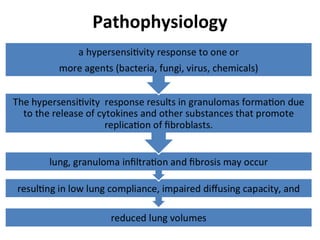
Pathophysiology
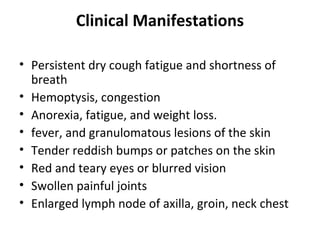
Clinical Manifestations
• Persistent dry cough fatigue and shortness of
breath
• Hemoptysis, congestion
• Anorexia, fatigue, and weight loss.
• fever, and granulomatous lesions of the skin
• Tender reddish bumps or patches on the skin
• Red and teary eyes or blurred vision
• Swollen painful joints
• Enlarged lymph node of axilla, groin, neck chest
Cont…
• Hoarse voice
• Pain in hand feet and other bony area due to the
formation of the cyst
• Chest pain, wheezing
• Kidney stone formation
• Enlarged liver
• Arrhythmias, pericarditis, heart failure
• Hearing loss, meningitis, seizures or psychiatric
disorder
Diagnostic Findings
• History Taking
• Physical Examination
• Chest x-rays are used to assess pulmonary adenopathy and
pulmonary infiltration looks cloudiness
• The chest x-ray may show hilar adenopathy and
disseminated miliary and nodular lesions in the lungs.
• CT scan to provide more detail picture of the lungs and
lymph node
• A mediastinoscopy or transbronchial biopsy (in which a
tissue specimen is obtained through the bronchial wall)
may be used to confirm the diagnosis.
• Biopsy
Cont….
• Lung function tests – to measure the rate, volume and efficiency of
breathing and ability to deliver oxygen to the circulation system
• Blood tests – to assess general health, as well as kidney and liver
function
• Electrocardiogram – to investigate abnormal activity or size of heart
tissue
• Positron emission tomography (PET) – to pinpoint affected areas to
help in the selection of tissue for biopsy
• Magnetic resonance imaging (MRI) – to investigate involvement of
heart and central nervous system tissue
• Eye examination – to detect eye involvement and evade serious
vision deterioration
• Urine dipstick test – to investigate signs of abnormalities the
kidneys
Cont…
• In rare cases, an open lung biopsy is performed.
Diagnosis is confirmed by a biopsy that shows
noncaseating granulomas.
• Pulmonary function test results are abnormal if there
is restriction of lung function (reduction in total lung
capacity).
• Arterial blood gas measurements may be normal or
may show reduced oxygen levels (hypoxemia) and
increased carbon dioxide levels (hypercapnia).
• Bronchoscopy to inspect the bronchial tubes and to
extract a biopsy
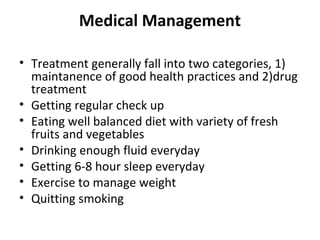
Medical Management
• Treatment generally fall into two categories, 1)
maintanence of good health practices and 2)drug
treatment
• Getting regular check up
• Eating well balanced diet with variety of fresh
fruits and vegetables
• Drinking enough fluid everyday
• Getting 6-8 hour sleep everyday
• Exercise to manage weight
• Quitting smoking
Medical Management contd…
• Corticosteroid therapy because of its anti-
inflammatory effect, which relieves symptoms
and improves organ function.
• Symptomatic treatment, corticosteroid therapy is
useful for patients with ocular and myocardial
involvement, skin involvement, extensive
pulmonary disease that compromises pulmonary
function, hepatic involvement, and
hypercalcemia.
• Other cytotoxic and immunosuppressive agents
Prognosis
• The prognosis for patients with sarcoidosis is relatively
positive and it is not usually fatal, with the overall death rate
remaining less than 5% without treatment.
• In fact, most individuals do not require treatment at all as
their symptoms do not significantly inhibit daily life activities
and will improve spontaneously within two to five years.
However, approximately 1 in 3 people will require treatment
and certain complications can lead to vast changes in the
prognosis of the condition.
Complication
• Irrversible damage to the tissue between the air
sac
• Breathing difficulties
• Inflammation of eye eventually blindness
• Rarely it casuse cataract and glaucoma
• Kidney failure and imbalance calcium metabolism
• Arrhythmias,
• Facial paralysis due to facial nerve damage
Pneumoconioses
Diseases of the lungs occur in numerous
occupations as a result of exposure to organic
and inorganic (mineral) dusts and noxious gases
(fumes and aerosols). The effects of inhaling
these materials depend on the composition of
the substance, its concentration, its ability to
initiate an immune response, its irritating
properties, the duration of exposure, and the
individual’s response or susceptibility to the
irritant.
Cont…
In other word pneumoconioses is group of lung
diseases caused by inhaled dust particles. It is
disease characterized by fibrosis and caused by
the chronic inhalation of mineral dusts
especially sillica, abestos
Pneumoconiosis refers to a non-neoplastic
alteration of the lung resulting from inhalation
of mineral or inorganic dust (eg, “dusty lung”).
The most common pneumoconioses are
silicosis, asbestosis, and coal workers’
pneumoconiosis.
Cont…
Smoking may compound the problem and may
increase the risk of lung cancers in people
exposed to the mineral asbestos. Key aspects of
any assessment of patients with a potential
occupational respiratory history include job and
job activities, exposure levels, general hygiene,
time frame of exposure, amount of respiratory
protection used, and direct versus indirect
exposures.
Epidemiology
• Number of death due to silicosis 160 per year
• 1000-2000 hospitalize in US
• Coal workers pneumoconiosis 700 death
5000-7000 hospitalize before (national
institute for occupational safety and health)
Cause
• Silicosis: from silica crystals
• Asbestosis: from asbestos
• Coal worker: from coal dust
• Berylliosis: from beryllium
• Bauxite fribrosis: from bauxite dust
• Talcosis: from talc (hydrated magnesium silicate)
• Siderosis: from iorn oxide
• Tanosis: from tin oxide
• Baritosis: from barium sulfate
• Byssinosis: from cotton
• Mixed dust pneumoconiosis: from mixture of cobalt and
other metals
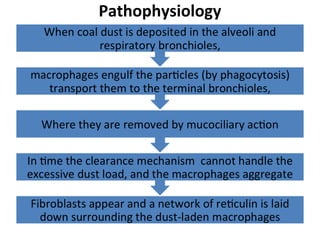
Pathophysiology
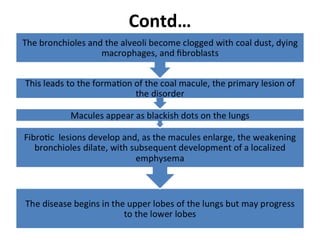
Contd…
Clinical Manifestations
• Due to decreased oxygen circulating in the blood
respiratory and heart failure
• Cough
• Shortness of breathe
• Chest pain
• Bluish coloration of the skin
• Swelling of the feet
• Liver enlargment
• Black lungs after 15-20 years exposure in coal mine
• Fibrosis nodules
• Clubbing finger
• Decrease lungs functions
Cont…
• Anorexia, weight loss, and malaise
• Early physical findings include bibasilar fine,
end-inspiratory crackles
• Cor pulmonale and respiratory failure
• Those who smoke or have a history of
smoking, Malignant mesotheliomas may also
occur.
• These are rare cancers of the pleura or
peritoneum
Diagnosis
• History taking type of exposure duration
ventilation of the work place
• Physical examination
• Lungs functions tests
• Chest X-ray (small round opaque area)
• CT scan
• Bronchoscopy to test the types of particles and
also called bronchoalveolar lavage
• Lungs biopsy to determine the type of lungs
diseaes
Medical Management
• Management is directed at controlling
infection and treating the lung disease.
• When oxygen– carbon dioxide exchange
becomes severely impaired, continuous
oxygen therapy may help improve activity
tolerance.
• The patient must be instructed to avoid
additional exposure to asbestos and to stop
smoking.
Medical Management
• Corticosteroid without oxygen
• Advice to quit smoking
• Dust control regulations
• Worker should go for regular check up
• The worker should provide the protective
environment
• Lobectomy surgical management
Nursing Management
Nursing assessment :
- Breath sounds, breathing pattern and respiratory
status.
- Pain or discomfort while breathing.
- Sputum – color, viscosity, amount, signs of blood.
- Fatigue, weakness, anorexia, weight loss, night
sweats,
- Low grade fever.
- Cough and chest pain
.
Contd….
Nursing diagnosis: Ineffective airway
clearance related to pain with coughing ,
inability to cough, abnormal respirations
CONTD….
Nursing Intervention
- Assess cough, sputum ( color,
consistency, amt, presence of blood)
- Encourage fluids (3-4lday)
- Humidify inspired air.
- Semi-fowler’s position
- Postural drainage.
CONTD…
Nursing Diagnosis: Pain r/t chest expansion
secondary to lung infection/inflammation
Nursing Intervention:
- Assess pain level
- Evaluate effectiveness of pain relief measures
- Instruct use of splinting techniques
- Administer analgesics as ordered
.
Nursing Diagnosis: Activity intolerance r/t
general weakness, respiratory difficulty, fever,
severity of illness
- Encourage rest periods.
- Prioritize necessary tasks.
- Assist with activities as needed.
- Keep equipments close by.
- Encourage active ROM exercises 3 times a day.
General considiration
• Requires close monitoring because the condition
could quickly change to a life threatening situation
• Frequent assessment of the patient’s status is
necessary to evaluate the effectiveness of treatment.
• Implementing the medical plan of care, the nurse
considers other needs of the patient positioning is
important.
Contd…
• Turn the patient frequently to improve
ventilation and perfusion in the lungs and
enhance secretion drainage.
• Closely monitor the patient for deterioration
in oxygenation with changes in position.
• The patient is extremely anxious and agitated
because of the increasing hypoxemia and
dyspnea.
CONTD
• Eye care is important as well because the patient
cannot blink, increasing the risk of corneal abrasions.
• Neuromuscular blockers predispose patients to the
development of deep venous thrombi, muscle
atrophy, and skin breakdown
• Nursing assessment is essential to minimize the
complications related to neuromuscular blockade.
TEACHING ABOUT PREVENTION
• The occupational health nurse serves as an
employee advocate, making every effort to
promote measures to reduce the exposure of
workers to industrial products.
• Dust control includes ventilation, spraying an
area with water to control dust, and effective
and frequent floor cleaning.
• Air samples need to be monitored.
• Toxic substances should be enclosed and
placed in restricted areas.
• Workers must wear or use protective devices
(facemasks, hoods, industrial respirators) to
provide a safe air supply when a toxic element
is present.
• Employees who are at risk should be carefully
screened and followed.
Contd…
• Asbestos and toxic dusts and substances may be
transferred to others through the handling of
clothing or shoes that have been exposed.
• The Right to Know law stipulates that employees
must be informed about all hazardous and toxic
substances in the workplace.
• Specifically, they must be educated about any
hazardous or toxic substances they work with,
what effects these substances can have on their
health, and the measures they can take to
protect themselves.
Contd…
Prognosis
• The outlook for this disease depends on the specific type of
pneumoconiosis, the length of exposure to mineral dust, the level
of exposure and whether the patient is a smoker.
• In the long term, people with asbestosis and talc pneumoconiosis
have an increased risk of lung cancer and malignant mesothelioma
(cancer of the membranes lining the lungs and abdominal cavity).
The risk of lung cancer is especially high in smokers with asbestosis.
• Because male workers fill most of the jobs that carry high risks of
pneumoconiosis, the majority of deaths from pneumoconiosis
occur in men.
Complication
• Silicosis: tuberculosis in 25% patient, massive
pulmonary fibrosis, autoimmune disease like
rheumatic arthritis and scleroderma, lung
cancer
• Coal worker’s: pulmonary fibrosis, digestive
system cancer
• Asbestosis: massive pulmonary fibrosis, lungs
cancer, cancer of the peritonieum
Thank you

5.occupational lung

  • 1.
  • 2.
    Definition of Sarcoidosis Sarcoidosisa disease of unknown origin that causes small lumps (granulomas) due to chronic inflammation in body tissue. Sarcoidosis is an inflammatory disease that affect multiple organs in the body but mostly lungs lymph node. In people with sarcoidosis, abnormal masses or nodules called granulomas consisting of inflamed tissues form in certain organs of the body
  • 3.
    Epidemiology • Women aremore vulnerable then men • The disease is 10-17 times more common in African – American than in Caucasians • People of Scandinavian, German, Irish, or Puerto Rican are more prone
  • 4.
    • common inwomen. In the United States, the disease is 10 times • more common in African Americans (40 cases per 100,000) than • in Caucasians (5 cases per 100,000), and the disease usually begins • in the third or fourth decade of life (American Thoracic • Society, 1999).
  • 5.
    Risk Factor • Age:20-40 years • Sex: female are slightly more likely to develop the disease • Race : African-American, • Family history
  • 6.
    Etiology • Idiopathic • Typeof autoimmune disease • How sarcoidosis spread in the body is still being studied • Genetic predisposition • Some microorganisms bateria virus dust and chemical
  • 7.
  • 8.
    Clinical Manifestations • Persistentdry cough fatigue and shortness of breath • Hemoptysis, congestion • Anorexia, fatigue, and weight loss. • fever, and granulomatous lesions of the skin • Tender reddish bumps or patches on the skin • Red and teary eyes or blurred vision • Swollen painful joints • Enlarged lymph node of axilla, groin, neck chest
  • 9.
    Cont… • Hoarse voice •Pain in hand feet and other bony area due to the formation of the cyst • Chest pain, wheezing • Kidney stone formation • Enlarged liver • Arrhythmias, pericarditis, heart failure • Hearing loss, meningitis, seizures or psychiatric disorder
  • 10.
    Diagnostic Findings • HistoryTaking • Physical Examination • Chest x-rays are used to assess pulmonary adenopathy and pulmonary infiltration looks cloudiness • The chest x-ray may show hilar adenopathy and disseminated miliary and nodular lesions in the lungs. • CT scan to provide more detail picture of the lungs and lymph node • A mediastinoscopy or transbronchial biopsy (in which a tissue specimen is obtained through the bronchial wall) may be used to confirm the diagnosis. • Biopsy
  • 11.
    Cont…. • Lung functiontests – to measure the rate, volume and efficiency of breathing and ability to deliver oxygen to the circulation system • Blood tests – to assess general health, as well as kidney and liver function • Electrocardiogram – to investigate abnormal activity or size of heart tissue • Positron emission tomography (PET) – to pinpoint affected areas to help in the selection of tissue for biopsy • Magnetic resonance imaging (MRI) – to investigate involvement of heart and central nervous system tissue • Eye examination – to detect eye involvement and evade serious vision deterioration • Urine dipstick test – to investigate signs of abnormalities the kidneys
  • 12.
    Cont… • In rarecases, an open lung biopsy is performed. Diagnosis is confirmed by a biopsy that shows noncaseating granulomas. • Pulmonary function test results are abnormal if there is restriction of lung function (reduction in total lung capacity). • Arterial blood gas measurements may be normal or may show reduced oxygen levels (hypoxemia) and increased carbon dioxide levels (hypercapnia). • Bronchoscopy to inspect the bronchial tubes and to extract a biopsy
  • 13.
    Medical Management • Treatmentgenerally fall into two categories, 1) maintanence of good health practices and 2)drug treatment • Getting regular check up • Eating well balanced diet with variety of fresh fruits and vegetables • Drinking enough fluid everyday • Getting 6-8 hour sleep everyday • Exercise to manage weight • Quitting smoking
  • 14.
    Medical Management contd… •Corticosteroid therapy because of its anti- inflammatory effect, which relieves symptoms and improves organ function. • Symptomatic treatment, corticosteroid therapy is useful for patients with ocular and myocardial involvement, skin involvement, extensive pulmonary disease that compromises pulmonary function, hepatic involvement, and hypercalcemia. • Other cytotoxic and immunosuppressive agents
  • 15.
    Prognosis • The prognosisfor patients with sarcoidosis is relatively positive and it is not usually fatal, with the overall death rate remaining less than 5% without treatment. • In fact, most individuals do not require treatment at all as their symptoms do not significantly inhibit daily life activities and will improve spontaneously within two to five years. However, approximately 1 in 3 people will require treatment and certain complications can lead to vast changes in the prognosis of the condition.
  • 16.
    Complication • Irrversible damageto the tissue between the air sac • Breathing difficulties • Inflammation of eye eventually blindness • Rarely it casuse cataract and glaucoma • Kidney failure and imbalance calcium metabolism • Arrhythmias, • Facial paralysis due to facial nerve damage
  • 17.
    Pneumoconioses Diseases of thelungs occur in numerous occupations as a result of exposure to organic and inorganic (mineral) dusts and noxious gases (fumes and aerosols). The effects of inhaling these materials depend on the composition of the substance, its concentration, its ability to initiate an immune response, its irritating properties, the duration of exposure, and the individual’s response or susceptibility to the irritant.
  • 18.
    Cont… In other wordpneumoconioses is group of lung diseases caused by inhaled dust particles. It is disease characterized by fibrosis and caused by the chronic inhalation of mineral dusts especially sillica, abestos Pneumoconiosis refers to a non-neoplastic alteration of the lung resulting from inhalation of mineral or inorganic dust (eg, “dusty lung”). The most common pneumoconioses are silicosis, asbestosis, and coal workers’ pneumoconiosis.
  • 19.
    Cont… Smoking may compoundthe problem and may increase the risk of lung cancers in people exposed to the mineral asbestos. Key aspects of any assessment of patients with a potential occupational respiratory history include job and job activities, exposure levels, general hygiene, time frame of exposure, amount of respiratory protection used, and direct versus indirect exposures.
  • 20.
    Epidemiology • Number ofdeath due to silicosis 160 per year • 1000-2000 hospitalize in US • Coal workers pneumoconiosis 700 death 5000-7000 hospitalize before (national institute for occupational safety and health)
  • 21.
    Cause • Silicosis: fromsilica crystals • Asbestosis: from asbestos • Coal worker: from coal dust • Berylliosis: from beryllium • Bauxite fribrosis: from bauxite dust • Talcosis: from talc (hydrated magnesium silicate) • Siderosis: from iorn oxide • Tanosis: from tin oxide • Baritosis: from barium sulfate • Byssinosis: from cotton • Mixed dust pneumoconiosis: from mixture of cobalt and other metals
  • 22.
  • 23.
  • 24.
    Clinical Manifestations • Dueto decreased oxygen circulating in the blood respiratory and heart failure • Cough • Shortness of breathe • Chest pain • Bluish coloration of the skin • Swelling of the feet • Liver enlargment • Black lungs after 15-20 years exposure in coal mine • Fibrosis nodules • Clubbing finger • Decrease lungs functions
  • 25.
    Cont… • Anorexia, weightloss, and malaise • Early physical findings include bibasilar fine, end-inspiratory crackles • Cor pulmonale and respiratory failure • Those who smoke or have a history of smoking, Malignant mesotheliomas may also occur. • These are rare cancers of the pleura or peritoneum
  • 26.
    Diagnosis • History takingtype of exposure duration ventilation of the work place • Physical examination • Lungs functions tests • Chest X-ray (small round opaque area) • CT scan • Bronchoscopy to test the types of particles and also called bronchoalveolar lavage • Lungs biopsy to determine the type of lungs diseaes
  • 27.
    Medical Management • Managementis directed at controlling infection and treating the lung disease. • When oxygen– carbon dioxide exchange becomes severely impaired, continuous oxygen therapy may help improve activity tolerance. • The patient must be instructed to avoid additional exposure to asbestos and to stop smoking.
  • 28.
    Medical Management • Corticosteroidwithout oxygen • Advice to quit smoking • Dust control regulations • Worker should go for regular check up • The worker should provide the protective environment • Lobectomy surgical management
  • 29.
    Nursing Management Nursing assessment: - Breath sounds, breathing pattern and respiratory status. - Pain or discomfort while breathing. - Sputum – color, viscosity, amount, signs of blood. - Fatigue, weakness, anorexia, weight loss, night sweats, - Low grade fever. - Cough and chest pain .
  • 30.
    Contd…. Nursing diagnosis: Ineffectiveairway clearance related to pain with coughing , inability to cough, abnormal respirations
  • 31.
    CONTD…. Nursing Intervention - Assesscough, sputum ( color, consistency, amt, presence of blood) - Encourage fluids (3-4lday) - Humidify inspired air. - Semi-fowler’s position - Postural drainage.
  • 32.
    CONTD… Nursing Diagnosis: Painr/t chest expansion secondary to lung infection/inflammation Nursing Intervention: - Assess pain level - Evaluate effectiveness of pain relief measures - Instruct use of splinting techniques - Administer analgesics as ordered .
  • 33.
    Nursing Diagnosis: Activityintolerance r/t general weakness, respiratory difficulty, fever, severity of illness - Encourage rest periods. - Prioritize necessary tasks. - Assist with activities as needed. - Keep equipments close by. - Encourage active ROM exercises 3 times a day.
  • 34.
    General considiration • Requiresclose monitoring because the condition could quickly change to a life threatening situation • Frequent assessment of the patient’s status is necessary to evaluate the effectiveness of treatment. • Implementing the medical plan of care, the nurse considers other needs of the patient positioning is important.
  • 35.
    Contd… • Turn thepatient frequently to improve ventilation and perfusion in the lungs and enhance secretion drainage. • Closely monitor the patient for deterioration in oxygenation with changes in position. • The patient is extremely anxious and agitated because of the increasing hypoxemia and dyspnea.
  • 36.
    CONTD • Eye careis important as well because the patient cannot blink, increasing the risk of corneal abrasions. • Neuromuscular blockers predispose patients to the development of deep venous thrombi, muscle atrophy, and skin breakdown • Nursing assessment is essential to minimize the complications related to neuromuscular blockade.
  • 37.
    TEACHING ABOUT PREVENTION •The occupational health nurse serves as an employee advocate, making every effort to promote measures to reduce the exposure of workers to industrial products. • Dust control includes ventilation, spraying an area with water to control dust, and effective and frequent floor cleaning. • Air samples need to be monitored.
  • 38.
    • Toxic substancesshould be enclosed and placed in restricted areas. • Workers must wear or use protective devices (facemasks, hoods, industrial respirators) to provide a safe air supply when a toxic element is present. • Employees who are at risk should be carefully screened and followed. Contd…
  • 39.
    • Asbestos andtoxic dusts and substances may be transferred to others through the handling of clothing or shoes that have been exposed. • The Right to Know law stipulates that employees must be informed about all hazardous and toxic substances in the workplace. • Specifically, they must be educated about any hazardous or toxic substances they work with, what effects these substances can have on their health, and the measures they can take to protect themselves. Contd…
  • 40.
    Prognosis • The outlookfor this disease depends on the specific type of pneumoconiosis, the length of exposure to mineral dust, the level of exposure and whether the patient is a smoker. • In the long term, people with asbestosis and talc pneumoconiosis have an increased risk of lung cancer and malignant mesothelioma (cancer of the membranes lining the lungs and abdominal cavity). The risk of lung cancer is especially high in smokers with asbestosis. • Because male workers fill most of the jobs that carry high risks of pneumoconiosis, the majority of deaths from pneumoconiosis occur in men.
  • 41.
    Complication • Silicosis: tuberculosisin 25% patient, massive pulmonary fibrosis, autoimmune disease like rheumatic arthritis and scleroderma, lung cancer • Coal worker’s: pulmonary fibrosis, digestive system cancer • Asbestosis: massive pulmonary fibrosis, lungs cancer, cancer of the peritonieum
  • 42.