




Classification of Fascial Spaces
 Based on mode of involvement-
 Primary spaces.
 Secondary spaces.
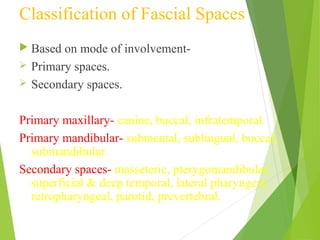
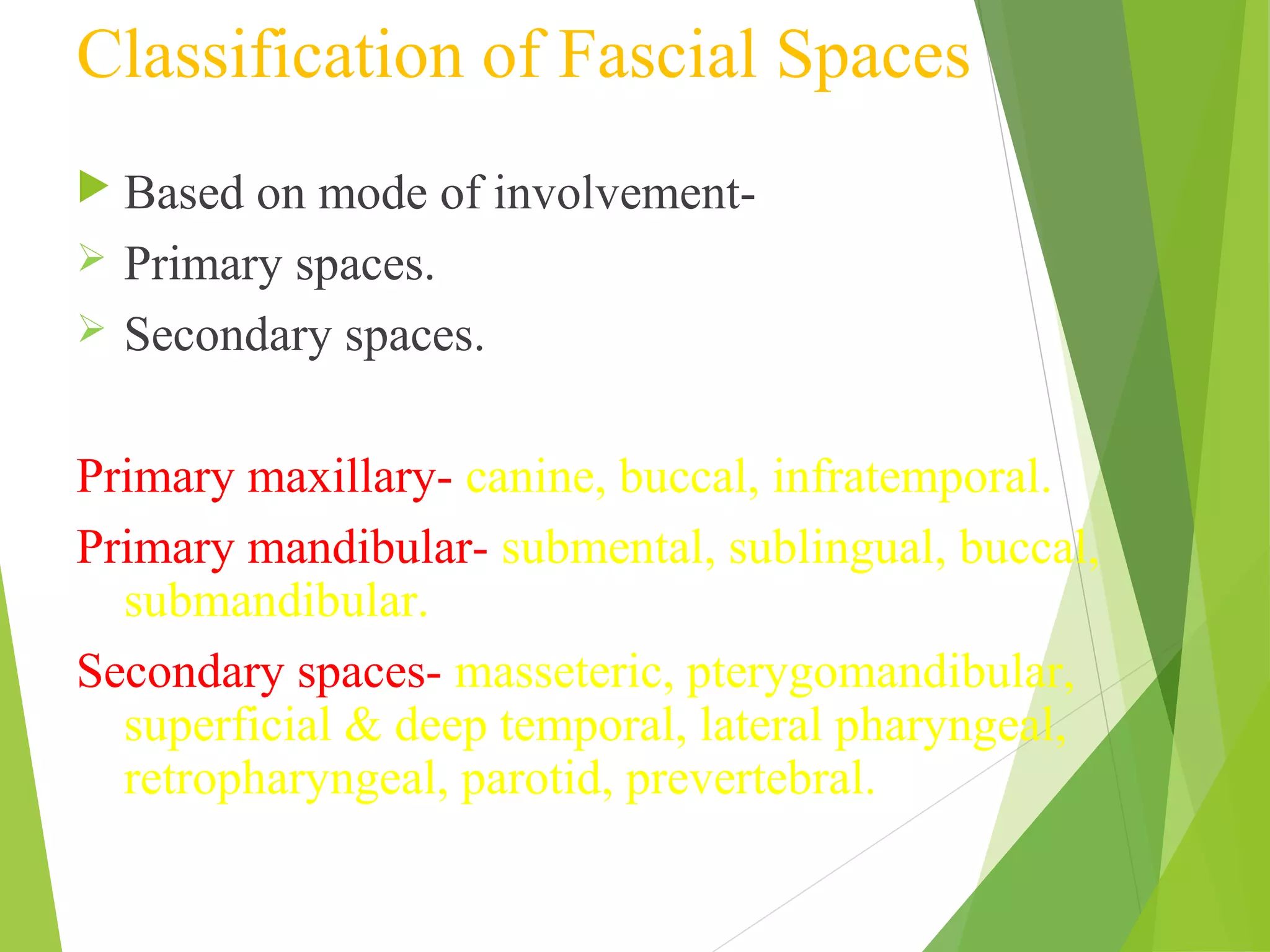
Primary maxillary- canine, buccal, infratemporal.
Primary mandibular- submental, sublingual, buccal,
submandibular.
Secondary spaces- masseteric, pterygomandibular,
superficial & deep temporal, lateral pharyngeal,
retropharyngeal, parotid, prevertebral.
INTRODUCTION
 Infection of orofacial and neck region, particularly
those of odontogenic have been one of most common
disease in human beings. Early reconignition of orofacial
infection &prompt appropriate therapy is essential .
PATHWAYS OF ODONTOGENIC INFECTION
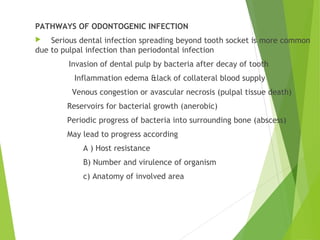
 Serious dental infection spreading beyond tooth socket is more common
due to pulpal infection than periodontal infection
Invasion of dental pulp by bacteria after decay of tooth
Inflammation edema &lack of collateral blood supply
Venous congestion or avascular necrosis (pulpal tissue death)
Reservoirs for bacterial growth (anerobic)
Periodic progress of bacteria into surrounding bone (abscess)
May lead to progress according
A ) Host resistance
B) Number and virulence of organism
c) Anatomy of involved area
Classification of Fascial Spaces
 Based on mode of involvement-
 Primary spaces.
 Secondary spaces.
Primary maxillary- canine, buccal, infratemporal.
Primary mandibular- submental, sublingual, buccal,
submandibular.
Secondary spaces- masseteric, pterygomandibular,
superficial & deep temporal, lateral pharyngeal,
retropharyngeal, parotid, prevertebral.
 Based on clinical significance-
 Face- Buccal, canine, parotid, masticatory.
 Suprahyoid- Sublingual, submental, submandibular,
lateral pharyngeal, peritonsillar.
 Infrahyoid- Pretracheal.
 Spaces of total neck- Retropharyngeal, space of
carotid sheath.
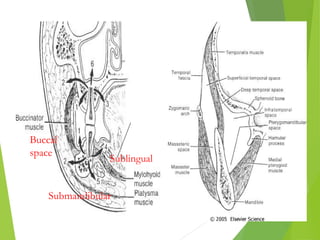
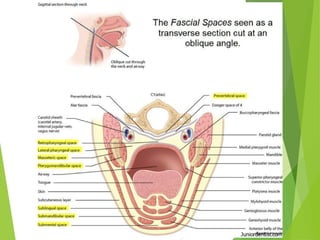
Buccal
space
Sublingual
Submandibular
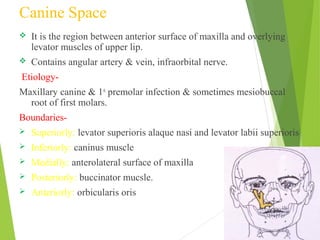
Canine Space
 It is the region between anterior surface of maxilla and overlying
levator muscles of upper lip.
 Contains angular artery & vein, infraorbital nerve.
Etiology-
Maxillary canine & 1st
premolar infection & sometimes mesiobuccal
root of first molars.
Boundaries-
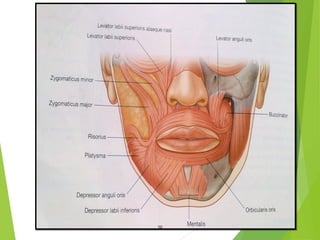
 Superiorly: levator superioris alaque nasi and levator labii superioris
 Inferiorly: caninus muscle
 Medially: anterolateral surface of maxilla
 Posteriorly: buccinator mucsle.
 Anteriorly: orbicularis oris
10
Clinical Features-
 Swelling of cheek, lower eyelid & upper lip.
 Drooping of angle of mouth.
 Nasolabial fold obliterated.
 Odema of lower eyelid
Buccal Space
Boundaries-
 Superiorly: zygomatic arch.
 Inferior: inferior border of mandible.
 Laterally: skin & subcutaneous tissue.
 Medially: buccinator muscle ,buccopharyngeal fascia.
 Posteriorly: anterior edge of masseter muscle.
 Anteriorly: posterior border of zygomaticus major & depressor
anguli oris.
Contents-
 Buccal fat pad.
 Stenson’s duct.
 Facial artery.
Etiology-
 Infected mandibular & maxillary premolars & molars.
Clinical Features-
 Obliteration of nasolabial fold.
 Angle of mouth shifted to opposite side.
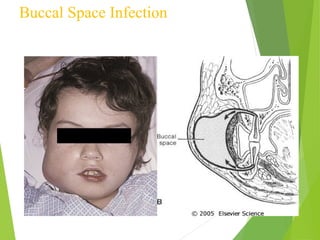
 Swelling in cheek extending to corner of mouth.
 Buccal space associated with temporal space – Dumb bell
shaped appearance due to lack of swelling over zygomatic
arch.
Buccal Space Infection
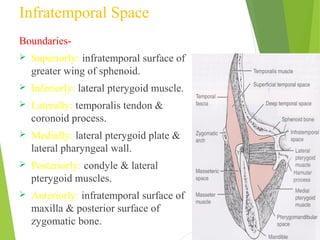
Infratemporal Space
Boundaries-
 Superiorly: infratemporal surface of
greater wing of sphenoid.
 Inferiorly: lateral pterygoid muscle.
 Laterally: temporalis tendon &
coronoid process.
 Medially: lateral pterygoid plate &
lateral pharyngeal wall.
 Posteriorly: condyle & lateral
pterygoid muscles.
 Anteriorly: infratemporal surface of
maxilla & posterior surface of
zygomatic bone.
Contents-
 Pterygoid plexus of veins.
 Internal maxillary artery.
 Mandibular nerve & its branches.
Etiology-
 Infected maxillary 3rd
molars.
 Infected needles or contaminated LA solution.
Clinical Features-
 Extra-oral swelling over sigmoid notch area.
 Intra-oral swelling in tuberosity area.
 Trismus.
Spread of Infection-
 To temporal space.
 Cavernous sinus thrombosis- infection spreads via pterygoid plexus
of veins.
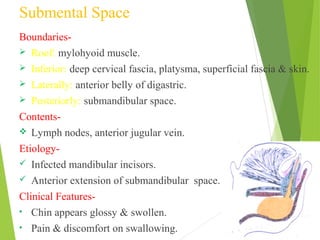
Submental Space
Boundaries-
 Roof: mylohyoid muscle.
 Inferior: deep cervical fascia, platysma, superficial fascia & skin.
 Laterally: anterior belly of digastric.
 Posteriorly: submandibular space.
Contents-
 Lymph nodes, anterior jugular vein.
Etiology-
 Infected mandibular incisors.
 Anterior extension of submandibular space.
Clinical Features-
• Chin appears glossy & swollen.
• Pain & discomfort on swallowing.
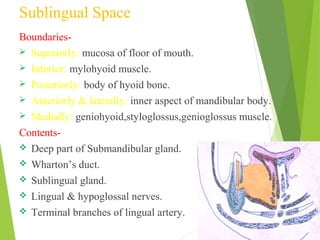
Sublingual Space
Boundaries-
 Superiorly: mucosa of floor of mouth.
 Inferior: mylohyoid muscle.
 Posteriorly: body of hyoid bone.
 Anteriorly & laterally: inner aspect of mandibular body.
 Medially: geniohyoid,styloglossus,genioglossus muscle.
Contents-
 Deep part of Submandibular gland.
 Wharton’s duct.
 Sublingual gland.
 Lingual & hypoglossal nerves.
 Terminal branches of lingual artery.
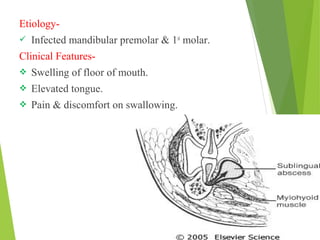
Etiology-
 Infected mandibular premolar & 1st
molar.
Clinical Features-
 Swelling of floor of mouth.
 Elevated tongue.
 Pain & discomfort on swallowing.
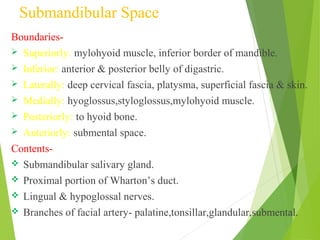
Submandibular Space
Boundaries-
 Superiorly: mylohyoid muscle, inferior border of mandible.
 Inferior: anterior & posterior belly of digastric.
 Laterally: deep cervical fascia, platysma, superficial fascia & skin.
 Medially: hyoglossus,styloglossus,mylohyoid muscle.
 Posteriorly: to hyoid bone.
 Anteriorly: submental space.
Contents-
 Submandibular salivary gland.
 Proximal portion of Wharton’s duct.
 Lingual & hypoglossal nerves.
 Branches of facial artery- palatine,tonsillar,glandular,submental.
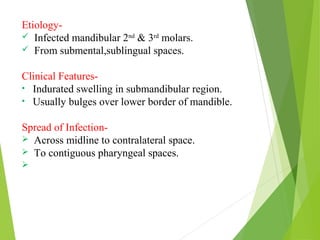
Etiology-
 Infected mandibular 2nd
& 3rd
molars.
 From submental,sublingual spaces.
Clinical Features-
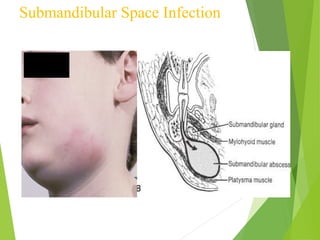
• Indurated swelling in submandibular region.
• Usually bulges over lower border of mandible.
Spread of Infection-
 Across midline to contralateral space.
 To contiguous pharyngeal spaces.

Submandibular Space Infection
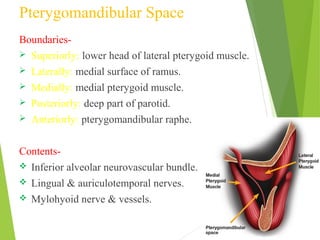
Pterygomandibular Space
Boundaries-
 Superiorly: lower head of lateral pterygoid muscle.
 Laterally: medial surface of ramus.
 Medially: medial pterygoid muscle.
 Posteriorly: deep part of parotid.
 Anteriorly: pterygomandibular raphe.
Contents-
 Inferior alveolar neurovascular bundle.
 Lingual & auriculotemporal nerves.
 Mylohyoid nerve & vessels.
Etiology-
 Infected mandibular 3rd
molars(mesioangular/horizontal)
 Pericoronitis.
 Infected needles or contaminated LA solution.
Clinical Features-
 Absence of extra-oral swelling.
 Severe trismus.
 Difficulty in swallowing.
 Anterior bulging of half of soft palate & tonsillar pillars with
deviation of uvula to unaffected side.
Spread of Infection-
 Superiorly to infratemporal space.
 Medially to lateral pharyngeal space.
 To submandibular space.
Masseteric Space
Boundaries-
 Superiorly: zygomatic arch.
 Inferiorly: inferior border of mandible.
 Laterally: masseter muscle.
 Medially: ramus of mandible.
 Posteriorly: parotid gland & its fascia.
 Anteriorly: buccal space & buccopharyngeal fascia.
Contents-
 Masseteric artery & vein.
Etiology-
 Mandibular 3rd
molars(pericoronitis).
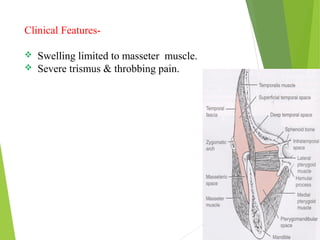
Clinical Features-
 Swelling limited to masseter muscle.
 Severe trismus & throbbing pain.
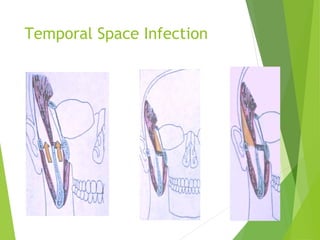
Temporal Spaces
 Superficial temporal-
 Laterally: temporalis fascia.
 Medially: temporalis muscle.
 Deep temporal-
 Laterally: temporalis muscle.
 Medially: temporal bone & greater wing of sphenoid.
Etiology-
 From infratemporal or pterygomandibular space.
Clinical Features-
 Superficial temporal- swelling limited by outline of temporalis
fascia. Trismus. Severe pain.
 Deep temporal- less swelling, difficult to diagnose. Trismus.
Temporal Space Infection
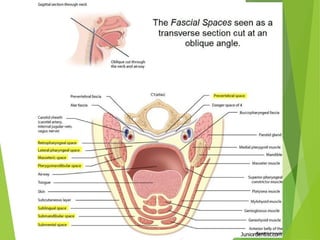
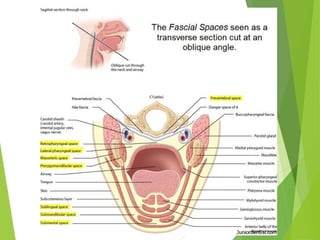
Lateral Pharyngeal Space
Boundaries-
 Shape of an inverted cone or pyramid, the base is at sphenoid
bone and the apex at hyoid bone.
 Anteriorly: pterygomandibular raphe.
 Posteriorly: extends to prevertebral fascia.
 Laterally: fascia covering medial pterygoid muscle, parotid &
mandible.
 Medially: buccopharyngeal fascia on lateral surface of
superior constrictor muscle.
 Styloid process divides the space into anterior muscular and
posterior vascular compartment.
Contents-
 Anterior compartment: fat, muscle, lymph nodes and
connective tissue.
 Posterior compartment: carotid sheath(carotid artery,internal
jugular vein,vagus nerve), cranial nerves IX through XII.
Etiology-
 Infected mandibular 3rd
molars.
 Tonsillar infections.
 Pharyngitis.
 Parotitis.
Spread of Infection-
 To retropharyngeal space.
 To peritonsillar space.
Clinical Features-
 Anterior compartment:
Trismus.
Induration & swelling at angle of jaw.
Fever.
Pharyngeal bulging.
 Posterior compartment:
Posterior tonsillar pillar deviation.
Neurological involvement.
Thrombosis of internal jugular vein.
Erosion of carotid vessels may occur.
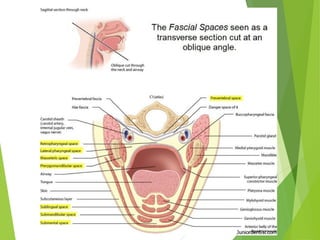
Retropharyngeal Space
Posteromedial to lateral pharyngeal space and anterior to the
prevertebral space .
Boundaries-
 Anterior: posterior pharyngeal wall.
 Posterior: prevertebral fascia.
 Superior: skull base.
 Inferior: mediastinum.
 Laterally: lateral pharyngeal space.
Etiology-
 Nasal & pharygeal infections.
 Spread from odontogenic infections.
Clinical Features-
 Stiffness of neck.
 Dysponea.
 Dysphagia.
 Bulging of posterior pharyngeal wall.
Complications-
 Airway obstruction.
 Aspiration pneumonia.
 Acute mediastinitis.
 Can spread to Danger space.
Prevertebral Space
 Potential space between two layers of prevertebral fascia (alar and prevertebral layers).
 Extends from skull base superiorly to the diaphragm inferiorly.
 Mediastinitis is concern with prevertebral space infections similarly to retropharyngeal space
infections.
Objectives
 Understand the microbiology of odontogenic infections.
 Understand the signs symptoms and findings in patients with
odontogenic infections.
 Review the various pathways of spread with odontogenic
infections.
 Understand the medical and surgical management of
odontogenic infections.
MICROBIOLOGY OF
ODONTOGENIC INFECTIONS Usually caused by endogenous bacteria.
 Most odontogenic infections due to mixed flora.
 Streptococcus species(alpha hemolytic) are usually the etiologic organisms if aerobic
bacteria present.
 Anaerobes- prevotella, bacteroids, fusobacterium also involved.
Factors affecting Spread of Infection
 General factors-
1. Microbial factors-
Level of virulence.
No. of organisms introduced.
2. Host factors-
General state of health.
Integrity of surface defence.
Level of immunity.
Capacity for inflammatory & immune response.
Impact of medical intervention.
3. Combination of both factors.
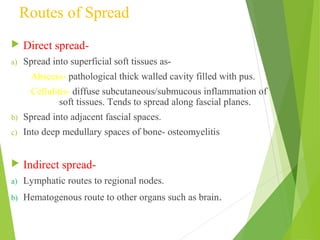
Routes of Spread
 Direct spread-
a) Spread into superficial soft tissues as-
Abscess- pathological thick walled cavity filled with pus.
Cellulitis- diffuse subcutaneous/submucous inflammation of
soft tissues. Tends to spread along fascial planes.
b) Spread into adjacent fascial spaces.
c) Into deep medullary spaces of bone- osteomyelitis
 Indirect spread-
a) Lymphatic routes to regional nodes.
b) Hematogenous route to other organs such as brain.
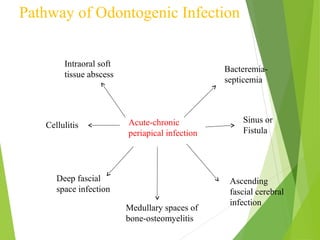
Pathway of Odontogenic Infection
Acute-chronic
periapical infection
Intraoral soft
tissue abscess
Cellulitis
Deep fascial
space infection
Bacteremia-
septicemia
Sinus or
Fistula
Ascending
fascial cerebral
infection
Medullary spaces of
bone-osteomyelitis
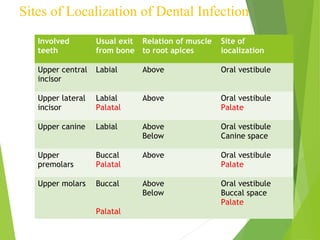
Sites of Localization of Dental Infection
Involved
teeth
Usual exit
from bone
Relation of muscle
to root apices
Site of
localization
Upper central
incisor
Labial Above Oral vestibule
Upper lateral
incisor
Labial
Palatal
Above Oral vestibule
Palate
Upper canine Labial Above
Below
Oral vestibule
Canine space
Upper
premolars
Buccal
Palatal
Above Oral vestibule
Palate
Upper molars Buccal
Palatal
Above
Below
Oral vestibule
Buccal space
Palate
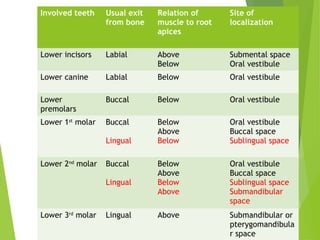
Involved teeth Usual exit
from bone
Relation of
muscle to root
apices
Site of
localization
Lower incisors Labial Above
Below
Submental space
Oral vestibule
Lower canine Labial Below Oral vestibule
Lower
premolars
Buccal Below Oral vestibule
Lower 1st
molar Buccal
Lingual
Below
Above
Below
Oral vestibule
Buccal space
Sublingual space
Lower 2nd
molar Buccal
Lingual
Below
Above
Below
Above
Oral vestibule
Buccal space
Sublingual space
Submandibular
space
Lower 3rd
molar Lingual Above Submandibular or
pterygomandibula
r space
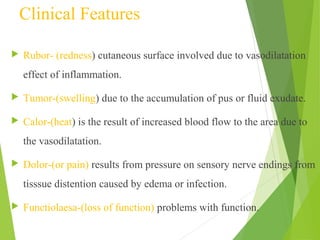
Clinical Features
 Rubor- (redness) cutaneous surface involved due to vasodilatation
effect of inflammation.
 Tumor-(swelling) due to the accumulation of pus or fluid exudate.
 Calor-(heat) is the result of increased blood flow to the area due to
the vasodilatation.
 Dolor-(or pain) results from pressure on sensory nerve endings from
tisssue distention caused by edema or infection.
 Functiolaesa-(loss of function) problems with function.
 Lymphadenopathy- nodes enlarged,soft & tender in acute infection.
Firm & enlarged in chronic.
 Halitosis.
 Fever & headache. Repeated chills.
 Presence of draining sinuses/fistulae.
 Increased salivation.
 Trismus.
 Difficulty in swallowing.
 Changes in phonation.
 Difficulty in breathing.
Investigations
 Routine laboratory investigations.
 Special laboratory investigations.
 Radiological examination- helpful in locating offending teeth or
other underlying cause.
 IOPA
 OPG
 Lateral oblique view mandible.
 A-P & Lateral view of neck for soft tissues can be useful in
detecting retropharyngeal space infection.
 Ultrasound of swelling.
 CT scan, MRI help in diagnosing extension of infection beyond
maxillofacial region.
Management of Odontogenic Infections
Goals of management of odontogenic
infection:
1. Airway protection.
2. Surgical drainage.
3. Identification of etiologic bacteria.
4. Selection of appropriate antibiotic therapy.
5. Medical & supportive therapy.
Selection of Antibiotic therapy
 Parenteral penicillin.
 Metronidazole in combination with penicillin can be used in
severe infections.
 Clindamycin for penicillin-allergic patients.
 Cephalosporins (1st
& 2nd
generation cephalosporins).
 Antibiotics do not substitute for incision and drainage in cases of
significant odontogenic infections.
 Causes for clinical failure include inadequate drainage or
antibiotic resistance.
Surgical Management
 Surgical treatment may range from simply opening
tooth & extirpation of pulp to complex incision &
drainage.
 Primary goal in surgical management is to remove
cause of infection.
 Secondary goal is to provide drainage of accumulated
pus & necrotic debris.
Extraction provides both removal of cause of infection
and drainage of pus & debris.
Incision & Drainage
Incision & drainage helps-
 To get rid of toxic purulent material.
 To decompress odematous tissues.
 To allow better perfusion of blood, containing antibiotics &
defensive elements.
 To increase oxygenation of infected area.
Removal of the cause; such as infected tooth, a segment of
necrotic bone, a foreign body should be done at the time of
I & D procedure.
Hilton’s method of I & D
1. Topical anesthesia achieved with spray or infiltration.
2. Stab incision given through skin & s/c tissue.
3. If pus is not encountered, further deepening of surgical site
done with sinus forceps.
4. Abscess cavity is entered and forceps opened in direction
parallel to vital structures.
5. Explore the entire cavity for additional loculi.
6. Cavity irrigated with saline & antiseptic solutions.
7. Placement of drain.
8. Dressing.
Drainage of Fascial Spaces
 Canine, Sublingual and Vestibular abscesses are drained
intraorally.
 Masseteric, Pterygomandibular, Buccal and Lateral Pharyngeal
space abscesses can be drained with combination of intraoral and
extraoral drainage.
 Temporal, Submandibular, Submental, Retropharyngeal and
Parotid space abscesses may mandate extraoral incision and
drainage.
Medical & Supportive Therapy
 Administration of antibiotics.
 Hydration of patient by I/V route.
 Soft or liquid diet rich of high proteins.
 Analgesics & NSAIDs.
 Antiseptic mouthwashes.
 Complete bed rest.
LUDWIG’S ANGINA::
DEFINITION– IT IS A FIRM, ACUTE,TOXIC CELLULITIS OF THE
SUBMANDIBULAR,SUBLINGUAL SPACES BILATERLLY
& OF THE SUBMENTALIS SPACE.
-- FRIST DISCRIBED BY WILHELM FREDREICH VON LUIDWIG IN 1836
ETIOLOGY:
1. PERIAPICAL,PERICORONAL OR PERIODONTAL INFECTION OF
A LOWER THIRD MOLAR
2. TRAUMATIC INJURIES & INFECTED LESIONS
3. INFECTIVE CONDITIONS SUCH AS OSTEOMYELITIS MAY
MENIFEST AS LUDWIG’S ANGINA
4. CYSTS OR TUMORS IN THIRD MOLAR REGION
PATHOLOGY:
1. INFECTION FROM LOWER THIRD MOLAR REACHES
THE SUBMANDIBULAR SPACES
2. FROM HERE INFECTION SPREADS ALONG THE
SUMANDIBULAR SALIVARY GLANDS ABOVE THE MYLOHYIOD
MUSCLE TO REACH THE SUBLINGUAL SPACE
CLINICAL FEATURES -
SYSTEMIC FEATURES- PYREXIA , DEHYDRATION , DYSPHAGIA ,
DYSPNOEA , HOARSENESS OF VOICE AND STRIDOR
EXTRA ORAL FEATURES – HARD TO FIRM BROWNY INDURATED SWELLING
SKIN OVER THE SWELLING APPEARS
ERYTHMATOUS AND STRETCHED
SWELLING IS TENDER WITH LOCAL RISE IN
TEMPERATURE
Difficulty in closing the mouth and drooling of saliva
Respiratory distress
INTRA ORAL FEATURES –
Trismus , floor of the mouth is raised , tongue raised upwards ,
increased salivation
MANAGEMENT -
1.Airway maintainence- Tracheostomy and Cricothyroidectomy
is advisable
2. Parentral antibiotics - Penicillin antibiotic of choice
Amoxycillin + Cloxacillin
Metronidazole in anaerobic infection
3.Surgical decompression – performed under L.A
Decompression improves vascularity and potentiates the action of antibiotics.
Bilateral submandibular incision with a midline submental incision pus
should be drained
4.Hydration of the patient –
It is necessary to put the pt on i.v. fluids
5. Removal of cause -
The offending tooth is removed
COMPLICATIONS –
• Death due to airway compromise
• septicemia
• mediastinitis
• carotid blow out
References
 Textbook of oral & maxillofacial surgery : Neelima
Malik.
 Oral & maxillofacial Infections : Topazian
 Textbook of oral & maxillofacial surgery : Laskin
THANK YOU!!!!

Fascialspaceinfections 140219122023-phpapp01

  • 1.
    Classification of FascialSpaces  Based on mode of involvement-  Primary spaces.  Secondary spaces. Primary maxillary- canine, buccal, infratemporal. Primary mandibular- submental, sublingual, buccal, submandibular. Secondary spaces- masseteric, pterygomandibular, superficial & deep temporal, lateral pharyngeal, retropharyngeal, parotid, prevertebral.
  • 2.
    INTRODUCTION  Infection oforofacial and neck region, particularly those of odontogenic have been one of most common disease in human beings. Early reconignition of orofacial infection &prompt appropriate therapy is essential .
  • 3.
    PATHWAYS OF ODONTOGENICINFECTION  Serious dental infection spreading beyond tooth socket is more common due to pulpal infection than periodontal infection Invasion of dental pulp by bacteria after decay of tooth Inflammation edema &lack of collateral blood supply Venous congestion or avascular necrosis (pulpal tissue death) Reservoirs for bacterial growth (anerobic) Periodic progress of bacteria into surrounding bone (abscess) May lead to progress according A ) Host resistance B) Number and virulence of organism c) Anatomy of involved area
  • 5.
    Classification of FascialSpaces  Based on mode of involvement-  Primary spaces.  Secondary spaces. Primary maxillary- canine, buccal, infratemporal. Primary mandibular- submental, sublingual, buccal, submandibular. Secondary spaces- masseteric, pterygomandibular, superficial & deep temporal, lateral pharyngeal, retropharyngeal, parotid, prevertebral.
  • 6.
     Based onclinical significance-  Face- Buccal, canine, parotid, masticatory.  Suprahyoid- Sublingual, submental, submandibular, lateral pharyngeal, peritonsillar.  Infrahyoid- Pretracheal.  Spaces of total neck- Retropharyngeal, space of carotid sheath.
  • 7.
  • 9.
    Canine Space  Itis the region between anterior surface of maxilla and overlying levator muscles of upper lip.  Contains angular artery & vein, infraorbital nerve. Etiology- Maxillary canine & 1st premolar infection & sometimes mesiobuccal root of first molars. Boundaries-  Superiorly: levator superioris alaque nasi and levator labii superioris  Inferiorly: caninus muscle  Medially: anterolateral surface of maxilla  Posteriorly: buccinator mucsle.  Anteriorly: orbicularis oris
  • 10.
  • 11.
    Clinical Features-  Swellingof cheek, lower eyelid & upper lip.  Drooping of angle of mouth.  Nasolabial fold obliterated.  Odema of lower eyelid
  • 12.
    Buccal Space Boundaries-  Superiorly:zygomatic arch.  Inferior: inferior border of mandible.  Laterally: skin & subcutaneous tissue.  Medially: buccinator muscle ,buccopharyngeal fascia.  Posteriorly: anterior edge of masseter muscle.  Anteriorly: posterior border of zygomaticus major & depressor anguli oris. Contents-  Buccal fat pad.  Stenson’s duct.  Facial artery.
  • 13.
    Etiology-  Infected mandibular& maxillary premolars & molars. Clinical Features-  Obliteration of nasolabial fold.  Angle of mouth shifted to opposite side.  Swelling in cheek extending to corner of mouth.  Buccal space associated with temporal space – Dumb bell shaped appearance due to lack of swelling over zygomatic arch.
  • 14.
  • 15.
    Infratemporal Space Boundaries-  Superiorly:infratemporal surface of greater wing of sphenoid.  Inferiorly: lateral pterygoid muscle.  Laterally: temporalis tendon & coronoid process.  Medially: lateral pterygoid plate & lateral pharyngeal wall.  Posteriorly: condyle & lateral pterygoid muscles.  Anteriorly: infratemporal surface of maxilla & posterior surface of zygomatic bone.
  • 16.
    Contents-  Pterygoid plexusof veins.  Internal maxillary artery.  Mandibular nerve & its branches. Etiology-  Infected maxillary 3rd molars.  Infected needles or contaminated LA solution. Clinical Features-  Extra-oral swelling over sigmoid notch area.  Intra-oral swelling in tuberosity area.  Trismus. Spread of Infection-  To temporal space.  Cavernous sinus thrombosis- infection spreads via pterygoid plexus of veins.
  • 17.
    Submental Space Boundaries-  Roof:mylohyoid muscle.  Inferior: deep cervical fascia, platysma, superficial fascia & skin.  Laterally: anterior belly of digastric.  Posteriorly: submandibular space. Contents-  Lymph nodes, anterior jugular vein. Etiology-  Infected mandibular incisors.  Anterior extension of submandibular space. Clinical Features- • Chin appears glossy & swollen. • Pain & discomfort on swallowing.
  • 19.
    Sublingual Space Boundaries-  Superiorly:mucosa of floor of mouth.  Inferior: mylohyoid muscle.  Posteriorly: body of hyoid bone.  Anteriorly & laterally: inner aspect of mandibular body.  Medially: geniohyoid,styloglossus,genioglossus muscle. Contents-  Deep part of Submandibular gland.  Wharton’s duct.  Sublingual gland.  Lingual & hypoglossal nerves.  Terminal branches of lingual artery.
  • 20.
    Etiology-  Infected mandibularpremolar & 1st molar. Clinical Features-  Swelling of floor of mouth.  Elevated tongue.  Pain & discomfort on swallowing.
  • 21.
    Submandibular Space Boundaries-  Superiorly:mylohyoid muscle, inferior border of mandible.  Inferior: anterior & posterior belly of digastric.  Laterally: deep cervical fascia, platysma, superficial fascia & skin.  Medially: hyoglossus,styloglossus,mylohyoid muscle.  Posteriorly: to hyoid bone.  Anteriorly: submental space. Contents-  Submandibular salivary gland.  Proximal portion of Wharton’s duct.  Lingual & hypoglossal nerves.  Branches of facial artery- palatine,tonsillar,glandular,submental.
  • 22.
    Etiology-  Infected mandibular2nd & 3rd molars.  From submental,sublingual spaces. Clinical Features- • Indurated swelling in submandibular region. • Usually bulges over lower border of mandible. Spread of Infection-  Across midline to contralateral space.  To contiguous pharyngeal spaces. 
  • 23.
  • 24.
    Pterygomandibular Space Boundaries-  Superiorly:lower head of lateral pterygoid muscle.  Laterally: medial surface of ramus.  Medially: medial pterygoid muscle.  Posteriorly: deep part of parotid.  Anteriorly: pterygomandibular raphe. Contents-  Inferior alveolar neurovascular bundle.  Lingual & auriculotemporal nerves.  Mylohyoid nerve & vessels.
  • 25.
    Etiology-  Infected mandibular3rd molars(mesioangular/horizontal)  Pericoronitis.  Infected needles or contaminated LA solution. Clinical Features-  Absence of extra-oral swelling.  Severe trismus.  Difficulty in swallowing.  Anterior bulging of half of soft palate & tonsillar pillars with deviation of uvula to unaffected side. Spread of Infection-  Superiorly to infratemporal space.  Medially to lateral pharyngeal space.  To submandibular space.
  • 26.
    Masseteric Space Boundaries-  Superiorly:zygomatic arch.  Inferiorly: inferior border of mandible.  Laterally: masseter muscle.  Medially: ramus of mandible.  Posteriorly: parotid gland & its fascia.  Anteriorly: buccal space & buccopharyngeal fascia. Contents-  Masseteric artery & vein. Etiology-  Mandibular 3rd molars(pericoronitis).
  • 27.
    Clinical Features-  Swellinglimited to masseter muscle.  Severe trismus & throbbing pain.
  • 28.
    Temporal Spaces  Superficialtemporal-  Laterally: temporalis fascia.  Medially: temporalis muscle.  Deep temporal-  Laterally: temporalis muscle.  Medially: temporal bone & greater wing of sphenoid. Etiology-  From infratemporal or pterygomandibular space. Clinical Features-  Superficial temporal- swelling limited by outline of temporalis fascia. Trismus. Severe pain.  Deep temporal- less swelling, difficult to diagnose. Trismus.
  • 29.
  • 30.
    Lateral Pharyngeal Space Boundaries- Shape of an inverted cone or pyramid, the base is at sphenoid bone and the apex at hyoid bone.  Anteriorly: pterygomandibular raphe.  Posteriorly: extends to prevertebral fascia.  Laterally: fascia covering medial pterygoid muscle, parotid & mandible.  Medially: buccopharyngeal fascia on lateral surface of superior constrictor muscle.  Styloid process divides the space into anterior muscular and posterior vascular compartment.
  • 32.
    Contents-  Anterior compartment:fat, muscle, lymph nodes and connective tissue.  Posterior compartment: carotid sheath(carotid artery,internal jugular vein,vagus nerve), cranial nerves IX through XII. Etiology-  Infected mandibular 3rd molars.  Tonsillar infections.  Pharyngitis.  Parotitis. Spread of Infection-  To retropharyngeal space.  To peritonsillar space.
  • 33.
    Clinical Features-  Anteriorcompartment: Trismus. Induration & swelling at angle of jaw. Fever. Pharyngeal bulging.  Posterior compartment: Posterior tonsillar pillar deviation. Neurological involvement. Thrombosis of internal jugular vein. Erosion of carotid vessels may occur.
  • 34.
    Retropharyngeal Space Posteromedial tolateral pharyngeal space and anterior to the prevertebral space . Boundaries-  Anterior: posterior pharyngeal wall.  Posterior: prevertebral fascia.  Superior: skull base.  Inferior: mediastinum.  Laterally: lateral pharyngeal space. Etiology-  Nasal & pharygeal infections.  Spread from odontogenic infections.
  • 36.
    Clinical Features-  Stiffnessof neck.  Dysponea.  Dysphagia.  Bulging of posterior pharyngeal wall. Complications-  Airway obstruction.  Aspiration pneumonia.  Acute mediastinitis.  Can spread to Danger space.
  • 37.
    Prevertebral Space  Potentialspace between two layers of prevertebral fascia (alar and prevertebral layers).  Extends from skull base superiorly to the diaphragm inferiorly.  Mediastinitis is concern with prevertebral space infections similarly to retropharyngeal space infections.
  • 38.
    Objectives  Understand themicrobiology of odontogenic infections.  Understand the signs symptoms and findings in patients with odontogenic infections.  Review the various pathways of spread with odontogenic infections.  Understand the medical and surgical management of odontogenic infections.
  • 39.
    MICROBIOLOGY OF ODONTOGENIC INFECTIONSUsually caused by endogenous bacteria.  Most odontogenic infections due to mixed flora.  Streptococcus species(alpha hemolytic) are usually the etiologic organisms if aerobic bacteria present.  Anaerobes- prevotella, bacteroids, fusobacterium also involved.
  • 40.
    Factors affecting Spreadof Infection  General factors- 1. Microbial factors- Level of virulence. No. of organisms introduced. 2. Host factors- General state of health. Integrity of surface defence. Level of immunity. Capacity for inflammatory & immune response. Impact of medical intervention. 3. Combination of both factors.
  • 41.
    Routes of Spread Direct spread- a) Spread into superficial soft tissues as- Abscess- pathological thick walled cavity filled with pus. Cellulitis- diffuse subcutaneous/submucous inflammation of soft tissues. Tends to spread along fascial planes. b) Spread into adjacent fascial spaces. c) Into deep medullary spaces of bone- osteomyelitis  Indirect spread- a) Lymphatic routes to regional nodes. b) Hematogenous route to other organs such as brain.
  • 42.
    Pathway of OdontogenicInfection Acute-chronic periapical infection Intraoral soft tissue abscess Cellulitis Deep fascial space infection Bacteremia- septicemia Sinus or Fistula Ascending fascial cerebral infection Medullary spaces of bone-osteomyelitis
  • 43.
    Sites of Localizationof Dental Infection Involved teeth Usual exit from bone Relation of muscle to root apices Site of localization Upper central incisor Labial Above Oral vestibule Upper lateral incisor Labial Palatal Above Oral vestibule Palate Upper canine Labial Above Below Oral vestibule Canine space Upper premolars Buccal Palatal Above Oral vestibule Palate Upper molars Buccal Palatal Above Below Oral vestibule Buccal space Palate
  • 44.
    Involved teeth Usualexit from bone Relation of muscle to root apices Site of localization Lower incisors Labial Above Below Submental space Oral vestibule Lower canine Labial Below Oral vestibule Lower premolars Buccal Below Oral vestibule Lower 1st molar Buccal Lingual Below Above Below Oral vestibule Buccal space Sublingual space Lower 2nd molar Buccal Lingual Below Above Below Above Oral vestibule Buccal space Sublingual space Submandibular space Lower 3rd molar Lingual Above Submandibular or pterygomandibula r space
  • 45.
    Clinical Features  Rubor-(redness) cutaneous surface involved due to vasodilatation effect of inflammation.  Tumor-(swelling) due to the accumulation of pus or fluid exudate.  Calor-(heat) is the result of increased blood flow to the area due to the vasodilatation.  Dolor-(or pain) results from pressure on sensory nerve endings from tisssue distention caused by edema or infection.  Functiolaesa-(loss of function) problems with function.
  • 46.
     Lymphadenopathy- nodesenlarged,soft & tender in acute infection. Firm & enlarged in chronic.  Halitosis.  Fever & headache. Repeated chills.  Presence of draining sinuses/fistulae.  Increased salivation.  Trismus.  Difficulty in swallowing.  Changes in phonation.  Difficulty in breathing.
  • 47.
    Investigations  Routine laboratoryinvestigations.  Special laboratory investigations.  Radiological examination- helpful in locating offending teeth or other underlying cause.  IOPA  OPG  Lateral oblique view mandible.  A-P & Lateral view of neck for soft tissues can be useful in detecting retropharyngeal space infection.  Ultrasound of swelling.  CT scan, MRI help in diagnosing extension of infection beyond maxillofacial region.
  • 48.
    Management of OdontogenicInfections Goals of management of odontogenic infection: 1. Airway protection. 2. Surgical drainage. 3. Identification of etiologic bacteria. 4. Selection of appropriate antibiotic therapy. 5. Medical & supportive therapy.
  • 49.
    Selection of Antibiotictherapy  Parenteral penicillin.  Metronidazole in combination with penicillin can be used in severe infections.  Clindamycin for penicillin-allergic patients.  Cephalosporins (1st & 2nd generation cephalosporins).  Antibiotics do not substitute for incision and drainage in cases of significant odontogenic infections.  Causes for clinical failure include inadequate drainage or antibiotic resistance.
  • 50.
    Surgical Management  Surgicaltreatment may range from simply opening tooth & extirpation of pulp to complex incision & drainage.  Primary goal in surgical management is to remove cause of infection.  Secondary goal is to provide drainage of accumulated pus & necrotic debris. Extraction provides both removal of cause of infection and drainage of pus & debris.
  • 51.
    Incision & Drainage Incision& drainage helps-  To get rid of toxic purulent material.  To decompress odematous tissues.  To allow better perfusion of blood, containing antibiotics & defensive elements.  To increase oxygenation of infected area. Removal of the cause; such as infected tooth, a segment of necrotic bone, a foreign body should be done at the time of I & D procedure.
  • 52.
    Hilton’s method ofI & D 1. Topical anesthesia achieved with spray or infiltration. 2. Stab incision given through skin & s/c tissue. 3. If pus is not encountered, further deepening of surgical site done with sinus forceps. 4. Abscess cavity is entered and forceps opened in direction parallel to vital structures. 5. Explore the entire cavity for additional loculi. 6. Cavity irrigated with saline & antiseptic solutions. 7. Placement of drain. 8. Dressing.
  • 53.
    Drainage of FascialSpaces  Canine, Sublingual and Vestibular abscesses are drained intraorally.  Masseteric, Pterygomandibular, Buccal and Lateral Pharyngeal space abscesses can be drained with combination of intraoral and extraoral drainage.  Temporal, Submandibular, Submental, Retropharyngeal and Parotid space abscesses may mandate extraoral incision and drainage.
  • 54.
    Medical & SupportiveTherapy  Administration of antibiotics.  Hydration of patient by I/V route.  Soft or liquid diet rich of high proteins.  Analgesics & NSAIDs.  Antiseptic mouthwashes.  Complete bed rest.
  • 55.
    LUDWIG’S ANGINA:: DEFINITION– ITIS A FIRM, ACUTE,TOXIC CELLULITIS OF THE SUBMANDIBULAR,SUBLINGUAL SPACES BILATERLLY & OF THE SUBMENTALIS SPACE. -- FRIST DISCRIBED BY WILHELM FREDREICH VON LUIDWIG IN 1836 ETIOLOGY: 1. PERIAPICAL,PERICORONAL OR PERIODONTAL INFECTION OF A LOWER THIRD MOLAR 2. TRAUMATIC INJURIES & INFECTED LESIONS 3. INFECTIVE CONDITIONS SUCH AS OSTEOMYELITIS MAY MENIFEST AS LUDWIG’S ANGINA 4. CYSTS OR TUMORS IN THIRD MOLAR REGION PATHOLOGY: 1. INFECTION FROM LOWER THIRD MOLAR REACHES THE SUBMANDIBULAR SPACES 2. FROM HERE INFECTION SPREADS ALONG THE SUMANDIBULAR SALIVARY GLANDS ABOVE THE MYLOHYIOD MUSCLE TO REACH THE SUBLINGUAL SPACE
  • 56.
    CLINICAL FEATURES - SYSTEMICFEATURES- PYREXIA , DEHYDRATION , DYSPHAGIA , DYSPNOEA , HOARSENESS OF VOICE AND STRIDOR EXTRA ORAL FEATURES – HARD TO FIRM BROWNY INDURATED SWELLING SKIN OVER THE SWELLING APPEARS ERYTHMATOUS AND STRETCHED SWELLING IS TENDER WITH LOCAL RISE IN TEMPERATURE Difficulty in closing the mouth and drooling of saliva Respiratory distress INTRA ORAL FEATURES – Trismus , floor of the mouth is raised , tongue raised upwards , increased salivation
  • 57.
    MANAGEMENT - 1.Airway maintainence-Tracheostomy and Cricothyroidectomy is advisable 2. Parentral antibiotics - Penicillin antibiotic of choice Amoxycillin + Cloxacillin Metronidazole in anaerobic infection 3.Surgical decompression – performed under L.A Decompression improves vascularity and potentiates the action of antibiotics. Bilateral submandibular incision with a midline submental incision pus should be drained 4.Hydration of the patient – It is necessary to put the pt on i.v. fluids 5. Removal of cause - The offending tooth is removed
  • 58.
    COMPLICATIONS – • Deathdue to airway compromise • septicemia • mediastinitis • carotid blow out
  • 59.
    References  Textbook oforal & maxillofacial surgery : Neelima Malik.  Oral & maxillofacial Infections : Topazian  Textbook of oral & maxillofacial surgery : Laskin
  • 60.