LU3- Instructions and Sequencing
Instructions and Sequencing
• Instructions for a computer must support:
–data transfers to and from the memory
–arithmetic and logic operations on data
–program sequencing and control
–input/output transfers
• First consider data transfer & arithmetic/logic
• Control and input/output examined later
Register Transfer Notation
• Register transfer notation is used to describe
hardware-level data transfers and operations
• Predefined names for processor registers (like
R0,R1) and I/O registers (like DATAIN)
• Arbitrary names for locations in
memory(A,B,LOC,DATA)
• Use […] to denote contents of a location
• Use  to denote transfer to a destination
• Example: R2  [LOC]
(transfer from LOC in memory to register R2)
Register Transfer Notation
• RTN can be extended to also show
arithmetic operations involving locations
• Example: R4  [R2]  [R3]
(add the contents of registers R2 and R3,
place the sum in register R4)
• Right-hand expression always denotes a value,
left-hand side always names a location
Assembly-Language Notation
• RTN shows data transfers and arithmetic
• Another notation is needed to represent
machine instructions & programs using them
• Assembly language is used for this purpose
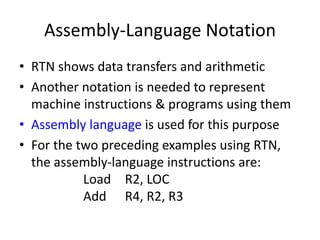
• For the two preceding examples using RTN,
the assembly-language instructions are:
Load R2, LOC
Add R4, R2, R3
Assembly-Language Notation
• An instruction specifies the desired operation
and the operands that are involved
• Examples in this chapter will use English words
for the operations (e.g., Load, Store, and Add)
• This helps emphasize fundamental concepts
• Commercial processors use mnemonics,
usually abbreviations (e.g., LD, ST, and ADD)
• Mnemonics differ from processor to processor
RISC and CISC Instruction Sets
• Nature of instructions distinguishes computer
• Two fundamentally different approaches
• Reduced Instruction Set Computers (RISC)
have one-word instructions and
require arithmetic operands to be in registers
• Complex Instruction Set Computers (CISC)
have multi-word instructions and
allow operands directly from memory
RISC Instruction Sets
• Focus on RISC first because it is simpler
• RISC instructions each occupy a single word
• A load/store architecture is used, meaning:
–only Load and Store instructions are used
to access memory operands
–operands for arithmetic/logic instructions
must be in registers, or one of them
may be given explicitly in instruction word
RISC Instruction Sets
• Instructions/data are stored in the memory
• Processor register contents are initially invalid
• Because RISC requires register operands,
data transfers are required before arithmetic
• The Load instruction is used for this purpose:
Load procr_register, mem_location
• Addressing mode specifies memory location;
different modes are discussed later
RISC Instruction Sets
• Consider high-level language statement:
C  A  B
• A, B, and C correspond to memory locations
• RTN specification with these symbolic names:
C  [A]  [B]
• Steps: fetch contents of locations A and B,
compute sum, and transfer result to location C
RISC Instruction Sets
• Sequence of simple RISC instructions for task:
Load R2, A
Load R3, B
Add R4, R2, R3
Store R4, C
• Load instruction transfers data to register
• Store instruction transfers data to the memory
• Destination differs with same operand order
A Program in the Memory
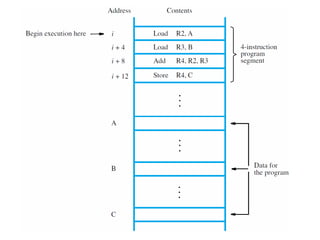
• Consider the preceding 4-instruction program
• How is it stored in the memory?
(32-bit word length, byte-addressable)
• Place first RISC instruction word at address i
• Remaining instructions are at i  4, i  8, i  12
• For now, assume that Load/Store instructions
specify desired operand address directly;
this issue is discussed in detail later
Instruction Execution/Sequencing
• How is the program executed?
• Processor has program counter (PC) register
• Address i for first instruction placed in PC
• Control circuits fetch and execute instructions,
one after another  straight-line sequencing
• During execution of each instruction,
PC register is incremented by 4
• PC contents are i  16 after Store is executed
Details of Instruction Execution
• Two-phase procedure: fetch and execute
• Fetch involves Read operation using PC value
• Data placed in processor instruction register (IR)
• To complete execution, control circuits
examine encoded machine instruction in IR
• Specified operation is performed in steps,
e.g., transfer operands, perform arithmetic
• Also, PC is incremented, ready for next fetch
Branching
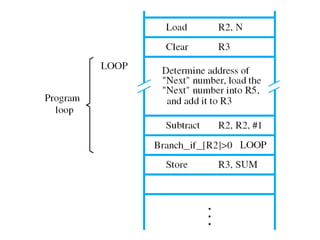
• Concept of branching illustrated with a
program that adds a list of numbers
• Same operations performed repeatedly,
so the program contains a loop
• Loop body is straight-line instruction sequence
• It must determine address of next number,
load value from the memory, and add to sum
• Branch instruction causes repetition of body
Branching
• Assume that size of list, n, stored at location N
• Use register R2 as a counter, initialized from N
• Body of loop includes the instruction
Subtract R2, R2, #1
to decrement counter in each loop pass
• Branch_if_[R2]0 goes to branch target LOOP
as long as contents of R2 are greater than zero
• Therefore, this is a conditional branch
Branching
• Branches that test a condition are used in
loops and various other programming tasks
• One way to implement conditional branches
is to compare contents of two registers, e.g.,
Branch_if_[R4][R5] LOOP
• In generic assembly language with mnemonics
the same instruction might actually appear as
BGT R4, R5, LOOP
Generating Memory Addresses
• Loop must obtain next number in each pass
• Load instruction cannot contain full address since
address size (32 bits)  instruction size
• Also, Load instruction itself would have to be
modified in each pass to change address
• Instead, use register Ri for address location
• Initialize to NUM1, increment by 4 inside loop
• Addressing modes - flexible ways to specify the
address of an operand.
LU5- Addressing Modes
Addressing Modes
• Addressing modes provide compiler with
different ways to specify operand locations
• Consider modes used in RISC-style processors
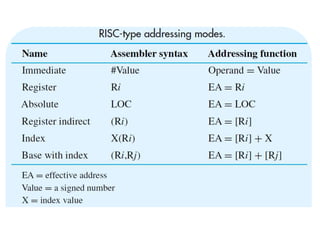
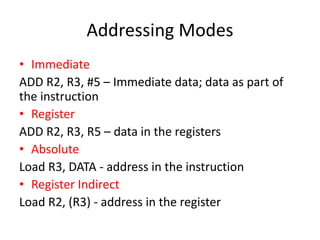
Addressing Modes
• Immediate
ADD R2, R3, #5 – Immediate data; data as part of
the instruction
• Register
ADD R2, R3, R5 – data in the registers
• Absolute
Load R3, DATA - address in the instruction
• Register Indirect
Load R2, (R3) - address in the register
Addressing Modes
• Index
Load R2, X(R3) – address specified as two parts
• Base With Index
Load R2, (R3,R4) – address specified in two
registers
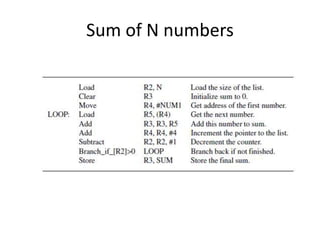
Sum of N numbers
Addressing Modes
• RISC-style instructions have a fixed size, hence
absolute mode information limited to 16 bits
• Usually sign-extended to full 32-bit address
• Absolute mode is therefore limited
to a subset of the full 32-bit address space
• Assume programs are limited to this subset
Try Yourself
• Write a assembly language program to sum N
numbers using indexed addressing mode.
sum = sum + a[i]
• Write a assembly language program to add a
scalar(constant) to an array of N numbers.
a[i] = a[i] + c
• Write a assembly language program to add
two arrays of size N.
c[i] = a[i] + b[i]

LU3- 4 Instructions and Sequencing.pptx

  • 1.
  • 2.
    Instructions and Sequencing •Instructions for a computer must support: –data transfers to and from the memory –arithmetic and logic operations on data –program sequencing and control –input/output transfers • First consider data transfer & arithmetic/logic • Control and input/output examined later
  • 3.
    Register Transfer Notation •Register transfer notation is used to describe hardware-level data transfers and operations • Predefined names for processor registers (like R0,R1) and I/O registers (like DATAIN) • Arbitrary names for locations in memory(A,B,LOC,DATA) • Use […] to denote contents of a location • Use  to denote transfer to a destination • Example: R2  [LOC] (transfer from LOC in memory to register R2)
  • 4.
    Register Transfer Notation •RTN can be extended to also show arithmetic operations involving locations • Example: R4  [R2]  [R3] (add the contents of registers R2 and R3, place the sum in register R4) • Right-hand expression always denotes a value, left-hand side always names a location
  • 5.
    Assembly-Language Notation • RTNshows data transfers and arithmetic • Another notation is needed to represent machine instructions & programs using them • Assembly language is used for this purpose • For the two preceding examples using RTN, the assembly-language instructions are: Load R2, LOC Add R4, R2, R3
  • 6.
    Assembly-Language Notation • Aninstruction specifies the desired operation and the operands that are involved • Examples in this chapter will use English words for the operations (e.g., Load, Store, and Add) • This helps emphasize fundamental concepts • Commercial processors use mnemonics, usually abbreviations (e.g., LD, ST, and ADD) • Mnemonics differ from processor to processor
  • 7.
    RISC and CISCInstruction Sets • Nature of instructions distinguishes computer • Two fundamentally different approaches • Reduced Instruction Set Computers (RISC) have one-word instructions and require arithmetic operands to be in registers • Complex Instruction Set Computers (CISC) have multi-word instructions and allow operands directly from memory
  • 8.
    RISC Instruction Sets •Focus on RISC first because it is simpler • RISC instructions each occupy a single word • A load/store architecture is used, meaning: –only Load and Store instructions are used to access memory operands –operands for arithmetic/logic instructions must be in registers, or one of them may be given explicitly in instruction word
  • 9.
    RISC Instruction Sets •Instructions/data are stored in the memory • Processor register contents are initially invalid • Because RISC requires register operands, data transfers are required before arithmetic • The Load instruction is used for this purpose: Load procr_register, mem_location • Addressing mode specifies memory location; different modes are discussed later
  • 10.
    RISC Instruction Sets •Consider high-level language statement: C  A  B • A, B, and C correspond to memory locations • RTN specification with these symbolic names: C  [A]  [B] • Steps: fetch contents of locations A and B, compute sum, and transfer result to location C
  • 11.
    RISC Instruction Sets •Sequence of simple RISC instructions for task: Load R2, A Load R3, B Add R4, R2, R3 Store R4, C • Load instruction transfers data to register • Store instruction transfers data to the memory • Destination differs with same operand order
  • 12.
    A Program inthe Memory • Consider the preceding 4-instruction program • How is it stored in the memory? (32-bit word length, byte-addressable) • Place first RISC instruction word at address i • Remaining instructions are at i  4, i  8, i  12 • For now, assume that Load/Store instructions specify desired operand address directly; this issue is discussed in detail later
  • 14.
    Instruction Execution/Sequencing • Howis the program executed? • Processor has program counter (PC) register • Address i for first instruction placed in PC • Control circuits fetch and execute instructions, one after another  straight-line sequencing • During execution of each instruction, PC register is incremented by 4 • PC contents are i  16 after Store is executed
  • 15.
    Details of InstructionExecution • Two-phase procedure: fetch and execute • Fetch involves Read operation using PC value • Data placed in processor instruction register (IR) • To complete execution, control circuits examine encoded machine instruction in IR • Specified operation is performed in steps, e.g., transfer operands, perform arithmetic • Also, PC is incremented, ready for next fetch
  • 16.
    Branching • Concept ofbranching illustrated with a program that adds a list of numbers • Same operations performed repeatedly, so the program contains a loop • Loop body is straight-line instruction sequence • It must determine address of next number, load value from the memory, and add to sum • Branch instruction causes repetition of body
  • 18.
    Branching • Assume thatsize of list, n, stored at location N • Use register R2 as a counter, initialized from N • Body of loop includes the instruction Subtract R2, R2, #1 to decrement counter in each loop pass • Branch_if_[R2]0 goes to branch target LOOP as long as contents of R2 are greater than zero • Therefore, this is a conditional branch
  • 19.
    Branching • Branches thattest a condition are used in loops and various other programming tasks • One way to implement conditional branches is to compare contents of two registers, e.g., Branch_if_[R4][R5] LOOP • In generic assembly language with mnemonics the same instruction might actually appear as BGT R4, R5, LOOP
  • 20.
    Generating Memory Addresses •Loop must obtain next number in each pass • Load instruction cannot contain full address since address size (32 bits)  instruction size • Also, Load instruction itself would have to be modified in each pass to change address • Instead, use register Ri for address location • Initialize to NUM1, increment by 4 inside loop • Addressing modes - flexible ways to specify the address of an operand.
  • 21.
  • 22.
    Addressing Modes • Addressingmodes provide compiler with different ways to specify operand locations • Consider modes used in RISC-style processors
  • 24.
    Addressing Modes • Immediate ADDR2, R3, #5 – Immediate data; data as part of the instruction • Register ADD R2, R3, R5 – data in the registers • Absolute Load R3, DATA - address in the instruction • Register Indirect Load R2, (R3) - address in the register
  • 25.
    Addressing Modes • Index LoadR2, X(R3) – address specified as two parts • Base With Index Load R2, (R3,R4) – address specified in two registers
  • 26.
    Sum of Nnumbers
  • 27.
    Addressing Modes • RISC-styleinstructions have a fixed size, hence absolute mode information limited to 16 bits • Usually sign-extended to full 32-bit address • Absolute mode is therefore limited to a subset of the full 32-bit address space • Assume programs are limited to this subset
  • 28.
    Try Yourself • Writea assembly language program to sum N numbers using indexed addressing mode. sum = sum + a[i] • Write a assembly language program to add a scalar(constant) to an array of N numbers. a[i] = a[i] + c • Write a assembly language program to add two arrays of size N. c[i] = a[i] + b[i]