Self-Guided Social Media Training
Learning Team B
AET 562
April 18, 2016
Dr. Sean Spear
Overview
Ethical Dilemmas
• Comprehensive guidelines
and procedures must be
created
• Staff must manage their
online reputations
• Staff must maintain
professionalism
Levels of Importance
• Organizations can’t
compete without it
• Quality employee training
= increased employee
productivity and growth
Social Learning
Barriers
• Social learning isn’t
predetermined, it’s
organic
• Organizations must
create safe learning
environments that
promote collaboration
Roles
• Learning doesn’t stop
when the training is over
• Learning doesn’t happen
alone, learning combines
interaction and
observation
Problem Solving
3 Ways Online Discussions Can Enhance Your Learning and Teaching Practice . (2016). Retrieved from
http://blogs.ntu.ac.uk/digital_practice/2016/01/14/3-ways-online-discussions-can-enhance-your-learning-and-
teaching-practice/
Problem Solving
Dramatically change
how you approach
solving a problem.
You are no longer
expected to carry the
burden alone. Place
the power in the
hands of your online
community.
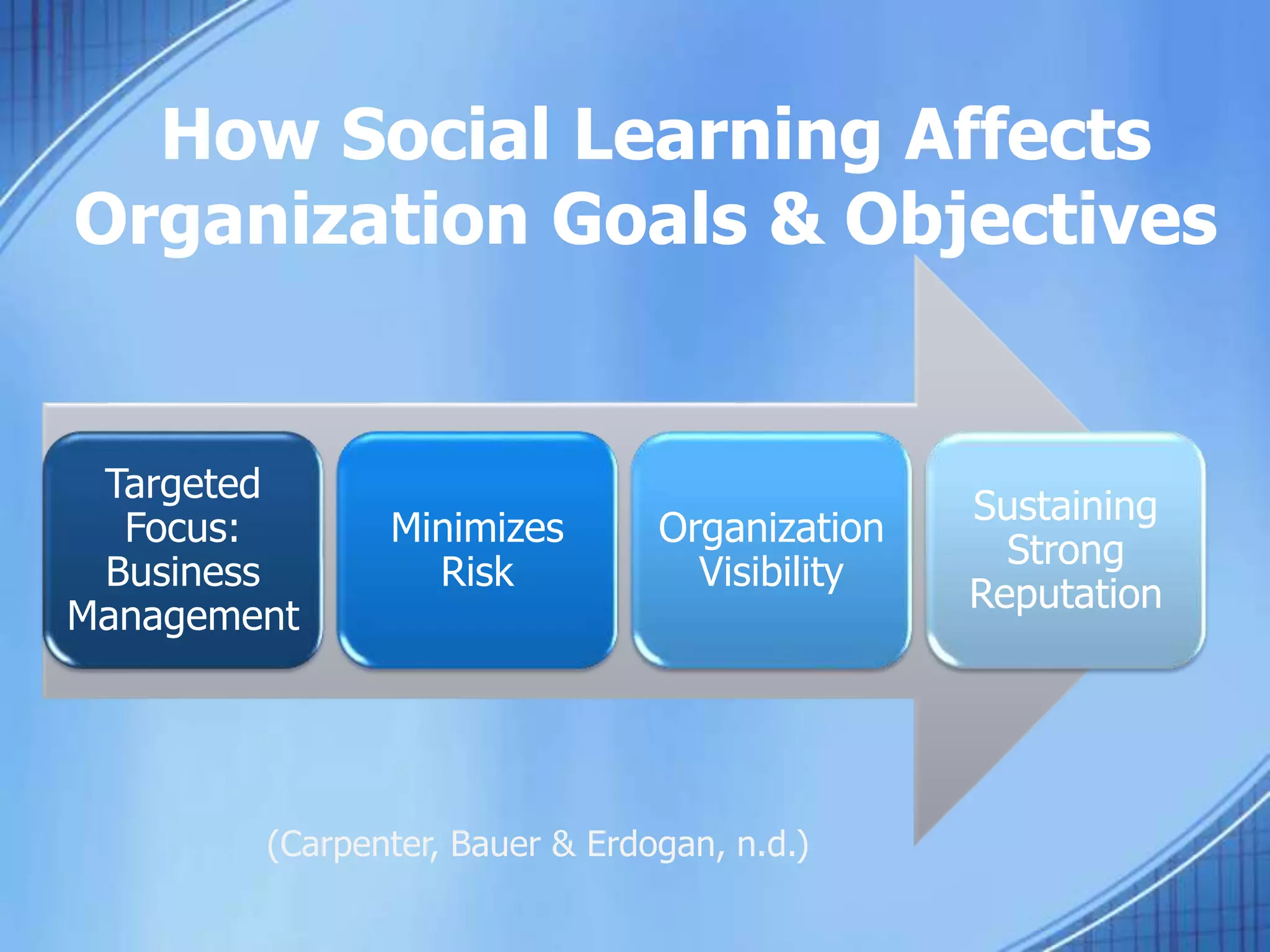
How Social Learning Affects
Organization Goals & Objectives
Targeted
Focus:
Business
Management
Minimizes
Risk
Organization
Visibility
Sustaining
Strong
Reputation
(Carpenter, Bauer & Erdogan, n.d.)
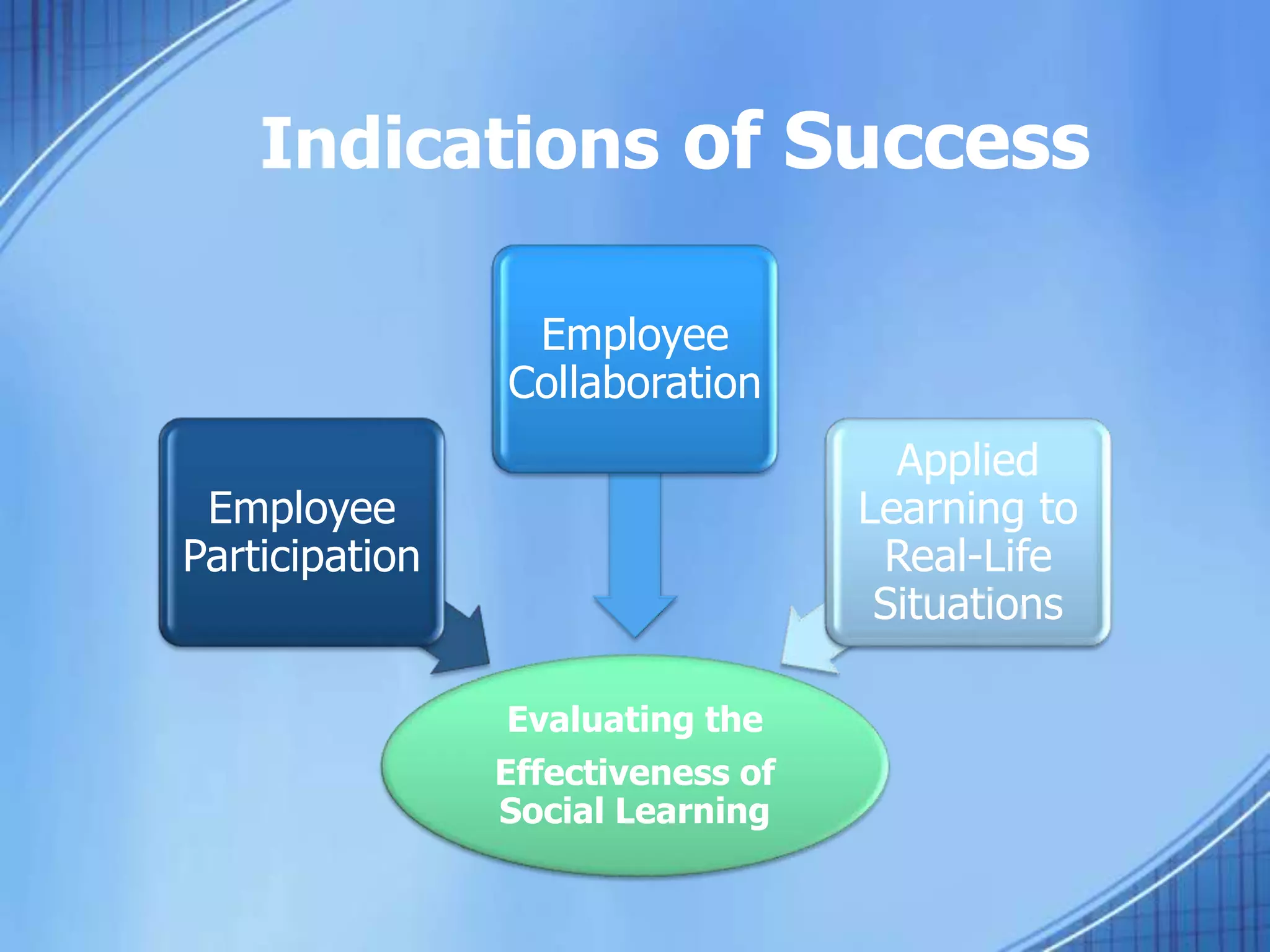
Indications of Success
Evaluating the
Effectiveness of
Social Learning
Employee
Participation
Employee
Collaboration
Applied
Learning to
Real-Life
Situations
Resource Allocation
Human
Resources
Financial
Resources
Material/Technological
Resources
Accountability
Social Media & Social Learning
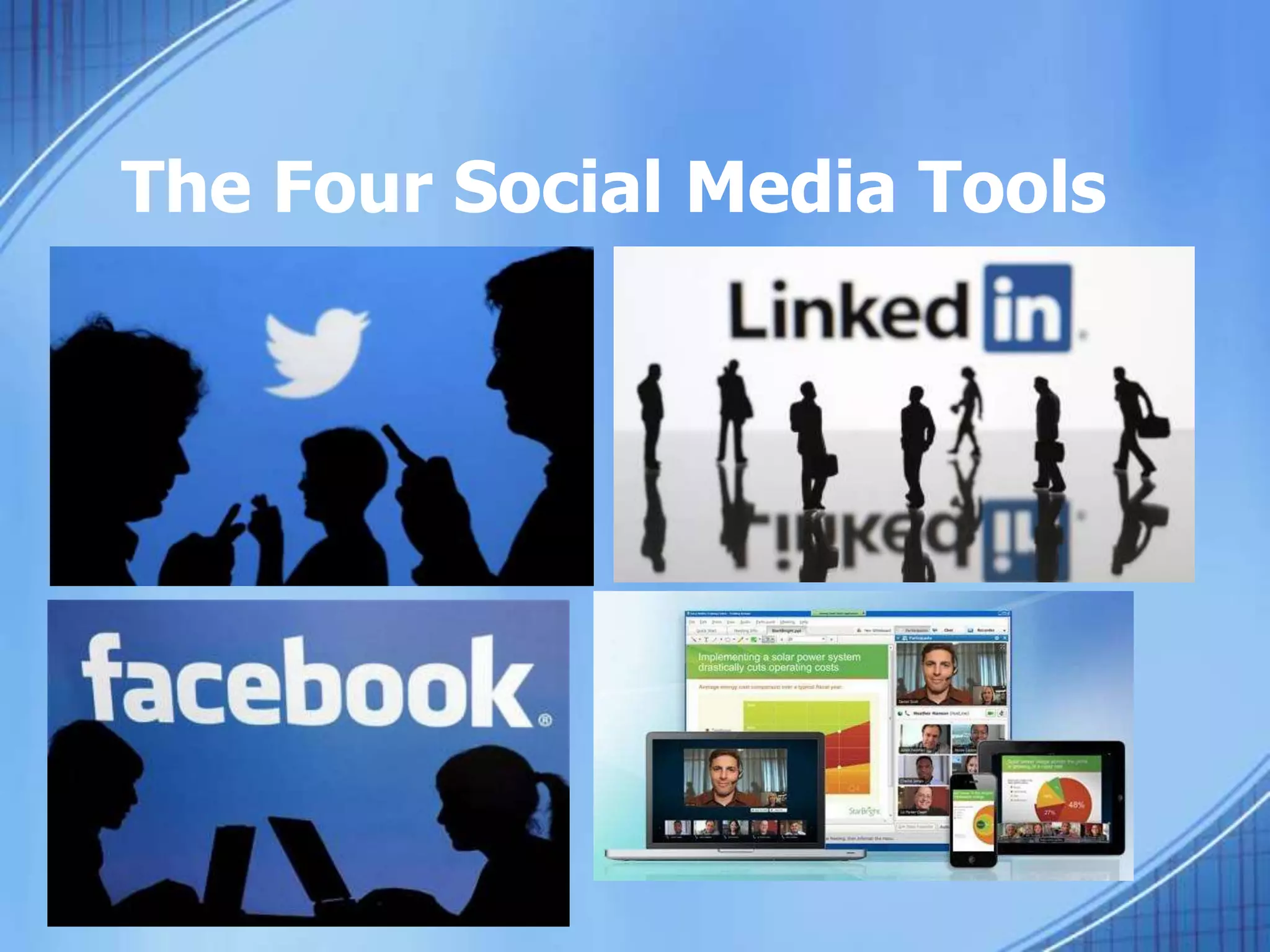
The Four Social Media Tools
References
• 3 Ways Online Discussions Can Enhance Your Learning and Teaching Practice . (2016). Retrieved
from http://blogs.ntu.ac.uk/digital_practice/2016/01/14/3-ways-online-discussions-can-enhance-
your-learning-and-teaching-practice/
• Carpenter, M., Bauer, T., & Erdogan, B. (n.d.) Integrating Goals and Objectives with Corporate
Social Responsibility. Retrieved from http://2012books.lardbucket.org/books/management-
principles-v1.0/s10-05-integrating-goals-and-objectiv.html
• Leonardi, P.M., Huysman, M., & Steinfield, C. (2013). Enterprise Social Media: Definition, History,
and Prospects for the Study of Social Technologies in Organizations. Journal Of Computer-
Mediated Communication, 19(1). Doi:10.1111/jc4.12029
• Pandey, A. (2016). Why You Should Adopt Social Learning. Retrieved from
http://elearningindustry.com/why-you-should-adopt-social-learning
• Rouse, M. (2015, February). LinkedIn. Retrieved from
http://whatis.techtarget.com/definition/LinkedIn
• Ericksen, C. (2011, November). What is WebEx? A Cool Way to Have an Online Meeting.
Retrieved from http://blogs.cisco.com/home/what-is-webex-a-cool-way-to-have-an-online-
meeting
• Lau, D. (2015). Take Online Education to t New Level. Retrieved from
https://www.webex.com/content/dam/webex/eopi/Americas/USA/en_us/documents/pdf/TC/pdf-
TC-Education-Overview.pdf

LTB Social Media Presentation

  • 1.
    Self-Guided Social MediaTraining Learning Team B AET 562 April 18, 2016 Dr. Sean Spear
  • 2.
    Overview Ethical Dilemmas • Comprehensiveguidelines and procedures must be created • Staff must manage their online reputations • Staff must maintain professionalism Levels of Importance • Organizations can’t compete without it • Quality employee training = increased employee productivity and growth
  • 3.
    Social Learning Barriers • Sociallearning isn’t predetermined, it’s organic • Organizations must create safe learning environments that promote collaboration Roles • Learning doesn’t stop when the training is over • Learning doesn’t happen alone, learning combines interaction and observation
  • 4.
    Problem Solving 3 WaysOnline Discussions Can Enhance Your Learning and Teaching Practice . (2016). Retrieved from http://blogs.ntu.ac.uk/digital_practice/2016/01/14/3-ways-online-discussions-can-enhance-your-learning-and- teaching-practice/
  • 5.
    Problem Solving Dramatically change howyou approach solving a problem. You are no longer expected to carry the burden alone. Place the power in the hands of your online community.
  • 6.
    How Social LearningAffects Organization Goals & Objectives Targeted Focus: Business Management Minimizes Risk Organization Visibility Sustaining Strong Reputation (Carpenter, Bauer & Erdogan, n.d.)
  • 7.
    Indications of Success Evaluatingthe Effectiveness of Social Learning Employee Participation Employee Collaboration Applied Learning to Real-Life Situations
  • 8.
  • 9.
  • 10.
    Social Media &Social Learning
  • 11.
    The Four SocialMedia Tools
  • 12.
    References • 3 WaysOnline Discussions Can Enhance Your Learning and Teaching Practice . (2016). Retrieved from http://blogs.ntu.ac.uk/digital_practice/2016/01/14/3-ways-online-discussions-can-enhance- your-learning-and-teaching-practice/ • Carpenter, M., Bauer, T., & Erdogan, B. (n.d.) Integrating Goals and Objectives with Corporate Social Responsibility. Retrieved from http://2012books.lardbucket.org/books/management- principles-v1.0/s10-05-integrating-goals-and-objectiv.html • Leonardi, P.M., Huysman, M., & Steinfield, C. (2013). Enterprise Social Media: Definition, History, and Prospects for the Study of Social Technologies in Organizations. Journal Of Computer- Mediated Communication, 19(1). Doi:10.1111/jc4.12029 • Pandey, A. (2016). Why You Should Adopt Social Learning. Retrieved from http://elearningindustry.com/why-you-should-adopt-social-learning • Rouse, M. (2015, February). LinkedIn. Retrieved from http://whatis.techtarget.com/definition/LinkedIn • Ericksen, C. (2011, November). What is WebEx? A Cool Way to Have an Online Meeting. Retrieved from http://blogs.cisco.com/home/what-is-webex-a-cool-way-to-have-an-online- meeting • Lau, D. (2015). Take Online Education to t New Level. Retrieved from https://www.webex.com/content/dam/webex/eopi/Americas/USA/en_us/documents/pdf/TC/pdf- TC-Education-Overview.pdf

Editor's Notes

  • #3 Ethical Dilemmas -To reduce potential ethical dilemmas, organizations must create comprehensive guidelines within their social media policy and procedures. By creating a comprehensive social media policy, staff can be educated on the dos and don’ts and proper behavior. Staff must understand their companies core values and make decisions that line up with their organizations online reputations. Employees need to understand how quickly they can tarnish their companies reputation with poor decision making. Communicating via social media on platforms like Twitter and Facebook is the same as communicating at work. Employees must take social media communication just as serious. Levels of Importance – Business is changing in today’s marketplace. For organizations to compete and to continue to grow, social media will be a vital tool to help the organization progress forward. The challenge today isn’t trying to figure out if social media should be integrated to day-to-day work. The challenge today is trying to determine which social media tools are best for the organization. Organizations must properly train staff on how to appropriately use the tools for maximum benefit. This provides the platform for the organization to show how much they truly value social media. As this occurs, the organization becomes more productive, because staff continues to learn and grow professionally.
  • #4 Barriers - The social learning environment is much different, because facilitators do not predetermine learning, learning arises organically, as staff work together to problem solve. Knowledge and skills are transferred from one individual or group to another, which in turn allows staff to grow because of it. Organizations need to create learning environments that promote collaboration, that feel safe, and where staff feel free to share their viewpoints. If this environment is not created, organizations will have talented staff keeping their knowledge to themselves. This keeps knowledge stuck in silos, and not shared. Roles –Organizations need to show their staff that they value idea sharing. This occurs when organizations realize that “learning doesn’t stop when lesson time is over” (Picocioli, 2015) and that they embrace staff working together to continue their growth and development. When formal training ends, organizations need to share the value of taking what has been taught in the classroom and to share success stories with each other . Social learning unlocks critically important tribal knowledge, and takes this knowledge from a few people transfers it to the whole organization. When the correct learning environment is created, think tanks are created where strategic collaboration and problem solving become the norm.
  • #5 Providing employees with a familiar outlet that simulates the working community aides in creating a solution focused mindset. Training your team to seek solutions in real-time as opposed to waiting for responses from the leader adds value to the organization as a whole. Empower individuals by promoting that their voice and research skills as vital for the greater good of the company. Help the team move beyond walls and time constraints. Concerns can now be perceived as achievable based on the network of colleagues who have come together for the purpose of solving problems. A structure for this process can be fostered by the facilitator at the onset of the communities creation. Some initial modeling of the process through facilitator questioning and probing will be necessary.
  • #6 Traditional approaches to problem solving involves some collaboration, but rarely extends beyond your internal department. Opening up the dialogue beyond your group increases the probability to view points beyond those in your network. In addition to increased opinions, best practices are reinforced and have an opportunity for replication by other stakeholders.
  • #7 Social media tools are implemented by the organization in an effort to provide communication avenues for their employees (Leonardi, Huysman & Steinfield, 2013). Social interactions foster social learning and it is these interactions that ultimately change the organization’s goals and objectives. The corporate social responsibility movement places targeted focus around the organization’s business management and how they positively impact our society (Carpenter, Bauer & Erdogan, n.d.). The movement itself provides value to all stakeholders within the business by minimizing the amount of risk associated with social media. Social learning enables the organization to establish a visible presence within the industry and maintain a strong reputation within the community.
  • #8 Social learning success can be determined by the amount of employee participation and collaboration efforts while utilizing a variety of social media tools. Employees demonstrate mastery through real-life applications. However, it is essential that the organization provides additional support and resources to continue to develop upon these skills. This continued focus will enable the organization to provide engaging content and foster simulated opportunities for learning.
  • #9 Allocating resources towards the integration of new tools that support social learning requires a good understanding of what is available and what the desired outcomes are. For example, we need X amount of people to monitor website hits in support of our new Facebook advertising campaign which would cost X amount of money this fiscal year with our current technological capabilities. Knowing the details and associated metrics may aid in the strategy that will be employed to manage the resources one would need to be successful in accomplish a set of objectives. It is important that the learning process within the organization be is as efficient as possible which is one reason why social media and associated tools may be implemented.
  • #10 Accountability regarding social media regarding usage and policy should be covered as often as needed. Increased accessibility and usage of technology poses multiple risks to an organization. Attitudes and behaviors associated with social learning should align to the organizations goals and objectives. To clearly define what actions are compliant, employees should be made aware of the policies and procedures set forth by the organization. Reference to the current policy and continual improvement of existing policy should be a priority within the organization.
  • #11 There are a plethora of social media tools available, which would enhance and benefit the social learning aspect of organizations. . It is important that we describe and breakdown the benefits of four powerful social media tools that will enhance your social learning. The social media tools are: LinkedIn, Twitter, WebEx, and Facebook.
  • #12 LinkedIn “LinkedIn is a social networking site designed specifically for the business community. The goal of the site is to allow registered members to establish and document networks of people they know and trust professionally.” (Rouse, 2015) There are so many benefits to LinkedIn, personally and professionally. This social media tool allows you to be discovered and connected with. You can align yourself with jobs and groups that interest you. You can also use LinkedIn to post your career accomplishments, achievements, and acknowledgements. Organizations are encouraging employees to browse LinkedIn and join groups. Groups that will enhance their contribution to the company, and groups that will promotes individual growth. It will be pertinent for you to not only join these types of groups, but create a group in your workplace where your fellow co-workers can exchange ideas and education. Twitter Twitter allows users to send and read content in 140 character messages called “tweets”. This feature enables people to connect, share information, and market a product or service, which can promote social learning within organizations. You can dramatically benefit from Twitter by following organizations, people and products in relation to your interests. You can also gain insight and information on important topics by following and utilizing “hashtags”, which allows you to gain valuable material from experts, people and organizations. Organizations can create hashtags within tweets for other members to follow. Learners will be able to provide feedback and communicate on the material presented (Pappas, 2013). This factors dramatically promotes social learning in all facets. You and your peers will have the ability to not only follow what is going on within the company, but can contribute to the information that was presented. WebEx Cisco’s “WebEx lets you have online meetings with anyone who has an Internet connection – including mobile users.” (Ericksen, 2011) This amazing social media tool makes a meeting come to life. Information can be shared and visible (ie. PowerPoint presentations). Conferences and lectures can be achieved and accessed. This is the most ideal social media tool for people are on the go and cannot make a meeting. Group collaborations hosted through the platforms web-conferencing tools, virtual breakout sessions targeting training highlights through the use of virtual meeting rooms, and self-paced learning accessed within an embedded library of recorded lectures all allow for a streamlined social learning experience (Lau, 2015). Facebook Facebook is a user-friendly social networking site that allows users to connect and share information with each other. The numerous capabilities such as real-time status updates, advertising, and mobile application make Facebook one of the core components of any social media component for organizational use. Private groups can be formed to post, respond and share information. Content can be shared through “tagging” another member and members can share their feelings on information by “liking” or posting a comment. Facebook is one of the core components of any social media component for an organization to use. Organizations can connect with their members, and through customized feeds and privacy settings, allow users to see and share only what they want to see. Engagement is fueled by targeted posts, contests, and advertising.