Ready To Learn Independent School District Department of Human Resources Priscilla Dawn Johnson EDUL 7023: Dr. Douglas Hermond May 8, 2010
Mission Statement for Ready To Learn Department of Human Resources WE  will sustain high academic achievement of all  Ready to Learn  students by recruiting, selecting, retaining, and supporting a diverse and highly talented staff.  WE   will train and educate our staff to be fluent in technical trends, cultural responsiveness, and excellent gatekeepers for the opportunities   WE  open for our students.  WE  are the voice for all staff, the developers of many, purposed to serve our students, who are   Ready To Learn.
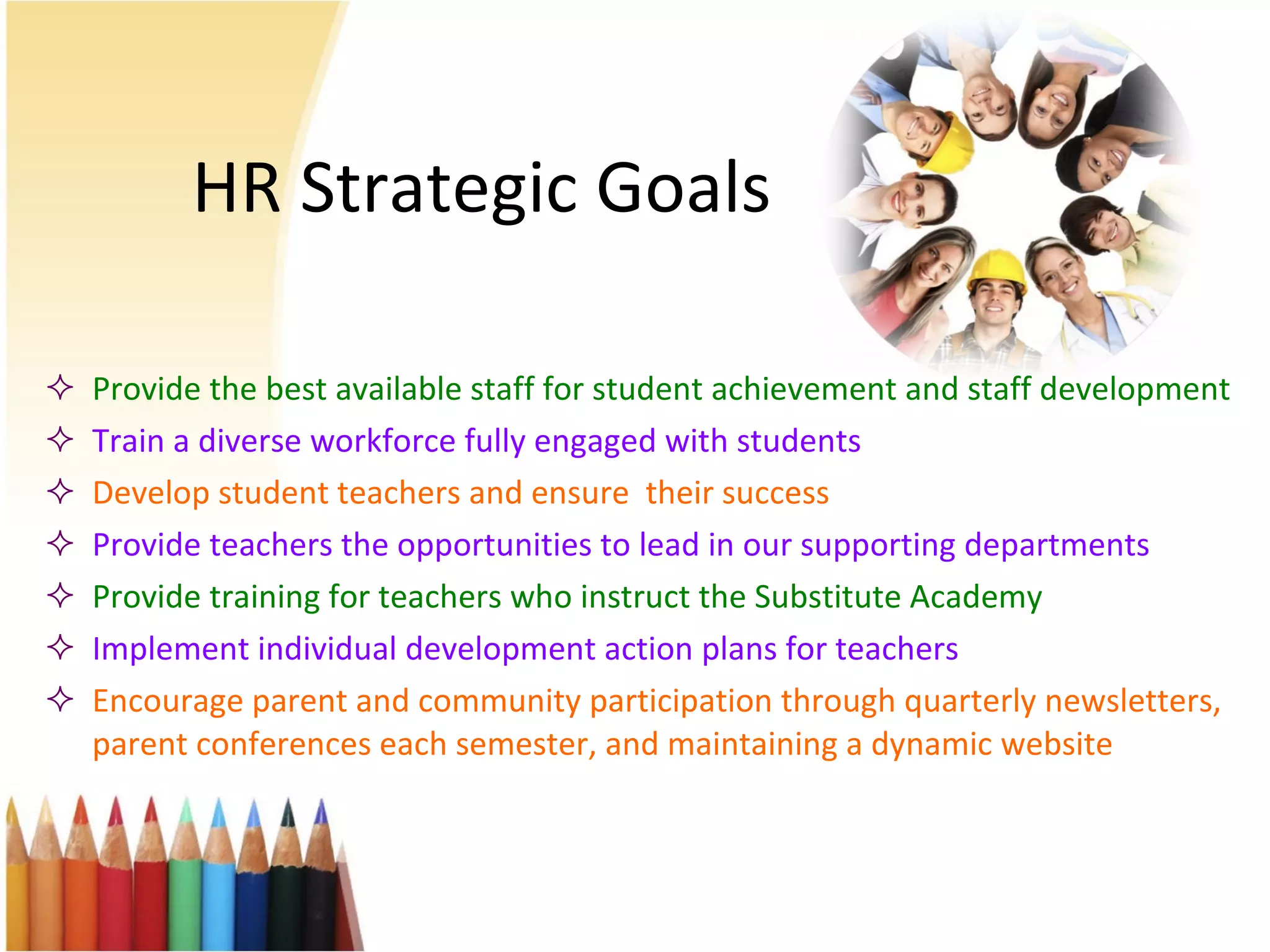
HR Strategic Goals Provide the best available staff for student achievement and staff development Train a diverse workforce fully engaged with students  Develop student teachers and ensure  their success Provide teachers the opportunities to lead in our supporting departments Provide training for teachers who instruct the Substitute Academy Implement individual development action plans for teachers Encourage parent and community participation through quarterly newsletters, parent conferences each semester, and maintaining a dynamic website
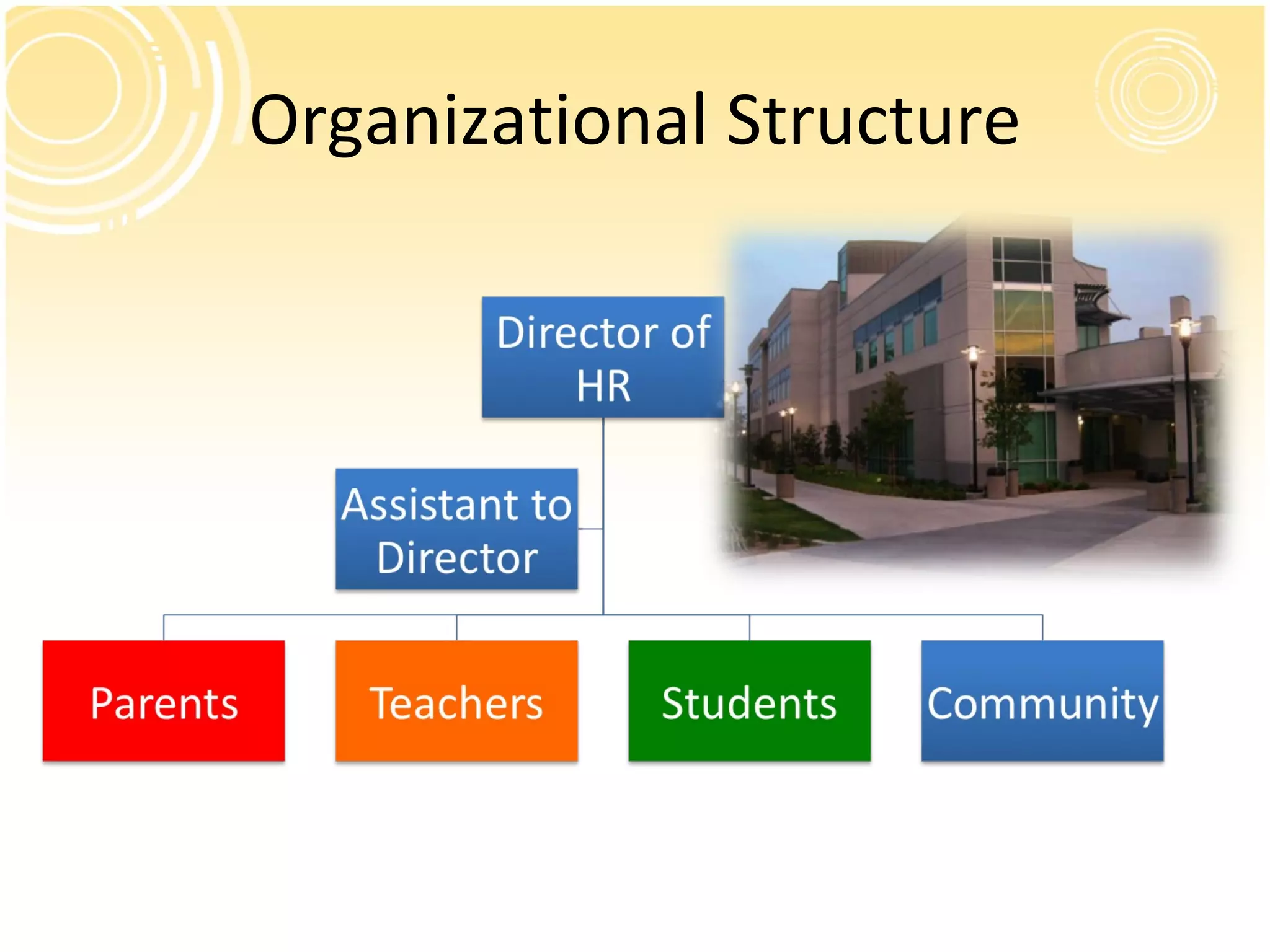
Organizational Structure
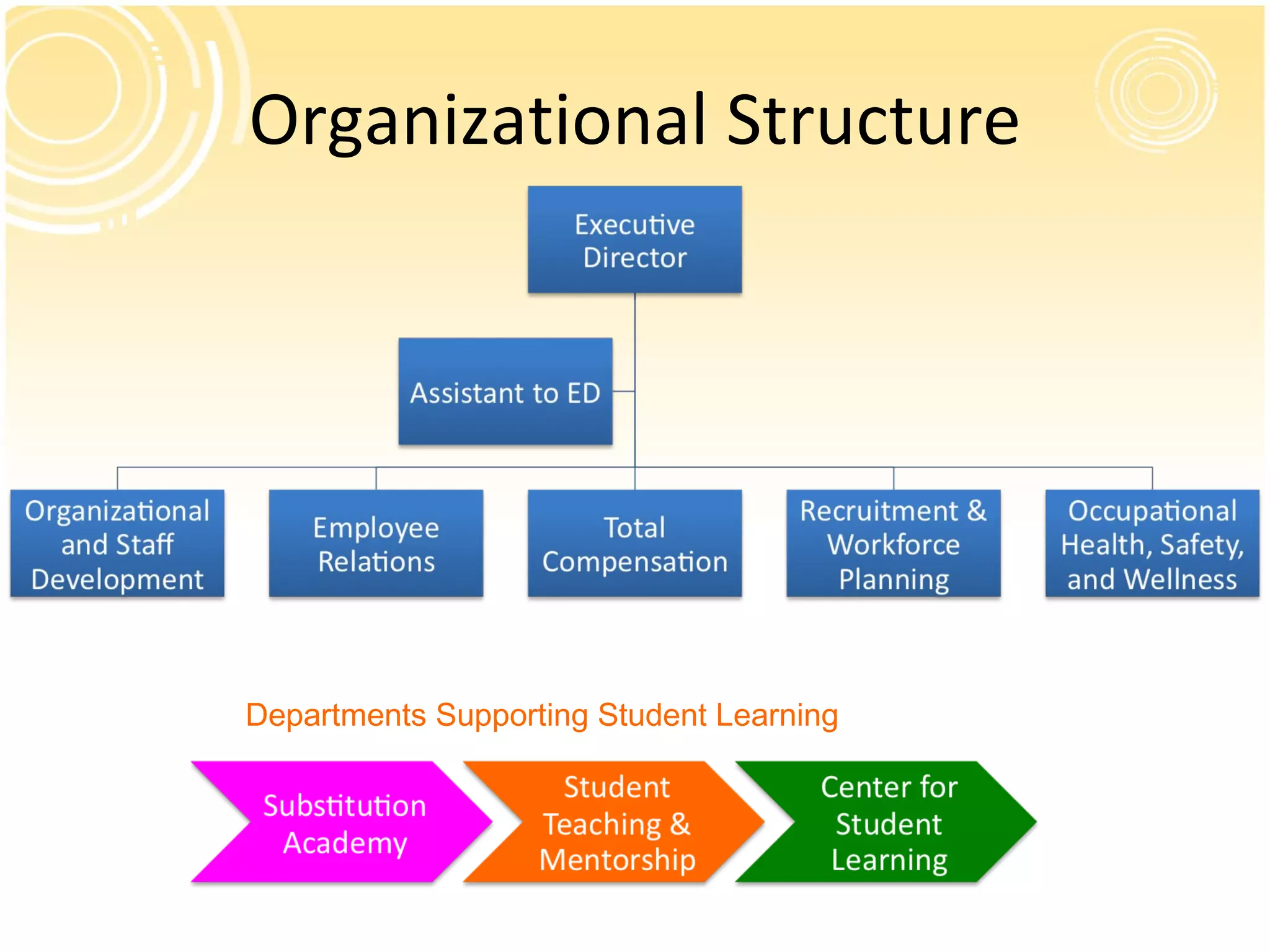
Organizational Structure Departments Supporting Student Learning
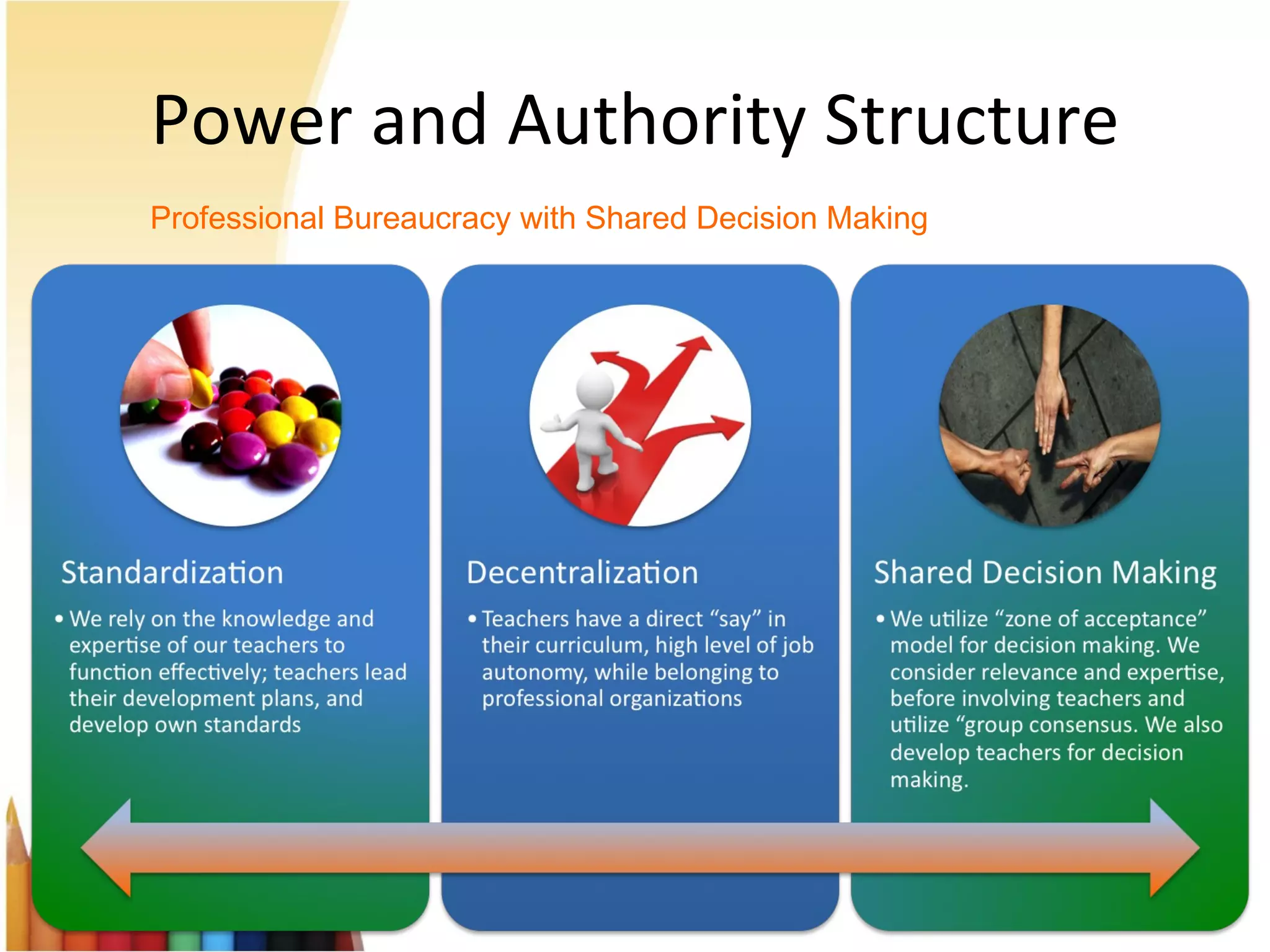
Power and Authority Structure Professional Bureaucracy with Shared Decision Making
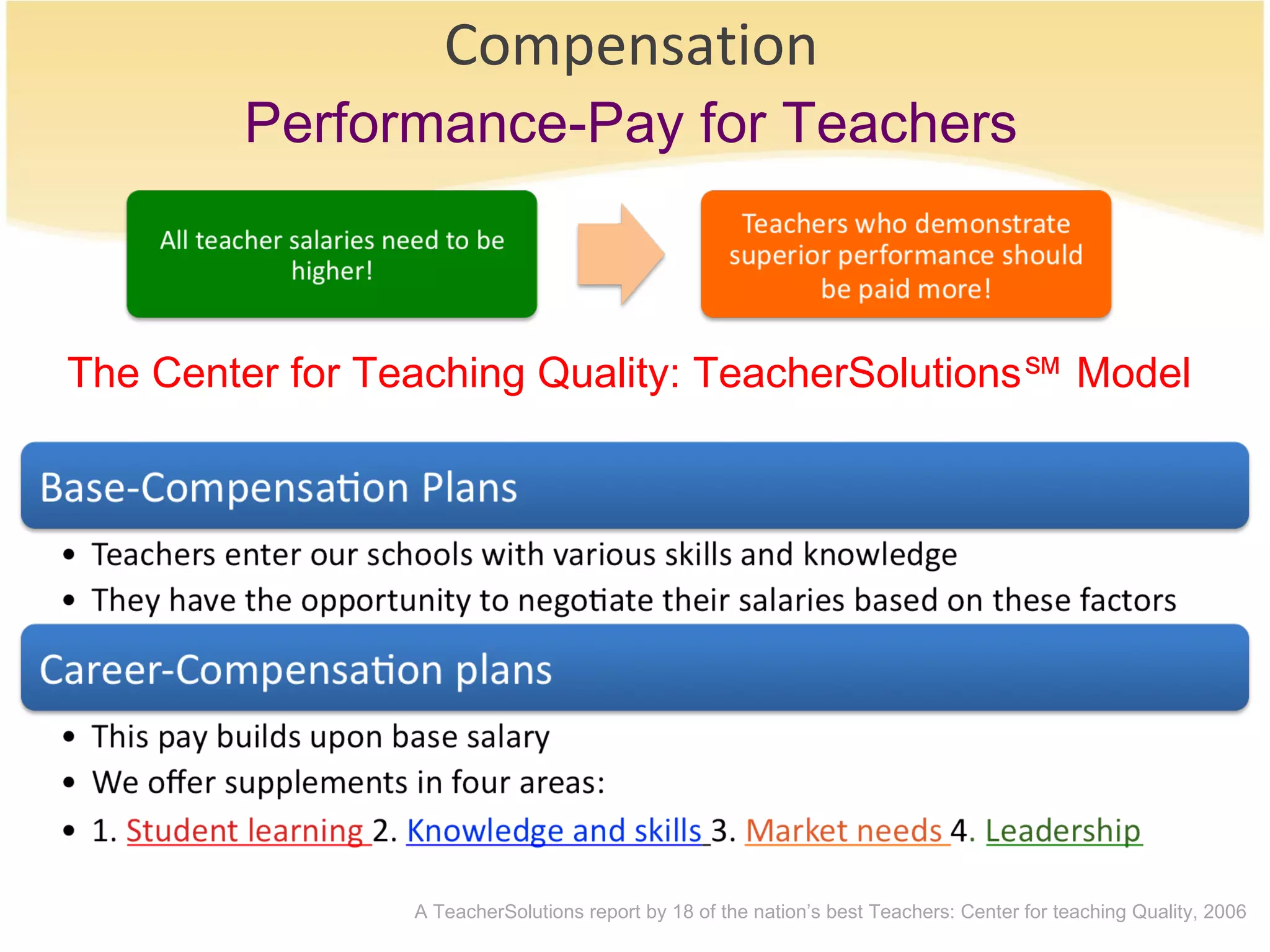
Compensation Performance-Pay for Teachers The Center for Teaching Quality: TeacherSolutions ℠ Model   A TeacherSolutions report by 18 of the nation’s best Teachers: Center for teaching Quality, 2006
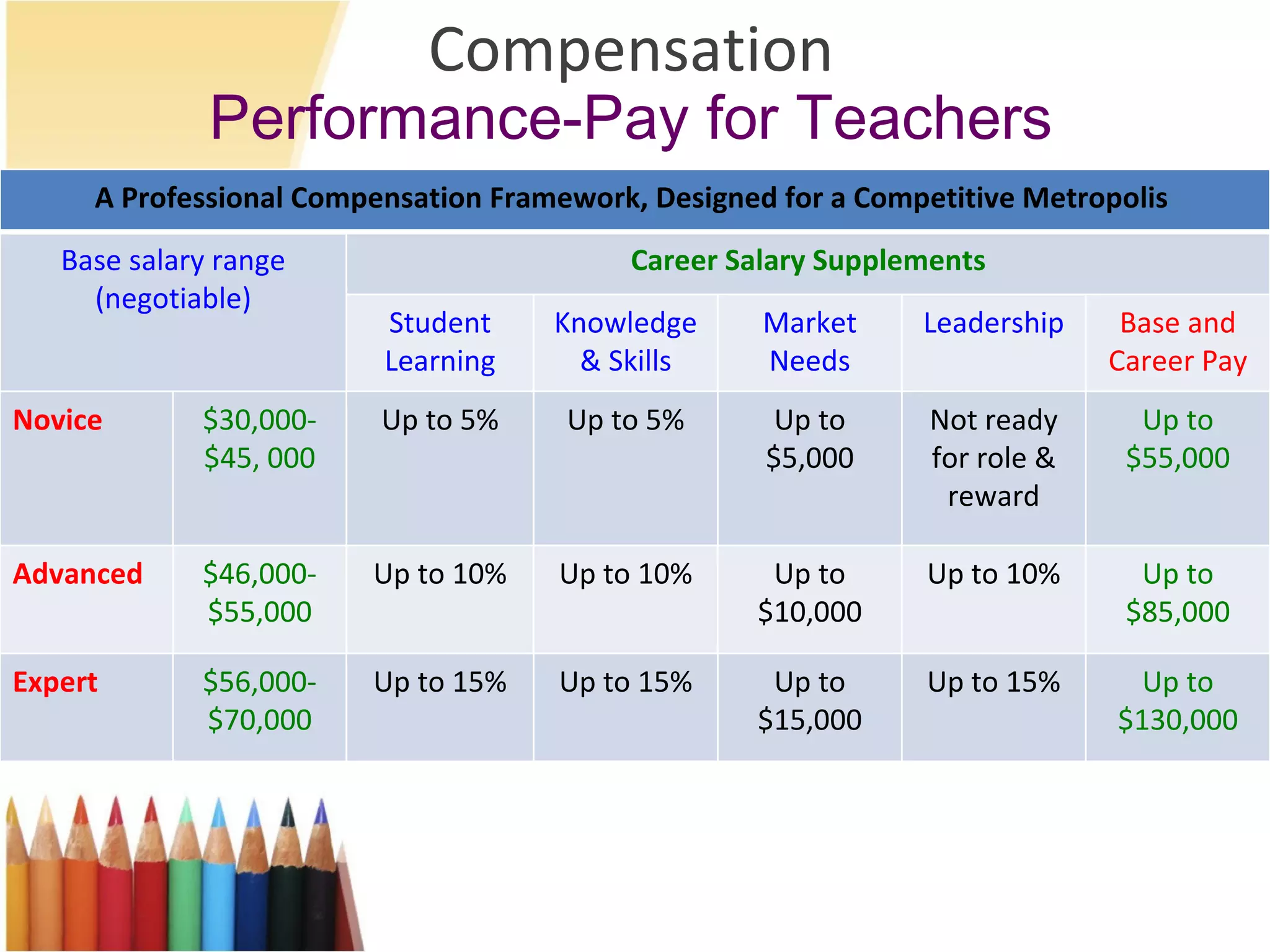
Compensation Performance-Pay for Teachers A Professional Compensation Framework, Designed for a Competitive Metropolis  Base salary range (negotiable) Career Salary Supplements Student Learning Knowledge & Skills Market Needs Leadership Base and Career Pay Novice $30,000-$45, 000 Up to 5% Up to 5% Up to $5,000 Not ready for role & reward Up to $55,000 Advanced $46,000-$55,000 Up to 10% Up to 10% Up to $10,000 Up to 10% Up to $85,000 Expert $56,000-$70,000 Up to 15% Up to 15% Up to $15,000 Up to 15% Up to $130,000
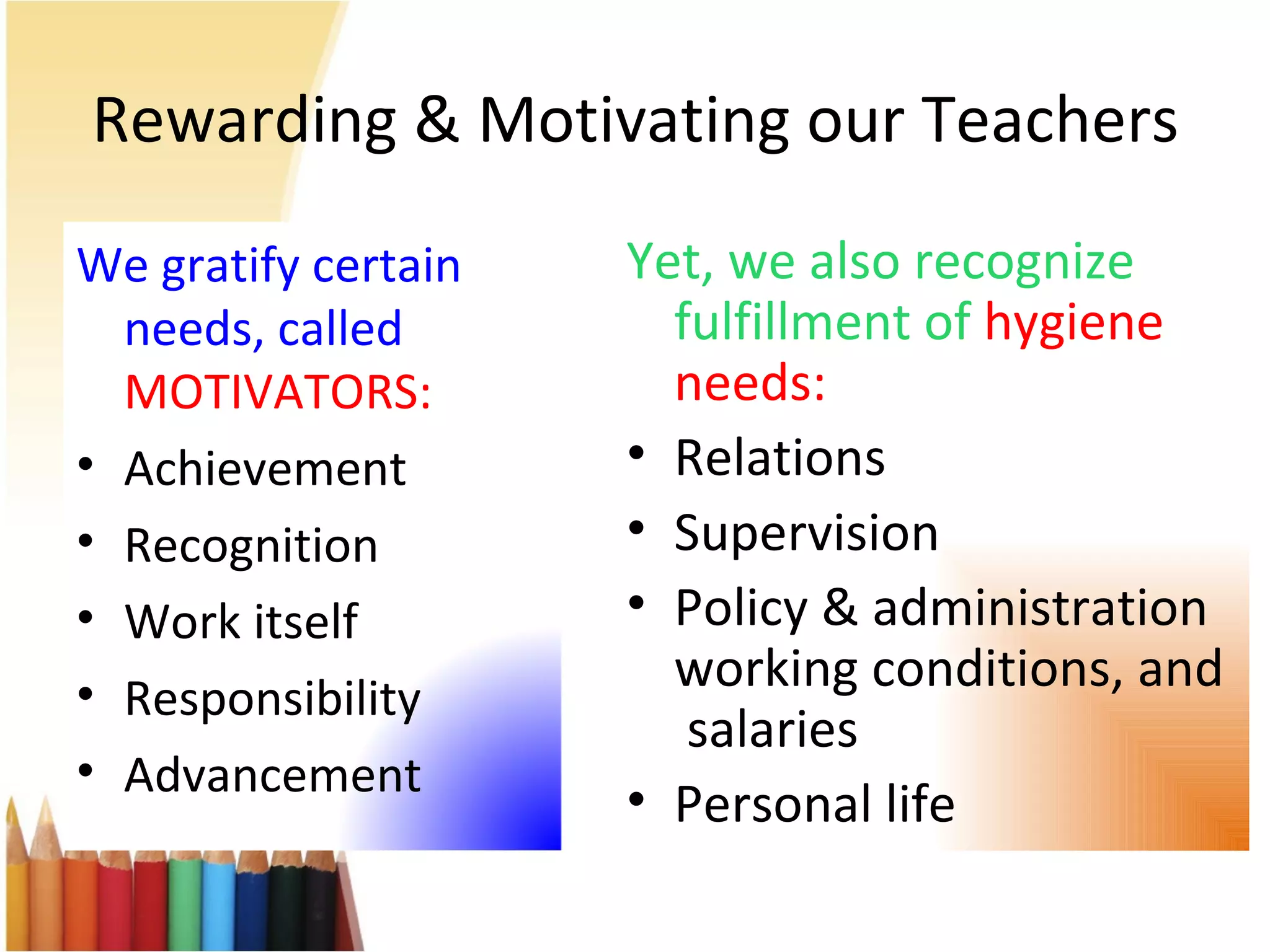
Rewarding & Motivating our Teachers Yet, we also recognize fulfillment of  hygiene needs: Relations Supervision Policy & administration working conditions, and  salaries  Personal life We gratify certain needs, called  MOTIVATORS: Achievement Recognition Work itself Responsibility Advancement
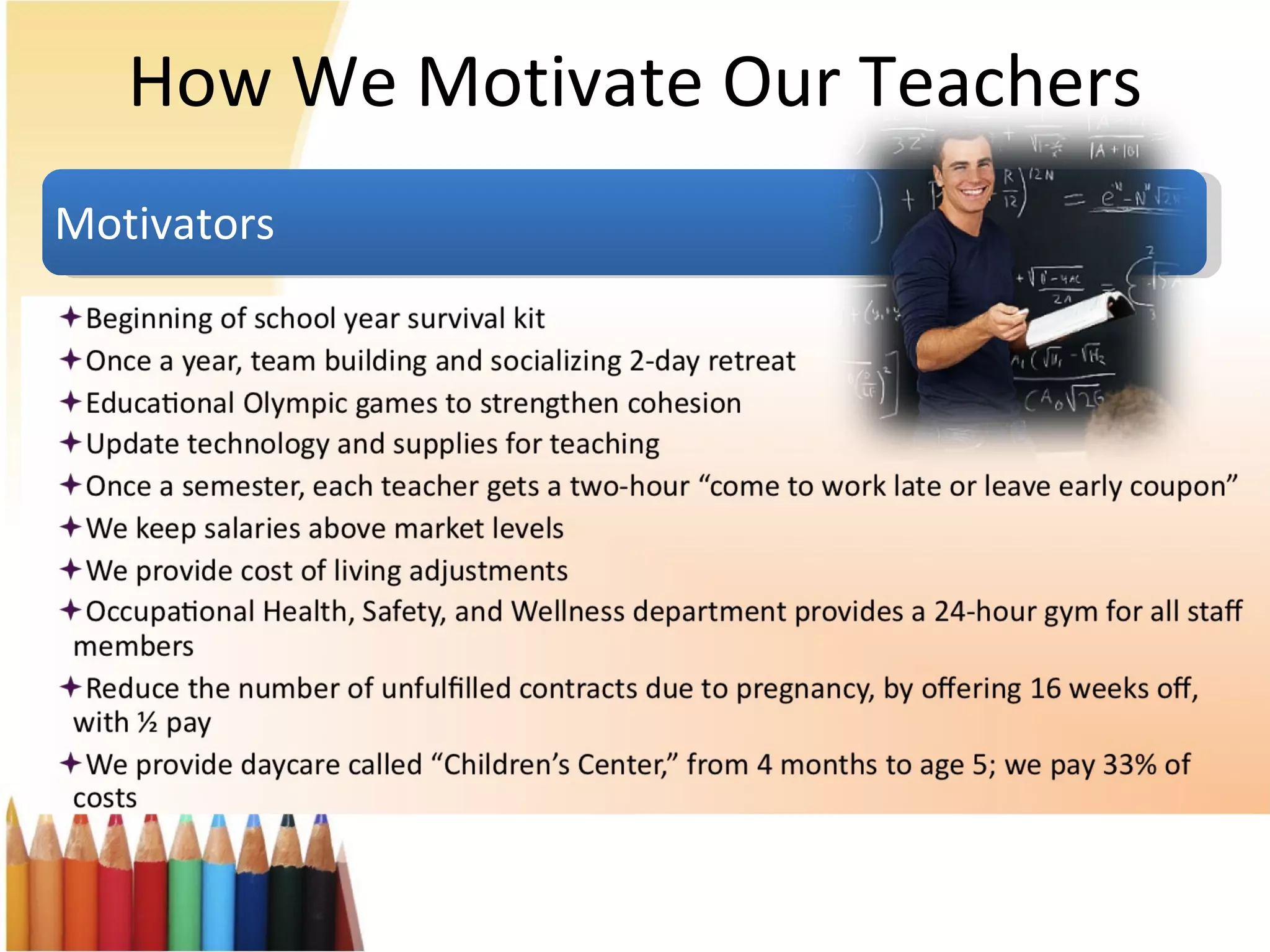
How We Motivate Our Teachers Motivators
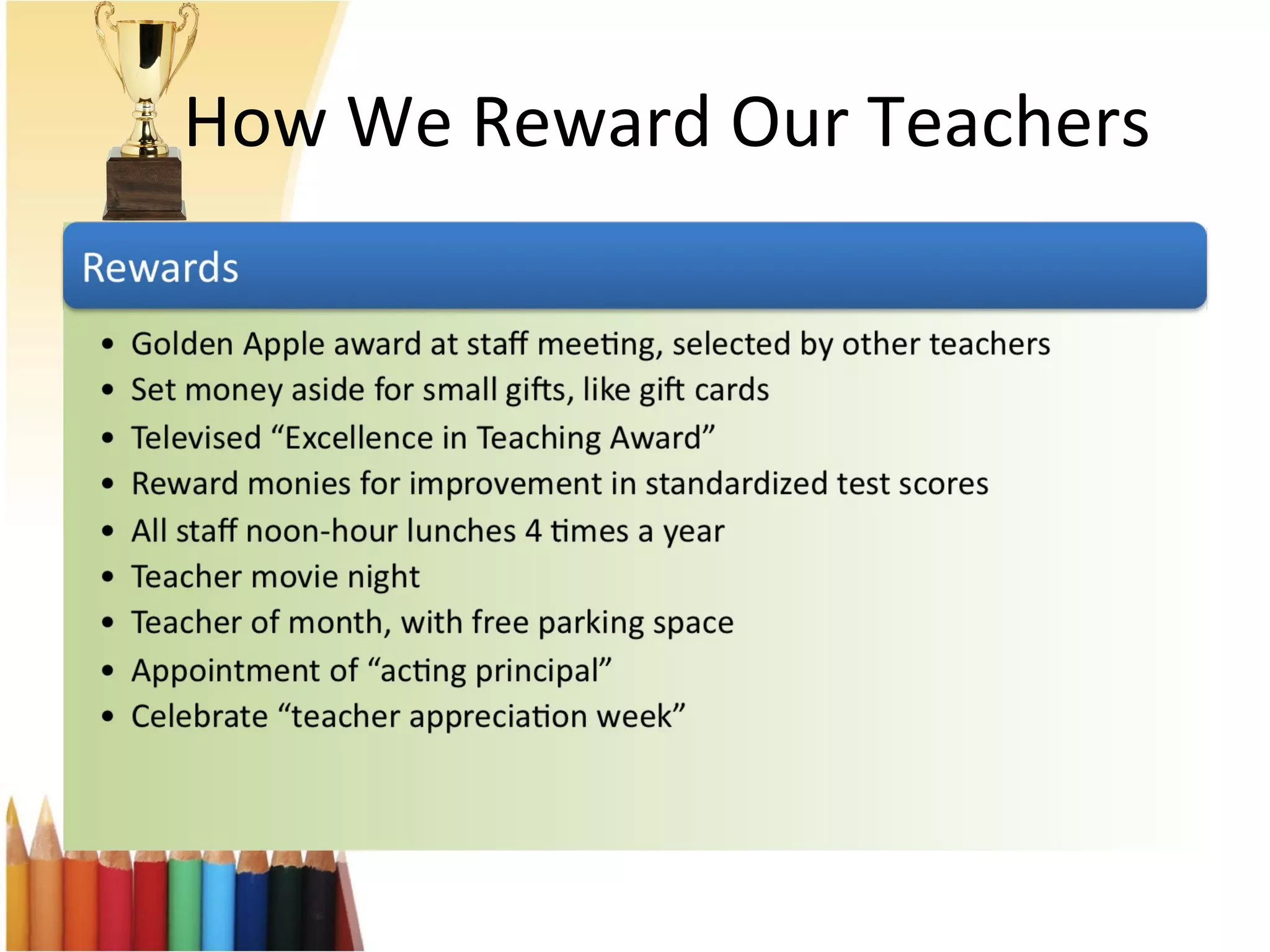
How We Reward Our Teachers
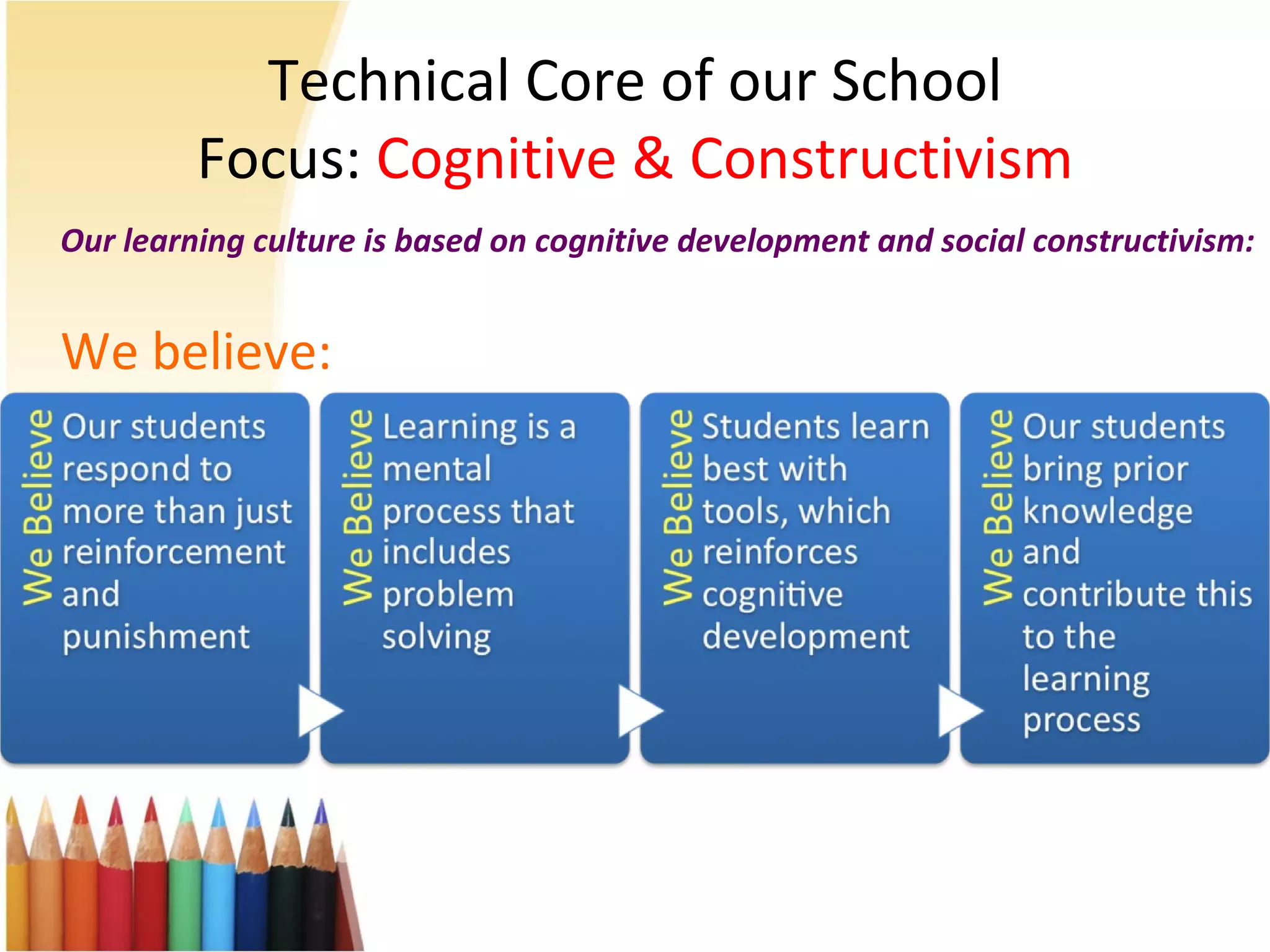
Technical Core of our School Focus:  Cognitive & Constructivism Our learning culture is based on cognitive development and social constructivism: We believe:
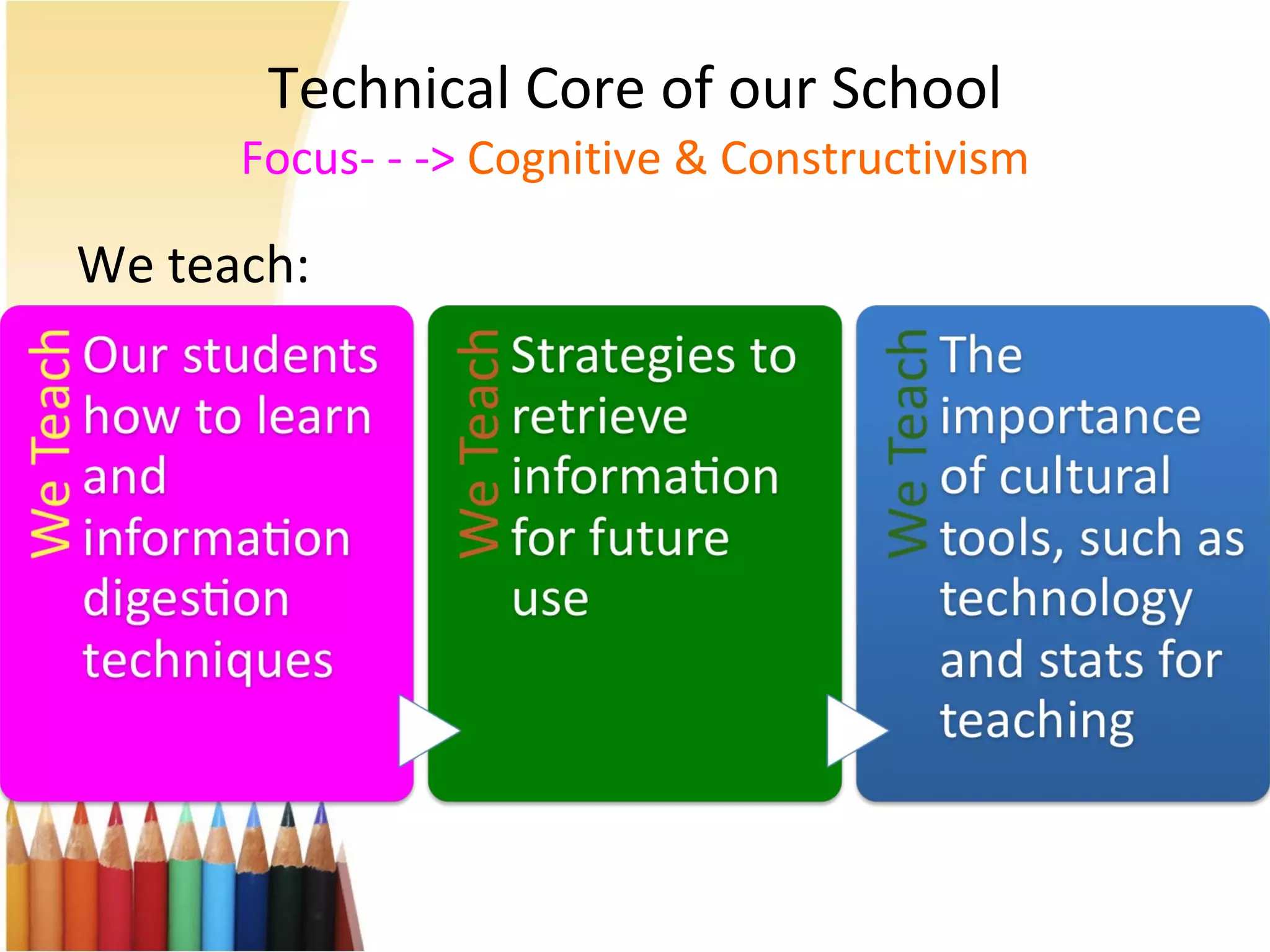
We teach: Technical Core of our School Focus- - ->  Cognitive & Constructivism
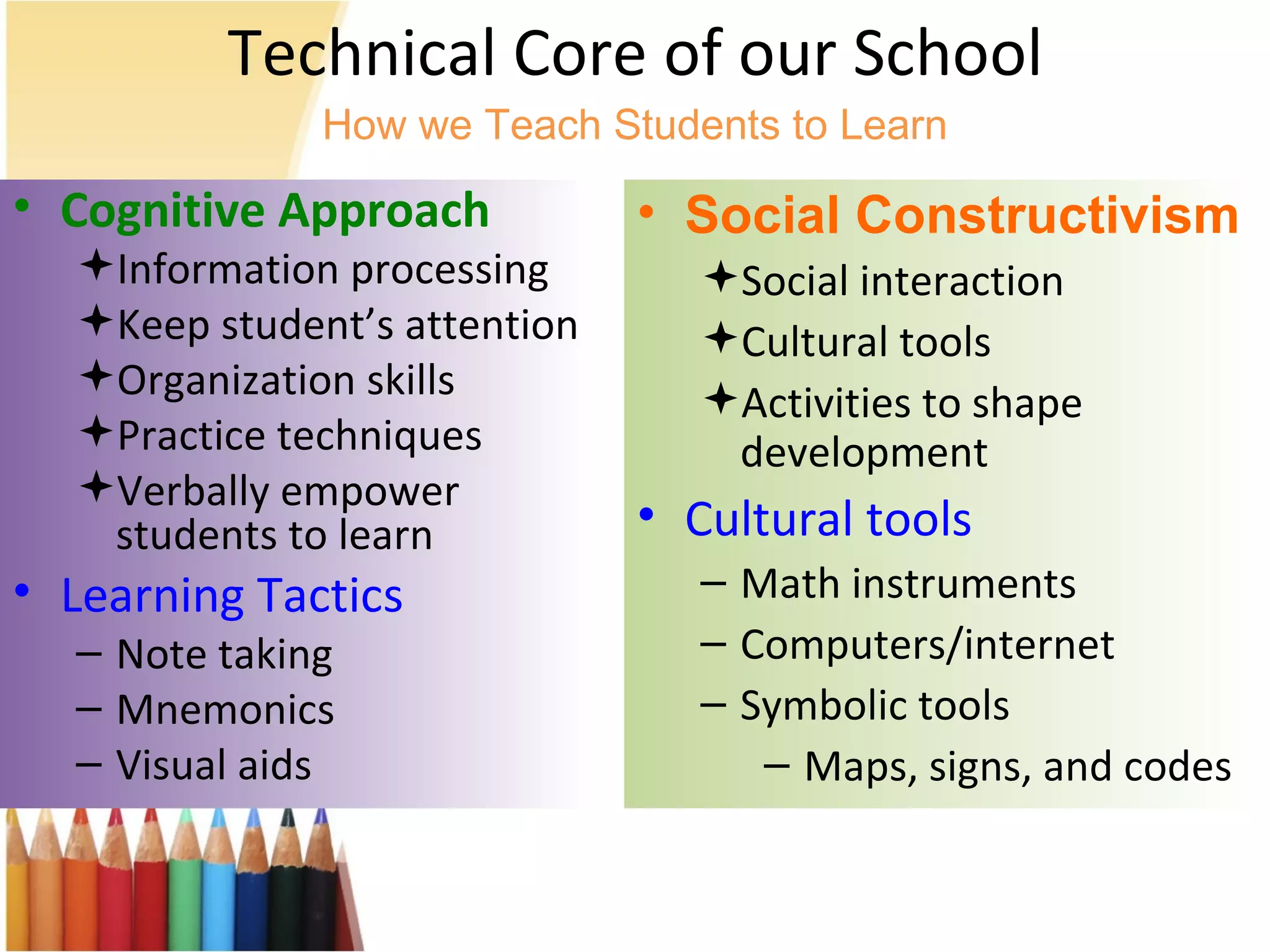
Technical Core of our School How we Teach Students to Learn Cognitive Approach Information processing Keep student’s attention Organization skills Practice techniques Verbally empower students to learn  Learning Tactics Note taking Mnemonics Visual aids Social Constructivism Social interaction Cultural tools Activities to shape development Cultural tools Math instruments Computers/internet Symbolic tools Maps, signs, and codes
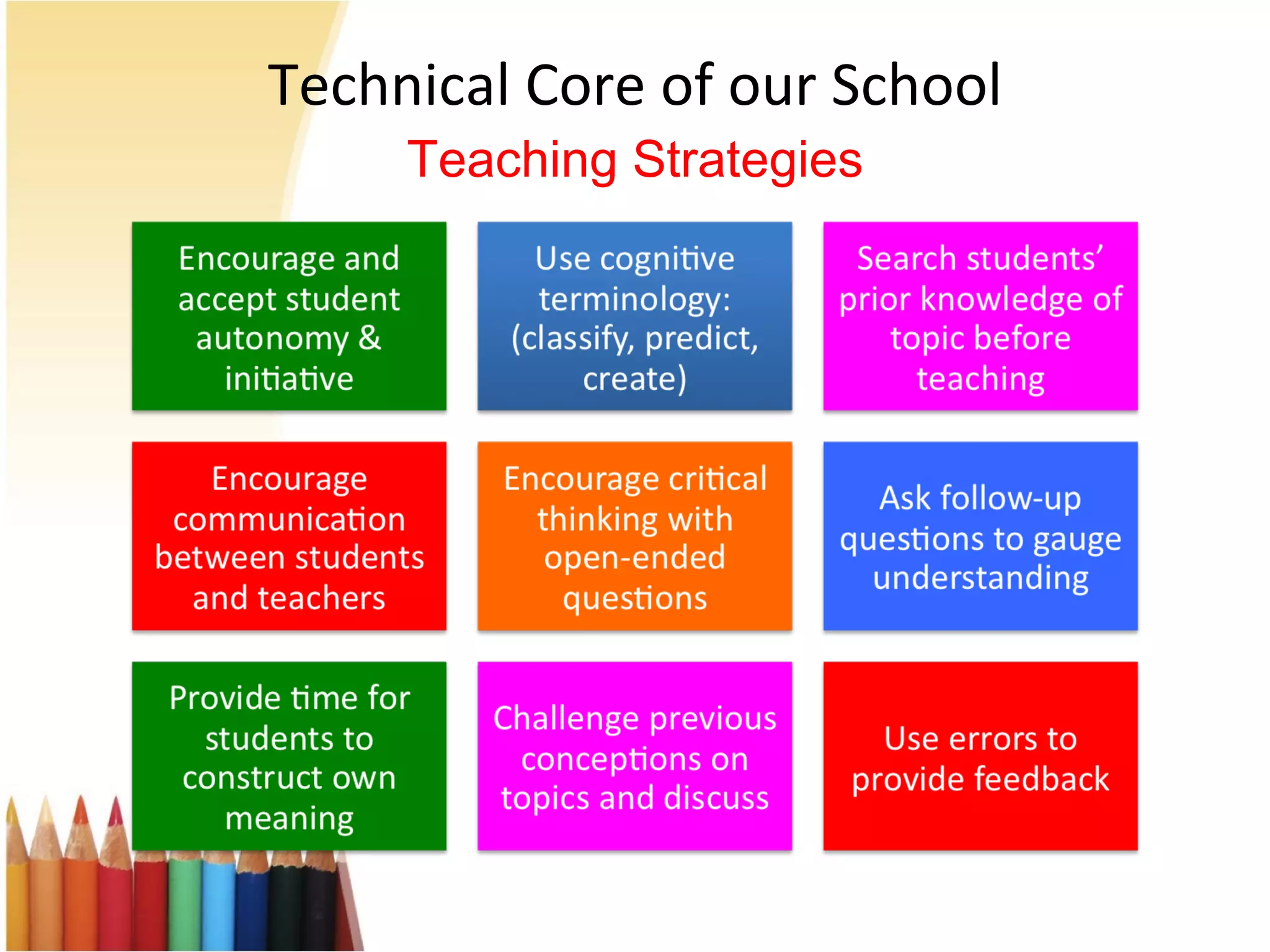
Technical Core of our School Teaching Strategies
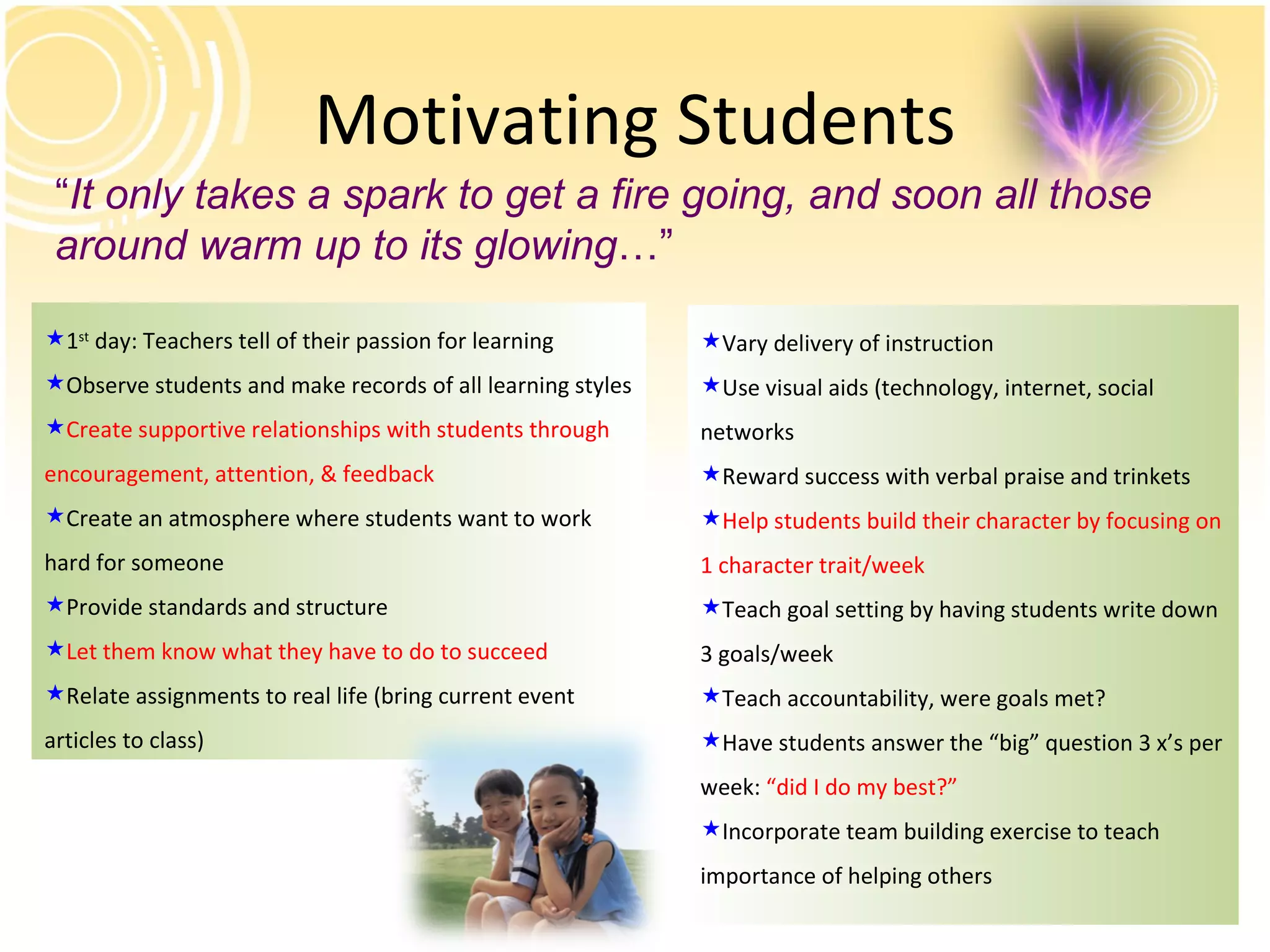
Motivating Students “ It only takes a spark to get a fire going, and soon all those around warm up to its glowing …” 1 st  day: Teachers tell of their passion for learning Observe students and make records of all learning styles Create supportive relationships with students through encouragement, attention, & feedback Create an atmosphere where students want to work hard for someone Provide standards and structure Let them know what they have to do to succeed Relate assignments to real life (bring current event articles to class) Vary delivery of instruction Use visual aids (technology, internet, social networks Reward success with verbal praise and trinkets Help students build their character by focusing on 1 character trait/week Teach goal setting by having students write down 3 goals/week Teach accountability, were goals met? Have students answer the “big” question 3 x’s per week:  “did I do my best?” Incorporate team building exercise to teach importance of helping others
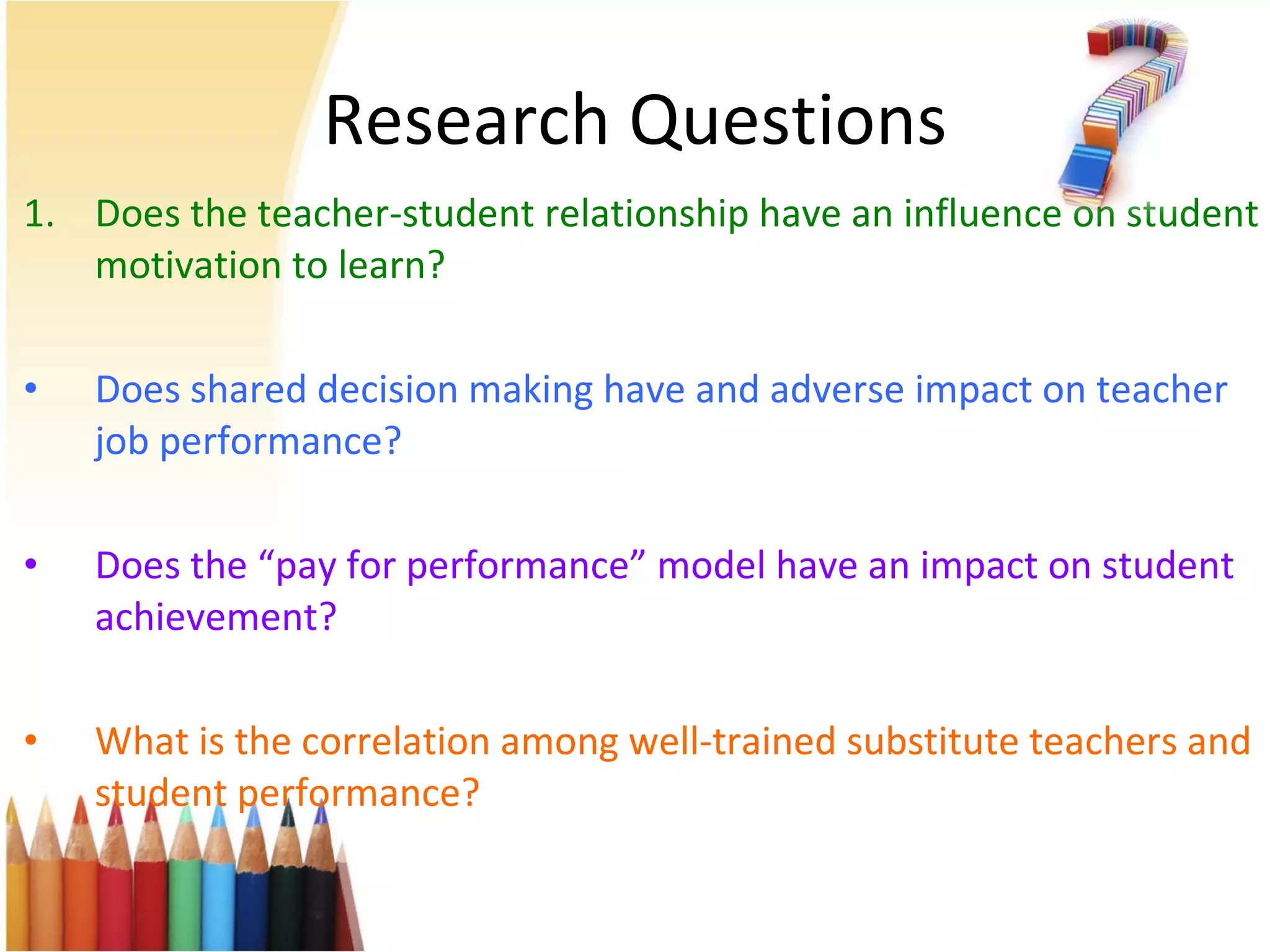
Research Questions Does the teacher-student relationship have an influence on student motivation to learn? Does shared decision making have and adverse impact on teacher job performance?  Does the “pay for performance” model have an impact on student achievement? What is the correlation among well-trained substitute teachers and student performance?
References Ames, R. and Ames, C. (nd). Nine ways to motivate your students.  Journal of Educational Psychology.  Retrieved May 5, 2010 from  http://www.imakenews.com/achievement/Nine_Ways_to_Motivate_2006.pdf Cambridge Public School (2009). Goals for 2008-2009. Retrieved April 30, 2010 from  http://www.cpsd.us/schcomm/goals.cfm Center for Teaching Quality (2007).  Designing a system that students deserve: A TeacherSolutions Report. Retrieved May 7, 2010 from http://www.teacherleaders.org/sites/default/files/TS2008_0.pdf Craven, H. (nd). Lighting the learning fire. Retrieved May 5, 2010 from  http://www.inspiringteachers.com/classroom_resources/articles/curriculum_and_instruction/learning_fire.html Hoy, W. & Miskel, C. (2008). Educational Administration: Theory, research, and practice (8 th  ed.).  New York, NY: McGraw-Hill.  Hopkins, G. (2008). 25 ways to motivate teachers. Education World. Retrieved April 30, 2010 from http://www.educationworld.com/a_admin/admin/admin289.shtml Kostelecky, K., & Hoskinson, M. (2005). A "NOVEL" approach to motivating students.  Education, 125(3), 438-442. Retrieved from Professional Development Collection database. Murphy, E. (1997). Characteristics of constructivist learning and teaching. Retrieved April 20, 2010 from  http://www.ucs.mun.ca/~emurphy/stemnet/cle3.html NDT Resource Center (2010). Teaching with the constructivist learning theory. Retrieved April 30, 2010 fromhttp://www.ndt-ed.org/TeachingResources/ClassroomTips/Constructivist%20_Learning.htm

Ready to learn isd hr p johnson

  • 1.
    Ready To LearnIndependent School District Department of Human Resources Priscilla Dawn Johnson EDUL 7023: Dr. Douglas Hermond May 8, 2010
  • 2.
    Mission Statement forReady To Learn Department of Human Resources WE will sustain high academic achievement of all Ready to Learn students by recruiting, selecting, retaining, and supporting a diverse and highly talented staff. WE will train and educate our staff to be fluent in technical trends, cultural responsiveness, and excellent gatekeepers for the opportunities WE open for our students. WE are the voice for all staff, the developers of many, purposed to serve our students, who are Ready To Learn.
  • 3.
    HR Strategic GoalsProvide the best available staff for student achievement and staff development Train a diverse workforce fully engaged with students Develop student teachers and ensure their success Provide teachers the opportunities to lead in our supporting departments Provide training for teachers who instruct the Substitute Academy Implement individual development action plans for teachers Encourage parent and community participation through quarterly newsletters, parent conferences each semester, and maintaining a dynamic website
  • 4.
  • 5.
    Organizational Structure DepartmentsSupporting Student Learning
  • 6.
    Power and AuthorityStructure Professional Bureaucracy with Shared Decision Making
  • 7.
    Compensation Performance-Pay forTeachers The Center for Teaching Quality: TeacherSolutions ℠ Model A TeacherSolutions report by 18 of the nation’s best Teachers: Center for teaching Quality, 2006
  • 8.
    Compensation Performance-Pay forTeachers A Professional Compensation Framework, Designed for a Competitive Metropolis Base salary range (negotiable) Career Salary Supplements Student Learning Knowledge & Skills Market Needs Leadership Base and Career Pay Novice $30,000-$45, 000 Up to 5% Up to 5% Up to $5,000 Not ready for role & reward Up to $55,000 Advanced $46,000-$55,000 Up to 10% Up to 10% Up to $10,000 Up to 10% Up to $85,000 Expert $56,000-$70,000 Up to 15% Up to 15% Up to $15,000 Up to 15% Up to $130,000
  • 9.
    Rewarding & Motivatingour Teachers Yet, we also recognize fulfillment of hygiene needs: Relations Supervision Policy & administration working conditions, and salaries Personal life We gratify certain needs, called MOTIVATORS: Achievement Recognition Work itself Responsibility Advancement
  • 10.
    How We MotivateOur Teachers Motivators
  • 11.
    How We RewardOur Teachers
  • 12.
    Technical Core ofour School Focus: Cognitive & Constructivism Our learning culture is based on cognitive development and social constructivism: We believe:
  • 13.
    We teach: TechnicalCore of our School Focus- - -> Cognitive & Constructivism
  • 14.
    Technical Core ofour School How we Teach Students to Learn Cognitive Approach Information processing Keep student’s attention Organization skills Practice techniques Verbally empower students to learn Learning Tactics Note taking Mnemonics Visual aids Social Constructivism Social interaction Cultural tools Activities to shape development Cultural tools Math instruments Computers/internet Symbolic tools Maps, signs, and codes
  • 15.
    Technical Core ofour School Teaching Strategies
  • 16.
    Motivating Students “It only takes a spark to get a fire going, and soon all those around warm up to its glowing …” 1 st day: Teachers tell of their passion for learning Observe students and make records of all learning styles Create supportive relationships with students through encouragement, attention, & feedback Create an atmosphere where students want to work hard for someone Provide standards and structure Let them know what they have to do to succeed Relate assignments to real life (bring current event articles to class) Vary delivery of instruction Use visual aids (technology, internet, social networks Reward success with verbal praise and trinkets Help students build their character by focusing on 1 character trait/week Teach goal setting by having students write down 3 goals/week Teach accountability, were goals met? Have students answer the “big” question 3 x’s per week: “did I do my best?” Incorporate team building exercise to teach importance of helping others
  • 17.
    Research Questions Doesthe teacher-student relationship have an influence on student motivation to learn? Does shared decision making have and adverse impact on teacher job performance? Does the “pay for performance” model have an impact on student achievement? What is the correlation among well-trained substitute teachers and student performance?
  • 18.
    References Ames, R.and Ames, C. (nd). Nine ways to motivate your students. Journal of Educational Psychology. Retrieved May 5, 2010 from http://www.imakenews.com/achievement/Nine_Ways_to_Motivate_2006.pdf Cambridge Public School (2009). Goals for 2008-2009. Retrieved April 30, 2010 from http://www.cpsd.us/schcomm/goals.cfm Center for Teaching Quality (2007). Designing a system that students deserve: A TeacherSolutions Report. Retrieved May 7, 2010 from http://www.teacherleaders.org/sites/default/files/TS2008_0.pdf Craven, H. (nd). Lighting the learning fire. Retrieved May 5, 2010 from http://www.inspiringteachers.com/classroom_resources/articles/curriculum_and_instruction/learning_fire.html Hoy, W. & Miskel, C. (2008). Educational Administration: Theory, research, and practice (8 th ed.). New York, NY: McGraw-Hill. Hopkins, G. (2008). 25 ways to motivate teachers. Education World. Retrieved April 30, 2010 from http://www.educationworld.com/a_admin/admin/admin289.shtml Kostelecky, K., & Hoskinson, M. (2005). A "NOVEL" approach to motivating students. Education, 125(3), 438-442. Retrieved from Professional Development Collection database. Murphy, E. (1997). Characteristics of constructivist learning and teaching. Retrieved April 20, 2010 from http://www.ucs.mun.ca/~emurphy/stemnet/cle3.html NDT Resource Center (2010). Teaching with the constructivist learning theory. Retrieved April 30, 2010 fromhttp://www.ndt-ed.org/TeachingResources/ClassroomTips/Constructivist%20_Learning.htm