Reviewing Verb Tenses
Verb Tense Review The Importance of Time Verb tense expresses the time of an event or action. Time and how it is expressed in writing is very important to English readers.  The English language has twelve different tenses.  In this lesson, we will review the meaning of each verb tense.
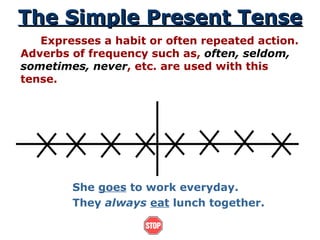
The Simple Present Tense Expresses a habit or often repeated action.  Adverbs of frequency such as,  often, seldom, sometimes, never , etc. are used with this tense. She  goes  to work everyday. They  always   eat  lunch together.
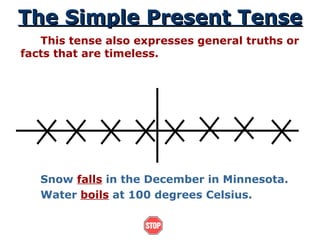
The Simple Present Tense This tense also expresses general truths or facts that are timeless.  Snow  falls  in the December in Minnesota. Water  boils  at 100 degrees Celsius.
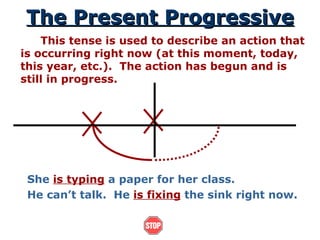
The Present Progressive This tense is used to describe an action that is occurring right now (at this moment, today, this year, etc.).  The action has begun and is still in progress. She  is typing  a paper for her class. He can’t talk.  He  is fixing  the sink right now.
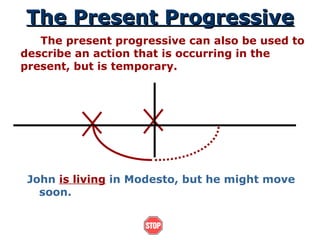
The Present Progressive The present progressive can also be used to describe an action that is occurring in the present, but is temporary. John  is living  in Modesto, but he might move soon.
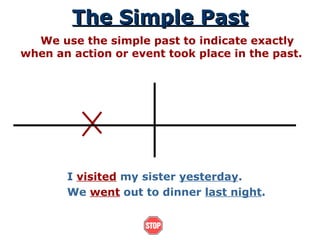
The Simple Past We use the simple past to indicate exactly when an action or event took place in the past. I  visited  my sister  yesterday . We  went  out to dinner  last night .
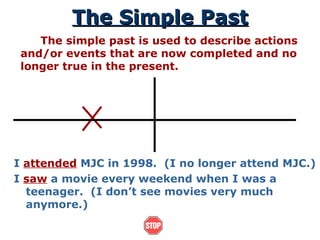
The Simple Past The simple past is used to describe actions and/or events that are now completed and no longer true in the present. I  attended  MJC in 1998.  (I no longer attend MJC.) I  saw  a movie every weekend when I was a teenager.  (I don’t see movies very much anymore.)
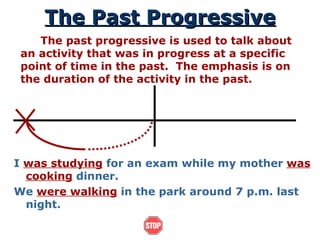
The Past Progressive The past progressive is used to talk about an activity that was in progress at a specific point of time in the past.  The emphasis is on the duration of the activity in the past. I  was studying  for an exam while my mother  was cooking  dinner. We  were walking  in the park around 7 p.m. last night.
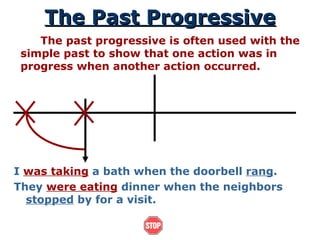
The Past Progressive The past progressive is often used with the simple past to show that one action was in progress when another action occurred. I  was taking  a bath when the doorbell  rang . They  were eating  dinner when the neighbors  stopped  by for a visit.
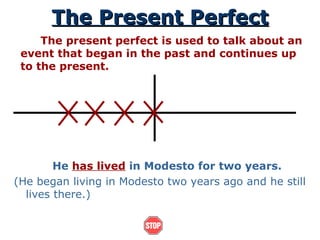
The Present Perfect The present perfect is used to talk about an event that began in the past and continues up to the present. He  has lived  in Modesto for two years.  (He began living in Modesto two years ago and he still lives there.)
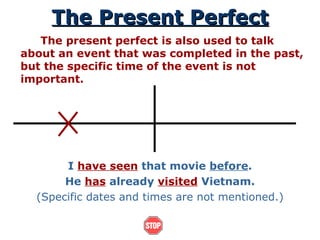
The Present Perfect The present perfect is also used to talk about an event that was completed in the past, but the specific time of the event is not important. I  have seen  that movie  before . He  has  already  visited  Vietnam. (Specific dates and times are not mentioned.)
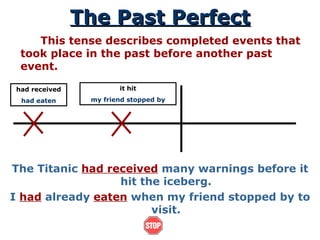
The Past Perfect This tense describes completed events that took place in the past before another past event. The Titanic  had received  many warnings before it hit the iceberg. I  had  already  eaten  when my friend stopped by to visit. had received had eaten it hit my friend stopped by
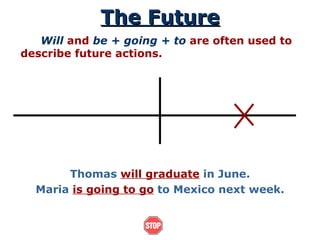
The Future Will   and  be + going + to  are often used to describe future actions. Thomas  will graduate  in June. Maria  is going to go  to Mexico next week.
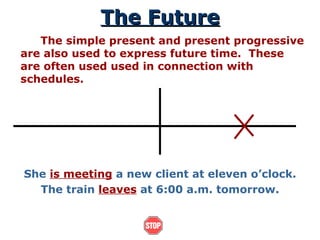
The Future The simple present and present progressive are also used to express future time.  These are often used used in connection with schedules. She  is meeting  a new client at eleven o’clock. The train  leaves  at 6:00 a.m. tomorrow.
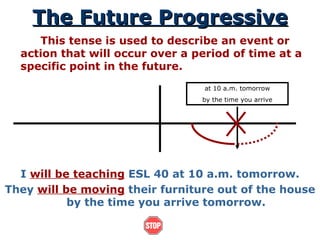
The Future Progressive This tense is used to describe an event or action that will occur over a period of time at a specific point in the future. I  will be teaching  ESL 40 at 10 a.m. tomorrow. They  will be moving  their furniture out of the house by the time you arrive tomorrow. at 10 a.m. tomorrow by the time you arrive

Verbtense

  • 1.
  • 2.
    Verb Tense ReviewThe Importance of Time Verb tense expresses the time of an event or action. Time and how it is expressed in writing is very important to English readers. The English language has twelve different tenses. In this lesson, we will review the meaning of each verb tense.
  • 3.
    The Simple PresentTense Expresses a habit or often repeated action. Adverbs of frequency such as, often, seldom, sometimes, never , etc. are used with this tense. She goes to work everyday. They always eat lunch together.
  • 4.
    The Simple PresentTense This tense also expresses general truths or facts that are timeless. Snow falls in the December in Minnesota. Water boils at 100 degrees Celsius.
  • 5.
    The Present ProgressiveThis tense is used to describe an action that is occurring right now (at this moment, today, this year, etc.). The action has begun and is still in progress. She is typing a paper for her class. He can’t talk. He is fixing the sink right now.
  • 6.
    The Present ProgressiveThe present progressive can also be used to describe an action that is occurring in the present, but is temporary. John is living in Modesto, but he might move soon.
  • 7.
    The Simple PastWe use the simple past to indicate exactly when an action or event took place in the past. I visited my sister yesterday . We went out to dinner last night .
  • 8.
    The Simple PastThe simple past is used to describe actions and/or events that are now completed and no longer true in the present. I attended MJC in 1998. (I no longer attend MJC.) I saw a movie every weekend when I was a teenager. (I don’t see movies very much anymore.)
  • 9.
    The Past ProgressiveThe past progressive is used to talk about an activity that was in progress at a specific point of time in the past. The emphasis is on the duration of the activity in the past. I was studying for an exam while my mother was cooking dinner. We were walking in the park around 7 p.m. last night.
  • 10.
    The Past ProgressiveThe past progressive is often used with the simple past to show that one action was in progress when another action occurred. I was taking a bath when the doorbell rang . They were eating dinner when the neighbors stopped by for a visit.
  • 11.
    The Present PerfectThe present perfect is used to talk about an event that began in the past and continues up to the present. He has lived in Modesto for two years. (He began living in Modesto two years ago and he still lives there.)
  • 12.
    The Present PerfectThe present perfect is also used to talk about an event that was completed in the past, but the specific time of the event is not important. I have seen that movie before . He has already visited Vietnam. (Specific dates and times are not mentioned.)
  • 13.
    The Past PerfectThis tense describes completed events that took place in the past before another past event. The Titanic had received many warnings before it hit the iceberg. I had already eaten when my friend stopped by to visit. had received had eaten it hit my friend stopped by
  • 14.
    The Future Will and be + going + to are often used to describe future actions. Thomas will graduate in June. Maria is going to go to Mexico next week.
  • 15.
    The Future Thesimple present and present progressive are also used to express future time. These are often used used in connection with schedules. She is meeting a new client at eleven o’clock. The train leaves at 6:00 a.m. tomorrow.
  • 16.
    The Future ProgressiveThis tense is used to describe an event or action that will occur over a period of time at a specific point in the future. I will be teaching ESL 40 at 10 a.m. tomorrow. They will be moving their furniture out of the house by the time you arrive tomorrow. at 10 a.m. tomorrow by the time you arrive