ESPAÑOL I – SR. JOHNSTON
jueves, el diecisiete de enero del 2012
ACTIVIDADES DEL LIBRO
DESCUBRE
 Abre el libro en las páginas 78-79 para estudiar
  el árbol genealógico (family tree) de José Miguel.
 En tu cuaderno, escribe (write) 1-10 y responde
  CIERTO o FALSO a las preguntas.

   Ahora, escucha la narración y escribe los
    miembros de familia que apareczan (appear).
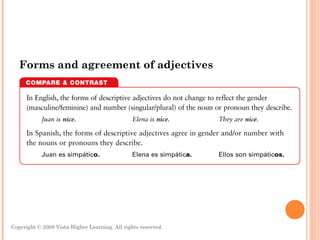
Adjectives are words that describe people,
      places, and things. In Spanish, descriptive adjectives
      are used with the verb ser to point out characteristics
      such as nationality, size, color, shape, personality,
      and appearance.


Copyright © 2008 Vista Higher Learning. All rights reserved.   3.1-3
Forms and agreement of adjectives


Copyright © 2008 Vista Higher Learning. All rights reserved.   3.1-4
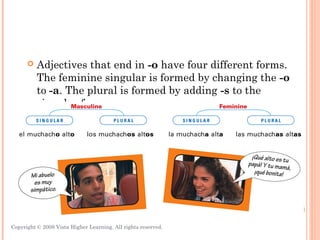
   Adjectives that end in -o have four different forms.
          The feminine singular is formed by changing the -o
          to -a. The plural is formed by adding -s to the
          singular forms.


Copyright © 2008 Vista Higher Learning. All rights reserved.   3.1-5
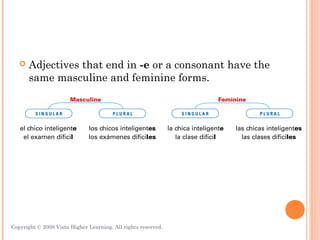
   Adjectives that end in -e or a consonant have the
       same masculine and feminine forms.


Copyright © 2008 Vista Higher Learning. All rights reserved.   3.1-6
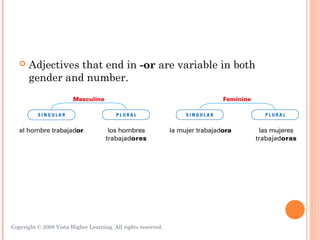
   Adjectives that end in -or are variable in both
       gender and number.


Copyright © 2008 Vista Higher Learning. All rights reserved.   3.1-7
*notas


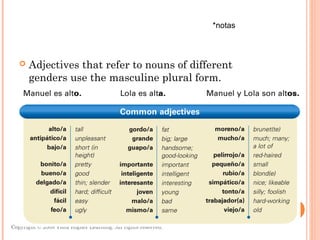
      Adjectives that refer to nouns of different
       genders use the masculine plural form.


Copyright © 2008 Vista Higher Learning. All rights reserved.            3.1-8
*notas


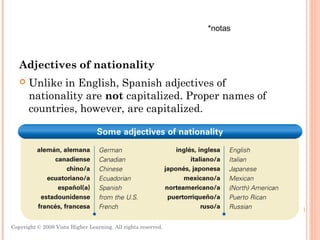
   Adjectives of nationality
      Unlike in English, Spanish adjectives of
       nationality are not capitalized. Proper names of
       countries, however, are capitalized.


Copyright © 2008 Vista Higher Learning. All rights reserved.            3.1-9
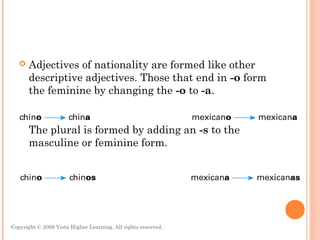
   Adjectives of nationality are formed like other
       descriptive adjectives. Those that end in -o form
       the feminine by changing the -o to -a.


       The plural is formed by adding an -s to the
       masculine or feminine form.


Copyright © 2008 Vista Higher Learning. All rights reserved.   3.1-10
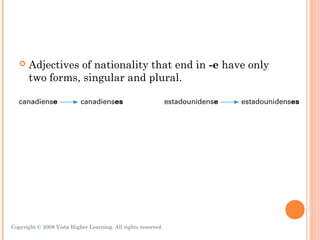
   Adjectives of nationality that end in -e have only
       two forms, singular and plural.


Copyright © 2008 Vista Higher Learning. All rights reserved.   3.1-11
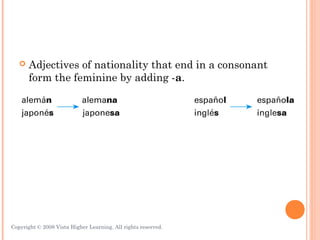
   Adjectives of nationality that end in a consonant
       form the feminine by adding -a.


Copyright © 2008 Vista Higher Learning. All rights reserved.   3.1-12
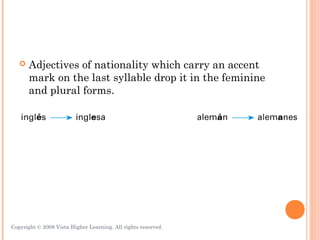
   Adjectives of nationality which carry an accent
       mark on the last syllable drop it in the feminine
       and plural forms.


Copyright © 2008 Vista Higher Learning. All rights reserved.   3.1-13
Position of adjectives
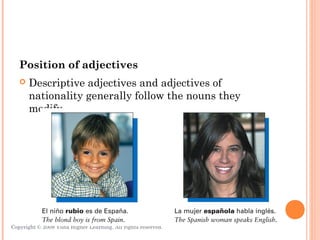
      Descriptive adjectives and adjectives of
       nationality generally follow the nouns they
       modify.


Copyright © 2008 Vista Higher Learning. All rights reserved.   3.1-14
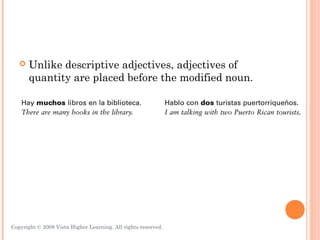
   Unlike descriptive adjectives, adjectives of
       quantity are placed before the modified noun.


Copyright © 2008 Vista Higher Learning. All rights reserved.   3.1-15
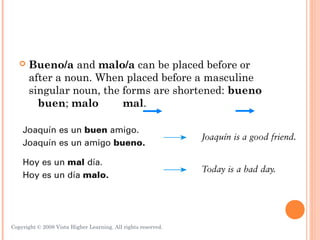
   Bueno/a and malo/a can be placed before or
       after a noun. When placed before a masculine
       singular noun, the forms are shortened: bueno
         buen; malo       mal.


Copyright © 2008 Vista Higher Learning. All rights reserved.   3.1-16
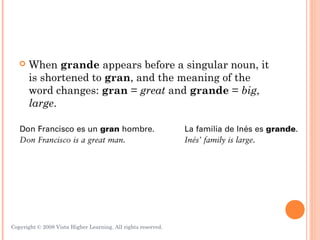
   When grande appears before a singular noun, it
       is shortened to gran, and the meaning of the
       word changes: gran = great and grande = big,
       large.


Copyright © 2008 Vista Higher Learning. All rights reserved.   3.1-17
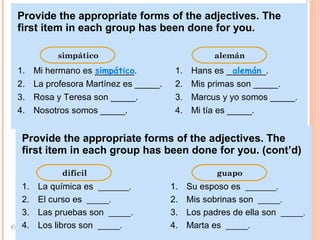
Provide the appropriate forms of the adjectives. The
  first item in each group has been done for you.

               simpático                                         alemán
  1.                 simpático
       Mi hermano es ________.                        1.               alemán
                                                            Hans es ________.
  2.   La profesora Martínez es _____.                2.    Mis primas son _____.
  3.   Rosa y Teresa son _____.                       3.    Marcus y yo somos _____.
  4.   Nosotros somos _____.                          4.    Mi tía es _____.


   Provide the appropriate forms of the adjectives. The
   first item in each group has been done for you. (cont’d)

                difícil                                           guapo
   1. La química es _______.                         1.    Su esposo es _______.
   2. El curso es _____.                             2.    Mis sobrinas son _____.
   3. Las pruebas son _____.                         3.    Los padres de ella son _____.
Copyright © 2008libros son _____. rights reserved.
   4. Los Vista Higher Learning. All                 4.    Marta es _____. 3.1-18
INDEPENDENT WORK
   p.91 Activities 1, 2, 3

Leccion 1 17 13

  • 1.
    ESPAÑOL I –SR. JOHNSTON jueves, el diecisiete de enero del 2012
  • 2.
    ACTIVIDADES DEL LIBRO DESCUBRE Abre el libro en las páginas 78-79 para estudiar el árbol genealógico (family tree) de José Miguel.  En tu cuaderno, escribe (write) 1-10 y responde CIERTO o FALSO a las preguntas.  Ahora, escucha la narración y escribe los miembros de familia que apareczan (appear).
  • 3.
    Adjectives are wordsthat describe people, places, and things. In Spanish, descriptive adjectives are used with the verb ser to point out characteristics such as nationality, size, color, shape, personality, and appearance. Copyright © 2008 Vista Higher Learning. All rights reserved. 3.1-3
  • 4.
    Forms and agreementof adjectives Copyright © 2008 Vista Higher Learning. All rights reserved. 3.1-4
  • 5.
    Adjectives that end in -o have four different forms. The feminine singular is formed by changing the -o to -a. The plural is formed by adding -s to the singular forms. Copyright © 2008 Vista Higher Learning. All rights reserved. 3.1-5
  • 6.
    Adjectives that end in -e or a consonant have the same masculine and feminine forms. Copyright © 2008 Vista Higher Learning. All rights reserved. 3.1-6
  • 7.
    Adjectives that end in -or are variable in both gender and number. Copyright © 2008 Vista Higher Learning. All rights reserved. 3.1-7
  • 8.
    *notas  Adjectives that refer to nouns of different genders use the masculine plural form. Copyright © 2008 Vista Higher Learning. All rights reserved. 3.1-8
  • 9.
    *notas Adjectives of nationality  Unlike in English, Spanish adjectives of nationality are not capitalized. Proper names of countries, however, are capitalized. Copyright © 2008 Vista Higher Learning. All rights reserved. 3.1-9
  • 10.
    Adjectives of nationality are formed like other descriptive adjectives. Those that end in -o form the feminine by changing the -o to -a. The plural is formed by adding an -s to the masculine or feminine form. Copyright © 2008 Vista Higher Learning. All rights reserved. 3.1-10
  • 11.
    Adjectives of nationality that end in -e have only two forms, singular and plural. Copyright © 2008 Vista Higher Learning. All rights reserved. 3.1-11
  • 12.
    Adjectives of nationality that end in a consonant form the feminine by adding -a. Copyright © 2008 Vista Higher Learning. All rights reserved. 3.1-12
  • 13.
    Adjectives of nationality which carry an accent mark on the last syllable drop it in the feminine and plural forms. Copyright © 2008 Vista Higher Learning. All rights reserved. 3.1-13
  • 14.
    Position of adjectives  Descriptive adjectives and adjectives of nationality generally follow the nouns they modify. Copyright © 2008 Vista Higher Learning. All rights reserved. 3.1-14
  • 15.
    Unlike descriptive adjectives, adjectives of quantity are placed before the modified noun. Copyright © 2008 Vista Higher Learning. All rights reserved. 3.1-15
  • 16.
    Bueno/a and malo/a can be placed before or after a noun. When placed before a masculine singular noun, the forms are shortened: bueno buen; malo mal. Copyright © 2008 Vista Higher Learning. All rights reserved. 3.1-16
  • 17.
    When grande appears before a singular noun, it is shortened to gran, and the meaning of the word changes: gran = great and grande = big, large. Copyright © 2008 Vista Higher Learning. All rights reserved. 3.1-17
  • 18.
    Provide the appropriateforms of the adjectives. The first item in each group has been done for you. simpático alemán 1. simpático Mi hermano es ________. 1. alemán Hans es ________. 2. La profesora Martínez es _____. 2. Mis primas son _____. 3. Rosa y Teresa son _____. 3. Marcus y yo somos _____. 4. Nosotros somos _____. 4. Mi tía es _____. Provide the appropriate forms of the adjectives. The first item in each group has been done for you. (cont’d) difícil guapo 1. La química es _______. 1. Su esposo es _______. 2. El curso es _____. 2. Mis sobrinas son _____. 3. Las pruebas son _____. 3. Los padres de ella son _____. Copyright © 2008libros son _____. rights reserved. 4. Los Vista Higher Learning. All 4. Marta es _____. 3.1-18
  • 19.
    INDEPENDENT WORK  p.91 Activities 1, 2, 3