This document summarizes key concepts related to deterministic systems and chaos theory. It defines deterministic systems as those where future states are fully determined by present conditions without any randomness. Chaos refers to unpredictable behavior in deterministic systems that is highly sensitive to initial conditions. Examples of strange attractors are given, including the Lorenz attractor discovered by Edward Lorenz in 1960 which demonstrated the butterfly effect and chaotic behavior in deterministic systems.
Presented by Wasif Irshad Khan and Muhammad Zubair Shahid.
Deterministic systems in math and physics produce consistent outputs from initial conditions. Examples include basic laws of nature.
Chaos refers to unpredictable behavior in deterministic systems, highlighted by sensitivity to initial conditions and exemplified by the Butterfly Effect.
Edward Lorenz, a meteorologist, discovered chaos in 1960 during weather prediction, with the term 'Chaos' introduced later.
Chaos manifests in various areas, including disease outbreaks, political unrest, wars, stock markets, and chemical reactions.
Attractors are key to chaos, with four types identified: Fixed Point, Limit Cycle, Torus, and Strange Attractors.
An overview of Fixed Point, Limit Cycle, Torus, and Strange Attractors, including examples and characteristics.
Point, Limit Cycle, and Torus attractors are fixed, while Strange Attractors are chaotic, showing sensitive dependence on initial conditions.
Edward Lorenz's 1960s atmospheric simulation led to the discovery of the Lorenz attractor, influenced by specific initial conditions.
Strange attractors exhibit fractal properties with infinite self-similarity in their dynamics.
Presentation concluded with thanks by Muhammad Zubair and Wasif Irshad.
DETERMINISTIC SYSTEMS
• Inmathematics and physics, a deterministic system is
a system in which no randomness is involved in the
development of future states of the system.
• A deterministic model will thus always produce the same
output from a given starting condition or initial state or
initial conditions.
4.
EXAMPLE
• Most ofthe basic laws of nature are deterministic, i.e.
they allow us to determine what will happen next
from the knowledge of present conditions.
• Pocket Watch
5.
WHAT IS CHAOS?
•Unpredictable behavior of deterministic system is
called Chaos.
• One of the pervasive features of chaos is “sensitivity
to initial conditions”.
6.
SENSITIVITY TO INITIALCONDITIONS
• In Deterministic System the output pattern of motion
/ representation remain same for different initial
conditions.
• The output pattern will be change for different initial
conditions.
Extreme sensitivityto initial conditions is referred to as the
Butterfly Effect, i.e. the flap of a butterfly's wings in Central
Park could ultimately cause an earthquake in China.
The Butterfly Effect was discovered by Edward Lorenz in
1960. In a paper in 1963 given to the New York Academy of
Sciences he remarks:
• “One meteorologist remarked that if the theory were correct,
one flap of a seagull's wings would be enough to alter the
course of the weather forever”.
9.
DISCOVERY OF CHAOS
Thefirst true experimenter in chaos was a
meteorologist , Edward Lorenz, who in 1960
discovered it while working on the problem of
weather prediction.
However the term “Chaos” was introduced by Tien-
Yien and James A.
10.
CHAOS IN REALWORLD
• Some examples of Chaos in Real World
–Disease – An outbreak of a deadly disease which has no
cure.
–Political Unrest – Can cause revolt, overthrow of
government and vast war.
–War – Lives of many people can be ruined in no time.
–Stock Market
–Chemical Reactions
11.
ATTRACTORS
• Attractors arethe origin of chaos.
• Attractor is a set of trajectories in phase space to
which all neighboring trajectories converge.
12.
TYPES OF ATTRACTORS
•Thereare four different types of attractors
– Fixed Point Attractors
– Limit Cycle Attractors
– Torus Attractors
– Strange Attractors
13.
FIXED POINT ATTRACTORS
Itis a simplest form of attractor in which a system
converges to a single fixed point
Example :
– Damped pendulum
Point Attractor
14.
LIMIT CYCLE ATTRACTORS
Alimit cycle attractor is a repeating loop of states.
Example :
– A planet orbiting around a star, an un-damped
pendulum.
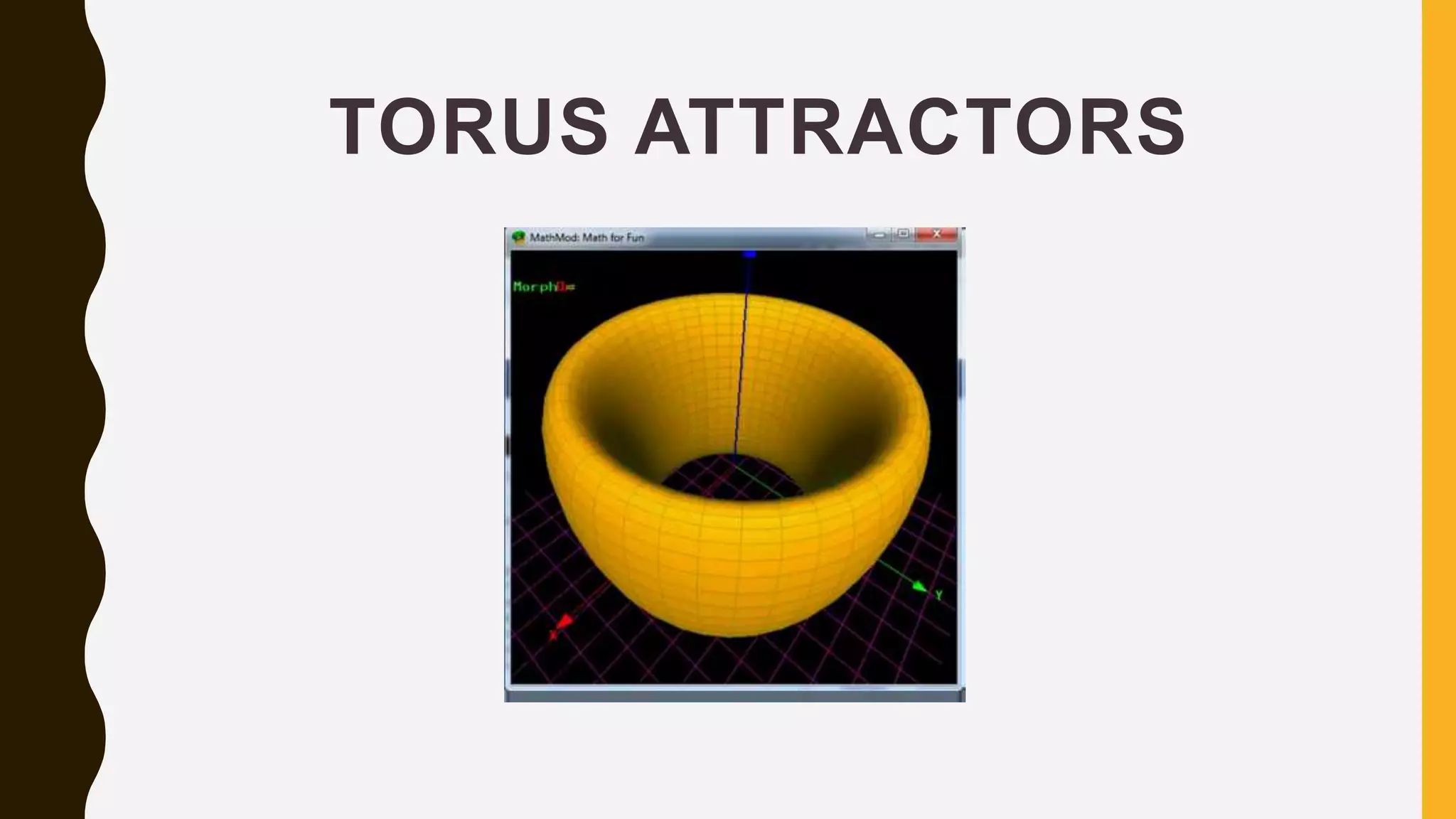
TORUS ATTRACTORS
• Asystem which changes in detailed characteristics over time
but does not change its form will have a trajectory which will
produce a path looking like the doughnut shape of a torus
• Example, picture walking on a large doughnut, going over,
under and around its outside surface area, circling, but never
repeating exactly the same path you went before.
• The torus attractor depicts processes that stay in a confined
area but wander from place to place in that area.
STRANGE ATTRACTORS
• Anattractor in phase space, where the points never
repeat themselves, and orbits never intersect, but they
stay within the same region of phase space.
• Unlike limit cycles or point attractors, strange
attractors are non-periodic.
• The Strange Attractor can take an infinite number of
different forms.
RELATIONSHIP WITH CHAOS
THEORY
•Point, Limit Cycle and Torus attractors are not associated with
Chaos theory, because they are fixed.
• Even though there is a high degree of irregularity and
complexity in the pattern associated with Limit Cycle and
Torus attractors, their pattern is finite and predictions can still
be made.
22.
RELATIONSHIP WITH CHAOS
THEORY
•The Strange Attractors can take an infinite number of different
forms. This is one of the most important properties of strange
attractors and show their chaotic behavior. Two initial
neighboring points will quickly drive apart and finally will not
have the same behavior at all.
• This shows the sensitive dependence of Chaos on initial
conditions.
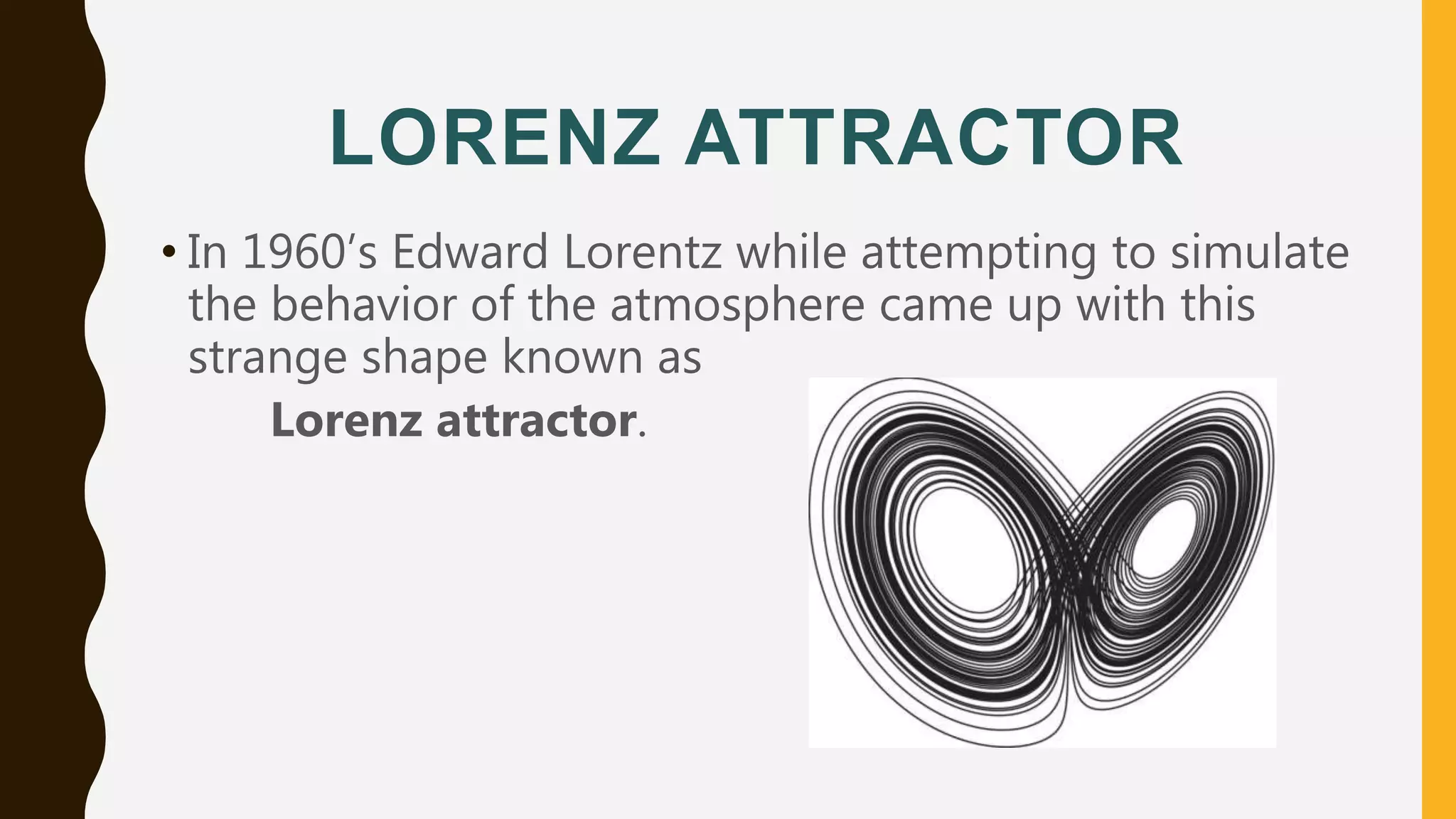
LORENZ ATTRACTOR
• In1960’s Edward Lorentz while attempting to simulate
the behavior of the atmosphere came up with this
strange shape known as
Lorenz attractor.
25.
LORENZ MODEL
• Lorenz'smodel for atmospheric convection consisted
of the following three ordinary differential equations:
26.
VARIABLES & CONSTANTS
•x – refers to the convective flow.
• y – refers to the horizontal temperature distribution.
• z – refers to the vertical temperature distribution.
• σ – sigma refers to the ratio of viscosity to thermal
conductivity.
• ρ – rho refers to the temperature difference between the
top and bottom of a given slice.
• β – beta refers to the ratio of the width to the height.
27.
LORENZ ATTRACTOR
• Aplot of the numerical values calculated from these
equations using particular initial conditions can be seen from
the picture.
28.
LORENZ ATTRACTOR
• Startingfrom any initial condition the calculations will
approach the paths displayed in the image, but the
actual path is highly dependent on the initial
conditions.
• The strange shape in the picture attracts points
outside of it and as such is called an attractor.
29.
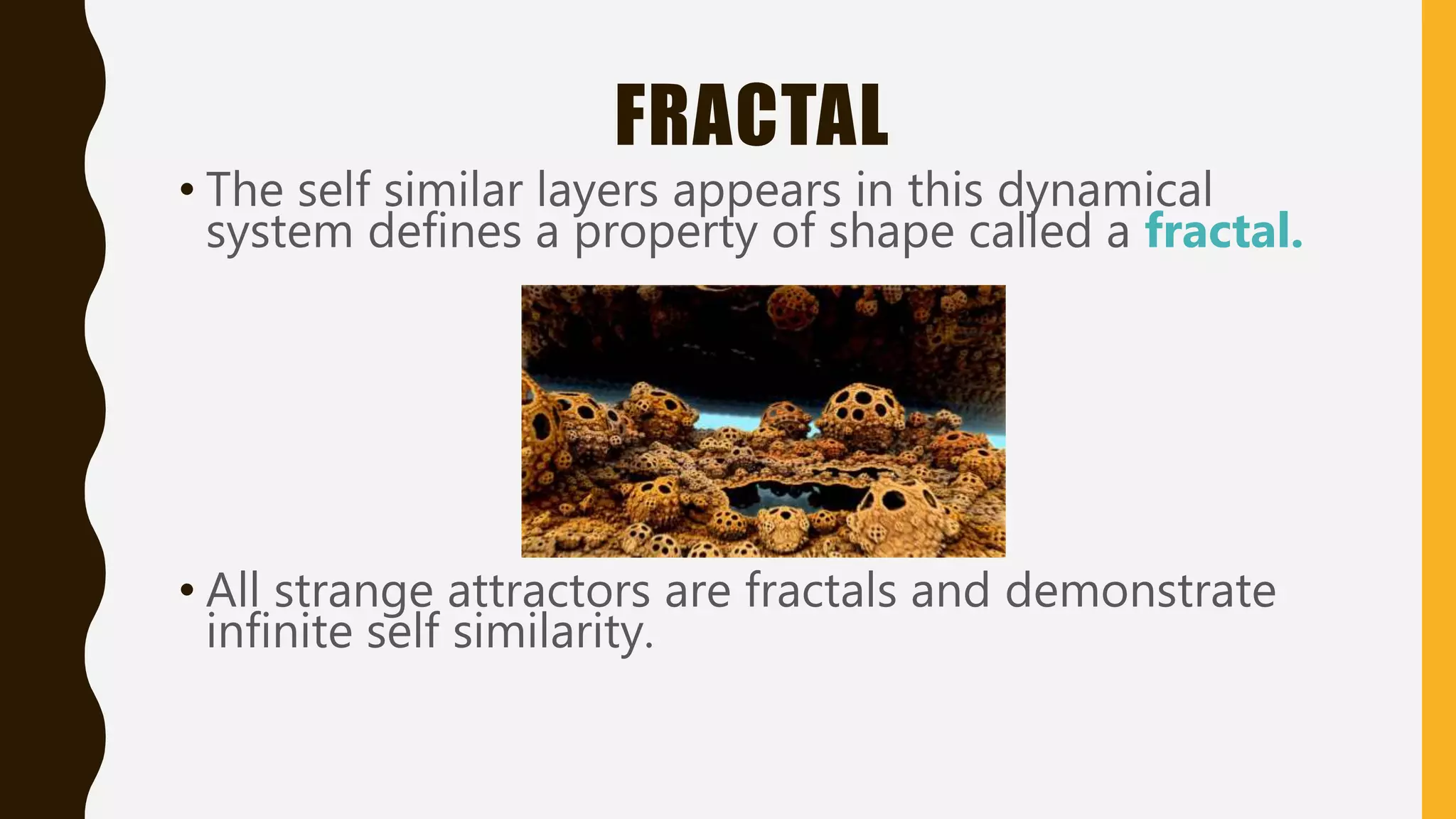
FRACTAL
• The selfsimilar layers appears in this dynamical
system defines a property of shape called a fractal.
• All strange attractors are fractals and demonstrate
infinite self similarity.
30.
EVERYTHING WITH ABEGINNING
HAS AN END
Thank you .. !
Muhammad Zubair Janjua Wasif Irshad Khan