CHAOS


Lorenz Attractor [Gleick, 1987]
Outline
Chaos Defined
Characteristics of Chaos
History of Chaos
Edward Lorenz and the Butterfly Effect
The Water Wheel
The Lorenz Attractor
Chaos in Action
Chaos Defined
“Irregular motion of a dynamical system that is deterministic,
sensitive to initial conditions, and impossible to predict in the
long term with anything less than an infinite and perfect
representation of analog values.” [Flake, ]
“Chaos is sustained and disorderly- looking long-term
evolution that satisfies certain special mathematical criteria
and that occurs in a deterministic non-linear system.”
[Williams, 1997]
“The property that characterizes a dynamical system in which
most orbits exhibit sensitive dependence.” [Lorenz, 1993]
Characteristics of Chaos
Deterministic – Chaotic systems are completely deterministic
and not random.
Sensitive – Chaotic systems are extremely sensitive to initial
conditions, since any perturbation, no matter how minute, will
forever alter the future of the chaotic system.
Ergodic – Chaotic motion is ergodic, which means that the
state space trajectory of a chaotic system will always return to
the local region of a previous point in the trajectory.
Embedded – Chaotic attractors are embedded with an infinite
number of unstable periodic orbits.
History of Chaos
The word chaos goes back to Greek mythology
where it had two meanings:
– The primeval emptiness of the universe before
  things came into being.
– The abyss of the underworld.
History of Chaos (cont.)
1873 – British physicist James Clerk Maxwell
said, “when an infinitely small variation in the
present state may bring about a finite
difference in the state of the system in a finite
time, the condition of the system is said to be
unstable…[and] renders impossible the
prediction of future events…”
History of Chaos (cont.)
1898 – French mathematician Jacques
Hadamard remarked that an error or
discrepancy in initial conditions can render a
system’s long-term behavior unpredictable.
1908 – French mathematician Henri Poincare
emphasized that slight differences in initial
conditions eventually can lead to large
differences, making prediction “impossible”.
History of Chaos (cont.)
It wasn’t until 1963 when meteorologist
Edward Lorenz of MIT published his paper
“Deterministic Nonperiodic Flow” that chaos
really took off.
As of 1991, the number of papers on chaos
was doubling about every two years.
Entire courses on chaos are taught at colleges
and universities.
Journals and magazines are devoted largely or
entirely to chaos now.
Edward Lorenz and the
       Butterfly Effect
Lorenz created a toy weather on his Royal McBee
at MIT in 1960.
Weather prediction was considered “less than
science” at that time.
Using a set of 12 equations his computer modeled
the weather.
In the winter of 1961, wanting to examine a
sequence at greater length, Lorenz took a shortcut.
Edward Lorenz and the
    Butterfly Effect (cont.)
Instead of starting the whole run over, he
started midway through.
To give the machine its initial conditions,
he typed the numbers straight from the
earlier printout.
He went to get a cup of coffee.
When he came back an hour later, the
sequence had evolved differently.
Edward Lorenz and the
Butterfly Effect (cont.)
Edward Lorenz and the
   Butterfly Effect (cont.)
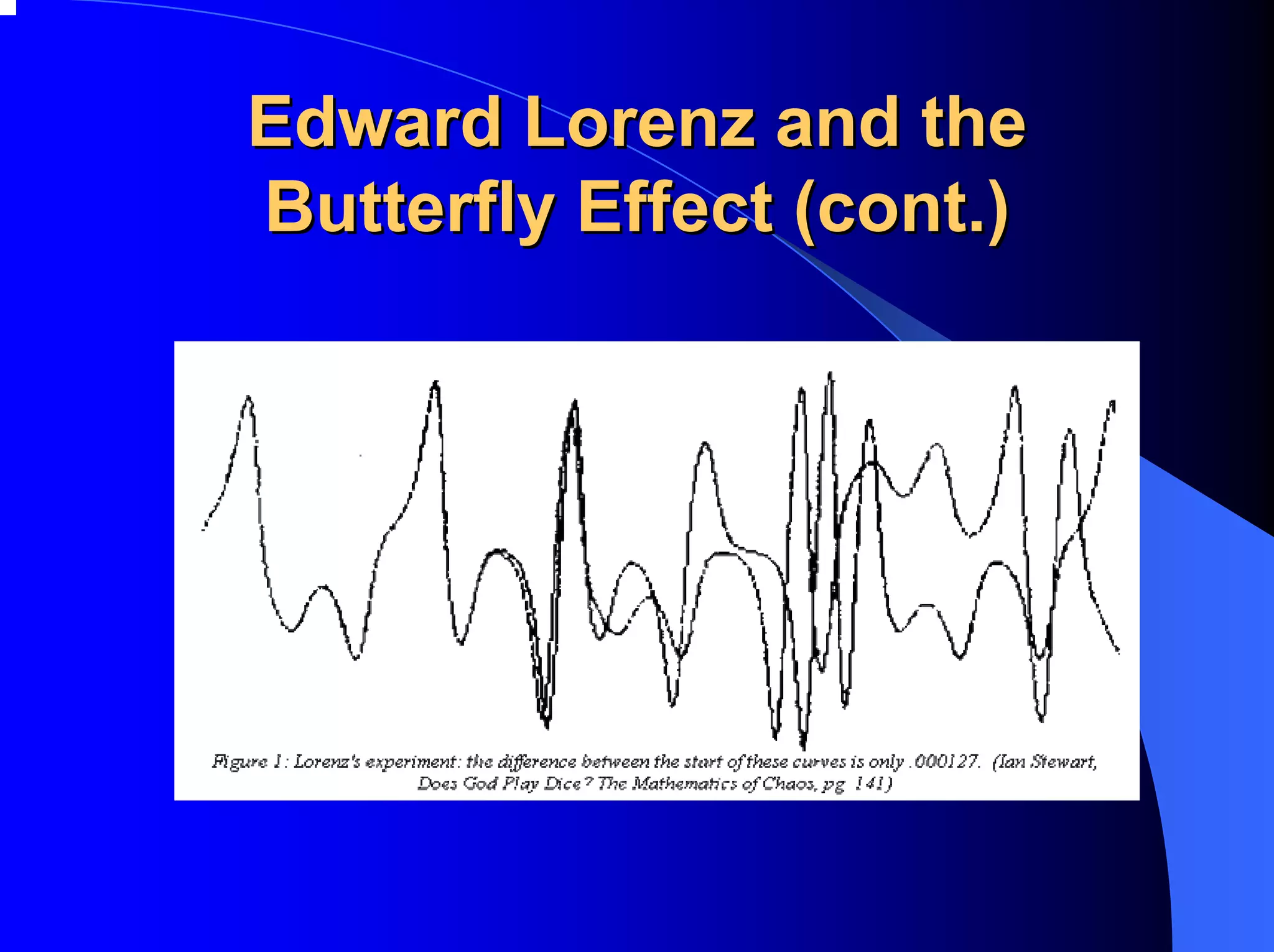
The new run should have exactly duplicated
the original…why didn’t it?
In the computer’s memory, six decimal
places were stored: 0.506127.
Lorenz entered 0.506 assuming that the
difference – one part in a thousand – was
inconsequential.
Edward Lorenz and the
     Butterfly Effect (cont.)
This effect came to be known as the butterfly effect.

“The flapping of a single butterfly’s wing today produces a
tiny change in the state of the atmosphere. Over a period of
time, what the atmosphere actually does diverges from what
it would have done. So, in a month’s time, a tornado that
would have devastated the Indonesian coast doesn’t happen.
Or maybe one that wasn’t going to happen, does.” [Ian
Stewart, Does God Play Dice? The Mathematics of Chaos]

This phenomenon is also known as sensitive dependence on
initial conditions.
The Water Wheel
Lorenz put the weather aside and looked for
even simpler ways to produce chaotic behavior.
Using three equations for convection which he
stripped down and made unrealistically simple,
Lorenz was able to illustrate sensitive
dependence on initial conditions.
His equations correspond exactly to a
mechanical device called the water wheel.
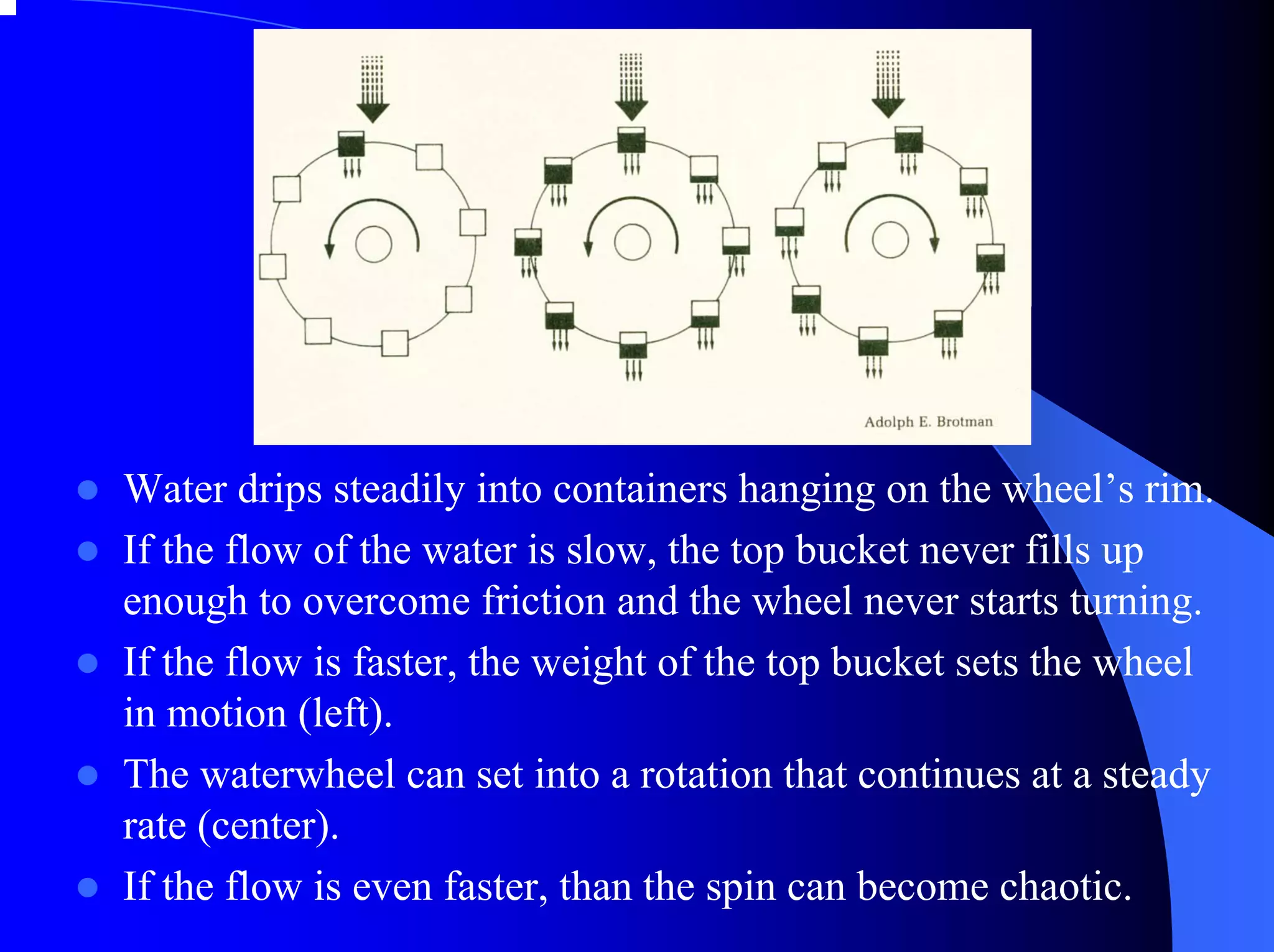
Water drips steadily into containers hanging on the wheel’s rim.
If the flow of the water is slow, the top bucket never fills up
enough to overcome friction and the wheel never starts turning.
If the flow is faster, the weight of the top bucket sets the wheel
in motion (left).
The waterwheel can set into a rotation that continues at a steady
rate (center).
If the flow is even faster, than the spin can become chaotic.
Lorenz discovered that over long periods, the spin
can reverse itself many times, never settling down
to a steady rate and never repeating itself in any
predictable pattern.
Lorenz summarized his findings in his 1963 paper
published in the Journal of Atmospheric Sciences.
He ultimately states, “In view of the inevitable
inaccuracy and incompleteness of weather
observations, precise very long-range forecasting
would seem to be non-existent.”
In addition, the Lorenz Attractor is born, which
became an emblem for early chaos theory.
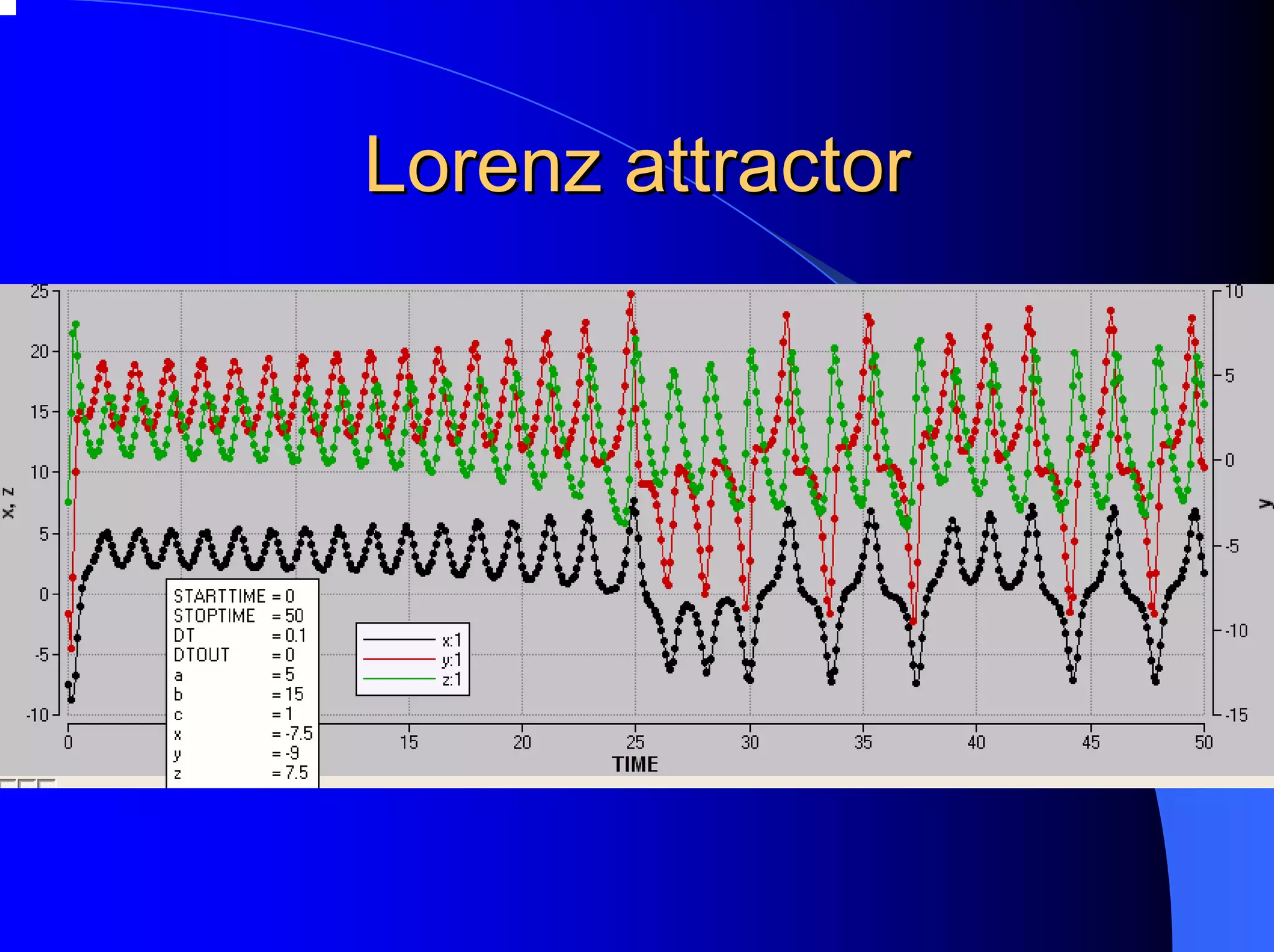
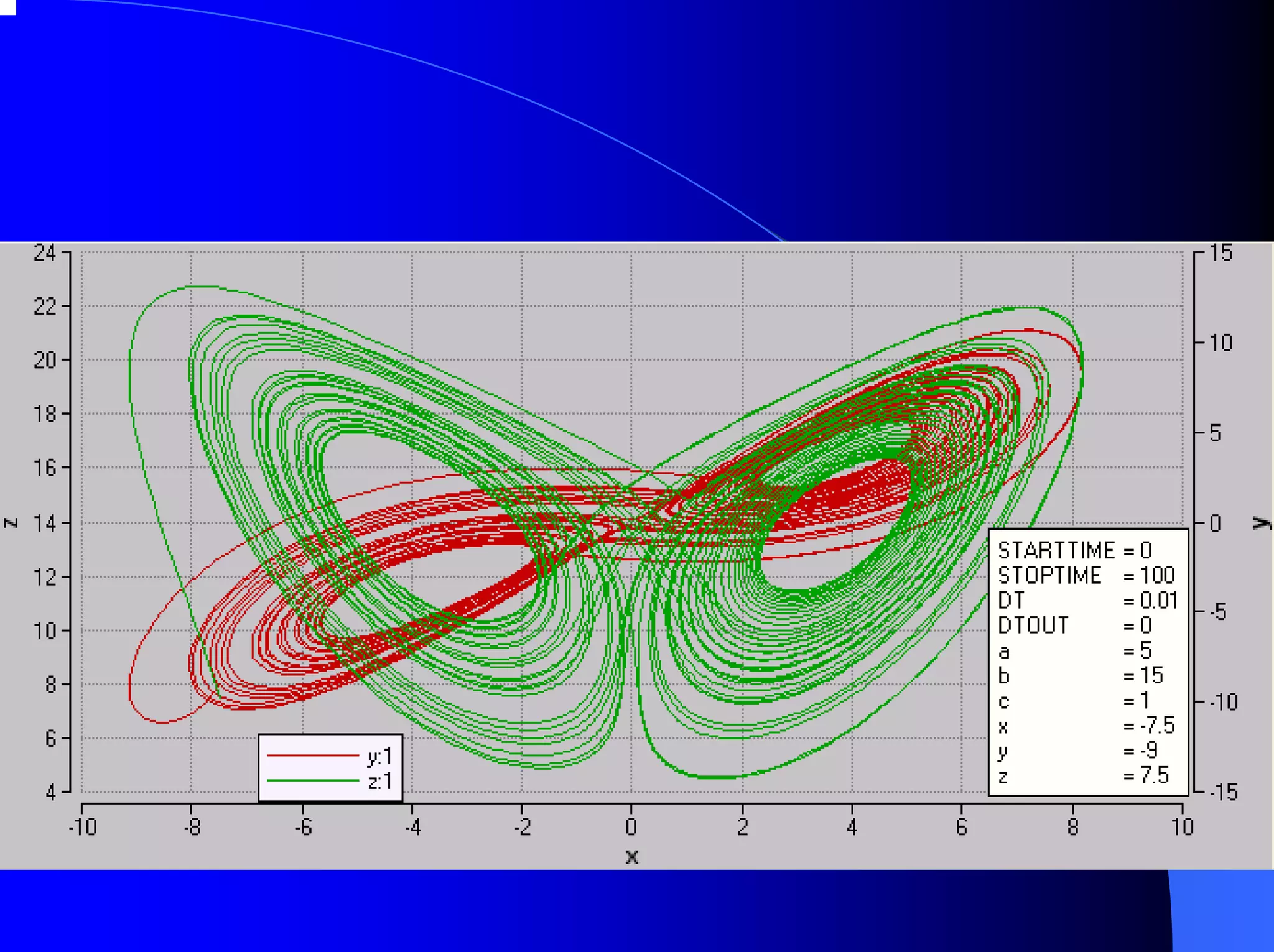
Lorenz Attractor
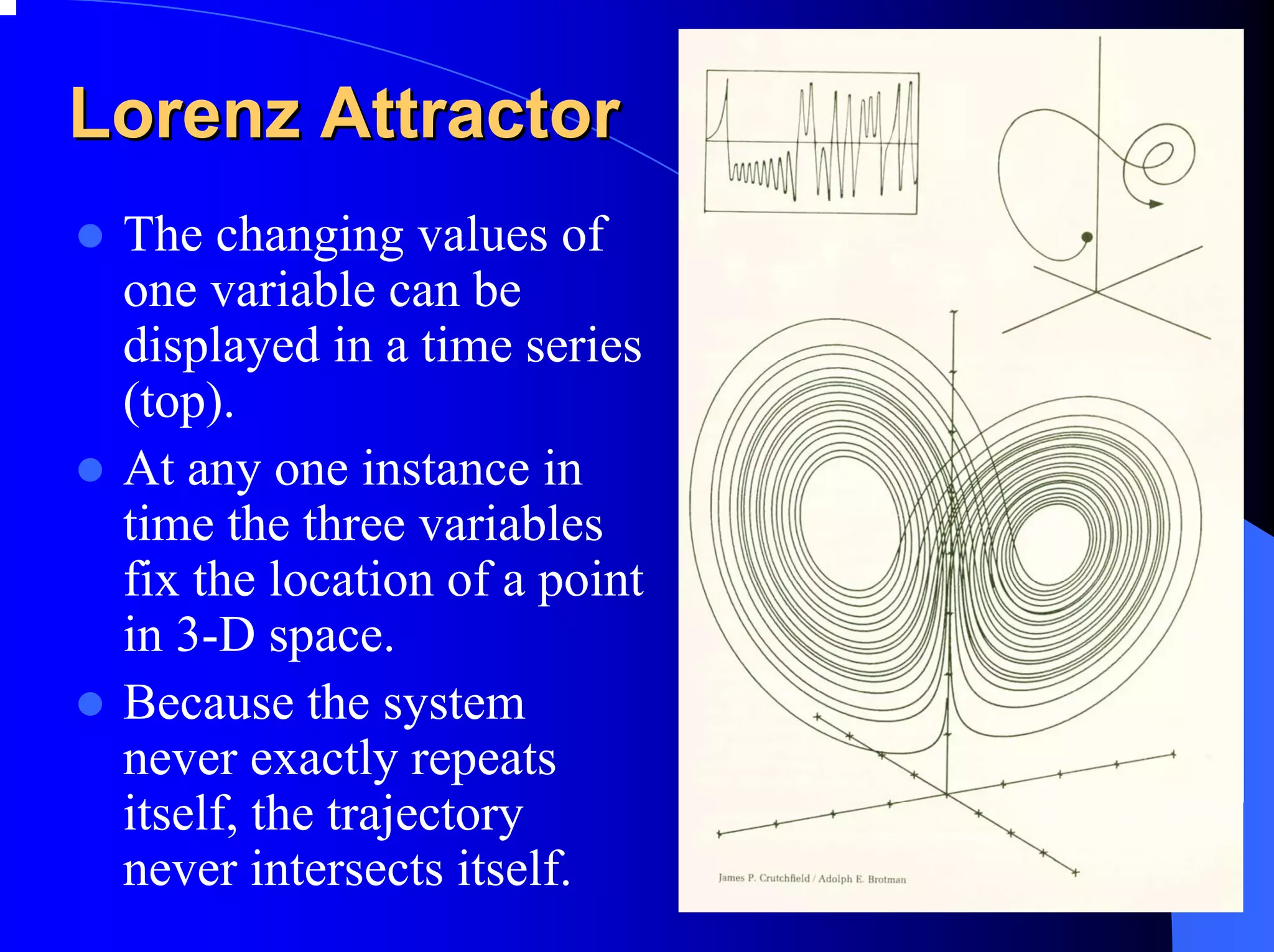
 The changing values of
 one variable can be
 displayed in a time series
 (top).
 At any one instance in
 time the three variables
 fix the location of a point
 in 3-D space.
 Because the system
 never exactly repeats
 itself, the trajectory
 never intersects itself.
Chaos in
   Action
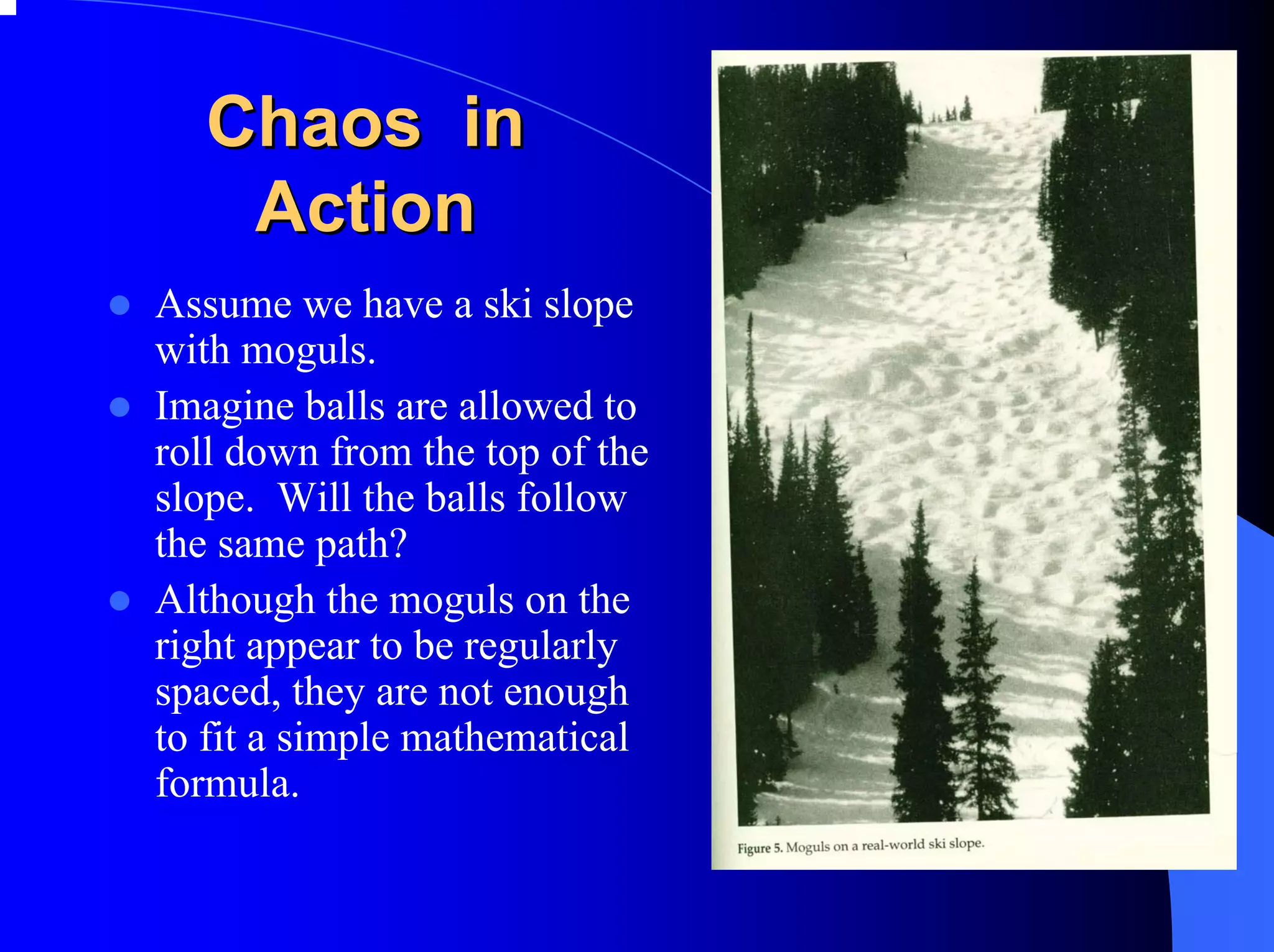
Assume we have a ski slope
with moguls.
Imagine balls are allowed to
roll down from the top of the
slope. Will the balls follow
the same path?
Although the moguls on the
right appear to be regularly
spaced, they are not enough
to fit a simple mathematical
formula.
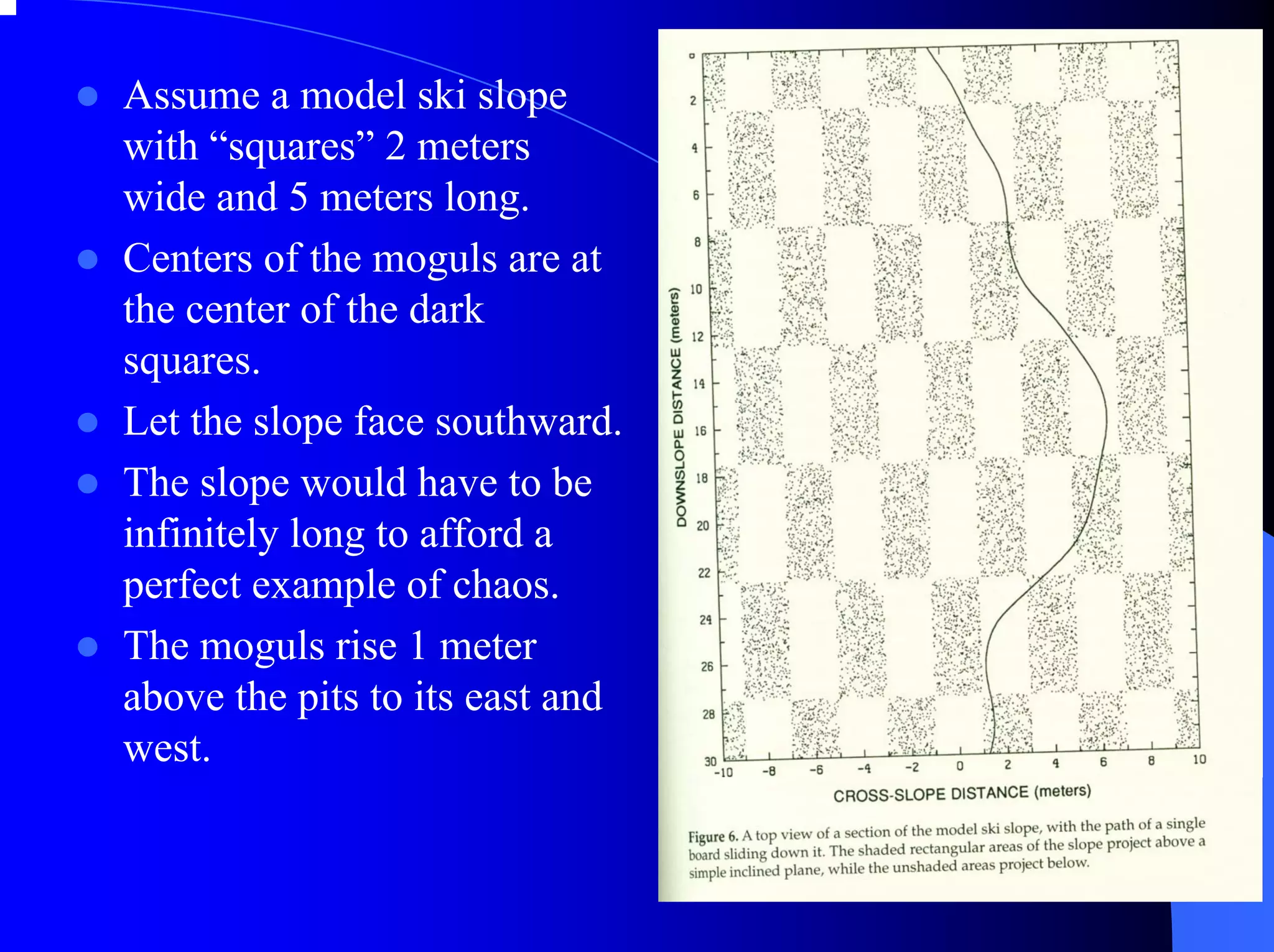
Assume a model ski slope
with “squares” 2 meters
wide and 5 meters long.
Centers of the moguls are at
the center of the dark
squares.
Let the slope face southward.
The slope would have to be
infinitely long to afford a
perfect example of chaos.
The moguls rise 1 meter
above the pits to its east and
west.
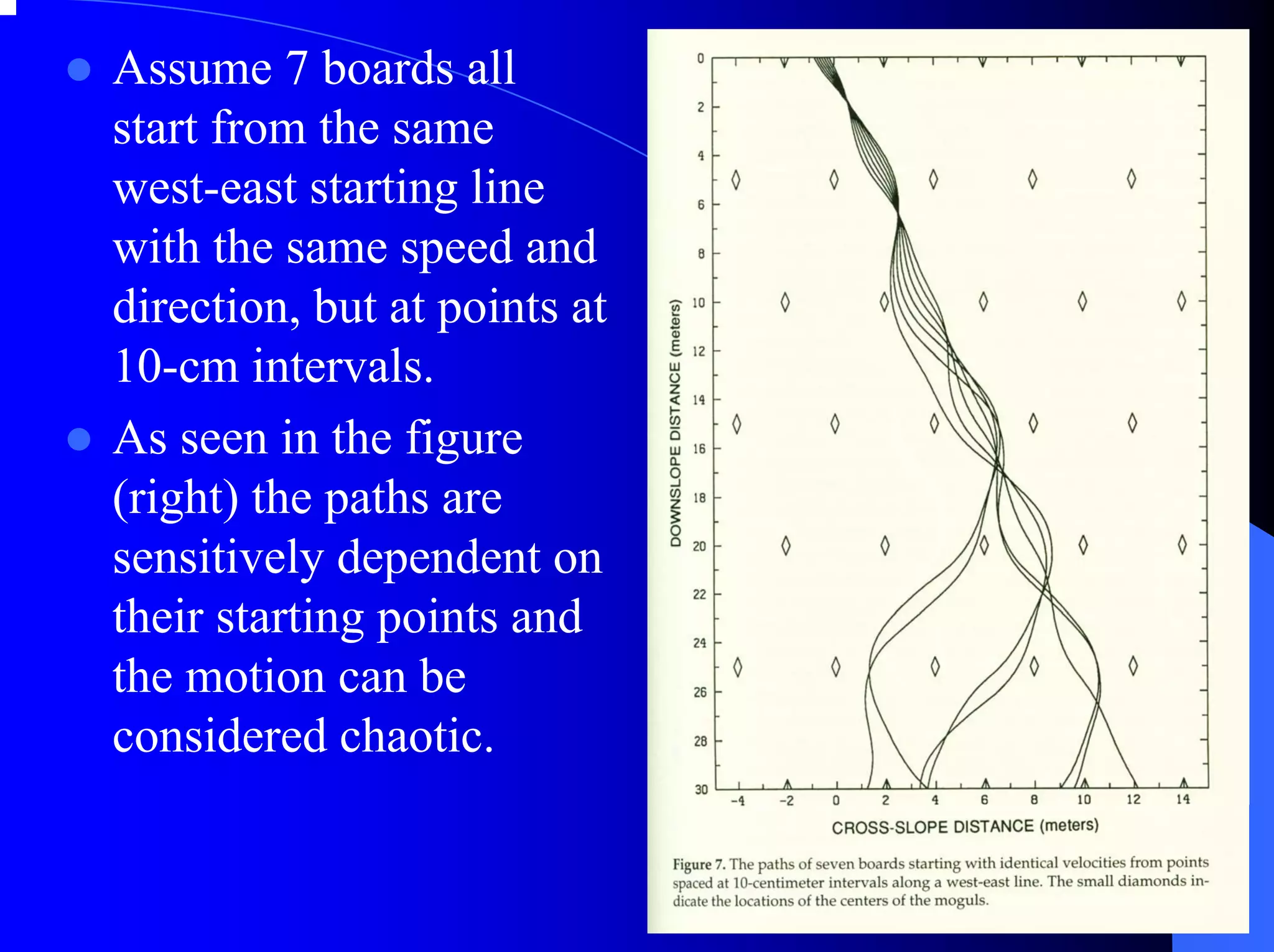
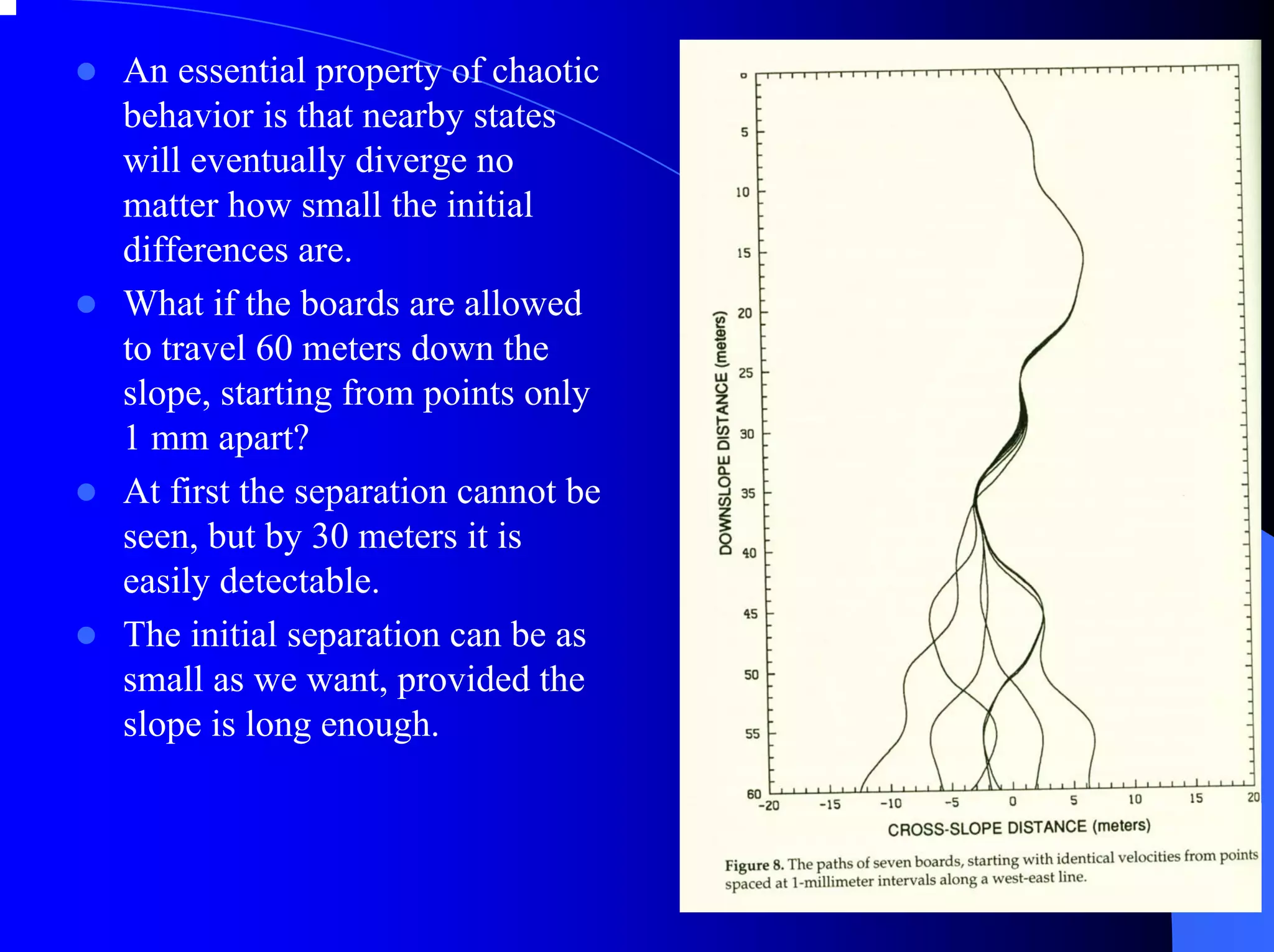
Assume 7 boards all
start from the same
west-east starting line
with the same speed and
direction, but at points at
10-cm intervals.
As seen in the figure
(right) the paths are
sensitively dependent on
their starting points and
the motion can be
considered chaotic.
An essential property of chaotic
behavior is that nearby states
will eventually diverge no
matter how small the initial
differences are.
What if the boards are allowed
to travel 60 meters down the
slope, starting from points only
1 mm apart?
At first the separation cannot be
seen, but by 30 meters it is
easily detectable.
The initial separation can be as
small as we want, provided the
slope is long enough.
“Now that science is looking, chaos seems to be
  everywhere. A rising column of cigarette smoke
  breaks into wild swirls. A flag snaps back and
  forth in the wind. A dripping faucet goes from a
  steady pattern to a random one. Chaos appears in
  the behavior of the weather, the behavior of an
  airplane in flight, the behavior of cars on an
  expressway, the behavior of oil flowing in
  underground pipes.”

                                    [Gleick, 1987]
Chaos’ qualities
Fractal functionality- self similarity
Chaotic unpredictability
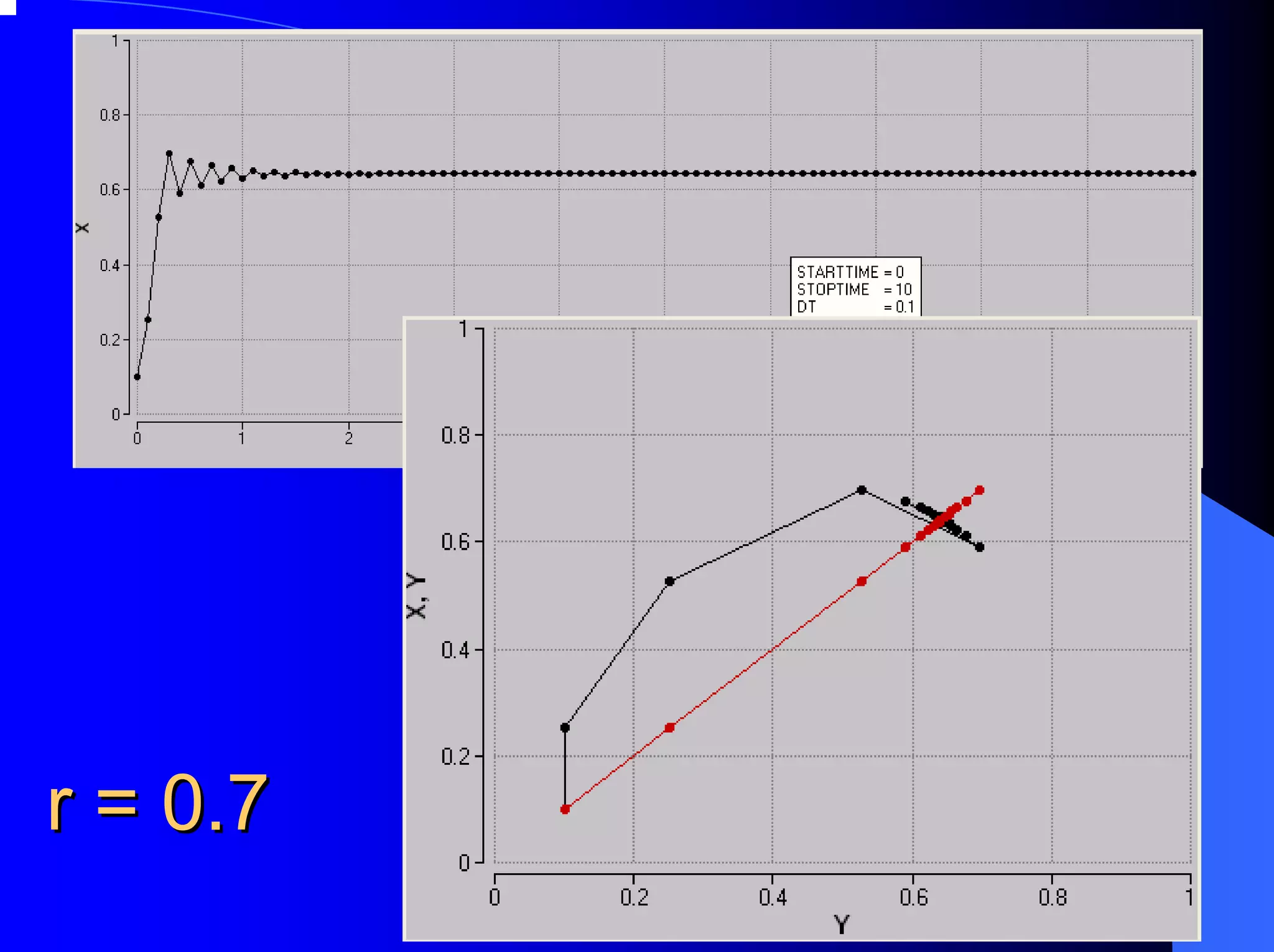
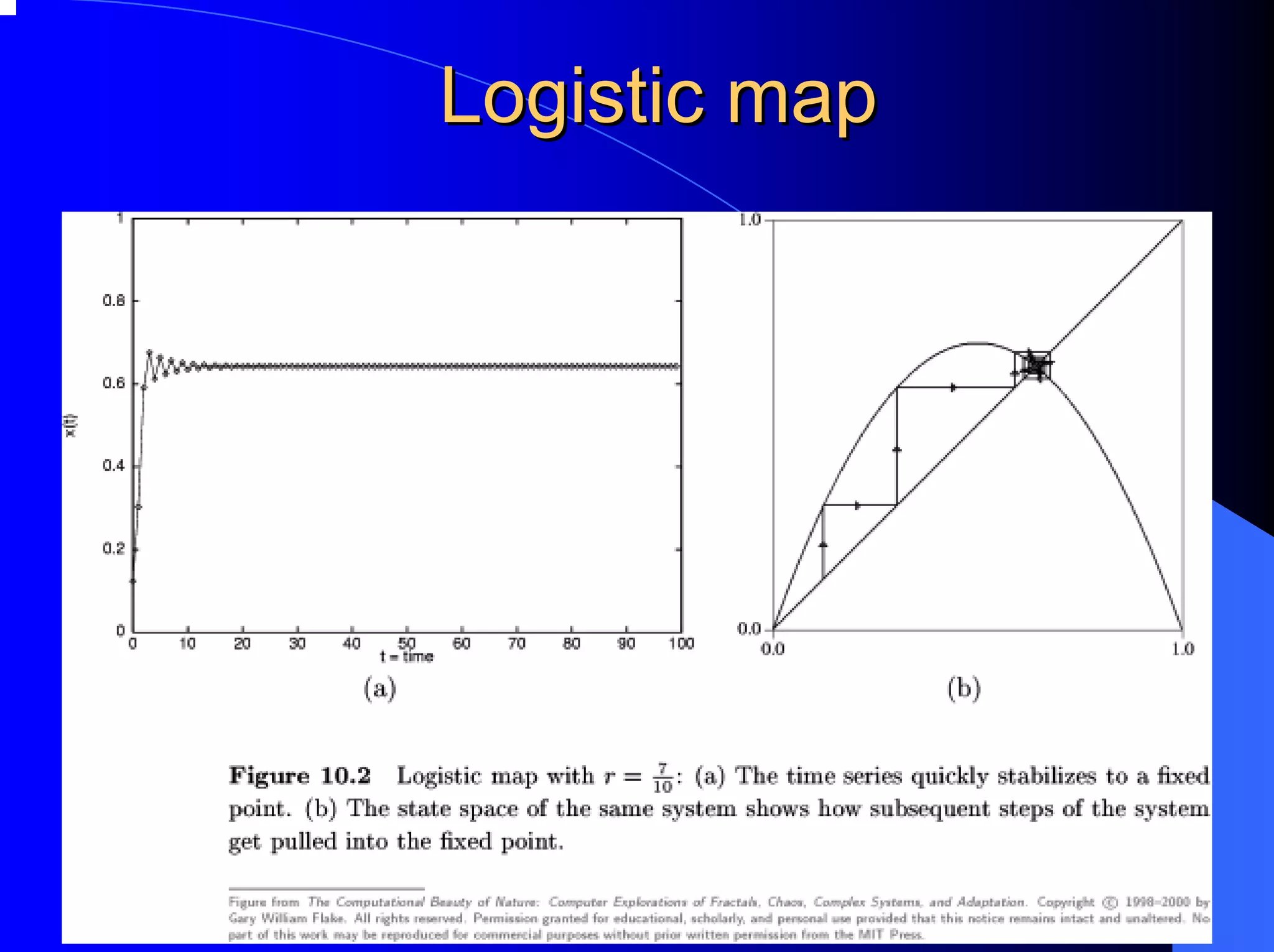
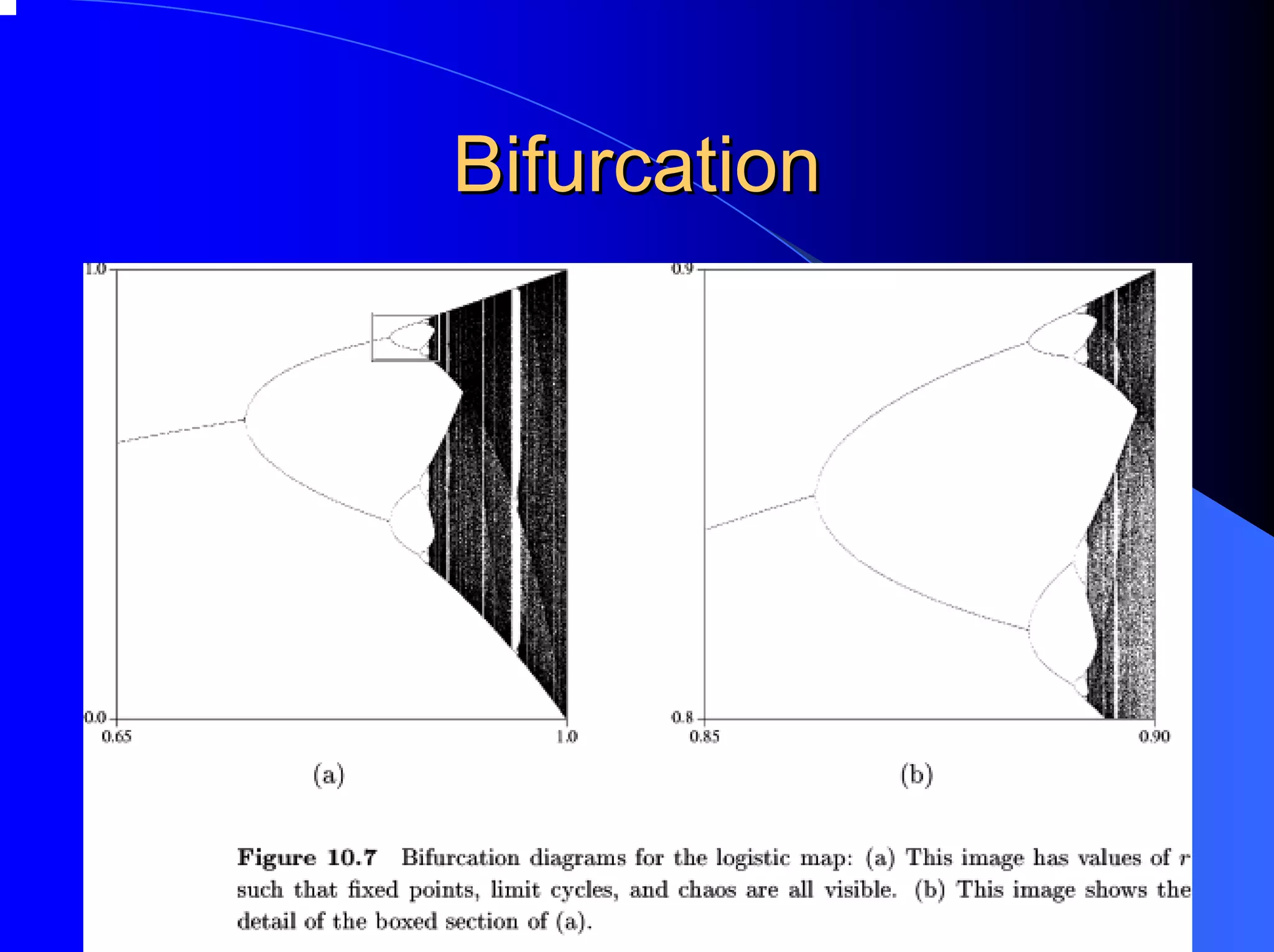
r = 0.7
Logistic map
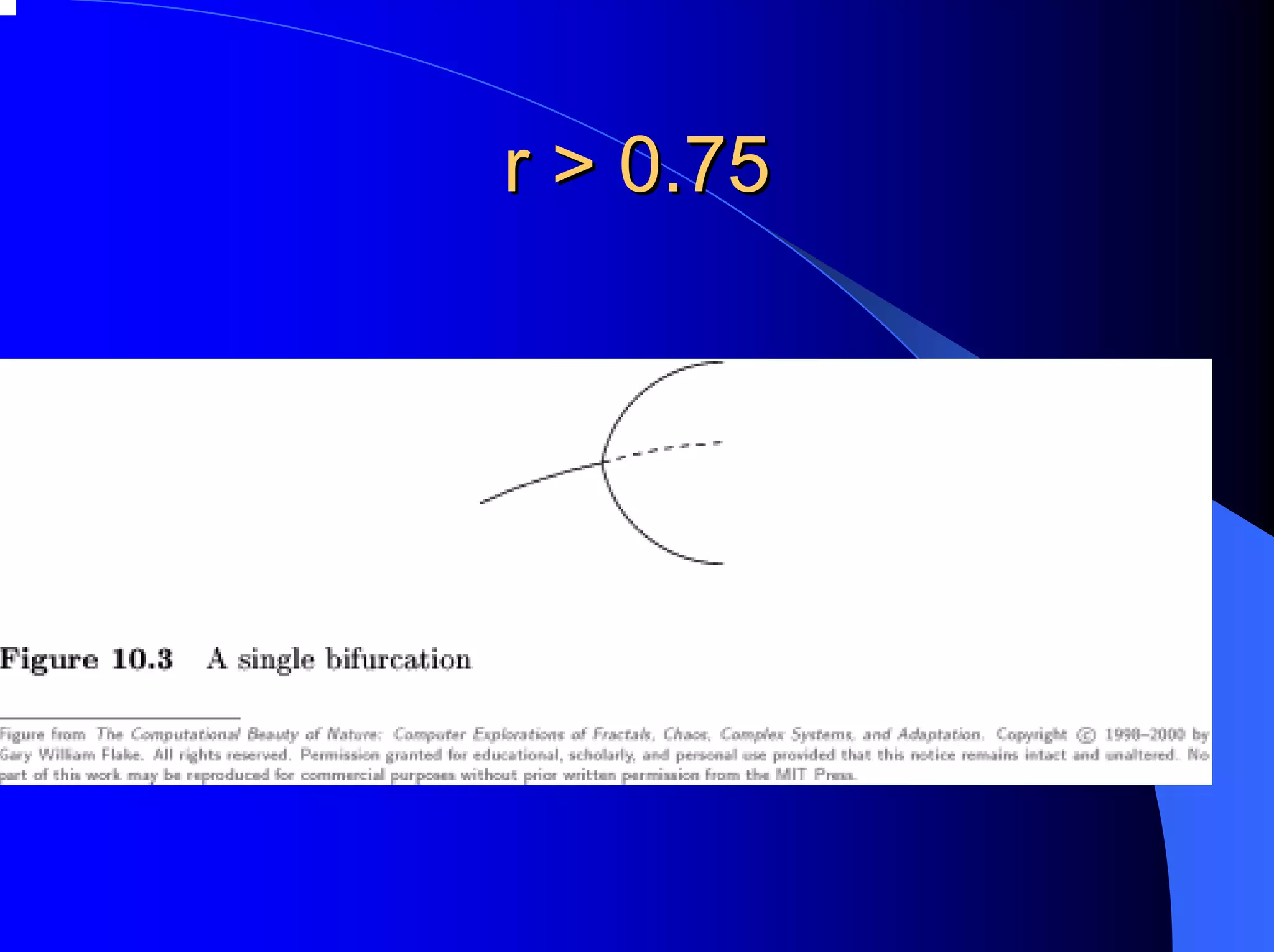
r > 0.75
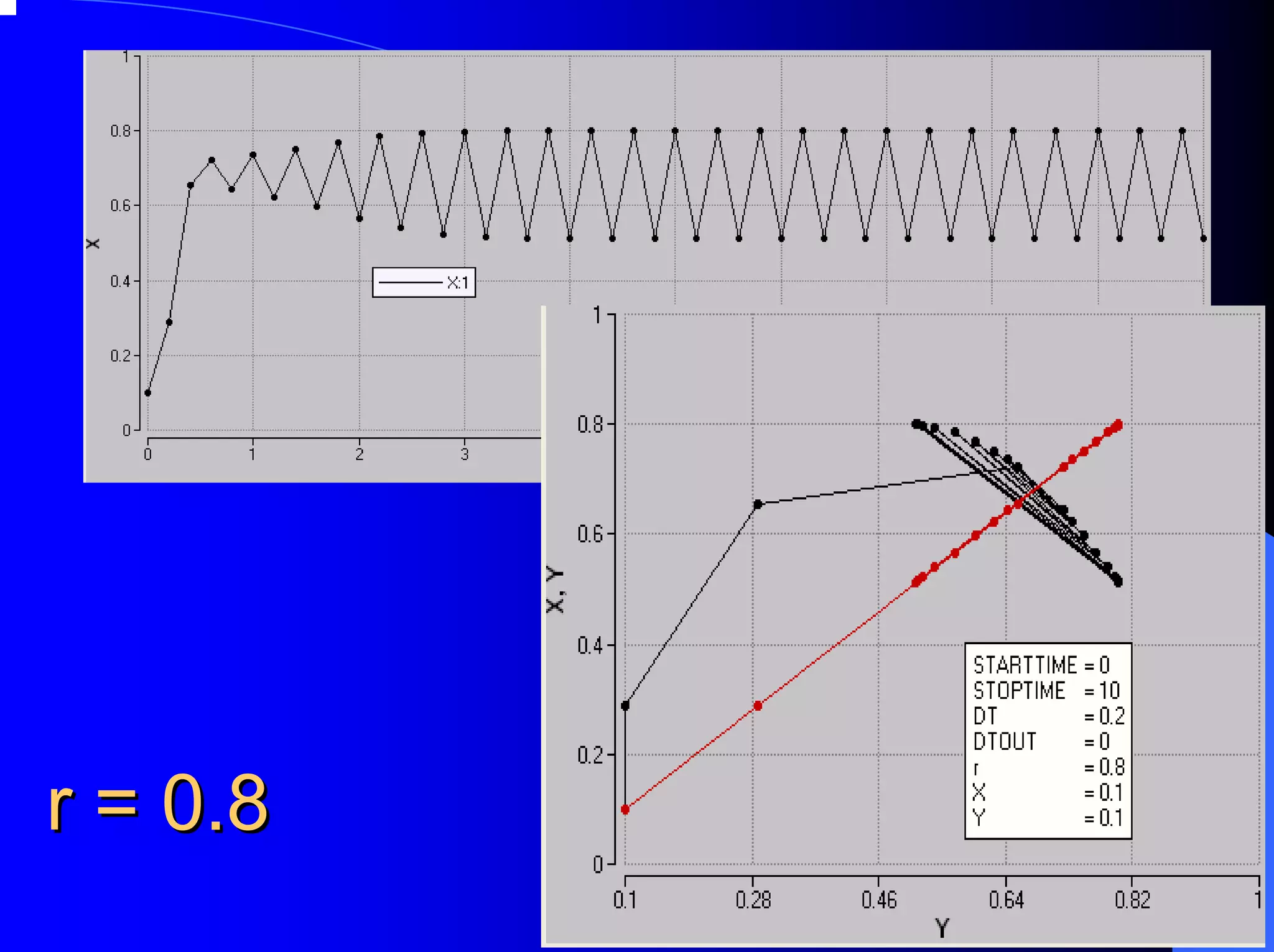
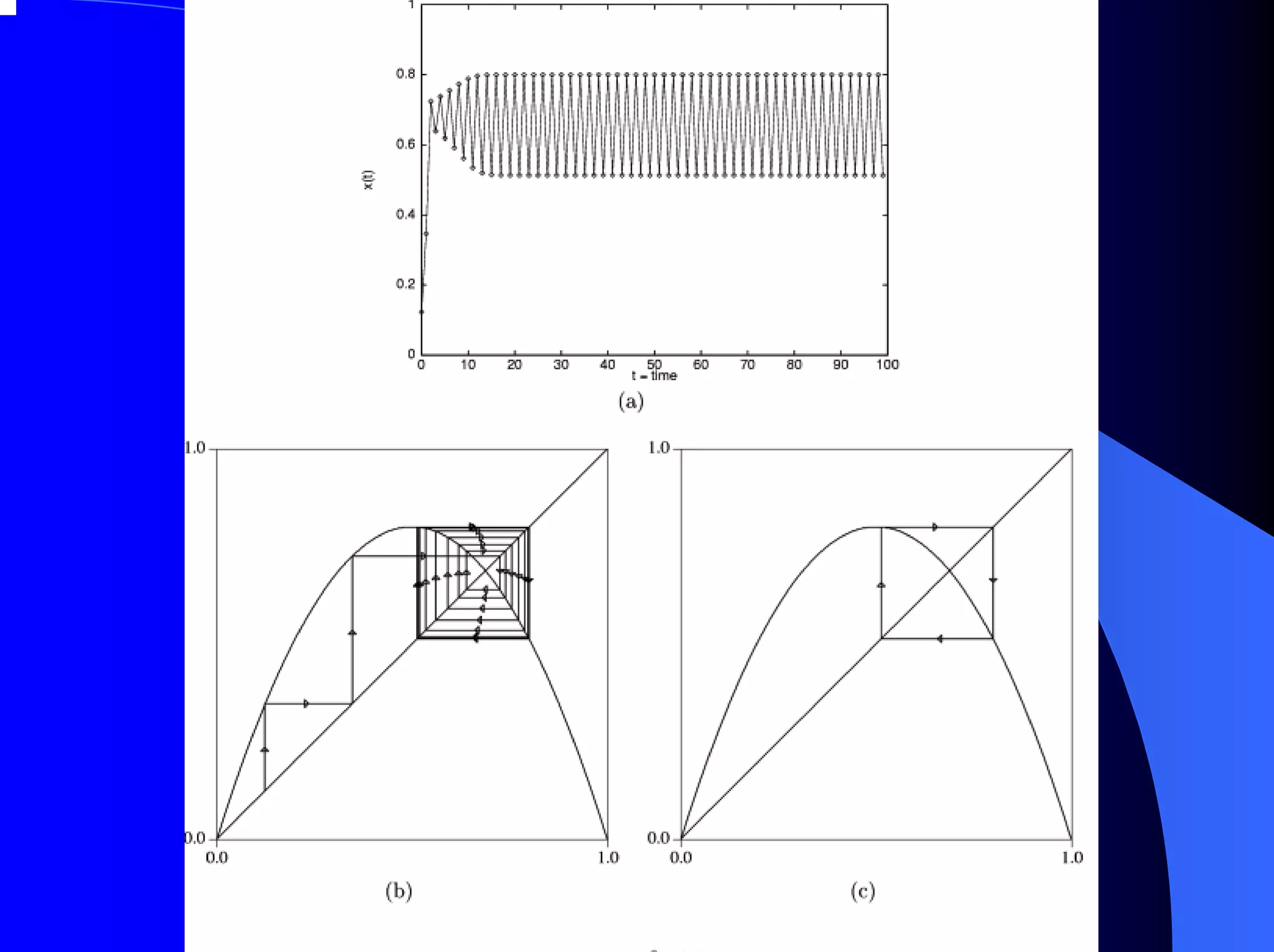
r = 0.8
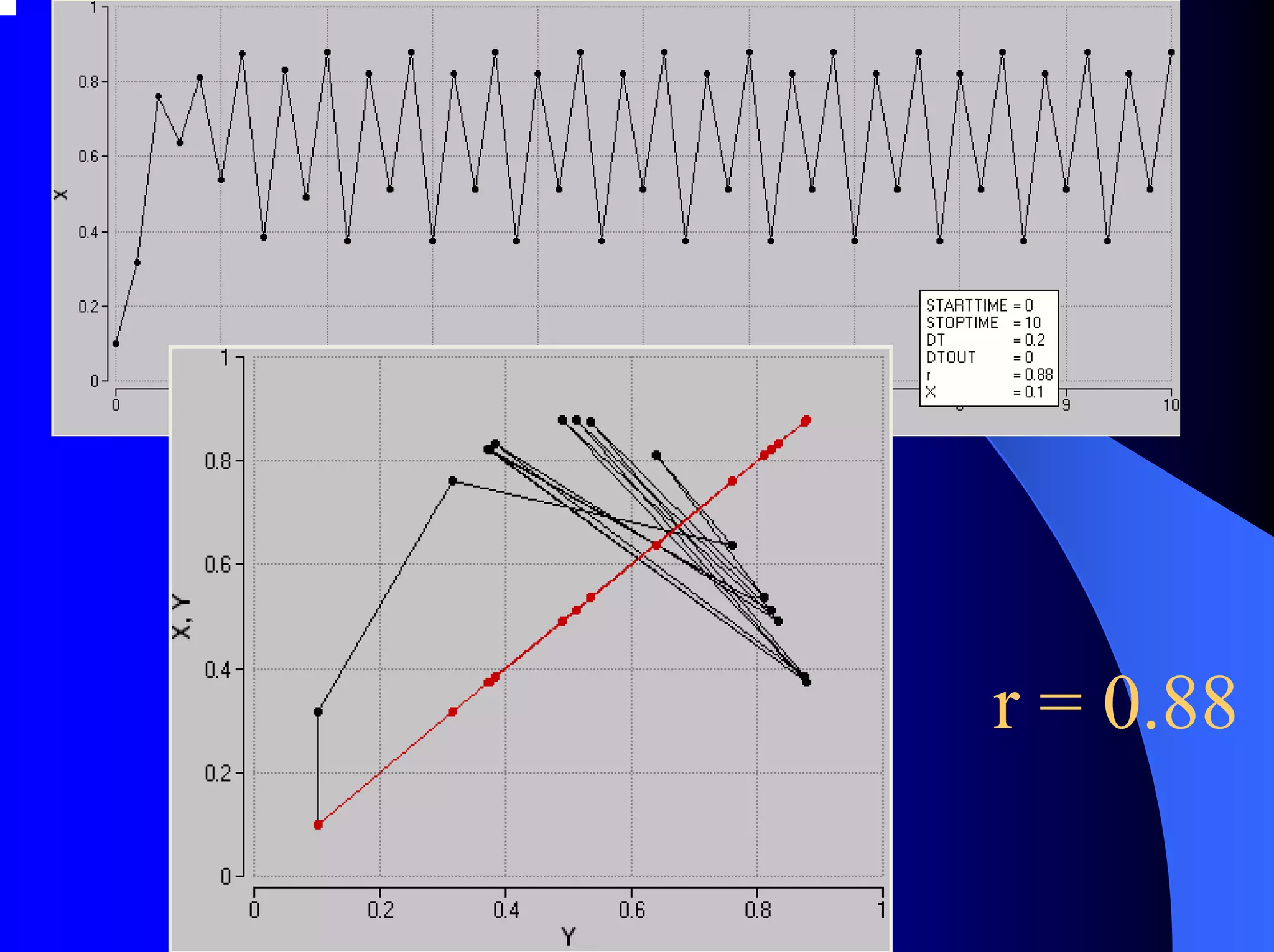
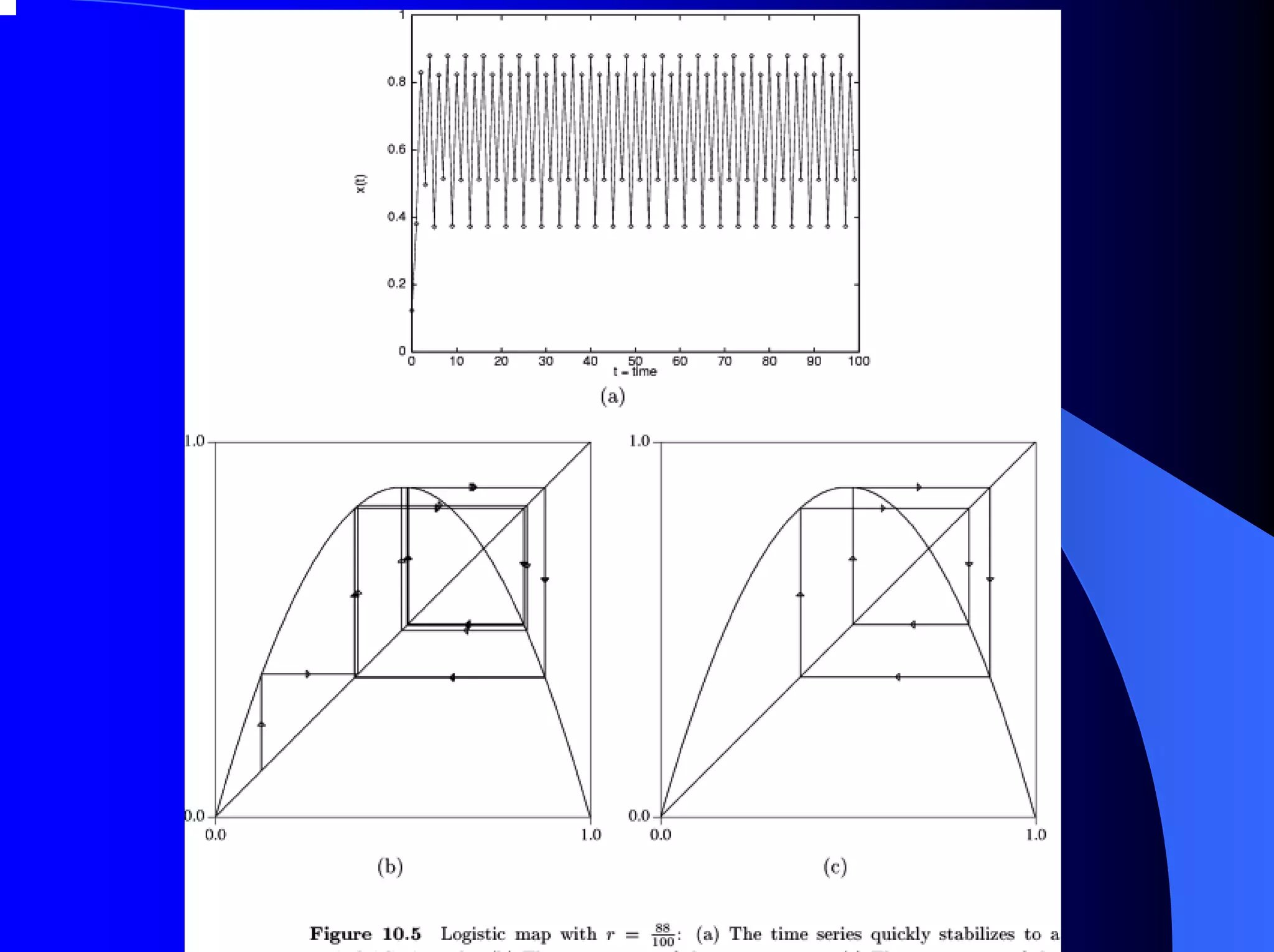
r = 0.88
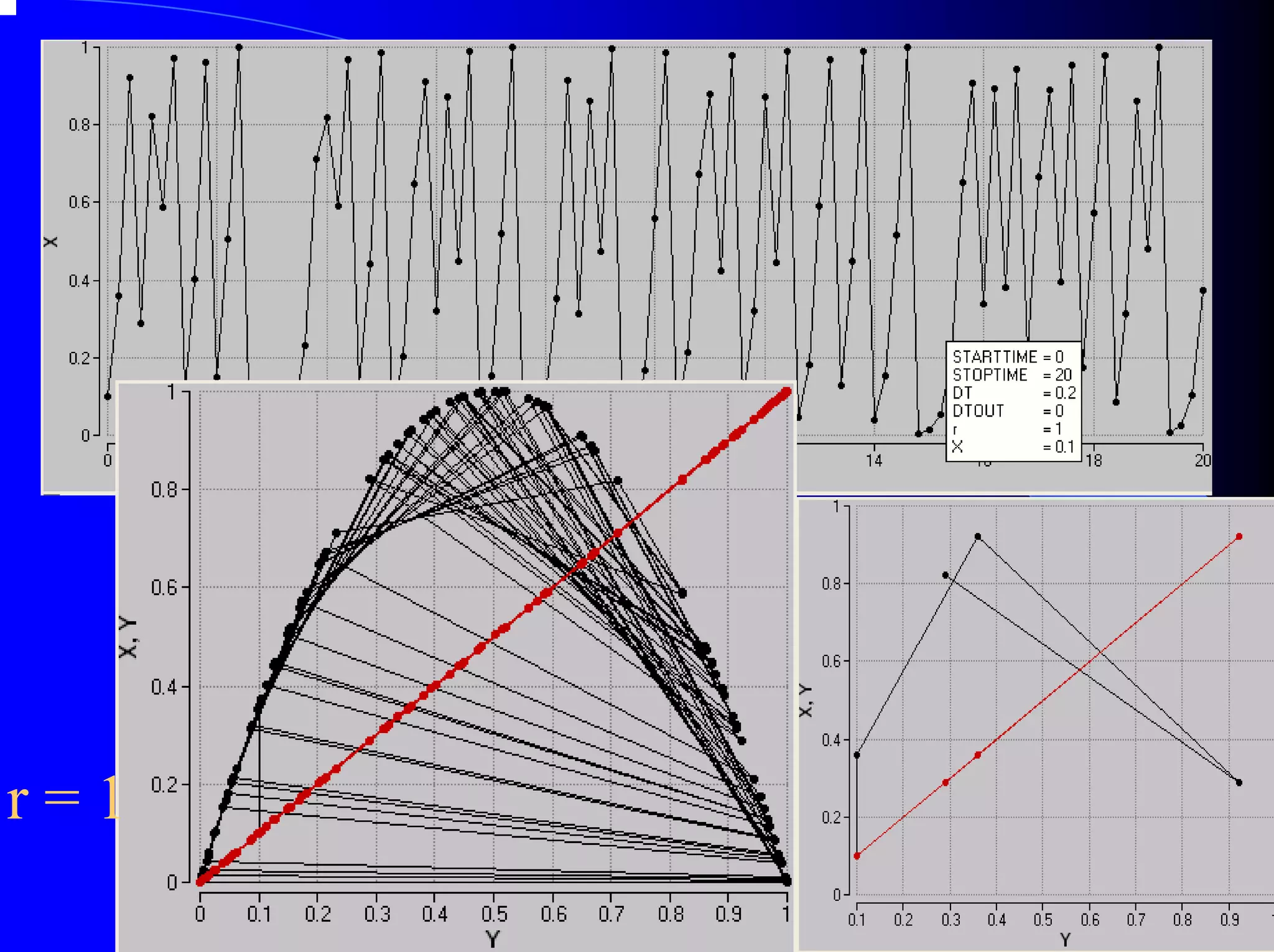
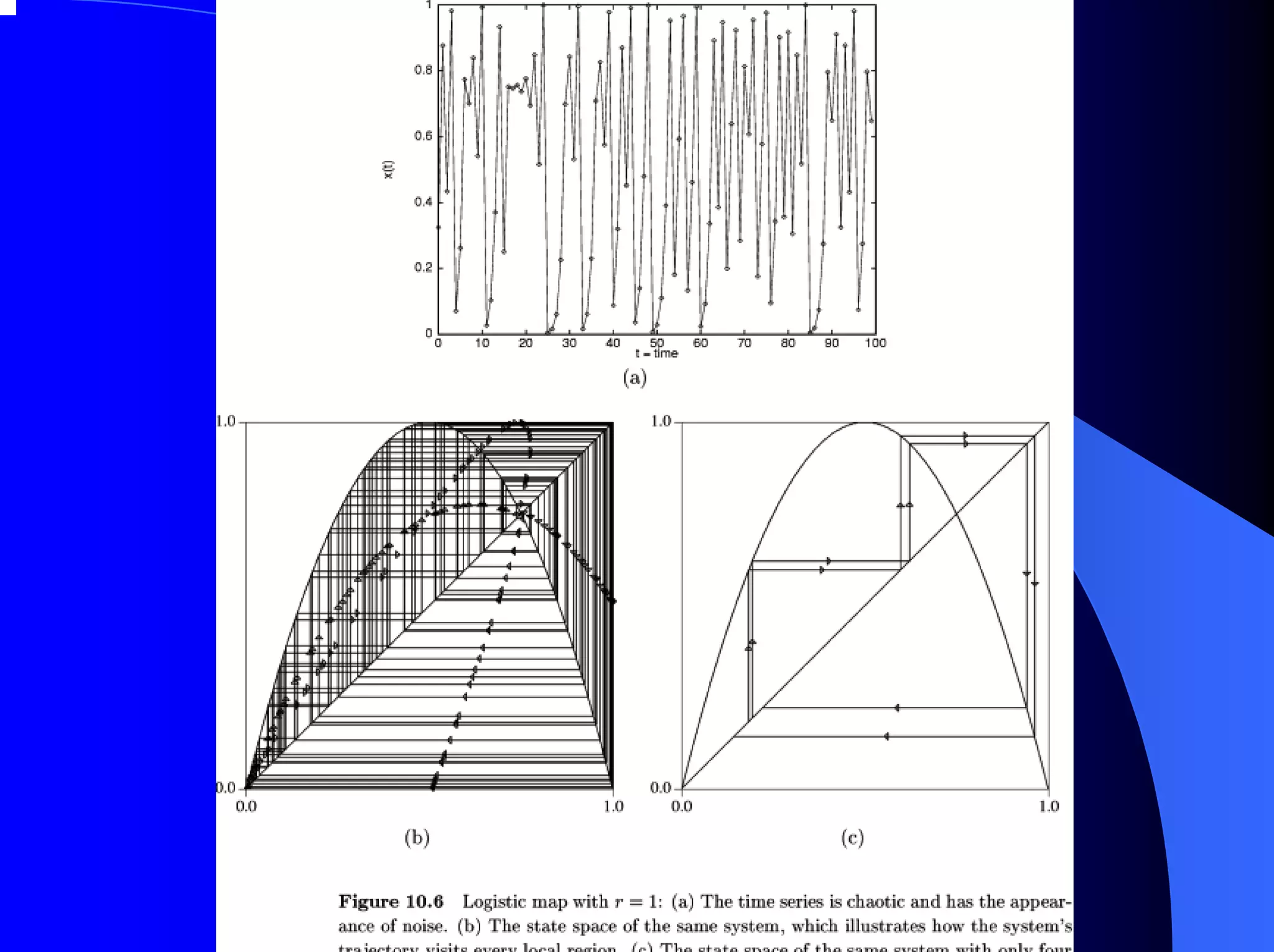
r=1
Bifurcation
Feigenbaum constant


                  ak − ak −1
             dk =
                  ak +1 − ak
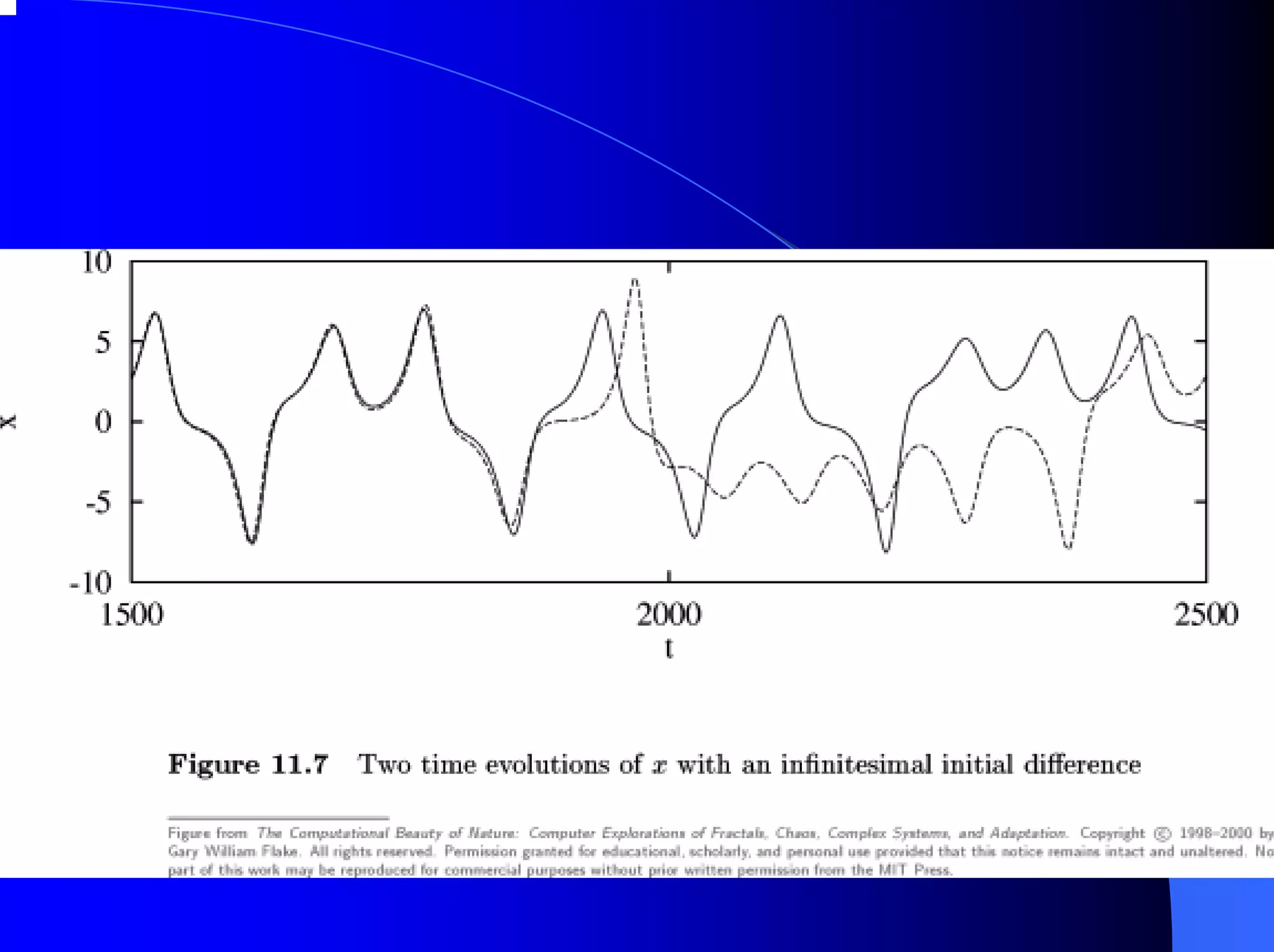
Chaotic vs stochastic
One of the most important differences
between chaotic processes and truly
stochastic processes is that the future
behavior of a chaotic system can be
predicted in the short term, while stochastic
processes can be characterized only
statistically
Strange attractors
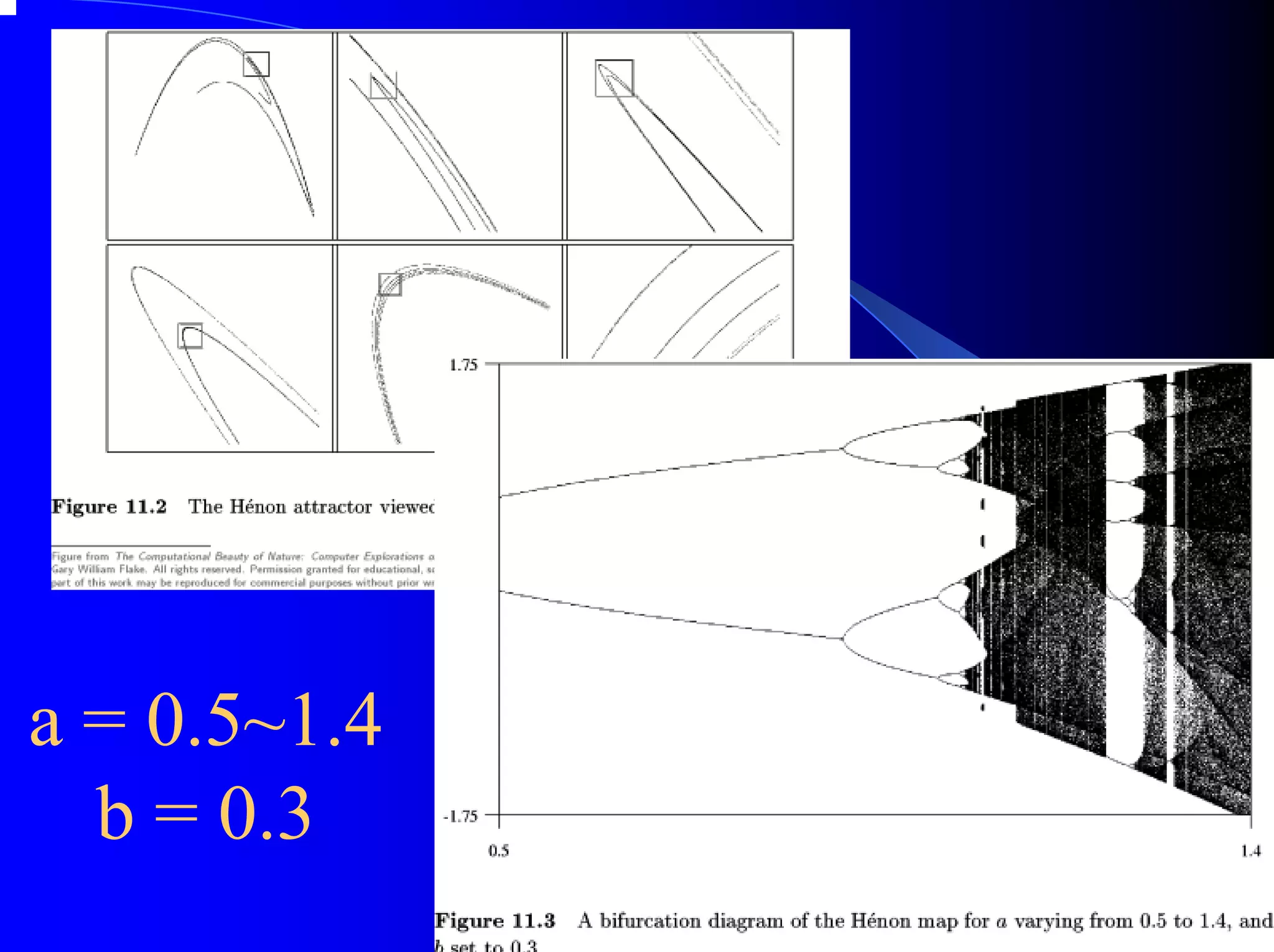
The Henon map – discrete
The Lorenz attractor – continuous
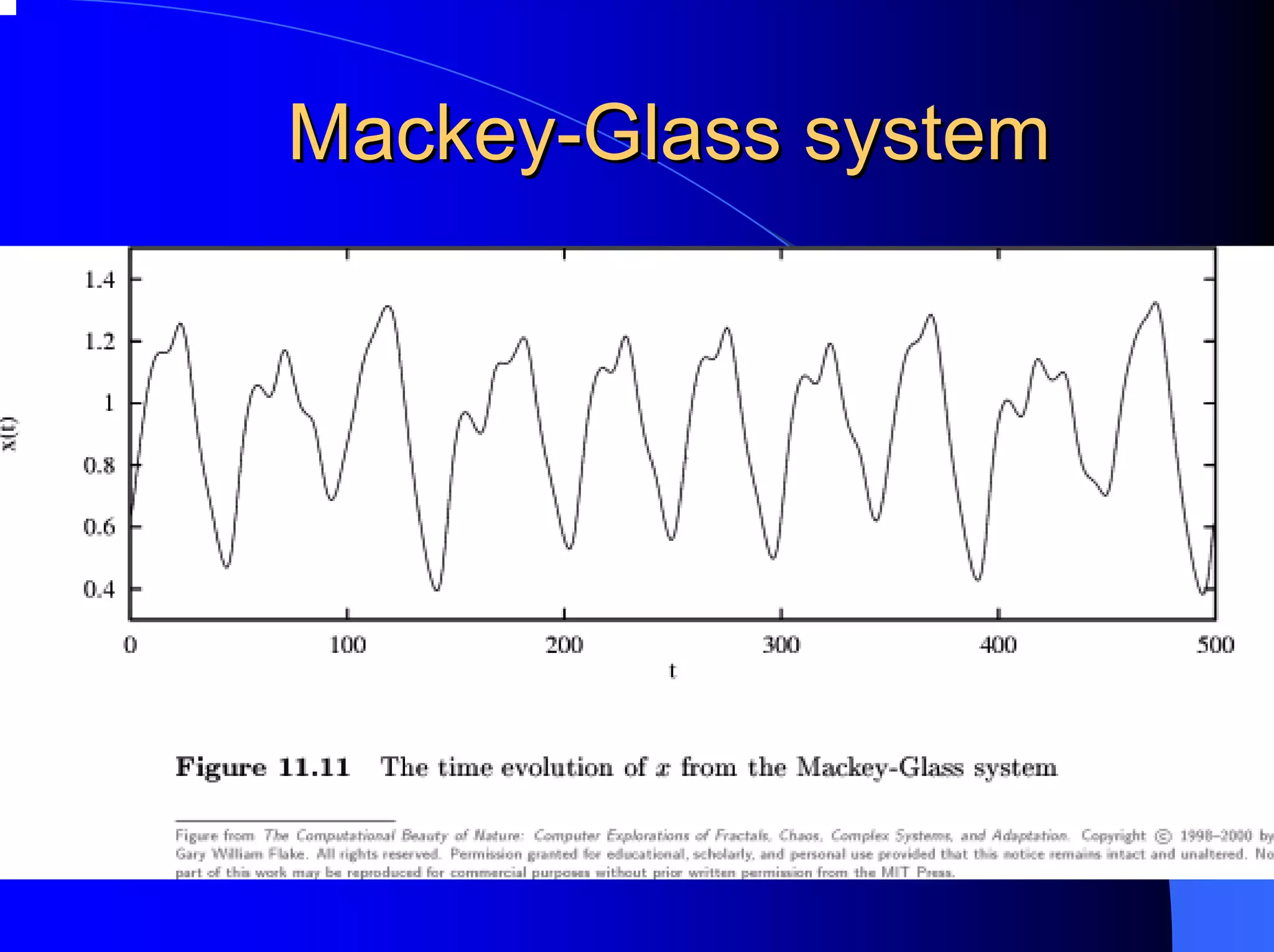
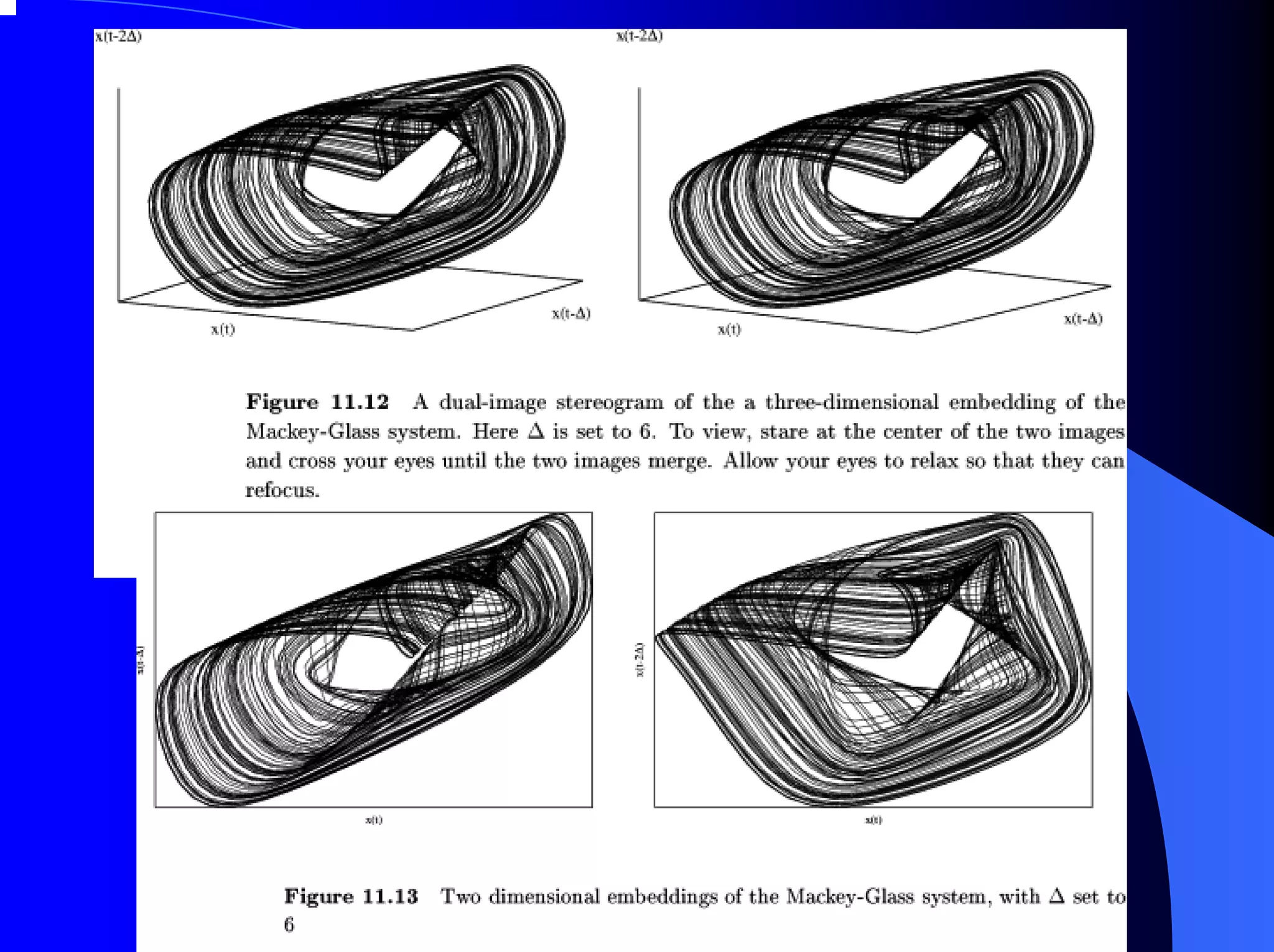
Mackey-Glass system – discrete and
continuous
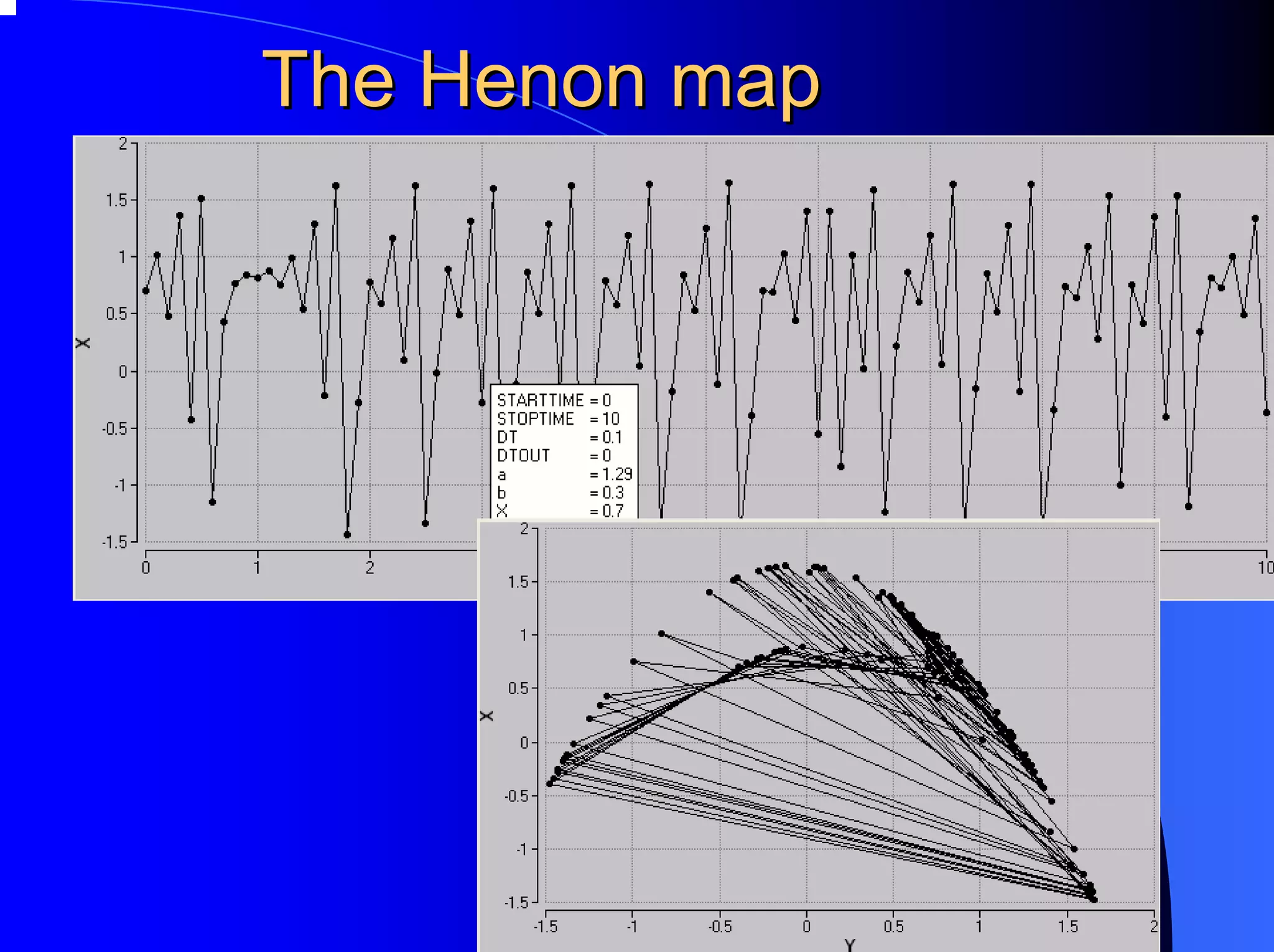
The Henon map
a = 0.5~1.4
  b = 0.3
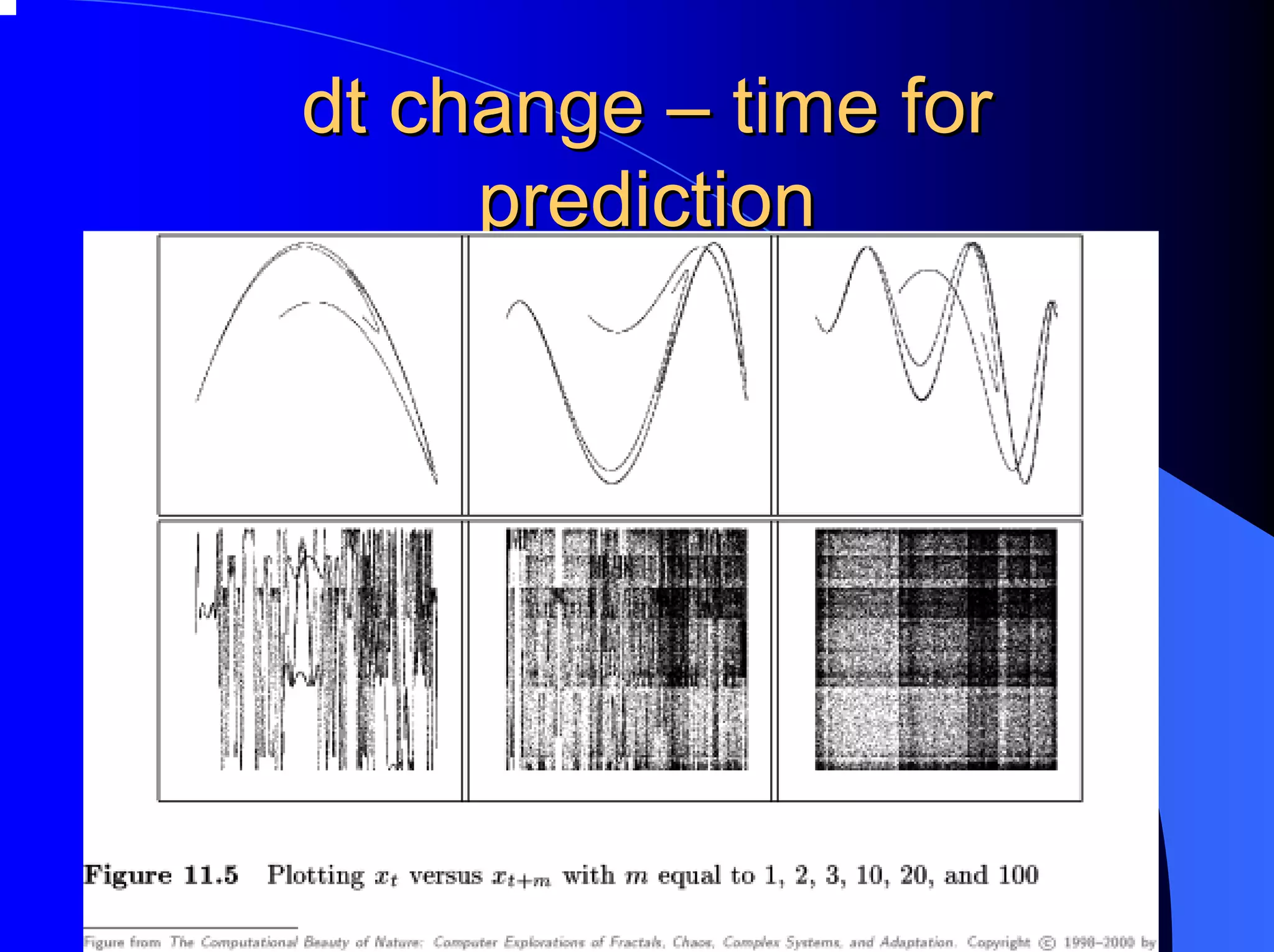
dt change – time for
     prediction
Lorenz attractor
Mackey-Glass system
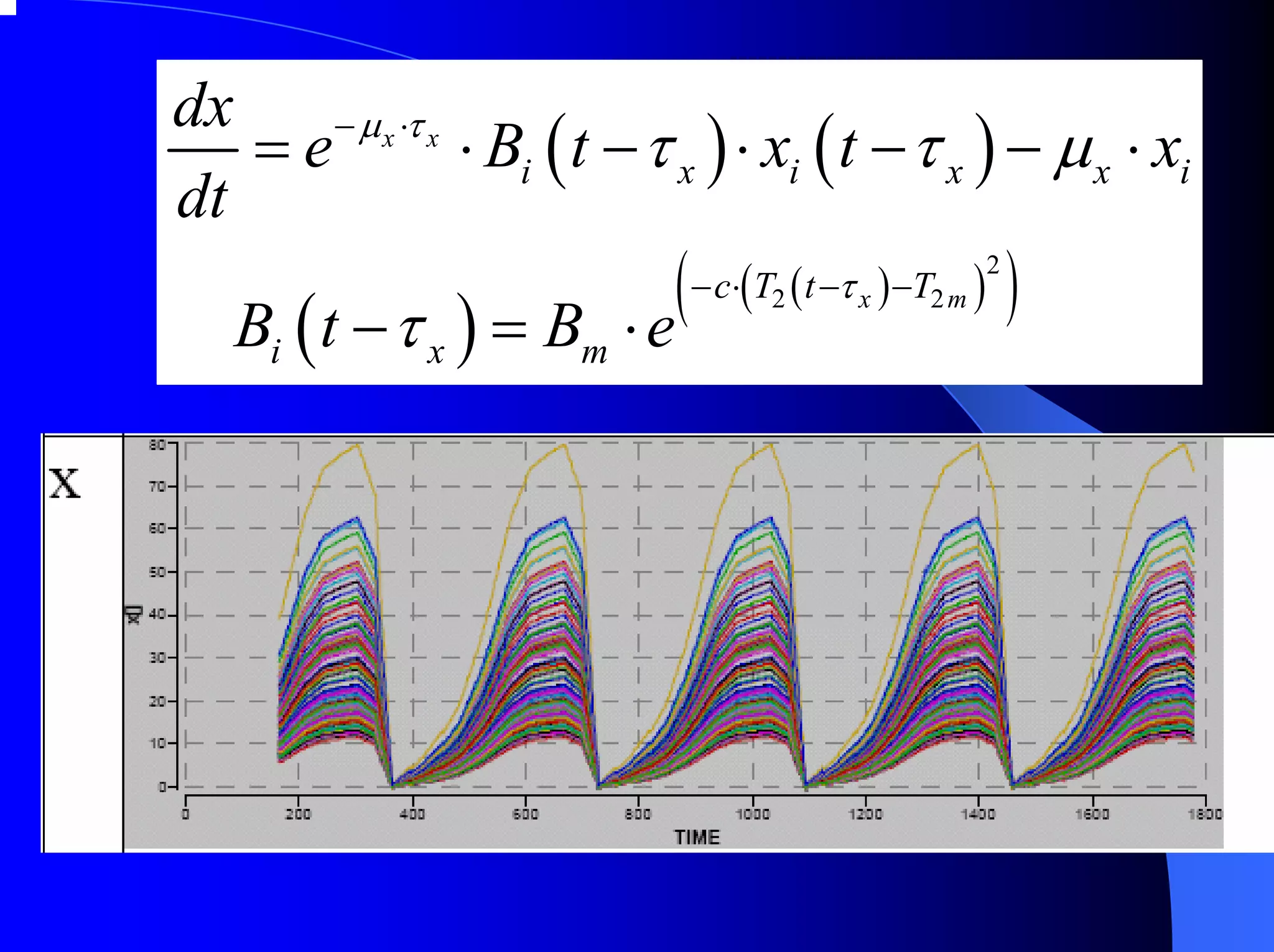
dx
   =e − µ x ⋅τ x
                 ⋅ Bi ( t − τ x ) ⋅ xi ( t − τ x ) − µ x ⋅ xi
dt

   Bi ( t − τ x ) = Bm    ⋅e
                             (   − c⋅(T2 ( t −τ x ) −T2 m )
                                                              2
                                                                  )
The day after tomorrow

Climatologist Jack Hall (Dennis Quaid) discovers erratic changes on the
weather patterns on the climate.It is from here that the earth,finally
rebelling against years of abuses from the greenhouse effect and global
warming,unleashes a cataclysmic onslaught of hurricanes,floods and
other natural disasters before everything freezes over.Hall must try and
save his son Sam (Jake Gyllenhaal) who is trapped over in New York.

Chaos

  • 1.
  • 2.
    Outline Chaos Defined Characteristics ofChaos History of Chaos Edward Lorenz and the Butterfly Effect The Water Wheel The Lorenz Attractor Chaos in Action
  • 3.
    Chaos Defined “Irregular motionof a dynamical system that is deterministic, sensitive to initial conditions, and impossible to predict in the long term with anything less than an infinite and perfect representation of analog values.” [Flake, ] “Chaos is sustained and disorderly- looking long-term evolution that satisfies certain special mathematical criteria and that occurs in a deterministic non-linear system.” [Williams, 1997] “The property that characterizes a dynamical system in which most orbits exhibit sensitive dependence.” [Lorenz, 1993]
  • 4.
    Characteristics of Chaos Deterministic– Chaotic systems are completely deterministic and not random. Sensitive – Chaotic systems are extremely sensitive to initial conditions, since any perturbation, no matter how minute, will forever alter the future of the chaotic system. Ergodic – Chaotic motion is ergodic, which means that the state space trajectory of a chaotic system will always return to the local region of a previous point in the trajectory. Embedded – Chaotic attractors are embedded with an infinite number of unstable periodic orbits.
  • 5.
    History of Chaos Theword chaos goes back to Greek mythology where it had two meanings: – The primeval emptiness of the universe before things came into being. – The abyss of the underworld.
  • 6.
    History of Chaos(cont.) 1873 – British physicist James Clerk Maxwell said, “when an infinitely small variation in the present state may bring about a finite difference in the state of the system in a finite time, the condition of the system is said to be unstable…[and] renders impossible the prediction of future events…”
  • 7.
    History of Chaos(cont.) 1898 – French mathematician Jacques Hadamard remarked that an error or discrepancy in initial conditions can render a system’s long-term behavior unpredictable. 1908 – French mathematician Henri Poincare emphasized that slight differences in initial conditions eventually can lead to large differences, making prediction “impossible”.
  • 8.
    History of Chaos(cont.) It wasn’t until 1963 when meteorologist Edward Lorenz of MIT published his paper “Deterministic Nonperiodic Flow” that chaos really took off. As of 1991, the number of papers on chaos was doubling about every two years. Entire courses on chaos are taught at colleges and universities. Journals and magazines are devoted largely or entirely to chaos now.
  • 9.
    Edward Lorenz andthe Butterfly Effect Lorenz created a toy weather on his Royal McBee at MIT in 1960. Weather prediction was considered “less than science” at that time. Using a set of 12 equations his computer modeled the weather. In the winter of 1961, wanting to examine a sequence at greater length, Lorenz took a shortcut.
  • 10.
    Edward Lorenz andthe Butterfly Effect (cont.) Instead of starting the whole run over, he started midway through. To give the machine its initial conditions, he typed the numbers straight from the earlier printout. He went to get a cup of coffee. When he came back an hour later, the sequence had evolved differently.
  • 11.
    Edward Lorenz andthe Butterfly Effect (cont.)
  • 12.
    Edward Lorenz andthe Butterfly Effect (cont.) The new run should have exactly duplicated the original…why didn’t it? In the computer’s memory, six decimal places were stored: 0.506127. Lorenz entered 0.506 assuming that the difference – one part in a thousand – was inconsequential.
  • 13.
    Edward Lorenz andthe Butterfly Effect (cont.) This effect came to be known as the butterfly effect. “The flapping of a single butterfly’s wing today produces a tiny change in the state of the atmosphere. Over a period of time, what the atmosphere actually does diverges from what it would have done. So, in a month’s time, a tornado that would have devastated the Indonesian coast doesn’t happen. Or maybe one that wasn’t going to happen, does.” [Ian Stewart, Does God Play Dice? The Mathematics of Chaos] This phenomenon is also known as sensitive dependence on initial conditions.
  • 14.
    The Water Wheel Lorenzput the weather aside and looked for even simpler ways to produce chaotic behavior. Using three equations for convection which he stripped down and made unrealistically simple, Lorenz was able to illustrate sensitive dependence on initial conditions. His equations correspond exactly to a mechanical device called the water wheel.
  • 15.
    Water drips steadilyinto containers hanging on the wheel’s rim. If the flow of the water is slow, the top bucket never fills up enough to overcome friction and the wheel never starts turning. If the flow is faster, the weight of the top bucket sets the wheel in motion (left). The waterwheel can set into a rotation that continues at a steady rate (center). If the flow is even faster, than the spin can become chaotic.
  • 16.
    Lorenz discovered thatover long periods, the spin can reverse itself many times, never settling down to a steady rate and never repeating itself in any predictable pattern. Lorenz summarized his findings in his 1963 paper published in the Journal of Atmospheric Sciences. He ultimately states, “In view of the inevitable inaccuracy and incompleteness of weather observations, precise very long-range forecasting would seem to be non-existent.” In addition, the Lorenz Attractor is born, which became an emblem for early chaos theory.
  • 17.
    Lorenz Attractor Thechanging values of one variable can be displayed in a time series (top). At any one instance in time the three variables fix the location of a point in 3-D space. Because the system never exactly repeats itself, the trajectory never intersects itself.
  • 18.
    Chaos in Action Assume we have a ski slope with moguls. Imagine balls are allowed to roll down from the top of the slope. Will the balls follow the same path? Although the moguls on the right appear to be regularly spaced, they are not enough to fit a simple mathematical formula.
  • 19.
    Assume a modelski slope with “squares” 2 meters wide and 5 meters long. Centers of the moguls are at the center of the dark squares. Let the slope face southward. The slope would have to be infinitely long to afford a perfect example of chaos. The moguls rise 1 meter above the pits to its east and west.
  • 20.
    Assume 7 boardsall start from the same west-east starting line with the same speed and direction, but at points at 10-cm intervals. As seen in the figure (right) the paths are sensitively dependent on their starting points and the motion can be considered chaotic.
  • 21.
    An essential propertyof chaotic behavior is that nearby states will eventually diverge no matter how small the initial differences are. What if the boards are allowed to travel 60 meters down the slope, starting from points only 1 mm apart? At first the separation cannot be seen, but by 30 meters it is easily detectable. The initial separation can be as small as we want, provided the slope is long enough.
  • 22.
    “Now that scienceis looking, chaos seems to be everywhere. A rising column of cigarette smoke breaks into wild swirls. A flag snaps back and forth in the wind. A dripping faucet goes from a steady pattern to a random one. Chaos appears in the behavior of the weather, the behavior of an airplane in flight, the behavior of cars on an expressway, the behavior of oil flowing in underground pipes.” [Gleick, 1987]
  • 23.
    Chaos’ qualities Fractal functionality-self similarity Chaotic unpredictability
  • 25.
  • 26.
  • 27.
  • 28.
  • 30.
  • 32.
  • 34.
  • 35.
    Feigenbaum constant ak − ak −1 dk = ak +1 − ak
  • 36.
    Chaotic vs stochastic Oneof the most important differences between chaotic processes and truly stochastic processes is that the future behavior of a chaotic system can be predicted in the short term, while stochastic processes can be characterized only statistically
  • 37.
    Strange attractors The Henonmap – discrete The Lorenz attractor – continuous Mackey-Glass system – discrete and continuous
  • 38.
  • 39.
    a = 0.5~1.4 b = 0.3
  • 40.
    dt change –time for prediction
  • 41.
  • 44.
  • 45.
    dx =e − µ x ⋅τ x ⋅ Bi ( t − τ x ) ⋅ xi ( t − τ x ) − µ x ⋅ xi dt Bi ( t − τ x ) = Bm ⋅e ( − c⋅(T2 ( t −τ x ) −T2 m ) 2 )
  • 47.
    The day aftertomorrow Climatologist Jack Hall (Dennis Quaid) discovers erratic changes on the weather patterns on the climate.It is from here that the earth,finally rebelling against years of abuses from the greenhouse effect and global warming,unleashes a cataclysmic onslaught of hurricanes,floods and other natural disasters before everything freezes over.Hall must try and save his son Sam (Jake Gyllenhaal) who is trapped over in New York.