Transportation
in
Logistics Management
Freight
Management
Rate Negotiation
Claim
Administration
Transport Mode
& Mix Decision
Route Planning
Shipment
Scheduling
Carrier
Evaluation &
Selection
Documentation
• “The process of moving an item from point A to point B.”
• “Safe, efficient, reliable, and sustainable movement
of persons and goods over time and space”.
• Transportation in Logistics:
 The operation of transportation determines the efficiency of
moving products.
 The progress in techniques and management principles improves
the moving load, delivery speed, service quality, operation costs,
the usage of facilities and energy saving.
 Transportation takes a crucial part in the Logistics Operation.
 Therefore, transportation is the base of efficiency and economy in
business logistics and expands other functions of logistics system
Transportation-Meaning and Definition
Transportation: An overview
• Transportation is the most visible logistic operation (approx
40-50 % of total Logistics cost)
• A good indicator to measure the Economic, Social &
Commercial progress of a country.
• Modes of Transportation can be categorized as Roadways,
Railways, Waterways, Airways, Pipelines & Ropeways.
• It facilitates production by moving the various means of
production.
• Serves to link the facilities of the firm which are
geographically distributed.
• It directly and indirectly accelerate employment.
• Benefits/ Advantages:
– Door-to-door service
– Flexibility
– Reliability
– Can reach remote locations
– Speed
• Challenges:
• Multi point octroi
• Multi point police checks
• Unauthorized local levy
• Poor conditions of road
• Mostly unorganized
MODES OF TRANSPORTATION : ROADWAYS
• Good for Larger loads, long distance transportation.
• Transport all types of goods- mostly the bulk items like Coal, Iron
ore, Cement, Fertilizers, Petroleum, Heavy Machineries, Raw
materials, Finished products, live cattle etc.
• High fixed cost due to infrastructure of railway tracks etc.
• Variable cost reduces as compared to other modes
• Slow speed due to consolidation of wagons
• Monopoly Carrier
• Route / service limitations can be over come by multi-modal
transportation.
MODES OF TRANSPORTATION : RAILWAYS
MODES OF TRANSPORTATION : AIRWAYS
• Fastest and less hazardous.
• Fixed cost is little low than other
• High variable cost due to fuel, maintenance, labour
USED FOR
 lightweight, high value and highly perishable items.
 urgent delivery
 critical maintenance
 passenger, cargo etc
Disadvantage
 Overall high cost
 Weather Disturbance
 Limited routes
MODES OF TRANSPORTATION:
Seaways
 Used mostly for International trade.
 Types-Tankers, Dry bulk carriers, Container ships and Special
vessels
 There are many shipping companies in Pakistan having big
fleets of ships
 Major items are- crude oil and other petroleum
products, Iron ores, Coal, Food grains etc
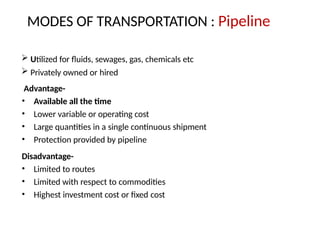
MODES OF TRANSPORTATION : Pipeline
 Utilized for fluids, sewages, gas, chemicals etc
 Privately owned or hired
Advantage-
• Available all the time
• Lower variable or operating cost
• Large quantities in a single continuous shipment
• Protection provided by pipeline
Disadvantage-
• Limited to routes
• Limited with respect to commodities
• Highest investment cost or fixed cost
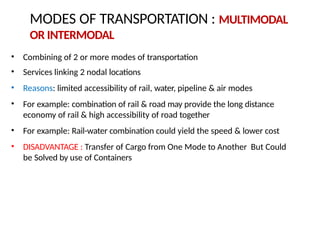
• Combining of 2 or more modes of transportation
• Services linking 2 nodal locations
• Reasons: limited accessibility of rail, water, pipeline & air modes
• For example: combination of rail & road may provide the long distance
economy of rail & high accessibility of road together
• For example: Rail-water combination could yield the speed & lower cost
• DISADVANTAGE : Transfer of Cargo from One Mode to Another But Could
be Solved by use of Containers
MODES OF TRANSPORTATION : MULTIMODAL
OR INTERMODAL
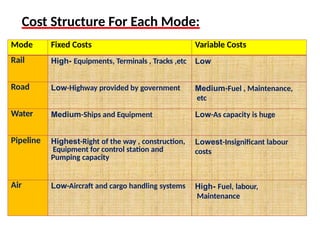
Cost Structure For Each Mode:
Mode Fixed Costs Variable Costs
Rail High- Equipments, Terminals , Tracks ,etc Low
Road Low-Highway provided by government Medium-Fuel , Maintenance,
etc
Water Medium-Ships and Equipment Low-As capacity is huge
Pipeline Highest-Right of the way , construction,
Equipment for control station and
Pumping capacity
Lowest-Insignificant labour
costs
Air Low-Aircraft and cargo handling systems High- Fuel, labour,
Maintenance
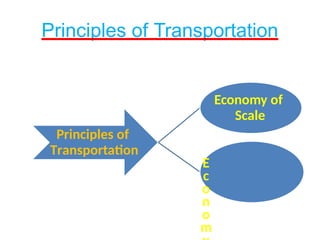
Principles of Transportation
Economy of
Scale
Principles of
Transportation
E
c
o
n
o
m
Principles of Transportation
1. Cost of transportation decrease with increasing loads &
increasing distance of transportation
For example: 10 kg shipment cost will be less per kg. than 5 kg.
shipment, because cost incurred in executing an order does not
vary much with the size of the order with most cost components
like order preparation, invoicing & collecting the shipment
remaining fixed irrespective of shipment size.
2. Also transportation vehicles having larger holding capacity cost
less than those with smaller
2) Principles Of Transportation Distance
• Unit cost of transportation decreases with increasing
distance in transportation
• Same load transported in one step across 1000 km cost less than
transporting load in two steps of 500 km each across the same
1000 km because of double loading & unloading charges.
• The two principles state that transportation management
decisions should aim to maximize size of load & distance of
shipment in order to obtain cost benefits, taking care of
customers requirements & satisfaction.
TRANSPORTATION TERMS
• Consignment (GOODS SHIPPED)
• Transportation mode (Form)
• Container (large box)
• Rights-of-way (legally permitted routes)
• Consignor (sender of goods shipment, seller)
• Consignee (receiver of goods shipment, buyer)
• Carrier (services of transporting goods)
• Public carrier (services to general public at non discriminatory pricing)
• Private carrier (services to own organisation)
TRANSPORTATION TERMS
• FRIGHT FORWARDERS (Consolidate Small Shipments Into Large Ones–
Forward To Common Destination)
• BILL OF LADING ( Document representing contract between buyer &
seller, gives details to shipper, receipt of goods & confers responsibility to
carrier for transportation by legal transfer of ownership)
• FREIGHT BILL (Invoice of The Carrier, may be Prepaid or on Time of Delivery)
• Multimodal transport (also known as combined
transport) is the transportation of goods under a single
contract, but performed with at least two different
means of transport;
• the carrier is liable (in a legal sense) for the entire
carriage, even though it is performed by several
different modes of transport (by rail, sea and road, for
example)
Multimodal Transport
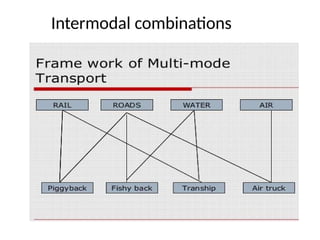
Intermodal combinations
SPECIFIC COMBINATION
Fishy Back:
It is a combination of road and water transport. Fishy back/
train ship/ containership are examples of the oldest mode of
the intermodal transport. They utilize waterways, which are
one of the least expensive methods for line- haul movement.
The fishy back, concepts load a truck trailer, railcar, or
container on to ship for transportation.
Birdy Back:
It is a combination of road and airways and is generally
used in International shipments Air- truck movements
usually provide service and flexibility comparable to
straight motor freight.
Intermodal (conti..)
Land Bridge (TranShip):
• A variant of this intermodal option is the “LAND
BRIDGE” concept, which moves containers by a
combination of sea and rail.
• The land bridge concept is based on the benefit of ocean
and rail combination that utilize a single tariff, which is
lower than the total cost of the separate rates.
• The-goods can be transported by water transferring the
shipment to surface transport and again finish
destination will be placed on a rail car and transported to
Karachi from where it will again be loaded on a vessel
for transferring to say Dubai port.
Transportation Management Decisions
It has two stage process
1) Mode of transportation selection:-
• Based on factors affecting desired performance , the total logistics
performance & cost incurred in it.
• Speed of transportation affects lead time of inventory, availability to firm,
inventory carrying cost, stock out cost
2) The carrier …whether Common (Public) , Contract, exempt or
Private:
• Reliability or consistency of lead time affects inventory carrying cost & stock
out cost
• Safety
• Capability – ability to transport different products
• Flexibility – door to door delivery
• Capacity – amount that can be carried in one trip
• Frequency
Legal Grouping of Carriers
• Common (Public)carrier :
1) Most frequently employed legal category for transportation
resources
2) Common carrier is a firm that transports for revenue at any
time & at any place within jurisdiction
3) Required to published all rates charged for this service & should
be similar for similar services.
4) Authorized to offer transport for hire upon receiving a certificate
for public convenience & need.
• CONTRACT CARRIER
1) Authorised the transportation of specific items over
specified routes.
2) Arises from contractual arrangements between two
parties
i.e. the shipper & the carrier
3) Contract provides shipper with defined transportation service at
agreeable price
4) Unlike common carrier they are not required to charged
the same rate for equal service
Legal Grouping of Carriers
• EXEMPT CARRIER:
1) do not fall under the umbrella of direct regulation w.r.t. Pricing policies &
operating rights
2) restricted to law of that state in which they are operated
3) transported commodities such as agriculture Products
4) exemptions may also be granted for specified areas such as within the city
and commercial areas of the activity
Legal Grouping of Carriers
• PRIVATE CARRIER:
1) originally consisted of transportation resources that are controlled by the
firm through ownership or lease.
2) permitted to use owner operators or others outside sources of vehicles &
drivers
3) restricted in that the materials being shipped must be owned by the firm
& the transportation of the materials must be incidental to the primary
business of the firm
Legal Grouping of Carriers
Transportation Costs
• Transportation cost is the cost occurred during
transporting the freight from one place to another. The
followings are the elements of transportation costs
1. Tariff of transportation mode:
It depends on-
– Nature of the product
– Distance to be covered
– Quantity of the shipment
– Transit time
– En route handling needs
– Trade relationship
Transportation Costs (Cont..)
2. Transit Time Cost:
– Working Capital cost
– Customer service cost
3. Obsolescence & Deterioration Cost:
- Changes in physical feature of the products resulting
in value reduction, especially perishable items like
Milk, Vegetables, Fruits, Fish, Egg etc.
3. Protective Packaging Cost-
– To avoid breakage and pilferage
– To avoid damage due to rain etc
– It depends on the mode of transport or multi modal
needs
4. Transit Insurance Cost-
-To cover the loss during transit
5. Miscellaneous Cost-
- Toll tax, Local levy etc
Transportation Costs (Cont..)
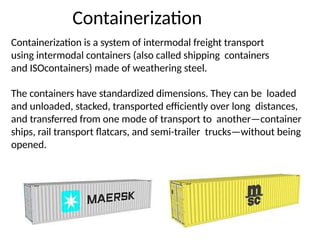
Containerization
Containerization is a system of intermodal freight transport
using intermodal containers (also called shipping containers
and ISOcontainers) made of weathering steel.
The containers have standardized dimensions. They can be loaded
and unloaded, stacked, transported efficiently over long distances,
and transferred from one mode of transport to another—container
ships, rail transport flatcars, and semi-trailer trucks—without being
opened.
Containerization (Cont..)
• Container Dimension:
– Length : 20Ft, 40Ft, 45 Ft
– Width : 8Ft
– Height: 8.6 Ft & 9.6Ft
– TEU (Twenty-foot Equivalent Unit):
– It is a standard unit for describing a ship's cargo
carrying capacity, or a shipping terminal's cargo
handling capacity. A standard twenty-foot (20x8x8.6
feet) container equals One TEU.
Benefits of Containerization
1.Secure the goods from damages like breakage &
pilferage during transportation
2. Ease of Handling
3. Lessen transit time due to fast loading, unloading,
checking etc.
4. Less documentation
5. Less Insurance cost due to low risk of loss.
6. Improve overall efficiency in operation.
7. It reduces overall transportation costs.
8. Least requirement of protective packaging.
Types of containers
• General purpose containers
• Tank Containers
• Refrigerated containers
• High Cube containers
• Ventilated Containers
• Open-Top containers
• Hard-Top containers
• Flat containers
• Platform containers
Challenges of Logistics
• Just in time requirement
• High customer expectations
• Uncertain demand
• Vehicle breakdown
• Customer line stoppage cost
THE END

Lecture-8 Logistics Transportation system.pptx

  • 1.
    Transportation in Logistics Management Freight Management Rate Negotiation Claim Administration TransportMode & Mix Decision Route Planning Shipment Scheduling Carrier Evaluation & Selection Documentation
  • 2.
    • “The processof moving an item from point A to point B.” • “Safe, efficient, reliable, and sustainable movement of persons and goods over time and space”. • Transportation in Logistics:  The operation of transportation determines the efficiency of moving products.  The progress in techniques and management principles improves the moving load, delivery speed, service quality, operation costs, the usage of facilities and energy saving.  Transportation takes a crucial part in the Logistics Operation.  Therefore, transportation is the base of efficiency and economy in business logistics and expands other functions of logistics system Transportation-Meaning and Definition
  • 3.
    Transportation: An overview •Transportation is the most visible logistic operation (approx 40-50 % of total Logistics cost) • A good indicator to measure the Economic, Social & Commercial progress of a country. • Modes of Transportation can be categorized as Roadways, Railways, Waterways, Airways, Pipelines & Ropeways. • It facilitates production by moving the various means of production. • Serves to link the facilities of the firm which are geographically distributed. • It directly and indirectly accelerate employment.
  • 4.
    • Benefits/ Advantages: –Door-to-door service – Flexibility – Reliability – Can reach remote locations – Speed • Challenges: • Multi point octroi • Multi point police checks • Unauthorized local levy • Poor conditions of road • Mostly unorganized MODES OF TRANSPORTATION : ROADWAYS
  • 5.
    • Good forLarger loads, long distance transportation. • Transport all types of goods- mostly the bulk items like Coal, Iron ore, Cement, Fertilizers, Petroleum, Heavy Machineries, Raw materials, Finished products, live cattle etc. • High fixed cost due to infrastructure of railway tracks etc. • Variable cost reduces as compared to other modes • Slow speed due to consolidation of wagons • Monopoly Carrier • Route / service limitations can be over come by multi-modal transportation. MODES OF TRANSPORTATION : RAILWAYS
  • 6.
    MODES OF TRANSPORTATION: AIRWAYS • Fastest and less hazardous. • Fixed cost is little low than other • High variable cost due to fuel, maintenance, labour USED FOR  lightweight, high value and highly perishable items.  urgent delivery  critical maintenance  passenger, cargo etc Disadvantage  Overall high cost  Weather Disturbance  Limited routes
  • 7.
    MODES OF TRANSPORTATION: Seaways Used mostly for International trade.  Types-Tankers, Dry bulk carriers, Container ships and Special vessels  There are many shipping companies in Pakistan having big fleets of ships  Major items are- crude oil and other petroleum products, Iron ores, Coal, Food grains etc
  • 8.
    MODES OF TRANSPORTATION: Pipeline  Utilized for fluids, sewages, gas, chemicals etc  Privately owned or hired Advantage- • Available all the time • Lower variable or operating cost • Large quantities in a single continuous shipment • Protection provided by pipeline Disadvantage- • Limited to routes • Limited with respect to commodities • Highest investment cost or fixed cost
  • 9.
    • Combining of2 or more modes of transportation • Services linking 2 nodal locations • Reasons: limited accessibility of rail, water, pipeline & air modes • For example: combination of rail & road may provide the long distance economy of rail & high accessibility of road together • For example: Rail-water combination could yield the speed & lower cost • DISADVANTAGE : Transfer of Cargo from One Mode to Another But Could be Solved by use of Containers MODES OF TRANSPORTATION : MULTIMODAL OR INTERMODAL
  • 10.
    Cost Structure ForEach Mode: Mode Fixed Costs Variable Costs Rail High- Equipments, Terminals , Tracks ,etc Low Road Low-Highway provided by government Medium-Fuel , Maintenance, etc Water Medium-Ships and Equipment Low-As capacity is huge Pipeline Highest-Right of the way , construction, Equipment for control station and Pumping capacity Lowest-Insignificant labour costs Air Low-Aircraft and cargo handling systems High- Fuel, labour, Maintenance
  • 11.
    Principles of Transportation Economyof Scale Principles of Transportation E c o n o m
  • 12.
    Principles of Transportation 1.Cost of transportation decrease with increasing loads & increasing distance of transportation For example: 10 kg shipment cost will be less per kg. than 5 kg. shipment, because cost incurred in executing an order does not vary much with the size of the order with most cost components like order preparation, invoicing & collecting the shipment remaining fixed irrespective of shipment size. 2. Also transportation vehicles having larger holding capacity cost less than those with smaller
  • 13.
    2) Principles OfTransportation Distance • Unit cost of transportation decreases with increasing distance in transportation • Same load transported in one step across 1000 km cost less than transporting load in two steps of 500 km each across the same 1000 km because of double loading & unloading charges. • The two principles state that transportation management decisions should aim to maximize size of load & distance of shipment in order to obtain cost benefits, taking care of customers requirements & satisfaction.
  • 14.
    TRANSPORTATION TERMS • Consignment(GOODS SHIPPED) • Transportation mode (Form) • Container (large box) • Rights-of-way (legally permitted routes) • Consignor (sender of goods shipment, seller) • Consignee (receiver of goods shipment, buyer) • Carrier (services of transporting goods) • Public carrier (services to general public at non discriminatory pricing) • Private carrier (services to own organisation)
  • 15.
    TRANSPORTATION TERMS • FRIGHTFORWARDERS (Consolidate Small Shipments Into Large Ones– Forward To Common Destination) • BILL OF LADING ( Document representing contract between buyer & seller, gives details to shipper, receipt of goods & confers responsibility to carrier for transportation by legal transfer of ownership) • FREIGHT BILL (Invoice of The Carrier, may be Prepaid or on Time of Delivery)
  • 16.
    • Multimodal transport(also known as combined transport) is the transportation of goods under a single contract, but performed with at least two different means of transport; • the carrier is liable (in a legal sense) for the entire carriage, even though it is performed by several different modes of transport (by rail, sea and road, for example) Multimodal Transport
  • 17.
  • 18.
    SPECIFIC COMBINATION Fishy Back: Itis a combination of road and water transport. Fishy back/ train ship/ containership are examples of the oldest mode of the intermodal transport. They utilize waterways, which are one of the least expensive methods for line- haul movement. The fishy back, concepts load a truck trailer, railcar, or container on to ship for transportation. Birdy Back: It is a combination of road and airways and is generally used in International shipments Air- truck movements usually provide service and flexibility comparable to straight motor freight.
  • 19.
    Intermodal (conti..) Land Bridge(TranShip): • A variant of this intermodal option is the “LAND BRIDGE” concept, which moves containers by a combination of sea and rail. • The land bridge concept is based on the benefit of ocean and rail combination that utilize a single tariff, which is lower than the total cost of the separate rates. • The-goods can be transported by water transferring the shipment to surface transport and again finish destination will be placed on a rail car and transported to Karachi from where it will again be loaded on a vessel for transferring to say Dubai port.
  • 20.
    Transportation Management Decisions Ithas two stage process 1) Mode of transportation selection:- • Based on factors affecting desired performance , the total logistics performance & cost incurred in it. • Speed of transportation affects lead time of inventory, availability to firm, inventory carrying cost, stock out cost 2) The carrier …whether Common (Public) , Contract, exempt or Private: • Reliability or consistency of lead time affects inventory carrying cost & stock out cost • Safety • Capability – ability to transport different products • Flexibility – door to door delivery • Capacity – amount that can be carried in one trip • Frequency
  • 21.
    Legal Grouping ofCarriers • Common (Public)carrier : 1) Most frequently employed legal category for transportation resources 2) Common carrier is a firm that transports for revenue at any time & at any place within jurisdiction 3) Required to published all rates charged for this service & should be similar for similar services. 4) Authorized to offer transport for hire upon receiving a certificate for public convenience & need.
  • 22.
    • CONTRACT CARRIER 1)Authorised the transportation of specific items over specified routes. 2) Arises from contractual arrangements between two parties i.e. the shipper & the carrier 3) Contract provides shipper with defined transportation service at agreeable price 4) Unlike common carrier they are not required to charged the same rate for equal service Legal Grouping of Carriers
  • 23.
    • EXEMPT CARRIER: 1)do not fall under the umbrella of direct regulation w.r.t. Pricing policies & operating rights 2) restricted to law of that state in which they are operated 3) transported commodities such as agriculture Products 4) exemptions may also be granted for specified areas such as within the city and commercial areas of the activity Legal Grouping of Carriers
  • 24.
    • PRIVATE CARRIER: 1)originally consisted of transportation resources that are controlled by the firm through ownership or lease. 2) permitted to use owner operators or others outside sources of vehicles & drivers 3) restricted in that the materials being shipped must be owned by the firm & the transportation of the materials must be incidental to the primary business of the firm Legal Grouping of Carriers
  • 25.
    Transportation Costs • Transportationcost is the cost occurred during transporting the freight from one place to another. The followings are the elements of transportation costs 1. Tariff of transportation mode: It depends on- – Nature of the product – Distance to be covered – Quantity of the shipment – Transit time – En route handling needs – Trade relationship
  • 26.
    Transportation Costs (Cont..) 2.Transit Time Cost: – Working Capital cost – Customer service cost 3. Obsolescence & Deterioration Cost: - Changes in physical feature of the products resulting in value reduction, especially perishable items like Milk, Vegetables, Fruits, Fish, Egg etc.
  • 27.
    3. Protective PackagingCost- – To avoid breakage and pilferage – To avoid damage due to rain etc – It depends on the mode of transport or multi modal needs 4. Transit Insurance Cost- -To cover the loss during transit 5. Miscellaneous Cost- - Toll tax, Local levy etc Transportation Costs (Cont..)
  • 28.
    Containerization Containerization is asystem of intermodal freight transport using intermodal containers (also called shipping containers and ISOcontainers) made of weathering steel. The containers have standardized dimensions. They can be loaded and unloaded, stacked, transported efficiently over long distances, and transferred from one mode of transport to another—container ships, rail transport flatcars, and semi-trailer trucks—without being opened.
  • 29.
    Containerization (Cont..) • ContainerDimension: – Length : 20Ft, 40Ft, 45 Ft – Width : 8Ft – Height: 8.6 Ft & 9.6Ft – TEU (Twenty-foot Equivalent Unit): – It is a standard unit for describing a ship's cargo carrying capacity, or a shipping terminal's cargo handling capacity. A standard twenty-foot (20x8x8.6 feet) container equals One TEU.
  • 30.
    Benefits of Containerization 1.Securethe goods from damages like breakage & pilferage during transportation 2. Ease of Handling 3. Lessen transit time due to fast loading, unloading, checking etc. 4. Less documentation 5. Less Insurance cost due to low risk of loss. 6. Improve overall efficiency in operation. 7. It reduces overall transportation costs. 8. Least requirement of protective packaging.

  • 31.
    Types of containers •General purpose containers • Tank Containers • Refrigerated containers • High Cube containers • Ventilated Containers • Open-Top containers • Hard-Top containers • Flat containers • Platform containers
  • 32.
    Challenges of Logistics •Just in time requirement • High customer expectations • Uncertain demand • Vehicle breakdown • Customer line stoppage cost
  • 33.