

BY- A RAJ SHRAVANTHI
      10-501-001
Introduction

 Factors important to the success or failure of a particular
  entry move include economic principles apart from all human,
  organizational, financial, legal and administrative factors.
 The economics of entry rests on some fundamental market
  forces
 In economist’s sense-

 if these forces work perfectly= entry not possible

 Not working perfectly= entry possible
Methods of entry


 Entry through Internal Development


 Entry through Acquisition


 Sequenced entry
Entry through Internal Development

 Also called internal entrant

 It involves creation of new business entity in an

 industry    including    new    production    capacity,
 distribution relationships, sales force etc

 Joint venture
Advantages & Disadvantages of Joint ventures
Advantages
                                           Disadvantages
 Acquire competencies or skills
                                            Partners do not have full control
  not available in-house
                                             of management
 When     market     needs    to    be
                                            May be impossible to recover
  penetrated quickly, eg. when
  competitive entry is imminent or           capital invested

  technological     change    is    very    Disagreement       on new export

  rapid                                      markets      Partners    may    have

 Spread the risk of a large project
                                             different    views      on   expected

  over more than one firm                    benefits .

 Enable faster entry and payback

 Avoid tariff barriers and satisfy

  local content requirements
Entry Barriers

 2 entry barriers in an industry:

 Structural entry barriers (investment & start up

 losses)

 Expected reaction of incumbent firm(eg: lowering

 prices)
Various costs involved

 Investment costs – manufacturing facilities &
 inventory
 Additional investment – brand identification &
 proprietary technology
 Expected cost from incumbents’ retaliation – lower
 prices & escalated marketing costs
 Expected cash flows from being in the industry
Factors often neglected in entry decisions

 Costs usually considered by internal entrants include- constructing manufacturing

  facilities and assembling sales force

 Costs usually neglected – costs for overcoming SEB like brand franchise,

  distribution channels tied up by competitors , competitors access to the most
  favorable sources of raw material

 Entrants new capacity

 Impact of the probable reactions of existing firms

 shaving prices- entry by Georgia- pacific in gypsum industry disrupted prices

 Escalation in marketing activities, special promotions, extension of warranty terms,

  easier credit & product quality improvements

 Excessive capacity expansion
Will retaliation occur?

Internal entry will harm future prospects in the following kinds of industries:

 Slow growing market- vigorous retaliation

 Commodity / commodity like products

 High fixed costs

 High industry concentration

 Incumbents who attach high strategic importance to their position in the

  business- sharp retaliation.

 Attitudes of incumbent management
Identifying target industries for internal entry

 Industry in disequilibrium

 New industries

 Rising entry barriers

 Poor information

 Slow or ineffectual retaliation from incumbents may be expected (niche markets-

  ice-creams)

 The firm has lower entry costs than other firms (eg: Nokia, general motors, John

  Deere’s)

 The firm has distinctive ability to influence the industry structure (like good

  distribution channel , good R & D)

 There will be positive effects on firms existing business ( ICICI BANK, Eaton

  corporations)
Generic concepts for entry

 Reduce product/process costs

 entirely new tech- Nokia smart phones, apple i-pod

 larger plant reaping greater economies of scale

 modern facilities- mobiles

 Shared activities- network sharing idea-aircel

 Buy in with low price

 Offer a superior product , broadly defined

 Discover a new niche

 Introduce a marketing innovation

 Use piggybacked distribution
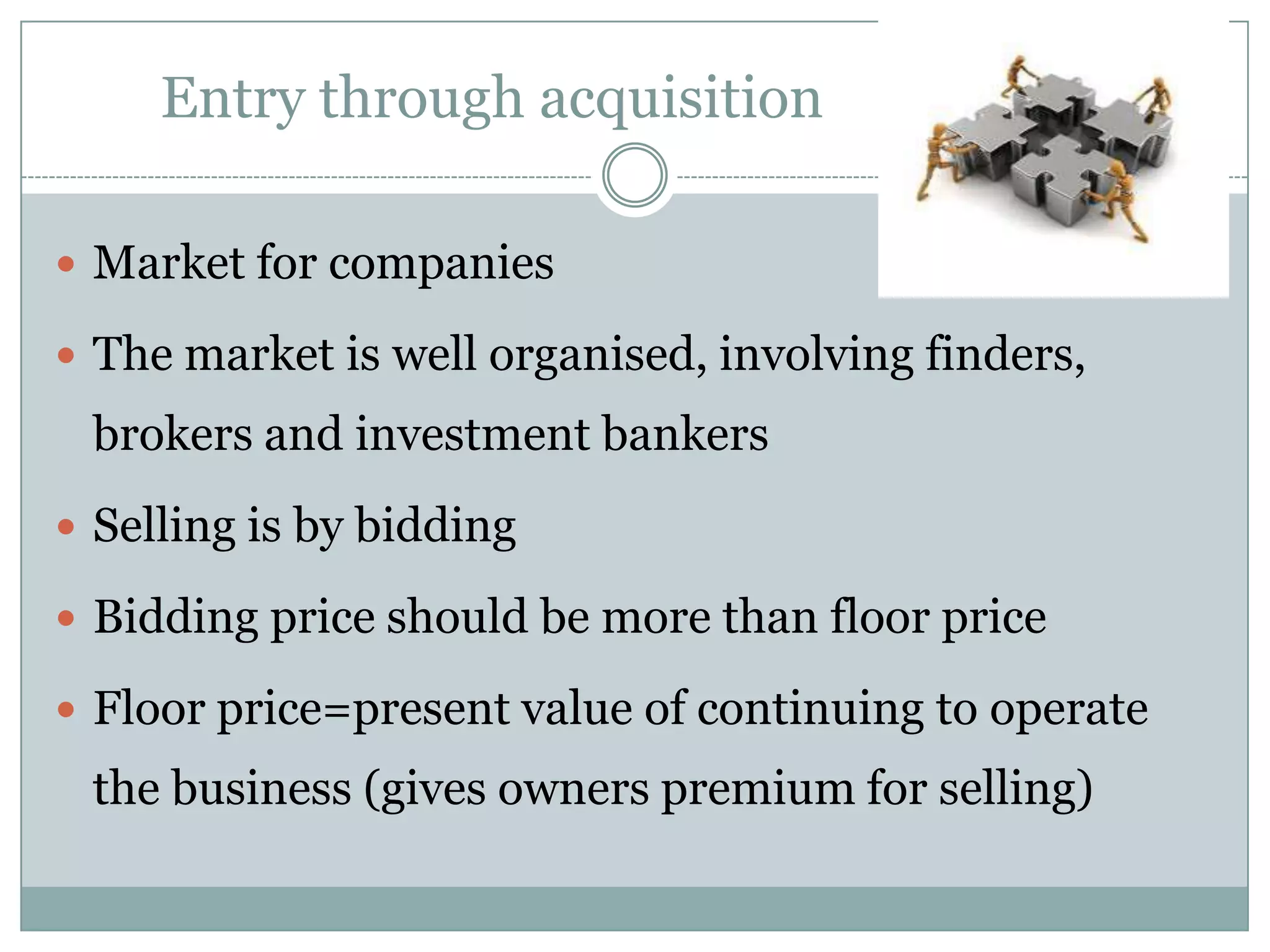
Entry through acquisition

 Market for companies

 The market is well organised, involving finders,
 brokers and investment bankers
 Selling is by bidding

 Bidding price should be more than floor price

 Floor price=present value of continuing to operate
 the business (gives owners premium for selling)
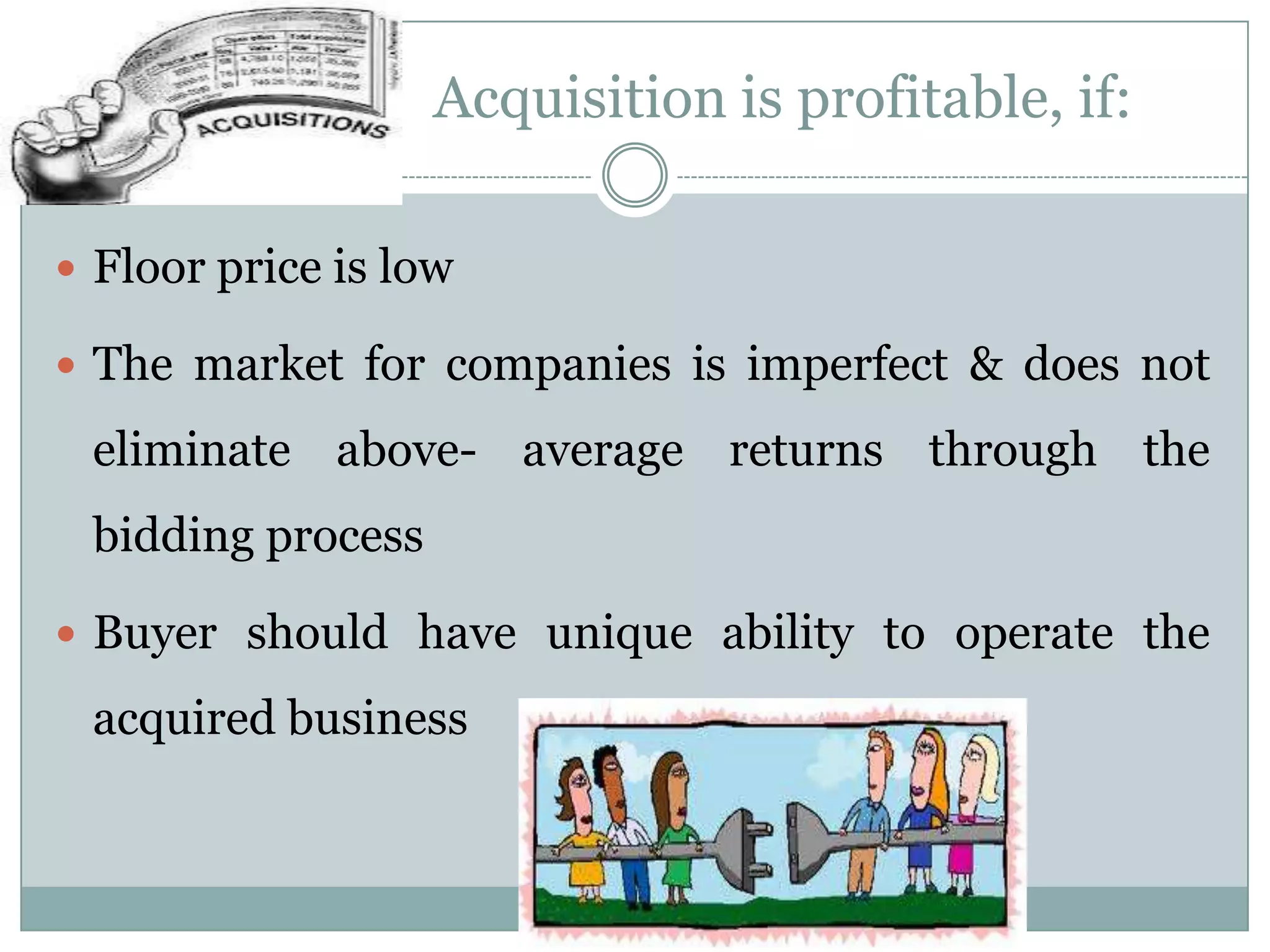
Acquisition is profitable, if:

 Floor price is low

 The market for companies is imperfect & does not

 eliminate above- average returns through the
 bidding process

 Buyer should have unique ability to operate the

 acquired business
Floor price

 Floor price is low when seller feels the greatest

  compulsion to sell, because:

 Seller has estate problems

 Seller needs capital quickly

 Has lost key magt / sees no successor

 Seller is not optimistic
Imperfections in the market for companies

Successful acquisition will occur, if:
 The buyer has superior information

 The number of bidders is low(unusual business or very
  large business)
 The condition of economy is bad

 The selling company is sick

 The seller has objectives besides maximising the price
  received for the business (hutch to vodafone)
Unique ability to operate the seller

 The buyer has a distinctive ability to improve the
 operations of the seller(Campbell’s of Vlasic)
 The firm buys into an industry that meets the criteria
 for internal development
 The acquisition will uniquely help a buyer’s position
 in its existing business (Reynolds acquisition of Del
 Monte)
Irrational bidders


 Bidding beyond the point of above-average returns
 Reasons for irrational bidders:

o The bidder sees a unique way to improve the

 acquisition target
o The acquisition will help the bidders existing
  business
o Bidders have goals other than profit max^n
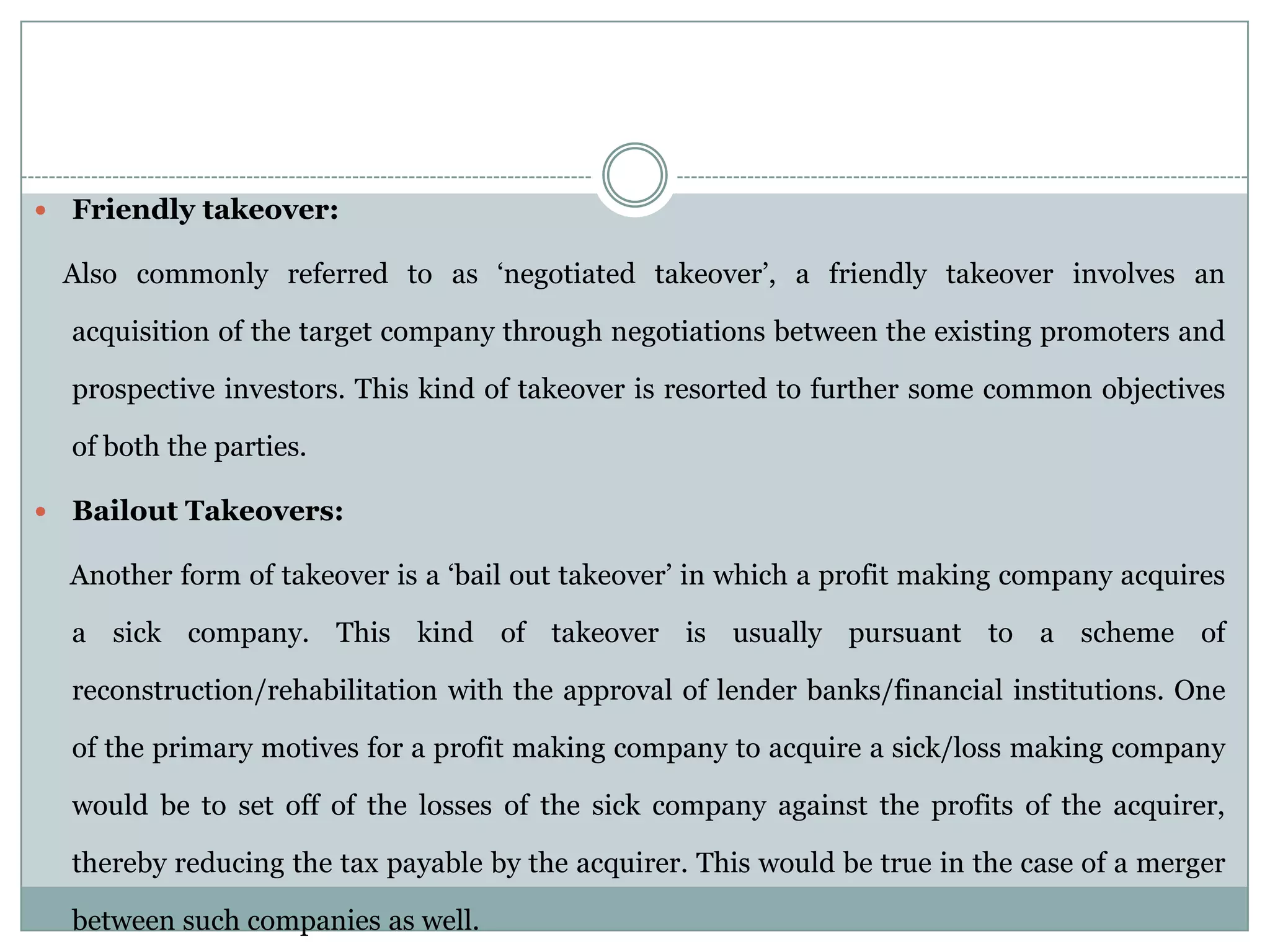
Types Of Acquisitions


 Friendly takeover/negotiated takeover


 Hostile Takeover


 Leveraged Buyouts


 Bailout Takeovers
   Friendly takeover:

    Also commonly referred to as ‘negotiated takeover’, a friendly takeover involves an

    acquisition of the target company through negotiations between the existing promoters and

    prospective investors. This kind of takeover is resorted to further some common objectives

    of both the parties.

   Bailout Takeovers:

    Another form of takeover is a ‘bail out takeover’ in which a profit making company acquires

    a sick company. This kind of takeover is usually pursuant to a scheme of

    reconstruction/rehabilitation with the approval of lender banks/financial institutions. One

    of the primary motives for a profit making company to acquire a sick/loss making company

    would be to set off of the losses of the sick company against the profits of the acquirer,

    thereby reducing the tax payable by the acquirer. This would be true in the case of a merger

    between such companies as well.
   Leveraged Buyouts:

    These are a form of takeovers where the acquisition is funded by borrowed money. Often

    the assets of the target company are used as collateral for the loan. This is a common

    structure when acquirers wish to make large acquisitions without having to commit too

    much capital, and hope to make the acquired business service the debt so raised.

    Ex: Acquisition of Britain’s Corus by Tata an Indian conglomerate by way of a leveraged

    buy-out. The Tatas also acquired Jaguar and Land Rover in a significant cross border

    transaction

   Hostile Takeover:

    A hostile takeover can happen if the board rejects the offer, but the bidder continues to

    pursue it or the bidder makes the offer without informing the board beforehand.
Advantages & Disadvantages of Acquisition

               Advantages
                                                                Disadvantages
   Decreased time to access and penetrate              Increased risk – may be a large financial
    target market as the existing company                commitment but faces political and
    already has a product line to be exploited           market risks
    and a distribution network
                                                        Poor or slow post-merger integration
   Prevents an increase in the number of
                                                        Target too large or too small
    competitors in the market
                                                        Overly optimistic appraisal of synergies
   Overcome entry barriers including
    restrictions on skills, technology , materials      Overestimation of market potential

    supply and patents                                  Inadequate due diligence

                                                        Incompatible corporate cultures
Examples of Mergers and Acquisition

 In FMCG Sector     : P&G and Gillette ; Dabur acquired Balsara for 143
  crores ;Godrej Consumer Care bought Keyline Brands ;Marico acquired
  HLL Nihar brand.

 One such example would be the acquisition of Britain’s Corus by Tata an

  Indian conglomerate. The Tatas also acquired Jaguar and Land Rover in a
  significant cross border transaction.

 Vijay Mallya's United Breweries Group (through Group entities Mc Dowell

  & Co, Phipson Distillery, United Spirits and United Breweries Holdings)
  acquired a controlling stake in the Jumbo Group's Shaw Wallace &
  Company for a total deal value of Rs 16.2 billion ($371.6 million).
 McLeod Russell India (part of the B. M. Khaitan Group)

 acquired a 90 per cent stake in Williamson Tea Assam
 for Rs 2.1 billion ($48.2 million).

 HLL's mergers with TOMCO, Lakme, Brook Bond Lipton

 India, Pond's India.
  HLL's acquisitions: Kissan, Kwality Icecreams and
 Modern Foods.
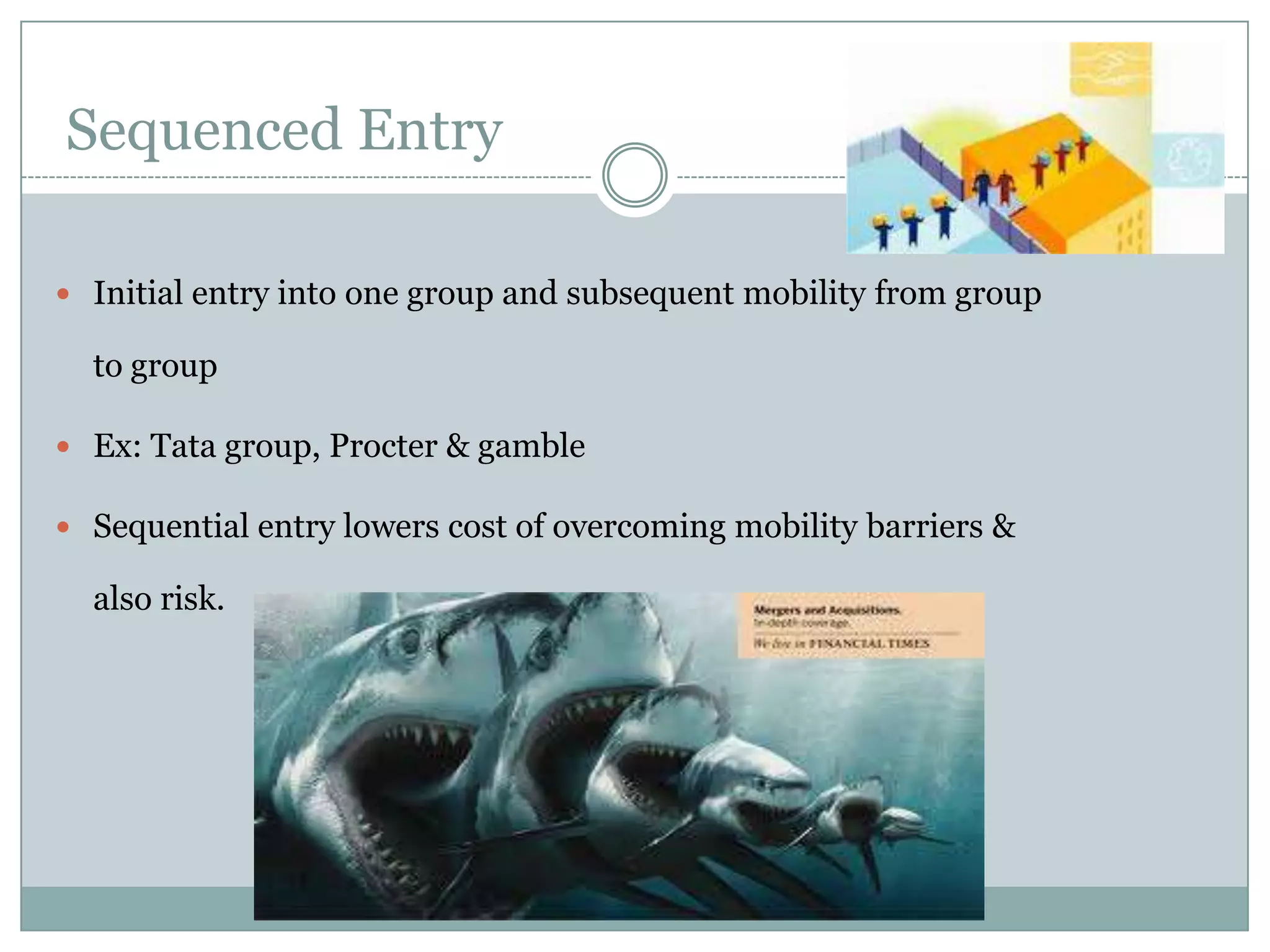
Sequenced Entry

 Initial entry into one group and subsequent mobility from group

  to group

 Ex: Tata group, Procter & gamble

 Sequential entry lowers cost of overcoming mobility barriers &

  also risk.
References:

 ‘Competitive Strategy’ by Porter
 www.en.wikipedia.org/wiki/Strategic_management
 http://www.marketingprofs.com
 www.nishithdesai.com Guideline No. 20-
  100/2007-AS-1 issued by the DoT, issued on April
  22,2008
 http://mgmt339.wordpress.com/
Strategies for entry into new agribusiness

Strategies for entry into new agribusiness

  • 1.
    BY- A RAJSHRAVANTHI 10-501-001
  • 2.
    Introduction  Factors importantto the success or failure of a particular entry move include economic principles apart from all human, organizational, financial, legal and administrative factors.  The economics of entry rests on some fundamental market forces  In economist’s sense-  if these forces work perfectly= entry not possible  Not working perfectly= entry possible
  • 3.
    Methods of entry Entry through Internal Development  Entry through Acquisition  Sequenced entry
  • 4.
    Entry through InternalDevelopment  Also called internal entrant  It involves creation of new business entity in an industry including new production capacity, distribution relationships, sales force etc  Joint venture
  • 5.
    Advantages & Disadvantagesof Joint ventures Advantages Disadvantages  Acquire competencies or skills  Partners do not have full control not available in-house of management  When market needs to be  May be impossible to recover penetrated quickly, eg. when competitive entry is imminent or capital invested technological change is very  Disagreement on new export rapid markets Partners may have  Spread the risk of a large project different views on expected over more than one firm benefits .  Enable faster entry and payback  Avoid tariff barriers and satisfy local content requirements
  • 6.
    Entry Barriers  2entry barriers in an industry:  Structural entry barriers (investment & start up losses)  Expected reaction of incumbent firm(eg: lowering prices)
  • 7.
    Various costs involved Investment costs – manufacturing facilities & inventory  Additional investment – brand identification & proprietary technology  Expected cost from incumbents’ retaliation – lower prices & escalated marketing costs  Expected cash flows from being in the industry
  • 8.
    Factors often neglectedin entry decisions  Costs usually considered by internal entrants include- constructing manufacturing facilities and assembling sales force  Costs usually neglected – costs for overcoming SEB like brand franchise, distribution channels tied up by competitors , competitors access to the most favorable sources of raw material  Entrants new capacity  Impact of the probable reactions of existing firms  shaving prices- entry by Georgia- pacific in gypsum industry disrupted prices  Escalation in marketing activities, special promotions, extension of warranty terms, easier credit & product quality improvements  Excessive capacity expansion
  • 9.
    Will retaliation occur? Internalentry will harm future prospects in the following kinds of industries:  Slow growing market- vigorous retaliation  Commodity / commodity like products  High fixed costs  High industry concentration  Incumbents who attach high strategic importance to their position in the business- sharp retaliation.  Attitudes of incumbent management
  • 10.
    Identifying target industriesfor internal entry  Industry in disequilibrium  New industries  Rising entry barriers  Poor information  Slow or ineffectual retaliation from incumbents may be expected (niche markets- ice-creams)  The firm has lower entry costs than other firms (eg: Nokia, general motors, John Deere’s)  The firm has distinctive ability to influence the industry structure (like good distribution channel , good R & D)  There will be positive effects on firms existing business ( ICICI BANK, Eaton corporations)
  • 11.
    Generic concepts forentry  Reduce product/process costs  entirely new tech- Nokia smart phones, apple i-pod  larger plant reaping greater economies of scale  modern facilities- mobiles  Shared activities- network sharing idea-aircel  Buy in with low price  Offer a superior product , broadly defined  Discover a new niche  Introduce a marketing innovation  Use piggybacked distribution
  • 12.
    Entry through acquisition Market for companies  The market is well organised, involving finders, brokers and investment bankers  Selling is by bidding  Bidding price should be more than floor price  Floor price=present value of continuing to operate the business (gives owners premium for selling)
  • 13.
    Acquisition is profitable,if:  Floor price is low  The market for companies is imperfect & does not eliminate above- average returns through the bidding process  Buyer should have unique ability to operate the acquired business
  • 14.
    Floor price  Floorprice is low when seller feels the greatest compulsion to sell, because:  Seller has estate problems  Seller needs capital quickly  Has lost key magt / sees no successor  Seller is not optimistic
  • 15.
    Imperfections in themarket for companies Successful acquisition will occur, if:  The buyer has superior information  The number of bidders is low(unusual business or very large business)  The condition of economy is bad  The selling company is sick  The seller has objectives besides maximising the price received for the business (hutch to vodafone)
  • 16.
    Unique ability tooperate the seller  The buyer has a distinctive ability to improve the operations of the seller(Campbell’s of Vlasic)  The firm buys into an industry that meets the criteria for internal development  The acquisition will uniquely help a buyer’s position in its existing business (Reynolds acquisition of Del Monte)
  • 17.
    Irrational bidders  Biddingbeyond the point of above-average returns  Reasons for irrational bidders: o The bidder sees a unique way to improve the acquisition target o The acquisition will help the bidders existing business o Bidders have goals other than profit max^n
  • 18.
    Types Of Acquisitions Friendly takeover/negotiated takeover  Hostile Takeover  Leveraged Buyouts  Bailout Takeovers
  • 19.
    Friendly takeover: Also commonly referred to as ‘negotiated takeover’, a friendly takeover involves an acquisition of the target company through negotiations between the existing promoters and prospective investors. This kind of takeover is resorted to further some common objectives of both the parties.  Bailout Takeovers: Another form of takeover is a ‘bail out takeover’ in which a profit making company acquires a sick company. This kind of takeover is usually pursuant to a scheme of reconstruction/rehabilitation with the approval of lender banks/financial institutions. One of the primary motives for a profit making company to acquire a sick/loss making company would be to set off of the losses of the sick company against the profits of the acquirer, thereby reducing the tax payable by the acquirer. This would be true in the case of a merger between such companies as well.
  • 20.
    Leveraged Buyouts: These are a form of takeovers where the acquisition is funded by borrowed money. Often the assets of the target company are used as collateral for the loan. This is a common structure when acquirers wish to make large acquisitions without having to commit too much capital, and hope to make the acquired business service the debt so raised. Ex: Acquisition of Britain’s Corus by Tata an Indian conglomerate by way of a leveraged buy-out. The Tatas also acquired Jaguar and Land Rover in a significant cross border transaction  Hostile Takeover: A hostile takeover can happen if the board rejects the offer, but the bidder continues to pursue it or the bidder makes the offer without informing the board beforehand.
  • 21.
    Advantages & Disadvantagesof Acquisition Advantages Disadvantages  Decreased time to access and penetrate  Increased risk – may be a large financial target market as the existing company commitment but faces political and already has a product line to be exploited market risks and a distribution network  Poor or slow post-merger integration  Prevents an increase in the number of  Target too large or too small competitors in the market  Overly optimistic appraisal of synergies  Overcome entry barriers including restrictions on skills, technology , materials  Overestimation of market potential supply and patents  Inadequate due diligence  Incompatible corporate cultures
  • 22.
    Examples of Mergersand Acquisition  In FMCG Sector : P&G and Gillette ; Dabur acquired Balsara for 143 crores ;Godrej Consumer Care bought Keyline Brands ;Marico acquired HLL Nihar brand.  One such example would be the acquisition of Britain’s Corus by Tata an Indian conglomerate. The Tatas also acquired Jaguar and Land Rover in a significant cross border transaction.  Vijay Mallya's United Breweries Group (through Group entities Mc Dowell & Co, Phipson Distillery, United Spirits and United Breweries Holdings) acquired a controlling stake in the Jumbo Group's Shaw Wallace & Company for a total deal value of Rs 16.2 billion ($371.6 million).
  • 23.
     McLeod RussellIndia (part of the B. M. Khaitan Group) acquired a 90 per cent stake in Williamson Tea Assam for Rs 2.1 billion ($48.2 million).  HLL's mergers with TOMCO, Lakme, Brook Bond Lipton India, Pond's India. HLL's acquisitions: Kissan, Kwality Icecreams and Modern Foods.
  • 24.
    Sequenced Entry  Initialentry into one group and subsequent mobility from group to group  Ex: Tata group, Procter & gamble  Sequential entry lowers cost of overcoming mobility barriers & also risk.
  • 25.
    References:  ‘Competitive Strategy’by Porter  www.en.wikipedia.org/wiki/Strategic_management  http://www.marketingprofs.com  www.nishithdesai.com Guideline No. 20- 100/2007-AS-1 issued by the DoT, issued on April 22,2008  http://mgmt339.wordpress.com/

Editor's Notes

  • #3 Find industry situations in which market forces don’t work perfectly in order to make entry
  • #7 Pay the price for overcoming structural entry barriers and face the risk that existing firms will retaliateRisk of retaliation by existing firms is an additional cost of entry to equate the magnitude of the adverse effects of retaliation
  • #9 The extent of these reactions & their probable duration must be forecasted & the prices or costs shud be included in proforma entry calculations
  • #10 SGM-Drop in absolute salesCLP- No brand loyalties or segmented marketsHigh F C- fall in capacity utilization
  • #11 Lower entry= assets, mskills or innovationNokia core business telecomminication and consumer electronics.ICICI BANK- bank into insurance, distributor relations, company image or defence against threats