

© Copyright EnterpriseDB Corporation, 2019. All rights reserved.1
Pulse of Postgres
© Copyright EnterpriseDB Corporation, 2019. All rights reserved.2
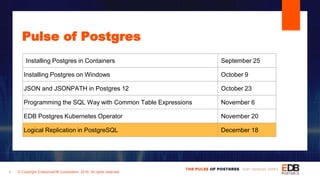
Installing Postgres in Containers September 25
Installing Postgres on Windows October 9
JSON and JSONPATH in Postgres 12 October 23
Programming the SQL Way with Common Table Expressions November 6
EDB Postgres Kubernetes Operator November 20
Logical Replication in PostgreSQL December 18
Logical Replication in
PostgreSQL
A step-by-step approach
Kuntal Ghosh, Senior Software Engineer
Marc Linster, SVP, Product Development
© Copyright EnterpriseDB Corporation, 2019. All rights reserved.3
Agenda
● Who is EDB?
● Logical Replication in PostgreSQL
○ Basic architecture including the publisher and subscriber model
○ Configuration, administration, and monitoring
○ Limitations and future plans
● Q & A
© Copyright EnterpriseDB Corporation, 2019. All rights reserved.4
5
Get your EDB
Socks!
Ask a question and give us your
business address in the US - and
we will send you a pair of EDB
Socks!
WHO IS EDB?
A global leader in
open-source based Postgres
software and services
6
• Founded in 2004
• Recognized RDBMS leader by:
• Gartner
• Forrester
• Customer base > 4000
• 300+ employees
• Offices worldwide
• Major PostgreSQL community contributor
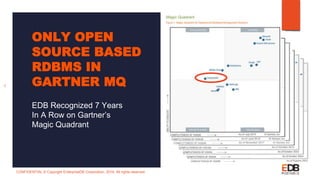
ONLY OPEN
SOURCE BASED
RDBMS IN
GARTNER MQ
EDB Recognized 7 Years
In A Row on Gartner’s
Magic Quadrant
7
CONFIDENTIAL © Copyright EnterpriseDB Corporation, 2019. All rights reserved.
8
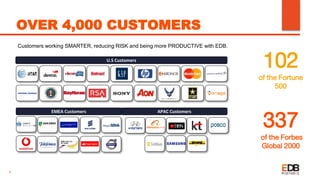
Customers working SMARTER, reducing RISK and being more PRODUCTIVE with EDB.
OVER 4,000 CUSTOMERS
U.S Customers
EMEA Customers APAC Customers
102
of the Fortune
500
337
of the Forbes
Global 2000
EDB OPEN SOURCE LEADERSHIP
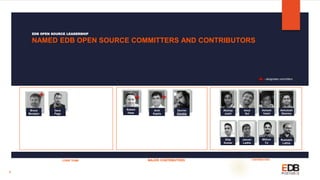
NAMED EDB OPEN SOURCE COMMITTERS AND CONTRIBUTORS
9
• CORE TEAM
• • •
• MAJOR CONTRIBUTORS • CONTRIBUTORS
Akshay
Joshi
Amul
Sul
Ashesh
Vashi
Dilip
Kumar
Jeevan
Ladhe
Mithun
Cy
Devrim
Gündüz
Amit
Kapila
Bruce
Momjian
Dave
Page
Robert
Haas
Ashutosh
Sharma
Rushabh
Lathia
- designates committers
Logical Replication in
PostgreSQL
10
What is logical replication?
● Introduced in PostgreSQL 10
● Replicate part of the database
● Online upgrade across major versions of PostgreSQL
● Write access to replicated data
● Auditing
● Allowing access to different set of users to different part of the replicated data
● Cross-platform replication
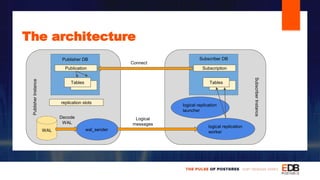
The architecturePublisherInstance
Publisher DB
SubscriberInstance
Subscriber DB
Publication
Tables
Subscription
Tables
Connect
WAL wal_sender
logical replication
launcher
logical replication
worker
Logical
messages
Decode
WAL
replication slots
The architecture
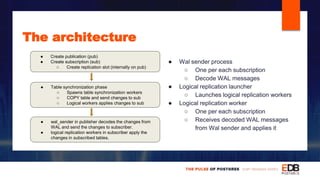
● Wal sender process
○ One per each subscription
○ Decode WAL messages
● Logical replication launcher
○ Launches logical replication workers
● Logical replication worker
○ One per each subscription
○ Receives decoded WAL messages
from Wal sender and applies it
● Create publication (pub)
● Create subscription (sub)
○ Create replication slot (internally on pub)
● Table synchronization phase
○ Spawns table synchronization workers
○ COPY table and send changes to sub
○ Logical workers applies changes to sub
● wal_sender in publisher decodes the changes from
WAL and send the changes to subscriber.
● logical replication workers in subscriber apply the
changes in subscribed tables.
Replication criteria
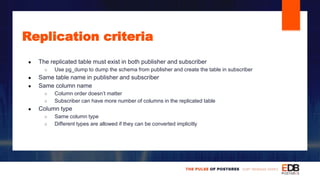
● The replicated table must exist in both publisher and subscriber
○ Use pg_dump to dump the schema from publisher and create the table in subscriber
● Same table name in publisher and subscriber
● Same column name
○ Column order doesn’t matter
○ Subscriber can have more number of columns in the replicated table
● Column type
○ Same column type
○ Different types are allowed if they can be converted implicitly
Quick setup
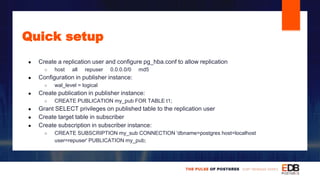
● Create a replication user and configure pg_hba.conf to allow replication
○ host all repuser 0.0.0.0/0 md5
● Configuration in publisher instance:
○ wal_level = logical
● Create publication in publisher instance:
○ CREATE PUBLICATION my_pub FOR TABLE t1;
● Grant SELECT privileges on published table to the replication user
● Create target table in subscriber
● Create subscription in subscriber instance:
○ CREATE SUBSCRIPTION my_sub CONNECTION 'dbname=postgres host=localhost
user=repuser' PUBLICATION my_pub;
Monitoring
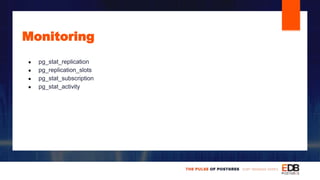
● pg_stat_replication
● pg_replication_slots
● pg_stat_subscription
● pg_stat_activity
Let’s try it!
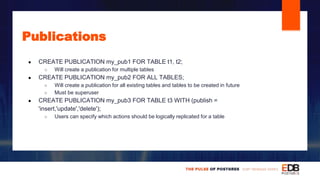
Publications
● CREATE PUBLICATION my_pub1 FOR TABLE t1, t2;
○ Will create a publication for multiple tables
● CREATE PUBLICATION my_pub2 FOR ALL TABLES;
○ Will create a publication for all existing tables and tables to be created in future
○ Must be superuser
● CREATE PUBLICATION my_pub3 FOR TABLE t3 WITH (publish =
'insert,'update','delete');
○ Users can specify which actions should be logically replicated for a table
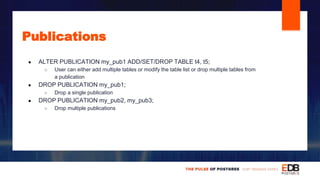
Publications
● ALTER PUBLICATION my_pub1 ADD/SET/DROP TABLE t4, t5;
○ User can either add multiple tables or modify the table list or drop multiple tables from
a publication
● DROP PUBLICATION my_pub1;
○ Drop a single publication
● DROP PUBLICATION my_pub2, my_pub3;
○ Drop multiple publications
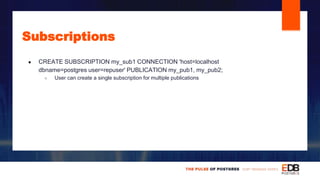
Subscriptions
● CREATE SUBSCRIPTION my_sub1 CONNECTION 'host=localhost
dbname=postgres user=repuser' PUBLICATION my_pub1, my_pub2;
○ User can create a single subscription for multiple publications
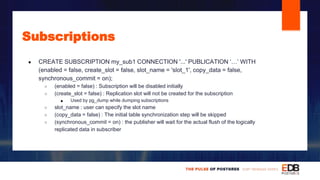
Subscriptions
● CREATE SUBSCRIPTION my_sub1 CONNECTION '...' PUBLICATION ‘…’ WITH
(enabled = false, create_slot = false, slot_name = 'slot_1', copy_data = false,
synchronous_commit = on);
○ (enabled = false) : Subscription will be disabled initially
○ (create_slot = false) : Replication slot will not be created for the subscription
■ Used by pg_dump while dumping subscriptions
○ slot_name : user can specify the slot name
○ (copy_data = false) : The initial table synchronization step will be skipped
○ (synchronous_commit = on) : the publisher will wait for the actual flush of the logically
replicated data in subscriber
Subscriptions
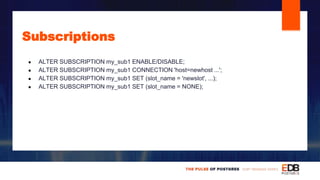
● ALTER SUBSCRIPTION my_sub1 ENABLE/DISABLE;
● ALTER SUBSCRIPTION my_sub1 CONNECTION 'host=newhost ...';
● ALTER SUBSCRIPTION my_sub1 SET (slot_name = 'newslot', ...);
● ALTER SUBSCRIPTION my_sub1 SET (slot_name = NONE);
Subscriptions
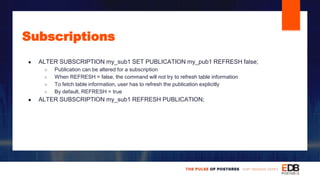
● ALTER SUBSCRIPTION my_sub1 SET PUBLICATION my_pub1 REFRESH false;
○ Publication can be altered for a subscription
○ When REFRESH = false, the command will not try to refresh table information
○ To fetch table information, user has to refresh the publication explicitly
○ By default, REFRESH = true
● ALTER SUBSCRIPTION my_sub1 REFRESH PUBLICATION;
Subscriptions
● DROP SUBSCRIPTION my_sub1;
○ Drop a single subscription
● DROP SUBSCRIPTION my_sub1, my_sub2;
○ Drop multiple subscriptions
Security
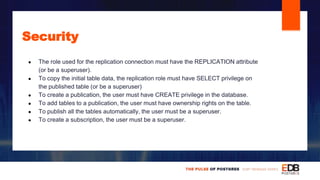
● The role used for the replication connection must have the REPLICATION attribute
(or be a superuser).
● To copy the initial table data, the replication role must have SELECT privilege on
the published table (or be a superuser)
● To create a publication, the user must have CREATE privilege in the database.
● To add tables to a publication, the user must have ownership rights on the table.
● To publish all the tables automatically, the user must be a superuser.
● To create a subscription, the user must be a superuser.
Replica Identity
● Controls information written to WAL to identify tuple data that is being deleted or
updated
● Four modes
○ DEFAULT
○ USING INDEX index
○ FULL
○ NOTHING
● Can only be modified using ALTER TABLE
Replica Identity
● DEFAULT
○ Identified with the primary key of the table
○ table public.t1: UPDATE: old-key: a[integer]:1 new-tuple: a[integer]:2 b[integer]:1
● USING INDEX index
○ Identified by the specified index entry
○ Index should be UNIQUE and must contain NOT NULL columns
Replica Identity
● FULL
○ Entire old row is written in WAL
○ Most resource consuming
○ table public.t1: UPDATE: old-key: a[integer]:1 b[integer]:1 new-tuple: a[integer]:2 b[integer]:1
● NOTHING
○ Only contains the new row
○ table public.aa: UPDATE: a[integer]:2 b[integer]:1
When replica identity is set to NOTHING or primary key is not defined with DEFAULT replica identity,
UPDATE/DELETE throws following error:
ERROR: cannot delete from table ‘t1’ because it does not have a replica identity and publishes deletes
Hint: To enable deleting from the table, set REPLICA IDENTITY using ALTER TABLE.
Restrictions
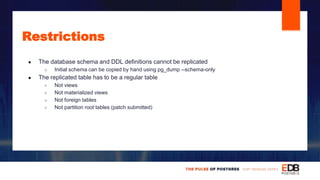
● The database schema and DDL definitions cannot be replicated
○ Initial schema can be copied by hand using pg_dump --schema-only
● The replicated table has to be a regular table
○ Not views
○ Not materialized views
○ Not foreign tables
○ Not partition root tables (patch submitted)
Restrictions
● Large objects are not replicated
● Sequence data is not replicated
○ The data in serial or identity columns backed by sequences will be replicated
○ But, the sequence itself would only reflect the start value
Restrictions
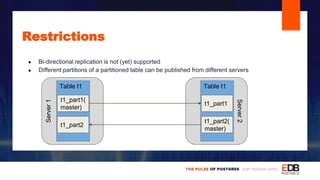
● Bi-directional replication is not (yet) supported
● Different partitions of a partitioned table can be published from different servers
Server1
Table t1
t1_part1(
master)
t1_part2
Server2
Table t1
t1_part1
t1_part2(
master)
Configuration parameters
● wal_level = logical (PUBLICATION)
● max_replication_slots (PUBLICATION)
○ Must be set to at least the number of subscriptions expected to connect
○ Some reserved for table synchronization
○ Increase the value in case of the following error:
■ ERROR: could not create replication slot "my_sub": ERROR: all replication slots are in use
● max_wal_senders (PUBLICATION)
○ Must be set to at least max_replication_slots plus number of physical replicas
○ Increase the values in case of the following error:
■ FATAL: number of requested standby connections exceeds max_wal_senders (currently 2)
Configuration parameters
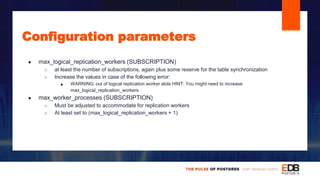
● max_logical_replication_workers (SUBSCRIPTION)
○ at least the number of subscriptions, again plus some reserve for the table synchronization
○ Increase the values in case of the following error:
■ WARNING: out of logical replication worker slots HINT: You might need to increase
max_logical_replication_workers
● max_worker_processes (SUBSCRIPTION)
○ Must be adjusted to accommodate for replication workers
○ At least set to (max_logical_replication_workers + 1)
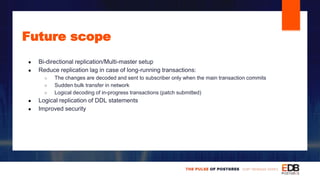
Future scope
● Bi-directional replication/Multi-master setup
● Reduce replication lag in case of long-running transactions:
○ The changes are decoded and sent to subscriber only when the main transaction commits
○ Sudden bulk transfer in network
○ Logical decoding of in-progress transactions (patch submitted)
● Logical replication of DDL statements
● Improved security
Q & A
© Copyright EnterpriseDB Corporation, 2019. All rights reserved.35

Logical Replication in PostgreSQL

  • 1.
    © Copyright EnterpriseDBCorporation, 2019. All rights reserved.1
  • 2.
    Pulse of Postgres ©Copyright EnterpriseDB Corporation, 2019. All rights reserved.2 Installing Postgres in Containers September 25 Installing Postgres on Windows October 9 JSON and JSONPATH in Postgres 12 October 23 Programming the SQL Way with Common Table Expressions November 6 EDB Postgres Kubernetes Operator November 20 Logical Replication in PostgreSQL December 18
  • 3.
    Logical Replication in PostgreSQL Astep-by-step approach Kuntal Ghosh, Senior Software Engineer Marc Linster, SVP, Product Development © Copyright EnterpriseDB Corporation, 2019. All rights reserved.3
  • 4.
    Agenda ● Who isEDB? ● Logical Replication in PostgreSQL ○ Basic architecture including the publisher and subscriber model ○ Configuration, administration, and monitoring ○ Limitations and future plans ● Q & A © Copyright EnterpriseDB Corporation, 2019. All rights reserved.4
  • 5.
    5 Get your EDB Socks! Aska question and give us your business address in the US - and we will send you a pair of EDB Socks!
  • 6.
    WHO IS EDB? Aglobal leader in open-source based Postgres software and services 6 • Founded in 2004 • Recognized RDBMS leader by: • Gartner • Forrester • Customer base > 4000 • 300+ employees • Offices worldwide • Major PostgreSQL community contributor
  • 7.
    ONLY OPEN SOURCE BASED RDBMSIN GARTNER MQ EDB Recognized 7 Years In A Row on Gartner’s Magic Quadrant 7 CONFIDENTIAL © Copyright EnterpriseDB Corporation, 2019. All rights reserved.
  • 8.
    8 Customers working SMARTER,reducing RISK and being more PRODUCTIVE with EDB. OVER 4,000 CUSTOMERS U.S Customers EMEA Customers APAC Customers 102 of the Fortune 500 337 of the Forbes Global 2000
  • 9.
    EDB OPEN SOURCELEADERSHIP NAMED EDB OPEN SOURCE COMMITTERS AND CONTRIBUTORS 9 • CORE TEAM • • • • MAJOR CONTRIBUTORS • CONTRIBUTORS Akshay Joshi Amul Sul Ashesh Vashi Dilip Kumar Jeevan Ladhe Mithun Cy Devrim Gündüz Amit Kapila Bruce Momjian Dave Page Robert Haas Ashutosh Sharma Rushabh Lathia - designates committers
  • 10.
  • 11.
    What is logicalreplication? ● Introduced in PostgreSQL 10 ● Replicate part of the database ● Online upgrade across major versions of PostgreSQL ● Write access to replicated data ● Auditing ● Allowing access to different set of users to different part of the replicated data ● Cross-platform replication
  • 12.
    The architecturePublisherInstance Publisher DB SubscriberInstance SubscriberDB Publication Tables Subscription Tables Connect WAL wal_sender logical replication launcher logical replication worker Logical messages Decode WAL replication slots
  • 13.
    The architecture ● Walsender process ○ One per each subscription ○ Decode WAL messages ● Logical replication launcher ○ Launches logical replication workers ● Logical replication worker ○ One per each subscription ○ Receives decoded WAL messages from Wal sender and applies it ● Create publication (pub) ● Create subscription (sub) ○ Create replication slot (internally on pub) ● Table synchronization phase ○ Spawns table synchronization workers ○ COPY table and send changes to sub ○ Logical workers applies changes to sub ● wal_sender in publisher decodes the changes from WAL and send the changes to subscriber. ● logical replication workers in subscriber apply the changes in subscribed tables.
  • 14.
    Replication criteria ● Thereplicated table must exist in both publisher and subscriber ○ Use pg_dump to dump the schema from publisher and create the table in subscriber ● Same table name in publisher and subscriber ● Same column name ○ Column order doesn’t matter ○ Subscriber can have more number of columns in the replicated table ● Column type ○ Same column type ○ Different types are allowed if they can be converted implicitly
  • 15.
    Quick setup ● Createa replication user and configure pg_hba.conf to allow replication ○ host all repuser 0.0.0.0/0 md5 ● Configuration in publisher instance: ○ wal_level = logical ● Create publication in publisher instance: ○ CREATE PUBLICATION my_pub FOR TABLE t1; ● Grant SELECT privileges on published table to the replication user ● Create target table in subscriber ● Create subscription in subscriber instance: ○ CREATE SUBSCRIPTION my_sub CONNECTION 'dbname=postgres host=localhost user=repuser' PUBLICATION my_pub;
  • 16.
    Monitoring ● pg_stat_replication ● pg_replication_slots ●pg_stat_subscription ● pg_stat_activity
  • 17.
  • 18.
    Publications ● CREATE PUBLICATIONmy_pub1 FOR TABLE t1, t2; ○ Will create a publication for multiple tables ● CREATE PUBLICATION my_pub2 FOR ALL TABLES; ○ Will create a publication for all existing tables and tables to be created in future ○ Must be superuser ● CREATE PUBLICATION my_pub3 FOR TABLE t3 WITH (publish = 'insert,'update','delete'); ○ Users can specify which actions should be logically replicated for a table
  • 19.
    Publications ● ALTER PUBLICATIONmy_pub1 ADD/SET/DROP TABLE t4, t5; ○ User can either add multiple tables or modify the table list or drop multiple tables from a publication ● DROP PUBLICATION my_pub1; ○ Drop a single publication ● DROP PUBLICATION my_pub2, my_pub3; ○ Drop multiple publications
  • 20.
    Subscriptions ● CREATE SUBSCRIPTIONmy_sub1 CONNECTION 'host=localhost dbname=postgres user=repuser' PUBLICATION my_pub1, my_pub2; ○ User can create a single subscription for multiple publications
  • 21.
    Subscriptions ● CREATE SUBSCRIPTIONmy_sub1 CONNECTION '...' PUBLICATION ‘…’ WITH (enabled = false, create_slot = false, slot_name = 'slot_1', copy_data = false, synchronous_commit = on); ○ (enabled = false) : Subscription will be disabled initially ○ (create_slot = false) : Replication slot will not be created for the subscription ■ Used by pg_dump while dumping subscriptions ○ slot_name : user can specify the slot name ○ (copy_data = false) : The initial table synchronization step will be skipped ○ (synchronous_commit = on) : the publisher will wait for the actual flush of the logically replicated data in subscriber
  • 22.
    Subscriptions ● ALTER SUBSCRIPTIONmy_sub1 ENABLE/DISABLE; ● ALTER SUBSCRIPTION my_sub1 CONNECTION 'host=newhost ...'; ● ALTER SUBSCRIPTION my_sub1 SET (slot_name = 'newslot', ...); ● ALTER SUBSCRIPTION my_sub1 SET (slot_name = NONE);
  • 23.
    Subscriptions ● ALTER SUBSCRIPTIONmy_sub1 SET PUBLICATION my_pub1 REFRESH false; ○ Publication can be altered for a subscription ○ When REFRESH = false, the command will not try to refresh table information ○ To fetch table information, user has to refresh the publication explicitly ○ By default, REFRESH = true ● ALTER SUBSCRIPTION my_sub1 REFRESH PUBLICATION;
  • 24.
    Subscriptions ● DROP SUBSCRIPTIONmy_sub1; ○ Drop a single subscription ● DROP SUBSCRIPTION my_sub1, my_sub2; ○ Drop multiple subscriptions
  • 25.
    Security ● The roleused for the replication connection must have the REPLICATION attribute (or be a superuser). ● To copy the initial table data, the replication role must have SELECT privilege on the published table (or be a superuser) ● To create a publication, the user must have CREATE privilege in the database. ● To add tables to a publication, the user must have ownership rights on the table. ● To publish all the tables automatically, the user must be a superuser. ● To create a subscription, the user must be a superuser.
  • 26.
    Replica Identity ● Controlsinformation written to WAL to identify tuple data that is being deleted or updated ● Four modes ○ DEFAULT ○ USING INDEX index ○ FULL ○ NOTHING ● Can only be modified using ALTER TABLE
  • 27.
    Replica Identity ● DEFAULT ○Identified with the primary key of the table ○ table public.t1: UPDATE: old-key: a[integer]:1 new-tuple: a[integer]:2 b[integer]:1 ● USING INDEX index ○ Identified by the specified index entry ○ Index should be UNIQUE and must contain NOT NULL columns
  • 28.
    Replica Identity ● FULL ○Entire old row is written in WAL ○ Most resource consuming ○ table public.t1: UPDATE: old-key: a[integer]:1 b[integer]:1 new-tuple: a[integer]:2 b[integer]:1 ● NOTHING ○ Only contains the new row ○ table public.aa: UPDATE: a[integer]:2 b[integer]:1 When replica identity is set to NOTHING or primary key is not defined with DEFAULT replica identity, UPDATE/DELETE throws following error: ERROR: cannot delete from table ‘t1’ because it does not have a replica identity and publishes deletes Hint: To enable deleting from the table, set REPLICA IDENTITY using ALTER TABLE.
  • 29.
    Restrictions ● The databaseschema and DDL definitions cannot be replicated ○ Initial schema can be copied by hand using pg_dump --schema-only ● The replicated table has to be a regular table ○ Not views ○ Not materialized views ○ Not foreign tables ○ Not partition root tables (patch submitted)
  • 30.
    Restrictions ● Large objectsare not replicated ● Sequence data is not replicated ○ The data in serial or identity columns backed by sequences will be replicated ○ But, the sequence itself would only reflect the start value
  • 31.
    Restrictions ● Bi-directional replicationis not (yet) supported ● Different partitions of a partitioned table can be published from different servers Server1 Table t1 t1_part1( master) t1_part2 Server2 Table t1 t1_part1 t1_part2( master)
  • 32.
    Configuration parameters ● wal_level= logical (PUBLICATION) ● max_replication_slots (PUBLICATION) ○ Must be set to at least the number of subscriptions expected to connect ○ Some reserved for table synchronization ○ Increase the value in case of the following error: ■ ERROR: could not create replication slot "my_sub": ERROR: all replication slots are in use ● max_wal_senders (PUBLICATION) ○ Must be set to at least max_replication_slots plus number of physical replicas ○ Increase the values in case of the following error: ■ FATAL: number of requested standby connections exceeds max_wal_senders (currently 2)
  • 33.
    Configuration parameters ● max_logical_replication_workers(SUBSCRIPTION) ○ at least the number of subscriptions, again plus some reserve for the table synchronization ○ Increase the values in case of the following error: ■ WARNING: out of logical replication worker slots HINT: You might need to increase max_logical_replication_workers ● max_worker_processes (SUBSCRIPTION) ○ Must be adjusted to accommodate for replication workers ○ At least set to (max_logical_replication_workers + 1)
  • 34.
    Future scope ● Bi-directionalreplication/Multi-master setup ● Reduce replication lag in case of long-running transactions: ○ The changes are decoded and sent to subscriber only when the main transaction commits ○ Sudden bulk transfer in network ○ Logical decoding of in-progress transactions (patch submitted) ● Logical replication of DDL statements ● Improved security
  • 35.
    Q & A ©Copyright EnterpriseDB Corporation, 2019. All rights reserved.35