Chapter 1: Supply Chain Management:  An Overview
Five major external forces seem to drive the rate of change and shape our economic and political landscape:  globalization technology organizational consolidation  the empowered consumer government policy and regulation
 
 
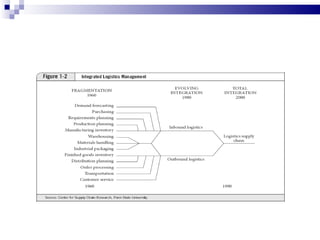
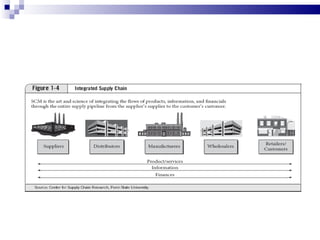
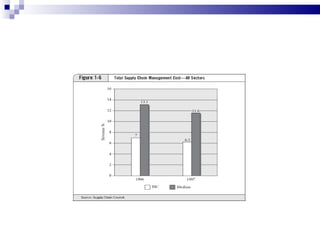
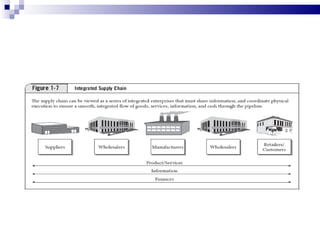
Development of the Supply Chain Concept  Started in the 1960s with the development of the physical distribution concept Initial focus on physical distribution or outbound logistics was logical since finished goods During the 1980s, the logistics or integrated logistics management concept developed in a growing number of organizations The underlying logic of the systems or total cost concept was also the rationale for logistics management Supply chain management can be viewed as a pipeline or conduit for the efficient and effective flow of products/materials, services, information, and financials


Major Supply Chain Issues Supply Chain Networks The network facilities and supporting transportation is important Increased complexity for organizations is a problem Inventory Deployments inventory duplication  the bullwhip effect  Collection and storage of vast amounts of data Cost/Value efficiency (cost) and effectiveness (value) prevention of suboptimization Organizational Relationships Tradeoffs and optimization Performance Measurement Why and how
Major Supply Chain Issues Technology challenge is to evaluate and successfully implement the technology Transportation Management right product, right time, right quantity, right quality, right cost, right destination Supply Chain Security concern and potential challenge since 9/11
Cash flow has become one of the most important measures of financial viability in today’s global markets. Supply chains are an important determinant of improved cash flow since they impact order cycle time to customers. Supply chains are an important determinant of capital consumption since they impact working capital, inventory levels, and other assets such as warehouses. Efficient and effective supply chains can free up valuable resources and improve customer fulfillment systems so as to increase return on investment or assets and improve shareholder value. The rate of change in our economy has accelerated the necessity of continuing changes in organizations or even transformation to remain competitive. Chapter 1 Summary
The rate of change has been driven by a set of external forces including but not limited to globalization, technology, organizational consolidation and shifts in power in supply chains, an empowered consumer, and government policy and regulations. The conceptual basis of the supply chain is not new. In fact, organizations have evolved from physical distribution management to logistics management to supply chain management. Supply chains need to focus on the customers at the end of the supply chain and be flexible and responsive. Technology is important to facilitate change, but it must follow a process and educate people to address problems and issues appropriately. Chapter 1 Summary (cont.)
Transportation management and security have become increasingly important in the twenty-first century because of changes that have occurred. Supply chains are boundary spanning and require managing three flows—products, information, and financials (cash). Supply chain management is a journey, not a goal, and there are no “silver bullets” since all supply chains are unique. Information is power, and collaborative relationships internally and externally are a necessary ingredient for success. The performance of supply chains must be measured in terms of overall corporate goals for success. Chapter 1 Summary (cont.)

Logi pp 1

  • 1.
    Chapter 1: SupplyChain Management: An Overview
  • 2.
    Five major externalforces seem to drive the rate of change and shape our economic and political landscape: globalization technology organizational consolidation the empowered consumer government policy and regulation
  • 3.
  • 4.
  • 5.
    Development of theSupply Chain Concept Started in the 1960s with the development of the physical distribution concept Initial focus on physical distribution or outbound logistics was logical since finished goods During the 1980s, the logistics or integrated logistics management concept developed in a growing number of organizations The underlying logic of the systems or total cost concept was also the rationale for logistics management Supply chain management can be viewed as a pipeline or conduit for the efficient and effective flow of products/materials, services, information, and financials
  • 6.
  • 7.
  • 8.
  • 9.
  • 10.
    Major Supply ChainIssues Supply Chain Networks The network facilities and supporting transportation is important Increased complexity for organizations is a problem Inventory Deployments inventory duplication the bullwhip effect Collection and storage of vast amounts of data Cost/Value efficiency (cost) and effectiveness (value) prevention of suboptimization Organizational Relationships Tradeoffs and optimization Performance Measurement Why and how
  • 11.
    Major Supply ChainIssues Technology challenge is to evaluate and successfully implement the technology Transportation Management right product, right time, right quantity, right quality, right cost, right destination Supply Chain Security concern and potential challenge since 9/11
  • 12.
    Cash flow hasbecome one of the most important measures of financial viability in today’s global markets. Supply chains are an important determinant of improved cash flow since they impact order cycle time to customers. Supply chains are an important determinant of capital consumption since they impact working capital, inventory levels, and other assets such as warehouses. Efficient and effective supply chains can free up valuable resources and improve customer fulfillment systems so as to increase return on investment or assets and improve shareholder value. The rate of change in our economy has accelerated the necessity of continuing changes in organizations or even transformation to remain competitive. Chapter 1 Summary
  • 13.
    The rate ofchange has been driven by a set of external forces including but not limited to globalization, technology, organizational consolidation and shifts in power in supply chains, an empowered consumer, and government policy and regulations. The conceptual basis of the supply chain is not new. In fact, organizations have evolved from physical distribution management to logistics management to supply chain management. Supply chains need to focus on the customers at the end of the supply chain and be flexible and responsive. Technology is important to facilitate change, but it must follow a process and educate people to address problems and issues appropriately. Chapter 1 Summary (cont.)
  • 14.
    Transportation management andsecurity have become increasingly important in the twenty-first century because of changes that have occurred. Supply chains are boundary spanning and require managing three flows—products, information, and financials (cash). Supply chain management is a journey, not a goal, and there are no “silver bullets” since all supply chains are unique. Information is power, and collaborative relationships internally and externally are a necessary ingredient for success. The performance of supply chains must be measured in terms of overall corporate goals for success. Chapter 1 Summary (cont.)